Flavisolibacter tropicus LCS9
Twas isolated from a soil sample collected from tropical zone within the Ecorium of the National Institute of Ecology in Seocheon, central-western Korea. In this study, we report the complete genome sequence of the bacterium Flavisolibacter tropicus LCS9
T, which possesses a circular chromosome comprised of 5, 940,863 bp with the G + C mol content of 41.5%. The genome sequence annotation showed that the complete genome includes 5,075 genes, 337 pseudogenes, and 59 rRNA genes. The radiation resistance genes such as excinuclease UvrABC complex and UvdE were present in the genome.
Keywords: Flavisolibacter tropicus LCS9
T, complete genome, nucleotide excision repair, PacBio RS II, radiation resistance
The family Chitinophagaceae belongs to the phylum Bacteroidetes and was created by Kämpfer et al. (2011) with Chitinophaga as the type genus. The family Chitinophagaceae
includes 27 genera (www.bacterio.net/chitinophagaceae.html) along with the genus Flavisolibacter and the members are Gram- stain-negative, aerobic or facultative anaerobic bacteria. Species of Chitinophagaceae were observed in gamma irradiated sediments along with others members of the phylum Bacteroidetes (Brown et al., 2015). The radiation resistant bacteria known to have advanced DNA repair and protein system to survive the ionizing irradiation (White et al., 1999; de Groot et al., 2009; Daly, 2012; Yu and Lee, 2017).
In this study, we report a complete genome sequence of Flavisolibacter tropicus LCS9
Tbelonging to the family Chitino- phagaceae isolated from tropical soil within the Ecorium of the National Institute of Ecology in Seocheon (Lee et al., 2016).
Flavisolibacter tropicus LCS9
Tis characterized as Gram-stain- negative, non-motile, deep yellow, rod-shaped bacterium. Strain LCS9
Tshowed lower level of gamma irradiation resistance (Lee et al., 2016). To understand the genomic features of radiation resistance, we determined the genome sequence of Flavisolibacter tropicus LCS9
T. The genomic features of strain LCS9
Tcon- firmed the presence of the main enzymes involved in the
Korean Journal of Microbiology (2018) Vol. 54, No. 1, pp. 87-89 pISSN 0440-2413
DOI https://doi.org/10.7845/kjm.2018.8005 eISSN 2383-9902
Copyright ⓒ 2018, The Microbiological Society of Korea
Complete genome sequence of Flavisolibacter tropicus LCS9 T , a radiation resistant bacterium
Myung Kyum Kim
1, Eun-Hwa Sohn
2, Hee-Young Jung
3,4*, and Sathiyaraj Srinivasan
1*
1
Department of Bio & Environmental Technology, College of Natural Science, Seoul Women’s University, Seoul 01797, Republic of Korea
2
Department of Herbal Medicine Resources, Kangwon National University, Samcheok 25949, Republic of Korea
3
School of Applied Biosciences, Kyungpook National University, Daegu 41566, Republic of Korea
4
Institute of Plant Medicine, Kyungpook National University, Daegu 41566, Republic of Korea
방사선 내성 세균 Flavisolibacter tropicus LCS9 T 의 완전한 게놈 서열
김명겸
1・ 손은화
2・ 정희영
3,4* ・ 스리니바산 사티야라지
1*
1
서울여자대학교 자연과학대학 생명환경공학과,
2강원대학교 생약자원개발학과,
3경북대학교 농업생명과학대학 응용생명과학부 응용생물학전공,
4경북대학교 식물의학연구소
(Received February 8, 2018; Revised February 27, 2018; Accepted March 2, 2018)
*For correspondence.
(S. Srinivasan) E-mail: [email protected];Tel.: +82-2-970-5667; Fax: +82-2-970-5974 / (H.Y. Jung) E-mail:
[email protected]; Tel.: +82-53-950-5760; Fax: +82-53-950-6758
88
∙Kim et al.미생물학회지 제54권 제1호
recovery of damaged DNA from ionizing radiation.
The genomic DNA was extracted using a genomic DNA purification kit (Promega). A library was constructed according to Pacific Biosciences RS II sequencing method. The 44,196 sequence reads were obtained and assembled using the PacBio SMRT Analysis (version 2.3.0) with default options. The protein- coding sequences (CDS) were predicted by Glimmer (version 3.02), and the genome annotation was performed by NCBI Prokaryotic Genome Automatic Annotation Pipeline (PGAP, http://www.ncbi.nlm.nih.gov/books/NBK174280/). The rRNA and tRNA were predicted by using rRNAmmer and tRNAscan- SE, respectively.
Flavisolibacter tropicus LCS9
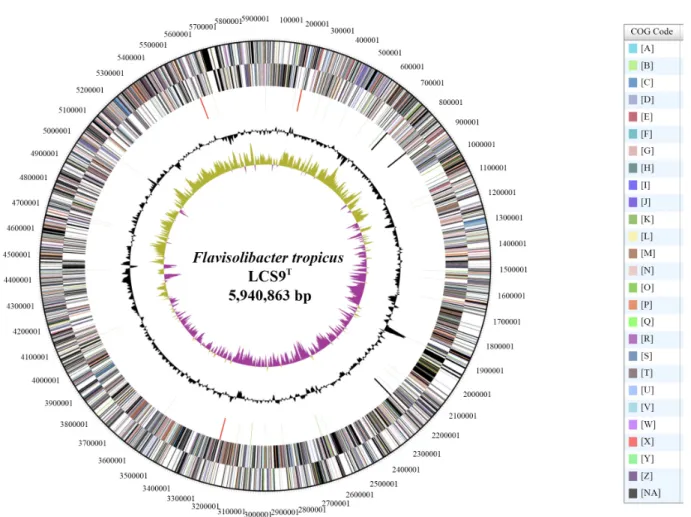
Tcontains a chromosome of 5,940,863 bp with a G + C mol of 41.5%, a total of 5,075 genes;
5,016 genes with protein-coding and 59 are RNA genes were assigned a putative function, and the remaining was annotated as hypothetical or conserved hypothetical proteins. The complete
genome of the strain LCS9
Trevealed the key enzymes involved in the DNA recovery after the gamma and UV irradiation rehabilitation. The genome annotation showed the presence of UvrABC pathway and RecA and MutS mediated pathways that repair the damaged DNA (Truglio et al., 2006).
Fig. 1. Graphical circular map of Flavisolibacter tropicus LCS9. From outside to the center: Genes on forward strand, Genes on reverse strand, RNA genes (tRNAs green, rRNAs red, other RNAs black), GC content, GC skew.
Table 1. General features of Flavisolibacter tropicus LCS9
Features Chromosome
Length (bp) 5,940,863
G + C content (%) 41.5
Genes 5,075
Pseudo Genes 337
Protein coding genes 5,016
rRNA gene 9
tRNA genes 49
Protein coding genes with function 3,576 Protein coding genes with enzymes 901
Protein coding genes with COGs 2,489
Complete genome sequence of Flavisolibacter tropicus LCS9T ∙
89
Korean Journal of Microbiology, Vol. 54, No. 1 The excinuclease UvrABC complex recognizes and repair
the structural changes caused by ionizing radiation by creating dual incisions 5′ and 3′ to the damaged site (Petit and Sancar, 1999). The cluster of genes involving in the nucleotide excision repair (NER) are also present in the genome, which include copies of excinuclease ABC subunit A, an excinuclease ABC subunit B and excinuclease ABC subunit C (Battista and Cox, 2006; Blasius et al., 2008). The radiation resistant mechanisms of Flavisolibacter tropicus LCS9
Tcan be potentially used for environmental bioengineering and radiation biotechnology.
Nucleotide sequence accession number
The genome sequence was deposited in DDBJ/EMBL/GenBank under the under the accession number CP011390. The strain is deposited at the Korean Collection for Type Cultures, and its ID is KCTC 42070
T.
적 요
Flavisolibacter tropicus LCS9
T은 한국 중서부에 위치한 서 천 국립생태원 에코리움 내 열대관 토양에서 분리되었다. 이 연구에서 G + C 함량이 41.5%인 5,940,863 bp 의 원형 염색체 로 구성된 Flavisolibacter tropicus LCS9
T의 완전한 게놈서열 을 분석하였다. 이 완전한 게놈서열은 5,075 개의 유전자, 337 개의 위유전자 그리고 59 개의 rRNA 유전자를 포함하고 있다.
유전체 특징은 감마선 및 UVC 에 대응하는 주요 효소를 포함 하였다.
Acknowledgements
This work was supported by a research grant from Seoul Women’s University (2018).
References
Battista, J. and Cox, M. 2006. Genome reconstitution in the extremely radiation resistant bacterium Deinococcus radiodurans, pp. 341 –359. In Cigna, A. and Durante, M. (eds.), Radiation Risk Estimates in Normal and Emergency Situations. Springer, Netherlands.
Blasius, M., Sommer, S., and Hubscher, U. 2008. Deinococcus radiodurans: what belongs to the survival kit? Crit. Rev.
Biochem. Mol. Biol. 43, 221–238.
Brown, A.R., Boothman, C., Pimblott, S.M., and Lloyd, J.R. 2015. The impact of gamma radiation on sediment microbial processes.
Appl. Environ. Microbiol. 81, 4014–4025.
Daly, M.J. 2012. Death by protein damage in irradiated cells. DNA Repair 11, 12–21.
de Groot, A., Dulermo, R., Ortet, P., Blanchard, L., Guerin, P., Fernandez, B., Vacherie, B., Dossat, C., Jolivet, E., Siguier, P., et al. 2009. Alliance of proteomics and genomics to unravel the specificities of Sahara bacterium Deinococcus deserti. PLoS Genet. 5, e1000434.
Kämpfer, P., Lodders, N., and Falsen, E. 2011. Hydrotalea flava gen.
nov., sp. nov., a new member of the phylum Bacteroidetes and allocation of the genera Chitinophaga, Sediminibacterium, Lacibacter, Flavihumibacter, Flavisolibacter, Niabella, Niastella, Segetibacter, Parasegetibacter, Terrimonas, Ferruginibacter, Filimonas and Hydrotalea to the family Chitinophagaceae fam.
nov. Int. J. Syst. Evol. Microbiol. 61, 518–523.
Lee, J.J., Kang, M.S., Kim, G.S., Lee, C.S., Lim, S., Lee, J., Roh, S.H., Kang, H., Ha, J.M., Bae, S., et al. 2016. Flavisolibacter tropicus sp. nov., isolated from tropical soil. Int. J. Syst. Evol. Microbiol.
66, 3413–3419.
Petit, C. and Sancar, A. 1999. Nucleotide excision repair: from E. coli to man. Biochimie 81, 15–25.
Truglio, J.J., Croteau, D.L., Van Houten, B., and Kisker, C. 2006.
Prokaryotic nucleotide excision repair: The UvrABC system.
Chem. Rev. 106, 233–252.
White, O., Eisen, J.A., Heidelberg, J.F., Hickey, E.K., Peterson, J.D., Dodson, R.J., Haft, D.H., Gwinn, M.L., Nelson, W.C., Richardson, D.L., et al. 1999. Genome sequence of the radioresistant bacterium Deinococcus radiodurans R1. Science 286, 1571–1577.
Yu, S.L. and Lee, S.K. 2017. Ultraviolet radiation: DNA damage, repair, and human disorders. Mol. Cell. Toxicol. 13, 21–28.