Korean Journal of Microbiology (2019) Vol. 55, No. 1, pp. 74-76 pISSN 0440-2413
DOI https://doi.org/10.7845/kjm.2019.9002 eISSN 2383-9902
Copyright ⓒ 2019, The Microbiological Society of Korea
Genome sequence of Actinomyces georgiae KHUD_A1 isolated from dental plaque of Korean elderly woman
Ji-Hoi Moon
1,2, Seung-Yun Shin
3, Won Young Hong
1, Eun-Young Jang
4, Seok Bin Yang
1, Jae-In Ryu
5, Jin-Yong Lee
1* , and Jae-Hyung Lee
1,2,6*
1
Department of Maxillofacial Biomedical Engineering, School of Dentistry,
2Department of Life and Nanopharmaceutical
Sciences,
3Department of Periodontology, School of Dentistry,
4Department of Dentistry, Graduate School,
5Department of Preventive Dentistry, School of Dentistry,
6Kyung Hee Medical Science Institute, Kyung Hee University, Seoul 02447, Republic of Korea
한국 노인 여성의 치태에서 분리된 Actinomyces georgiae KHUD_A1의 유전체 염기서열 해독
문지회
1,2・ 신승윤
3・ 홍원영
1・ 장은영
4・ 양석빈
1・ 류재인
5・ 이진용
1* ・ 이재형
1,2,6*
1
경희대학교 치과대학 악안면생체공학교실,
2경희대학교 나노의약생명과학과,
3경희대학교 치과대학 치주과학교실,
4경희대학교 대학원 치의학과,
5경희대학교 치과대학 예방치과학교실,
6경희의과학연구소
(Received January 2, 2019; Revised January 16, 2019; Accepted January 16, 2019)
*For correspondence.
(J.Y. Lee) E-mail: [email protected];Tel.: +82-2-961-9544; Fax: +82-2-962-0598 / (J.H. Lee) E-mail: [email protected];
Tel.: +82-2-961-9290; Fax: +82-2-962-0598
Gram-positive anaerobic bacilli Actinomyces spp. commonly reside on mucosal surfaces of the oropharynx, gastrointestinal tract, and urogenital tract. Here, we first report the draft genome sequence of Actinomyces georgiae KHUD_A1, isolated from dental plaque of a Korean elderly woman. The genome is 2,652,059 bp in length and has a GC content of 68.06%. The genome includes 2,242 protein-coding genes, 9 rRNAs, and 64 tRNA. We identified 157 KHUD_A1 strain-specific genes, including genes encoding CPBP family intramembrane metalloprotease, bile acid: sodium symporter family protein, Txe/YoeB family addiction module toxin and Phd/YefM family antitoxin. The sequence information of A. georgiae KHUD_A1 will help understand the general characteristics of the bacterial species and the genome diversity of the genus Actinomyces.
Keywords: Actinomyces georgiae, dental plaque, genome
Gram-positive anaerobic bacilli Actinomyces spp. commonly
reside on mucosal surfaces of the body, including oropharynx,
gastrointestinal tract, and urogenital tract (Könönen and Wade,
2015). Currently, the genus Actinomyces consists of over 30
species, with several novel Actinomyces spp. described in recent
years (Gao et al., 2017). Actinomyces spp. have been frequently
isolated from polymicrobial infections and are assumed to
contribute to the pathogenetic processes, although the obvious
virulence factors are poorly characterized (Könönen and Wade,
2015). A. georgiae was first isolated from subgingival plaque
(Johnson et al., 1990) and has been occasionally recovered
from a variety of polymicrobial infections, including orocer-
vicofacial actinomycosis, soft tissue abscesses, eye infections,
dental caries, and failed dental implant fixture (Könönen and
Wade, 2015). The genomes of two A. georgiae strains, DSM
6843
T(= ATCC 49285) and F0490, have been sequenced thus
far. However, there is still much to learn about the genetic
potential of this microorganism and its impact on our health.
Genome sequence of A. georgiae∙
75
Korean Journal of Microbiology, Vol. 55, No. 1
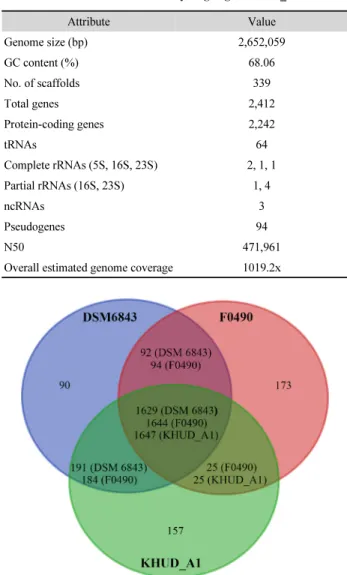
Table 1. Genome features of Actinomyces georgiae KHUD_A1Attribute Value
Genome size (bp) 2,652,059
GC content (%) 68.06
No. of scaffolds 339
Total genes 2,412
Protein-coding genes 2,242
tRNAs 64
Complete rRNAs (5S, 16S, 23S) 2, 1, 1
Partial rRNAs (16S, 23S) 1, 4
ncRNAs 3
Pseudogenes 94
N50 471,961
Overall estimated genome coverage 1019.2x
Fig. 1. The pan-genome of Actinomyces georgiae. Venn diagram illustrates the number of shared and strain-specific genes found in each genome of A.
georgiae strain.
Here, we report the draft genome sequence of A. georgiae KHUD_A1 isolated from dental plaque of a 79-year-old Korean woman.
A. georgiae KHUD_A1 was grown at 37°C on brain heart infusion agar supplemented with 5% sheep blood, hemin (5 µ g/ml), vitamin K1 (0.5 µg/ml), cysteine (0.1%), and arginine (100 µM) under anaerobic conditions (80% N
2, 10% H
2, and 10% CO
2). The bacterial genomic DNA was extracted using G-spin ™ Genomic DNA Extraction Mini Kit (Intron Bio- technology), then the sequencing library was constructed according to Illumina TruSeq DNA library preparation protocol. Briefly, the purified bacterial whole genomic DNA was randomly fragmented by acoustic shearing with a Covaris instrument, followed by an end-repair (3' →5' exonuclease and polymerase fill in) to generate blunt ends. After a cleaning step using AMPure XP Beads, the 3' ends of the fragmented genomic DNA were adenylated to make the fragment ends complementary for ligation with the 3' T overhangs on the Illumina adaptors. The DNA fragments containing the adapter sequences (500–600 bp) were extracted from a 2% agarose gel, then enhanced via PCR using adapter-specific primers. The constructed library was used for the paired-end sequencing on the Illumina Hi-Seq 2500 platform. In total, 30,636,164 paired-end read pairs (2 × 151 bp) were obtained. After filtering out low quality raw reads, SPAdes (version 3.12.0) (Bankevich et al., 2012) with default parameters was used to construct the genome, creating 339 scaffolds (> 500-bp length). The genome sequences passed the contamination screening of GenBank submission service and finally met the quality level required by GenBank submission standards. Gene annotation of the genome was performed by the NCBI prokaryotic genome annotation pipeline (Tatusova et al., 2016).
The genome of A. georgiae KHUD_A1 was found to contain 2,652,059 bp with a G+C content of 68.06% (Table 1). A total of 2,242 protein-coding genes, 9 rRNAs, and 64 tRNAs were annotated (Table 1). Genes that encode obvious virulence determinants, such as classical exotoxins, were not identified in the genomes of A. georgiae strains. It is presumed that A.
georgiae cooperate with the multispecies community to evade the host as well as to provide nutrients for the entire community through serial degradation of host tissues. Global pairwise comparison between the genome sequences of KHUD_A1 and
the other two strains identified 157 KHUD_A1 strain-specific genes (Fig. 1), including genes encoding CPBP (type II CAAX Proteases and Bacteriocin-Processing enzymes) family intra- membrane metalloprotease, bile acid: sodium symporter family protein, Txe/YoeB family addiction module toxin and Phd/
YefM family antitoxin. The new clinical isolate and its genome sequence obtained here will be useful for future studies on the phenotypic characteristics of A. georgiae as well as genome diversity of the genus Actinomyces.
Nucleotide sequence accession number
This Whole Genome Shotgun sequencing project for A.
76
∙Moon et al.미생물학회지 제55권 제1호
georgiae KHUD_A1 is available at GenBank under the accession RSCF00000000. The version described in this paper is version RSCF01000000.
적 요
그람 양성 혐기성 간균 Actinomyces는 구강 인두, 위장관 및 비뇨 생식 기관의 점막 표면에서 흔히 서식한다. 본 논문에서 는 한국 노인 여성의 치태에서 분리된 Actinomyces georgiae KHUD_A1의 유전체 염기서열을 분석하여 보고한다. 이 균주 의 유전체는 2,652,059 bp의 크기로 GC 함량은 68.06%이며, CPBP family intramembrane metalloprotease 유전자와 bile acid: sodium symporter family protein 유전자 등 157개의 KHUD_A1 균주 특이적인 유전자들을 포함한다. 이 유전체의 서열 정보는 A. georgiae종의 일반적인 특성과 Actinomyces속 의 유전체 다양성을 이해하는데 유용한 정보를 제공할 것이다.
Acknowledgements
This research was supported by a grant of the Korean Health Technology R&D Project, Ministry of Health and Welfare (HI13C1945) and by the National Research Foundation of
Korea (NRF) funded by the Ministry of Science & ICT (NRF-2018R1A2B6002173 and NRF-2017M3A9B6062027).
References
Bankevich A, Nurk S, Antipov D, Gurevich AA, Dvorkin M, Kulikov AS, Lesin VM, Nikolenko SI, Pham S, Prjibelski AD, et al.
2012. SPAdes: a new genome assembly algorithm and its applications to single-cell sequencing. J. Comput. Biol. 19, 455–
477.
Gao YX, Zhou YY, Xie Y, Wang M, Wang SJ, and Shen SG. 2017.
Complete genome sequence of Actinomyces hongkongensis HKU8T isolated from human blood. Genome Announc. 5, e01650-16.
Johnson JL, Moore LV, Kaneko B, and Moore WE. 1990. Actinomyces georgiae sp. nov., Actinomyces gerencseriae sp. nov., designation of two genospecies of Actinomyces naeslundii, and inclusion of A. naeslundii serotypes II and III and Actinomyces viscosus serotype II in A. naeslundii genospecies 2. Int. J. Syst. Bacteriol.
40, 273–286.
Könönen E and Wade WG. 2015. Actinomyces and related organisms in human infections. Clin. Microbiol. Rev. 28, 419–442.
Tatusova T, DiCuccio M, Badretdin A, Chetvernin V, Nawrocki EP, Zaslavsky L, Lomsadze A, Pruitt KD, Borodovsky M, and Ostell J. 2016. NCBI prokaryotic genome annotation pipeline. Nucleic Acids Res. 44, 6614–6624.