The genus Staphylococcus belonging to Firmicutes division has been known as Gram-positive low G + C content group.
The members of the genus are closely related as an important microorganism to humans and animals. Here, we isolated strain B2-b from fecal sample of infant and report the draft genome sequence with a sequence length of approximately 2.57 Mbp and a mean G + C content of 32.9%. The draft genome included 2,463 coding sequences of 2,535 predicted genes, and 9 ribosomal RNA and 59 transfer RNA genes. In the draft genome, genes involved in the drug resistance and various defense systems have been identified.
Keywords: Staphylococcus, faces, genome, infant
As an important microorganism in humans, Staphylococcus spp. belong to the Gram-positive low G + C content groups classified into a member of the Firmicutes division of bacteria.
At the time of writing, only 54 species have been validated and isolated from skin and mucous membranes of human or other organisms (http://www.bacterio.net/streptococcus.html). Generally, the members are found as a harmless commensalism or opportunity pathogens (Götz et al., 2006). They are facultative anaerobic and cocci. Here, we describe the draft genome
sequence and annotation of Staphylococcus sp. strain B2-b isolated from infant faces as potential opportunity pathogen.
This study was approved by the Institutional Review Board of Jeju National University Hospital (IRB No. 2019-05-018).
To isolate, the fecal samples were swabbed using sterilized cotton, rinsed into saline solution (0.9% w/v of NaCl), immediately. Then, the saline was serially diluted to five-folds with fresh saline. Then 100 µl of the aliquot from the diluted sample was spread on Lactobacilli MRS agar plates (BD Difco
TM) and incubated at 37°C for two weeks under a microaerobic condition generated by BD GasPak EZ Campy- Pouch system (BD). Under naked eyes, we selected several separated strains and repetitively transferred to new MRS in order to get purified colony. Finally, only one strain has been purified and designed as strain B2-b. The phylogenetic relationship for the strain B2-b was determined using the sequence of the 16S ribosomal RNA gene (Koh et al., 2015) and used EzBioCloud server (https://www.ezbiocloud.net/).
Then, the strain B2-b was most closely related to Staphylo- coccus warneri ATCC 27836
T(L37603, 100% 16S rRNA gene sequence similarity) isolated from human skin (Kloos and Schleifer, 1975). The purified strain B2-b has been deposited at Korean Culture Center for Microorganisms (KCCM) as KCCM 43329. For genome sequencing, genomic DNA (gDNA) of
Korean Journal of Microbiology (2020) Vol. 56, No. 2, pp. 177-179 pISSN 0440-2413
DOI https://doi.org/10.7845/kjm.2020.0028 eISSN 2383-9902
Copyright ⓒ 2020, The Microbiological Society of Korea
Draft genome sequence of Staphylococcus sp. strain B2-b isolated from infant faces
Young Mi Yoon
1, Minji Kim
2, and Soo-Je Park
2*
1
Department of Pediatrics, Jeju National University Hospital, Jeju 63241, Republic of Korea
2
Department of Biology, Jeju National University, Jeju 63243, Republic of Korea
태변으로부터 분리된 Staphylococcus sp. B2-b 균주의 유전체분석
윤영미
1・ 김민지
2・ 박수제
2*
1
제주대학교병원,
2제주대학교 생물학과
(Received March 24, 2020; Revised April 9, 2020; Accepted April 10, 2020)
*For correspondence. E-mail: [email protected];
Tel.: +82-64-754-3524; Fax: +82-64-756-3541
178 ∙ Yoon et al.
미생물학회지 제56권 제2호
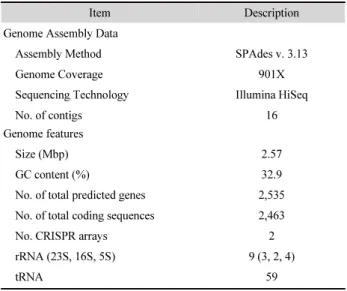
strain B2-b was extracted using a commercial DNA extraction kit (GeneAll Biotechnology Co. Ltd.) according to the manufacturer’s instructions. Whole-genome sequencing was performed at Macrogen Inc. using the HiSeq 2500 sequencing platform (Illumina Inc.). Read sequences (a total of about 2.31 Gb) after passed filtering were used into contig assembly. The trimming of the resulting nucleotide sequences and assembling de novo were accomplished by SPAdes (v.3.13). Finally, 16 contigs (a mean of 901 depth) were obtained in this study. To estimate genome completeness and quality, we used checkM (Parks et al., 2015). The resulting assembled sequences were annotated by NCBI Prokaryotic Genome Annotation Pipeline with GeneMarkS-2+ version 4.9, using the best-placed reference protein method (Angiuoli et al., 2008). Finally, the draft genome length of the strain B2-b is ca. 2.57 Mbp with 32.9%
mean G + C content. The results of CheckM estimation indicated that genome completeness at 99.7% with 0.0% contamination and 0.0% strain heterogeneity. Phylogenomics tree based on type species inferred with FastME 2.1.6.1 (Lefort et al., 2015) was generated by TYGS (Meier-Kolthoff and Goker, 2019) (Fig. 1). Branch support and intergenomic distances were inferred from 100 pseudo-bootstrap replicates each and a balanced minimum evolution, respectively.
The genome includes 2,535 predicted genes, and 9 ribosomal
RNA and 59 transfer RNA genes (Table 1). Among coding sequences (n = 2,463), 1,786 CDSs were matched in KEGG database (72.5% of total CDSs). Despite the similarity for 16S rRNA gene sequence was high, the result (66.5%) of digital DDH estimated by GGDC (Meier-Kolthoff et al., 2013) and phylogenomics tree (Fig. 1) indicated that strain B2-b is a potential new species of the genus Staphylococcus, against Staphylococcus warneri NCTC 11044
T(GCF_002901765).
Fig. 1. Tree inferred with FastME 2.1.6.1 from GBDP distances calculated from genome sequences. The branch lengths are scaled in terms of GBDP distance formula d
5. The sequence of Streptococcus infantis ATCC 700779 (GCA_000187465) was used as the outgroup in this study. The GenBank accession numbers are given in parentheses. The numbers above branches are GBDP pseudo-bootstrap support values > 60% from 100 replications. The tree was rooted at the midpoint. Bar 0.01 substitutions per nucleotide position.
Table 1. Staphylococcus sp. strain B2-b genome assembly and its general features
Item Description
Genome Assembly Data
Assembly Method SPAdes v. 3.13
Genome Coverage 901X
Sequencing Technology Illumina HiSeq
No. of contigs 16
Genome features
Size (Mbp) 2.57
GC content (%) 32.9
No. of total predicted genes 2,535
No. of total coding sequences 2,463
No. CRISPR arrays 2
rRNA (23S, 16S, 5S) 9 (3, 2, 4)
tRNA 59
Staphylococcus sp. strain B2-b genome ∙ 179
Korean Journal of Microbiology, Vol. 56, No. 2 Genome analysis revealed that genes involved in prokaryotic
defense systems (e.g. CRISPR-Cas system, restriction and modification system, and toxin-antitoxin system) (Zhang et al., 2020) were identified, which have been reported to resist heterologous DNA and survive from viral infection. Additionally, genes for drug resistance genes such as Bla system (beta-lactam resistance), DltABCD operon, lysyl-phosphatidylglycerol (L- PG) synthase (MprF), VraFG transporter for Cationic anti- microbial peptide (CAMP) resistance, and efflux pumps (AbcA and NorB) for multidrug resistance were completely identified in the genome of the strain B2-b. These results indicate that strain B2-b have various survival strategies against resistant matters. Also, it might be supported that various genes involved in two-component regulatory systems for envelope stress response (BaeSR), aerobic and anaerobic respiration (ResED), cell wall metabolism (VicKR), bacitracin transport (BraSR), cationic antimicrobial peptide transport (GraSR), and virulence regulation (ArlSR). We also confirmed that the genome completely encoded proteins for assimilatory sulfate reduction (Sat and CysCHJI), and dissimilatory nitrate reduction (NarGHI and NirBD) for anaerobic respiration using nitrate as a terminal electron acceptor (Sparacino-Watkins et al., 2014).
Accession number
This Whole Genome Shotgun project of the strain B2-b (=
KCCM 43329) has been deposited at DDBJ/ENA/GenBank under the accession WEHV00000000. This version of the project (01) has the accession number WEHV01000000 and consists of sequences WEHV01000001-WEHV01000016.
적 요
Firmicutes에 속하는 Staphylococcus 속은 그람 양성 및 낮 은 G + C 함량 세균으로 알려져 있다. 이 속은 인간과 동물들에 게 중요한 미생물로 밀접한 관련이 있다. 본 연구에서는 태변 으로부터 분리된 Staphylococcus 속에 속하는 약 2.57 Mb의 크기와 32.9%의 평균 G + C 함량을 가진 B2-b 균주의 비완전 한 유전체를 보고한다. 유전체는 2,463개의 코딩서열, 9개의 리보솜 RNA 및 59개의 전사 RNA 유전자를 포함하였다. 본
유전체로부터, 약제내성과 다양한 방어시스템에 관련된 유전 자들이 확인되었다.
Acknowledgments
This work was supported by a research grant from Jeju National University Hospital in 2019.
References