Community Analysis of Endophytic Fungal strains Isolated from the Roots of Plants Inhabiting Mujechi-neup
Woo-Jae Cheon
1†, Hye-Rim Choi
1†, Hyun Kim
1, Yoon-Jong Nam
1, Yoosun Oh
1, Minji Jeong
1, Nan-Yeong Lee
1, Sang-Chul Ha
2and Jong-Guk Kim
1*
1
Department of Life Sciences and Biotechnology, Institute for Microorganisms, Kyungpook National University, Daegu 41566, Korea
2
Department of Hotel Culinary Arts, Daegu Future College, Gyeongsan 38607, Korea
Received September 26, 2016 /Revised December 23, 2016 /Accepted December 27, 2016
Wetlands exhibit intermediate characteristics of both terrestrial and aquatic ecosystems, and the bio- diversity is rich in these unique biological habitats. The symbiotic relationships between plants and fungi that inhabit these wetlands play an important role in natural resource management, biodiversity, and conservation. Accordingly, the mujechi, having academic value for the study of the natural envi- ronment, was investigated in terms of genetic diversity of endophytic fungi, which inhabit the roots of wild plants. The internal transcribed spacer (ITS) region was amplified to identify fungal strains.
In total, 226 strains were isolated and categorized into three phyla, seven classes, 10 orders, 22 fami- lies, and 31 genera. In plants by endophytic fungi were classified in Isachne globosa (Ig) to 19 genera, Scirpus karuisawensis (Sk) to 11 genera, Utricularia racemosa (Ur) to 19 genera, and one incertae sedis, Eriocaulon decemflorum (Ed) to 11 genera. The fungal taxa was identified the genera Acephala (19.9%), Tolypocladium (16.3%), Neopestalotiopsis (11.5%), and Perenniporia (7.1%). The fungal group isolated from Isachne globosa (Ig) grew the largest number of isolated fungal strains. After comprehensive evaluation, the endophytic fungal group from Utricularia racemosa (Ur) ranked highest in diversity analyses. From the roots of wild plant in mujechi-neup, it confirmed the distribution and diversity of endophytic fungi. This study provides the basic data to understand fungal community structure in peat wetlands.
Key words : Endophytic fungi, fungal diversity, Mujechi-neup, Mountain wetland
†
Authors contributed equally.
*Corresponding author
*Tel : +82-53-950-5379, Fax : +82-53-955-5379
*E-mail : [email protected]
This is an Open-Access article distributed under the terms of the Creative Commons Attribution Non-Commercial License (http://creativecommons.org/licenses/by-nc/3.0) which permits unrestricted non-commercial use, distribution, and reproduction in any medium, provided the original work is properly cited.
Journal of Life Science 2016 Vol. 26. No. 12. 1446~1457 DOI : http://dx.doi.org/10.5352/JLS.2016.26.12.1446
서 론
산지습지는 산에 형성된 습지를 말하며 일반적으로 내륙 습지에 속한다(Ministry of Environment Republic of Korea, 1999). 산지습지의 생태계는 육상 생태계와 수중생태계의 중 간 특성을 띄고 있어, 독특한 생물 서식처로 생물다양성이 풍 부하다. 또한 탄소 저장능력이 뛰어나며, 독성물질을 늪에 가 두는 능력이 있어 수질을 정화시키는데 중요한 역할을 한다 [20, 30]. 이러한 특성이 잘 나타나있는 무제치늪은 자연환경을 연구할 학술적 가치가 매우 크기 때문에 생태계 보전지역 (Ministry of Environment Republic of Korea, 1998) 및 람사르 습지로 지정되었다.
무제치늪의 토지적 환경조건에 따라 산림식생, 산지습원식 생의 군락종조성이 미묘하게 다르며, 구성 식물종이 식물군락
에서 연속적으로 나타남을 보이고 있다. 이러한 산림식생유형 과 생장특성 및 과거식생을 통한 기후변화를 알기 위한 화분 분석 연구는 1996년부터 이루어 졌지만, 산지습지의 식생과 관련된 미생물에 대한 연구는 이루어지지 않았다[21, 24, 25].
최근에 우리나라에서 습지의 보호와 환경 보존을 위하여 갯벌, 해안 사구 및 해안 염습지와 그곳에 자생하는 염생식물 을 대상으로 식물과 공생 및 공존하는 미생물에 대한 연구가 활발히 이루어 지고 있지만, 식물과 내생균류에 대한 연구는 거의 없는 실정이다[16, 17, 22].
내생진균는 식물과 공생 및 공존하는 미생물로서 천연 자원
관리, 종 다양성, 보존 및 복원에 중요한 역할을 한다. 공생관
계에 대한 연구가 수행되면서, 식물과 균류사이의 생리학적
상호 작용의 메커니즘에 대한 이해가 증가했다. 하나의 식물
에 많은 균을 형성 할 수 있으며, 하나의 균은 여러 식물을
연결 할 수 있다[7, 9, 32]. 또한, 식물과 내생진균이 가지고
있는 환경적으로 다른 특성과 균류에 의한 유전적 다양성이
함께 영향을 미쳐서, 균이 식물 뿌리에서 기능을 할 수 있도록
해주어 서로 상호 의존적인 기능을 하게 하는 것이다. 즉, 식물
과 내생하는 균류의 상리공생은 식물에게 있어 종 다양성을
풍부하게 만들어주고, 식물 뿌리에 공생하는 곰팡이의 종 다
양성을 풍부하게 만들어주며, 자연생태계에서 살아남을 수 있
는 생존력과 경쟁력을 갖출 수 있게 해 주는 것이다[1, 28].
Table 1. The scientific name, abbreviated plant name, and habitat of 4 plants
No. Scientific name Plant code Habitat
1 2 3 4
Isachne globosa (Thunb.) Kuntze Scirpus karuisawensis Makino Utricularia racemosa Wall.
Eriocaulon decemflorum Maxim.
Ig Sk Ur Ed
Mujechi-neup 35°27'26.10"N, 129°08'03.51"E 본 연구에서는 내생진균의 분포 및 다양성 분석을 통하여
유연관계를 확인하기 위해 무제치늪에서 자생하는 식물 뿌리 의 내생진균류를 형태적으로 순수분리하여 동정하였고, 다양 성지수(diversity index)를 확인하였다.
재료 및 방법
식물 채집
울산 울주군 웅촌면 고령리에 위치한 무제치늪 중 제 3늪에 서만 식물채집이 이루어졌으며, 채집한 4종의 식물은 우리나 라 담수습지에서 많이 자생하는 산지습지 식물이다. 4종의 식 물은 기장대풀(Isachne globosa Kuntze), 솔방울고랭이(Scirpus karuisawensis Makino), 이삭귀개(Utricularia racemosa Wall.), 좀개수염(Eriocaulon decemflorum Maxim.)이며(Table 1), 이 4 종의 식물들은 3늪에 많은 군락을 이루고 있어 이 외 다른식물 들을 채집하는데 어려움이 있다. 따라서, 채집된 위의 식물들 을 본 연구에 사용하였다.
내생진균 분리 및 배양
먼저 채집한 식물 뿌리의 토양을 제거하기 위해 물로 세척 하였다. 뿌리를 약 3~4 cm 절단하여 표백제인 과염소산(1%
Perchloric acid)을 사용하여 10분간 처리하하고 멸균증류수로 세척하였다. 그 뒤 계면활성제(Tween 80)를 10분간 처리하여 멸균증류수로 세척하였다. 전처리 된 식물 뿌리에서 내생진균 류를 분리 배양하기 위해 스트렙토마이신(Streptomycin, 80 ppm)이 함유된 Hagem Minimal media (HM) 최소배지를 사 용하여 25°C 조건에서 배양하였다[33, 35]. 배양된 뿌리의 끝 단면에서 뻗어 나온 내생진균류의 균사를 HM 배지에 획선도 말법을 이용하여 25°C에서 배양하였다. 그리고 HM 배지에 배양된 내생진균류를 Potato Dextrose Agar (PDA) 배지에 계 대배양을 하여 순수분리를 하였다. 순수 분리된 내생진균은 Potato Dextrose Broth (PDB) 배지에 7~14일 동안, 25°C 조건 에서 100 rpm으로 진탕배양하였고, 내생진균의 균체를 여과 하여 5일 동안 동결건조 하였다. 동결건조된 시료는 내생진균 을 동정하기위해 사용하였다[18, 19, 37].
내생진균의 DNA 추출 및 PCR
DNeasy Plant mini kit (QIAgen, Valencia, CA, USA)를 이용하여 동결건조 된 균체의 Genomic DNA를 추출하였다.
PCR 프라이머는 ITS1 (5‘-TCC GTA GGT GAA CCT GCG
G-3’)과 ITS4 (5‘-TCC TCC GCT TAT TGA TAT GC-3’)를 이 용하였다. PCR 조건은 predenaturation (95°C, 2 min), 35 사이 클의 denaturation (95°C, 30 sec), annealing (55°C, 1min), ex- tension (72°C, 1 min), 그리고 final extension (72°C, 7 min)으 로 수행하였다[36]. PCR 산물은 전기영동 후, Ethidium Bromide (EtBr)으로 염색하여 분석하였다. 염기서열 결정을 위하여 ABI PRISM BigDye Terminator Cycle Sequencing Kit (PE Biosystems Foster, CA, USA)과 ABI 310 DNA sequencer (Perkin Elmer, Foster, CA, USA)를 사용하여 내생진균의 염 기서열을 결정하였다. 이러한 과정을 거친 rDNA-ITS 영역의 염기서열을 NCBI의 BLASTN으로 확인하였다.
내생진균의 계통분석 및 다양성지수 분석
내생진균류의 유연관계를 확인하기 위해 분석한 ITS영역 염기서열을 Bioedit program의 ClustalW를 사용하여 염기서 열을 정리하였다. 또한, MEGA6 program의 neighbor-joining (NJ) 방법으로 분석하여 계통수를 작성하였다. 계통수의 신뢰 성 평가를 위해 1,000의 replication을 적용한 bootstrap 분석을 하였다[31].
내생진균의 다양성 분석은 각 식물의 속(Genus)을 대상으 로 하였다. 각 식물군에 대한 내생균류의 다양성 지수를 분석 하기 위해, Shannon diversity index (H’), 그리고 Simpson’s index(1-D)를 사용하였다[12, 13, 15]. 그리고, 종 풍부도를 분 석하기 위해 Margalef’s index (Dmg), Menhinick’s index (Dmn)를 적용하였다[12] (Table 2).
결과 및 고찰
내생균류의 동정 및 계통학적 유연관계
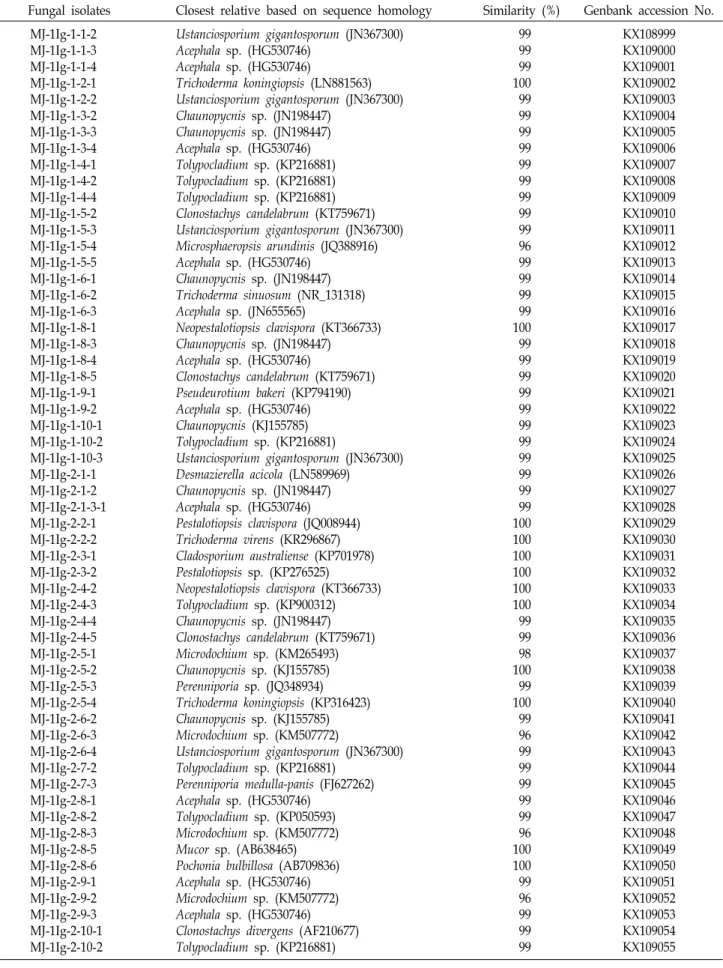
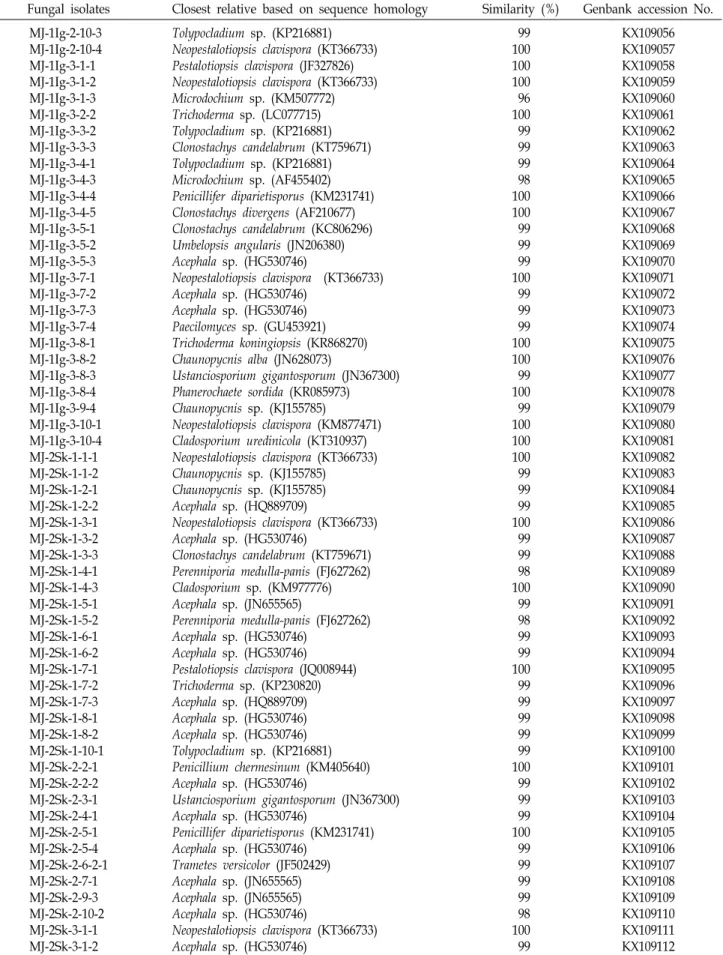
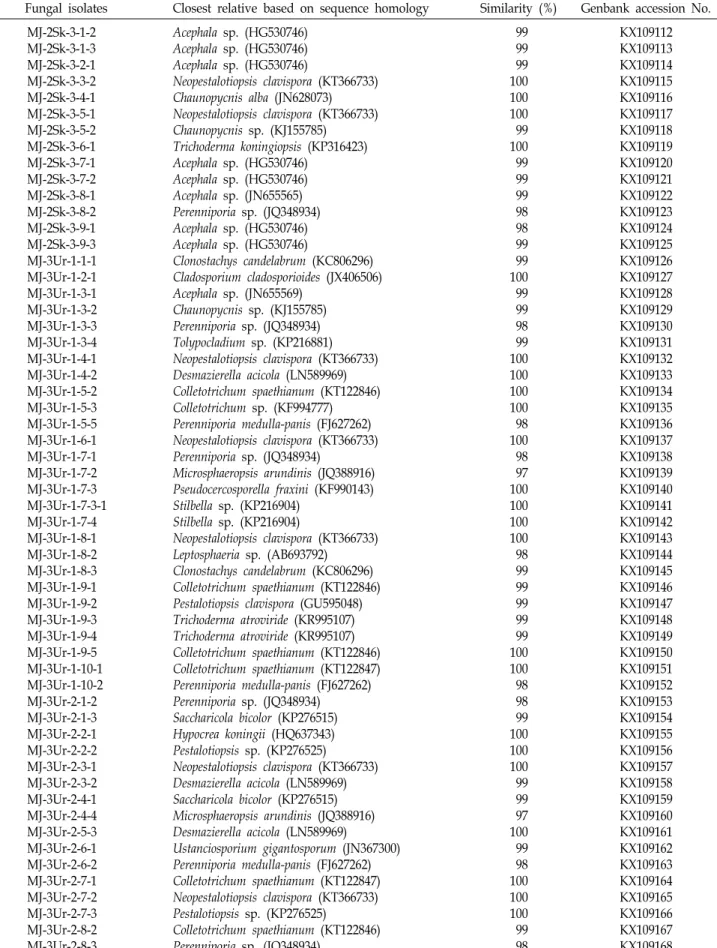
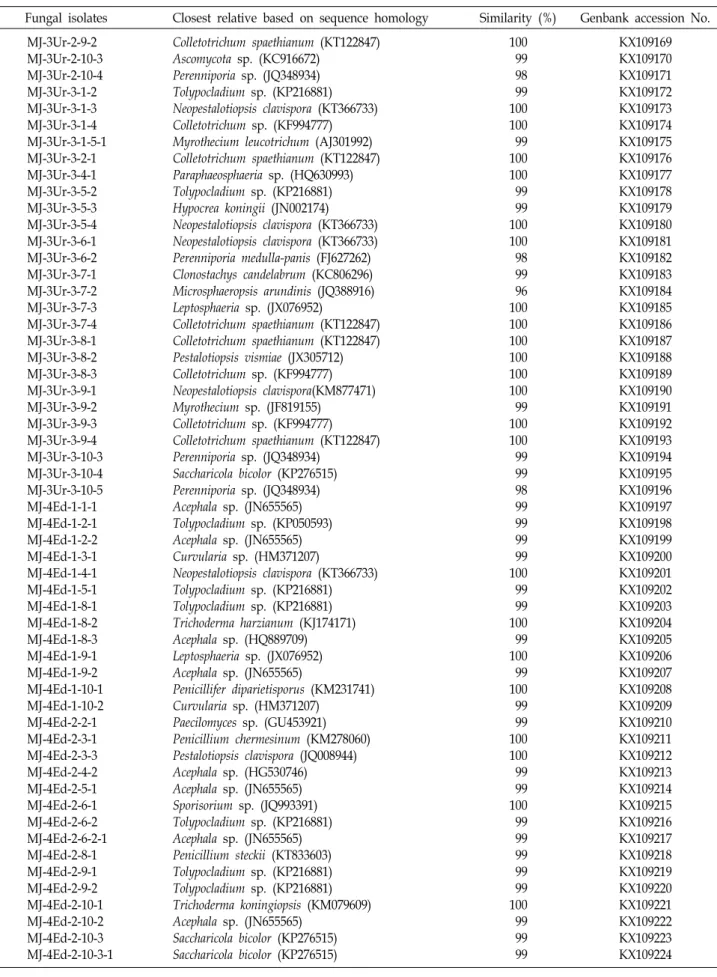
무제치늪에서 자생하는 4종류의 습지식물로부터 형태학적 으로 다른 내생진균류 226주을 분리 및 선별하였다. 선별된 내생균류는 기장대풀(Ig)로부터 83주, 솔방울고랭이(Sk)로부 터 44주, 이삭귀개(Ur)로부터 71주, 좀개수염(Ed)로부터 28주 가 분리 동정되었다. 내생진균류의 염기서열은 NCBI의 Gen- Bank에 등록하여 모든 내생진균류에 대한 accession number [KX108999~KX109224]를 부여받았다(Table 3).
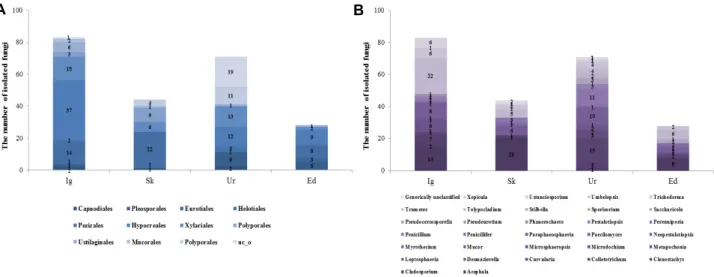
식물별 내생진균은 Ig에서 19속, Sk에서 11속, Ur에서 19속 과 분류체계가 명확하지 않은 Incertae sedis에 속하는 1속, Ed에서 11속이 분류되었다(Table 4).
내생진균류의 계통분석은, Ig에서 자낭균문(Ascomycota),
Table 2. The diversity index formulas used in this study
Diversity indices Formula Description
Shannon;s diversity index (H’) P, the proportion of objects of a particular species
Simpson’ index of diversity (1-D) N, total number of the individuals in each sample
Menhinick’ index (Dmn) S, the species number
Margalef’s index (Dmg) S, the number of different genera in a sample
A B
Fig. 1. Distribution of fungal isolates in different plant samples at the order (A) and genus (B) levels. Ig, Isachne globosa (Thunb.) Kuntze.; Sk, Scirpus karuisawensis Makino.; Ur Utricularia racemosa Wall.; Ed, Eriocaulon decemflorum Maxim.
Capnodiales목에 속하는 Cladosporium속, Pleosporales목에 속하는 Microsphaeropsis속, Eurotiales목에 속하는 Paecilomyces 속, Helotiales목에 속하는 Acephala속, Pezizales목에 속하는 Desmazierella속, Hypocreales목에 속하는 Clonostachys속, Metapochonia속, Trichoderma속, Penicillifer속, Tolypocladium속 과 Xylariales목에 속하는 Neopestalotiopsis속, Pestalotiopsis속, Microdochium속과 분류체계가 명확하지 않는 incertae sedis에 속하는 Pseudeurotium속이 확인되었다. 담자균문(Basidiomy- cota), Polyporales목에 속하는 Perenniporia속, Phanerochaete속 과 Ustilaginales목에 속하는 Ustanciosporium속이 확인되었으 며, 접합균문(Zygomycota)에서는 Mucorales목에서 속하는 Mucor속, Umbelopsis속이 확인되었다. Sk에서 Ascomycota문, Capnodiales목에 속하는 Cladosporium속, Eurotiales목에 속하 는 Penicillium속, Helotiales목에 속하는 Acephala속, Hypocre- ales목에 속하는 Clonostachys속, Trichoderma속, Penicillifer속, Tolypocladium속과 Xylariales목에 속하는 Neopestalotiopsis속 이 확인되었으며, Basidiomycota문, Polyporales목에 속하는 Perenniporia속, Trametes속과 Ustilaginales목에 속하는 Ustan- ciosporium속이 확인되었다. Ur에서 Ascomycota문, Capnodi-
ales목에 속하는 Cladosporium속, Pseudocercosporella속과 Pleo-
sporales목에 속하는 Leptosphaeria속, Saccharicola속, Micro-
sphaeropsis속, Paraphaeosphaeria속과 Helotiales목에 속하는
Acephala속, Pezizales목에 속하는 Desmazierella속, Hypocreales
목에 속하는 Clonostachys속, Trichoderma속, Myrothecium속,
Tolypocladium속과, Xylariales목에 속하는 Neopestalotiopsis속,
Pestalotiopsis속과 분류체계가 명확하지 않는 incertae sedis에
속하는 Colletotrichum속, Stilbella속이 확인되었다. Ed에서
Ascomycota문, Pleosporales목에 속하는 Leptosphaeria속, Sac-
charicola속, Curvularia속과 Eurotiales목에 속하는 Paecilomy-
ces속, Penicillium속과 Helotiales목에 속하는 Acephala속,
Hypocreales목에 속하는 Trichoderma속, Penicillifer속, Tolypo-
cladium속과 Xylariales목에 속하는 Neopestalotiopsis속이 확인
되었으며, Basidiomycota문, Ustilaginales목에 속하는 Spor-
isorium속이 확인되었다(Fig. 1, Fig. 2). 그다음으로 내생진균
류 226균주를 문으로 분류하였을 때, Ascomycota이 197주로
가장 많은 부분을 차지하였으며, 그다음으로 Basidiomycota
이 27주, Zygomycota문이 2주를 차지하였다. 생물 분류체계로
보면, Ascomycota은 5강(classes), 7목(orders), 17과(families),
Table 3. Partial identification of the 226 fungal isolates using the internal transcribed spacer sequence analysis
Fungal isolates Closest relative based on sequence homology Similarity (%) Genbank accession No.
MJ-1Ig-1-1-2 MJ-1Ig-1-1-3 MJ-1Ig-1-1-4 MJ-1Ig-1-2-1 MJ-1Ig-1-2-2 MJ-1Ig-1-3-2 MJ-1Ig-1-3-3 MJ-1Ig-1-3-4 MJ-1Ig-1-4-1 MJ-1Ig-1-4-2 MJ-1Ig-1-4-4 MJ-1Ig-1-5-2 MJ-1Ig-1-5-3 MJ-1Ig-1-5-4 MJ-1Ig-1-5-5 MJ-1Ig-1-6-1 MJ-1Ig-1-6-2 MJ-1Ig-1-6-3 MJ-1Ig-1-8-1 MJ-1Ig-1-8-3 MJ-1Ig-1-8-4 MJ-1Ig-1-8-5 MJ-1Ig-1-9-1 MJ-1Ig-1-9-2 MJ-1Ig-1-10-1 MJ-1Ig-1-10-2 MJ-1Ig-1-10-3 MJ-1Ig-2-1-1 MJ-1Ig-2-1-2 MJ-1Ig-2-1-3-1 MJ-1Ig-2-2-1 MJ-1Ig-2-2-2 MJ-1Ig-2-3-1 MJ-1Ig-2-3-2 MJ-1Ig-2-4-2 MJ-1Ig-2-4-3 MJ-1Ig-2-4-4 MJ-1Ig-2-4-5 MJ-1Ig-2-5-1 MJ-1Ig-2-5-2 MJ-1Ig-2-5-3 MJ-1Ig-2-5-4 MJ-1Ig-2-6-2 MJ-1Ig-2-6-3 MJ-1Ig-2-6-4 MJ-1Ig-2-7-2 MJ-1Ig-2-7-3 MJ-1Ig-2-8-1 MJ-1Ig-2-8-2 MJ-1Ig-2-8-3 MJ-1Ig-2-8-5 MJ-1Ig-2-8-6 MJ-1Ig-2-9-1 MJ-1Ig-2-9-2 MJ-1Ig-2-9-3 MJ-1Ig-2-10-1 MJ-1Ig-2-10-2
Ustanciosporium gigantosporum (JN367300) Acephala sp. (HG530746)
Acephala sp. (HG530746)
Trichoderma koningiopsis (LN881563) Ustanciosporium gigantosporum (JN367300) Chaunopycnis sp. (JN198447)
Chaunopycnis sp. (JN198447) Acephala sp. (HG530746) Tolypocladium sp. (KP216881) Tolypocladium sp. (KP216881) Tolypocladium sp. (KP216881) Clonostachys candelabrum (KT759671) Ustanciosporium gigantosporum (JN367300) Microsphaeropsis arundinis (JQ388916) Acephala sp. (HG530746)
Chaunopycnis sp. (JN198447) Trichoderma sinuosum (NR_131318) Acephala sp. (JN655565)
Neopestalotiopsis clavispora (KT366733) Chaunopycnis sp. (JN198447)
Acephala sp. (HG530746)
Clonostachys candelabrum (KT759671) Pseudeurotium bakeri (KP794190) Acephala sp. (HG530746) Chaunopycnis (KJ155785) Tolypocladium sp. (KP216881)
Ustanciosporium gigantosporum (JN367300) Desmazierella acicola (LN589969)
Chaunopycnis sp. (JN198447) Acephala sp. (HG530746) Pestalotiopsis clavispora (JQ008944) Trichoderma virens (KR296867) Cladosporium australiense (KP701978) Pestalotiopsis sp. (KP276525)
Neopestalotiopsis clavispora (KT366733) Tolypocladium sp. (KP900312) Chaunopycnis sp. (JN198447) Clonostachys candelabrum (KT759671) Microdochium sp. (KM265493) Chaunopycnis sp. (KJ155785) Perenniporia sp. (JQ348934) Trichoderma koningiopsis (KP316423) Chaunopycnis sp. (KJ155785) Microdochium sp. (KM507772)
Ustanciosporium gigantosporum (JN367300) Tolypocladium sp. (KP216881)
Perenniporia medulla-panis (FJ627262) Acephala sp. (HG530746)
Tolypocladium sp. (KP050593) Microdochium sp. (KM507772) Mucor sp. (AB638465) Pochonia bulbillosa (AB709836) Acephala sp. (HG530746) Microdochium sp. (KM507772) Acephala sp. (HG530746) Clonostachys divergens (AF210677) Tolypocladium sp. (KP216881)
99 99 99 100 99 99 99 99 99 99 99 99 99 96 99 99 99 99 100 99 99 99 99 99 99 99 99 99 99 99 100 100 100 100 100 100 99 99 98 100 99 100 99 96 99 99 99 99 99 96 100 100 99 96 99 99 99
KX108999
KX109000
KX109001
KX109002
KX109003
KX109004
KX109005
KX109006
KX109007
KX109008
KX109009
KX109010
KX109011
KX109012
KX109013
KX109014
KX109015
KX109016
KX109017
KX109018
KX109019
KX109020
KX109021
KX109022
KX109023
KX109024
KX109025
KX109026
KX109027
KX109028
KX109029
KX109030
KX109031
KX109032
KX109033
KX109034
KX109035
KX109036
KX109037
KX109038
KX109039
KX109040
KX109041
KX109042
KX109043
KX109044
KX109045
KX109046
KX109047
KX109048
KX109049
KX109050
KX109051
KX109052
KX109053
KX109054
KX109055
Table 3. Continued
Fungal isolates Closest relative based on sequence homology Similarity (%) Genbank accession No.
MJ-1Ig-2-10-3 MJ-1Ig-2-10-4 MJ-1Ig-3-1-1 MJ-1Ig-3-1-2 MJ-1Ig-3-1-3 MJ-1Ig-3-2-2 MJ-1Ig-3-3-2 MJ-1Ig-3-3-3 MJ-1Ig-3-4-1 MJ-1Ig-3-4-3 MJ-1Ig-3-4-4 MJ-1Ig-3-4-5 MJ-1Ig-3-5-1 MJ-1Ig-3-5-2 MJ-1Ig-3-5-3 MJ-1Ig-3-7-1 MJ-1Ig-3-7-2 MJ-1Ig-3-7-3 MJ-1Ig-3-7-4 MJ-1Ig-3-8-1 MJ-1Ig-3-8-2 MJ-1Ig-3-8-3 MJ-1Ig-3-8-4 MJ-1Ig-3-9-4 MJ-1Ig-3-10-1 MJ-1Ig-3-10-4 MJ-2Sk-1-1-1 MJ-2Sk-1-1-2 MJ-2Sk-1-2-1 MJ-2Sk-1-2-2 MJ-2Sk-1-3-1 MJ-2Sk-1-3-2 MJ-2Sk-1-3-3 MJ-2Sk-1-4-1 MJ-2Sk-1-4-3 MJ-2Sk-1-5-1 MJ-2Sk-1-5-2 MJ-2Sk-1-6-1 MJ-2Sk-1-6-2 MJ-2Sk-1-7-1 MJ-2Sk-1-7-2 MJ-2Sk-1-7-3 MJ-2Sk-1-8-1 MJ-2Sk-1-8-2 MJ-2Sk-1-10-1 MJ-2Sk-2-2-1 MJ-2Sk-2-2-2 MJ-2Sk-2-3-1 MJ-2Sk-2-4-1 MJ-2Sk-2-5-1 MJ-2Sk-2-5-4 MJ-2Sk-2-6-2-1 MJ-2Sk-2-7-1 MJ-2Sk-2-9-3 MJ-2Sk-2-10-2 MJ-2Sk-3-1-1 MJ-2Sk-3-1-2
Tolypocladium sp. (KP216881) Neopestalotiopsis clavispora (KT366733) Pestalotiopsis clavispora (JF327826) Neopestalotiopsis clavispora (KT366733) Microdochium sp. (KM507772) Trichoderma sp. (LC077715) Tolypocladium sp. (KP216881) Clonostachys candelabrum (KT759671) Tolypocladium sp. (KP216881) Microdochium sp. (AF455402) Penicillifer diparietisporus (KM231741) Clonostachys divergens (AF210677) Clonostachys candelabrum (KC806296) Umbelopsis angularis (JN206380) Acephala sp. (HG530746)
Neopestalotiopsis clavispora (KT366733) Acephala sp. (HG530746)
Acephala sp. (HG530746) Paecilomyces sp. (GU453921) Trichoderma koningiopsis (KR868270) Chaunopycnis alba (JN628073)
Ustanciosporium gigantosporum (JN367300) Phanerochaete sordida (KR085973) Chaunopycnis sp. (KJ155785)
Neopestalotiopsis clavispora (KM877471) Cladosporium uredinicola (KT310937) Neopestalotiopsis clavispora (KT366733) Chaunopycnis sp. (KJ155785)
Chaunopycnis sp. (KJ155785) Acephala sp. (HQ889709)
Neopestalotiopsis clavispora (KT366733) Acephala sp. (HG530746)
Clonostachys candelabrum (KT759671) Perenniporia medulla-panis (FJ627262) Cladosporium sp. (KM977776) Acephala sp. (JN655565)
Perenniporia medulla-panis (FJ627262) Acephala sp. (HG530746)
Acephala sp. (HG530746) Pestalotiopsis clavispora (JQ008944) Trichoderma sp. (KP230820) Acephala sp. (HQ889709) Acephala sp. (HG530746) Acephala sp. (HG530746) Tolypocladium sp. (KP216881) Penicillium chermesinum (KM405640) Acephala sp. (HG530746)
Ustanciosporium gigantosporum (JN367300) Acephala sp. (HG530746)
Penicillifer diparietisporus (KM231741) Acephala sp. (HG530746)
Trametes versicolor (JF502429) Acephala sp. (JN655565) Acephala sp. (JN655565) Acephala sp. (HG530746)
Neopestalotiopsis clavispora (KT366733) Acephala sp. (HG530746)
99 100 100 100 96 100 99 99 99 98 100 100 99 99 99 100 99 99 99 100 100 99 100 99 100 100 100 99 99 99 100 99 99 98 100 99 98 99 99 100 99 99 99 99 99 100 99 99 99 100 99 99 99 99 98 100 99
KX109056
KX109057
KX109058
KX109059
KX109060
KX109061
KX109062
KX109063
KX109064
KX109065
KX109066
KX109067
KX109068
KX109069
KX109070
KX109071
KX109072
KX109073
KX109074
KX109075
KX109076
KX109077
KX109078
KX109079
KX109080
KX109081
KX109082
KX109083
KX109084
KX109085
KX109086
KX109087
KX109088
KX109089
KX109090
KX109091
KX109092
KX109093
KX109094
KX109095
KX109096
KX109097
KX109098
KX109099
KX109100
KX109101
KX109102
KX109103
KX109104
KX109105
KX109106
KX109107
KX109108
KX109109
KX109110
KX109111
KX109112
Table 3. Continued
Fungal isolates Closest relative based on sequence homology Similarity (%) Genbank accession No.
MJ-2Sk-3-1-2 MJ-2Sk-3-1-3 MJ-2Sk-3-2-1 MJ-2Sk-3-3-2 MJ-2Sk-3-4-1 MJ-2Sk-3-5-1 MJ-2Sk-3-5-2 MJ-2Sk-3-6-1 MJ-2Sk-3-7-1 MJ-2Sk-3-7-2 MJ-2Sk-3-8-1 MJ-2Sk-3-8-2 MJ-2Sk-3-9-1 MJ-2Sk-3-9-3 MJ-3Ur-1-1-1 MJ-3Ur-1-2-1 MJ-3Ur-1-3-1 MJ-3Ur-1-3-2 MJ-3Ur-1-3-3 MJ-3Ur-1-3-4 MJ-3Ur-1-4-1 MJ-3Ur-1-4-2 MJ-3Ur-1-5-2 MJ-3Ur-1-5-3 MJ-3Ur-1-5-5 MJ-3Ur-1-6-1 MJ-3Ur-1-7-1 MJ-3Ur-1-7-2 MJ-3Ur-1-7-3 MJ-3Ur-1-7-3-1 MJ-3Ur-1-7-4 MJ-3Ur-1-8-1 MJ-3Ur-1-8-2 MJ-3Ur-1-8-3 MJ-3Ur-1-9-1 MJ-3Ur-1-9-2 MJ-3Ur-1-9-3 MJ-3Ur-1-9-4 MJ-3Ur-1-9-5 MJ-3Ur-1-10-1 MJ-3Ur-1-10-2 MJ-3Ur-2-1-2 MJ-3Ur-2-1-3 MJ-3Ur-2-2-1 MJ-3Ur-2-2-2 MJ-3Ur-2-3-1 MJ-3Ur-2-3-2 MJ-3Ur-2-4-1 MJ-3Ur-2-4-4 MJ-3Ur-2-5-3 MJ-3Ur-2-6-1 MJ-3Ur-2-6-2 MJ-3Ur-2-7-1 MJ-3Ur-2-7-2 MJ-3Ur-2-7-3 MJ-3Ur-2-8-2 MJ-3Ur-2-8-3
Acephala sp. (HG530746) Acephala sp. (HG530746) Acephala sp. (HG530746)
Neopestalotiopsis clavispora (KT366733) Chaunopycnis alba (JN628073) Neopestalotiopsis clavispora (KT366733) Chaunopycnis sp. (KJ155785)
Trichoderma koningiopsis (KP316423) Acephala sp. (HG530746)
Acephala sp. (HG530746) Acephala sp. (JN655565) Perenniporia sp. (JQ348934) Acephala sp. (HG530746) Acephala sp. (HG530746)
Clonostachys candelabrum (KC806296) Cladosporium cladosporioides (JX406506) Acephala sp. (JN655569)
Chaunopycnis sp. (KJ155785) Perenniporia sp. (JQ348934) Tolypocladium sp. (KP216881) Neopestalotiopsis clavispora (KT366733) Desmazierella acicola (LN589969) Colletotrichum spaethianum (KT122846) Colletotrichum sp. (KF994777) Perenniporia medulla-panis (FJ627262) Neopestalotiopsis clavispora (KT366733) Perenniporia sp. (JQ348934)
Microsphaeropsis arundinis (JQ388916) Pseudocercosporella fraxini (KF990143) Stilbella sp. (KP216904)
Stilbella sp. (KP216904)
Neopestalotiopsis clavispora (KT366733) Leptosphaeria sp. (AB693792)
Clonostachys candelabrum (KC806296) Colletotrichum spaethianum (KT122846) Pestalotiopsis clavispora (GU595048) Trichoderma atroviride (KR995107) Trichoderma atroviride (KR995107) Colletotrichum spaethianum (KT122846) Colletotrichum spaethianum (KT122847) Perenniporia medulla-panis (FJ627262) Perenniporia sp. (JQ348934)
Saccharicola bicolor (KP276515) Hypocrea koningii (HQ637343) Pestalotiopsis sp. (KP276525)
Neopestalotiopsis clavispora (KT366733) Desmazierella acicola (LN589969) Saccharicola bicolor (KP276515) Microsphaeropsis arundinis (JQ388916) Desmazierella acicola (LN589969)
Ustanciosporium gigantosporum (JN367300) Perenniporia medulla-panis (FJ627262) Colletotrichum spaethianum (KT122847) Neopestalotiopsis clavispora (KT366733) Pestalotiopsis sp. (KP276525)
Colletotrichum spaethianum (KT122846) Perenniporia sp. (JQ348934)
99 99 99 100 100 100 99 100 99 99 99 98 98 99 99 100 99 99 98 99 100 100 100 100 98 100 98 97 100 100 100 100 98 99 99 99 99 99 100 100 98 98 99 100 100 100 99 99 97 100 99 98 100 100 100 99 98
KX109112
KX109113
KX109114
KX109115
KX109116
KX109117
KX109118
KX109119
KX109120
KX109121
KX109122
KX109123
KX109124
KX109125
KX109126
KX109127
KX109128
KX109129
KX109130
KX109131
KX109132
KX109133
KX109134
KX109135
KX109136
KX109137
KX109138
KX109139
KX109140
KX109141
KX109142
KX109143
KX109144
KX109145
KX109146
KX109147
KX109148
KX109149
KX109150
KX109151
KX109152
KX109153
KX109154
KX109155
KX109156
KX109157
KX109158
KX109159
KX109160
KX109161
KX109162
KX109163
KX109164
KX109165
KX109166
KX109167
KX109168
Table 3. Continued
Fungal isolates Closest relative based on sequence homology Similarity (%) Genbank accession No.
MJ-3Ur-2-9-2 MJ-3Ur-2-10-3 MJ-3Ur-2-10-4 MJ-3Ur-3-1-2 MJ-3Ur-3-1-3 MJ-3Ur-3-1-4 MJ-3Ur-3-1-5-1 MJ-3Ur-3-2-1 MJ-3Ur-3-4-1 MJ-3Ur-3-5-2 MJ-3Ur-3-5-3 MJ-3Ur-3-5-4 MJ-3Ur-3-6-1 MJ-3Ur-3-6-2 MJ-3Ur-3-7-1 MJ-3Ur-3-7-2 MJ-3Ur-3-7-3 MJ-3Ur-3-7-4 MJ-3Ur-3-8-1 MJ-3Ur-3-8-2 MJ-3Ur-3-8-3 MJ-3Ur-3-9-1 MJ-3Ur-3-9-2 MJ-3Ur-3-9-3 MJ-3Ur-3-9-4 MJ-3Ur-3-10-3 MJ-3Ur-3-10-4 MJ-3Ur-3-10-5 MJ-4Ed-1-1-1 MJ-4Ed-1-2-1 MJ-4Ed-1-2-2 MJ-4Ed-1-3-1 MJ-4Ed-1-4-1 MJ-4Ed-1-5-1 MJ-4Ed-1-8-1 MJ-4Ed-1-8-2 MJ-4Ed-1-8-3 MJ-4Ed-1-9-1 MJ-4Ed-1-9-2 MJ-4Ed-1-10-1 MJ-4Ed-1-10-2 MJ-4Ed-2-2-1 MJ-4Ed-2-3-1 MJ-4Ed-2-3-3 MJ-4Ed-2-4-2 MJ-4Ed-2-5-1 MJ-4Ed-2-6-1 MJ-4Ed-2-6-2 MJ-4Ed-2-6-2-1 MJ-4Ed-2-8-1 MJ-4Ed-2-9-1 MJ-4Ed-2-9-2 MJ-4Ed-2-10-1 MJ-4Ed-2-10-2 MJ-4Ed-2-10-3 MJ-4Ed-2-10-3-1
Colletotrichum spaethianum (KT122847) Ascomycota sp. (KC916672)
Perenniporia sp. (JQ348934) Tolypocladium sp. (KP216881) Neopestalotiopsis clavispora (KT366733) Colletotrichum sp. (KF994777) Myrothecium leucotrichum (AJ301992) Colletotrichum spaethianum (KT122847) Paraphaeosphaeria sp. (HQ630993) Tolypocladium sp. (KP216881) Hypocrea koningii (JN002174) Neopestalotiopsis clavispora (KT366733) Neopestalotiopsis clavispora (KT366733) Perenniporia medulla-panis (FJ627262) Clonostachys candelabrum (KC806296) Microsphaeropsis arundinis (JQ388916) Leptosphaeria sp. (JX076952)
Colletotrichum spaethianum (KT122847) Colletotrichum spaethianum (KT122847) Pestalotiopsis vismiae (JX305712) Colletotrichum sp. (KF994777) Neopestalotiopsis clavispora(KM877471) Myrothecium sp. (JF819155)
Colletotrichum sp. (KF994777) Colletotrichum spaethianum (KT122847) Perenniporia sp. (JQ348934)
Saccharicola bicolor (KP276515) Perenniporia sp. (JQ348934) Acephala sp. (JN655565) Tolypocladium sp. (KP050593) Acephala sp. (JN655565) Curvularia sp. (HM371207)
Neopestalotiopsis clavispora (KT366733) Tolypocladium sp. (KP216881) Tolypocladium sp. (KP216881) Trichoderma harzianum (KJ174171) Acephala sp. (HQ889709) Leptosphaeria sp. (JX076952) Acephala sp. (JN655565)
Penicillifer diparietisporus (KM231741) Curvularia sp. (HM371207)
Paecilomyces sp. (GU453921) Penicillium chermesinum (KM278060) Pestalotiopsis clavispora (JQ008944) Acephala sp. (HG530746) Acephala sp. (JN655565) Sporisorium sp. (JQ993391) Tolypocladium sp. (KP216881) Acephala sp. (JN655565) Penicillium steckii (KT833603) Tolypocladium sp. (KP216881) Tolypocladium sp. (KP216881) Trichoderma koningiopsis (KM079609) Acephala sp. (JN655565)
Saccharicola bicolor (KP276515) Saccharicola bicolor (KP276515)
100 99 98 99 100 100 99 100 100 99 99 100 100 98 99 96 100 100 100 100 100 100 99 100 100 99 99 98 99 99 99 99 100 99 99 100 99 100 99 100 99 99 100 100 99 99 100 99 99 99 99 99 100 99 99 99
KX109169
KX109170
KX109171
KX109172
KX109173
KX109174
KX109175
KX109176
KX109177
KX109178
KX109179
KX109180
KX109181
KX109182
KX109183
KX109184
KX109185
KX109186
KX109187
KX109188
KX109189
KX109190
KX109191
KX109192
KX109193
KX109194
KX109195
KX109196
KX109197
KX109198
KX109199
KX109200
KX109201
KX109202
KX109203
KX109204
KX109205
KX109206
KX109207
KX109208
KX109209
KX109210
KX109211
KX109212
KX109213
KX109214
KX109215
KX109216
KX109217
KX109218
KX109219
KX109220
KX109221
KX109222
KX109223
KX109224
A
B
Fig. 2. Phylogenetic analysis of endophytic fungal strains iso-
lated from the Mujechi-neup in wild plants. The genus
of at the phylum level; Ascomycota (A), Basidiomycota,
Zygomycota (B).
Table 4. Diversity of fungal isolates from wild plants of Mujechi Plant
code
Fungal
isolates Taxon of fungal strains Ig
Sk Ur Ed
83 44 71 28
19 genera 11 genera
19 genera, 1 unclassified (genus) 11 genera
Ig, Isachne globosa (Thunb.) Kuntze.; Sk, Scirpus karuisawensis Makino.; Ur Utricularia racemosa Wall.; Ed, Eriocaulon decem- florum Maxim.
24속(genera), Basidiomycota은 2강, 2목, 3과, 5속, Zygomycota 은 1목, 2과, 2속으로 분류할 수 있다. 이 중 Zygomycota은 Ig에서만 분리되어졌다. 채집한 식물군에서 분리한 내생진균 은 Acephala속이 19.9%로 가장 많이 차지하였고, 그 다음은 Tolypocladium 16.4%, Neopestalotiopsis 11.5%, and Perenniporia 7.1% 순으로 나타났다.
Acephala속은 식물 Sk에서 48.9%로 가장 많이 우점하는 것 으로 나타났으며, 또 다른 식물종인 Ig에서 31.1%, Ed에서 17.8
% 순으로 나타났다. Tolypocladium속은 식물 Ig에서 59.5%, Ed 에서 16.2%, 그리고 Sk에서 13.5%을 차지하였다. Neopestalo- tiopsis속은 Ur에서 38.5%, Ig에서 30.8%, Sk에서 23.1%를 차지 하였다.
본 연구는 무제치늪에 자생하고 있는 4종의 식물로부터 32 속에 해당하는 내생진균류를 분리 및 동정하였다. Acephala속 은 이 연구에서 가장 중요한 우점종이다. Smolander의 연구 결과에 의하면, 소나무와 가문비나무 뿌리에서 Acephala속이 가장 많이 분리되어진 것으로 보고되었다[29]. 일반적으로 소 나무는 낮은 pH와 풍부한 유기물 토양에서 잘 자라는 것으로 보고되어, 이와 같은 특징은 무제치의 토양과 유사한 것으로 나타났다[3, 11, 29].
2번째로 많이 분리된 Tolypocladium속은 식물 Ig에서 22균 주가 분리되었으며, Sk에 5균주, Ur에서 4균주, Ed에서 6균주 가 분리되었다. 이 속은 곤충병원성균으로 알려져 있으며, 몇 몇 연구에서는 식물에 부정적인 영향을 주는 틱(ticks)과 모기 를 죽이는 살충효과가 있는것으로 알려져 있다[26, 38].
Neopestalotiopsis속은 1종(clavispora)만 분리되었으며, 식물 Ig에서 8균주, Sk에서 6균주, Ur에서 10균주, Ed에서 2균주가 분리되었다. 이 균주는 딸기 뿌리 썩음병을 유발하는 것으로 알려져 있다[5].
Perenniporia속은 식물 Ig에서 2균주, Sk에서 3균주, Ur에서 11균주가 분리되었지만, Ed에서는 분리되지 않았다. 그 중, Perenniporia medulla-panis 균주는 흰구멍버섯으로 과일나무 식물병원균으로 알려져있다[8].
Colletotrichum속은 식물 Ur에서만 분리되었다. Colletotri- chum spaethianum 균주는 탄저병을 유발하며, 한국의 옥잠화 라는 꽃에서 처음 발견이 되었다[6, 27].
Trichoderma속은 식물 Ig에서 6균주, Ur에서 4균주, Sk와 Ed 에서 각각 2균주가 분리되었다. 이 속은 식물이 겪는 질병이나 가뭄 등의 스트레스를 견딜 수 있게 도와주는 생물학적 제제 로 개발하고 있다[4, 14]. 그 중 Trichoderma koningiopsis 균주의 Th003이 식물 병충해 방제를 유도하는 것으로 알려졌다. 이 식물방제는 식물보다는 병원체에 영향을 주는 경우가 많다고 한다[23, 34].
Clonostachys속은 식물 Ig에서 7균주, Sk에서 1균주, Ur에서 3균주가 분리되었지만, Ed에서는 분리되지 않았다. 이 속에서 많이 나온 Clonostachys candelabrum균주에서 추출한 five dia- stereomeric polyketide glycosides, roselipins A3-3E로 구충 제 연구가 활발히 진행되고 있다[2].
내생진균류의 다양성지수 분석
무제치늪의 식물 뿌리로부터 분리한 내생진균류의 다양성 (diversity)과 종 풍부도(species richness)를 분석하였다. Shan- non diversity index에 적용하여 습지식물에 따른 각 내생진균 의 다양성 지수는 Ig(2.37), Sk(1.71), Ur(2.57), Ed(2.11)으로 확 인되었다. 종 풍부도를 나타내는 Margalef’s index를 적용한 다양성 지수는 Ig(4.07), Sk(2.64), Ur(4.46), Ed(3.00)으로 확인 되었다. Menhinick’s index를 적용한 다양성 지수도 Ig(2.09), Sk(1.66), Ur(2.37), Ed(2.08)으로 확인되었다. 종 균등도를 나타 내는 Simpson’s index of diversity를 적용한 다양성 지수는 Ig(0.88), Sk(0.73), Ur(0.91), Ed(0.87)으로 확인되었다(Table 5).
위의 결과를 볼 때, 식물 Ur이 다른 식물 종에 비해 종 풍부도, 종 균등도, 다양성에서 높게 나타난 반면에 식물 Sk에서는 낮 게 나타났다. 이처럼, 다양성지수를 이용한 분석을 통해서 본 결과 식물 Ur에서 내생진균이 가장 다양하게 살 수 있는 것으 로 사료된다. 그러나 식물 Sk를 제외한 3종의 식물에서 내생진 균의 특정 속이 우점하고 있지 않았기 때문에 변동성을 가지 는 것으로 간주된다. 식물 Sk에서 분리한 내생진균은 Acephala 속이 우점하고 있으며, 그외 나머지 균들도 고르게 분포하지 않고, 다양성 지수도 낮기 때문에 제외한다.
요약하면, 무제치늪에서 채집한 식물 기장대풀(Ig), 솔방울 고랭이(Sk), 이삭귀개(Ur), 그리고 좀개수염(Ed)의 뿌리로부터 내생진균 226균주를 분리 및 동정하였다. 분리된 진균류는 ITS1과 ITS4를 포함하는 ITS영역의 서열에 의해 분석되었다.
균류들 간의 계통분석을 수행하였다. 그 결과, 자낭균문 (Ascomycota)에서 24속, 담자균문(Basidiomycota)에서 5속, 접합균문(Zygomycota)에서 2속을 확인 할 수 있었다. 그리고 Acephala (19.9%) 속이 가장 우점종인것을 확인하였다. 내생진 균이 많이 분리된 식물은 기장대풀(Ig)이지만, 균류의 다양성 지수 분석에 있어서 식물 이삭귀개(Ur)가 다른 식물 종에 비해 종 풍부도, 종 균등도, 다양성에서 높은 수치를 보였다.
본 연구는 무제치늪에서 자생하는 습지 식물의 뿌리로부터
내생진균류의 분포 및 다양성을 확인 하였고, 이는 습지 생태
Table 5. Fungal diversity analysis using 5 diversity indices at the genus level
Fungal taxon Ig Sk Ur Ed
Ascomycota_uc_g Xepicula Pseudeurotium
Cladosporium Pseudocercosporella
Leptosphaeria Saccharicola Microsphaeropsis Paraphaeosphaeria
Curvularia Paecilomyces
Penicillium Acephala Desmazierella
Clonostachys Metapochonia
Trichoderma Myrothecium
Penicillifer Tolypocladium Colletotrichum
Stilbella Neopestalotiopsis
Pestalotiopsis Microdochium
Perenniporia Phanerochaete
Trametes Ustanciosporium
Sporisorium Mucor Umbelopsis
1 2
1
1 14
1 7 1 6 1 22
8 1 6 2 1 6 1 1
1
1 22
1 2 1 5
6
3 1 1
1 1 1 1 2 3 3 1
1 3 3 4 1 4 15
2 10
3 11
1
1 2
2 1 2 8
2 1 6
2
1
N S
83 19
44 11
71 20
28 11 Shannon diversity index (H')
Simpson’s index of diversity (1-D) Menhinick's index (Dmn)
Margalef's index (Dmg)
2.37 0.88 2.09 4.07
1.71 0.73 1.66 2.64
2.57 0.91 2.37 4.46
2.11 0.87 2.08 3.00 Ig, Isachne globosa (Thunb.) Kuntze.; Sk, Scirpus karuisawensis Makino.; Ur Utricularia racemosa Wall.; Ed, Eriocaulon decemflorum Maxim.
계에서 균류자원 및 미생물 다양성연구에 기초자료가 될 것이 라 생각된다.
감사의 글
본 연구는 환경부 ‘차세대 에코이노베이션 기술개발사업’
으로 지원받은 연구이며, 연구비 지원에 감사드립니다.
References