• 검색 결과가 없습니다.

Surgical Extraction of an Embolized Atrial Septal Defect Occluder Device into Pulmonary Artery after Percutaneous Closure

N/A
N/A
Protected

Academic year: 2021

Share "Surgical Extraction of an Embolized Atrial Septal Defect Occluder Device into Pulmonary Artery after Percutaneous Closure"

Copied!
3
0
0

로드 중.... (전체 텍스트 보기)

전체 글

(1)

Korean J Thorac Cardiovasc Surg 2013;46:135-137 □ Case Report □ http://dx.doi.org/10.5090/kjtcs.2013.46.2.135 ISSN: 2233-601X (Print) ISSN: 2093-6516 (Online)

− 135 −

Departments of

1

Cardiology and

2

Cardiovascular Surgery, Erzurum Region Training and Research Hospital Received: August 16, 2012, Revised: October 18, 2012, Accepted: October 18, 2012

Corresponding author: Mustafa Yolcu, Department of Cardiology, Erzurum Bolge Egitim ve Arastırma Hastanesi, Kardiyoloji Klinigi, 25100, Palandoken, Erzurum, Turkey

(Tel) 90-442-319-18-00 (Fax) 90-442-232-64-05 (E-mail) [email protected]

C

The Korean Society for Thoracic and Cardiovascular Surgery. 2013. All right reserved.

CC
This is an open access article distributed under the terms of the Creative Commons Attribution Non-Commercial License (http://creative- commons.org/licenses/by-nc/3.0) which permits unrestricted non-commercial use, distribution, and reproduction in any medium, provided the original work is properly cited.

Surgical Extraction of an Embolized Atrial Septal Defect Occluder Device into Pulmonary Artery after Percutaneous Closure

Mustafa Yolcu, M.D.

1

, Mehmet Ali Kaygin, M.D.

2

, Emrah Ipek, M.D.

1

, Fatih Rifat Ulusoy, M.D.

1

, Bilgehan Erkut, M.D.

2

An atrial septal defect is the most common type of congenital heart disease among adults. Surgical repair or per- cutaneous closure of the defect is the treatment options. Even though percutaneous closure seems to be less ris- ky than surgical repair, it may result in fatal complications like device embolism, cardiac perforation and tampo- nade. Herein we report a case of the embolism of a device into the pulmonary artery after one hour of percuta- neous closure in which the embolized device was surgically removed and the defect was closed with a pericardial patch.

Key words: 1. Heart septal defects, atrial 2. Device, septal occluder 3. Embolism

CASE REPORT

A 22 years old female patient was admitted to our out- patient clinic with a complaint of dyspnea for the previous three years. Her physical examination revealed a 1–2/6 pan- systolic murmur in the mesocardiac area. A right bundle branch block was detected on her electrocardiogram. In the transthorasic echocardiography (TTE), a 22 mm secundum type atrial septal defect (ASD), right heart dilatation and pul- monary arterial hypertension (PAP 45 mmHg) were detected.

Transesophageal echocardiography (TEE) showed that the de- fect was 25 mm, the superior rim was 16 mm and the aortic rim was 8 mm in size. The defect was closed through a right femoral route with a 30 mm ASD occluder after balloon siz- ing with TTE. In the cineangiography and TTE early after the procedure, the device was observed to be in the correct

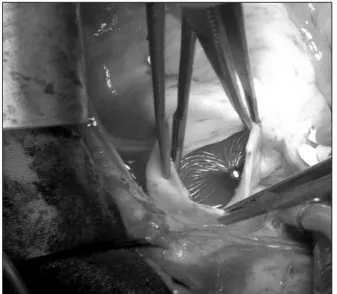
position (Fig. 1). The patient had experienced dyspnea one hour after the procedure. The TTE revealed that the device was not in the defect and it had embolized to the pulmonary artery. The patient was referred to the cardiovascular surgery unit and underwent surgery promptly. Under general anaes- thesia, a median sternotomy was done. The pericardium was opened with an aortobicaval cannulation under cardio-pulmo- nary bypass. The pulmonary artery was incised along its ver- tical axis and the occluder device was removed (Fig. 2). The right atrium was opened and the defect was then closed with a pericardial patch. The patch was patent by the first post- operative day as shown on control echocardiography.

DISCUSSION

ASD is the most common type of congenital heart disease

(2)

Mustafa Yolcu, et al

− 136 − Fig. 1. Flouroscopic view of the atrial septal defect occluder after percutaneous closure.

Fig. 2. View of the embolized device in the pulmonary artery during surgery.

in adults [1,2]. There are three different types of ASD ac- cording to their shape and location [1,3]. Secundum ASD is the most common type, which accounts for 50% to 70% of all ASDs and located in the fossa ovalis [1,3]. Primum ASD together with complete endocardial cushion defects comprises 10% of all ASDs [1,3]. Sinus venosus type ASD is located at the upper portion of the interatrial septum where the vena cava superior opens [1,3].

A shunt between atria leads to chronic right ventricular volume overload, which in turn causes lower filling rates of left ventricle [4]. Surgical or percutaneous closure in asymp- tomatic patients is indicated in the case of right ventricular volume overload and if the pulmonary to systemic flow ratio increases beyond 1.5 [5]. In adult patients, the defect should be repaired as soon as possible after it is detected because patients who undergo repair after 25 years of age have a shorter life span than a control population [6].

The most important factor for success in percutaneous clo- sure is the correct patient selection [5,6]. In patients with se- cundum ASD, percutaneous closure can be performed safely with careful evaluation of anatomical factors like defect size and sufficiency of the rims [5,6]. In a previous report, it was shown that atrial defects up to 43 mm in diameter can be closed percutaneously [7]. A sufficient anterior rim is not necessary to bring the device into a stable position [7].

Conversely, deploying the device in patients with deficient cranial rims can be difficult and may lead to an unstable po- sition of the device and increased risk of device embolization [7].

The most common type of complications in percutaneous closure is device embolization, with a rate of 0.5% to 1 % [8]. In a study with 450 patients, seven cases of device em- bolization into pulmonary artery in the first 12 hours were re- ported [8]. In our case, one hour after intervention we de- tected device embolization into the pulmonary artery after performing echocardiography since the patient had dyspnea.

After that, emergency surgery was performed within one hour with a median sternotomy and under cardiopulmonary bypass.

The pulmonary artery was incised and the embolized device was taken out.

The most frequent reason for device embolization is floppy or insufficient rims [8,9]. Additionally, using a smaller ASD occluder device is another reason for device embolization [8,9]. Device embolization requires emergency treatment [8,9]. In appropriate cases, snares can be used to take out the device, but most of the time, surgical extraction of the device and ASD patch closure is needed [8,9].

Percutaneous ASD closure is a widely used and has been performed successfully throughout the world in recent years.

However, it should be kept in mind that improper patient and

(3)

Surgical Extraction of an Embolized ASD Occluder Device after Percutaneous Closure

− 137 − device selection may result in deadly complications like de- vice embolization, cardiac perforation and tamponade.

CONFLICT OF INTEREST

No potential conflict of interest relevant to this article was reported.

REFERENCES

1. Miyaji K, Furuse A, Tanaka O, Kubota H, Ono M, Kawauchi M. Surgical repair for atrial septal defect in pa- tients over 70 years of age. Jpn Heart J 1997;38:677-84.

2. Guray U, Guray Y, Yylmaz MB, et al. Evaluation of P wave duration and P wave dispersion in adult patients with secundum atrial septal defect during normal sinus rhythm.

Int J Cardiol 2003;91:75-9.

3. Park MK. Specific congenital heart defects: left-to-right shunt lesions: atrial septal defect. In: Park MK. Pediatric cardiology for practitioners. 5th ed. Philadelphia: Mosby/

Elsevier; 2008. p. 161-5.

4. Dickinson DF, Arnold R, Wilkinson JL. Congenital heart disease among 160 480 liveborn children in Liverpool 1960 to 1969. Implications for surgical treatment. Br Heart J 1981;46:55-62.

5. Sahin M, Ozkutlu S, Yıldırım I, Karagoz T, Celiker A.

Transcatheter closure of atrial septal defects with trans- thoracic echocardiography. Cardiol Young 2011;21:204-8.

6. Uzun M, Ulusoy E, Baysan O, et al. Our cases with atrial septal defect: properties of a series of 240 cases. Gulhane Med J 2007;49:21-4.

7. Majunke N, Bialkowski J, Wilson N, et al. Closure of atrial septal defect with the Amplatzer septal occluder in adults.

Am J Cardiol 2009;103:550-4.

8. Kapoor MC, Singh S, Sharma S, Chatterjee S, Cassorla L, Sommer RJ. Case 6-2003: embolization of an atrial septal occluder device. J Cardiothorac Vasc Anesth 2003;17:755-63.

9. Chessa M, Carminati M, Butera G, et al. Early and late complications associated with transcatheter occlusion of se- cundum atrial septal defect. J Am Coll Cardiol 2002;39:

1061-5.

수치

Fig. 2. View of the embolized device in the pulmonary artery  during surgery.

참조

관련 문서

► See the article “Reversibility of Pulmonary Hypertension Following Surgical Atrial Septal Defect Closure in Children with Down Syndrome” in volume 27 on page 247... In an

Several reports have shown good results of defect closure even in irreversible severe PAH with ASD after advanced therapy. 4-6)9) Previously published articles suggested that

The absolute contraindication for transcatheter closure of ASD is mitral rim deficiency because of mitral valve touching/erosion and the defect more than 40 mm. Also, the

When we analyzed the four failed cases, 3 of 4 patients (75%) showed the LA AP diameter/device size was very small (<1.0) and we could consider surgical correction after much

In the first case described above, we used two ASOs. The larger defect was closed first, because the smaller defect was detected after closure of the larger defect. Most

Fistula of Ascending Aorta and Right Atrium Following Percutaneous Transcatheter Atrial Septal Defect Closure.. Hong Gook Lim, M.D.*, Chang-Ha Lee, M.D.*, Hong Joo Seo,

Embolization of the Device to the Left Pulmonary Artery after the Interventional Closure of Ruptured Sinus of Valsalva Aneurysm.. Lalit Kumar Choudhry, M.Ch., Vinay M Rao,

Minimally Invasive Cardiac Surgery versus Conventional Median Sternotomy for Atrial Septal Defect Closure.. Joon Chul Jung, M.D., Kyung-Hwan Kim,