1112 https://e-kcj.org
Technical complications of percutaneous closure of an atrial septal defect (ASD) with device malposition, valve regurgitation, or infective endocarditis have been reported.
1)2)Minimally invasive cardiac surgery (MICS) approaches are being increasingly adopted to repair ASD with smoother postoperative course and an earlier discharge time.
3)A 20-year-old female underwent uneventful occlusion of an ASD, ostium secundum type, through transcatheter implantation of a 32-mm Amplatzer device. At 2 years, physical examination revealed an apical systolic murmur grade 2/6. No shunt was detectable and the device appeared in place; however, in the early systolic phase, the base of the anterior mitral leaflet seemed to collide with the inferior edge of the device. Mitral regurgitation (MR) had increased to severe by year 4 of follow-up (Supplementary Video 1). An eccentric regurgitant jet was clearly originating from the base of the anterior mitral leaflet, where the leaflet touched the inferior margin of the device in systole (Figure 1). Considering the great increase in MR compared with the prior year, surgery was done to prevent the persistent of this contact from eventually injuring the mitral leaflet and further compromising valve function.
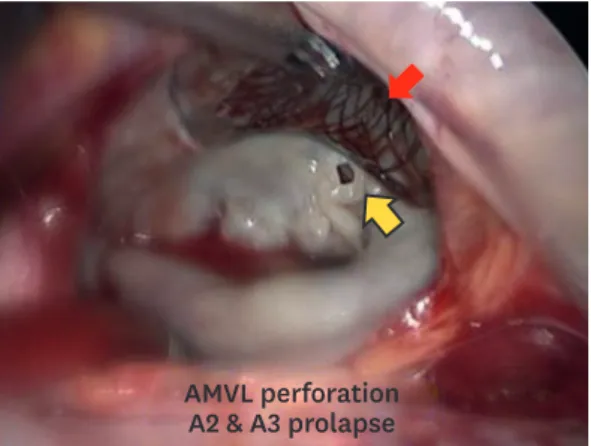
MICS was decided on because of the relatively young age of the patient. Surgical inspection revealed the presence of diffuse prolapsed anterior mitral leaflet and a tear in the basal area of the medial scallop of the anterior mitral leaflet (Figure 2). Repair was accomplished through Korean Circ J. 2019 Nov;49(11):1112-1113
https://doi.org/10.4070/kcj.2019.0244 pISSN 1738-5520·eISSN 1738-5555
Images in
Cardiovascular Medicine
Received: Jul 24, 2019 Revised: Aug 22, 2019 Accepted: Sep 11, 2019 Correspondence to Kyung-Hee Kim, MD, PhD
Division of Cardiovascular Disease, Sejong General Hospital, 28, Hohyeon-ro 489beon-gil, Bucheon 14754, Korea.
E-mail: [email protected] Copyright © 2019. The Korean Society of Cardiology
This is an Open Access article distributed under the terms of the Creative Commons Attribution Non-Commercial License (https://
creativecommons.org/licenses/by-nc/4.0) which permits unrestricted noncommercial use, distribution, and reproduction in any medium, provided the original work is properly cited.
ORCID iDs Jae Suk Yoo
https://orcid.org/0000-0002-7008-054X Kyung-Hee Kim
https://orcid.org/0000-0003-0708-8685 Conflict of Interest
The authors have no financial conflicts of interest.
Author Contributions
Conceptualization: Kim KH; Data curation: Yoo JS, Kim KH; Visualization: Yoo JS; Writing - original draft: Kim KH.
Jae Suk Yoo , MD, PhD
1and Kyung-Hee Kim , MD, PhD
21
Department of Thoracic and Cardiovascular Surgery, Sejong General Hospital, Bucheon, Korea
2
Division of Cardiovascular Disease, Sejong General Hospital, Bucheon, Korea
Images of Mitral Valve Perforation due to Atrial Septal Occluder Device
Figure 1. Transesophageal echo showed the atrial septal occluder attached to the anterior mitral leaflet. Yellow
arrow indicates the perforated anterior mitral leaflet. Red arrow indicates atrial septal defect closure device.
direct suture concomitant with the removal of the device and atrial septum closure with a Gore-Tex cardiovascular patch.
SUPPLEMENTARY MATERIAL
Supplementary Video 1
Apical 4 chamber view color Doppler image. Moderate to severe mitral regurgitation was observed beside atrial septal defect closure device.
Click here to view
REFERENCES
1. Moore J, Hegde S, El-Said H, et al. Transcatheter device closure of atrial septal defects: a safety review.
JACC Cardiovasc Interv 2013;6:433-42.
PUBMED | CROSSREF
2. Masura J, Gavora P, Podnar T. Long-term outcome of transcatheter secundum-type atrial septal defect closure using Amplatzer septal occluders. J Am Coll Cardiol 2005;45:505-7.
PUBMED | CROSSREF
3. Mishaly D, Ghosh P, Preisman S. Minimally invasive congenital cardiac surgery through right anterior minithoracotomy approach. Ann Thorac Surg 2008;85:831-5.
PUBMED | CROSSREF