• 검색 결과가 없습니다.

Large Atrial Septal Defect Closure in a Patient with Severe Pulmonary Arterial Hypertension

N/A
N/A
Protected

Academic year: 2021

Share "Large Atrial Septal Defect Closure in a Patient with Severe Pulmonary Arterial Hypertension"

Copied!
4
0
0

로드 중.... (전체 텍스트 보기)

전체 글

(1)

ISSN: 2233-601X (Print) ISSN: 2093-6516 (Online)

− 378 −

Received: April 12, 2017, Revised: June 5, 2017, Accepted: June 13, 2017, Published online: October 5, 2017

Corresponding author: Supomo Supomo, Department of Surgery, Faculty of Medicine, Dr. Sardjito General Hospital, Universitas Gadjah Mada, Sleman, Yogyakarta 55281, Indonesia

(Tel) 62-858-8072-8100 (Fax) 62-274-581333 (E-mail) [email protected]

© The Korean Society for Thoracic and Cardiovascular Surgery. 2017. All right reserved.

This is an open access article distributed under the terms of the Creative Commons Attribution Non-Commercial License (http://creativecommons.org/

licenses/by-nc/4.0) which permits unrestricted non-commercial use, distribution, and reproduction in any medium, provided the original work is properly cited.

Fig. 1. Simple chest X-ray showing cardiomegaly and a dilated pulmonary trunk.

Large Atrial Septal Defect Closure in a Patient with Severe Pulmonary Arterial Hypertension

Supomo Supomo, M.D., Ph.D. 1 , Anggoro Budi Hartopo, M.D., Ph.D. 2 , Dyah Wulan Anggrahini, M.D., Ph.D. 2 , Handy Darmawan, M.D. 1 ,

Lucia Kris Dinarti, M.D., Ph.D. 2

1

Thoracic and Cardiovascular Surgery Division, Department of Surgery and

2

Department of Cardiology and Vascular Medicine, Dr. Sardjito General Hospital, Universitas Gadjah Mada

Patients with an atrial septal defect (ASD) and severe pulmonary arterial hypertension (PAH) are considered ineligible for defect closure surgery because of the risk of right ventricular decompensation and death after the operation. We report the case of a patient with large ASD and severe PAH who was able to undergo defect closure surgery successfully following long-term use of combined oral sildenafil and beraprost.

Key words: 1. Atrial heart septal defects 2. Beraprost

3. Congenital heart disease 4. Pulmonary hypertension 5. Sildenafil citrate

Case report

A 32-year-old female patient with a 5-year history of exertional dyspnea was referred to to Dr. Sardjito General Hospital. She presented with New York Heart Association (NYH A) class III exertional dyspnea with- out orthopnea or paroxysmal nocturnal dyspnea. Her vital signs were as follows: blood pressure, 100/60 mm Hg; heart rate, 90 beats per minute; and respira- tory rate, 20 breaths per minute. Right ventricular heave and a wide, fixed, split S2 at the pulmonary valve area were found on a physical examination.

Her walking distance was 357 m during a 6-minute walk test. A simple chest X-ray showed cardiomegaly and a dilated pulmonary trunk (Fig. 1). Electrocardio- graphy revealed normal sinus rhythm with right axis deviation and right ventricular hypertrophy.

Korean J Thorac Cardiovasc Surg 2017;50:378-381 □ CASE REPORT □

https://doi.org/10.5090/kjtcs.2017.50.5.378

(2)

Defect Closure for Pulmonary Hypertension

− 379 −

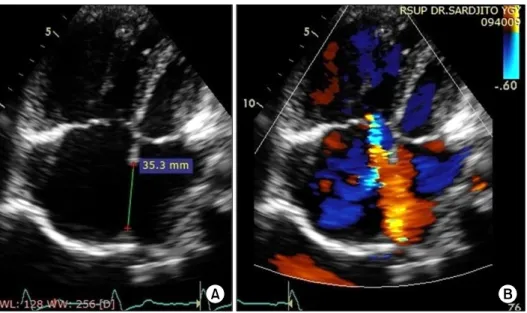
Fig. 2. (A, B) Transthoracic echo- cardiogram showing a large tissue defect of 35 mm, with a bidirec- tional shunt through the interatrial septum.

Transthoracic echocardiography (TTE) showed a large, 35-mm defect in the interatrial septum with a predominantly left-to-right bidirectional shunt (Fig. 2).

The right ventricle and right atrium were markedly dilated, with a D-shaped left ventricle showing a nor- mal ejection fraction and contractility. Cardiac cathe- terization indicated severe pulmonary arterial hyper- tension (PAH), with a mean pulmonary artery pres- sure (mPAP) of 77 mm Hg, baseline pulmonary vas- cular resistance (PVR) of 4 Wood units, and a sys- temic oxygen saturation level of 94%. Based on these findings, closure of the atrial septal defect (ASD) was not performed. Instead, medical treatment using oral sildenafil was started to reduce mPAP and PVR.

One year after starting the sildenafil therapy, the NYHA functional class of the patient improved from class III to II. The mPAP decreased from 77 to 50 mm Hg and was down to 44 mm Hg after a vaso- dilator test. In addition, PVR increased from 4 to 4.6 Wood units. We decided to add oral beraprost ther- apy to the patient’s regimen. After 1 year of treat- ment using both oral sildenafil and beraprost, her symptoms and exercise tolerant were maintained at NYH A class II. She was able to walk 400 m during the 6-minute walk test and had a good oxygen satu- ration level of 97% at room air. The oxygen satu- ration level decreased slightly to 92% after the 6-mi- nute walk test.

A follow-up TTE showed a reduction of mPAP from 50 to 38 mm Hg with a baseline PVR of 2.52 Wood units. Therefore, we decided to perform ASD

closure surgery. After the surgery, the patient was given oral sildenafil; the dosage was 20 mg 3 times daily during the first month, and then reduced to 20 mg twice daily and once daily during the second and fourth month, respectively.

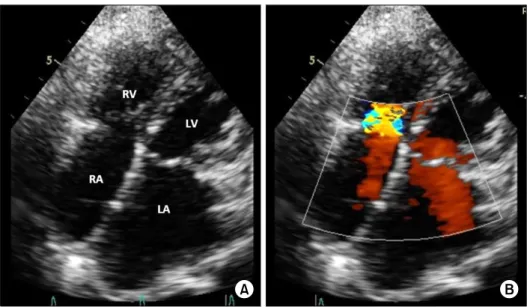
Four months after surgery, the patient’s symptoms and exercise tolerance improved from NYHA class II to I. She was able to walk 439 m during the 6-mi- nute walk test. No residual leakage was observed on the follow-up TTE. The diameters of the right atrium and right ventricle decreased from 55 to 19 mm and 53 to 24 mm, respectively, with normal contractility (Fig. 3). She was successfully weaned off sildenafil over a period of 6 months after surgery.

Discussion

Patients with ASD and an uncorrected left-to-right shunt are at risk for developing PAH. Persistent ex- posure to increased blood flow and pressure leads to vascular remodeling and dysfunction, resulting in a progressive rise of PVR and mPAP [1]. Patients with PAH have mPAP ≥25 mm Hg at rest or ≥30 mm Hg with exercise, pulmonary capillary wedge pres- sure ≤15 mm Hg, and PVR >3 Wood units. Mild, moderate, and severe PAH are defined by a mPAP between 25 and 45 mm Hg, between 46 and 65 mm Hg, and >65 mm Hg, respectively [2].

In patients with shunt-related PAH, the current

practice is to perform a pulmonary vasodilator test

to assess its reversibility. A decrease in mPAP or

(3)

Supomo Supomo, et al

− 380 −

Fig. 3. (A, B) Transthoracic echo- cardiogram showing no residual leakage with normal RA, RV, LA, and LV diameters. RA, right atrium;

RV, right ventricle; LA, left atrium;

LV, left ventricle.

PVR that is less than 20% after a pulmonary vaso- dilator test indicates irreversible PAH [3]. Patients with severe or irreversible PAH are considered in- eligible for defect closure, as the procedure is asso- ciated with a decrease in cardiac output, an increase in right-sided heart failure, and death in such pa- tients [4,5].

The use of nonselective vasodilators that specifi- cally target pulmonary vasodilation was reported to have a beneficial effect in patients with secondary PAH related to cardiac shunts [6,7]. Schwerzmann et al. [4] and Jung et al. [5] used 1-year intravenous prostacyclin and oral bosentan therapy, respectively, to treat ASD patients with less severe PAH. These patients showed clinical improvement after shunt clo- sure following long-term vasodilator therapy. Our case illustrates that a similar result might be ach- ieved in patients with more severe PAH if initially treated with sildenafil for 2 years and beraprost for an additional 1 year.

Sildenafil is a selective and potent inhibitor of phosphodiesterase type 5 that specifically degrades cyclic guanosine monophosphate in the pulmonary artery, which then acts to mediate smooth muscle re- laxation of the vessel. Three randomized controlled trials demonstrated the safety and efficacy of sildena- fil in improving mPAP, PVR, the cardiac index, and exercise tolerance in patients with PAH [7]. However, in our case, sildenafil alone was insufficient to re- duce mPAP and to affect the reversibility of PAH.

The mPAP remained moderately high and the PAH

remained irreversible (<20% reduction of mPAP) af- ter the vasodilator test and 1 year of therapy with oral sildenafil alone.

A systematic review demonstrated the effectiveness of a nonintravenous prostanoid (beraprost) in re- ducing the mortality of patients with severe PAH [6].

In our case, oral beraprost was combined with silde- nafil, resulting in a marked reduction of mPAP and PVR. The value of PVR was within the normal range (<3 Wood units) and mPAP slightly increased [2].

The distance for the 6-minute walk test increased to the normal range of 380–782 m [8]. A follow-up 4 months after surgery showed a remarkable improve- ment of symptoms and exercise tolerance, from NYHA class II to I, with a walking distance of 439 m during the 6-minute walk test. No residual leakage was observed on the follow-up TTE. Furthermore, the function and diameter of the right atrium and right ventricle became normal (Fig. 3).

In conclusion, long-term combined sildenafil and beraprost therapy may offer the opportunity for ASD closure in situations where it was not previously considered feasible. This result also suggests that this therapy can be effective in the treatment of patients with shunt-related PAH.

Conflict of interest

No potential conflict of interest relevant to this ar-

ticle was reported.

(4)

Defect Closure for Pulmonary Hypertension

− 381 −

Acknowledgments

We certify that this report is our own work and all source of information used in this report have been fully acknowledged.

References

1. D’Alto M, Mahadevan VS. Pulmonary arterial hypertension associated with congenital heart disease. Eur Respir Rev 2012;21:328-37.

2. Oliveira EC, Amaral CF, Moura MA, Campos FT, Pauperio HM. Testing pulmonary vasoreactivity. J Bras Pneumol 2008;34:838-44.

3. Tonelli AR, Alnuaimat H, Mubarak K. Pulmonary vaso- dilator testing and use of calcium channel blockers in pul- monary arterial hypertension. Respir Med 2010;104:481-96.

4. Schwerzmann M, Zafar M, McLaughlin PR, Chamberlain DW, Webb G, Granton J. Atrial septal defect closure in a patient with “irreversible” pulmonary hypertensive arteriopathy. Int J Cardiol 2006;110:104-7.

5. Jung IH, Lee SY, Lee SJ, et al. Device closure of a large at- rial septal defect in a patient with severe pulmonary arte- rial hypertension after 1 year use of an oral endothelin re- ceptor antagonist. J Cardiovasc Ultrasound 2013;21:140-4.

6. Ryerson CJ, Nayar S, Swiston JR, Sin DD. Pharmacotherapy in pulmonary arterial hypertension: a systematic review and meta-analysis. Respir Res 2010;11:12.

7. Barnett CF, Machado RF. Sildenafil in the treatment of pulmonary hypertension. Vasc Health Risk Manag 2006;2:

411-22.

8. Casanova C, Celli BR, Barria P, et al. The 6-min walk dis-

tance in healthy subjects: reference standards from seven

countries. Eur Respir J 2011;37:150-6.

수치

Fig. 1. Simple chest X-ray showing cardiomegaly and a dilated  pulmonary trunk.
Fig. 2. (A, B) Transthoracic echo- echo-cardiogram showing a large tissue  defect of 35 mm, with a  bidirec-tional shunt through the interatrial  septum.
Fig. 3. (A, B) Transthoracic echo- echo-cardiogram showing no residual  leakage with normal RA, RV, LA,  and LV diameters

참조

관련 문서

161 with operation and transient use of oral bosentan. ASD is most common congenital heart disease in adults. PAH can occur as a result of chronic exposure of the pulmo- nary vessels

However, we preferred surgical treatment in large ASD with severe TR (grade IV), thus further investigation for these patients is still needed... PAH assessed by

The absolute contraindication for transcatheter closure of ASD is mitral rim deficiency because of mitral valve touching/erosion and the defect more than 40 mm. Also, the

The term pulmonary arterial hypertension (PAH) describes a subpopulation of patients with pulmonary hypertension (PH) characterized hemodynamically by the presence of pre-capillary

Erratum to: Small Left Atrial Size Complicating Percutaneous Transcatheter Device Closure of Secundum Atrial Septal Defect with Conventional Approach. Hong Ki Ko, MD 1 , So

The different deployment method in atrial septal defect (ASD) patients with central defect and anterosuperior (AS) rim defect. With sufficient rims, 87% of procedure was

Fistula of Ascending Aorta and Right Atrium Following Percutaneous Transcatheter Atrial Septal Defect Closure.. Hong Gook Lim, M.D.*, Chang-Ha Lee, M.D.*, Hong Joo Seo,

Airway = suspect airway problem, APVC = unrepaired anomalous pulmonary venous connection, ASD = unrepaired atrial septal defect, CCT = cardiac computed tomography, Coronary =