• 검색 결과가 없습니다.

Embolization of the Device to the Left Pulmonary Artery after the Interventional Closure of Ruptured Sinus of Valsalva Aneurysm

N/A
N/A
Protected

Academic year: 2021

Share "Embolization of the Device to the Left Pulmonary Artery after the Interventional Closure of Ruptured Sinus of Valsalva Aneurysm"

Copied!
4
0
0

로드 중.... (전체 텍스트 보기)

전체 글

(1)

ISSN: 2233-601X (Print) ISSN: 2093-6516 (Online)

− 202 − Department of Cardiothoracic Surgery, Christian Medical College and Hospital

Received: December 3, 2014, Revised: February 26, 2015, Accepted: March 3, 2015, Published online: June 5, 2015

Corresponding author: Choudhry Lalit, Department of Cardiothoracic Surgery, Christian Medical College Hospital, Vellore-632004, Tamil Nadu, India

(Tel) 91-99-4464-2729 (Fax) 91-41-6223-2035 (E-mail) [email protected]

C

The Korean Society for Thoracic and Cardiovascular Surgery. 2015. All right reserved.

CC

This is an open access article distributed under the terms of the Creative Commons Attribution Non-Commercial License (http://creative- commons.org/licenses/by-nc/4.0) which permits unrestricted non-commercial use, distribution, and reproduction in any medium, provided the original work is properly cited.

Embolization of the Device to the Left Pulmonary Artery after the Interventional Closure of Ruptured Sinus of Valsalva Aneurysm

Lalit Kumar Choudhry, M.Ch., Vinay M Rao, M.Ch., Birla Roy Gnanamuthu, M.Ch., Vishal Agrawal, M.S., Ravi Shankar, M.Ch., Ram Prasath, M.Ch.

Formation of an aneurysm in the sinus of Valsalva of the aortic root is usually due to an area of congenital weakness in its wall. This aneurysm may progressively dilate and rupture into any of the cardiac chambers or into the pericardial cavity. Though this is conventionally treated by surgery, interventional therapy using various closure devices is becoming more common. Embolization of these closure devices may occur. We report a case of embo- lization of such a device into the left pulmonary artery which during surgical retrieval, unmasked the hidden ven- tricular septal defect (VSD). Therefore one has to be cautious while making a diagnosis of rupture of the sinus of Valsalva of right coronary sinus without VSD.

Key words: 1. Aneurysm 2. Device

3. Pulmonary artery 4. Rupture

CASE REPORT

Rupture of the sinus of Valsalva (RSOV) is conventionally treated by surgery [1]. Interventionalists have recently experi- enced success in closing these defects using devices designed to close atrial septal defects or a patent ductus [2,3]. Several complications of this procedure, including embolization of the devices to the descending aorta, are well documented. We re- port a case of embolisation of a device used to close a RSOV into the left pulmonary artery with concomitant un- masking of a hidden ventricular septal defect (VSD), which had not been identified before the procedure.

A 44-year-old man presented with complaints of dyspnoea and palpitation on exertion. An examination demonstrated cardiomegaly and a continuous murmur at the left third inter-

costal space. An electrocardiogram showed left ventricular hy- pertrophy, and echocardiography showed a dilated aortic root.

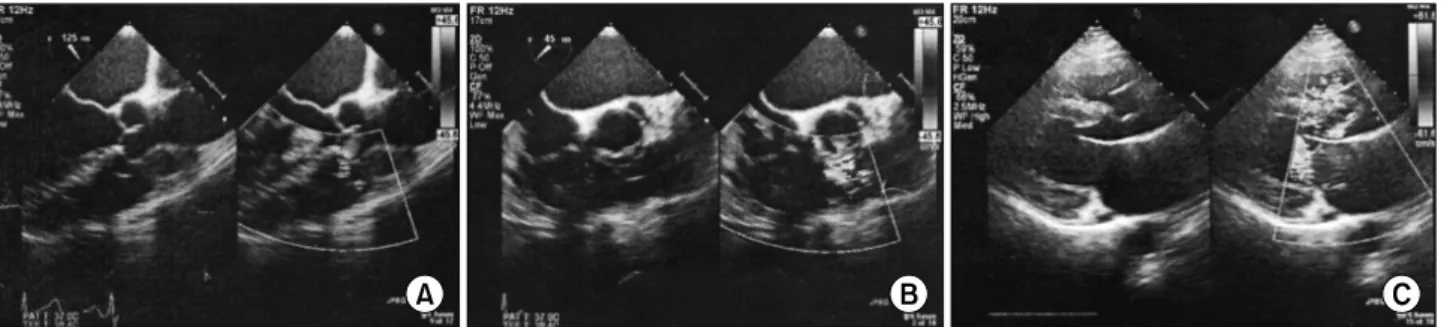
A colour Doppler examination showed a high-velocity jet originating from the right coronary sinus (RCS) of the aorta and entering the right ventricular outflow tract (RVOT) (Fig.

1). When cardiac catheterisation was performed, the aorto- gram showed the contrast passing freely from the RCS into the RVOT. No VSDs were visualised, and the pulmonary ar- tery pressure was normal.

A diagnosis of a RSOV aneurysm without VSD was made.

An attempt was made to close the defect with a 16/14 size Lifetech patent ductus arteriosus closure device (Lifetech Scientific Co. Ltd., Shenzhen, China). After successful de- ployment, accurate positioning of the device was confirmed by an aortogram (Fig. 2) and an echocardiogram.

Korean J Thorac Cardiovasc Surg 2015;48:202-205 □ Case Report □

http://dx.doi.org/10.5090/kjtcs.2015.48.3.202

(2)

Embolization of Sinus of Valsalva Closure Device

− 203 −

Fig. 3. A chest X-ray suggestive of the embolised device in the left pulmonary artery. Inset: the retrieved occluder device.

Fig. 4. A fluoroscopic image indicating the presence of the em- bolised device in the left pulmonary artery.

Fig. 2. An aortogram showing a ductus-occluding device deployed in the ruptured right coronary sinus aneurysm. Inset: outline dia- gram of aortogram. RCC, right coronary cusp.

Fig. 1. Preoperative echocardiographic images of RSOV to the RVOT. (A) RSOV to RVOT. (B) RSOV in aortic short-axis view. (C) Parasternal long-axis view. RSOV, rupture of the sinus of Valsalva; RVOT, right ventricular outflow tract.

Three days after the procedure, the patient began to experi- ence cough and dyspnoea. A chest X-ray (Fig. 3) and fluoro- scopy (Fig. 4) revealed embolisation of the device into the left pulmonary artery. Fluoroscopy-guided percutaneous de- vice retrieval was unsuccessful, and the patient was taken for emergency surgical retrieval of the displaced prosthesis.

At surgery, the pulmonary artery was noticed to be tense and dilated to twice the size of the aorta. The RCS was aneurysmal, had ruptured, and was prolapsing through a 15-mm VSD into the RVOT. The device was palpable, wedged in the left pulmonary artery just beyond the origin of the anterior artery branch. A pulmonary arteriotomy was per- formed and the device was retrieved.

The aneurysm was excised and both this defect and the

VSD were closed using a patch of Dacron fabric. The patient

recovered uneventfully from the operation and was discharged

(3)

Lalit Kumar Choudhry, et al

− 204 −

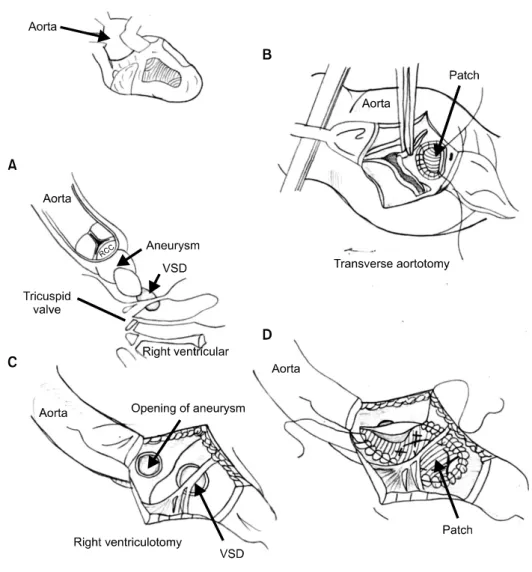
Fig. 5. Anatomical details of the rupture of the sinus of Valsalva. VSD, ventricular septal defect.

on the seventh postoperative day.

DISCUSSION

The sinuses of Valsalva at the root of the aorta may be- come aneurysmal, forming thin-walled saccular or tubular outpouchings. Such defects are mostly congenital and com- prise 0.15%–0.24% of congenital cardiac anomalies [4,5].

They are usually located in the right coronary sinus (75%–

90%) or the noncoronary sinus (10%–25%), and rarely in the left coronary sinus [1]. These aneurysms have been shown to develop in a weak area between the aortic annulus fibrosa and media, which emerges due to the failure of the distal bulbar septum to fuse with the truncal ridges [5].

In addition to a congenital aetiology, these aneurysms may occur secondary to trauma, infective endocarditis, or tertiary

syphilis. Iatrogenic injuries to the sinuses during VSD closure or during debridement of a calcified aortic or mitral valve may also result in aneurysm formation.

Sinus of Valsalva aneurysms (SVA) are often associated with other congenital defects, most commonly VSD and aort- ic regurgitation [1]. RCS aneurysms are more frequently asso- ciated with VSDs than non-coronary sinus aneurysms. Other anomalies are also known to co-occur with SVA, such as pulmonary stenosis, atrial septal defects, bicuspid aortic valve, patent ductus arteriosus, coarctation of the aorta, and sub- aortic stenosis [1,4].

The aneurysm and rupture of the coronary sinuses may oc-

cur at any age, with a male preponderance [1]. The aneur-

ysmal pouch usually has an intra-cardiac course, but may pro-

trude into the pericardial space. An aneurysm can simulta-

neously rupture into more than one site. Most RCS aneurysms

(4)

Embolization of Sinus of Valsalva Closure Device

− 205 − rupture into the right ventricle (73%), while most non-coro- nary sinus aneurysms rupture into the right atrium (86%) (Fig.

5) [1]. Aneurysms can rarely rupture into the left ventricle, left atrium, pulmonary artery, or the pericardial cavity.

Clinical symptoms of RSOV include the sudden onset of dyspnoea, chest pain, palpitation, fatigue, or orthopnoea due to a significant left-to-right shunt [4]. The rupture and its symptoms are generally precipitated by exertion. Echocardio- graphy is the gold standard for the diagnosis of RSOV and the identification of other co-existing congenital anomalies [5]. Catheterisation is carried out in patients who require an evaluation of their coronary artery anatomy or if an interven- tional procedure is planned [1]. In this patient, a VSD was missed on an echocardiogram and on cardiac catheterisation, probably due to the large aneurysmal RCS that completely obstructed the VSD. Our patient underwent device closure since the VSD was not visualised. Therefore, one must be cautious when diagnosing RSOV of the RCS without VSD.

Patients with RSOV are best treated expediently [1]. Surgery is the conventional method of treatment, having a <4% mor- tality rate and good long-term results [4]. However, recur- rences have been reported [3]. Non-ruptured SVAs requiring surgical intervention include those in patients with VSD, ven- tricular arrhythmia, infection, coronary ostial obstruction, RVOT obstruction, severe AR, and extra-cardiac SVA [4].

The era of catheter-based device closure of RSOV began in 1994 with Cullen et al. [3] successfully deploying a modified Rashkind umbrella device to close an RSOV. Since then, many other occluder devices have been utilised, with overwhelmingly favourable results [2]. Catheter-based procedures are currently considered to be the treatment of choice. Interventional proce- dures are particularly beneficial in the presence of previous sternotomy, recurrence, or severe co-morbidities [2].

The size of the device used for RSOV closure must be ac- curately assessed, since a large device may interfere with cor- onary blood flow or aortic valve cusp movement. However, a device of suboptimal size might dislodge and embolise, or re- sult in a significant residual shunt.

Success rates up to 90% have been reported in cathe- ter-based closures. Complications, although rare, include car- diac perforation, fistula formation, thrombosis, and device em- bolisation into the systemic or pulmonary circulation. These

complications result in acute symptoms and haemodynamic compromise, requiring urgent surgical retrieval.

Post-deployment follow-up includes the assessment of coro- nary blood flow, aortic valve function, and the presence of thromboembolism. After the deployment of a device, a short course of anticoagulants or antiplatelet drugs is recommended to prevent thromboembolism until the endothelialisation of the device occurs [3]. The risk of infective endocarditis is un- known, and hence the need for life-long antibiotic prophy- laxis is debatable [3].

In conclusion, RSOV, which is conventionally treated by surgery, is currently being successfully treated using occluder devices. As more centres take up such interventional proce- dures, varied complications are being reported. Despite the rapidly growing enthusiasm for the catheter-based device clo- sure of RSOV, we should be aware of the fact that VSDs can be missed before the procedure. We report a case of the embolisation of a device used to close a RSOV into the left pulmonary artery.

CONFLICT OF INTEREST

No potential conflict of interest relevant to this article was reported.

REFERENCES

1. Moustafa S, Mookadam F, Cooper L, et al. Sinus of Valsalva aneurysms: 47 years of a single center experience and systematic overview of published reports. Am J Cardiol 2007;99:1159-64.

2. Sen S, Chattopadhyay A, Ray M, Bandyopadhyay B.

Transcatheter device closure of ruptured sinus of Valsalva:

immediate results and short term follow up. Ann Pediatr Cardiol 2009;2:79-82.

3. Cullen S, Somerville J, Redington A. Transcatheter closure of a ruptured aneurysm of the sinus of Valsalva. Br Heart J 1994;71:479-80.

4. Takach TJ, Reul GJ, Duncan JM, et al. Sinus of Valsalva aneurysm or fistula: management and outcome. Ann Thorac Surg 1999;68:1573-7.

5. Shah RP, Ding ZP, Ng AS, Quek SS. A ten-year review of

ruptured sinus of valsalva: clinico-pathological and echo-

Doppler features. Singapore Med J 2001;42:473-6.

수치

Fig. 3. A chest X-ray suggestive of the embolised device in the  left pulmonary artery
Fig. 5. Anatomical details of the  rupture of the sinus of Valsalva. VSD,  ventricular septal defect.

참조

관련 문서

MP Yousef Al-Fadalah, Supervisor of Parliament Business Environment Committee declared that the Public Institution for Housing Care intends to dedicate nearly 150

Due to the heavy downpours during the coming few hours, and anticipations of Meteorological Department that weather fluctuation shall continue, it has been decided

Kuwait Direct Investment Promotion Authority (KDIPA) said the 2019 Doing Business Report of the World Bank Group, came in recognition of the reforms made between June 2, 2017, and

The main objective of the Bi Regional Center for SMES Development is oriented towards generating the conditions of cooperation among the countries which

Current Tokyo is rich in green compared to other metro cities. In some parts, the greenery has been contributed by the many inherited gardens from the Edo era to today which

In a statement to Kuwait News Agency (KUNA) on the sidelines of a meeting of the Arab Parliament's Foreign Affairs Political and National Security

The meeting was attended by Assistant Foreign Minister for GCC Affairs, Ambassador, Nasser Al-Muzayyen, and Deputy Assistant Foreign Minister for the Office of the

“ Sheikh Nasser has a written message from HH the Amir, Sheikh Sabah Al-Ahmad Al-Jaber Al-Sabah to the Chinese President, Chi Gen Beng related to enhancing mutual