• 검색 결과가 없습니다.

Emergent Surgical Intervention for Embolization of Atrial Septal Defect Closure Device

N/A
N/A
Protected

Academic year: 2021

Share "Emergent Surgical Intervention for Embolization of Atrial Septal Defect Closure Device"

Copied!
3
0
0

로드 중.... (전체 텍스트 보기)

전체 글

(1)

Korean J Thorac Cardiovasc Surg 2012;45:320-322 □ Case Report □ http://dx.doi.org/10.5090/kjtcs.2012.45.5.320 ISSN: 2233-601X (Print) ISSN: 2093-6516 (Online)

− 320 −

Departments of

1

Thoracic and Cardiovascular Surgery,

2

Cardiology, Hanyang University College of Medicine Received: March 26, 2012, Revised: May 12, 2012, Accepted: May 19, 2012

Corresponding author: Young Hak Kim, Department of Thoracic and Cardiovascular Surgery, Hanyang University Seoul Hospital, Hanyang University College of Medicine, 222 Wangsimni-ro, Seongdong-gu, Seoul 133-791, Korea

(Tel) 82-2-2290-8469 (Fax) 82-2-2290-8470 (E-mail) [email protected]

C

The Korean Society for Thoracic and Cardiovascular Surgery. 2012. All right reserved.

CC

This is an open access article distributed under the terms of the Creative Commons Attribution Non-Commercial License (http://creative- commons.org/licenses/by-nc/3.0) which permits unrestricted non-commercial use, distribution, and reproduction in any medium, provided the original work is properly cited.

Fig. 1. Transthoracic echocardiography shows secundum atrial septal defect (arrow).

Emergent Surgical Intervention for Embolization of Atrial Septal Defect Closure Device

Young Hak Kim, M.D.

1

, Hyuck Kim, M.D.

1

, Sung Jin Kim, M.D.

1

, Jeong Ho Kang, M.D.

1

, Won-Sang Chung, M.D.

1

, Jin-Ho Shin, M.D.

2

, Young-Hyo Lim, M.D.

2

The percutaneous transcatheter closure of secundum atrial septal defect has recently become an increasingly wide- spread alternative to surgical closure in many centers. Although immediate, short, and intermediate term results of percutaneous transcatheter septal closure are promising, the procedure is not free from inherent complications that could be lethal. We report a case of device embolization necessitating emergent surgical retrieval.

Key words: 1. Heart septal defects, atrial 2. Transcatheter closure 3. Device embolization

CASE REPORT

Fifty-year-old woman was admitted with known atrial sep- tal defect (ASD) that was diagnosed 1 year ago. She com- plained of dyspnea on exertion and mild general weakness.

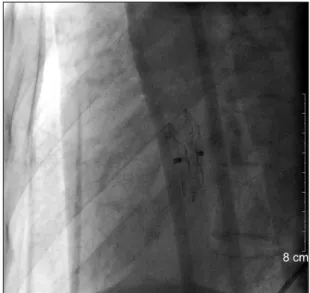
Transthoracic echocardiography demonstrated a 1.8 cm-sized secundum ASD with a large left-to-right shunt (Qp/Qs=2.0) seen by color flow Doppler. Retrospectively, it appeared that the anterosuperior rim of the defect was not well developed (Fig. 1). Percutaneous transcatheter septal closure (PTSC) was then scheduled. In the cardiac catheterization laboratory, the ASD was measured to be 18 mm in diameter with a balloon under fluoroscopic guidance using a 6-French (6F) sheath through the right femoral vein after induction of general anesthesia. An Amplatzer septal occluder (18 mm) was deliv- ered through delivery sheath (10F) to the left atrium, and de- ployed successfully. The position of the device was con- firmed by transesophageal echocardiography (TEE) and fluo-

roscopic Imaging (Fig. 2). The patient was hemodynamically stable.

The follow-up echocardiogram on the next day after PTSC

revealed disappearance of the device at the atrial septal re-

(2)

Embolization of Atrial Septal Defect Closure Device

− 321 − Fig. 2. Fluoroscopic image after percutaneous transcatheter septal closure.

Fig. 3. Follow-up echocardiography performed the day after percu- taneous transcatheter septal closure. The device was observed in left ventricular outflow tract (arrow).

Fig. 4. Retrieved Amplatzer septal occluder device.

gion and the shunt flow through ASD was noted again. The device was observed at the left ventricular outflow tract (LVOT), but luckily there was no significant disturbance of blood flow (Fig. 3). The patient was emergently taken to the operating room. Cardiopulmonary bypass was initiated with aortic and bi-caval cannulation. Aorta was clamped and the heart was arrested with antegrade cardioplegia. Right atriot- omy was performed and the secundum ASD was found to be 2×1.5 cm in size. The anterosuperior rim of the ASD was absent. Some bruising was identified at the aortic root. The

Amplatzer septal occluder device was located in LVOT, be- neath the anterior leaflet of the mitral valve. The device was successfully retrieved through the mitral opening without damage to the valvular apparatus. Close examination of the retrieved specimen showed structural integrity of the device (Fig. 4). The ASD was closed with bovine pericardial patch.

The patient was weaned from cardiopulmonary bypass with- out difficulty. Intraoperative TEE demonstrated normal func- tion of both mitral and aortic valves. The patient was then discharged in good condition.

DISCUSSION

Although morbidity and mortality are extremely low in sur- gical repair of ASD, the advantages of the PTSC (including avoidance of cardiopulmonary bypass, reducing blood trans- fusion, shortening hospital stay, and early return to daily life) have led PTSC to become the primary treatment option for most patent foramen ovale (PFO) and secundum ASD in many centers [1].

Since the first implantation of Amplatzer septal occluder in

1997, this device is currently the most commonly used device

for percutaneous closure of ASD [2]. In spite of progressive

evolution of techniques and devices, this procedure has at-

tendant failure and complications. And not all secundum

ASDs are amenable to device closure.

(3)

Young Hak Kim, et al

− 322 − The reported complications of the ASD device include re- sidual shunt, device malposition, caval thrombosis, systemic or pulmonary embolization, erosion and perforation of the heart, thromboembolism, and atrial arrhythmia [3,4]. And the most important mechanism is poor patient selection or device selection. Device dislodgement can occur if the size of the defect greatly exceeds the waist diameter of the device. On the other hand, implantation of overly large device may cause erosion and perforation, especially when there is a deficient anterosuperior rim of the defect. The incidence of major com- plication is not well defined. One of the largest series of 2,800 secundum ASD closures using the Amplatzer septal oc- cluder reported 5 cases of cardiac erosion and 7 cases of de- vice embolization [5]. In a meta-analysis of PFO closure, ma- jor complications occurred in 1.5% of patients [6]. The risk factors for device embolization are large defect, large device, undersizing of device relative to the defect, inadequate defect rim to hold the device and mobility of device or atrial rim of tissue after device implantation. Moreover, inaccurate deploy- ment and failure to button the ASD or unbuttoning of the oc- cluder can also result in device embolization [4]. Most com- monly reported causes of device embolization are inadequate rim of the defect and undersized device. The PTSC criteria by Amin et al. [7] include a defect size less than 32 mm and the presence of at least 4 mm rim of atrial septal tissue sur- rounding the defect. In this case the cause of the device em- bolization was likely due to the fact that the device was less than securely positioned because of the deficient ante- rosuperior septal rim. The time of the occurrence of device embolization may vary. Mashman et al. [2] reported late em- bolization of the device that occurred 7 weeks after im- plantation and recommended avoidance of strenuous exercise for 6 months and close echocardiographic surveillance.

Application of the device to secundum ASD with deficient anterosuperior rim can be associated with other serious com- plications such as erosion and cardiac perforation. The bruises

on the aortic root found during surgical procedure were re- garded to be caused by device abrasion. If the device had been left at the atrial septum for longer periods of time with- out embolization it could have resulted in aorta to atrial fistu- la or free wall perforation of the atria resulting in tamponade.

A short or deficient anterosuperior rim should be considered as a risk factor for device embolization as well as aortic per- foration in PTSC.

In order to prevent these complications associated with PTSC, proper selection of patient and device is mandatory and surgical repair should remain the standard management for this variant of secundum ASD.

REFERENCES

1. Yuan YQ, Huang Q, Yu L, et al. Long-term follow up of in- terventional therapy of secundum atrial septal defect. Chin Med J (Engl) 2012;125:149-52.

2. Mashman WE, King SB, Jacobs WC, Ballard WL. Two cas- es of late embolization of Amplatzer septal occluder devices to the pulmonary artery following closure of secundum atrial septal defects. Catheter Cardiovasc Interv 2005;65:588-92.

3. Knott-Craig CJ, Goldberg SP. Emergent surgical retrieval of embolized atrial septal defect closure device. Ann Thorac Surg 2008;85:319-21.

4. Agarwal SK, Ghosh PK, Mittal PK. Failure of devices used for closure of atrial septal defects: mechanisms and management. J Thorac Cardiovasc Surg 1996;112:21-6.

5. Ueda H, Yanagi S, Nakamura H, et al. Device closure of at- rial septal defect: immediate and mid-term results. Circ J 2012;76:1229-34.

6. Hanzel GS. Complications of patent foramen ovale and at- rial septal defect closure devices. J Interv Cardiol 2006;19:

160-2.

7. Amin Z, Hijazi ZM, Bass JL, Cheatham JP, Hellenbrand

WE, Kleinman CS. Erosion of Amplatzer septal occluder de-

vice after closure of secundum atrial septal defects: review

of registry of complications and recommendations to mini-

mize future risk. Catheter Cardiovasc Interv 2004;63:496-502.

수치

Fig. 1. Transthoracic echocardiography shows secundum atrial  septal defect (arrow).
Fig. 3. Follow-up echocardiography performed the day after percu- percu-taneous transcatheter septal closure

참조

관련 문서

Ejectors is a fluid transportation device for which a principle is used that high-pressure fluid are spouted through driving pipe and the pressure

– General controls with Special controls AND Premarket Approval (PMA) – PMA approval requires the safety and effectiveness of the

In conclusion, ellipsis plays an important role in English discourse as a grammatical device for drawing the listener's attention to the focal information

The lateral size of the defect obtained from the deformation amount and the defect detection test using the shearing interferometer, width and depth of

• Channel : an open connection to hardware device, file, network, program component.. •

• If the earbuds do not connect to a mobile device, the connection pop-up window does not appear, or your mobile device cannot find the earbuds, store them in the charging

LoRa® Network Server – Open Source... LoRa® Network Server

1st association group – “Lifeline” reports the device status and al- lows for assigning single device only (main controller by default)4. 2nd association group –