• 검색 결과가 없습니다.

Migration of Atrial Septal Defect Closure Device due to Coughing

N/A
N/A
Protected

Academic year: 2021

Share "Migration of Atrial Septal Defect Closure Device due to Coughing"

Copied!
5
0
0

로드 중.... (전체 텍스트 보기)

전체 글

(1)

Corresponding Author: Chang Wook Nam, M.D., Department of Internal Medicine, Keimyung University School of Medicine 56 Dalseong-ro, Jung-gu, Daegu 700-712, Korea

Tel : +82-53-250-8015 E-mail : [email protected]

Introduction

Atrial septal defect (ASD) is one of the most common congenital heart disease in adults [1].

Percutaneous device closure of ASD has emerged as an alternative to traditional surgical closure [2].

The first percutaneous device closure of ASD was reported in 1974 [3]. Because percutaneous device closure has advantages including less surgical morbidity, avoidance of a scar and reduced

hospitalization duration compared with surgical closure [4], and amplatzer duct occluder (ADO) is very efficient in clinical studies reporting success rates of 94% [5], it is regarded as current standard treatment for secondum type of ASD throughout the world. However, several serious complications after procedure may be concluded in a fatal outcome, or it requires surgical intervention for the management of complication. We report a rare complication of migration of the ADO into the left

Abstract

Percutaneous device closure of atrial septal defect (ASD) has emerged as an alternative to traditional surgical closure. Percutaneous device closure has advantages including less surgical morbidity, avoidance of a scar and reduced hospitalization duration compared with surgical closure and high success rate. However, some complications after procedure require immediate surgery. We report a rare complication of migration of ASD occluder into the left ventricle due to coughing.

Key Words : Cough, Heart septal defect, Septal occlude device

Department of Internal Medicine, Pediatrics

1

, Thoracic and Cardiovascular Surgery

2

and Radiology

3

, Keimyung University School of Medicine, Daegu, Korea

Sang Woong Choi, M.D., Chang Wook Nam, M.D, Jae Pil Lee, M.D., Hyungseop Kim, M.D., Yeo Hyang Kim

1

, M.D., Jae Hyun Kim

2

, M.D.,

Kwang Sook Lee

2

, M.D., Byung Hak Rho

3

, M.D.

Migration of Atrial Septal Defect Closure Device due to Coughing

(2)

ventricle, one day after implantation.

Case Report

78 year-old women presented with dyspnea on exertion for 2 months. 4 years ago, she was diagnosed as secondum type of ASD. Although the d e f e c t w a s 2 . 2 5 c m b y t r a n s t h o r a c i c echocardiography (TTE), patient underwent with medical therapy in accordance with the decision of her family. Current clinical examination revealed a systolic murmur at the left upper sternal border.

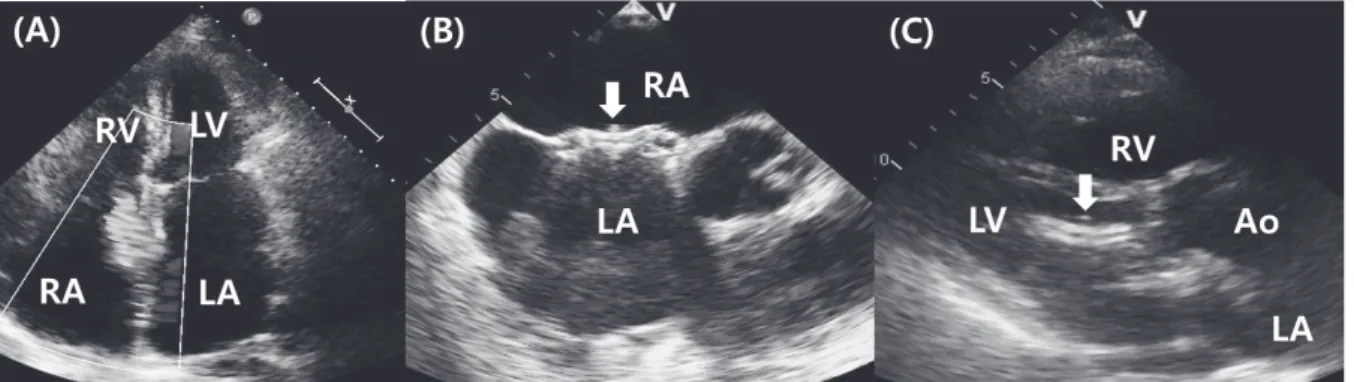
Electrocardiography revealed atrial fibrillation and right ventricular hypertrophy. Laboratory findings including white blood cell count, hemoglobin, platelet count, electrolyte, blood urea nitrogen and serum creatinine were unremarkable. TTE revealed a 2.29 cm secondum type of ASD with left to right shunt flow (Fig. 1A) and left atrial enlargement (7.24 cm) and moderate tricuspid regurgitation.

Percutaneous device closure of ASD was recommended to treat slowly progressive dyspnea.

T T E a n d C a r d i a c c o m p u t e d t o m o g r a p h y demonstrated sufficient rim length for device closure (Fig. 2A). Cardiac catheterization was performed and pulmonary-systemic flow ratio (Qp/Qs) was 3.23. Percutaneous device closure of

ASD was performed under general anesthesia.

Before implantation of the occluder, balloon sizing of the interatrial communication performed in 2 planes by both fluoroscopy and TEE. A 22 mm sized amplatz septal occlude was successfully deployed. No flow across the inter-atrial septum was observed on TEE (Fig. 1B). Chest X-ray, w h i c h wa s pe r f o r m e d im m e d i a t e l y a f te r procedure, revealed the adequate location of ADO.

She had no coughing before procedure. But she had recurrent severe coughing with foreign body sensation in the larynx at that night. Chest X-ray, performed at following day, showed migration of ADO. TTE confirmed the migration of the ADO into the left ventricle (Fig. 1C). Because the location of migrated ADO was not indicated for percutaneous removal, the patient was consulted to cardiac surgeon immediately for open heart operation. The device was removed out of left ventricle through aortotomy and secondum type of ASD direct closure was performed through right atriotomy without complication.

Discussion

Percutaneous device closure of ASD has been developed as alternative treatment to surgical

Fig. 1. (A) Secondum type ASD with left to right shunt flow. (B) successful deployment of ADO (arrow). (C) the

dislodgement of the ADO (arrow) into the left ventricle.

(3)

closure because it has high success rate, lesser morbidity, shorter hospital stay, lack of a scar, and comparable rate of complications [2,4]. However, serious complications after procedure may have a fatal outcome and require surgical treatment.

Reported complications include migration or embolization of the device, pericardial effusion, arrhythmias, thrombus formation on the device, vascular injury, and mitral regurgitation [3].

T h e m o s t c o m m o n c o m p l i c a t i o n o f percutaneous closure of ASD is device migration or embolization with incidence ranging from 4% to 21% [6,7]. The majority of device migration or embolization occurs during the procedure or within a day (Table 1). Therefore, particular attention should be paid during ADO procedure.

There are several reasons of acute device migration, such as a too large defect or a poor device selection (low ratio of device to defect), the inadequate experience of the operator with

inaccurate deployment, thin rim of atrial tissue, mobility of device post-implantation, and acute change in intracardiac pressure by physical stress [2,7,8].

Several cases with device migration were reported as the result from acute change in intracardiac pressure due to physical stress. In a usual physical stress, a sudden increase in afterload to the left heart in conjunction with diminished right heart filling (valsalva) may favored the migration of the device to the right and pulmonary artery. Therefore, avoidance from strenous exercise or heavy lifting was recommended for 6 months after procedure [9].

In our case, after waking up from general anesthesia, repeated severe cough was developed several hours later in the intensive care unit room.

TEE during procedure was likely to irritate her larynx. Unfortunately, ADO was detected in left ventricle, one day after the procedure confirmed Fig. 2. (A) Contrast-enhanced coronary CT scan. four-chamber CT image showed a large ostium secundum defect (arrow) in the region of the fossa ovalis. (B) three dimensional virtual endoscopic image demonstrated large atrial septal defect.

(A) (B)

(4)

by TTE. Most of dislocated devices migrated into the pulmonary artery [10], or right side heart as described in table 1. However, a few cases of systemic arterial embolization of ADO have been reported [2]. Suggested mechanism was that repeatedly coughing might raise intra-abdominal pressure and overloaded pressure in the right atrium might induce result in migration of the ADO into the left ventricle.

When ADO is embolized, percutaneous or surgical removal of the device is indicated [2]. In our case, percutaneous removal was not considered because of the orientation of the device in the left ventricle, just below the aortic valve, which can not be snared due to the risk of mitral valve injury and of systemic circulatory system embolization.

In conclusion, recurrent severe coughing can

raise right atrial pressure, which may cause migration and embolization of ADO early after procedure. Physicians and patients should be informed that recurrent coughing can induce this serious complication. After ASD closure with ADO, careful monitoring with follow up TTE should be checked routinely for detecting early dislocation of ADO or other complications.

References

1. Marelli AJ, Mackie AS, Ionescu-Ittu R, Rahme E, Pilote L. Congenital heart disease in the general population: changing prevalence and age distribution.

Circulation 2007;115:163-72.

2. Chessa M, Carminati M, Butera G, Bini RM, Drago M, Rosti L, et al. Early and late complications associated Table 1. ADO migrations and embolizations in previous and our reports

Year Author Age

(year) Sex ASD

size (mm) Location Time

(days) Treatment

2006 Constantinos et al [11] 11 M 25 LV 0 surgery

2007 Manoranjan et al [8] 18 M 24.5 PA 1 surgery

2008 Thomas bartel et al [12] 56 F 15 RA 180 surgery

2009 Stephan Schoof et al [13] 3.5 F 9.5 aorta 1 surgery

2009 Harvinder SD et al [14] 34 M 20 PA 1 surgery

2010 Kam TC et al [15] 23 F 35 RV 1 percutaneous

2010 Selcuk Para et al [16] 35 F 4 aorta 0 percutaneous

2011 Muneer MA et al [17] 16 F 32 RV 1 surgery

2011 Muneer MA et al [17] 53 F 15 aorta 0 surgery

2012 Durmus YS et al [18] 16 M 20 PA 90 surgery

2012 Jeng Wei et al [19] 43 M 5 RIA 0 surgery

2013 Current case 78 F 22 LV 1 surgery

ASD: atrial septal defect, LV: left ventricle, PA:pulmonary artery, RA: right atrium, RV: right ventricle,

RIA: right iliac artery.

(5)

with transcatheter occlusion of secundum atrial septal defect. J Am Coll Cardiol 2002;39:1061-5.

3. King TD, Mills NL. Nonoperative closure of atrial septal defects. Surgery 1974;75:383-8.

4. Berdat PA, Chatterjee T, Pfammatter JP, Windecker S, Meier B, Carrel T. Surgical management of complications after transcatheter closure of an atrial septal defect or patent foramen ovale. J Thorac Cardiovasc Surg 2000;120:1034-9.

5. Fischer G, Stieh J, Uebing A, Hoffmann U, Morf G, Kramer HH. Experience with transcatheter closure of secundum atrial septal defects using the Amplatzer septal occluder: a single centre study in 236 consecutive patients. Heart 2003;89:199-204.

6. Butera G, Carminati M, Chessa M, Youssef R, Drago M, Giamberti A, et al. Percutaneous versus surgical closure of secundum atrial septal defect: comparison of early results and complications. Am Heart J 2006;151:228-34.

7. Chiappini B, Gregorini R, Di Eusanio M, Ciocca M, Villani C, Minuti U, et al. Embolization of an Amplatzer atrial septal closure device to the pulmonary artery. J Card Surg 2008;23:164-7.

8. Misra M, Sadiq A, Namboodiri N, Karunakaran J. The 'aortic rim' recount: embolization of interatrial septal occluder into the main pulmonary artery bifurcation after atrial septal defect closure. Interact Cardiovasc Thorac Surg 2007;6:384-6.

9. Mashman WE, King SB, Jacobs WC, Ballard WL. Two cases of late embolization of Amplatzer septal occluder devices to the pulmonary artery following closure of secundum atrial septal defects. Catheter Cardiovasc Interv 2005;65:588-92.

10. Du ZD, Hijazi ZM, Kleinman CS, Silverman NH, Larntz K. Comparison between transcatheter and surgical closure of secundum atrial septal defect in children and adults: results of a multicenter nonrandomized trial. J Am Coll Cardiol 2002;39:1836-44.

11. Contrafouris CA, Chatzis AC, Giannopoulos NM, Milonakis M, Bobos D, Kirvassilis G, et al.

Emergency surgery for embolisation of Amplatzer device into the left atrium. Hellenic J Cardiol 2006;47:245-6.

12. Bartel T, Bonatti JO, Muller S. Device dislocation, probably due to paroxysmal coughing early after percutaneous closure of secundum type atrial septal defect. Am J Cardiol 2008;101:548-9.

13. Schoof S, Norozi K, Breymann T, Wessel A, Bertram H. Cough: a potentially life-threatening condition after interventional closure of atrial septal defect. Circ Cardiovasc Imaging 2009;2:e30-1.

14. Dod HS, Reddy VK, Bhardwaj R, Gudausky T, Warden BE, Beto RJ, et al. Embolization of atrial septal occluder device into the pulmonary artery: a rare complication and usefulness of live/real time three-dimensional transthoracic echocardiography.

Echocardiography 2009;26:739-41.

15. Chan KT, Cheng BC. Retrieval of an embolized amplatzer septal occluder. Catheter Cardiovasc Interv 2010;75:465-8.

16. Pala S, Acar G, Tigen K, Kirma C. Percutaneous retrieval of an interatrial septal occluder device embolized into the aortic arch. Turk Kardiyol Dern Ars 2010;38:502-4.

17. Amanullah MM, Siddiqui MT, Khan MZ, Atiq MA.

Surgical rescue of embolized amplatzer devices. J Card Surg 2011;26:254-8.

18. Sahin DY, Koc M, Cakir H, Arik OZ, Elbasan Z, Cayli M. A silent and late embolization of atrial septal defect occluder device into the right pulmonary artery: a case report. Korean Circ J 2012;42:781-3.

19. Wei J, Hsiung MC, Tsai SK, Yin WH, Ou CH, Donmez C, et al. Atrial septal occluder device embolization to an iliac artery: a case highlighting the utility of three-dimensional transesophageal echocardiography during percutaneous closure.

Echocardiography 2012;29:1128-31.

수치

Fig. 1. (A) Secondum type ASD with left to right shunt flow. (B) successful deployment of ADO (arrow)

참조

관련 문서

On his part, CEO of Express Roads Authority, Saud Al-Naqqi said that the heavy rains of the previous day led to clogging parts of the express

Kuwait will celebrate on Sunday the fourth anniversary of the UN honoring and proclamation of His Highness the Amir, Sheikh Sabah Al-Ahmad Al-Jaber Al-Sabah as

• 이명의 치료에 대한 매커니즘과 디지털 음향 기술에 대한 상업적으로의 급속한 발전으로 인해 치료 옵션은 증가했 지만, 선택 가이드 라인은 거의 없음.. •

The proposal of the cell theory as the birth of contemporary cell biology Microscopic studies of plant tissues by Schleiden and of animal tissues by Microscopic studies of

[r]

[r]

It considers the energy use of the different components that are involved in the distribution and viewing of video content: data centres and content delivery networks

3) ACC/AHA/ESC 2006 Guidelines for the Management of Patients with Atrial Fibrillation: a report of the American College of Cardiology/American Heart