CONTENTS
Ⅰ. INTRODUCTION
Ⅱ. MATERIALS AND METHODS
Ⅲ. RESULTS
Ⅳ. DISCUSSION
Ⅴ. CONCLUSIONS REFERENCES KOREAN ABSTRACT
Ⅰ. INTRODUCTION
Many clinician have observed for many years that there is a relationship between the psychological characteristics of certain patients and there courses of illness and responses to treatment.
1-5)Anxiety and depression of psychological factors were shown to be particularly discriminative in this regards, a finding that has found additional support in subsequent studies.
6-9)In studies concerned with the role of psychological factors in cancer, some investigators have entertained the hypothesis that psychological stress plays an etiological role in the development of neoplasia,
10)while others have assessed the possibility that psychological disorders, particularly
depression, are prodromal signs of neoplastic disease.
11-14)Some investigators reported that cancer patients who were able to externalize conflicts and the negative emotions associated with them survived significantly longer than those who did not.
1,15)The relationship between psychological factors and responses to treatment, if substantiated, could have important implications for the comprehensive management of patients with cancer.
9,14,16)Psychological interventions presently designed to provide support and comfort for the cancer patient could to some degree be redesigned to place the patient in better contact with his or her emotions and possibly promote a more successful psychological orientation toward the diease..
1,11,14)For these reasons, we undertook the present investigation to further evaluate the relationship between psychological factors and responses to treatment in cancer patients.
The purpose of this study was to assess psychological characteristics of patients with oral squamous cell carcinoma, and to compare with their psychologic distress levels following operation and the psychologic distress levels of patients for routine dental treatment.
Psychological Analysis in Patients with Oral Squamous Cell Carcinoma
Chae-Hoon Lee, D.D.S.,M.S.D., Sung-Woo Lee, D.D.S.,Ph.D., Young-Ku Kim, D.D.S.,Ph.D.
Department of Oral Medicine and Oral Diagnosis, College of Dentistry, Seoul National University
* This research was supported by grant (00-1-3-5) from Seoul National University Research Center.
Ⅱ. MATERIALS AND METHODS 1. Subjects
The subjects consisted of thirty patients with oral squamous cell carcinoma, twenty-two patients with oral squamous cell carcinoma following operation, and thirty patients for routine dental treatment who visited Seoul National University Dental Hospital(SNUDH), Seoul, Korea, between June 2001 and May 2002.
Thirty patients(mean age: 58.5±13.2) with oral squamous cell carcinoma were selected for presurgical groups. Twenty-two patients(mean age:
53.9±13.8) with oral squamous cell carcinoma following operation were selected for postsurgical groups.
Thirty patients (mean age: 30.8±11.8) for routine dental treatment were selected for control groups.
2. Psychologic measurement
The Korean version of the Revised Symptom Checklist(SCL-90-R)
17)was used to assess the amount of psychological status. The subjects and controls were asked to participate in a formal interview and to complete the SCL-90-R.
Patient's assessments of psychological distress were recorded via the SCL-90-R, a self-report symptom inventory comprising 90 items and requiring approximately 15 to 20 minutes for completion. Each symptom is rated on a five-point scale of distress from "not at all"(0) to
"extremely"(4). It has been utilized and validated in a large number of clinical contexts, including studies of psychological distress in cancer patients.
The SCL-90-R approaches the assessment of psychological symptoms through a multidimensional framework, providing a profile of the patient's symptom levels in nine key areas as well as three measures of overall psychological distress.
Somatization reflects the degree of conscious distress arising from bodily complaints, while obsessive-compulsive mirrors cognitive performance
difficulties. Interpersonal sensitivity indicates problems in the area of self-image, while depression, anxiety, and hostility disclose problems arising in these negative affect spheres. Phobic anxiety reflects a phobic response to moving away from familiar and safe surroundings, and paranoid ideation reveals a style of thinking involving a high degree of suspiciousness. Psychoticism can reflect psychotic thought process, but in most medical samples actually measures alienation. In addition to these primary symptom dimensions, the "90" also has several overall global scores that represent summary measures of psychological distress.
Data from thirty subjects with oral squamous cell carcinoma(presurgical groups) were collected at 1 week to 4 weeks prior to operation.
Data from twenty-two subjects with oral squamous cell carcinoma(postsurgical groups) were collected at 1 week to 6 months following operation.
Data from thirty subjects for routine dental treatment(control groups) were collected.
All participants signed an informed consent for their participation.
3. Data Analysis
All statistical calculations reported in this study were generated by the use of SPSS.
Ⅲ. RESULTS
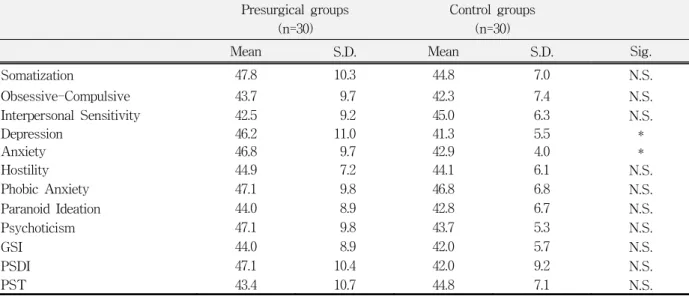
The mean psychological symptom profiles for the presurgical groups and the control groups are presented in Fig 1. and Table 1.
The psychological distress levels of the presurgical groups tended to show higher than those of the control groups, however, significant difference was only shown in depression(P<.05) and anxiety level (P<.05).
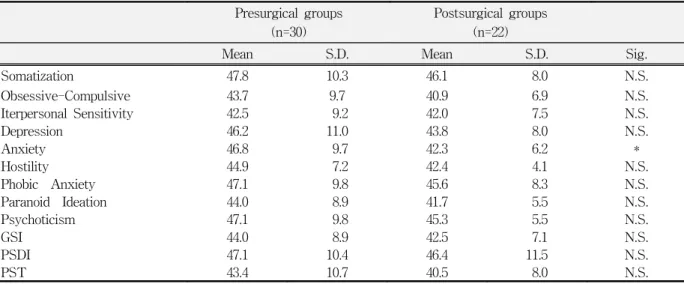
The mean psychological symptom profiles for the presurgical groups and the postsurgical groups are presented in Fig 2. and Table 2.
The psychological distress levels of the presurgical
groups tended to show higher than those of the
Fig. 1.
Mean symptom profiles on SCL-90-R for the presurgical groups and the control groups.
Presurgical groups: patients with oral squamous cell carcinoma prior to operation Control groups : patients for routine dental treatment
SOM: Somatization, O-C: Obssesive-Compulsive, I-S: Interpersonal Sensitivity, DEP: Depression, ANX: Anxiety, HOST: Hostility, PHOB: Phobic Anxiety, PAR: Paranoid Ideation, PSY: Psychoticism, GSI: Global Severity Index, PSDI: Positive Symptom Distress Index, PST: Positive Symptom Total 38
40 42 44 46 48 50
SOM O-
C I-S DEP ANX HOST PHOB PAR PSY GSI PSDI PST
Presurgical groups Control groups
Table 1. Comparison of the presurgical groups and the control groups on the SCL-90-R symptom profiles.
Presurgical groups (n=30)
Control groups (n=30)
Mean S.D. Mean S.D. Sig.
Somatization 47.8 10.3 44.8 7.0 N.S.
Obsessive-Compulsive 43.7 9.7 42.3 7.4 N.S.
Interpersonal Sensitivity 42.5 9.2 45.0 6.3 N.S.
Depression 46.2 11.0 41.3 5.5 *
Anxiety 46.8 9.7 42.9 4.0 *
Hostility 44.9 7.2 44.1 6.1 N.S.
Phobic Anxiety 47.1 9.8 46.8 6.8 N.S.
Paranoid Ideation 44.0 8.9 42.8 6.7 N.S.
Psychoticism 47.1 9.8 43.7 5.3 N.S.
GSI 44.0 8.9 42.0 5.7 N.S.
PSDI 47.1 10.4 42.0 9.2 N.S.
PST 43.4 10.7 44.8 7.1 N.S.
Presurgical groups : Patients with oral squamous cell carcinoma prior to operation Control groups : Patients for routine dental treatment
S.D. : Standard deviation
Sig. : Significance (N.S. : P>.05, * : P<.05) GSI : General Severity Index
PSDI : Positive Symptom Distress Index PST : Positive Symptom Total
Fig. 2
. Mean Symptom profiles on SCL-90-R for the presurgical groups and the postsurgical groups.
Presurgical groups: patients with oral squamous cell carcinoma prior to operation Postsurgical groups: patients with oral squamous cell carcinoma following operation
SOM: Somatization, O-C: Obssesive-Compulsive, I-S: Interpersonal Sensitivity, DEP: Depression, ANX:
Anxiety, HOST-Hostility, PHOB: Phobic Anxiety, PAR: Paranoid Ideation, PSY: Psychoticism, GSI: Global Severity Index, PSDI: Positive Symptom Distress Index, PST: Positive Symptom Total
38 40 42 44 46 48 50
SOM O-C I-S DEP ANX HOST PHOB PAR PSY GSI PSDI PST
Presurgical groups postsurgical groups
Table 2. Comparison of the presurgical groups and the postsurgical groups on the SCL-90-R symptom profiles.
Presurgical groups (n=30)
Postsurgical groups (n=22)
Mean S.D. Mean S.D. Sig.
Somatization 47.8 10.3 46.1 8.0 N.S.
Obsessive-Compulsive 43.7 9.7 40.9 6.9 N.S.
Iterpersonal Sensitivity 42.5 9.2 42.0 7.5 N.S.
Depression 46.2 11.0 43.8 8.0 N.S.
Anxiety 46.8 9.7 42.3 6.2 *
Hostility 44.9 7.2 42.4 4.1 N.S.
Phobic Anxiety 47.1 9.8 45.6 8.3 N.S.
Paranoid Ideation 44.0 8.9 41.7 5.5 N.S.
Psychoticism 47.1 9.8 45.3 5.5 N.S.
GSI 44.0 8.9 42.5 7.1 N.S.
PSDI 47.1 10.4 46.4 11.5 N.S.
PST 43.4 10.7 40.5 8.0 N.S.
Presurical groups : Patients with oral squamous cell carcinoma prior to operation Postsurgical groups : Patients with oral squamous cell carcinoma following operation S.D. : Standard deviation
Sig. : Significance (N.S.: P>.05, * : P<.05) GSI : General Severity Index
PSDI : Positive Symptom Distress Index PST : Positive Symptom Total
postsurgical groups, however, significant difference was only shown in anxiety level(P<.05).
Ⅳ. DISCUSSION
In the present study, Symptom Checklist 90-Revision (SCL-90-R) was used in evaluation for the psychological characteristics of patients with oral squamous cell carcinoma. The SCL-90-R is one of the best methods to evaluate emotions as well as cognitive variables in measurement of psycho- pathology. The SCL-90-R questionnaire developed by Derogatis et al.
18)as a general measurement of psychiatric outpatients in both clinical and research situation. The SCL-90-R has shown high rate of validity and reliability in numerous clinical studies and has been successfully used in dentistry in conjugation with craniomandibular pain, chronic orofacial pain, burning mouth syndrome, dental fear and phobic dental anxiety
2,4,13-15). Because SCL-90-R is a self-reporting test, it has following advantages:
(1) gives information on the subjective experiences undetectable by an operator; (2) is used as a screening tool to detect the patients who need a psychopathological care; (3) can be performed and scored by a non-specialist without psychological knowledge. And SCL-90-R has characteristics such as : (1) can be performed within 20 minutes; (2) is so easy and applicable to everyone who can make conversation without trouble in daily life; (3) can be used as a diagnostic and evaluating tool for students in consulting, psychological patients in clinic and ward ambulated patients; (4) gives whole and general information on the patients.
Our investigation disclosed substantive differences in the psychological profiles of patients with oral squamous cell carcinoma campare to patients for routine dental treatment.
The patients with oral squamous cell carcinoma manifested elevated symptom profiles and substantially higher levels of dysphoric affect than the patients with oral squamous cell carcinoma following operation and control groups.
In the present study, psychological distress levels
of the presurgical groups tended to show higher than those of the control groups, however, significant difference was only shown in depression (P<.05) and anxiety level(P<.05), and psychological distress levels of the presurgical groups tended to show higher than those of the postsurgical groups, however, significant difference was only shown in anxiety level(P<.05).
These findings are similar to previous research and closely parallel the results of several cancer studies
16-19).
Clearly, the patients with oral squamous cell carcinoma in this series manifested a psychological profile that suggests a characteristic response toward their illness. They were distressed, and had measurable elevations in levels of anxiety and a sense of alienation ; they were unhappy, and showed it in their moods.
However, the results via SCL-90-R of patients with oral squamous cell carcinoma following operation indicate that these patients have low levels of distress in dimension of anxiety.
We would like to emphasize the point that marked psychologic symptomatology was detected by the SCL-90-R not only in those patients with very poor prognosis and outcome but also in patients who subsequently achieved both clinical remissions and long term survivals.
These studies have been completed on small samples, in only a few diagnostic classes, and sometimes with inadequate controls. It remains, however, that a number of independent investigators have arrived at very similar conclusions regarding the relationship between the psychological distress and cancer patients
8,10-12).
If a relationship between psychological factors and somatic factors of cancer patients can be defined in cancer patients, then we will have taken an important step.
Not only will we have gained knowledge concer- ning the mechanisms of mind-body interaction, we may also be able to make an important contribution to the clinical management of the patient with cancer.
In summary, the research studies described in this
paper represent one approach to gaining a better understanding of the psychosocial dynamics of patients with oro-facial cancer. We feel that recent advances in the medical therapy of cancer should further stimulate efforts to achieve more effective programs in psychologic rehabilitation of patients with this common neoplasm. Such psychologic research projects are well received by the patients particularly if these studies are an integral part of their overall treatment and rehabilitation program.
V. CONCLUSIONS
The authors investigated the psychological characteristics of patients with oral squamous cell carcinoma via SCL-90-R.
Thirty patients with oral squamous cell carcinoma, twenty-two patients with oral squamous cell car- cinoma following operation and thirty patients for routine dental treatment were participated in the present study.
The obtained results were as follows :
1. The psychological distress levels of the patients with oral squamous cell carcinoma tended to show higher than those of the patients for routine dental treatment, but significant difference was only shown in depression(P<.05) and anxiety level(P<.05).
2. The psychological distress levels of the patients with oral squamous cell carcinoma tended to improve after operation, but significant difference was only shown in anxiety level(P<.05).
REFERENCES
1 Derogatis, L.R. and Abeloff, M.D. : Psychological coping mechanisms and survical time in metastatic breast cancer. J. Am. Med. Assoc., 242(14):1504-1508, 1979.
2. Ko, M.Y. : Psychological Analysis of TMD Patients through the SCL-90-R. Journal of Korean Academy of Oral Medicine, 24(1): 59-67, 1999.
3. Lee, S.Y., Kim, H.S. and Kim, Y.K. : Psychological characteristics in oral malodor patients. Journal of
Korean Academy of Oral Medicine, 26(3):225-241, 2001.
4. Ko, M.Y. and Kim, Y.K. :A study on personality traits of the patients with TMJ dysfunction through the MMPI. Journal of Korean Academy of Oral Medicine, 10(1):17-31, 1985.
5. Lee, Y.O. and Lee, S.W. : A study of the emotional characteristics of temporomandibular disorder patients using SCL-90-R. J Craniomandib Disorder Facial Oral Pain 3:25-34, 1989.
6. Irene, H.A., Aartmen, Ad de Jongh and Marylee, J., van der Meulen : Psychological characteristics of patients applying for treatment in a dental fear clinic.
Eur. J. Oral Sci., 105:384-388, 1997.
7. Berggren, U., Carlsson, S.G., Hakeberg, M., Hӓgglin, C., and Samsonowitzm, V. : Assessment of patients with phobic dental anxiety. Acta. Odontol. Scand., 55:217-222, 1997.
8. Ha, H.K. : Anxiety and depression of the hospitalized cancer patients. J. Korean Neuropsychiatr. Assoc., 21(4):665-674, 1982.
9. Scott, A.A., Hatch, J.P., Rugh, J.D. et al.: Psychosocial predictors of high-risk patients undergoing orthognathic surgery, Int. J .Adult Orthod.
Orthognath. Surg., 14(2):113-124, 1999.
10. Derogatis, L.S., Morrow, G.R., Fetting, J. et al. : The prevalence of psychiatric disorders among cancer patients. J. Am. Med. Assoc., 249:751-757, 1983.
11. Abeloff, M.D. and Derogatis, L.R. : Psychologic as- pects of the management of primary and metastatic breast cancer. Breast Cancer, 505-516, 1977.
12. Koh, K.B. : A comparison of illness behavior between cancer and noncancer patients. J. Korean Neuropsychiatr. Assoc., 30(4): 739-748, 1991.
13. Koh, K.B., Lee, S.I. and Lee, J.M. : Comparison of stress perception and depression between gastric cancer and gastritis patients. Korean Psychosomatid.
Society, 2(1):88-97, 1994.
14. Koh, K.B. and Kim, G.E. : A comparison of psy- chopathology between cancer patients on radiotherapy and noncancer patients.
15. Tross, S., Herndon II, J., Korzun, A. et al .: Psy- chological symptoms and disease-free and overall survival in women with stage II breast cancer.
Journal of the National Cancer Institute, 88(10):661-667, 1996.
16. Razavi, D., Delvaux, N., Farvacques, D. et al : Pre- vention of adjustment disorders and anticipatory nausea secondary to adjuvant chemotherapy: a double
-blind, placebo-controlled study assessing the usefulness of alprazolam. Journal of Clinical Oncology, 11(7):1384-1390, 1993.
17. Kim, K.I., Kim, J.W. and Won, H.T. : Korean manual of symptom checklist-90-revision: 7-36, Chungang Attitude Publishing Co., Seoul, Korea, 1984.
18. Derogatis, L.R. : Administration, scoring and pro- dures manual for the SCL-90-12. Baltimore, Clinical Psychometrics Research, 1977.
Corresponding Author : Young-Ku Kim, Professor, Department of Oral Medicine & Oral Diagnosis, College of Dentistry, Seoul National University, 28 Yunkeun- Dong, Chongro-Ku, Seoul 110-744, Korea