CONTENTS
Ⅰ. INTRODUCTION
Ⅱ. MATERIALS AND METHODS
Ⅲ. RESULTS
Ⅳ. DISCUSSION
Ⅴ. CONCLUSIONS REFERENCES KOREAN ABSTRACT
Ⅰ. INTRODUCTION
The term oral malodor is used to describe a foul or offensive odor emanating from the oral cavity1). It has been considered as a worrisome problem for centuries. References to bad breath and remedies for this condition can be found in writing of ancient Greece and Rome, including the works of Hippocrates, the "father" of medicine (460-377 BC)
2).
Oral malodor is of major importance socially and economically. Unsubstantiated commercial adverti- sement in the United States lay press claim as many as 25 million Americans "suffer" from bad breath1). The complaint of oral malodor is one of the main reasons why adults seek dental clinic. Some of them feel that they suffer from the problem due to oral malodor sporadically, and others claim to suffer from oral malodor at all times to the degree that it interferes with their social and professional
life.
Oral malodor may be caused by a number of factors and can occasionally be linked to underlying medical etiologies. In the large majority of cases, oral malodor originates in the oral cavity as a result of microbial metabolism3,4). Oral malodor of oral etiology may result from excessive microbial meta- bolism on the tongue dorsum, and periodontium, periodontal disease, excessive caries, poor oral hygiene, oral ulcers, food impaction, improper or faulty restoration, unclean denture, dry mouth and diet5-7). Non-oral etiologies include upper and lower respiratory tract conditions, gastrointestinal and neurologic disorders, diabetes mellitus, liver failure, kidney failure and use of certain drugs7-9).
Tonzetich and colleagues10-12) regarded that the volatile sulfur compounds (VSC) are mainly respo- nsible for oral malodor. According to Tonzetich13), the VSC responsible for oral malodor are hydrogen sulfide, methyl mercaptan and dimethylsulfide.
Measurement of oral malodor is complicated by a variety of parameters including complexity of gaseous molecular species, sampling difficulties, temporal variation, choice of suitable subject population, and lack of agreement on reference standards. The most simple and commonly used approach to measure oral malodor is direct nasal sniffing of mouth air. But this organoleptic method has lack of objectivity, reproducibility and reliability14). In order to overcome this limitation,
Psychological Characteristics in Oral Malodor Patients
Seung-Ryeul Lee, D.D.S.,M.S.D., Hyung-Suk Kim, D.D.S.,M.S.D.,Ph.D., Young-Ku Kim, D.D.S.,M.S.D.,Ph.D.
Department of Oral Medicine and Oral Diagnosis, College of Dentistry, Seoul National University
several investigators proposed quantitative approaches based on instrumental measurement of VSC which are associated with oral malodor.
Highly sensitive and discriminatory measurements of VSC can be made using gas chromatography13,14). However, gas chromatography is technically difficult, time-consuming and relatively expensive.
One possible solution to this problem is the use of portable gas monitors. Recently, the application of an industrial sulfide monitor for measuring gases associated with oral malodor has been reported14-17). Although oral malodor have a physiological etiology originating from oral and/or systemic conditions in many cases, the subjective complaint of oral malodor sometimes originates from presumption based on others' attitudes18). Yasuno et al.19) reported that despite patient complained of oral malodor, actual oral malodor was often not found through sensory and instrumental examination. Iwu and Akpata20) reported that there are apparently healthy individuals who complain of having bad breath which no one else can smell and for which no local or systemic condition can be found, and referred this condition as delusional halitosis.
Pryse-Phillips21) described an "olfactory reference syndrome" in which the patient claims to actually perceive a malodor that others cannot detect. The personalities of patients suffering from the symptom show tendencies toward self-observation, self-criticism, neuroticism, inferiority, shyness, difficulty in expressing emotion, and obsessional feature. Hawkins22) pointed out that patients who complain of oral malodor and yet have normal smelling breath may be suffering from depression, and some cases can be diagnosed as imaginary halitosis, a solitary delusion based on hypocho- ndriasis. Patients who suffer from delusion of oral malodor have been reported23-26).
The number of oral malodor cases with psychosomatic or psychiatric aspects may have been increased gradually according as the social stress is increased. However, it is not easy to treat psychosomatic oral malodor such as halitophobia.
The patients may be greatly distraught by
presumed malodor, stating that oral malodor is separating him or her from friends, is interfering job, or is causing avoidance of social interaction27). Even some oral malodor patients have been reported to commit suicide because of depression28). The psychological aspects, which are described above, of oral malodor patients are not yet fully understood. And it is the reason for the difficulties in treating oral malodor patients successfully. The purpose of this study is to investigate the chara- cteristics of oral malodor patients using Symptom Checklist-90-Revision (SCL-90-R) questionnaire, the oral malodor questionnaire and physical evaluations on patients with primary complaint of oral malodor. From these investigations, we expect to get diagnostic and treatment clues for oral malodor patients, especially for the patients with some psychological problems.
Ⅱ. MATERIALS AND METHODS 1. Subjects
The subjects consisted of 481 patients with primary complaint of oral malodor, who visited the Oral Malodor Clinic of Department of Oral Medicine
& Oral Diagnosis, Seoul National University Dental Hospital (SNUDH), Seoul, Korea, between May 1998 and June 1999. There were 35 patients (10 men and 25 women) who had history of psychological treatment and medication, and they are excluded in this study in order to minimize the negative influence on psychological evaluation. Therefore, in the present study, oral malodor patients were consisted of 446 patients (mean age : 34.5 years) with primary complaint and treatment need for oral malodor.
Sixty-three dental patients (mean age 34.0 years) for routine dental treatment without any complaint for oral malodor in SNUDH, were selected for controls. Table 1 shows number and mean age of oral malodor patients and controls. There were no differences of age distribution between genders, and between oral malodor patients and controls.
In order to determine the criteria for classifying oral malodor patients into two groups according to their oral malodor level, the organoleptic exami- nation and halimeter measurement, described in methods, was carried out on 196 subjects that were randomly selected in oral malodor patients and controls. According to results, oral malodor patients were classified into two groups : the high VSC (VSC level > 150 ppb; 347 patients) and the low VSC (VSC level (≤150 ppb; 99 patients) groups.
Number and mean age of the high VSC and the low VSC groups and differences of age between genders and between two groups were showed in table 2.
2. Methods
All subjects were requested to complete the computerized SCL-90-R questionnaire and to fill out the oral malodor questionnaire, developed in Oral Malodor Clinic. The oral malodor questionnaire was consisted of several investigated variables, such as age, gender, type of consciousness for having oral malodor, frequency and period of oral malodor, and self-rating oral malodor intensity and distress using visual analog scale (VAS).
The level of volatile sulfur compounds (VSC) of all subjects were measured with a portable sulfide monitor (Halimeter; RH-17 series, Interscan Corp., CA, USA)29,30). Three readings were taken in each subject, and the average of those readings was accepted as the breath content of the VSC for that subject; VSC level (ppb). For organoleptic measurement on randomly selected subjects, the subjects were instructed to close their mouth for a moment, then exhale briefly the mouth at a distance of about 20cm from the nose of the judge. Two judges examined the mouth air of subjects on the scale of 0 to 5, that was proposed by Rosenberg15), as follows: 0: no appreciable odor; 1: barely noticeable odor; 2: slight, but clearly noticeable odor; 3: moderate odor; 4: strong odor; 5: extremely foul odor. And when both judges did not agree, they discussed and the score agreed upon was
recorded; Organoleptic score.
Types of consciousness for having oral malodor were classified into 3 types according to answering to 3 questions in the oral malodor questionnaire, developed by Iwakura et.al.18), as follows : 1. Do you have bad breath ?; 2. Have you ever been told by others you have bad breath ?; 3. Do you have suspected that you had bad breath based upon the actions of others (their hand or face movement when you closed to them, etc.) ? . Type A was self-consciousness and indication by others and/or presumption from others' attitude, and Type B was only self-consciousness, and Type C was no self-consciousness and indication by others and/or presumption from others' attitude.
3. Statistical analyses
The Chi-square test was used to evaluate the difference between genders for age distributions of oral malodor patients and for types of consciousness for having oral malodor. A student's t-test was used to evaluate the difference between genders and between the high VSC and the low VSC groups for age, dimensions and global scales of SCL-90-R, self-rating oral malodor intensity and distress, and oral malodor scales. A student's t-test was also used to evaluate the difference between oral malodor patients and controls for the same valuables. And Pearson correlation analysis was used to evaluate the correlation between organo- leptic score and oral malodor scale, and the correlation between self-rating oral malodor intensity and dimensions and global scales of SCL-90-R, and between self-rating oral malodor distress and dimensions of SCL-90-R.
Ⅲ. RESULTS
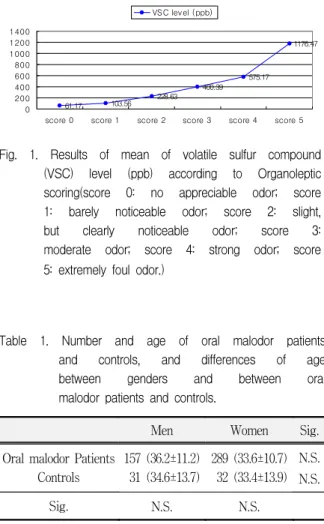
In organoleptic examination, organoleptic score showed significant high correlation to VSC level (r=0.793, p=0.000). Mean and standard deviation of VSC level according to organoleptic score disclosed as follows; score 0 (n=2) : 61.17 ± 17.21 ppb, score
Fig. 1. Results of mean of volatile sulfur compound (VSC) level (ppb) according to Organoleptic scoring(score 0: no appreciable odor; score 1: barely noticeable odor; score 2: slight, but clearly noticeable odor; score 3:
moderate odor; score 4: strong odor; score 5: extremely foul odor.)
61.17 103.56 228.63 400.39
575.17 1176.47
0 200 400 600 800 1000 1200 1400
score 0 score 1 score 2 score 3 score 4 score 5 VSC level (ppb)
Table 1. Number and age of oral malodor patients and controls, and differences of age between genders and between oral malodor patients and controls.
Men Women Sig.
Oral malodor Patients Controls
157 (36.2±11.2) 31 (34.6±13.7)
289 (33.6±10.7) 32 (33.4±13.9)
N.S.
N.S.
Sig. N.S. N.S.
Table 2. Number and age of two oral malodor patient groups with high VSC and low VSC level, and differences of age between genders and between two groups.
Men Women Sig.
High VSC Group Low VSC Group
125 (36.4±10.9) 32 (35.4±12.2)
222 (34.1±10.9) 67 (32.0± 9.6)
N.S.
N.S.
Sig. N.S. N.S.
High VSC Group : Volatile sulfur compound (VSC) level 〉 150ppb
Low VSC Group : Volatile sulfur compound (VSC) level ≤ 150ppb
1 (n=68) : 103.26 ± 21.31 ppb, score 2 (n=60) : 228.63
± 76.00 ppb, score 3 (n=31) : 400.39 ± 205.04 ppb, score 4 (n=20) : 575.17 ± 298.37 ppb, score 5 (n=15)
Fig. 2. Number and distribution of oral malodor patients per age category and gender.
0 20 40 60 80 100 120
under 19 20-29 30-39 40-49 50-59 over 60
Men Women
Fig. 3. Number and distribution of oral malodor patients per gender and type of consci- ousness for having oral malodor as follows : Type A : self-consciousness, indication by others and/or presumption from others' attitude; Type B : only self-consciousness;
Type C : no self-consciousness, indication by others and/or presumption from others' attitude
0 50 100 150 200 250
Type A Type B Type C
Men Women
: 1176.47 ± 482.55 ppb(Fig. 1).
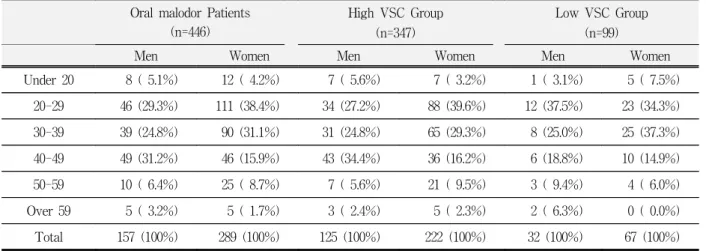
Oral malodor was more prevalent in women than in men (men:women=35:65, table 1), and the highest incidence occurred 40s in men (31.2%) and 20s in women (38.4%) (table 3).
The difference in distribution of oral malodor patients per age category between genders was significant in the Chi-square test (p=0.005) (figure 2). In man oral malodor patients, the distribution per age category had an even distribution on 20s, 30s, and 40s (29.3%, 24.8%, and 31.2%). However, in women, there were the concentrated distribution on 20s and 30s (38.4% and 31.1%) (table 3).
The difference in type of consciousness for having oral malodor between genders was significant in the Chi-square test (p=0.004) (figure
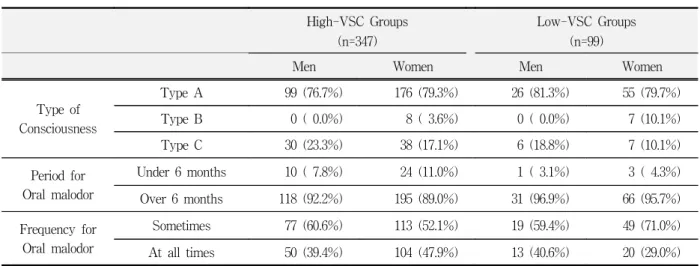
3). Type A was the most prevalent motive for the patients to recognize their oral malodor followed by type C and type B. Type B oral malodor patients was found in women only (table 4). Type A was the most prevalent in both of oral malodor patients groups, the high VSC and the low VSC groups.
The followed type was type C and type B. Type B was more prevalent in the low VSC group (10.1%)
Table 4. Types of consciousness for having oral malodor and period & frequency for oral malodor in oral malodor patients
Men Women Total
Type of Consciousness
Type A 125 (77.6%) 231 (79.4%) 356 (78.8%)
Type B 0 ( 0.0%) 15 ( 5.2%) 15 ( 3.3%)
Type C 36 (22.4%) 45 (15.5%) 81 (17.9%)
Period for Oral malodor
Under 6 months 11 ( 6.9%) 27 ( 9.4%) 38 ( 8.5%)
Over 6 months 149 (93.1%) 261 (90.6%) 410 (91.5%)
Frequency for Oral malodor
Sometimes 96 (60.4%) 162 (56.6%) 258 (58.0%)
At all times 63 (39.6%) 124 (43.4%) 187 (42.0%)
Type A : self-consciousness, indication by others and/or presumption from others attitude Type B : only self-consciousness
Type C : no self-consciousness, indication by others and/or presumption from others attitude
than in the high VSC group (3.6%) (table 5).
Most of patients (above 90%) had complained their oral malodor for more than 6 months (table 4).
The percentage of patients, suffered from oral malodor for more than 6 months, was slightly higher in the low VSC group than the high VSC group in both genders (table 5). About 42% of patients felt their oral malodor at all time and about Table 3. Distribution of oral malodor patients and the high VSC & the low VSC groups per age category and
gender.
Oral malodor Patients (n=446)
High VSC Group (n=347)
Low VSC Group (n=99)
Men Women Men Women Men Women
Under 20 8 ( 5.1%) 12 ( 4.2%) 7 ( 5.6%) 7 ( 3.2%) 1 ( 3.1%) 5 ( 7.5%)
20-29 46 (29.3%) 111 (38.4%) 34 (27.2%) 88 (39.6%) 12 (37.5%) 23 (34.3%)
30-39 39 (24.8%) 90 (31.1%) 31 (24.8%) 65 (29.3%) 8 (25.0%) 25 (37.3%)
40-49 49 (31.2%) 46 (15.9%) 43 (34.4%) 36 (16.2%) 6 (18.8%) 10 (14.9%)
50-59 10 ( 6.4%) 25 ( 8.7%) 7 ( 5.6%) 21 ( 9.5%) 3 ( 9.4%) 4 ( 6.0%)
Over 59 5 ( 3.2%) 5 ( 1.7%) 3 ( 2.4%) 5 ( 2.3%) 2 ( 6.3%) 0 ( 0.0%)
Total 157 (100%) 289 (100%) 125 (100%) 222 (100%) 32 (100%) 67 (100%)
High VSC Group : Volatile sulfur compound (VSC) level 〉150 ppb Low VSC Group : Volatile sulfur compound (VSC) level ≤ 150 ppb
Fig. 4. SCL-90-R mean T-score profile of oral malodor patients and controls as follows : oral malodor patients- patients with a primary complaint of oral malodor ; controls - a dental patients for routine dental treatment.
SCL-90-R dimensions and global scales:
SOM-Somatization ; O-C-Obsession-Com- pulsion ; I-S-Interpersonal sensitivity ; DEP-Depression ; ANX-Anxiety ; HOST- Hostility ; PHOB-Phobic anxiety ; PAR- Paranoid ideation ; PSY-Psychoticism ; GSI -Global Severity Index ; PST-Positive Symptom Total ; PSDI-Positive Symptom Distress Index.
40 42 44 46 48 50
SOM O
-C I-S DEP ANX HO STPHOB
PAR PSY G
SI PST PSDI
Oral malodor patients Controls
Fig. 5. SCL-90-R mean T-score profile of man and woman oral malodor patients.
SCL-90-R dimensions and global scales : SOM-Somatization ; O-C-Obsession-Com- pulsion ; I-S-Interpersonal sensitivity ; DEP-Depression ; ANX-Anxiety ; HOST- Hostility ; PHOB-Phobic anxiety ; PAR- Paranoid ideation ; PSY-Psychoticism ; GSI -Global Severity Index ; PST-Positive Symptom Total ; PSDI-Positive Symptom Distress Index.
40 42 44 46 48 50
SOM O-C I-S D
EP ANX HO STPHOB
PAR PSY G SI PST PSDI
Men Women
Table 5. Type of consciousness for having oral malodor, and period & frequency for oral malodor in two oral malodor patients groups with high volatile sulfur compound (VSC) level (>150ppb) and low VSC level
≤150 ppb)
High-VSC Groups (n=347)
Low-VSC Groups (n=99)
Men Women Men Women
Type of Consciousness
Type A 99 (76.7%) 176 (79.3%) 26 (81.3%) 55 (79.7%)
Type B 0 ( 0.0%) 8 ( 3.6%) 0 ( 0.0%) 7 (10.1%)
Type C 30 (23.3%) 38 (17.1%) 6 (18.8%) 7 (10.1%)
Period for Oral malodor
Under 6 months 10 ( 7.8%) 24 (11.0%) 1 ( 3.1%) 3 ( 4.3%)
Over 6 months 118 (92.2%) 195 (89.0%) 31 (96.9%) 66 (95.7%)
Frequency for Oral malodor
Sometimes 77 (60.6%) 113 (52.1%) 19 (59.4%) 49 (71.0%)
At all times 50 (39.4%) 104 (47.9%) 13 (40.6%) 20 (29.0%)
Type A : self-consciousness, indication by others and/or presumption by others attitude Type B : only self-consciousness
Type C : no self-consciousness, indication by others and/or presumption by others attitude
58% of patients felt their oral malodor sometimes (table 4). Only 29% of woman patients of the low VSC group felt their oral malodor at all time (table 5).
When data regarding self-rating oral malodor intensity and distress, oral malodor scale, and dimensions and global scales of SCL-90-R of oral malodor patients compared with age- and gender- matched controls, a general trend for an elevated psychological profile, as evaluated SCL-90-R, was
evident for oral malodor patients (figure 4). And significant differences were found in self-rating oral malodor intensity (p<0.01) and distress (p<0.01), oral malodor scale (p<0.01), and some items of SCL-90-R (obsession-compulsion (p<0.05), anxiety (p<0.05) and hostility (p<0.05)) and global severity index (p<0.05)) (table 6). By comparison between genders, no significant differences were found in self-rating oral malodor intensity and distress, and oral malodor scale, Table 6. Differences of means and S.D. of self-rating oral malodor intensity and distress (VAS), volatile sulfur
compound (VSC) level (ppb) and dimensions and global scales of SCL-90-R between oral malodor patients and controls.
Oral malodor Patients (n=446)
Controls (n=63)
Mean S.D. Mean S.D. Sig.
Self-rating oral malodor (VAS)
Intensity 6.57 2.07 2.60 1.45 **
Distress 6.04 2.34 1.41 1.53 **
Dimensions of SCL-90-R (T-score)
Somatization 45.13 7.09 44.22 4.65 N.S.
Obsession-Compulsion 44.18 8.00 41.94 6.46 *
Interpersonal sensitivity 46.50 8.12 44.71 7.87 N.S.
Depression 44.13 7.61 42.70 6.09 N.S.
Anxiety 45.13 7.35 43.02 6.09 *
Hostility 45.76 7.08 44.14 5.85 *
Phobic anxiety 45.79 6.87 44.71 5.10 N.S.
Paranoid ideation 43.86 6.91 43.19 5.10 N.S.
Psychoticism 45.19 7.13 43.87 5.77 N.S.
Global scales of SCL-90-R (T-score)
GSI 43.74 7.32 42.06 5.66 *
PST 44.08 6.51 42.68 5.31 N.S.
PSDI 44.53 9.65 43.14 8.33 N.S.
S.D. : Standard deviation Sig. : Significance GSI : General Severity Index PST : Positive Symptom Total PSDI : Positive Symptom Distress Index
N.S. : p>0.05 * : p<0.05 ** : P<0.01
however, significant differences were found in three dimensions of SCL-90-R : obsession-compulsion (p<0.05), depression (p<0.05), and paranoid ideation (p<0.01) (table 7). The psychological profile, as evaluated by SCL-90-R, of man and woman oral malodor patients was presented in figure 5.
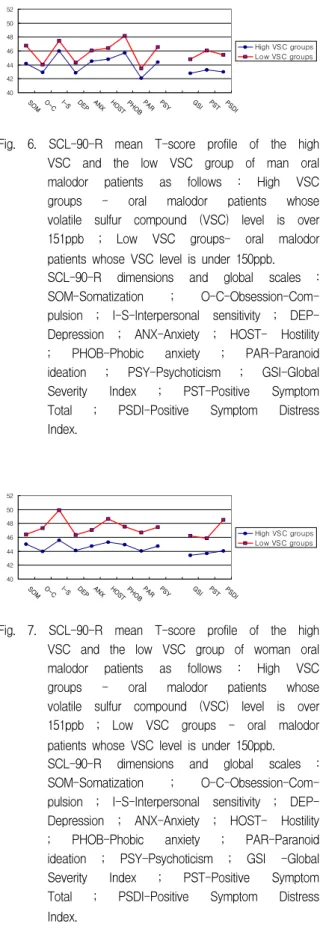
When data regarding self-rating oral malodor intensity and distress, and dimensions and global
scales of SCL-90-R of the low VSC group compared with the high VSC group, a general trend for an elevated psychological profile, as evaluated by SCL-90-R, was evident for the low VSC group in man and woman oral malodor patients (figure 6, 7). Although self-rating oral malodor intensity was not different between the high VSC and the low VSC group, self-rating oral malodor distress of the Table 7. Differences of means and S.D. of self-rating oral malodor intensity and distress (VAS), volatile sulfur
compound (VSC) level (ppb) and dimensions and global scales of SCL-90-R between genders in oral malodor patients.
Men (n=157)
Women (n=289)
Mean S.D. Mean S.D. Sig.
Self-rating oral malodor (VAS)
Intensity 6.49 1.98 6.62 2.13 N.S.
Distress 5.98 2.25 6.08 2.39 N.S.
VSC level (ppb) 532.55 520.28 461.31 413.34 N.S.
Dimensions of SCL-90-R (T-score)
Somatization 44.68 6.69 45.37 7.30 N.S.
Obsession-Compulsion 43.14 6.98 44.76 8.47 *
Interpersonal sensitivity 46.31 8.33 46.61 8.01 N.S.
Depression 43.16 6.93 44.67 7.92 *
Anxiety 44.84 6.78 45.30 7.65 N.S.
Hostility 45.14 6.24 46.11 7.49 N.S.
Phobic anxiety 46.19 6.44 45.56 7.10 N.S.
Paranoid ideation 42.35 6.20 44.69 7.16 **
Psychoticism 44.81 6.86 45.40 7.29 N.S.
Global scales of SCL-90-R (T-score)
GSI 43.17 6.83 44.06 7.57 N.S.
PST 43.84 6.06 44.22 6.76 N.S.
PSDI 43.47 9.60 45.12 9.65 N.S.
S.D. : Standard deviation Sig. : Significance GSI : General Severity Index PST : Positive Symptom Total PSDI : Positive Symptom Distress Index
N.S. : p>0.05
* : p<0.05 ** : P<0.01
Fig. 6. SCL-90-R mean T-score profile of the high VSC and the low VSC group of man oral malodor patients as follows : High VSC groups - oral malodor patients whose volatile sulfur compound (VSC) level is over 151ppb ; Low VSC groups- oral malodor patients whose VSC level is under 150ppb.
SCL-90-R dimensions and global scales : SOM-Somatization ; O-C-Obsession-Com- pulsion ; I-S-Interpersonal sensitivity ; DEP- Depression ; ANX-Anxiety ; HOST- Hostility
; PHOB-Phobic anxiety ; PAR-Paranoid ideation ; PSY-Psychoticism ; GSI-Global Severity Index ; PST-Positive Symptom Total ; PSDI-Positive Symptom Distress Index.
40 42 44 46 48 50 52
SOM
O-C I-S DEP ANX HO STPHO
B
PAR PSY G
SI PST PS DI
High VSC groups Low VSC groups
Fig. 7. SCL-90-R mean T-score profile of the high VSC and the low VSC group of woman oral malodor patients as follows : High VSC groups - oral malodor patients whose volatile sulfur compound (VSC) level is over 151ppb ; Low VSC groups - oral malodor patients whose VSC level is under 150ppb.
SCL-90-R dimensions and global scales : SOM-Somatization ; O-C-Obsession-Com- pulsion ; I-S-Interpersonal sensitivity ; DEP- Depression ; ANX-Anxiety ; HOST- Hostility
; PHOB-Phobic anxiety ; PAR-Paranoid ideation ; PSY-Psychoticism ; GSI -Global Severity Index ; PST-Positive Symptom Total ; PSDI-Positive Symptom Distress Index.
40 42 44 46 48 50 52
SOM O
-C I-S DEP ANX HO
STPHOBPAR PSY G SI PST PS
DI
High VSC groups Low VSC groups
Fig. 8. SCL-90-R mean T-score profile of the high VSC and the low VSC group of oral malodor patients and controls in men as follows : High VSC groups - oral malodor patients whose volatile sulfur compound (VSC) level is over 151ppb ; Low VSC groups - oral malodor patients whose VSC level is under 150ppb ; Controls - a dental patients for routine dental treatment.
SCL-90-R dimensions and global scales : SOM-Somatization ; O-C-Obsession-Com- plsion ; I-S-Interpersonal sensitivity ; DEP- Depression ; ANX-Anxiety ; HOST-Hostility ; PHOB-Phobic anxiety ; PAR-Paranoid ideation ; PSY-Psychoticism ; GSI-Global Severity Index ; PST-Positive Symptom Total
; PSDI-Positive Symptom Distress Index.
40 42 44 46 48 50 52
SOM
O-C I-S DEP ANX HO STPHO
B
PAR PSY G
SI PST PS DI
High VSC groups Low VSC groups Controls
Fig. 9. SCL-90-R mean T-score profile of the high VSC and the low VSC group of oral malodor patients and controls in women as follows : High VSC groups - oral malodor patients whose volatile sulfur compound (VSC) level is over 151ppb ; Low VSC groups - oral malodor patients whose VSC level is under 150ppb ; Controls - a dental patients for routine dental treatment.
SCL-90-R dimensions and global scales : SOM-Somatization ; O-C-Obsession-Com- pulsion ; I-S-Interpersonal sensitivity ; DEP- Depression ; ANX-Anxiety ; HOST-Hostility ; PHOB-Phobic anxiety ; PAR-Paranoid ideation ; PSY- Psychoticism ; GSI-Global Severity Index ; PST-Positive Symptom Total
; PSDI-Positive Symptom Distress Index.
40 42 44 46 48 50 52
SOM
O-C I-S DEP ANX HO STPHOB
PAR PSY G
SI PST PSDI
High VSC groups Low VSC groups Controls
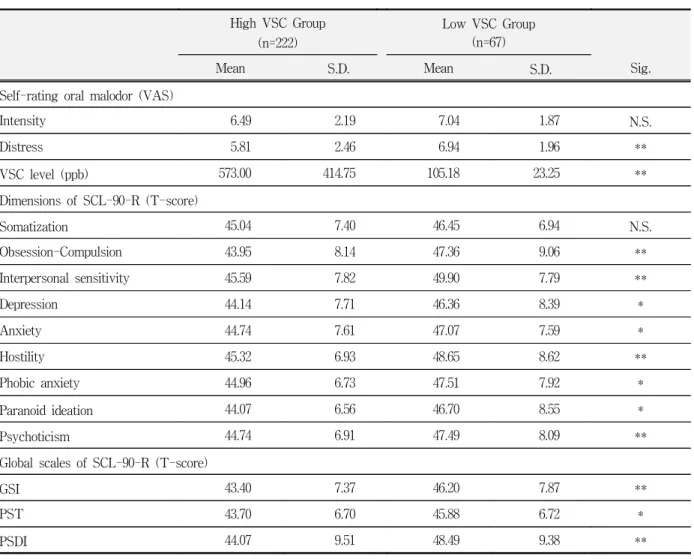
low VSC group was significantly higher (p<0.05) than that of the high VSC group, and also for positive symptom total (p<0.05) of SCL-90-R in man oral malodor patients (table 8). In woman oral malodor patients, although self-rating oral malodor intensity was not different between the high VSC and the low VSC group, self-rating oral malodor distress of the low VSC group was significantly higher (p<0.01) than that of the high VSC group.
And the low VSC group was significantly higher for all of dimensions except for somatization and global sales of SCL-90-R (p<0.05) than the high VSC group (table 9). All items of SCL-90-R of the high VSC and the low VSC group were not different from those of controls in man oral malodor patients (figure 8). In woman oral malodor patients, all items of SCL-90-R were not different from those of controls in the high VSC group, but all items of SCL Table 8. Differences of means and S.D. of self-rating oral malodor intensity and distress (VAS), volatile sulfur
compound (VSC) level (ppb) and dimensions and global scales of SCL-90-R between the high VSC (>150ppb) and the low VSC (≤150 ppb) group in men.
High VSC Group (n=125)
Low VSC Group (n=32)
Mean S.D. Mean S.D. Sig.
Self-rating oral malodor (VAS)
Intensity 6.43 2.05 6.72 1.69 N.S.
Distress 5.78 2.26 6.81 2.02 *
VSC level (ppb) 637.55 531.34 109.27 24.31 **
Dimensions of SCL-90-R (T-score)
Somatization 44.16 5.95 46.78 8.90 N.S.
Obsession-Compulsion 42.92 6.81 44.03 7.66 N.S.
Interpersonal sensitivity 46.03 8.30 47.44 8.45 N.S.
Depression 42.86 6.85 44.34 7.23 N.S.
Anxiety 44.53 6.74 46.09 6.93 N.S.
Hostility 44.83 6.03 46.41 6.98 N.S.
Phobic anxiety 45.71 5.68 48.13 8.73 N.S.
Paranoid ideation 42.07 6.23 43.47 6.05 N.S.
Psychoticism 44.37 6.44 46.59 8.20 N.S.
Global scales of SCL-90-R (T-score)
GSI 42.78 6.51 44.78 7.92 N.S.
PST 43.29 5.54 46.06 7.52 *
PSDI 42.98 9.36 45.47 10.41 N.S.
S.D. : Standard deviation Sig. : Significance GSI : General Severity Index PST : Positive Symptom Total
N.S. : p>0.05 * : p<0.05 ** : p<0.01
-90-R, except for somatization, were significantly higher than those of controls in the low VSC group (p<0.05) (figure 9).
No statistically significant correlation was found in self-rating oral malodor intensity and distress with dimensions and global scales of SCL-90-R in men oral malodor patients. In women oral malodor patients, significant correlation were found in self- rating oral malodor intensity with 5 dimensions
(obsession-compulsion (p<0.05), interpersonal sensitivity (p<0.05), anxiety (p<0.05), hostility (p<0.05) and phobic anxiety (p<0.05)) and 2 global scales (global severity index (p<0.05) and positive symptom distress index (p<0.05)) of SCL-90-R, and significant correlation were found in self-rating distress with all dimension and global scales of SCL-90-R (p<0.05) (table 10).
Table 9. Differences of means and S.D. of self-rating oral malodor intensity and distress (VAS), volatile sulfur compound (VSC) level (ppb) and dimensions and global scales of SCL-90-R between the high VSC (>150ppb) and the low VSC (≤150 ppb) group in women.
High VSC Group (n=222)
Low VSC Group (n=67)
Mean S.D. Mean S.D. Sig.
Self-rating oral malodor (VAS)
Intensity 6.49 2.19 7.04 1.87 N.S.
Distress 5.81 2.46 6.94 1.96 **
VSC level (ppb) 573.00 414.75 105.18 23.25 **
Dimensions of SCL-90-R (T-score)
Somatization 45.04 7.40 46.45 6.94 N.S.
Obsession-Compulsion 43.95 8.14 47.36 9.06 **
Interpersonal sensitivity 45.59 7.82 49.90 7.79 **
Depression 44.14 7.71 46.36 8.39 *
Anxiety 44.74 7.61 47.07 7.59 *
Hostility 45.32 6.93 48.65 8.62 **
Phobic anxiety 44.96 6.73 47.51 7.92 *
Paranoid ideation 44.07 6.56 46.70 8.55 *
Psychoticism 44.74 6.91 47.49 8.09 **
Global scales of SCL-90-R (T-score)
GSI 43.40 7.37 46.20 7.87 **
PST 43.70 6.70 45.88 6.72 *
PSDI 44.07 9.51 48.49 9.38 **
S.D. : Standard deviation Sig. : Significance GSI : General Severity Inde PST : Positive Symptom Total PSDI : Positive Symptom Distress Index
N.S. : p>0.05
* : p<0.05 ** : p<0.01
Ⅳ. DISCUSSION
In many patients, oral malodor originate from various local physiological causes and certain systemic disease conditions such as : poor oral hygiene, periodontal disease, dry mouth, food impaction, improper or faulty restorations, unclean denture, microbial activity, throat infection, oral carcinoma, benign or malignant oral ulcer, diabetes mellitus, liver failure and kidney failure. In some patients, however, complaints of oral malodor cannot be substantiated by physical examinations. The complaints for oral malodor of these patients have been suspected to originate from other causes such as psychotic problems rather than from physio- logical causes. Actually, it seems that psychotic problem can be considered as a cause and/or a result
of oral malodor and therefore it is meaningful to investigate the psychological characteristics of oral malodor patients.
The demographic data of the present study indicated that women, especially younger and/or unmarried women, are more likely to seek treatment for oral malodor than men. This result corresponds with the Iwakura's report18). In the present study, there was significant difference in the age distribution of oral malodor patients between men and women. The majority of man patients aged evenly on 20s, 30s and 40s, but most of women aged 20s and 30s. We could suspect from these results that socially active persons are more sensitive to oral malodor than socially inactive persons.
The type of consciousness for having oral malodor of woman patients was different from men and this Table 10. Correlation between the self-rating oral malodor intensity / distress and dimensions and global scales
of SCL-90-R in oral malodor patients.
Men (n=157)
Women (n=289)
Intensity Distress Intensity Distress
Dimensions of SCL-90-R (T-score)
Somatization r=0.085 0.057 0.095 0.156**
Obsession-Compulsion 0.036 0.067 0.133* 0.220**
Interpersonal sensitivity 0.034 0.122 0.145* 0.254**
Depression 0.064 0.139 0.107 0.222**
Anxiety 0.051 0.103 0.148* 0.277**
Hostility 0.030 0.109 0.133* 0.227**
Phobic anxiety 0.063 0.086 0.119* 0.225**
Paranoid ideation 0.088 0.044 0.052 0.148*
Psychoticism 0.099 0.116 0.098 0.184**
Global scales of SCL-90-R(T-score)
GSI 0.051 0.098 0.142* 0.243**
PST 0.061 0.061 0.115 0.213**
PSDI 0.064 0.108 0.131* 0.231**
GSI : General Severity Index PST : Positive Symptom Total PSDI : Positive Symptom Distress Index
* : p<0.05 ** : p<0.01
result corresponds with the Kishi's report31) and the Aizawa's report32), which presented that there were significant differences in self-consciousness of bad breath between boys and girls. It may be due to the greater interest of cosmetics in women of that age.
Most of oral malodor patients became conscious of their odor by themselves and by other's behavior in both men and women, but it is noteworthy that the patients, who became conscious only by themselves without any indication of others and presumption from others' attitude, were all women. It suggests that women may have a complaint of oral malodor in spite of having no actual odor.
Above 90% of patients were suffered from oral malodor for more than 6 months and it correspond with other recent report33). This result suggests that oral malodor is a chronic problem which may induce psychological problems, such as depression, obsession and so on.
The levels of VSC of randomly selected subjects, whose organoleptic score was 1 or 2, were less than 150ppb except only one subject with 157ppb. This result suggests that breath odor become noticeable at an approximate value of 150ppb, and corresponds with other recent report29). Therefore, oral malodor patients in the present study were classified into two groups, the high VSC group consisted of patients over 150ppb and the low VSC group consisted of patients below 150ppb. Patients in the high VSC group might have the clearly noticeable malodor and patients in the low VSC group might have no or questionable odor that is detectable though a judge could not recognized it as malodor.
It is noteworthy that the woman oral malodor patients who became conscious only by themselves without any indication of others and presumption from others' attitude was more prevalent in the low VSC group than in the high VSC group. Even though they did not have any objective odor and never be mentioned of odor, they did more concern of the odor. This excessive attention on oral malodor may induce delusional or imaginary oral malodor.
In contrast that 43% of total oral malodor patients recognized their own oral malodor at all times, only
29% of women patients in the low VSC group did the same. It suggested that 71% of women in the low VSC group recognized their own odor infre- quently and they might consider the physiological odor as pathologic. This may induce several psychological problems.
In the present study, Symptom Checklist 90- Revision (SCL-90-R) was used in evaluation for psychological characteristics of oral malodor patients. The SCL-90-R is one of the best methods to evaluate emotion as well as cognitive variables in measurement of psychopathology. The SCL-90- R questionnaire developed by Derogatis et al.34) as a general measurement of psychiatric outpatients in both clinical and research situations. The SCL-90- R has shown high rate of validity and reliability in numerous clinical studies and has been successfully used in dentistry in conjugation with cranio- mandibular pain, chronic orofacial pain, burning mouth syndrome, dental fear and phobic dental anxiety35-41). Because SCL-90-R is a self- reporting test, it has following advantages: (1) gives infor- mation on the subjective experiences undetectable by an operator; (2) is used as a screening tool to detect the patients who need a psychopathological care; (3) can be performed and scored by a non-specialist without psychological knowledge42). And SCL-90-R has characteristics such as : (1) can be performed within 20 minutes; (2) is so easy and applicable to everyone who can make conversation without trouble in daily life; (3) can be used as a diagnostic and evaluating tool for students in consulting, psychological patients in clinic and ward ambulated patients; (4) gives whole and general information on the patients42). The SCL-90-R may be the most appropriate psychological test for oral malodor patients because it can present global psychological status, which affects the subjective symptoms and can be performed rapidly for a huge number of patients in clinic.
A general trend for an elevated psychological profile was evident for oral malodor patients and they showed significant differences in obsession- compulsion, anxiety, hostility and global severity
index compared to controls. It is similar with the reports of Eli et al.43,44) and Ham et al.45). However, those previous results may be reconsidered, because following results of the present study show some differences between genders. There were significant differences in age distribution and type of consciou- sness for having oral malodor between genders.
There were also significant gender differences of obsession-compulsion, depression and paranoid ideation in oral malodor patients. So, in the present study, the psychological evaluation for oral malodor patients was performed with classifying into men and women.
Even though a general trend for elevated psychological profile was evident for the low VSC group, the low VSC group in man patients showed no significant differences in all items of SCL-90-R except for elevated level of positive symptom total in compared with those of the high VSC group.
However, in women, all items of SCL-90-R, except for somatization, of the low VSC group were significantly elevated in compared with those of the high VSC group. It suggests that women patients who complained oral malodor without any objective evidence have elevated psychological profiles in compare to other oral malodor patients groups. We pay attention to the psychological profile of woman oral malodor patients with low VSC level and/or without actual malodor in the diagnosis.
This elevated psychological scores of oral malodor patients, especially women with low VSC level, resemble another groups of dental patients:
glossodynia or burning mouth syndrome, dental fear, craniomandibular disorder and orofacial pain patients. They have tendency to focus on the psychosomatic aspects.
We found that the psychological profile is positively related to their self-rating oral malodor intensity and distress in woman oral malodor patients, but not in man oral malodor patients. This result may be affected by the difference of sample size between man and woman oral malodor patients.
Nevertheless, by results, self-rating distress is more useful in prediction of patient's psychological profile
than self-rating intensity in woman oral malodor patients.
The complaint of oral malodor presents a complex issue. Some people who suffer from repellent body or oral malodor may be unaware even when the problem is pointed out by significant others. Others become overanxious about having a potential repelling smell to the point of development of delusion of bad breath. This unique population of dental patients with a subjective, persistent complaint of oral malodor, presents a problem which has not, as yet, received enough attention from dentists. Early recognition of psychological characteristics of oral malodor patients, especially in women with low VSC value, may prevent them from undergoing protracted investigation or unnecessary procedure. Better understanding of the possible factors, which contribute to the development of the complaint of oral malodor, is important in order to manage the patients better.
Ⅴ. CONCLUSIONS
In the studying on the oral malodor, the accurate recognition of psychological characteristics of patients is important in diagnosis procedure, because the subjective and persistent perception of oral malodor is highly affected by psychological variables as in other subjective perceptions.
The author investigated the psychological chara- cteristics of oral malodor patients with SCL-90-R questionnaire, the oral malodor questionnaire and physical evaluations. Four hundreds and forty-six patients with primary complaint of oral malodor and 63 dental patients for routine dental treatment were participated in the present study.
The obtained results were as follows :
1. The age distribution of man oral malodor patients was different from that of women (p<0.001). The majority of man oral malodor patients aged evenly on 20s, 30s and 40s, but most of women aged 20s and 30s.
2. The type of consciousness for having oral malo-
dor of man patients was different from that of women (p<0.01). The type of self-consciousness without any indication and presumption from others' attitudes was found in woman oral malodor patients only.
3. Oral malodor patients showed significant diffe- rences in obsession-compulsion, anxiety, hostility and global severity index compare to controls (p<0.05).
4. In oral malodor patients, there were significant gender differences of obsession-compulsion, depression (p<0.05) and paranoid ideation (p<0.01).
5. The low VSC group in man oral malodor patients showed no significant differences in all items of SCL-90-R except for positive symptom total (p<0.05) in compared with those of the high VSC group. In women, all items of SCL-90-R, except for somatization, of the low VSC group were significantly elevated in compared with those of the high VSC group (p<0.05).
6. In woman oral malodor patients, the self-rating oral malodor intensity was related to obsession- compulsion, interpersonal sensitivity, anxiety, hostility, phobic anxiety, global severity index and positive symptom distress index (p<0.05). And the self-rating oral malodor distress was related to all items of SCL-90-R (p<0.05).
REFERENCES
1. Newman MG : The role of periodontitis in oral malodour: Clinical perspectives. In: van Steenberghe D and Rosenberg M (Eds), Bad breath: A multidisci- plinary Approach: pp3-14, Leuven University Press, Leuven, Belgium, 1996.
2. Rosenberg M : Introduction. In: Rosenberg M (Ed), Bad breath: Research perspectives: pp1-12, Ramot Publishing-Tel Aviv University, Tel Aviv, Israel, 1995.
3. McNamara TF, Alexander JF and Lee M: The role of microorganisms in the production of oral malodor.
Oral Surg Oral Med Oral Pathol 34: 41-48, 1972.
4. Tonzetich J and McBride BC : Characterization of volatile sulphur production by pathogenic and non-pathogenic strains of oral bacteriodes. Arch Oral Biol 26: 963-979, 1981.
5. Kostelc JG, Preti G, Zelson PR, Brauner L and Baehni P : Oral odors in early experimental gingivitis. J Periodont Res 19: 303-312, 1984.
6. Yeagaki K and Sanada K : Biochemical and clinical factors influencing oral malodor in periodontal patients. J Periodontol 63: 783-789, 1992.
7. Lu DP : Halitosis : an etiologic classification, a treatment approach, and prevention. Oral Surgery 54:
521-526, 1982.
8. Preti G, Lawley HJ, Hormann CA, Cowart BJ, Feldman RS, Lowry LD and Young IM : Non-oral aspects of oral malodor. In: Rosenberg M (Ed), Bad breath: Research perspectives: pp149-173, Ramot Publishing-Tel Aviv University, Tel Aviv, Israel, 1995.
9. Preti G, Clark L, Cowart BJ, Feldman RS, Lowry LD, Weber E and Young IM : Non-oral etiologies of oral malodor and altered chemosensation. J Periodontol 63:
790-796, 1992.
10. Tonzetich J : Oral malodour: An health status and oral cleanliness. Int Dent J 28: 309-319, 1977.
11. Ng W and Tonzetich J : Effect of hydrogen sulfide and methyl mercaptan on the permeability of oral mucosa. J Dent Res 63: 994-997, 1984.
12. Tonzetich J : Production and origin of oral malodor:
A review of mechanisms and methods of analysis. J Periodontol 28: 13-20, 1977.
13. Tonzetich J : Direct gas chromatographic analysis of sulphur compounds in mouth air in man. Arch Oral Biol 16: 587-597, 1971.
14. Rosenberg M and McCulloch CA : Measurement of oral malodor: Current methods and future prospects.
J Periodontol 63: 776-782, 1992.
15. Rosenberg M, Septon I, Eli I, Bar-Ness R, Gelernter I, Brenner S and Gabbay J : Halitosis measurement by an industrial sulphide monitor. J Periodontol 62:
487-489, 1991.
16. Rogenberg M, Kulkarni GV, Bosy A and McCulloch CA : Reproducibility and sensitivity of oral malodor measurements with a portable sulphide monitor. J Dent Res 70: 1436-1440, 1991.
17. Rosenberg M : First international workshop on oral malodor. J Dent Res 73: 586-589, 1994.
18. Iwakura M, Yasuno Y, Shimura M and Sakamoto S : Clinical characteristics of Halitosis : Differences in two patient groups with primary and secondary complaints of oral malodor. J Dent Res 73: 1568-1574, 1994.
19. Yasuno Y, Iwakura M and Shimada Y : Relationship between volatile sulfur compounds in mouth air and some symptoms in patients complaining of bad
breath. J Dent Health 39: 663-674, 1989.
20. Iwu CO and Akpata O : Delusional Halitosis. Review of the literature and analysis of 32 cases. Br Dent J 167: 294-296, 1989.
21. Pryse-Phillips W : An olfactory reference syndrome.
Acta Psychiatr Scand 47: 484-509, 1971.
22. Hawkins C : Real and imaginary halitosis. Br Med J 294: 200-201, 1987.
23. Oxtoby A and Field EA : Delusional symptoms in dental patients: A report of four cases. Br Dent J 176:
140-143, 1994.
24. Bishop ER : An olfactory reference syndrome- Monosymptomatic hypochondriasis. J Clin Psychiatry 41: 57-59, 1980.
25. Masnik R : Olfactory reference syndrome and depression. Am J Psychiatry 140: 670-671, 1983.
26. Malasi TH, El-Hilu SR, Mirza IA and El-Islam MF : Olfactory delusional syndrome with various aetiologies. Br J Psychiatry 156: 256-260, 1990.
27. Johnson BE : The olfactory reference syndrome and halitosis. In: van Steenberghe D and Rosenberg M (Eds), Bad breath: A multidisciplinary Approach: pp 231-237, Leuven University Press, Leuven, Belgium, 1996.
28. Yaegaki K, Matudaira H, Sano S and Kitamira T : Attitudes towards one's and others' oral malodour.
In: van Steenberghe D and Rosenberg M (Eds), Bad breath: A multidisciplinary Approach: pp217-230, Leuven University Press, Leuven, Belgium, 1996.
29. RH-17 series Halimeter instruction manual. Interscan corp., Chartworth, CA, USA.
30. Kim YK, Lee SW, Chung SC and Kim HS : A preliminary study on oral malodor measurement.
Journal of Korean Academy of Oral Medicine 22:
233-239, 1997.
31. Kishi M, Aizawa F and Yonemitsu M : Difference in boys and girls in self-consciousness of oral malodor.
In: Proceedings of 4th International Conference on Breath Odor, p44, 1999.
32. Aizawa F, Kishi M and Yonemitsu M : Risk factors for imagined halitosis in high school students. In:
Proceedings of 4th International Conference on Breath Odor, p47, 1999.
33. Delanghe G, Ghyselen J, Feenstra L and van Steen- berghe D : Experiences of Belgian multidisciplinary breath odour clinic. In: van Steenberghe D and Rosenberg M (Eds), Bad breath: A multidisciplinary Approach: pp199-208, Leuven University Press, Leuven, Belgium, 1996.
34. Derogatis LR, Lipman RC and Covi I : SCL-90: an
outpatient psychiatric rating scale - preliminary report. Psycho Pharmacol Bull 9: 13-28, 1973.
35. Butterworth JC and Deardorff WW : Psychometric profiles of craniomandibular pain patients: identifying specific subgroups. J Craniomandibular Practice 5:
226-232, 1987.
36. Lee YO and Lee SW : A study of the emotional characteristics of temporomandibular disorder patients using SCL-90-R. J Craniomandib Disord Facial Oral Pain 3:25-34, 1989.
37. McGregor NR, Butt HL, Zerbes M, Klineberg IJ, Dunstan RH and Roberts TK : Assessment of pain (distribution and onset), symptoms, SCL-90-R inventory responses, and the association with infectious events in patients with chronic orofacial pain. J Orofacial Pain 10: 339-350, 1996.
38. Eli I, Kleinhauz M, Baht R and Littner M : Antece- dents of burning mouth syndrome (glossodynia) - Recent life events vs. psychopathologic aspects. J Dent Res 73: 567-572, 1994.
39. Eli I, Bath R, Littner MM and Kleinhauz M : Detection of psychopathologic trends in glossodynia patients. Psychosom Med 56: 389-394, 1994.
40. Kleinhauz M, Eli I, Baht R and Shamay D : Correlates of success and failure in behavioral therapy for dental fear. J Dent Res 71: 1832-1835, 1992.
41. Berggren U, Carlsson SG, Hakeberg M, Hagglin C and Samsonwitz V : Assessment of patients with phobic dental anxiety. Acta Odontol Scand 55: 217-222, 1997.
42. Kim K-I, Kim J-W and Won H-T : Korean Manual of Symptom Checklist-90-Revision: 7-36, Chungang Attitude Publishing Co., Seoul, Korea, 1984.
43. Eli I, Bath R and Rosenberg M : Psychological factors in self assessment of oral malodor. In: Rosenberg M (Ed), Bad breath: Research perspectives: pp201-213, Ramot Publishing-Tel Aviv University, Tel Aviv, Israel, 1995.
44. Eli I, Bath R, Kozlovsky A and Rosenberg M : The complaint of oral malodor: Possible psychopatho- logical aspects. Psychosom Med 58: 156-159, 1996.
45. Ham DS, Chun YH, Lee JY, Cho HG and Hong JP : A study of personality profile of oral malodor patients by Symptom Checklist-90-Revision (SCL-90-R).
Journal of Korean Academy of Oral Medicine 23:
361-367, 1998.
Corresponding Author : Young-Ku Kim, Professor, Department of Oral Medicine & Oral Diagnosis, College of Dentistry, Seoul National University, 28 Yunkeun- Dong, Chongro-Ku, Seoul 110-744, Korea
국문초록
구취 환자의 심리학적 특징에 관한 연구
서울대학교 치과대학 구강내과․진단학 교실 이승렬․김형석․김영구
구취에 대한 환자의 주관적 감각은 다양한 심리학적 요소들에 의하여 영향을 받을 가능성이 있다. 본 연구에서 는 구취 환자의 심리학적 특징을 살펴보기 위하여, 구취를 주소로 내원한 환자 446명과 일반적인 치과 치료를 위하여 내원한 환자 63명을 대상으로 간이정신진단검사 (SCL-90-R), 구취 설문검사, 구취 측정 검사를 시행하여 분석한 결과 아래와 같은 결론을 얻었다.
1. 남성 구취 환자와 여성 구취 환자의 연령분포는 통계학적으로 유의한 차이를 보였다 (p<0.001). 남성에서는 20대, 30대, 40대에 고르게 분포한 반면, 여성에서는 20대와 30대에 집중되어 분포하였다2. 구취의 인식 유형은 남녀간에 통계학적으로 유의한 차이를 보였다 (p<0.01). 구취 인식 유형 중 타인에 의한 지적이나 타인의 행동 으로 인한 추측 없이 스스로 구취를 인지하는 유형은 여성 구취 환자에서만 관찰되었다.
3. 구취 환자는 대조군에 비하여 강박증, 불안, 적대감, 전체심도지수에서 높은 수치를 보였다 (p<0.05).
4. 여성 구취 환자는 남성 구취 환자에 비하여 강박증(p<0.05), 불안 (p<0.05), 편집증 (p<0.001)에서 높은 수치를 보였다.
5. 남성 구취 환자에서는 표출증상합계를 (p<0.05) 제외한 모든 간이정신진단검사 항목에서 고농도 VSC군과 저 농도 VSC군간에 유의한 차이를 보이지 않았다. 여성 구취 환자에서는 저농도 VSC군이 신체화를 제외한 모든 간이정신진단검사 항목에서 고농도 VSC군에 비하여 높은 수치를 보였다 (p<0.05).
6. 여성 구취 환자에서 주관적 구취심도는 강박증, 대인예민성, 불안, 적대감, 공포불안, 전체심도지수, 표출증상심 도지수 들과 유의한 상관관계를 보였고 (p<0.05), 주관적 구취불편감은 모든 간이정신진단검사 항목들과 유의 한 상관관계를 보였다 (p<0.05).
주요어 : 구취, 간이정신진단검사, 할리미터, 구취심도, 구취불편감