—39—
INTRODUCTION
The cottid genus Ocynectes Jordan and Starks, 1904, being characterized by having a lateral line undulating anteriorly and protected by concealed plates, usually with a small tentacle at each pore, and large pectoral fins, com- prises only two species O. maschalis Jordan and Starks, 1904 from Korea and Japan and O. modestus Snyder, 1911 from Korea, Japan to Sakhalin (Masuda et al., 1984;
Kim et al., 2005).
From the Korean waters, Mori (1952) firstly recorded O. maschalis in his checklist of fishes of Korea. Althou- gh Chyung (1954, 1977) subsequently described shortly the species, no specimens used in his works were pre- served as voucher. Furthermore, the identification of O.
maschalis by Chyung (1977) was uncertain, although de- scription of the species was generally acceptable. Sub- sequently Kim and Youn (1992) also reported O. masch- alis from the northern coast of Jeju Island and from mid- dle coast of the East Sea, Korea, however any description of the species as well as taxonomical discussion was not provided.
In the present study we gave morphological description of O. maschalis to provide external characteristics for
identification of the Ocynectes species from Korea on the basis of 14 specimens collected from the coastal wa- ters of Korea to date. Counts and measurements general- ly follow those of Hubbs and Lagler (1964) and speci- mens examined are deposited in CNUC (Chonbuk Natio- nal University, Korea), KNUM (Kunsan National Univer- sity), and NIBR-P (National Institute of Biological Re- sources, Korea).
Ocynectes maschalis Jordan and Starks, 1904 (Korean name: Ga-si-ggeog-jeong-i)
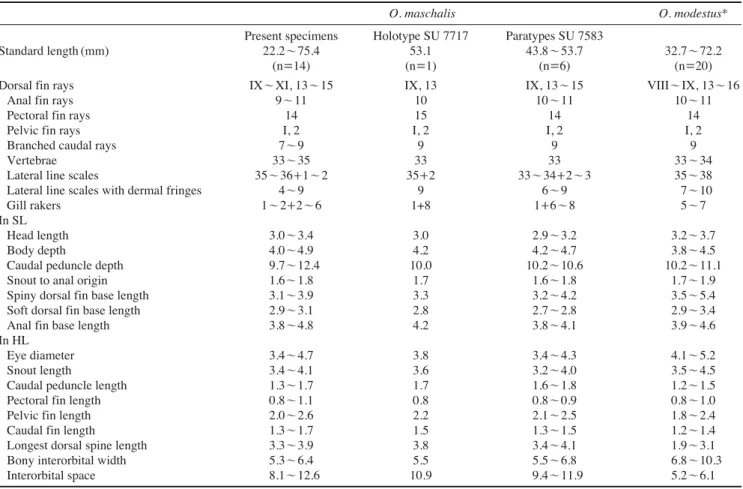
(Fig. 1; Table 1)
Ocynectes maschalis Jordan and Starks, 1904: 307, fig.
34 (type locality: Wakanoura, Wakayama Prefecture, Japan, Inland Sea); Mori, 1952: 165 (Fusan [Busan], Korea); Chyung, 1954: 438 (Fusan [Busan], Korea);
Chyung, 1977: 538 (Busan, Korea, in part); Kim and Youn, 1992: 72 (Korea); Youn, 2002: 577 (Jeju, Busan, Yeongdeok, Korea); Kim et al., 2005: 249 (Ulreung Island, South Sea of Korea).
Materials examined. 14 specimens: CNUC 16397, 31.0 mm in standard length (SL), CNUC 16398, 33.0 mm SL, CNUC 16399, 35.6 mm SL, Hamdeok Beach, Jeju- do, Korea, 5 August 1986; CNUC 16402, 39.5 mm SL, CNUC 11067, 50.1 mm SL, Ganggu 4-dong, Ganggu, Yeongdeok-gun, Gyeongbuk-do, Korea, 11 August 1986;
CNUC uncatalogued, 55.6 mm SL, collection data same
Description of a Small Sculfin, Ocynectes maschalis (Scorpaeniformes: Cottidae) from Korea
By Byung-Jik Kim*, Min-Ki Oh
1and Jung-Hyun An
2Biological and Genetic Resources Utilization Division, National Institute of Biological Resources, Environmental Research Complex, Hwangyeong-ro 42, Seo-gu, Incheon 404-708, Korea
1Department of Ichthyology, California Academy of Sciences, Golden Gate Park, San Francisco, CA 94118, USA
2National Biodiversity Center, National Institute of Biological Resources, Environmental Research Complex, Hwangyeong-ro 42, Seo-gu, Incheon 404-708, Korea
ABSTRACT Based on the 14 specimens collected from the Korean waters, we described the exter- nal morphology of Ocynectes maschalis in detail to provide morphological characteristics for species identification. The species from Korea is characterized by having a low first dorsal fin with a dark spot posteriorly, no dark blotches ventrally, three saddle-like blotches on dorsal midline posterior to the second dorsal fin, and two occipital cirri on head.
Key words : Ocynectes maschalis, description, morphology, Korea, identification
*Corresponding author: Byung-Jik Kim Tel: 82-32-590-7127 Fax: 82-32-590-72230, E-mail: [email protected]
Accepted: March 11, 2015
http://www.fishkorea.or.kr
as CNUC 11067; KNUM 5075, 75.4 mm SL, Hakampo, Chungnam-do, Korea, 10 October 2005; NIBR-P2426, 53.0 mm SL, Bangeojin, Ulsan, Gyeongnam-do, Korea, 9 June 1977; NIBR-P20400, 6 specimens, 22.2~53.9 mm SL, Sehwa-ri, Gujwa-eup, Jeju-si, Jeju-do, Korea, 23 May 2013, collected by B.J. Kim, hand net.
Diagnosis. An Ocynectes species with three pairs of multifid flaps (or palmate cirri) on dorsal region of head including a single supraorbital and two occipital cirri, first dorsal fin low and with a dark spot posteriorly, no dark blotches on ventral side of body, and three saddle- like blotches on dorsal midline posterior to second dorsal fin.
Description. Dorsal fin rays IX~XI, 13~15 (mainly IX, 13~14); anal fin rays 9~11 (10); pectoral fin rays 14 (14); pelvic fin rays I, 2 (I, 2); principal caudal rays generally 9~11 (11); vertebrae 33~35; lateral line scales 35~36 excluding one or two pored scales on base of cau- dal fin. Body proportion of percentage in SL: body depth at pelvic fin base 20.3~25.2 (mean 22.6); body width 15.7~21.3 (18.9); head length 29.8~33.3 (31.9); head width 18.3~23.8 (21.0); snout length 7.7~9.4 (8.4); orbit diameter 64~9.5 (8.1); fresh interorbital width 4.9~6.2 (5.6); bony interorbital width 2.5~3.7 (3.3); upper jaw length 10.2~13.1 (11.8); postorbital length 15.7~17.6 (16.7); snout to origin of first dorsal fin 25.7~32.0 (28.9);
snout to origin of pelvic fin 26.3~31.9 (28.5); snout to origin of anal fin 55.0~61.0 (57.6); first dorsal spine 6.9
~8.0 (7.4); second dorsal spine 7.8~9.2 (8.4); longest dorsal spine (third spine) 7.9~10.4 (8.8); longest dorsal soft ray (sixth soft ray) 13.5~15.2 (14.2); longest anal soft ray (ninth) 11.7~15.5 (13.6); pectoral fin length 29.9
~36.5 (32.8); pelvic fin length 12.4~15.4 (13.6); base of first dorsal fin 25.9~32.1 (29.1); base of second dor- sal fin 31.8~34.9 (33.7); base of anal fin 20.6~26.1 (23.8); caudal fin length 20.1~23.2 (21.4); caudal pedun- cle length 18.7~23.4 (21.7); caudal peduncle depth 8.1
~10.4 (9.4).
Head small, body slender, and caudal peduncle moder- ate low. Snout short and nasal tube two, simple, upper one larger and longer than lower one; nasal spine short and stout with a simple flap, sometimes branched or lac- king. Mouth terminal, upper jaw slightly longer than lo- wer jaw, its posterior tip nearly reaching a vertical at pos- terior margin of eye; upper and lower jaws with small conical teeth arranged irregularly in 4~7 and 3~7 rows, respectively; vomer and palatines with small conical teeth arranged irregularly 2~4 rows or a small tooth patch in larger specimen. Eye moderate situated at antero-dorsal head with a flatten flap (supraorbital cirrus) bearing five to nine minute fringes on supraorbital. Two branched flaps (occipital cirrus) bearing three to 10 minute fringes on occipital region of head prominent. Posterior margin of preopercle smooth, but a snout blunt spine directly up- ward at lower level of eye; a simple short appendage pre- sent sometimes; posterior margin of opercle smooth. Gill
Fig. 1.Ocynectes maschalis, NIBR-P20400, 65.7 mm SL, male, Gujwa, Jeju Island, Korea, 23 May 2013. Photo by B.J. Kim.
membranes fused each other and free from isthmus. Bran- chiostegal rays six. Pseudobranchiae present. Dorsal fin double, nearly connected each other sometimes; first dor- sal fin uniformly low, generally third spine longest; se- cond dorsal fin higher than first dorsal, last ray attached to caudal peduncle by membrane. Pectoral fin large, all fin rays unbranched; eighth ray longest from upper, its posterior tip reaching a vertical at origin of fifth ray of second dorsal fin; lower six rays thickened and deeply incised. Pelvic fin short, not extending anus when depre- ssed. Anal fin origin a little before midpoint of body, its base shorter than that of second dorsal fin, all anal rays thickened and deeply incised. Caudal fin round. No scales on body, except for lateral line scales. Lateral line com- plete, with 35~37 pored scales excluding two or three pored scales on caudal fin. Some lateral line scales with dermal appendages discontinuously, their total number from four to nine; anterior three to six scales always with simple or branched dermal appendages. Urogenital papil- la thickened proximally and pointed distally in male.
Color when fresh (based on NIBR-P20400, 53.9 mm SL, male). - Ground color of body greenish gray with numerous irregular dark or white blotches laterally and
pale gray ventrally without any dark marks. Snout rather dark. Cheek with some whitish or dark irregular blotches.
Small dark dots scattered on postorbital region. Three dark blotches saddle-like along dorsal midline, two on base of second dorsal fin and one on caudal peduncle.
Five white round marks on lateral midline posteriorly.
First dorsal fin with six purple and five yellowish oblique short bands, a dark blackish spot among last three fin rays. Second dorsal fin with six oblique purple bands and five yellowish oblique bands by turns. Anal fin with three purple and two light yellowish bands on each fin rays. Pectoral fin with five purple and yellowish bands by turns with a whitish irregular blotch on base. Pelvic fin transparent without any dark markings. Caudal fin yellowish with five purple bands on each fin rays includ- ing a rather borad purple band on base.
Color after preservation.- All purple, yellowish, and whitish colored blotches disappeared. Head and body pale yellowish with grey irregular blotches laterally and without any dark marks ventrally. Dorsal half of snout region dark and two dark bars on cheek. Three dark irre- gular saddle-like blotches on postero-dorsal midline. First dorsal fin with five oblique dark bars and a blackish spot
Table 1.Comparison of morphometric and meristic characters between Ocynectes maschalis and O. modestus
O. maschalis O. modestus*
Present specimens Holotype SU 7717 Paratypes SU 7583
Standard length (mm) 22.2~75.4 53.1 43.8~53.7 32.7~72.2
(n==14) (n==1) (n==6) (n==20)
Dorsal fin rays IX~XI, 13~15 IX, 13 IX, 13~15 VIII~IX, 13~16
Anal fin rays 9~11 10 10~11 10~11
Pectoral fin rays 14 15 14 14
Pelvic fin rays I, 2 I, 2 I, 2 I, 2
Branched caudal rays 7~9 9 9 9
Vertebrae 33~35 33 33 33~34
Lateral line scales 35~36++1~2 35++2 33~34++2~3 35~38
Lateral line scales with dermal fringes 4~9 9 6~9 7~10
Gill rakers 1~2++2~6 1+8 1++6~8 5~7
In SL
Head length 3.0~3.4 3.0 2.9~3.2 3.2~3.7
Body depth 4.0~4.9 4.2 4.2~4.7 3.8~4.5
Caudal peduncle depth 9.7~12.4 10.0 10.2~10.6 10.2~11.1
Snout to anal origin 1.6~1.8 1.7 1.6~1.8 1.7~1.9
Spiny dorsal fin base length 3.1~3.9 3.3 3.2~4.2 3.5~5.4
Soft dorsal fin base length 2.9~3.1 2.8 2.7~2.8 2.9~3.4
Anal fin base length 3.8~4.8 4.2 3.8~4.1 3.9~4.6
In HL
Eye diameter 3.4~4.7 3.8 3.4~4.3 4.1~5.2
Snout length 3.4~4.1 3.6 3.2~4.0 3.5~4.5
Caudal peduncle length 1.3~1.7 1.7 1.6~1.8 1.2~1.5
Pectoral fin length 0.8~1.1 0.8 0.8~0.9 0.8~1.0
Pelvic fin length 2.0~2.6 2.2 2.1~2.5 1.8~2.4
Caudal fin length 1.3~1.7 1.5 1.3~1.5 1.2~1.4
Longest dorsal spine length 3.3~3.9 3.8 3.4~4.1 1.9~3.1
Bony interorbital width 5.3~6.4 5.5 5.5~6.8 6.8~10.3
Interorbital space 8.1~12.6 10.9 9.4~11.9 5.2~6.1
*, from Shiogaki (1987).
posteriorly; second dorsal fin six oblique dark bars; pec- toral fin with five irregular bars; anal fin with three dark bars; caudal fin with five dark bars including a rather broad dark band on base.
Distribution. Known from the Northwest Pacific: Korea (Kim and Youn, 1992; Kim et al., 2005), Japan to Sakh- alin (Masuda et al., 1984). In the Korean waters, the spe- cies has been reported from the coastal waters at Taean, Jeju Island, Ulsan, and Yeongdeok (Kim and Youn, 1992, present study), and also at Ulreung Island (Kim et al., 2005).
Remarks. In the present study, we described the exter- nal morphology of Ocynectes maschalis Jordan and Starks in detail on the basis of specimens collected from the Korean waters to understand the morphological charac- teristics as well as to identify of the Ocynectes species.
All the specimens collected from Korea were well accor- dance with the original description of O. maschalis in having diagnostic characteristics as follows: three pairs of multifid flaps (or palmate cirri) on dorsal region of head including a single supraorbital and two occipital cirri, first dorsal fin low and with a dark spot posteriorly, three saddle-like blotches on dorsal midline posterior to second dorsal fin, and so on as shown in Table 1.
From the Korean waters, Ocynectes maschalis had been firstly recorded by Mori (1952: 165) in his checklist of fishes of Korea, however there was no any informa- tion of the species except for both scientific name and its locality (i.e., Fusan==Busan). Subsequently, Chyung (1954: 438) shortly described the morphological charac- teristics of the species proposing a Korean name, “Ka- si-kkok-chong-i”. Chyung (1977: 538) also subsequently given a short description of O. maschalis with two pho- tographs (Pl. 284. 2, Color Pl. 119. 4) proposing a differ- ent name in English, “Ga-si-ggeog-jeong-i”. Morpholog- ical descriptions given by Chyung (1954, 1977) are well agree to those of original description of O. maschalis, for example, a black spot on posterior portion of the first dorsal fin, three palmate cirri on the occipital region (in- cluding a cirrus above eye) as well as numbers of each fin rays. Chyung (1977) also attached two photographs to his description of O. maschalis, i.e., the one was taken from specimen collected at Busan fish market, Korea and the other a color photograph taken from aquarium when fresh. However, the latter (Color Pl. 119. 4) is not O. machalis but Pseudoblennius cottoides (Richardson, 1848) in having a simple (not branched or palmate) su- praorbital cirrus and elongated anterior two or three rays of the first dorsal fin as well as general pattern of body color. The former (Pl. 284. 2) also seems to be the other species belongs to the cottid genus Cottiusculus Jordan and Starks, 1904 in the color pattern of body as well as its general morphological features.
O. maschalis is easily distinguished from its most sim- ilar species O. modestus (Snyder, 1911), not only by the
presence (vs. absence for O. modestus) of two pairs of dermal cirri on the occipital region but by the broader in- terorbital region (vs. narrower), as mentioned by Shioga- ki (1987). Although development of larvae and juveniles of the species have been known by Kim et al. (2000) based on fish samples collected from the South Sea of Korea, any additional record on the adult of O. modestus does not given from the Korean waters to date.
Comparative materials. Ocynectes maschalis: CAS- SU (California Academy of Sciences, USA) 7717, holo- type of O. maschalis Jordan and Starks, 53.1 mm SL, Wakanoura, Wakayama Prefecture, Honshu Island, Japan, 1904, collected by D.S. Jordan and J.O. Snyder; CAS- SU 7583, n==6, 438~53.7 mm SL, Enoshima, Kanagawa Prefecture, Honshu Island, Japan, 1904, collected by D.S.
Jordan and J.O. Snyder.
ACKNOWLEDGMENTS
We thank to Mr. Hyun-Geun Cho (NIBR) and Ms. Ye- Seul Lee (NIBR) for their kind assistance to taking radio- graphs and specimen processing. We also express our special thanks to Dr. Youn Choi (KNUM) and Dr. Jong- Young Park (CNUC) for their loan of fish specimens.
This work was supported by a grant from the National Institute of Biological Resources, funded by the Ministry of Environment of the Republic of Korea (NIBR201501 117).
REFERENCES
Chyung, M.K. 1954. Korean fishes. Department of Commerce and Industry, Republic of Korea, 14+1+48+517+12+
16+12+4+13pp. (in Korean)
Chyung, M.K. 1977. The fishes of Korea. Ilchisa, Seoul, 727 pp, 238pls. (in Korean)
Hubbs, C.L. and K.F. Lagler. 1964. Fishes of the great lakes region. University of Michigan Press, Ann Arbor, xv +213pp.
Jordan, D.S. and E.C. Starks. 1904. A review of the Cottidae or sculpins found in the waters of Japan. Proceedings of the United States National Museum, 27: 231-335.
Kim, I.S. and C.H. Youn. 1992. Synopsis of the family Cotti- dae (Pisces: Scorpaeniformes) from Korea. Korean Journal of Ichthyology, 4: 54-79.
Kim, I.S., Y. Choi, C.L. Lee, Y.J. Lee, B.J. Kim and J.H. Kim.
2005. Illustrated book of Korean fishes. Kyo-Hak Publishing, Seoul, 615pp. (in Korean)
Kim, Y.U., C.B. Kang and K.H. Han. 2000. Development of larvae and juveniles of the Smoothskin sculfin, Ocy- nectes modestus. Korean Journal of Ichthyology, 12:
146-154. (in Korean)
Masuda, H., K. Amaoka, C. Araga, T. Uyeno and T. Yoshino.
1984. The fishes of the Japanese Archipelago. Tokai University Press, Tokyo, Text: xxii+437pp, Atlas:
370pls.
Mori, T. 1952. Check list of the fishes of Korea. Memoirs of the Hyogo University of Agriculture, Japan, 1: 1-228.
Richardson, J. 1848. Fishes, Pp. 1-28, Pls. 1-10. In: Adams, A. (ed.), The zoology of the voyage of H. M. S. Sama- rang; under the command of Captain Sir Edward Bel- cher, during the years 1843~1846. Reeve & Benham,
London.
Shiogaki, M. 1987. An additional record of the rare cottid fish Ocynectes modestus from Aomori Pref., Japan.
Japanese Journal of Ichthyology, 34: 222-226.
Snyder, J.O. 1911. Descriptions of new genera and species of fishes from Japan and the Riu Kiu Islands. Proceed- ings of the United States National Museum, 40: 525- 549.
Youn, C.H. 2002. Fishes of Korea, with pictorial key and systematic list. Akademy Book, Seoul, 747pp.
둑중개과 가시꺽정이 Ocynectes maschalis의 형태적 특징
김병직∙오민기1∙안정현2
국립생물자원관 유용자원활용과, 1미국 캘리포니아 과학아카데미, 2국립생물자원관 국가생물다양성센터
요 약 : 우리나라 주변해역에서 채집된 둑중개과 가시꺽정이 14개체를 근거로 종 동정을 위해 외부 형태적 특징을 상세히 기재했다. 본 종은 제1등지느러미가 낮고 그 후방에 흑색 반점이 있는 점, 복부에 암색 반점이 없 는 점, 제2등지느러미 후방에서 꼬리지느러미 기부에 이르는 등쪽 정중선을 따라 3개의 암색 안장 모양의 반문 이 있는 점, 그리고 후두부에 2쌍의 피변이 있는 점에서 유사종인 ‘민가시꺽정이’와 쉽게 구별된다.
찾아보기 낱말 :Ocynectes maschalis, 둑중개과, 가시꺽정이, 기재