Plasma Adiponectin Concentration and Its Association with Metabolic Syndrome in Patients with Heart Failure
Hoyoun Won,1 Seok-Min Kang,1,2 Min-Jeong Shin,3 Jaewon Oh,1 Namki Hong,1 Sungha Park,1,2 Sang-Hak Lee,1,2 Yangsoo Jang,1,2 and Namsik Chung1,2
1Cardiology Division, Severance Cardiovascular Hospital and Cardiovascular Research Institute,
2Brain Korea 21 Project for Medical Science, Yonsei University College of Medicine, Seoul;
3Department of Food and Nutrition, Korea University, Seoul, Korea.
Received: June 14, 2011 Revised: July 28, 2011 Accepted: August 2, 2011
Corresponding author: Dr. Seok-Min Kang, Cardiology Division, Severance Cardiovascular Hospital and Cardiovascular Research Institute, Yonsei University College of Medicine, 50 Yonsei-ro, Seodaemun-gu, Seoul 120-752, Korea.
Tel: 82-2-2228-8450, Fax: 82-2-2227-7732 E-mail: [email protected]
∙ The authors have no financial conflicts of interest.
© Copyright:
Yonsei University College of Medicine 2012 This is an Open Access article distributed under the terms of the Creative Commons Attribution Non- Commercial License (http://creativecommons.org/
licenses/by-nc/3.0) which permits unrestricted non- commercial use, distribution, and reproduction in any medium, provided the original work is properly cited.
Purpose: Plasma adiponectin concentrations are inversely related with metabolic syndrome (MetS), and MetS is associated with increased risk for heart failure (HF). However, the relationship between adiponectin and MetS in HF remains un- determined. Therefore, we tested whether MetS was associated with the degree of plasma adiponectin concentrations in HF patients. Materials and Methods: One hundred twenty eight ambulatory HF patients with left ventricular ejection fraction of <50% (80 males, 61.8±11.9 years old) were enrolled for this cross-sectional study. Echocardiographic measurements were performed, and plasma concentra- tions of adiponectin, lipoproteins, apolipoproteins (apoB, apoA1) and high sensi- tive C-reactive protein (hsCRP) were measured. Results: Adiponectin concentra- tions in HF patients with MetS (n=43) were significantly lower than those without MetS (n=85) (9.7±7.0 vs. 15.8±10.9 µg/mL, p=0.001). Higher concentrations of apoB (p=0.017), apoB/A1 ratio (p<0.001), blood urea nitrogen (p=0.034), creati- nine (p=0.003), and fasting insulin (p=0.004) were observed in HF patients with MetS compared with those without MetS. In HF patients with MetS, adiponectin concentrations were negatively correlated with hsCRP (r=-0.388, p=0.015) and positively correlated with the ratio of early mitral inflow velocity to early diastolic mitral annular velocity, E/E' (r=0.399, p=0.015). There was a significant trend to- wards decreased adiponectin concentrations with an increasing number of compo- nents of MetS (p for trend=0.012). Conclusion: Our study demonstrated that adi- ponectin concentrations decreased in HF patients with MetS, and that relationship between adiponectin, inflammation and abnormal diastolic function, possibly lead- ing to the progression of HF.
Key Words: Adiponectin, metabolic syndrome, heart failure
INTRODUCTION
Adiponectin, an adipocyte-derived cytokine, has been shown to decrease in obesi- ty1 and in patients with type 2 diabetes mellitus.2 Furthermore, adiponectin concen-
ria (WHO Western Pacific Region obesity criteria) as having three or more of the following components13: 1) waist cir- cumference ≥90 cm for men or ≥80 cm for women; 2) tri- glycerides ≥150 mg/dL; 3) high-density lipoprotein (HDL)- cholesterol <40 mg/dL for men or <50 mg/dL for women;
4) high blood pressure (systolic blood pressure ≥ 130 mm Hg or diastolic pressure ≥85 mm Hg) or current use of anti- hypertensive medications; 5) fasting glucose ≥110 mg/dL or receiving treatment for diabetes. MetS severity was scored on a scale of 1 to 5 according to the number of MetS com- ponents.
Biochemical analysis
Venous blood samples were collected from the forearm after fasting overnight for a minimum of eight hours. Serum total cholesterol and lipoproteins were measured by commercially available kits (Choongwae, Seoul, Korea). Serum triglycer- ide was measured with a total glycerol test kit (Roche, Basel, Switzerland). Fasting serum glucose levels were measured by using a Beckman Glucose Analyzer (Beckman Instru- ments, Irvine, CA, USA). Fasting serum insulin concentra- tions were measured with an immunoradiometric assay and a gamma counter (Hewlett Packard, Meriden, CT, USA).
The plasma adiponectin was measured using an enzyme- linked immunoassay (Linco Research, St. Charles, MO, USA). The minimal detection limit for adiponectin was 0.78 µg/mL, and the intra- and interassay coefficients of vari- ation were both <15%. Apolipoprotein (apo) A1 and apoB were measured by immunoturbidometry (Hitachi autoana- lyzer, model 705, Tokyo, Japan). All other chemistries were examined by enzymatic methods using a Hitachi 7600-110, automated chemistry analyzer (Hitachi, Tokyo, Japan). The homeostasis model of insulin resistance (HOMA-IR) was calculated using the equation16; HOMA-IR=fasting insulin (μIU/mL)×fasting glucose (mg/dL)/405.
Echocardiographic measurement
Standard two-dimensional echocardiography was performed in all patients. LVEF was calculated by the modified Qui- nones method. Left atrial volume was calculated by the prolate ellipsoid method. The left atrial volume index (LAVI) was calculated by left atrial volume divided by body sur- face area. Peak velocity of early diastolic filling (E) was ob- tained from mitral inflow velocities by pulsed wave Dop- pler at apical four chamber view. Peak early diastolic velocity of mitral annulus (E’) was obtained from the tissue Doppler imaging of the septal mitral annulus.
trations correlate negatively with C reactive protein (CRP), interleukin 6 and tumor necrosis factor-α.3,4 Decreased adi- ponectin concentrations are also related to the presence of coronary artery disease5,6 and hypertension.7 Therefore, adi- ponectin has been suggested to have anti-inflammatory, anti- diabetic and anti-atherogenic effects. However, adiponectin concentrations are paradoxically high in patients with heart failure (HF).8-10 Moreover, high circulating concentrations of adiponectin are associated with mortality, severity and cardi- ac cachexia in patients with HF.11,12
Metabolic syndrome (MetS), which consists of hyperten- sion, impaired glucose tolerance, obesity and dyslipidemia, has been reported to be associated with an increased risk of HF,13 and it is also associated with an increased risk of death in HF patients.14 To date, the relationship between adiponec- tin and MetS in patients with HF has not yet been investigat- ed. Therefore, we examined to test how the degree of plas- ma adiponectin concentrations would be changed according to the presence of MetS in HF patients.
MATERIALS AND METHODS
Study subjects
This cross-sectional study included 128 ambulatory HF pa- tients from the HF outpatient clinic at Severance Cardiovas- cular Hospital. Inclusion criteria were: 1) clinical diagnosis of HF with left ventricular ejection fraction (LVEF) <50% as documented by echocardiography, 2) age under 80 years old, and 3) stable HF on medication for at least three months before inclusion. We excluded patients with 1) diagnosis of HF with preserved ejection fraction (≥50%) and 2) diagno- sis of acute myocardial infarction three months prior to inclu- sion. Etiology of HF, comorbidities and medications were obtained from hospital database. Chronic kidney disease was defined as an estimated glomerular filtration rate (eGFR) of less than 60 mL/min/1.73m2. The eGFR was estimated by using the simplified Modification of Diet in Renal Dis- ease study equation.15
Patient data were collected in accordance with the institu- tional ethics guidelines. All patients gave written informed consent and study approval was obtained from the internal review board of Severance Hospital.
Definition of MetS
MetS was defined according to the updated National Cho- lesterol Education Program/Adult Treatment Panel III crite-
Triglyceride, HDL-cholesterol, apoB, apoB/A1 ratio and al- bumin had significant correlations with plasma adiponectin Statistical analysis
SPSS version 17.0 (SPSS Inc., Chicago, IL, USA) was used for statistical analysis. Continuous variables were described using mean±standard deviations or medians, and interquar- tile ranges and categorical variables were described using numbers or percentages. Triglyceride, hsCRP, insulin and HOMA-IR were logarithmically transformed for analysis.
Differences in variables between the groups were evaluated using Student’s t-test or the Mann-Whitney U test and us- ing analysis of covariance (ANCOVA) for adjusting other variables. The χ2 test was used for categorical data. The cor- relation between adiponectin and both laboratory and echo- cardiographic parameters was evaluated using Spearman’s correlation. ANOVA was used to compare adiponectin con- centrations between groups based on the number of MetS components. A p value of <0.05 was considered statistically significant.
RESULTS
Baseline characteristics
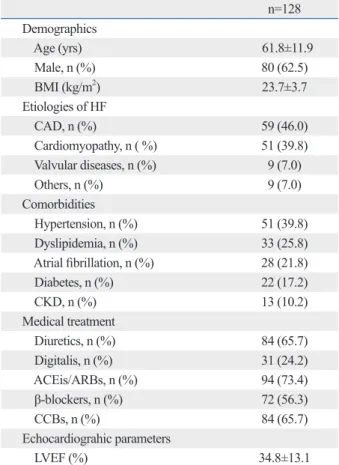
Table 1 presents the baseline characteristics of all HF pa- tients. This study consisted of 128 HF patients (80 of whom were male) with a mean age of 61.8±11.9 years. Most of the subjects were in New York Heart Association functional class I (47.7%) and II (52.3%). Coronary artery disease was the most common etiology of HF (46.0%). Hypertension (39.8%), dyslipidemia (25.8%), and atrial fibrillation (21.8%) were common prevalent comorbidities. Medical treatment for all subjects consisted of diuretics (65.7%), digitalis (24.2%), angiotensin converting enzyme inhibitors and/or angiotensin II receptor blockers (73.4%), β-blockers (56.3%) and calcium channel blockers (65.7%). The mean LVEF was 34.8±13.1% among all HF patients.
Adiponectin and its correlations with variables in HF patients
Plasma adiponectin concentrations were correlated with body mass index (BMI) (r=-0.352, p<0.001), waist circum- ference (r=-0.336, p<0.001), triglyceride (r=-0.402, p<0.001), HDL-cholesterol (r=0.359, p<0.001), apoB (r=-0.265, p=0.025), apoB/A1 ratio (r=-0.273, p=0.021), hemoglobin (r=-0.260, p=0.003), albumin (r=-0.193, p=0.029) and fast- ing glucose (r=-0.185, p=0.037) (Table 2). However, no asso- ciation was found between adiponectin and hsCRP, nor was adiponectin correlated with fasting insulin and HOMA-IR.
Table 1. Baseline Characteristics for All HF Patients n=128 Demographics
Age (yrs) 61.8±11.9
Male, n (%) 80 (62.5)
BMI (kg/m2) 23.7±3.7
Etiologies of HF
CAD, n (%) 59 (46.0)
Cardiomyopathy, n ( %) 51 (39.8)
Valvular diseases, n (%) 9 (7.0)
Others, n (%) 9 (7.0)
Comorbidities
Hypertension, n (%) 51 (39.8)
Dyslipidemia, n (%) 33 (25.8)
Atrial fibrillation, n (%) 28 (21.8)
Diabetes, n (%) 22 (17.2)
CKD, n (%) 13 (10.2)
Medical treatment
Diuretics, n (%) 84 (65.7)
Digitalis, n (%) 31 (24.2)
ACEis/ARBs, n (%) 94 (73.4)
β-blockers, n (%) 72 (56.3)
CCBs, n (%) 84 (65.7)
Echocardiograhic parameters
LVEF (%) 34.8±13.1
HF, heart failure; BMI, body mass index; CAD, coronary artery disease;
CKD, chronic kidney disease; ACEis, angiotension converting enzyme inhibitors; ARBs, angiotension II receptor blockers; CCBs, calcium channel blockers; LVEF, left ventricular ejection fraction.
Values are expressed as mean±SD.
Table 2. Factors Correlated with Adiponectin Concentra- tions in All HF Patients
Variables Coefficient p value
BMI (kg/m2) -0.352 <0.001
Waist circumference (cm) -0.336 <0.001 Triglyceride (mg/dL)*,† -0.402 <0.001 HDL-cholesterol (mg/dL)* 0.359 <0.001
ApoB (mg/L)* -0.265 0.025
ApoB/A1* -0.273 0.021
Hemoglobin (g/dL) -0.260 0.003
Albumin (mg/dL)* -0.193 0.029
Glucose, fasting (mg/dL) -0.185 0.037
LAVI (mL/m2) 0.197 0.026
E/E’ 0.217 0.021
HF, heart failure; BMI, body mass index; HDL, high density lipoprotein;
Apo, apolipoprotein; LAVI, left atrial volume index; E/E’, early mitral inflow velocity to early diastolic mitral annular velocity ratio.
*Significant variables after adjustment for age, sex and BMI.
†Triglyceride was log-transformed for analysis.
(p<0.001), and chronic kidney disease (p<0.001) were sig- nificantly higher in HF patients with MetS than in those without MetS.
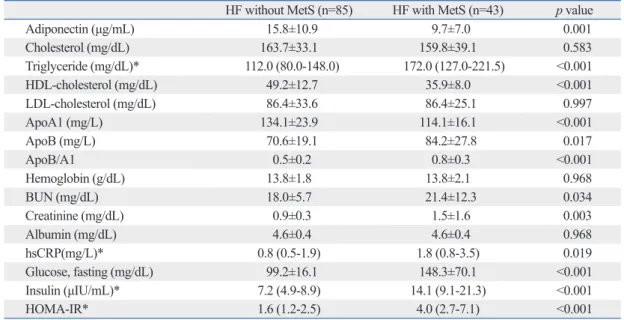
We compared the concentrations of adiponectin, lipopro- teins, apolipoproteins and other laboratory parameters be- tween the two groups (Table 4). Serum concentrations of glucose, triglyceride and HDL-cholesterol were differed significantly between the two groups, while serum total cholesterol levels were similar. Concentrations of adiponec- tin were significantly lower in HF patients with MetS (9.7±
7.0 μg/mL) than in HF patients without MetS (15.8±10.9 μg/mL) (p=0.001). Adiponectin level was also lower in HF with MetS than with HF without MetS after adjusting age and BMI in ANCOVA analysis (p=0.006). Higher concentra- tions of blood urea nitrogen (p=0.034), creatinine (p=0.003), hsCRP (p=0.019), fasting glucose (p<0.001), fasting insulin (p<0.001), and HOMA-IR (p<0.001) were observed in HF concentrations after adjusting for age, gender, and BMI.
Plasma adiponectin concentrations were significantly and positively correlated with LAVI (r=0.197, p=0.026) and E/
E’ (r=0.217, p=0.021), however, no significant association was found between adiponectin concentrations and LVEF.
Adiponectin and MetS in HF patients
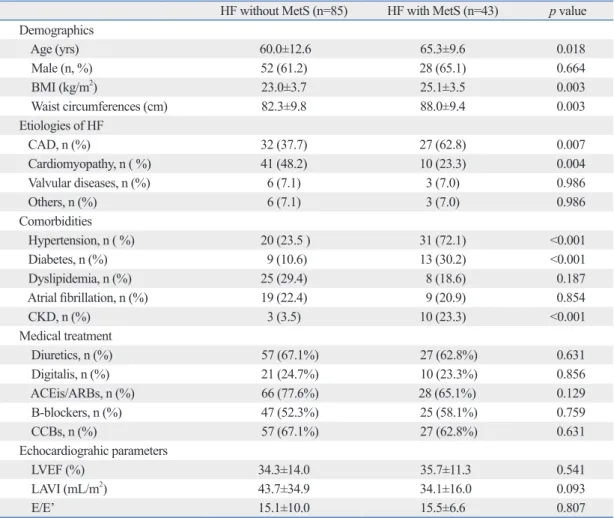
Among the total 128 HF patients, 43 subjects (33.6% of to- tal, 28 males) had MetS. As presented in Table 3, gender, medical treatment and echocardiographic parameters were similar between HF patients with and without MetS. HF patients with MetS were significantly older than HF pa- tients without MetS. As expected, the BMIs (p=0.003) and waist circumferences (p=0.003) of HF patients with MetS were significantly higher compared with those without MetS.
The proportions of the patients with coronary artery disease (p=0.007), hypertension (p<0.001), type 2 diabetes mellitus
Table 3. Baseline Characteristics and Echocardiographic Parameters of HF Patients without MetS and HF Pa- tients with MetS
HF without MetS (n=85) HF with MetS (n=43) p value Demographics
Age (yrs) 60.0±12.6 65.3±9.6 0.018
Male (n, %) 52 (61.2) 28 (65.1) 0.664
BMI (kg/m2) 23.0±3.7 25.1±3.5 0.003
Waist circumferences (cm) 82.3±9.8 88.0±9.4 0.003
Etiologies of HF
CAD, n (%) 32 (37.7) 27 (62.8) 0.007
Cardiomyopathy, n ( %) 41 (48.2) 10 (23.3) 0.004
Valvular diseases, n (%) 6 (7.1) 3 (7.0) 0.986
Others, n (%) 6 (7.1) 3 (7.0) 0.986
Comorbidities
Hypertension, n ( %) 20 (23.5 ) 31 (72.1) <0.001
Diabetes, n (%) 9 (10.6) 13 (30.2) <0.001
Dyslipidemia, n (%) 25 (29.4) 8 (18.6) 0.187
Atrial fibrillation, n (%) 19 (22.4) 9 (20.9) 0.854
CKD, n (%) 3 (3.5) 10 (23.3) <0.001
Medical treatment
Diuretics, n (%) 57 (67.1%) 27 (62.8%) 0.631
Digitalis, n (%) 21 (24.7%) 10 (23.3%) 0.856
ACEis/ARBs, n (%) 66 (77.6%) 28 (65.1%) 0.129
Β-blockers, n (%) 47 (52.3%) 25 (58.1%) 0.759
CCBs, n (%) 57 (67.1%) 27 (62.8%) 0.631
Echocardiograhic parameters
LVEF (%) 34.3±14.0 35.7±11.3 0.541
LAVI (mL/m2) 43.7±34.9 34.1±16.0 0.093
E/E’ 15.1±10.0 15.5±6.6 0.807
HF, heart failure; BMI, body mass index; MetS, metabolic syndrome; CAD, coronary artery disease; CKD, chronic kidney disease; ACEis, angiotension converting enzyme inhibitors; ARBs, angiotension II receptor blockers; CCBs, calcium channel blockers; LVEF, left ventricu- lar ejection fraction; LAVI, left atrial volume index; E/E’, early mitral inflow velocity to early diastolic mitral annular velocity ratio.
Values are expressed as mean±SD.
and insulin resistance by the 5’-adenosine monophosphate- activated kinase signaling pathway, and decreases also free fatty acid concentrations by stimulating fatty acid oxidation in muscle.16 Thus, adiponectin may act as a potential link between MetS and its cardiovascular consequences. Hypo- adiponectinemia has already been shown to be associated patients with MetS than in those without. The apoB and
apoB/A1 ratio were significantly higher in HF patients with MetS than in those without MetS. Although hsCRP concen- trations in HF patients with MetS were relatively higher than in those without MetS, this difference was not statisti- cally significant (8.3±26.7 vs. 4.6±15.9 mg/L, p=0.433).
In HF patients with MetS, plasma adiponectin concentra- tions were correlated with waist circumference (r=-0.337, p=0.031), hemoglobin (r=-0.508, p=0.001) and E/E’ (r=0.399, p=0.015) (Table 5). Fig. 1 shows the trends of adiponectin concentrations according to MetS severity score: as MetS se- verity scores increased, adiponectin concentrations decreased significantly in HF with MetS (p for trend=0.012).
DISCUSSION
The purpose of this study was to investigate whether the presence of MetS was associated with the degree of plasma adiponectin concentrations in HF patients. We demonstrat- ed that concentrations of adiponectin were significantly lower in HF patients with MetS than in those without MetS.
Furthermore, plasma adiponectin concentrations tended to decrease in HF patients as the number of MetS components increased.
Adiponectin specifically secreted from adipose tissue is an adipokine. Adiponectin modulates glucose metabolism
Table 4. Laboratory Findings for HF Patients without MetS and with MetS
HF without MetS (n=85) HF with MetS (n=43) p value
Adiponectin (μg/mL) 15.8±10.9 9.7±7.0 0.001
Cholesterol (mg/dL) 163.7±33.1 159.8±39.1 0.583
Triglyceride (mg/dL)* 112.0 (80.0-148.0) 172.0 (127.0-221.5) <0.001
HDL-cholesterol (mg/dL) 49.2±12.7 35.9±8.0 <0.001
LDL-cholesterol (mg/dL) 86.4±33.6 86.4±25.1 0.997
ApoA1 (mg/L) 134.1±23.9 114.1±16.1 <0.001
ApoB (mg/L) 70.6±19.1 84.2±27.8 0.017
ApoB/A1 0.5±0.2 0.8±0.3 <0.001
Hemoglobin (g/dL) 13.8±1.8 13.8±2.1 0.968
BUN (mg/dL) 18.0±5.7 21.4±12.3 0.034
Creatinine (mg/dL) 0.9±0.3 1.5±1.6 0.003
Albumin (mg/dL) 4.6±0.4 4.6±0.4 0.968
hsCRP(mg/L)* 0.8 (0.5-1.9) 1.8 (0.8-3.5) 0.019
Glucose, fasting (mg/dL) 99.2±16.1 148.3±70.1 <0.001
Insulin (μIU/mL)* 7.2 (4.9-8.9) 14.1 (9.1-21.3) <0.001
HOMA-IR* 1.6 (1.2-2.5) 4.0 (2.7-7.1) <0.001
HF, heart failure; MetS, metabolic syndrome; HDL, high density lipoprotein; LDL, low density lipoprotein; BUN, blood urea nitrogen;
hsCRP, high sensitive C-reactive protein; HOMA-IR, the homeostasis model assessment of insulin resistance.
Values are expressed as mean±SD.
*Values were expressed as median (lower quartile-upper quartile), p value from Mann-Whitney U test.
Table 5. Factors Correlated with Adiponectin Concentra- tions in HF Patients with MetS
Variables Coefficient p value
Waist circumference (cm) -0.337 0.031
Hemoglobin (g/dL) -0.508 0.001
E/E’ 0.399 0.043
HF, heart failure; MetS, metabolic syndrome; E/E’, early mitral inflow ve- locity to early diastolic mitral annular velocity ratio.
Fig. 1. Adiponectin concentrations according to MetS severity score.
MetS, metabolic syndrome.
0 5 10 15 20 25 30 35
Serum adiponectin (μg/mL)
1 (n=33) 2 (n=28) 3 (n=30) 4 (n=11) 5 (n=2) MetS severity score
p for trend=0.012
tween adiponectin concentrations and LVEF among all the HF patients and with MetS, while plasma adiponectin con- centrations correlated significantly and positively with LAVI and E/E’ in all HF patients. Previous study reported that ad- iponectin had significant correlation with LA size and volume after adjusting confounding factors, which were associated with the severity and chronicity of diastolic dysfunction. The LV diastolic dysfunction in tissue Doppler imaging (e.g. el- evated E/E’) presents subclinical myocardial dysfunction in general population and a better independent predictor than LVEF in systolic heart failure patients.27-30 As far as we are aware of, this is the first report about the association between adiponectin and E/E’, suggesting that adiponectin could be a surrogate marker of subclinical myocardial dysfunction.
Interestingly, the correlation between adiponectin and E/E’
existed only in HF patients with MetS, but not in HF patients without MetS. This is consistent with recent reports that LV diastolic function and structure are associated with meta- bolic syndrome and insulin resistance.31
The use of β-blockers might improve metabolic profiles by improving insulin sensitivity.32,33 Yamaji, et al.34 reported that carvedilol treatment in patients with HF reduced plas- ma adiponectin levels and was associated with improvement of LVEF. In addition, Van Berendoncks, et al.35 showed that high adiponectin levels predicted poor outcomes in HF pa- tients, but its prognostic value was significantly affected by β-blocker treatment. This effect of β-blocker therapy on ad- iponectin levels was only significant in patients with lower BMI (<30 kg/m2). In our present study, HF patients without MetS who had a relatively low BMI and were treated with β-blockers (carvedilol and bisoprolol) had significantly low- er adiponectin concentrations than those not given β-blockers (data not shown).
The limitations of this study include its relatively small sample size and cross-sectional design. The cross-sectional setting of this study made it difficult to draw causality. Fur- ther studies will be warranted to investigate the effects of adiponectin on the progression of HF with MetS. Second, adiponectin concentrations have been found to increase in parallel to increases in brain natriuretic peptide (BNP) in HF patients.36 However, we were unfortunately unable to measure BNP levels in this study, therefore, we could not investigate the relationship between BNP levels and adipo- nectin concentrations in HF patients with or without MetS.
Moreover, because all the patients had been diagnosed with systolic HF at our heart failure clinic and they were rela- tively non-obese, our results should be interpreted with cau- with obesity, diabetes mellitus, insulin resistance and coro-
nary artery disease.1,2,5,6,17-19 However, the recent literatures suggest that HF patients have significantly higher adiponec- tin concentrations.9,10 Although the mechanism is not clear, the possible reasons for high adiponectin concentrations in HF could be compensatory response to HF progression or adiponectin resistance.20,21 Takano, et al.22 also showed that adiponectin released from the heart may partly contribute to the increased adiponectin concentrations which are seen in the peripheral circulation of HF patients. Moreover, a high adiponectin concentration is a predictor of mortality of HF patients, independent of the risk markers of HF severity.10 Our results suggest that the presence of MetS may have an effect on the adiponectin concentration in HF patients, which implies that adiponectin may contribute to the progression of HF associated with MetS.
Plasma adiponectin concentrations are related to several clinical variables. The present study confirmed several cor- relations with variables including BMI, waist circumfer- ence, triglyceride, apoB, apoB/A1 ratio, and fasting glucose in HF patients. ApoB/A1 ratio has been found to be associ- ated strongly with insulin resistance.20 Park, et al.21 demon- strated that apoB/A1 ratio was significantly correlated with adiponectin level in Koreans. In addition, Ingelsson, et al.23 reported that apoB/A1 ratio was an independent risk factor for HF. We found in the present study that adiponectin was negatively associated with apoB/A1 ratio in HF patients, even after adjustment for age, gender, and BMI.
Inflammation plays an important role in the pathogenesis and progression of HF. CRP has been found to be consis- tently elevated in HF and MetS patients. Our study showed that the concentrations of hsCRP were relatively higher in HF patients with MetS than in those without MetS, howev- er, it did not reach statistical significance. It might have been due to relatively small sample size. Adiponectin has been found to correlate negatively with CRP.24 We found that hsCRP was negatively correlated with adiponectin con- centrations in HF patients with MetS, although not in all HF patients.
Previous studies showed that adiponectin was correlated with cardiac geometry and function. Gustafsson, et al.25 showed that adiponectin was inversely associated with LVEF in elderly men in a community-based cohort, even after ad- justing for BMI. In addition, Unno, et al.26 reported that adi- ponectin levels were positively associated with diastolic dys- function in patients with hypertrophic cardiomyopathy. In the present study, no significant association was found be-
9. George J, Patal S, Wexler D, Sharabi Y, Peleg E, Kamari Y, et al.
Circulating adiponectin concentrations in patients with congestive heart failure. Heart 2006;92:1420-4.
10. Kistorp C, Faber J, Galatius S, Gustafsson F, Frystyk J, Flyvbjerg A, et al. Plasma adiponectin, body mass index, and mortality in patients with chronic heart failure. Circulation 2005;112:1756-62.
11. Tsutamoto T, Tanaka T, Sakai H, Ishikawa C, Fujii M, Yamamoto T, et al. Total and high molecular weight adiponectin, haemody- namics, and mortality in patients with chronic heart failure. Eur Heart J 2007;28:1723-30.
12. Celik T, Yaman H. Elevated adiponectin levels in patients with chronic heart failure: an independent predictor of mortality or a marker of cardiac cachexia? Int J Cardiol 2010;144:319-20.
13. Steering Committee of the WHO Western Pacific Region, IASO
& IOTF. The Asia-Pacific perspective: redefining obesity and its treatment. Austrailia; 2000.
14. Tamariz L, Hassan B, Palacio A, Arcement L, Horswell R, Hebert K. Metabolic syndrome increases mortality in heart failure. Clin Cardiol 2009;32:327-31.
15. National Kidney Foundation. K/DOQI clinical practice guidelines for chronic kidney disease: evaluation, classification, and stratifi- cation. Am J Kidney Dis 2002;39:S1-266.
16. Matthews DR, Hosker JP, Rudenski AS, Naylor BA, Treacher DF, Turner RC. Homeostasis model assessment: insulin resistance and beta-cell function from fasting plasma glucose and insulin concen- trations in man. Diabetologia 1985;28:412-9.
17. Shim CY, Park S, Kim JS, Shin DJ, Ko YG, Kang SM, et al. As- sociation of plasma retinol-binding protein 4, adiponectin, and high molecular weight adiponectin with insulin resistance in non- diabetic hypertensive patients. Yonsei Med J 2010;51:375-84.
18. Salas-Salvadó J, Granada M, Bulló M, Corominas A, Casas P, Foz M. Plasma adiponectin distribution in a Mediterranean population and its association with cardiovascular risk factors and metabolic syndrome. Metabolism 2007;56:1486-92.
19. Koh SB, Yoon J, Kim JY, Yoo BS, Lee SH, Park JK, et al. Rela- tionships between serum adiponectin with metabolic syndrome and components of metabolic syndrome in non-diabetic Koreans:
ARIRANG Study. Yonsei Med J 2011;52:234-41.
20. Yusuf S, Hawken S, Ounpuu S, Bautista L, Franzosi MG, Com- merford P, et al. Obesity and the risk of myocardial infarction in 27,000 participants from 52 countries: a case-control study. Lancet 2005;366:1640-9.
21. Park JS, Cho MH, Nam JS, Yoo JS, Lee YB, Roh JM, et al. Adi- ponectin is independently associated with apolipoprotein B to A-1 ratio in Koreans. Metabolism 2010;59:677-82.
22. Takano H, Obata JE, Kodama Y, Kitta Y, Nakamura T, Mende A, et al. Adiponectin is released from the heart in patients with heart failure. Int J Cardiol 2009;132:221-6.
23. Ingelsson E, Arnlöv J, Sundström J, Zethelius B, Vessby B, Lind L. Novel metabolic risk factors for heart failure. J Am Coll Cardiol 2005;46:2054-60.
24. Sugiura K, Tamakoshi K, Yatsuya H, Otsuka R, Wada K, Matsu- shita K, et al. Contribution of adipocytokines to low-grade inflam- matory state as expressed by circulating C-reactive protein in Jap- anese men: comparison of leptin and adiponectin. Int J Cardiol 2008;130:159-64.
25. Gustafsson S, Lind L, Zethelius B, Venge P, Flyvbjerg A, Söder- berg S, et al. Adiponectin and cardiac geometry and function in el- derly: results from two community-based cohort studies. Eur J Endocrinol 2010;162:543-50.
tion. Third, weight loss and cardiac cachexia cause signifi- cant increases in circulating adiponectin concentrations.37 We had no information as to whether weight loss occurred in our HF patients.
In conclusion, we have shown that plasma adiponectin concentrations were significantly lower in HF patients with MetS than in those without MetS, and were significantly correlated with hsCRP and E/E’ in HF patients with MetS.
Also, there is a tendency toward decreased plasma adiponec- tin concentrations according to the severity score of MetS.
This study implies that decreased plasma concentrations of adiponectin in HF patients with MetS are associated with inflammation and abnormal diastolic function, which could lead to progression of HF.
ACKNOWLEDGEMENTS
This study was supported by a grant from KRIBB Research Initiative Program.
REFERENCES
1. Arita Y, Kihara S, Ouchi N, Takahashi M, Maeda K, Miyagawa J, et al. Paradoxical decrease of an adipose-specific protein, adipo- nectin, in obesity. Biochem Biophys Res Commun 1999;257:79- 2. Pellmé F, Smith U, Funahashi T, Matsuzawa Y, Brekke H, 83.
Wiklund O, et al. Circulating adiponectin levels are reduced in nonobese but insulin-resistant first-degree relatives of type 2 dia- betic patients. Diabetes 2003;52:1182-6.
3. Ouchi N, Kihara S, Funahashi T, Nakamura T, Nishida M, Kuma- da M, et al. Reciprocal association of C-reactive protein with adi- ponectin in blood stream and adipose tissue. Circulation 2003;107:
671-4.
4. Matsushita K, Yatsuya H, Tamakoshi K, Wada K, Otsuka R, Take- fuji S, et al. Comparison of circulating adiponectin and proinflam- matory markers regarding their association with metabolic syn- drome in Japanese men. Arterioscler Thromb Vasc Biol 2006;26:
871-6.
5. Kumada M, Kihara S, Sumitsuji S, Kawamoto T, Matsumoto S, Ouchi N, et al. Association of hypoadiponectinemia with coronary artery disease in men. Arterioscler Thromb Vasc Biol 2003;23:85-9.
6. Hashimoto N, Kanda J, Nakamura T, Horie A, Kurosawa H, Hashimoto T, et al. Association of hypoadiponectinemia in men with early onset of coronary heart disease and multiple coronary artery stenoses. Metabolism 2006;55:1653-7.
7. Adamczak M, Wiecek A, Funahashi T, Chudek J, Kokot F, Matsu- zawa Y. Decreased plasma adiponectin concentration in patients with essential hypertension. Am J Hypertens 2003;16:72-5.
8. Biolo A, Shibata R, Ouchi N, Kihara S, Sonoda M, Walsh K, et al.
Determinants of adiponectin levels in patients with chronic systol- ic heart failure. Am J Cardiol 2010;105:1147-52.
2011. [Epub ahead of print]
32. Kirpichnikov D, McFarlane SI, Sowers JR. Heart failure in dia- betic patients: utility of beta-blockade. J Card Fail 2003;9:333-44.
33. Kovacić D, Marinsek M, Gobec L, Lainscak M, Podbregar M. Ef- fect of selective and non-selective beta-blockers on body weight, insulin resistance and leptin concentration in chronic heart failure.
Clin Res Cardiol 2008;97:24-31.
34. Yamaji M, Tsutamoto T, Tanaka T, Kawahara C, Nishiyama K, Yamamoto T, et al. Effect of carvedilol on plasma adiponectin concentration in patients with chronic heart failure. Circ J 2009;
73:1067-73.
35. Van Berendoncks AM, Beckers P, Hoymans VY, Possemiers N, Coenen S, Elseviers MM, et al. Beta-blockers modify the prog- nostic value of adiponectin in chronic heart failure. Int J Cardiol 2011;150:296-300.
36. Haugen E, Furukawa Y, Isic A, Fu M. Increased adiponectin level in parallel with increased NT-pro BNP in patients with severe heart failure in the elderly: a hospital cohort study. Int J Cardiol 2008;125:216-9.
37. Coughlin CC, Finck BN, Eagon JC, Halpin VJ, Magkos F, Mo- hammed BS, et al. Effect of marked weight loss on adiponectin gene expression and plasma concentrations. Obesity (Silver Spring) 2007;15:640-5.
26. Unno K, Shibata R, Izawa H, Hirashiki A, Murase Y, Yamada T, et al. Adiponectin acts as a positive indicator of left ventricular dia- stolic dysfunction in patients with hypertrophic cardiomyopathy.
Heart 2010;96:357-61.
27. Kuznetsova T, Herbots L, López B, Jin Y, Richart T, Thijs L, et al.
Prevalence of left ventricular diastolic dysfunction in a general population. Circ Heart Fail 2009;2:105-12.
28. Perry GJ, Ahmed MI, Desai RV, Mujib M, Zile M, Sui X, et al.
Left ventricular diastolic function and exercise capacity in com- munity-dwelling adults ≥65 years of age without heart failure. Am J Cardiol 2011;108:735-40.
29. Sharp AS, Tapp RJ, Thom SA, Francis DP, Hughes AD, Stanton AV, et al. Tissue Doppler E/E’ ratio is a powerful predictor of pri- mary cardiac events in a hypertensive population: an ASCOT sub- study. Eur Heart J 2010;31:747-52.
30. Gardin JM, Leifer ES, Fleg JL, Whellan D, Kokkinos P, Leblanc MH, et al. Relationship of Doppler-Echocardiographic left ven- tricular diastolic function to exercise performance in systolic heart failure: the HF-ACTION study. Am Heart J 2009;158:S45-52.
31. Hwang YC, Jee JH, Kang M, Rhee EJ, Sung J, Lee MK. Metabol- ic syndrome and insulin resistance are associated with abnormal left ventricular diastolic function and structure independent of blood pressure and fasting plasma glucose level. Int J Cardiol