ABSTRACT
Background and Objectives: A relationship between renin-angiotensin system (RAS) components and metabolic syndrome (MetS) has been suggested, but not elucidated clearly.
We examined the levels of RAS components in patients with and without MetS and their association with MetS in Korean population.
Methods: This study was approved by the review boards of the participating institutions and endorsed by the Korean Society of Lipid and Atherosclerosis. We screened 892 Koreans aged
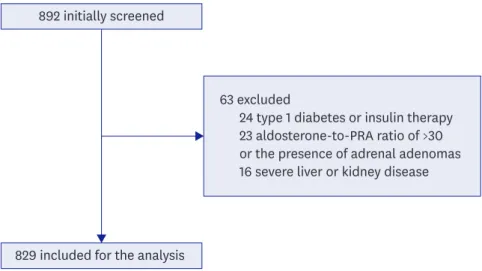
≥20 years who underwent evaluation of hypertension, diabetes, or dyslipidemia at 6 tertiary hospitals in 2015–2016. After excluding patients who were taking diuretics, β-blockers, or RAS blockers, or suspected of primary aldosteronism, 829 individuals were enrolled.
Anthropometric and biochemical parameters including aldosterone, plasma renin activity (PRA), and aldosterone-to-PRA ratio were evaluated. The homeostasis model assessment for insulin resistance (HOMA-IR) were used for evaluating insulin resistance.
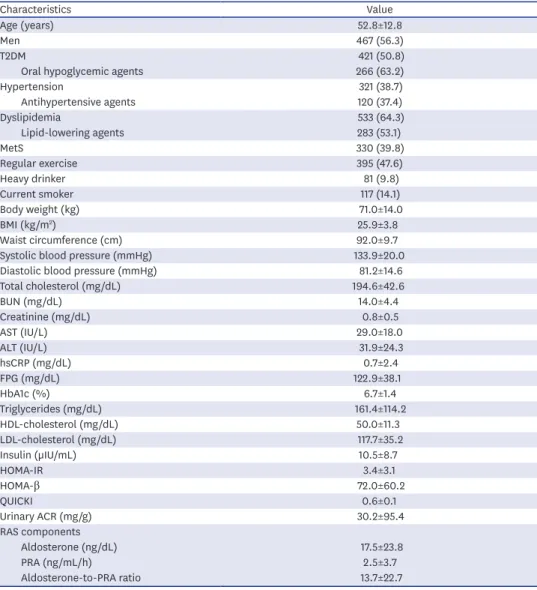
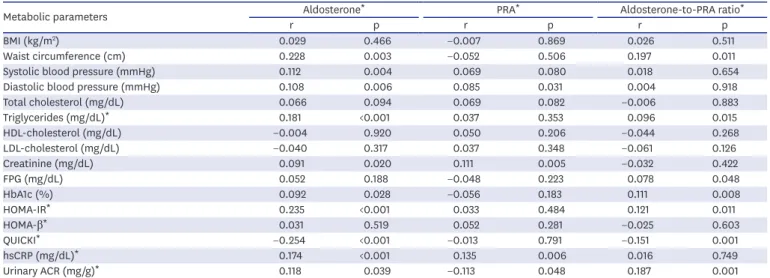
Results: The mean age of the participants was 52.8±12.8 years, 56.3% were male, and their mean systolic and diastolic blood pressures were 133.9±20.0 and 81.2±14.6 mmHg, respectively. The levels of serum aldosterone, but not PRA, were significantly higher in subjects with MetS than in those without (20.6±33.6 vs. 15.3±12.2 ng/dL, p<0.05), and positively correlated with waist circumference, blood pressure, triglycerides, and glycated hemoglobin. The levels of aldosterone were independently associated with the number of MetS components and HOMA-IR after adjusting for conventional risk factors.
Conclusion: Serum aldosterone levels were higher in Korean adults with MetS than in those without. This finding suggests that increased aldosterone level might be closely associated with insulin resistance.
Original Article
Received: Sep 3, 2017 Revised: Nov 13, 2017 Accepted: Nov 21, 2017 Correspondence to Soo Lim, MD, PhD
Department of Internal Medicine, Seoul National University Bundang Hospital, Seoul National University College of Medicine, 82, Gumi-ro, Bundang-gu, Seongnam 13620, Korea.
E-mail: [email protected]
Copyright © 2018. The Korean Society of Cardiology
This is an Open Access article distributed under the terms of the Creative Commons Attribution Non-Commercial License (https://
creativecommons.org/licenses/by-nc/4.0) which permits unrestricted noncommercial use, distribution, and reproduction in any medium, provided the original work is properly cited.
ORCID iDs Se Hee Min
https://orcid.org/0000-0001-9423-3937 Se-Hong Kim
https://orcid.org/0000-0001-6465-8993 In-Kyung Jeong
https://orcid.org/0000-0001-7857-546X Ho Chan Cho
https://orcid.org/0000-0002-3727-000X Jin-Ok Jeong
https://orcid.org/0000-0003-0763-4754 Ju-Hee Lee
https://orcid.org/0000-0002-0858-0973 Hyun-Jae Kang
https://orcid.org/0000-0002-3500-1746 Hyo Soo Kim
https://orcid.org/0000-0003-2977-6323
Se Hee Min , MD 1 , Se-Hong Kim , MD, PhD 2 , In-Kyung Jeong , MD, PhD 3 , Ho Chan Cho , MD, PhD 4 , Jin-Ok Jeong , MD, PhD 5 , Ju-Hee Lee , MD 6 ,
Hyun-Jae Kang , MD, PhD 1 , Hyo Soo Kim , MD, PhD 1 , Kyong Soo Park , MD, PhD 1 , and Soo Lim , MD, PhD 7
1
Department of Internal Medicine, Seoul National University College of Medicine, Seoul, Korea
2
Department of Family Medicine, St. Vincent's Hospital, The Catholic University of Korea College of Medicine, Suwon, Korea
3
Department of Internal Medicine, Kyung Hee University Hospital at Gangdong, Kyung Hee University College of Medicine, Seoul, Korea
4
Department of Internal Medicine, Keimyung University Dongsan Medical Center, Daegu, Korea
5
Department of Internal Medicine, Chungnam National University Hospital, Chungnam National University School of Medicine, Daejeon, Korea
6
Department of Internal Medicine, Chungbuk National University Hospital, Chungbuk National University College of Medicine, Cheongju, Korea
7