• 검색 결과가 없습니다.

The Prognostic Implication of Metabolic Syndrome in Patients with Heart Failure

N/A
N/A
Protected

Academic year: 2021

Share "The Prognostic Implication of Metabolic Syndrome in Patients with Heart Failure"

Copied!
6
0
0

로드 중.... (전체 텍스트 보기)

전체 글

(1)

Korean Circulation Journal

Introduction

Heart failure (HF) is responsible for an increasingly large propor- tion of cardiovascular morbidity and mortality. Hypertension and coronary heart disease (CHD) are considered to be the main causes of HF.

1)

Diabetes, smoking, obesity, and dyslipidemia are also asso-

Print ISSN 1738-5520 • On-line ISSN 1738-5555

The Prognostic Implication of Metabolic Syndrome in Patients with Heart Failure

Hyun Ju Yoon, MD 1 , Youngkeun Ahn, MD 1 , Kye Hun Kim, MD 1 , Jong Chun Park, MD 1 , Dong-Ju Choi, MD 2 , Seongwoo Han, MD 3 , Eun-Seok Jeon, MD 4 , Myung-Chan Cho, MD 5 , Jae-Joong Kim, MD 6 , Byung-Su Yoo, MD 7 , Mi-Seung Shin, MD 8 , In-Whan Seong, MD 9 , Seok-Min Kang, MD 10 , Yung-Jo Kim, MD 11 , Hyung Seop Kim, MD 12 , Shung Chull Chae, MD 13 , Byung-Hee Oh, MD 14 , Myung-Mook Lee, MD 15 , Kyu-Hyung Ryu, MD 16 , and

on behalf of the Korea HF Registry

1

Department of Cardiology, Chonnam National University Hospital, Gwangju,

2

Department of Cardiology, Seoul National University College of Medicine, Bundang Hospital, Seongnam,

3

Department of Cardiology, Hallym University College of Medicine, Kangnam Sacred Heart Hospital, Seoul,

4

Department of Cardiology,

Sungkyunkwan University College of Medicine, Samsung Medical Center, Seoul,

5

Department of Cardiology, Chungbuk National University College of Medicine, Cheongju,

6

Department of Cardiology, University of Ulsan College of Medicine, Asan Medical Center, Seoul,

7

Department of Cardiology, Yonsei University Wonju Christian Hospital, Wonju,

8

Department of Cardiology, Gachon University Gil Hospital, Incheon,

9

Department of Cardiology, Chungnam National University Hospital, Daejeon,

10

Department of Cardiology, Yonsei University Severance Hospital, Seoul,

11

Department of Cardiology, Yeungnam University College of Medicine, Daegu,

12

Department of Cardiology, Keimyung University College of Medicine, Daegu,

13

Department of Cardiology, Kyungpook National University College of Medicine, Busan,

14

Department of Cardiology, Seoul National University College of Medicine, Seoul,

15

Department of Cardiology, Dongguk University College of Medicine, Ilsan Hospital, Goyang,

16

Department of Cardiology, Hallym University College of Medicine, Dongtan Sacred Heart Hospital, Hwaseong, Korea

Background and Objectives: Metabolic syndrome (MetS) increases the risk of heart failure (HF). The purpose of this study was to identi- fy the prevalence of MetS in patients with HF and determine the syndrome’s association with HF in clinical and laboratory parameters.

Subjects and Methods: A total of 3200 HF patients (67.6±14.5 years) enrolled in a nationwide prospective Korea HF Registry between Jan. 2005 and Oct. 2009. Patients were divided into two groups according to the presence or absence of MetS at admission: group I (pres- ence, n=1141) and group II (absence, n=2059).

Results: The prevalence of MetS was 35.7% across all subjects and was higher in females (56.0%). The levels of white blood cells, platelets, creatinine, glucose, and cholesterol were significantly higher in group I than in group II. Left ventricular dimension and volume was smaller and ejection fraction was higher in group I than in group II. An ischemic cause of HF was more frequent in group I. The rates of valvular and idiopathic cause were lower in group I than in group II. The rate of mortality was lower in group I than in group II (4.9% vs. 8.3%, p<0.001).

Conclusion: Despite the increased cardiovascular risks in MetS, MetS was found to be associated with decreased mortality in HF. (Korean Circ J 2013;43:87-92)

KEY WORDS: Metabolic syndrome; Heart failure.

Received: June 20, 2012 / Revision Received: August 27, 2012 / Accepted: October 8, 2012

Correspondence: Youngkeun Ahn, MD, Department of Cardiology, Chonnam National University Hospital, 671 Jaebong-ro, Dong-gu, Gwangju 501-757, Korea

Tel: 82-62-220-4764, Fax: 82-62-224-4764, E-mail: [email protected]

• The authors have no financial conflicts of interest.

This is an Open Access article distributed under the terms of the Creative Commons Attribution Non-Commercial License (http://creativecommons.org/licenses/

by-nc/3.0) which permits unrestricted non-commercial use, distribution, and reproduction in any medium, provided the original work is properly cited.

ciated with HF.

2-5)

The main features of metabolic syndrome (MetS)

include insulin resistance, hypertension (high blood pressure), cho-

lesterol abnormalities, and increased risk of clotting. Patients are

likely to be overweight or obese. MetS, which comprises a cluster

of cardiovascular risk factors, also increases the risk of cardiovascu-

lar disease (CVD) and many of its components can lead to HF. Some-

(2)

times medications for HF can affect the components of MetS. Like- wise, the treatment of MetS can also affect the prognosis of HF.

6)

The association between MetS and HF has been less studied than that between MetS and CHD. It is unknown whether MetS is associated with HF independent of myocardial infarction (MI) and diabetes mellitus. Therefore, the aim of the present study was to in- vestigate the prevalence of MetS in patients with HF and determine whether the presence or absence of MetS is associated with the clinical outcome of HF.

Subjects and Methods

Study population and grouping

From the nationwide prospective Korea HF Registry (KorHFR), 3200 HF patients were enrolled from 24 centers in Korea between Jan. 2005 and Oct. 2009. The patients had been admitted to hospi- tal for HF that was confirmed at the time of discharge. The data was recorded via a web-based electronic capture system, which also re- corded follow up events. Data collection and audition were per- formed by the KorHF Registry Steering of the Korean Society of He- art Failure.

The patients were divided into two groups according to the pres- ence or absence of MetS at the time of admission, with MetS defin- ed as the presence of three or more criteria from the National Cho- lesterol Education Program (NCEP) and the American Association of Clinical Endocrinologists criteria (AACE). Patients were separated into group I (presence, n=1141) and group II (absence, n=2059).

The study protocol was approved by the Institutional Review Bo- ard or ethics committee at each participating hospital. Approval was obtained from Chonnam National University Hospital (No=06-타).

Definitions of the metabolic syndrome and other risk factors The present study was based on the NCEP, AACE, and American Heart Association (AHA) definitions of MetS, which all include sub- jects with diabetes mellitus in their definitions.

7)8)

With respect to ob- esity, body mass index (BMI) was used according to the AACE crite- ria. MetS was defined as presence of ≥3 of the following criteria:

high blood pressure (≥130 mm Hg systolic or ≥85 mm Hg diastolic blood pressure) or taking blood pressure medication, impaired glu- cose tolerance (fasting blood glucose ≥110 mg/dL) or diagnosed diabetes, obesity (BMI >25), triglycerides >150 mg/dL, high density lipoprotein-cholesterol (HDL-C) <40 mg/dL in men or <50 mg/dL in women. Weight, height, and blood pressure were measured at ba- seline. BMI was calculated as the weight in kilograms divided by the square of the height in meters. Smoking status was defined as cur- rent smoking. With respect to alcohol consumption, subjects were classified as alcohol users or non-users.

Laboratory tests

Blood samples to assess the serum lipid profile and glucose were obtained in the morning after a 12-hour overnight fast. High sensi- tivity C-reactive protein (hs-CRP) was measured by the immunotur- bidimetric CRP-Latex (II) high-sensitivity assay using an Olympus 5431 autoanalyzer (Olympus America Inc., Melville, NY, USA). Elec- trocardiography was performed at first visit day. Serum N-terminal- pro-brain-natriuretic peptide (NT-pro-BNP) was measured using an electrochemiluminescence sandwich immunoassay method with an Elecsys 2010 analyzer (Roche Diagnostics, Mannheim, Germany). The analytic range of the NT-pro-BNP assay extends from 5 to 35000 pg/mL.

Echocardiography

A comprehensive two-dimensional, spectral and color flow Dop- pler echocardiographic examination was performed at admission.

Indices of global and segmental systolic function and diastolic func- tion were obtained. Left ventricular (LV) size and ejection fraction (EF) were determined using the Teicholz method or modified biplane Simp- son’s method by orthogonal apical views (2 and 4-chambers).

9)10)

Pulse wave Doppler curves of blood flow and tissue Doppler were assessed by the apical 4-chamber view. Mitral diastolic inflow ve- locities were obtained at the tip of leaflets; LV outflow systolic flow curves were obtained just below the aortic valve closure plane. The ratio of mitral E/A wave diastolic velocities, deceleration time of early LV diastolic filling and E/E were also checked. Valvular stenosis or re- gurgitation was evaluated by color Doppler imaging.

Statistical analysis

The Statistical Package for the Social Sciences for Windows, ver- sion 15.0 (Chicago, IL, USA) was used for all analyses. All values were expressed as a mean±standard deviation. Comparisons of means between the groups were done by using a Student t-test and analysis of variance as appropriate. A p<0.05 was considered statistically sig- nificant. Kaplan-Meier probability was tested by using the log-rank method.

Results

Clinical characteristics

A total of 3200 HF patients (68.2±15.5 years, male=50%) were

enrolled in the KorHFR between Jan. 2005 and Oct. 2009. The ob-

servational period was mean 90.5 days (range=0 to 1180 days). The

prevalence of MetS was 35.7% in patients with HF and was higher

in females (56.0%). Weight, BMI, systolic and diastolic blood pres-

sure were higher in group I (presence of MetS) than in group II (ab-

sence of MetS). There were no significant differences in age, heart

rate, and New York Heart Association (NYHA) classification between

(3)

the two groups. Comorbidities such as hypertension, diabetes, and chronic kidney disease were more frequent in group I than in group II. Prior HF, valvular heart disease, and post valve surgery status were more frequent in group II. Prior coronary intervention or bypass sur- gery, arrhythmia, and chronic lung disease were not affected by the presence of MetS (Table 1).

Etiology of heart failure

Ischemic HF was significantly more frequent in group I than in gr- oup II. Valvular or idiopathic causes were less frequent in group I than in group II (Fig. 1A). MetS was present in 40.4% of the patients with ischemic HF compared to 27.5% of patients with valvular heart disease.

Laboratory findings

The laboratory findings of the patients at admission are summa- rized in Table 2. The levels of white blood cells, platelets, creatinine, glucose, and cholesterol were higher in group I than in group II. The levels of NT-proBNP and hs-CRP were similar between the two groups.

Echocardiographic findings

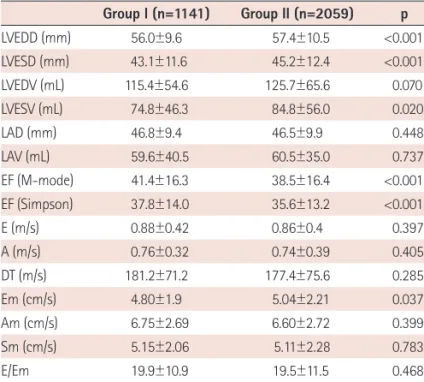
In echocardiographic findings, LV dimension and volume were sm- aller in group I than in group II. EF was higher in group I than in gr- oup II. Diastolic parameters were not different between the two gr- oups except for mitral annular velocity (Table 3).

The prevalence of systolic HF was significantly higher in group II, whereas diastolic HF with preserved EF above 50% was higher in group I (Fig. 1B).

Table 1. Baseline clinical characteristics according to the presence of MetS Group I (n=1141) Group II (n=2059) p

Age (years) 67.2±13.9 67.8±14.6 0.233

Gender (female, %) 640 (56.1) 960 (46.6) <0.001

Height (cm) 159.5±9.7 160.3±10.1 0.036

Weight (cm) 64.4±14.4 56.8±11.8 <0.001

BMI (kg/m

2

) 25.1±4.72 21.8±3.73 <0.001

SBP (mm Hg) 137.3±28.7 126.0±30.3 <0.001

DBP (mm Hg) 81.2±18.4 76.07±17.75 <0.001

HR (/min) 91.0±25.2 91.3±25.5 0.730

NYHA (≥III, %) 733 (64.2) 1259 (61.1) 0.472

Hypertension (%) 747 (65.4) 739 (35.8) <0.001

Diabetes (%) 515 (45.1) 460 (22.3) <0.001

Smoking (%) 51 (4.5) 110 (5.3) 0.388

CKD (%) 133 (11.6) 162 (7.8) 0.001

Prior HF (%) 291 (25.5) 580 (28.2) 0.040

VHD (%) 115 (10.1) 286 (13.9) 0.004

Valve surgery (%) 11 (1.0) 53 (2.6) 0.005

Prior PCI (%) 100 (8.8) 161 (7.8) 0.211

CABG (%) 27 (2.4) 49 (2.4) 0.745

Arrhythmia (%) 127 (11.1) 265 (12.9) 0.231

COPD (%) 32 (2.8) 72 (3.5) 0.407

BMI: body mass index, SBP: systolic blood pressure, DBP: diastolic bold pres- sure, HR: heart rate, NYHA: New York heart association, CKD: chronic kidney disease, VHD: valvular heart disease, CABG: coronary artery bypass graft, PCI:

percutaneous coronary intervention, COPD: chronic obstructive lung disease, MetS: metabolic syndrome

Unknown Non IHD IHD HFPSF (EF ≥50%) Systolic HF

30%

24%

7%

8%

70%

76%

49%

42%

44%

50%

Group I

Group II

Group I

Group II

p<0.001 p<0.001

A   B  

Fig. 1. Incidence of heart failure according to the etiology and ejection fraction. A: the etiology of heart failure between the two groups. B: the per- cent of systolic heart failure and heart failure with preserved systolic func- tion (HFPSF). Group I: patients with metabolic syndrome, Group II: patients without metabolic syndrome. IHD: ischemic heart disease, HF: heart failure.

Table 2. Laboratory findings according to the presence of MetS Group I (n=1141) Group II (n=2059) p

WBC 9714±5375 9035±2546 0.001

Hb (g/dL) 12.4±2.5 12.4±2.28 0.882

Platelet 241.5±86.6 223.7±86.8 <0.001

Creatinine (mg/dL) 1.56±1.34 1.46±1.25 <0.001 Glucose (mg/dL) 179.3±85.4 151.3±80.6 <0.001

TC (mg/dL) 167.3±50.6 160.6±43.5 <0.001

TG (mg/dL) 131.3±79.3 88.8±41.3 <0.001

HDL (mg/dL) 38.4±11.5 47.7±14.9 <0.001

CRP 3.16±5.82 2.70±4.7 0.043

NT-pro BNP 1480±2446 1895±3333 0.080

MetS: metabolic syndrome, WBC: white blood cell, Hb: hemoglobin, TC: total

cholesterol, TG: triglyceride, HDL: high density lipoprotein, CRP: C-reactive

protein, NT-pro BNP: N terminal-pro B type natriuretic peptide

(4)

Short and mid-term events

During the admission period, half of the patients with HF were supported in an intensive care unit (ICU). Total admission duration and the rate of ICU care were similar across the two groups. All cau-

ses of death occurred in 197 cases (6.2%) during the follow up peri- od. Mortality was lower in group I than in group II (Table 4).

The incidence of cardiac arrest, in-hospital infection, cerebrovas- cular accident, bleeding complication, and new onset malignant ar- rhythmia during admission were not different between the two gr- oups. During the follow-up period, the cumulative survival rate was significant higher in group I than in group II (log rank p=0.010). How- ever, there was no difference in the re-admission rate between the two groups at one and three-month follow up (Fig. 2).

Discussion

Heart failure is a syndrome rather than a diagnosis of one single pathology. Many HF patients succumb to progressive pump failure and fluid congestion.

11)

Results from prospective cohort studies have indicated that older age, male sex, hypertension, diabetes, obesity, valvular heart disease, and CHD are important risk factors for CHF.

12)13)

These factors must be carefully monitored and controlled because they put extra strain on the heart and can lead to HF. These cardio- vascular risk factors were also associated with MetS. The relation- ship between MetS and HF has been relatively rarely reported. Ne- vertheless, many components of MetS can lead to HF, and are as- sociated with insulin resistance, inflammation, and fluid accumul- ation. Furthermore, medical treatment of HF can affect insulin sensi- tivity and treatment of the components of the MetS may affect HF.

Metabolic syndrome, which comprises a cluster of cardiovascular risk factors, increases the risk of CVD. MetS involves complex condi- tions, including obesity, high blood pressure, and low levels of HDL- C. A person with MetS is at an increased risk of developing CHD, st- roke, and diabetes.

14)

There are several criteria of MetS based on the WHO,

15)

the NC- EP,

16)

the International Diabetes Federation,

17)

and the AHA and the AA- Table 3. Echocardiographic findings according to the presence of MetS

Group I (n=1141) Group II (n=2059) p

LVEDD (mm) 56.0±9.6 57.4±10.5 <0.001

LVESD (mm) 43.1±11.6 45.2±12.4 <0.001

LVEDV (mL) 115.4±54.6 125.7±65.6 0.070

LVESV (mL) 74.8±46.3 84.8±56.0 0.020

LAD (mm) 46.8±9.4 46.5±9.9 0.448

LAV (mL) 59.6±40.5 60.5±35.0 0.737

EF (M-mode) 41.4±16.3 38.5±16.4 <0.001

EF (Simpson) 37.8±14.0 35.6±13.2 <0.001

E (m/s) 0.88±0.42 0.86±0.4 0.397

A (m/s) 0.76±0.32 0.74±0.39 0.405

DT (m/s) 181.2±71.2 177.4±75.6 0.285

Em (cm/s) 4.80±1.9 5.04±2.21 0.037

Am (cm/s) 6.75±2.69 6.60±2.72 0.399

Sm (cm/s) 5.15±2.06 5.11±2.28 0.783

E/Em 19.9±10.9 19.5±11.5 0.468

LVEDD: left ventricular end diastolic dimension, LVESD: left ventricular end systolic dimension, LVEDV: left ventricular end diastolic volume, LVESV: left ventricular end systolic volume, LAD: left atrial dimension, LAV: left atrial vol- ume, EF: ejection fraction, DT: deceleration time, MetS: metabolic syndrome Table 4. In hospital morbidity and mortality according to the presence of MetS

Group I (n=1141) Group II (n=2059) p

Total admission days 12.6±17.3 12.6±18.2 0.988

ICU admission days 3.35±8.81 3.21±9.09 0.712

In hospital death (%) 5.1 7.7 0.006

ICU: intensive care unit, MetS: metabolic syndrome

Fig. 2. Kaplan-Meier survival curve for two groups associatd with patient survival and adverse events. A: survival curve in patients with heart failure. B: in hos- pital and mid-term adverse events in patients with heart failure. Group I: patients with metabolic syndrome, Group II: patients without metabolic syndrome.

1.0 0.9 0.8 0.7 0.6 0.5

Days

Cu m ul at iv e su rv iv al

0 20 40 60 80 100 Group I

Group II

Log rank p=0.185

B  

1.0 0.8 0.6 0.4 0.2 0.0

Days

Cu m ul at iv e su rv iv al

0 200 400 600 800 1000 1200 Group I

Group II

Log rank p=0.010

A  

(5)

CE, all of which include subjects with diabetes in their definitions.

With respect to obesity, we used BMI rather than waist circumfer- ence because of lack of information on waist circumference. Body weight tends to be increased at initial admission compared with that in usual condition due to fluid accumulation. We analyzed the data according to the measured body weight, which could affect how we examined the incidence of MetS.

However, BMI had a somewhat higher hazard ratio in predicting HF than did waist circumference in the present study. A recent Sw- edish prospective study in 1187 male subject aged over 50 years found that BMI had almost same heart rate as waist circumference for incident congestive HF.

18)

Therefore, BMI was deemed to be ac- ceptable for definition of MetS according to the AACE criteria. The definition of overweight tends to be given as BMI ≥25 kg/m

2

in the Korean population.

19)20)

In a recent study concerning patients with HF, obesity appeared to be associated with a better overall clinical prognosis and patients with more severe HF tended to have lower BMI compared with age and gender-matched control subjects

21)

and higher BMI was asso- ciated with a better survival rate in patients with stage IV HF.

22)

Our study also showed that the percentage of advanced stage HF (NY- HA ≥III) was significantly higher in group I.

Heart failure risk increases with advancing age.

23-25)

HF is the most common reason for hospitalization in people age 65 years and older.

The mean age of the patients in this study was 67 years. However, there was no significant difference according to the presence of MetS in our data. It is known that men are at higher risk of HF than women.

26)

However, our data showed female predominance in the MetS group. Women are more likely to develop diastolic HF than their male counterparts, which is often a precursor to systolic HF. Subjects with MetS have been reported to have higher LV mass and more con- centric LV hypertrophy, as indicated by higher relative wall thick- ness.

27)

This morphologic change is often thought to characterize patients with HF in the setting of a preserved EF. In our data, HF with preserv- ed systolic function was more frequent in the MetS group. In the la- boratory findings, the levels of white blood cells, platelets, creati- nine, CRP, and lipid were higher in the MetS group. This might be due to the role of inflammation. In a previous study, all subjects with MetS were associated with a 1.45-1.74-fold risk for incident HF af- ter adjustment for confounding factors. When subjects with interim MI during the follow up and those with prevalent diabetes were ex- cluded, MetS was significantly associated with a 1.37-1.87-fold risk for incident HF after adjustment for confounding factors.

28)29)

Despite the increased cardiovascular risk it involves, MetS was not associated with mortality and morbidity in patients with HF in our study. Total admission duration, the duration of ICU care, rate of re-

admission and the mid-term mortality were not significantly differ- ent according to the presence of MetS. In addition, in-hospital mor- tality was lower in the MetS group. The question is whether MetS plays a protective role in HF prognosis. It is important here to note that HF patients with MetS may be detected earlier due to multiple risk factors at a less severe level of HF and this may affect the prog- nosis. This study showed that MetS could affect HF via a different route than is the case in the usual mechanism. This may involve mi- cro vascular ischemia leading to maladaptive subclinical cardiac st- ructural changes.

A limitation of our study is that we carried out retrospective an- alysis of the data present in the registry. Therefore we could not con- duct intervention or modulation of risk factors. We did not know the precise details of any substantial reduction of weight, or control of blood pressure, glucose, and lipid levels, which change the cardiac structure and function as well as the clinical manifestations of HF.

Because the Echocardiography Core Lab was not used during the registry process, the echocardiographic data may not be standard- ized. Further studies are needed to elucidate the mechanism that underlies the relationship between MetS and HF prognosis.

Acknowledgments

This work was supported by a grant from the National Research Foundation of Korea funded by the Korean Government (MEST), Re- public of Korea (2010-0020261), and by a grant from the Korea He- althcare Technology R&D Project, Ministry for Health, Welfare &

Family Affairs, Republic of Korea (A084869).

References

1. Levy D, Larson MG, Vasan RS, Kannel WB, Ho KK. The progression from hypertension to congestive heart failure. JAMA 1996;275:1557-62.

2. Qiao Q, Gao W, Zhang L, Nyamdorj R, Tuomilehto J. Metabolic syn- drome and cardiovascular disease. Ann Clin Biochem 2007;44(Pt 3):

232-63.

3. Swedberg K, Cleland J, Dargie H, et al. Guidelines for the diagnosis and treatment of chronic heart failure: executive summary (update 2005):

The Task Force for the Diagnosis and Treatment of Chronic Heart Fail- ure of the European Society of Cardiology. Eur Heart J 2005;26:1115-40.

4. Eriksson H, Svärdsudd K, Larsson B, et al. Risk factors for heart failure in the general population: the study of men born in 1913. Eur Heart J 1989;

10:647-56.

5. Kenchaiah S, Evans JC, Levy D, et al. Obesity and the risk of heart failure.

N Engl J Med 2002;347:305-13.

6. Thethi T, Bratcher C, Fonseca V. Metabolic syndrome and heart failure.

Heart Fail Clin 2006;2:1-11.

7. Kahn R, Buse J, Ferrannini E, Stern M; American Diabetes Association;

European Association for the Study of Diabetes. The metabolic syn-

drome: time for a critical appraisal: joint statement from the American

(6)

Diabetes Association and the European Association for the Study of Diabetes. Diabetes Care 2005;28:2289-304.

8. Mechanick JI, Cobin RH, Einhorn D, et al. American College of Endo- crinology/American Association of Clinical Endocrinologiest: Reaffirm- ation of 2003 ACE Insulin Resistance Syndrome (IRS) position state- ment. 2005. Available from: http://www.aace.com/pub/pdf/guidelines/

IRSStatement.pdf.

9. Soufer R, Wohlgelernter D, Vita NA, et al. Intact systolic left ventricular function in clinical congestive heart failure. Am J Cardiol 1985;55:

1032-6.

10. Marantz PR, Tobin JN, Wassertheil-Smoller S, et al. The relationship between left ventricular systolic function and congestive heart failure diagnosed by clinical criteria. Circulation 1988;77:607-12.

11. Hunt SA, Abraham WT, Chin MH, et al. ACC/AHA 2005 Guideline Up- date for the Diagnosis and Management of Chronic Heart Failure in the Adult: a report of the American College of Cardiology/American Heart Association Task Force on Practice Guidelines (Writing Commit- tee to Update the 2001 Guidelines for the Evaluation and Management of Heart Failure): developed in collaboration with the American Col- lege of Chest Physicians and the International Society for Heart and Lung Transplantation: endorsed by the Heart Rhythm Society. Circula- tion 2005;112:e154-235.

12. Kannel WB, D’Agostino RB, Silbershatz H, Belanger AJ, Wilson PW, Levy D. Profile for estimating risk of heart failure. Arch Intern Med 1999;

159:1197-204.

13. Chen YT, Vaccarino V, Williams CS, Butler J, Berkman LF, Krumholz HM.

Risk factors for heart failure in the elderly: a prospective community- based study. Am J Med 1999;106:605-12.

14. Ford ES, Giles WH, Mokdad AH. Increasing prevalence of the metabolic syndrome among u.s. Adults. Diabetes Care 2004;27:2444-9.

15. World Health Organization. Definition, diagnosis and classification of diabetes mellitus and its complications. Report of a WHO consultation.

Part 1: diagnosis and classification of diabetes and mellitus. Geneva:

World Health Organization;1999.

16. Expert Panel on Detection, Evaluation, and Treatment of High Blood Cholesterol in Adults. Executive Summary of The Third Report of The National Cholesterol Education Program (NCEP) Expert Panel on Detec- tion, Evaluation, And Treatment of High Blood Cholesterol In Adults (Adult Treatment Panel III). JAMA 2001;285:2486-97.

17. Alberti KG, Zimmet P, Shaw J; IDF Epidemiology Task Force Consensus Group. The metabolic syndrome--a new worldwide definition. Lancet 2005;366:1059-62.

18. Huxley R, Mendis S, Zheleznyakov E, Reddy S, Chan J. Body mass index, waist circumference and waist: hip ratio as predictors of cardiovascular risk--a review of the literature. Eur J Clin Nutr 2010;64:16-22.

19. Oh SW, Shin SA, Yun YH, Yoo T, Huh BY. Cut-off point of BMI and obe- sity-related comorbidities and mortality in middle-aged Koreans. Obes Res 2004;12:2031-40.

20. Park HS, Park CY, Oh SW, Yoo HJ. Prevalence of obesity and metabolic syndrome in Korean adults. Obes Rev 2008;9:104-7.

21. Kalantar-Zadeh K, Block G, Horwich T, Fonarow GC. Reverse epidemi- ology of conventional cardiovascular risk factors in patients with ch- ronic heart failure. J Am Coll Cardiol 2004;43:1439-44.

22. Horwich TB, Fonarow GC, Hamilton MA, MacLellan WR, Woo MA, Til- lisch JH. The relationship between obesity and mortality in patients with heart failure. J Am Coll Cardiol 2001;38:789-95.

23. McNeill AM, Katz R, Girman CJ, et al. Metabolic syndrome and cardio- vascular disease in older people: the cardiovascular health study. J Am Geriatr Soc 2006;54:1317-24.

24. Denys K, Cankurtaran M, Janssens W, Petrovic M. Metabolic syndrome in the elderly: an overview of the evidence. Acta Clin Belg 2009;64:

23-34.

25. Ha JW, Oh JK. The pathophysiology and diagnostic approaches for dia- stolic left ventricular dysfunction: a clinical perspective. Korean Circ J 2005;35:865-76.

26. Butler J, Rodondi N, Zhu Y, et al. Metabolic syndrome and the risk of cardiovascular disease in older adults. J Am Coll Cardiol 2006;47:1595- 602.

27. Dinh W, Lankisch M, Nickl W, et al. Metabolic syndrome with or with- out diabetes contributes to left ventricular diastolic dysfunction. Acta Cardiol 2011;66:167-74.

28. Wang J, Ruotsalainen S, Moilanen L, Lepistö P, Laakso M, Kuusisto J.

The metabolic syndrome predicts cardiovascular mortality: a 13-year follow-up study in elderly non-diabetic Finns. Eur Heart J 2007;28:

857-64.

29. Wang J, Sarnola K, Ruotsalainen S, et al. The metabolic syndrome pre-

dicts incident congestive heart failure: a 20-year follow-up study of

elderly Finns. Atherosclerosis 2010;210:237-42.

수치

Table 2. Laboratory findings according to the presence of MetS Group I (n=1141) Group II (n=2059) p WBC  9714±5375 9035±2546 0.001 Hb (g/dL)  12.4±2.5 12.4±2.28 0.882 Platelet  241.5±86.6 223.7±86.8 &lt;0.001 Creatinine (mg/dL)  1.56±1.34 1.46±1.25 &lt;0.0
Fig. 2. Kaplan-Meier survival curve for two groups associatd with patient survival and adverse events

참조

관련 문서

Because tradi- tional risk factors of cardiovascular disease are known to be associated with increasing degree of arteriosclerosis, the clustering of risk factors in patients with

Physiologically, metabolic syndrome involves insulin resistance, which reduces uric acid excretion and increases uric acid reabsorption in the kidneys, ultimately resulting in

Background: The predictive abilityuse of insulin resistance or insulin sensitivity as risk factors for metabolic syndrome, in combination with traditional cardiovascular risk

Chronic ventricular dyssynchrony and its consequent ventricular remodeling thought to be a main mechanism of LBBB to worsens the course of HF over time. 4) However,

We investigated the difference between the degree of obesity, metabolic syndrome risk factors, plasma homocysteine and anthropometric obesity factors.. Totally 398 participated in

Conclusion: Orlistat usage induced not only reduction of weight and abdominal obesity but also improvement of metabolic parameters including blood pressures, lipid

Obesity is a cardinal feature of the MetS. Insulin resistance can be caused by central obesity and can lead to metabolic complications 7). Previous reports show that in

Prevalence and cardiovascular disease risk of the metabolic syndrome us- ing National Cholesterol Education Program and Inter- national Diabetes Federation definitions in the