• 검색 결과가 없습니다.

Relationship Between Plasma Adiponectin, Retinol-Binding Protein 4and Uric Acid in Hypertensive Patients With Metabolic Syndrome

N/A
N/A
Protected

Academic year: 2022

Share "Relationship Between Plasma Adiponectin, Retinol-Binding Protein 4and Uric Acid in Hypertensive Patients With Metabolic Syndrome"

Copied!
5
0
0

로드 중.... (전체 텍스트 보기)

전체 글

(1)

198

Open Access

Relationship Between Plasma Adiponectin, Retinol-Binding Protein 4 and Uric Acid in Hypertensive Patients With Metabolic Syndrome

Chan Seok Park, MD, Sang-Hyun Ihm, MD, Hun-Jun Park, MD, Woo-Seung Shin, MD, Pum-Jun Kim, MD, Kiyuk Chang, MD, Hee-Yeol Kim, MD, Ho-Joong Youn, MD, Wook-Sung Chung, MD, Ki Bae Seung, MD, and Jae-Hyung Kim, MD

Department of Cardiology, College of Medicine, The Catholic University of Korea, Bucheon St. Mary’ Hospital, Bucheon, Korea ABSTRACT

Background and Objectives: Adipokines have been suggested for their potential use in tracking the clinical progress in the subjects with metabolic syndrome (MS). To investigate the relationship between the serum levels of adipokines {adiponectin and retinol-binding protein 4 (RBP4)} and the serum level of uric acid in hypertensive (HTN) patients with MS. Subjects and Methods: In this study, 38 totally untreated HTN patients were enrolled. Anthropometric measurements, blood pressure (BP) were taken in the 12 HTN patients without MS and the 26 HTN patients with MS. Fasting blood samples were collected for measurement of adiponectin, RBP4, nitric oxide (NO), glucose, creatinine, uric acid, lipid profile and insulin. Results: The HTN with MS group had significant higher values of body mass index, waist length, serum uric acid and triglyceride levels than the HTN without MS group. Compared to the HTN without MS group, the HTN with MS group showed significantly lower adiponectin (p=0.030), NO (p=0.003) and high density lipoprotein levels (p<0.001). Serum adiponectin levels negatively correlated with insulin level (R=-0.453, p=0.026) and uric acid level (R=-0.413, p=0.036), and serum RBP4 levels positively correlated with uric acid level (R=0.527, p=0.006) in the HTN with MS group. Multiple linear regression analysis using RBP4 and adiponectin levels as the dependent variables showed that uric acid level correlated with serum RBP4 level (p=0.046) and adiponectin level (p=0.044). Conclusion: The HTN with MS group showed a correlation with two types of adipokines (adiponectin, RBP4) and uric acid. Adiponectin, RBP4 and uric acid may be important components associated with MS, es- pecially when associated with hypertension. (Korean Circ J 2011;41:198-202)

KEY WORDS: Adiponectin; Retinol-binding protein 4; Uric acid; Hypertension; Metabolic syndrome.

Received: June 7, 2010

Revision Received: August 9, 2010 Accepted: August 29, 2010

Correspondence: Sang-Hyun Ihm, MD, Department of Cardiology, College of Medicine, The Catholic University of Korea, Bucheon St. Mary’

Hospital, 2 Sosa-dong, Wonmi-gu, Bucheon 420-717, Korea Tel: 82-32-340-2018, Fax: 82-32-340-2669

E-mail: [email protected]

• The authors have no financial conflicts of interest.

cc

This is an Open Access article distributed under the terms of the Cre- ative Commons Attribution Non-Commercial License (http://creativecom- mons.org/licenses/by-nc/3.0) which permits unrestricted non-commer- cial use, distribution, and reproduction in any medium, provided the origi- nal work is properly cited.

Introduction

Metabolic syndrome (MS), that is the clustering of abnor- malities in glucose metabolism, lipid metabolism, and blood pressure (BP),

1)

and is associated with an increased preval-

ence of subclinical damage in a variety of organs. MS increa- ses the risk for the target organ damage in hypertensive (HTN) patients

2)

and the development of type 2 diabetes mellitus.

3)

Hyperuricemia mediates the development of end-organ da- mage such as increased carotid intima-media thickness,

4)

and it is regarded as a cardiovascular risk factor and a determinant of MS,

5)

although the other studies have concluded that an association between serum uric acid and cardiovascular dis- ease merely reflects the link between serum uric acid and other risk factors.

6)

Adiponectin is known to have anti-inflammatory and anti-

atherogenic activities

7)

and adiponectin levels significantly

correlated with various indices (including serum uric acid) of

MS.

8)

Circulating levels of retinol-binding protein-4 (RBP4)

are elevated in humans with insulin resistance, which is a hall-

mark of MS. It can also predict early stages in the development

of insulin resistance, a major cause of type 2 diabetes as well

(2)

as cardiovascular disease.

9)

Impairment of nitric oxide (NO) re- lease is associated with endothelial dysfunction.

10)

In this study, we screened the metabolic parameters, renal involvement, uric acid, adiponectin, RBP4, NO and insulin in HTN patients with or without MS. We investigated the relationship between the plasma levels of adiponectin and RBP4 with the other variables of MS in the HTN with MS gr- oup. Finally, we also clarified the association between the two types of adipokines (adiponectin, RBP4) and uric acid, which are the known markers of endothelial dysfunction and car- diovascular damage in MS, in the HTN with MS group.

Subjects and Methods

Patients

In total, seventy consecutive patients diagnosed with essen- tial hypertension were enrolled from the outpatient clinic at Bucheon St. Mary’s Hospital, Bucheon, South Korea. Hyper- tension was defined as official systolic BP ≥140 mmHg or dia- stolic BP ≥90 mmHg. These patients had no history of anti- hypertensive and anti-diabetic treatment and they had not taken lipid lowering agents within the last 6 months. The main exclusion criteria were: the presence of clinical or laboratory evidence of congestive heart failure, atrial fibrillation, previ- ous stroke, significant valvular heart disease, previous myo- cardial infarction, history of coronary bypass, secondary cau- se of hypertension, and neoplastic disease. The patients in- formed consent had been obtained during the initial visit.

The patients were categorized into two groups: HTN with- out MS group and HTN with MS group. The study protocol was approved by the Ethics Committee of Bucheon St. Mary’s Hospital.

Definition of metabolic syndrome

MS was diagnosed when two or more of the following cri- teria were present in the HTN patients: abdominal obesity (waist circumference >90 cm and >80 cm in women),

11)

hyper- triglyceridemia (>150 mg/dL), reduced high density lipopro- tein-cholesterol (HDL-C) (<40 mg/dL in men and <50 mg/dL in women), high fasting blood glucose (≥100 mg/dL).

1)

Official blood pressure measurement

BP was measured by nurses during two different visits to the outpatient clinic by using a mercury sphygmomanometer.

At each visit, three measurements were taken at 1-minute in- tervals after the subject had rested for 5 minutes in the sitting position, and the average of the measurements was considered.

Laboratory methods

Blood samples were obtained from the subjects by venipu- ncture and were placed into ethylenediaminetetraacetic acid- containing tubes, the samples were centrifuged to obtain se-

rum; the serum was stored at -70°C. Serum adiponectin levels were determined using a commercially available enzyme-link- ed immunosorbent assay (ELISA) kit (R&D Systems, Inc., Minneapolis, MN, USA) with a detection limit of 0.1 ng/mL.

Serum RBP4 concentration was measured by a commercially available ELISA according to the manufacturer’s instructions (AdipoGen Inc., Seoul, Korea). NO levels were measured us- ing a commercial kit supplied by BioAssay Systems (Hayward, CA, USA), which uses metallic cadmium beads to convert ni- trates into nitrites. The quantitative insulin sensitivity check index (QUICKI) of insulin sensitivity was calculated from the fasting insulin and fasting glucose values: QUICKI=1/{log (fasting insulin)+log (fasting glucose)} as described by Katz et al.

12)

Statistics

The results are expressed as means±standard deviation.

Comparisons of the serum markers between the HTN with MS and the HTN without MS groups were analyzed by using the independent t-test. Nonparametric test was also perform- ed using Mann-Whitney test. Correlations between the levels of adiponectin, RBP4, NO and uric acid were also analyzed us- ing the Pearson correlation test. Several multiple linear re- gression models were also performed by using plasma adipo- nectin, RBP4 or NO as the dependent variable and using age, body mass index (BMI), creatinine, total cholesterol, QUI- CKI, and uric acid level as independent variables in the HTN with MS group. All statistical calculations were performed using a commercially available statistical package (SAS, ver- sion 8.0, NC). A value of p<0.05 was considered statistically significant.

Results

Of the seventy consecutive HTN patients, 26 patients were categorized into HTN with MS group. Considering for age and sex, 12 patients were selected from the remaining 44 pa- tients and they were categorized into HTN without MS group.

Only BMI and waist circumference were significantly higher in the HTN with MS group. Serum adiponectin (HTN with- out MS : HTN with MS=8.57±6.58 : 4.53±4.31, p=0.030) and NO (HTN without MS : HTN with MS=61.2±36.0 : 27.5±

22.5, p=0.003) concentrations were lower in the HTN with MS group. Serum levels of RBP4 were elevated in the HTN with MS group, although this was not statistically significant (HTN without MS : HTN with MS=21.3±12.6 : 38.4±29.7, p=0.106). Serum levels of uric acid were higher in both the patient groups (HTN without MS : HTN with MS=4.13±

1.26 : 5.03±1.19, p=0.040). Triglyceride levels were elevated

and HDL-C levels were reduced in the HTN with MS group

(Table 1).

(3)

Relationship between classical and novel biomarkers in hypertensive patients with or without metabolic syndrome

Correlation between two adipokines, uric acid and NO are summarized in Table 2. In the HTN with MS group, serum adiponectin levels were negatively correlated with uric acid (r=-0.413, p=0.036) (Fig. 1) and insulin levels (r=-0.453, p=

0.026) and positively with QUICKI (r=0.442, p=0.031). RBP4

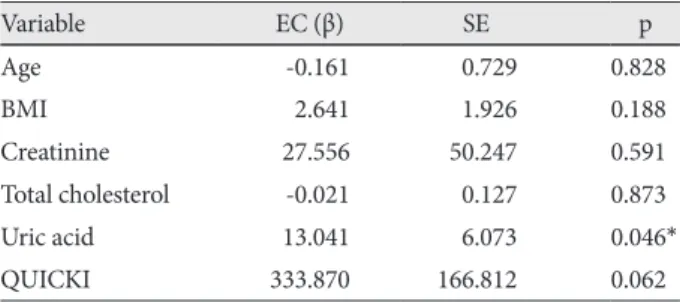
levels showed positive correlation with uric acid (r=0.527, p=0.006) (Fig. 2), but serum NO levels did not correlate posi- tively with uric acid, insulin or QUICKI. These correlations were not observed in the HTN without MS group. Multiple linear regression analysis with serum adiponectin and RBP4 levels as the dependent variables revealed that only uric acid

Table 1. Clinical characteristics and metabolic variables of hyper- tensive patients with or without metabolic syndrome

MS (-) n=12 MS (+) n=26 p

Age (years) 49±9 0 48±80 0.947

Sex (M/F) 5/7 12/14 0.800

BMI (kg/m

2

) 23.2±1.80 25.9±3.20 0.012

Waist (cm) 84.9±4.90 89.9±6.00 0.012

Sys. BP (mmHg) 150±130 147±140 0.539

Dia. BP (mmHg) 98±10 100±100 0.558

Heart rate (/minutes) 68±68 72±15 0.106 Fasting glucose (mg/dL) 93±9 0 96±90 0.306

HbA1C (%) 5.5±0.4 5.5±0.4 0.755

Creatinine (mg/dL) 0.8±0.2 0.8±0.2 0.850 Total cholesterol (mg/dL) 209±38 0 207±410 0.878 Triglyceride (mg/dL) 103±430 165±760 0.012

HDL-C (mg/dL) 53±10 43±80 <0.001

Spot urine MCR (mg/g) 43±40 071±220 0.094 hs-CRP (mg/dL) 1.79±2.71 2.21±6.85 0.848

Fibrinogen (mg/dL) 282±77 324±540 0.111

Uric acid (mg/dL) 4.13±1.26 5.03±1.19 0.040

Insulin (µU/mL) 4.6±2.5 6.8±3.5 0.129

QUICKI 0.39±0.04 0.37±0.04 0.099

RBP4 (μg/mL) 21.3±12.6 38.4±29.7 0.106

Adiponectin (µg/mL) 8.57±6.58 4.53±4.31 0.030 Nitric oxide (µmol/mL) 61.2±36.0 27.5±22.5 0.003 BMI: body mass index, BP: blood pressure, HDL-C: high density-li- poprotein-cholesterol, MCR: microalbumin to creatinine ratio, hs- CRP: high sensitivity C-reactive protein, QUICKI: quantitative in- sulin sensitivity check index, RBP4: retinol-binding protein 4

Table 2. Correlation between classical and novel biomarkers in hypertensive patients with or without metabolic syndrome

UA Adiponectin RBP4 NO

MS (-)

UA Pearson

product-moment correlation coefficient

1

Adiponectin -0.482 1

RBP4 -0.247 -0.339 1

NO -0.088 -0.370 -0.438 1

MS (+)

UA Pearson

product-moment correlation coefficient

1

Adiponectin -0.413* 1

RBP4 -0.527

-0.113 1

NO -0.243 -0.149 -0.286 1

*Correlation is significant at the 0.05 level,

Correlation is significant at the 0.01 level. MS: metabolic syndrome, UA: uric acid, RBP4: retinol binding protein 4, NO: nitric oxide

Fig. 1. The relationship between the plasma adiponectin and uric acid in the hypertensive patients with metabolic syndrome.

15

10

5

0

Uric acid (mg/dL)

Ad ip on ec tin g/ m L)

2 3 4 5 6 7 8 r=-0.413 p=0.036

Fig. 2. The relationship between the plasma RBP and uric acid in the hypertensive patients with metabolic syndrome.

120

80

40

0

Uric acid (mg/dL)

RB P4 g/ m L)

2 4 6 8

r=0.527

p=0.006

(4)

correlated independently with serum RBP4 and adiponectin level (Table 3 and 4).

Discussion

We have presented a correlation between the two types of adipokines (adiponectin and RBP4) and uric acid in the HTN with MS group. RBP4 had a positive correlation with uric acid, while adiponectin had an inverse correlation with uric acid. In addition, we also demonstrated that the HTN with MS group had significantly higher values of serum uric acid and lower serum adiponectin and NO levels than the HTN without MS group. The strength of this study was that the sub- jects were initially diagnosed as HTN had not taken any me- dications; thus there were no confounding factors such as anti- hypertensive, anti-diabetic and lipid-lowering agents which are known to affect cytokine levels. Secondly, we used multi- ple linear regression analysis to confirm the association be- tween the two adipokines (adiponectin or RBP4), NO and uric acid, which are the known risk factors of MS and cardio- vascular events in HTN accompanying MS.

Our study also showed that the levels of serum uric acid were elevated in the HTN with MS group. Hyperuricemia is related to an increased incidence of high BMI, high BP, high triglycerides and a 10-year probability of coronary heart dis- ease.

6)12)

It is also associated with insulin resistance and its me-

chanism is a decreased renal excretion of uric acid.

13)14)

Increased serum RBP4 levels were known to contribute to impaired insulin-stimulated glucose uptake in muscle and elevated hepatic glucose production, both of which are char- acteristic of type 2 diabetes.

9)

RBP4 level is currently known to be independently associated with uric acid level in pa- tients with type 2 diabetes mellitus.

15)

Our data showed that serum RBP4 levels were elevated in the HTN with MS group, but was not significantly different than in the HTN without MS group (p=0.106). However, RBP4 was strongly correlated with uric acid which was a cardiovascular risk factor and a determinant of MS.

6)

The levels of two types of adipokines (adiponectin and RBP4) showed a significant relationship with uric acid in the HTN with MS group and it was stronger be- tween RBP4 and uric acid. Only RBP4 levels showed a inde- pendent relationship with uric acid after multivariate regres- sion analysis when considering for age, BMI, creatinine, total cholesterol and QUICKI. Elevated plasma levels of RBP4 are known to be related with cerebrovascular disease and meta- bolic complication.

16)

In our study, serum adiponectin levels were decreased in the HTN with MS group as compared to the HTN without MS group. Adiponectin levels also correlated with uric acid, but this relationship was weaker than the relationship between RBP4 and uric acid. In contrast to the other adipocyte-derived proteins, adiponectin has anti-inflammatory and anti-athero- genic activities. Low levels of adiponectin are considered as a hallmark of MS and increases the risk of insulin resistance, visceral adipocity and related MS.

17)

The plasma levels of NO were significantly different between the two groups. But NO failed to exhibit a relationship with the other clinical or bio- chemical markers of hypertension with MS. It may be due to its labile character and a relatively small number of patients in this study.

The limitations of our study are a cross-sectional design and small sample size. Large, prospective, placebo-controlled in- tervention trials are needed to document whether changing the levels of the two types of adipokines (adiponectin and RBP4) or uric acid by pharmacological treatment might lead to a reduced risk for cardiovascular event.

In conclusion, plasma levels of the two types of adipokines (adiponectin and RBP4) and uric acid showed a correlation in the HTN with a complication of MS group. This result can add further evidence of RBP4 as a marker of metabolic com- plication in addition to adiponectin, especially in the HTN patients.

REFERENCES

1) Grundy SM, Cleeman JI, Daniels SR, et al. Diagnosis and manage- ment of the metabolic syndrome: an America Heart Association/Na- tional Heart, Lung, and Blood Institute Scientific Statement. Circula- tion 2005;112:2735-52.

2) Cuspidi C, Meani S, Valerio C, et al. Age and target organ damage in Table 3. Multiple linear regression analysis using RBP4 level as

the dependent variable in hypertensive patients with a complication of metabolic syndrome

Variable EC (β) SE p

Age -0.161 0.729 0.828

BMI 2.641 1.926 0.188

Creatinine 27.556 50.247 0.591

Total cholesterol -0.021 0.127 0.873

Uric acid 13.041 6.073 0.046*

QUICKI 333.870 166.812 0.062

*Statistically significant at the 0.05 level. RBP4: retinol-binding pro- tein 4, BMI: body mass index, QUICKI: quantitative insulin sensi- tivity check index

Table 4. Multiple linear regression analysis using adiponectin le- vel as the dependent variable in hypertensive patients with a com- plication of metabolic syndrome

Variable EC (β) SE p

Age 0.080 0.113 0.486

BMI 0.018 0.298 0.952

Creatinine 7.678 7.773 0.337

Total cholesterol -0.012 0.020 0.548

Uric acid -2.047 0.939 0.044*

QUICKI 46.281 25.804 0.091

*Statistically significant at the 0.05 level. BMI: body mass index, QUI-

CKI: quantitative insulin sensitivity check index

(5)

essential hypertension: role of the metabolic syndrome. Am J Hyper- tens 2007;20:296-303.

3) Lakka HM, Laaksonen DE, Lakka TA, et al. The metabolic syndrome and total and cardiovascular disease mortality in middle-aged men.

JAMA 2002;288:2709-16.

4) Ishizaka N, Ishizaka Y, Toda E, Nagai R, Yamamoto M. Association between serum uric acid, metabolic syndrome, and carotid atheroscle- rosis in Japanese individuals. Arterioscler Thromb Vasc Biol 2005;

25:1038-44.

5) Coutinho Tde A, Turner ST, Peyser PA, Bielak LF, Sheedy PF 2nd, Kullo IJ. Associations of serum uric acid with markers of inflamma- tion, metabolic syndrome, and subclinical coronary atherosclerosis.

Am J Hypertens 2007;20:83-9.

6) Culleton BF, Larson MG, Kannel WB, Levy D. Serum uric acid and risk for cardiovascular disease and death: the Framingham Heart Study. Ann Intern Med 1999;131:7-13.

7) Ouchi N, Kihara S, Arita Y, et al. Adipocyte-derived plasma protein, adiponectin, suppresses lipid accumulation and class A scavenger re- ceptor expression in human monocyte-derived macrophages. Circu- lation 2001;103:1057-63.

8) Yang WS, Lee WJ, Funahashi T, et al. Plasma adiponectin levels in overweight and obese Asians. Obes Res 2002;10:1104-10.

9) Graham TE, Yang Q, Bluher M, et al. Retinol-binding protein 4 and insulin resistance in lean, obese, and diabetic subjects. N Engl J Med 2006;354:2552-63.

10) Balletshofer BM, Rittig K, Enderle MD, et al. Endothelial dysfunc- tion is detectable in young normotensive first-degree relatives of sub-

jects with type 2 diabetes in association with insulin resistance. Circu- lation 2000;101:1780-4.

11) Alberti KG, Zimmet P, Shaw J, et al. The metabolic syndrome-a new worldwide definition. Lancet 2005;366:1059-62.

12) Katz A, Nambi SS, Mather K, et al. Quantitative insulin sensitivity ch- eck index: a simple, accurate method for assessing insulin sensitivity in humans. J Clin Endocrinol Metab 2000;85:2402-10.

13) Hong SP, Lee YS, Bae KR, et al. Relationship between serum uric acid level and metabolic syndrome according to gender. Korean Circ J 2008;38:152-60.

14) Facchini F, Chen YD, Hollenbeck CB, Reaven GM. Relationship be- tween resistance to insulin-mediated glucose uptake, urinary uric acid clearance, and plasma uric acid concentration. JAMA 1991;266:

3008-11.

15) Yoo TW, Sung KC, Kim YC, et al. The relationship of the hyperten- sion, insulin resistance, and metabolic syndrome in the serum uric acid level. Korean Circ J 2004;34:874-82.

16) Chen CC, Wu JY, Chang CT, et al. Levels of retinol-binding 4 and uric acid in patients with type 2 diabetes mellitus. Metabolism 2009;58:

1812-6.

17) Ingelsson E, Sundstrom J, Melhbus H, et al. Circulating retinol bind- ing 4, cardiovascular risk factors and prevent cardiovascular disease in elderly. Atherosclerosis 2009;206:239-44.

18) Patel DA, Srinivasan SR, Xu JH, Chen W, Berenson GS. Adiponec-

tin and its correlates of cardiovascular risk in young adults: the Bog-

alusa Heart Study. Metabolism 2006;55:1551-7.

수치

Fig. 1. The relationship between the plasma adiponectin and uric  acid in the hypertensive patients with metabolic syndrome.
Table 4. Multiple linear regression analysis using adiponectin le- le-vel as the dependent variable in hypertensive patients with a  com-plication of metabolic syndrome

참조

관련 문서