INTRODUCTION
The family Myliobatidae belong to order Myliobatifor
mes, is comprised of 40 species and seven genera world
wide, 10 species and 6 genera in Japan, and 3 species and 3 genera in Korea(Nakabo, 2013; Nelson et al., 2016;
MABIK, 2020). The Korean species are Aetobatus flagel- lum(Bloch and Schneider, 1801), Myliobatis tobijei Blee
ker, 1854, Mobula japanica(Müller and Henle, 1841).
They are distributed across tropical and temperate regions found both on continental and insular shelves, and offshore (Nelson et al., 2016), and their body consist of a rhomboi
dal disc that is wider than it is long with the head elevated above the disc and the eye and spiracles placed laterally on
the head. They also have a whiplike tail that is thin and lon
ger than the overall length of the disc(Nelson et al., 2016).
The family Mobulidae includes two genera, Manta Ban
croft, 1829 and Mobula. These genera are separated by the position of the mouth, which is located ventrally in Mobula and terminally in Manta(Townsend and Kyne, 2010).
The genus Mobula is characterized by a pair of cephalic fins in front of the head that assist in feeding activities.
In the present study, two specimens of Mobula thurstoni were collected near Yeosu, Korea in 11 September 2018.
Herein, we describe the morphological characteristics of these samples and add Mobula thurstoni to the list of Kor
ean fish fauna.
MATERIALS AND METHODS
Two Mobula thurstoni specimens were collected by set net from the coast of Yeondo(34°26′4.91″N 127°49′17.09″
—148 — http://www.fishkorea.or.kr
저자 직위: 명세훈(연수연구원), 송영선(해양수산연구사), 강충배(실장), 최홍인(책임큐레이터), 김종관(선임학예사), 윤문근(실장), 임재복(주임연구원), 한동진(아쿠아리스트)
* Corresponding author: ChungBae Kang Tel: 82419500722, Fax: 82419500661, Email: [email protected]
ISSN: 1225-8598(Print), 2288-3371(Online). DOI: https://doi.org/10.35399/ISK.33.2.11
Accepted June 3, 2021
First Record of the Smoothtail Mobula, Mobula thurstoni (Myliobatiformes: Myliobatidae) in Southern Korea
By Se Hun Myoung, Young Sun Song
1, Chung-Bae Kang
2,*, Hong-In Choi
2, Jong-Gwan Kim
2, Moongeun Yoon
3, Jaebok Im
4and Dong-Jin Han
5Dokdo Research Center, Korea Institute of Ocean Science and Technology, Uljin 36315, Republic of Korea
1Dokdo Fisheries Research Center, National Institute of Fisheries Science, Pohang 37709, Republic of Korea
2Department of Exhibition and Education, National Marine Biodiversity Institute of Korea, Seochen 33662, Republic of Korea
3Department of Ecology and Conservation, National Marine Biodiversity Institute of Korea, Seochen 33662, Republic of Korea
4Department of Taxonomy and Systematics, National Marine Biodiversity Institute of Korea, Seochen 33662, Republic of Korea
5Hanwha Aqua Planet Yeosu, Yeosu, Jeollanamdo 59744, Republic of Korea
ABSTRACT Two specimens(1770~1850mm disc width) of Mobula thurstoni, belonging to the family Myliobatidae, order Myliobatiformes, were first collected from the central coast of the Southern Sea of Korea in September 2018. This species is characterized by an anterior margin of disc with double curvature, a white-tipped dorsal fin, and the absence of a caudal spine. This species is morphologically similar to Mobula kuhlii, but has an anterior margin of pectoral fins with a double curvature and the dorsal coloration is bluish black rather than white. In addition, M. thurstoni was well distinguished from M. kuhlii as determined by mitochondrial DNA 16S rRNA sequences with genetic distances ranging from 0.030 to 0.069. The Korean name ‘Mae-kkeun-kko-li-jwi-ga-o-li’ is proposed for the species M. thurstoni.
Key words: Mobula thurstoni, Myliobatidae, first record, Southern Korea, Yeosu
rac ted from muscle tissue using 10% Chelex resin(Bio
Rad, Hercules, CA) and a polymerase chain reaction(PCR) was then performed for mitochondrial DNA 16S ribosomal RNA sequence(16S rRNA) using an MJ Mini Thermal Cycler PTC1148(BioRad) in mixtures consisting of 1μL of genomic DNA, 2μL of 10 PCR buffer, 1.6μL of 2.5 mM dNTPs, 0.5μL of each primer, 0.1μL of TaKaRa EX- Taq polymerase(TaKaRa Bio Inc., Kyoto, Japan), and dis
tilled water to bring the final volume to 20μL. PCR pro- ducts were amplified using universal primers: 16SAR-L (5′CGC CTG TTT ATC AAA AAC AT3′) and 16SBRH (5′CCG GTC TGA ACT CAG ATC ACG T3′) designed by(Ivanova et al., 2007). The PCR profile consisted of initial denaturation at 95℃ for 5 minutes, followed by 35 cycles of denaturation at 95℃ for 1 minute, annealing at 50℃, extension at 72℃ for 1 minute, and a final exten
sion at 72℃ for 5 minutes. The PCR products were puri
technology Information. Sequences were aligned using ClustalW(Thompson et al., 1994) in BioEdit, version 7 (Hall, 1999). The genetic divergences were calculated using the Kimura 2parameter(K2P)(Kimura, 1980) model with Mega 6(Tamura et al., 2013). Phylogenetic trees were con
structed using the neighborjoining method(Saitou and Nei, 1987) in Mega 6(Tamura et al., 2013), with confidence assessed based on 1000 bootstrap replications.
RESULTS AND DISCUSSION Mobula thurstoni(Lloyd, 1908)
(New Korean name: Maekkeunkkolijwigaoli) (Figs. 1, 2; Table 1)
Dicerobatis thurstoni Lloyd, 1908: 179(type locality:
India).
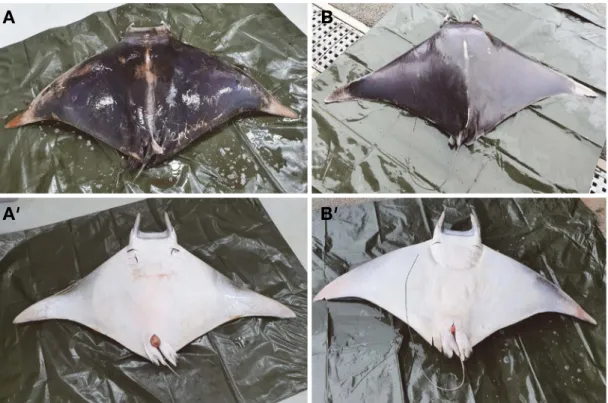
Fig. 1. A, Mobula thurstoni; MABIK SQ002885, 1850mm disc width; B, MABIK SQ002886, 1770mm DW. A, B, dorsal views; A′, B′, ventral views.
A B
A' B '
Mobula lucasana Beebe and TeeVan, 1938: 299(type locality: San Lucas Bay, Baja California, Mexico).
Mobula thurstoni: NotarbartolodiSciara, 1987: 36(India);
Allen and Robertson, 1994: 37(eastern Pacific); Randall, 1995: 51(Oman); Thomson et al., 2000: 284(Gulf of California); Ehemann et al., 2018: 27(Mexico); Zajonz et al., 2019: 61(Yemen); Psomadakis et al., 2020: 216 (Myanmar).
Material examined. MABIK SQ002885, MABIK SQ002886, two specimens, 1770~1850 DW, collected by set net, coast of Yeondo, Yeosu, Korea(34°26′4.91″N 127°
49′17.09″E), September 2018.
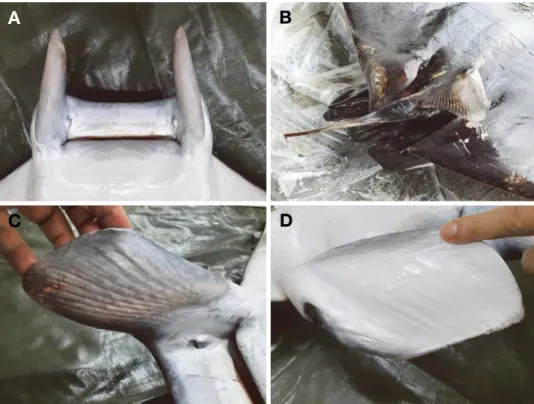
Description. Measurements are shown in Table 1. Primary shape broad rhomboidal, winglike disc, with disc much wider than long. Disc thick towards center and thinner towards edges with head protruding in front of disc. Mouth very broad and located ventrally. Eye and spiracles on both sides(Fig. 2A). Spiracle openings small and located below pectoral fin base. Teeth bands present on both jaws. A pair of nostrils located in front of mouth and can be identified by a very small hole. The nostrils located between corners of the mouth and rostrum. One pair of cephalic fins, rela
tively short and curled outward, extend about 45 degrees down and forward from anterior margin of disc with double
curvature. Dorsal fin small and a whitetip(Fig. 2B). Tail whiplike, thin, long, soft, and begins behind dorsal fin.
Length of tail shorter than disc width. Caudal spine com
pletely absent and skin entirely smooth.
Coloration. Dark blue to black above, dorsal cephalic fins and pectoral fins tips light gray(Fig. 1). Light gray straight line along spine to tip of dorsal fin running down middle of body behind the head. Light gray from back of head to middle of body to dorsal fin. Dorsal fin with distinct white tip. Ventral surface mostly white and shiny silver color that stretches from middle of disc to end of pectoral fin. Dark blue in front of middle part of pectoral fins and a light gray color around mouth. Inside of the cephalic fins light gray white the outside white(Fig. 2C, D). Tip of rostrum dark blue. Tip of the pelvic fins blue color.
Distribution. Yeosu, Korea(present study), Japan(Naka
bo, 2013), Indonesia(White et al., 2006; Mukharror et al., 2018), Philippines(Bessey et al., 2019), Mexico(Campbell and Beveridge, 2006; Santillán-Lugo et al., 2017), Cape Verde(Ratão et al., 2017), Arabian Sea(Di Sciara et al., 2017), Andaman Sea(Shirke et al., 2017), Atlantic Ocean (Mas et al., 2015).
Remarks. The two specimens examined in this study belong to the Mobulinae as the disc is much wider than its length as well as the head protruding in front of the disc,
Fig. 2. Mobula thurstoni, MABIK SQ002885(1850mm disc width); A, Ventral view of head; B, Dorsal view of dorsal fin(caudal fin cutting state); C, Inside view of cephalic fin; D, Outside view of cephalic fin.
A B
C D
eyes and spiracles on both sides, and one pair of cepha
lic fins(Nelson et al., 2016). They also are in the genus Mobula by having the position of the mouth located under the head(Yamaguchi et al., 2013). Additionally, they mat
ched the original description of Mobula thurstoni(Lloyd, 1908) well as follows; anterior margin of disc with double curvature, caudal spine absent, dorsal fin with white tip, dorsal coloration bluish black(Shirke et al., 2017; White
Between antorbitals 17.6 17.6 - 16.5 21.2
Preorbital length 8.0 7.8 - 8.4 7.9
Spiracle length 1.0 1.0 - 0.1 0.1
Interspiracle distance 16.8 17.2 - 15.9 16.9
Tip of cephalic fin to spiracle 12.2 12.4 - 13.0 13.1
Mouth width 11.2 11.0 - 11.1 11.2
Upper toothband length 8.6 8.2 - 8.8 8.3
Lower toothband length 8.8 8.4 - 9.1 9.0
Preoral length 4.2 4.0 - 3.6 4.3
Tip of cephalic fin to mouth 11.0 10.7 - 11.6 11.4
Internarial distance 10.3 9.9 10.0 10.8 9.7
Anterior projection 35.7 36.7 - 33.8 34.6
Cephalic fin length 11.1 10.9 - - 12.1
Cephalic fin width 6.4 5.8 - - 4.6
Clasper length(left) 7.2 6.8 - - -
Clasper length(right) 8.4 8.8 - - -
Head length 13.3 11.9 - - 17.8
1st gill slit length 5.0 4.7 - 5.1 4.9
2nd gill slit length 5.1 4.2 - 5.0 5.0
3rd gill slit length 5.3 4.1 - 5.4 5.1
4th gill slit length 4.9 4.3 - 5.0 5.1
5th gill slit length 3.6 3.2 - 3.2 3.7
Between 1st gill slit 11.7 11.1 - 11.7 11.5
Between 2nd gill slit 10.5 10.2 - 10.8 4.4
Between 3rd gill slit 9.2 8.5 - 9.0 9.3
Between 4th gill slit 6.9 6.5 - 6.8 7.5
Between 5th gill slit 4.8 4.5 - 5.0 5.1
Rostrum to pelvic fin 51.9 51.4 - 49.7 51.0
Rostrum to 1st gill slit 11.9 10.8 - - 18.4
Rostrum to 2nd gill slit 14.2 13.5 - - 10.3
Rostrum to 5th gill slit 22.7 21.2 - - 30.4
Predorsal length 42.7 42.4 - - 43.1
Precloacal length 43.2 41.5 - - 43.3
Dorsal fin base 5.7 5.2 - - 6.3
Dorsal fin height 4.1 3.6 - - 4.3
Pelvic fin length 10.2 9.8 - - 5.8
Tail length - 71.8 33.1 - 65.1
et al., 2018). According to the original description of this species, the length of tail is as short as 33.1% of the disc width, whereas the present specimens showed a difference in the tail length(71.8%, Table. 1). The spiracle length of the specimens was also longer(1.0% DW) than the record
ed spiracle length(0.1% DW in Shirke et al., 2017). In addition, these specimens were shorter(11.9~13.3% DW) than the recorded head length(17.8% DW in Shirke et al., 2017). Such morphological differences require further study of geographic variation. Nevertheless, these speci
mens were consistent with M. thurstoni in primary fea
tures, including spiracles opening below the pectoral fin base, no spine behind dorsal fin, an anterior margin of disc with double curvature, and the dorsal side of the disc was dark brown(Lloyd, 1908; Shirke et al., 2017; White et al., 2018).
M. thurstoni is most similar to M. kuhlii in external shape(Müller and Henle, 1841), but differs in the shape of the anterior margin of the pectoral fins(with a double curvature for M. thurstoni vs. straight or slightly convex for M. kuhlii) and disc color of the dorsal side(bluish black vs. greyish brown)(White et al., 2018). A single species of M. japanica has been known from the Korean waters to date, and the second species of the genus from Korea, M. thurstoni, is easily distinguished from the former by the presence of a caudal spine and by tail length(33.1~
71.8% of WD for M. thurstoni vs. 120~171.6% of WD for M. japanica)(Paulin et al., 1982; Shirke et al., 2017). In addition, our specimens also corresponded well with M.
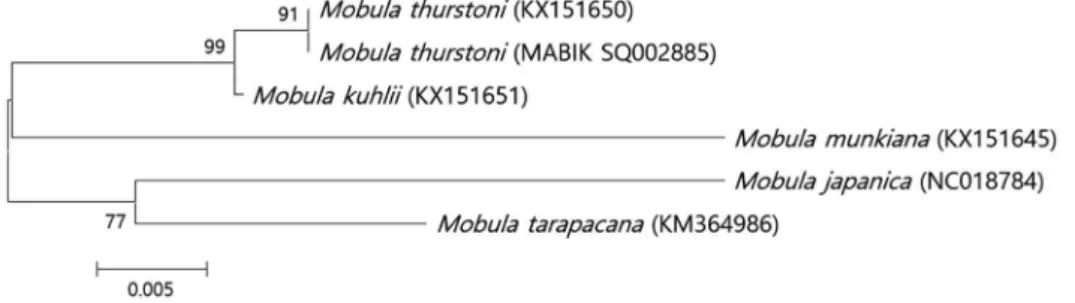
thurstoni and fell as sister to M. kuhlii(99% bootstrap sup
port) compared by mitochondrial DNA 16S rRNA sequen
ces(Fig. 3). M. thurstoni was well distinguished from M.
kuhlii and also well separated from other congeners by gene
tic distances(d) ranging from 0.030 to 0.069. We propose the new Korean name, ‘Maekkeunkkolijwigaoli’, for M. thurstoni because the common name of this species is
‘smoothtail mobula’.
ACKNOWLEDGEMENTS
This work was supported by a grant from the National Marine Biodiversity Institute of Korea(2021M00300).
REFERENCES
Allen, G.R. and D.R. Robertson. 1994. Fishes of the tropical eastern Pacific. University of Hawaii Press, Honolulu, HI, U.S.A., 352pp.
Bancroft, E.N. 1829. On the fish known in Jamaica as the sea-devil.
In: Vigors, N.A.(ed.), Zoological Journal. Vol. 4. Phillips Publishing, London, U.K., pp. 444-457.
Bloch, M.E. and J.G. Schneider. 1801. Systema ichthyologiae iconi
bus ex illustratum. Vol. 2. Berlin, Germany, p. 584.
Bessey, C., S.N. Jarman, M. Stat, C.A. Rohner, M. Bunce, A. Koziol, M. Power, J.M. Rambahiniarison, A. Ponzn, A.J. Richardson and O. Berry. 2019. DNA metabarcoding assays reveal a diverse prey assemblage for Mobula rays in the Bohol Sea, Philippines. Ecol. Evol., 9: 24592474. https://doi.org/10.
1002/ece3.4858.
Campbell, R.A. and I. Beveridge. 2006. Three new genera and seven new species of Trypanorhynch cestodes(family Eutetrar
hynchidae) from manta rays, Mobula spp.(Mobulidae) from the Gulf of California, Mexico. Folia Parasitol., 53: 255275.
https://doi.org/10.14411/fp.2006.033.
Di Sciara, G.N., D. Fernando, S. Adnet, H. Cappetta and R.W. Jaba
do. 2017. Devil rays(Chondrichthyes: Mobula) of the Arab
ian Seas, with a redescription of Mobula kuhlii(Valenciennes in Müller and Henle, 1841). Aquat. Conserv., 27: 197218.
https://doi.org/10.1002/aqc.2635.
Ehemann, N.R., L. del Valle González-González, J.G. Chollet-Villal
pando and J. De La Cruz-Agüero. 2018. Updated checklist of the extant Chondrichthyes within the Exclusive Econo
mic Zone of Mexico. Zookeys, 774: 1739. https://doi.org/
10.3897/zookeys.774.25028.
Hall, T.A. 1999. BioEdit: a userfriendly biological sequence align
ment editor and analysis program for Windows 95/98/NT.
Fig. 3. A neighborjoining tree based on partial mtDNA 16S rRNA region using Mobula thurstoni(MABIK SQ002885) and other species of Mobula. Numbers at branches indicate bootstrap probabilities in 1,000 bootstrap replications. Scale bar equals 0.005 of Tamura and Nei’s dis
tance(1993) with K2 parameter model.
Lloyd, R.E. 1908. On two new species of eagle-rays(Myliobatidae), with notes on the skull of the genus Ceratoptera. Rec. Zool.
Surv. India., 2: 175180.
MABIK(Marine Biodiversity Institute of Korea). 2020. National List of Marine Species. Namu Press, Seocheon, Korea, 126pp.
Mas, F., R. Forselledo and A. Domingo. 2015. Mobulid ray bycatch in longline fisheries in the south-western Atlantic Ocean. Mar.
Freshwater Res., 66: 767777. https://doi.org/10.1071/MF 14180.
Mukharror, D.A., I.T. Baiti, S.A. Harahap, D.J. Prihadi, M. Ichsan and N. Pridina. 2018. First records of bentfin devil ray(Mobula thurstoni) and the examination in physical factors of its habi
tat in the western waters of Morotai Island(North Moluccas).
IOP. Conf. Ser. Earth. Environ. Sci., 137: 012048. https://doi.
org/10.1088/17551315/137/1/012048.
Müller, J. and J. Henle. 1841. Systematische Beschreibung der Pla
giostomen. Berlin, Germany, p. 200.
Nakabo, T. 2013. Fishes of Japan with pictorial keys to the species, 3rd ed. Vol. 1. Tokai Univ. Press, Kanagawa, Japan, 864pp.
Nelson, J.S., T.C. Grande and V.H. Wilson. 2016. Fishes of the World, 5th ed. John Wiley and Sons Inc., Hoboken, New Jersey, U.S.A., p. 386.
NotarbartolodiSciara, G. 1987. A revisionary study of the genus Mobula Rafinesque, 1810(Chondrichthyes: Mobulidae) with the description of a new species. Zool. J. Linn. Soc., 91:
191. https://doi.org/10.1111/j.10963642.1987.tb01723.x.
Paulin, C.D., G. Habib, C.L. Carey, P.M. Swanson and G.J. Voss.
1982. New records of Mobula japanica and Masturus lanceolatus, and further records of Luvaris imperialis(Pisces:
Mobulidae, Molidae, Louvaridae) from New Zealand. N. Z. J.
Mar. Freshwater Res., 16: 1117. https://doi.org/10.1080/002 88330.1982.9515943.
Psomadakis, P., H. Thein, B.C. Russell and M.T. Tun. 2020. Field identification guide to the living marine resources of Myan
mar. FAO species identification guide for fishery purposes.
FAO, Rome, Italy, 357pp.
Randall, J.E. 1995. Coastal fishes of Oman. University of Hawaii Press, Honolulu, HI, U.S.A., 439pp.
Ratão, S.S., D. Dias and V. Stiebens. 2017. First record of smoothtail mobula Mobula thurstoni(Myliobatidae) in Cabo Verde. Zool.
Caboverdiana, 6: 1114.
Saitou, N. and M. Nei. 1987. The NeighborJoining Method: a new
Shirke, S.S., M. Nashad, M.D. Sukham and H.D. Pradeep. 2017. A first record of the bentfin devil ray Mobula thurstoni(Lloyd, 1908)(Myliobatiformes: Mobulidae) from the Indian EEZ of the Andaman Sea. J. Threat. Taxa., 9: 1107411080. https://
doi.org/10.11609/jott.3089.9.12.1107411080.
Tamura, K. and M. Nei. 1993. Estimation of the number of nucleo
tide substitutions in the control region of mitochondrial DNA in humans and chimpanzees. Mol. Biol. Evol., 10: 512526.
https://doi.org/10.1093/oxfordjournals.molbev.a040023.
Tamura, K., G. Stecher, D. Peterson, A. Filipski and S. Kumar. 2013.
MEGA6: Molecular Evolutionary Genetics Analysis version 6.0. Mol. Biol. Evol., 30: 27252729. https://doi.org/10.1093/
molbev/mst197.
Thomson, D.A., L.T. Findley and A.N. Kerstitch. 2000. Reef fishes of the Sea of Cortez: the rocky-shore fishes of the Gulf of Cali
fornia. University of Texas Press, Austin, TX, U.S.A., p. 44.
Thompson, J.D., D.G. Higgins and T.J. Gibson. 1994. Clustal W:
improving the sensitivity of progressive multiple sequence alignment through sequence weighting, position-specific gap penalties and weight matrix choice. Nucl. Acid. Res., 22:
46734680. https://doi.org/10.1093/nar/22.22.4673.
Townsend, K.A. and P.M. Kyne. 2010. New records of the Japanese Devilray Mobula japanica(Müller & Henle, 1841) for Aus
tralian waters. Mem. Queensl. Mus., 55: 225230.
White, W.T., S. Corrigan, L. Yang, A.C. Henderson, A.L. Bazinet, D.L.
Swofford and G.J. Naylor. 2018. Phylogeny of the manta and devilrays(Chondrichthyes: Mobulidae), with an updated taxo
nomic arrangement for the family. Zool. J. Linn. Soc., 182:
5075. https://doi.org/10.1093/zoolinnean/zlx018.
White, W.T., J. Giles and I.C. Potter. 2006. Data on the bycatch fishery and reproductive biology of mobulid rays(Mylio
batiformes) in Indonesia. Fish. Res., 82: 6573. https://doi.
org/10.1016/j.fishres.2006.08.008.
Yamaguchi, A., N. Yagishita, Y. Aonuma and T. Yoshino. 2013. Mylio
batidae. In: Nakabo, T.(ed.), Fishes of Japan with pictorial keys to the species, 3rd ed. Tokai Univ. Press, Kanagawa, Japan, pp. 228231.
Zajonz, U., E. Lavergne, S.V. Bogorodsky, F.N. Saeed, M.S. Aideed and F. Krupp. 2019. Coastal fish diversity of the Socotra Archipelago, Yemen. Zootaxa, 4636: 1108. https://doi.org/
10.11646/zootaxa.4636.1.1.
한국 여수에서 채집된 매가오리과 (Myliobatidae) 어류 첫기록종 , Mobula thurstoni
명세훈
·
송영선1·
강충배2·
최홍인2·
김종관2·
윤문근3·
임재복4·
한동진5한국해양과학기술원 독도전문연구센터, 1국립수산과학원 독도수산연구센터, 2국립해양생물자원관 전시교육실,
3국립해양생물자원관 생태보존실, 4국립해양생물자원관 생물분류실, 5여수아쿠아플라넷
요 약 : 매가오리목 매가오리과에 속하는 Mobula thurstoni 2개체(1770~1850mm 체반폭)가 2018년 9월 전라
남도 여수시 연도 연안에서 정치망으로 채집되었다. 이 종은 가슴지느러미의 앞부분이 이중 굴곡이고, 등지느러미
바로 뒤 꼬리 시작부분에 가시가 없으며, 등지느러미 끝부분에는 흰색이고, 그리고 등쪽의 체색이 어두운 남색을
띤다. Mobula kuhlii와 가장 형태적으로 유사하였지만, 가슴지느러미 앞부분에 이중 굴곡을 가지고 있다는 점(vs.
직선이거나 약간의 굴곡을 가진다)과 등쪽 체색이 어두운 남색을 띤다는 점(vs. 회갈색)에서 잘 구분된다. 또한, 이
종은 M. kuhlii와 미토콘드리아 16S rRNA 영역에서 유전적 거리 0.030~0.069의 차이를 보여 구분되었다. 이 종의
새로운 국명으로 ‘매끈꼬리쥐가오리’를 제안한다.
찾아보기 낱말 : 매가오리과, Mobula thurstoni, 매끈꼬리쥐가오리, 첫기록종, 여수