https://orcid.org/0000-0003-0043-3191 https://orcid.org/0000-0002-2788-1392 https://orcid.org/0000-0003-0062-342X https://orcid.org/0000-0002-5751-7209 https://orcid.org/0000-0003-1353-5795 https://orcid.org/0000-0001-7677-2881
https://orcid.org/0000-0002-9125-7156 https://orcid.org/0000-0002-7313-2384
Received December 14, 2020; revised February 10, 2021; accepted February 26, 2021.
Corresponding author: Dae Hyun Kim, Department of Family Medicine, Keimyung University Dongsan Hospital, Keimyung University School of Medicine, 1035 Dalgubeol-daero, Dalseo-gu, Daegu 42601, Korea. E-mail: [email protected]; and Hyun ah Kim, Department of Infectious Disease, Keimyung University Dongsan Hospital, Keimyung University School of Medicine, 1035 Dalgubeol-daero, Dalseo-gu, Daegu 42601, Korea. E-mail: [email protected]
*Dae Hyun Kim and Hyun ah Kim contributed equally to this work and are joint corresponding authors.
Copyright Ⓒ 2021 The Korean Academ y of Clinical Geriatrics
This is an open access article distributed under the term s of the Creative Com m ons Attribution Non-Com m ercial License (http://creativecom m ons.org/licenses/by-nc/4.0) which
perm its unrestricted non-com m ercial use, distribution, and reproduction in any m edium , provided the original work is properly cited.
Factors Associated with Severe Outcomes of the Coronavirus Disease 2019 among Elderly Patients in South Korea
Seung Wan Hong
1 , Ji yeon Lee
2 , Miri Hyun
2 , Jae Seok Park
3 , Jae Hyuck Lee
4 , Young Sung Suh
1 , Hyun ah Kim
2* , Dae Hyun Kim
1*
1
Department of Family Medicine, Keimyung University Dongsan Hospital, Keimyung University School of Medicine, Daegu;
2
Department of Infectious Disease, Keimyung University Dongsan Hospital, Keimyung University School of Medicine, Daegu;
3
Department of Pulmonology, Keimyung University Dongsan Hospital, Keimyung University School of Medicine, Daegu;
4Department of Family Medicine, Daegu Dongsan Hospital, Daegu, Korea
Background: The coronavirus disease 2019 (COVID-19) has been rapidly spreading globally since its outbreak in December 2019 at Wuhan, Hubei Province, China. The mortality rate of the older population with COVID-19 is particularly high. Therefore, investigating risk factors related to severe outcomes in older COVID-19 patients is important for effective management of the disease. This study aimed to assess the epidemiological and medical factors in older patients to investigate the risk factors related to the severe outcomes of COVID-19.
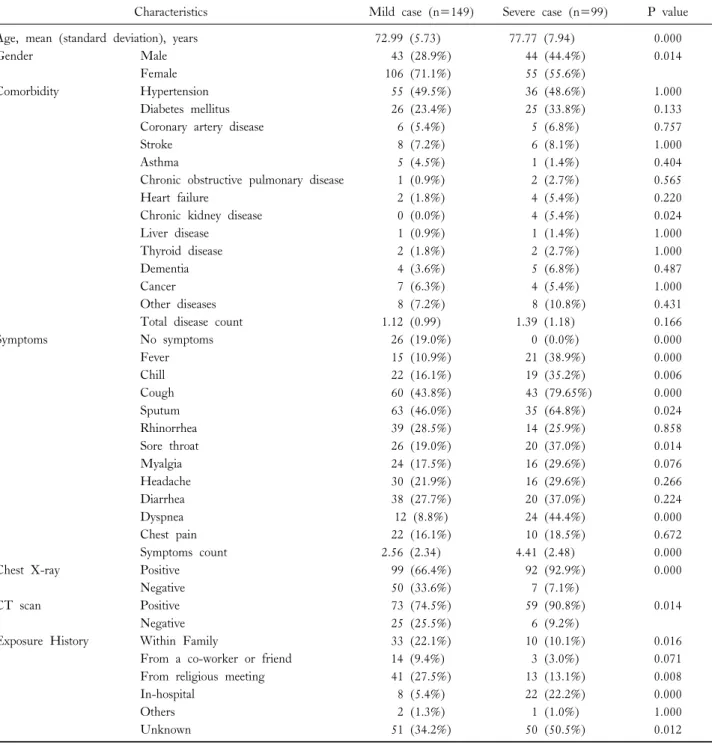
Methods: We collected clinical and demographic data and assessed the laboratory parameters, radiologic findings, symptoms, and outcomes of older patients with COVID-19. Among the 248 older patients with COVID-19, of whom 99 had severe COVID-19.
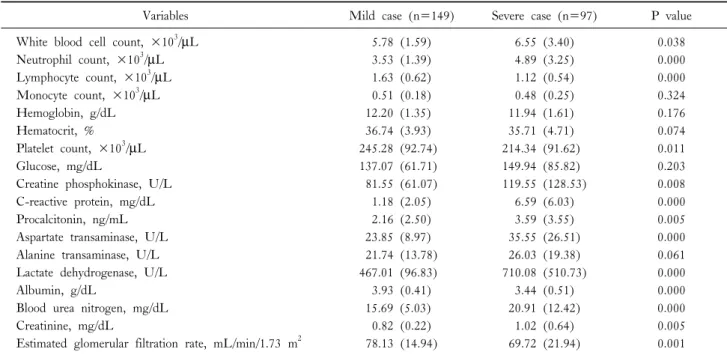
Results: The mortality rate was 6.5%. Older and male patients have more severe COVID-19 outcomes. White blood cell counts and creatine phosphokinase, C-reactive protein, procalcitonin, aspartate transaminase, lactate dehydrogenase, and creatinine levels were higher in the severe outcome group. Age, sex, chest X-ray findings, neutrophil count, C-reactive protein level, lactate dehydrogenase level, and albumin level, total number of symptoms, within-family exposure history, and in-hospital exposure history were associated with severe outcomes in the logistic regression model.
Conclusions: Age, C-reactive protein and lactate dehydrogenase levels, and the total number of symptoms were important risk factors among older patients with COVID-19. Therefore, older patients with these factors require more careful attention and medical care.
Key Words: Coronavirus disease (COVID-19), Older patients, Risk factors, Severe acute respiratory syndrome
coronavirus 2 (SARS-CoV-2)