312 https://kshpa.jams.or.kr/co/main/jmMain.kci
보건행정학회지 2021;31(3):312-327 | ISSN 1225-4266 Health Policy and Management Vol.31 No.3, 312-327
https://doi.org/10.4332/KJHPA.2021.31.3.327
ORIGINAL ARTICLE
INTRODUCTION
Infection prevention and control (IPC) to manage healthcare- associated infection (HCAI) has emerged as one of the most significant public health issues worldwide. World Health Organization (WHO) estimates that HCAI prevalence in high-income countries is 7.6%, and the number may be as high as 19.1% in countries with lower income and limited resources [1]. Accordingly, WHO has underscored the significance of IPC and has been developing series of strategies and guidelines to support countries in their effort to manage
HCAI [2,3], of which the most pivotal is “the guidelines on core components of infection prevention and control programs” [4]. This guideline recommends essential elements that IPC policies and programs should encompass at both the national and individual facility levels and has aided in the development of numerous national policies since its development in 2016.
HCAI has also evolved into a serious health concern in Korea, presenting significant socioeconomic burden [5]. Population aging and advancement in health care technology which brought increased invasive procedures into the healthcare setting were making HCAI
A Comparative Analysis of Healthcare-Associated Infection Policy in South Korea and Its Implications in Coronavirus Disease 2019
Yoolwon Jeong 1 ㆍKinam Kim 2
1
Ministry of Health and Welfare, Sejong;
2Korea Disease Control and Prevention Agency, Cheongju, Korea
Background: Infection prevention and control (IPC) to manage healthcare-associated infection (HCAI) has emerged as one of the most significant public health issues in Korea. The purpose of this study is to draw implications in IPC policies by analyzing the context, process, and major actors in policy development and comparatively analyzing IPC policy contents of Korea with three other countries. Additionally, IPC policies were analyzed in the context of coronavirus disease 2019 (COVID-19) to provide implications for future pandemics and HCAI events.
Methods: This study incorporates a qualitative approach based on document and content analysis, applying codes and thematic categorization. IPC policy contents are comparatively analyzed by adopting the concept model, developed by the World Health Organization, which consists of core components of IPC structure at the national and facility level.
Results: National IPC policies were developed within a complex social and political context, through the involvement of various stakeholders. IPC policies in Korea place a high emphasis on establishing IPC programs and built environments in healthcare facilities, whereas there were potentials for improvement in policies involving patients and promoting a safety culture. IPC policies, which currently focus on general hospitals and certain functions of hospitals, should further be expanded to target all healthcare facilities and functions, to ensure more efficient and sustainable IPC responses in the current and future disease outbreaks.
Conclusion: IPC is a complex policy arena and lessons learned from the analysis of existing policies in the context of COVID-19 should provide valuable strategic implications for future policies.
Keywords: Health policy; Policy making; Infection control; COVID-19; Republic of Korea
Correspondence to: Yoolwon Jeong
Ministry of Health and Welfare, 13 Doum 4-ro, Sejong 30113, Korea Tel: +82-44-202-2508, Fax: +82-44-202-3910, Email: [email protected]
Received: June 23, 2021, Revised: August 25, 2021, Accepted after revision: September 2, 2021
© Korean Academy of Health Policy and Management
◯
㏄This is an open-access article distributed under the terms of the Creative Commons Attribution Non-Commercial License (http://creativecommons.org/licenses/by-nc/4.0) which permits unrestricted non-commercial use,
distribution, and reproduction in any medium, provided the original work is properly cited.
more favorable in Korea. The spread of Middle East respiratory syndrome (MERS) in healthcare facilities in 2015 and notable HCAI incidents in mid-2010s aroused great academic and public interest in more effective IPC policy measures [6-9]. Series of IPC actions plans and strategies were developed and rolled out since the early 2010s, and finally the government established its first stand-alone, overarching 5-year national policy on HCAI in 2018, which was largely based on the above mentioned WHO guideline on core components (CC) [10].
In the context of coronavirus disease 2019 (COVID-19) pandemic, the emphasis has been put on HCAI all the more urging governments and healthcare facilities to maintain strict IPC measures in aim to prevent introduction or spread of COVID-19. Healthcare facilities, which have been continuously challenged and overwhelmed by the outbreak and the workload that is brought by it, were revealed to be fragile to the influx and transmission of COVID-19. IPC capacity in response to COVID-19, even in institutions with already established IPC structure, was often compromised. In light of such circumstances, international institutions, including WHO, US Centers for Disease
Control and Prevention (CDC), and European Centre for Disease Prevention and Control (ECDC) among others, have published IPC recommendations in COVID-19, which include details of effective IPC response measures as well as sustainable IPC structure in healthcare facilities [11-14].
This study analyzes the IPC policies in South Korea, focusing mainly on “the national policy for prevention and management of healthcare-associated infection 2018–2022”, developed by the Ministry of Health and Welfare (MoH), the context and process of its development, major policy actors and their roles, as well as its key contents. The contents of the national policy will further be comparatively analyzed with the national policies of three other countries, using the conceptual model of IPC structure adapted from
“the WHO guidelines on core components of infection prevention and control programs” in aim to identify its strengths and weaknesses.
COVID-19 IPC recommendations of WHO, CDC, ECDC will be analyzed in comparison with IPC policies in Korea, to demonstrate policy implications in current and future disease outbreaks.
Figure 1. Policy analysis triangle applied to this study. Adapted from Walt G, et al. Health Policy Plan 1994;9(4):353-370 [15]. WHO,
World Health Organization; CDC, US Centers for Disease Control and Prevention; ECDC, European Centre for Disease Prevention
and Control; IPC, infection prevention and control; COVID-19, coronavirus disease 2019.
314 https://kshpa.jams.or.kr/co/main/jmMain.kci
Jeong Y et al ∙ Healthcare-Associated Infection Policy in South Korea and Implications in Coronavirus Disease 2019
Health Policy Manag 2021;31(3):312-327
METHODS
1. Study design and data analysis
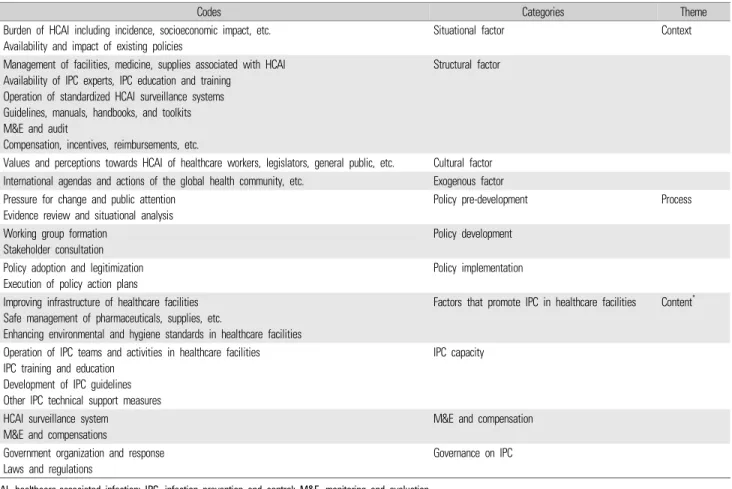
The Walt and Gilson [15] policy triangle framework was applied to analyze the context, process, actors, and content of the IPC policy (Figure 1). A qualitative approach based on document and content analysis was used for the analysis of the context, actor involved, and the process of the development of “the national policy for prevention and management of healthcare-associated infection 2018–2022”. A qualitative approach was appropriate to meet this because it allowed comprehensive exploration of the various aspects of policy development [16]. The content analysis incorporated codes and thematic categorization, through which key concepts or codes of each document were identified and subsequently classified into more
general, pre-determined categories (Table 1). Categories were grouped into themes that are relevant to the respective dimensions of the policy triangle. The context of the IPC policy was analyzed based on four categories: situational, structural, cultural, and exogenous factors [17]. The policy development process was examined via three stages: pre-development, development, and implementation of the national policy. The policy actors were classified as government, health sector and academia, lawmakers, civil society organizations (CSOs) and non-governmental organizations (NGOs), and the media.
In analyzing policy actors’ respective positions in the development of the policy, their positions were classified using a spectrum of Supporter, Moderate supporter, Neutral, Moderate opponent, and Opponent [18].
The content of “the national policy for prevention and management of healthcare-associated infection 2018–2022” is analyzed using the
Codes Categories Theme
• Burden of HCAI including incidence, socioeconomic impact, etc.
• Availability and impact of existing policies
Situational factor Context
• Management of facilities, medicine, supplies associated with HCAI
• Availability of IPC experts, IPC education and training
• Operation of standardized HCAI surveillance systems
• Guidelines, manuals, handbooks, and toolkits
• M&E and audit
• Compensation, incentives, reimbursements, etc.
Structural factor
• Values and perceptions towards HCAI of healthcare workers, legislators, general public, etc. Cultural factor
• International agendas and actions of the global health community, etc. Exogenous factor
• Pressure for change and public attention
• Evidence review and situational analysis
Policy pre-development Process
• Working group formation
• Stakeholder consultation
Policy development
• Policy adoption and legitimization
• Execution of policy action plans
Policy implementation
• Improving infrastructure of healthcare facilities
• Safe management of pharmaceuticals, supplies, etc.
• Enhancing environmental and hygiene standards in healthcare facilities
Factors that promote IPC in healthcare facilities Content
*• Operation of IPC teams and activities in healthcare facilities
• IPC training and education
• Development of IPC guidelines
• Other IPC technical support measures
IPC capacity
• HCAI surveillance system
• M&E and compensations
M&E and compensation
• Government organization and response
• Laws and regulations
Governance on IPC
HCAI, healthcare-associated infection; IPC, infection prevention and control; M&E, monitoring and evaluation.
*Categories of the policy content analysis applied the framework incorporated in “the national policy for prevention and management of healthcare-associated infection 2018–2022”, which were (1) eliminating factors that promote infection prevention and control in healthcare facilities; (2) IPC capacity building; (3) monitoring, evaluation, compensation; and (4) strengthening national governance.
Table 1. Codes, categories, and themes applied in the data analysis of this study
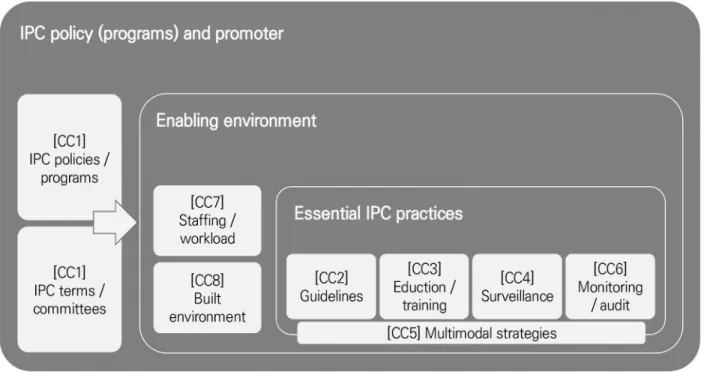
conceptual model of IPC structure and programs adapted from “the WHO guidelines on core components of infection prevention and control programs”. An effective IPC structure suggested in this model consists of eight essential elements, labeled here as the “CC”, each of which are applied at both the national and facility levels (Figure 2).
CC1 is the main IPC program and promoter, which is the overarching national IPC policy and facility-specific IPC programs, as well as a dedicated IPC team and committee at facilities. IPC team is a group of trained experts who organize and conduct IPC programs at the facility. IPC committee is a decision-making body of the facility regarding IPC policies. Components from CC2 through CC6 are essential IPC practices that should be conducted. CC2 is the development of IPC guidelines and standards at both the national and facility levels. At the facility level, it includes development of facility-specific guidelines and manuals as well as adaptation of national guidelines to the local context. CC3 is the IPC training and education of health workers and hospital staff. At the facility level, it is provision of IPC training to its staff. At the national level, it signifies development of legal and policy measures to support provision of such training to health workers, such as mandatory continuing education on IPC. CC4 is IPC surveillance at both the national and facility level,
as well as linkage and integration of both systems. CC5 is defined as
“multimodal strategies”, which is defined as conducting three or more CCs in an integrated fashion to achieve cross-organizational culture change and quality improvement in IPC. CC6 is monitoring and auditing of IPC practices, which include feedback of its results to various involved players. CC7 and CC8 refer to environmental and infrastructure aspects of IPC, namely adequate workload and staffing (CC7) and adequate management of built environment and equipment (CC8). It is advised that a successful IPC structure in country should encompass all of the eight components in a coordinated manner, and thus this CC framework has been applied in many countries to evaluate the status of IPC structure [19,20].
Using the WHO CC framework, the content of the national policy was compared with the national policies of three other countries:
Scotland, Australia, and South Africa. These countries are either high-income (Scotland, Australia) or middle income (South Africa) countries, and were selected because WHO CC framework, despite its implications to all countries, may be restricted in its application to low-income countries due to resource limitations such as lack of IPC experts [4]. Therefore, low-income countries were excluded from the comparative analysis. The selection of these countries was also based
Figure 2. Conceptual model of national IPC structure and programs applied in the comparative analysis. IPC, infection prevention and
control; CC, core components.
316 https://kshpa.jams.or.kr/co/main/jmMain.kci
Jeong Y et al ∙ Healthcare-Associated Infection Policy in South Korea and Implications in Coronavirus Disease 2019
Health Policy Manag 2021;31(3):312-327
on the level and extent of online access to necessary policy documents and resources. For analysis of COVID-19 specific IPC recommendations against IPC policies of Korea, the latest IPC guidance documents from WHO [11,12], CDC [13], and ECDC [14]
were analyzed, also applying the WHO CC framework.
2. Data collection
The content analysis targeted all relevant documents which include original studies, policy documents, and minutes of the national assembly, dating from January 2013 to June 2018. Of these, the policy documents obtained and reviewed included national strategic plans, policy reports, press releases as well as technical guidelines sponsored by the government. The starting date was set at 2013, as it was in the national policy entitled “national framework for communicable disease control 2013–2017”, that series of action plans for HCAI were first and explicitly stipulated in a national-level policy document. The end date was set at June 2018 which was when “the national policy for prevention and management of healthcare-associated infection 2018–
2022” was adopted. The documents were obtained through numerous platforms which include: PubMed, the “PRISM” database (www.prism.go.kr) which is the repository for all government- ponsored studies of Korea, the Korea Citation Index which is the citation system for domestic research papers, official government web pages, the official National Assembly web page, and the official web page of the Health and Welfare Committee of the National Assembly.
The keywords used for document search were “healthcare associated infection”, “hospital infection”, “infection prevention and control”,
“national policy”, “policy development”, and their combinations. The searched documents were reviewed to exclude those that were not relevant to the main purpose of this study, which included studies on practical details of IPC measures and specific communicable diseases not directly related to HCAI. A total of 165 documents were read through for primary review and of these, 22 met the exclusion criteria.
A total of 143 documents which include original studies, policy documents, minutes, and records were reviewed for analysis.
For the comparative analysis of national IPC policies, national policies and relevant documents were intentionally searched through Google Scholar and/or were attained through respective government focal points of the selected countries. The national policies reviewed for comparative analysis were “the national infection prevention and
control strategic framework (South Africa)”, “the national infection prevention and control policy and strategy (South Africa)”,
“healthcare associated infection standards (Scotland)”, “national infection prevention and control manual (Scotland)”, “infection prevention and control policy (New South Wales/Australia)”, and
“infection prevention and control practice handbook (Australia)”
[21-26].
For the analysis of COVID-19 specific IPC recommendations, documents were searched and attained from official web pages of respective institutions. The documents reviewed for analysis were
“Infection prevention and control during health care when COVID-19 is suspected or confirmed (WHO)”, “Infection prevention and control healthcare facility response for COVID-19 (WHO)”,
“Interim infection prevention and control recommendations for healthcare personnel during the coronavirus disease 2019 pandemic (CDC), “Infection prevention and control and preparedness for COVID-19 in healthcare settings, sixth update (ECDC) [11-14].
RESULTS
1. Healthcare-associated infection Policy development in Korea
1) Policy context
Since the early 2010s, various significant IPC policies and strategies were rolled out, one of which was the requirement of an IPC team and infection control committee in hospitals with more than 150 beds, made mandatory through the amendment of the Medical Service Act in 2011. The Medical Service Act has also regulated hospitals to acquire certain standards to prevent HCAI, such as limitation of the number of beds per hospital room, space standards for bed areas, requirement of negative pressure isolation rooms for hospitals with more than 300 beds, and so forth. Financial compensation and incentives for IPC efforts within the National Health Insurance Service proved to be particularly effective in promoting IPC activities in hospitals [6]. Korean National Healthcare-associated Infections Surveillance System, established in 2006, was also considered a significant achievement [9].
However, despite introduction of such policy strategies, studies
have shown that socioeconomic burden of IPC, such as health costs
and length of hospital stay, has increased significantly [5]. Also, significant HCAI incidents continued to occur, such as the spread of MERS in healthcare facilities in 2015, the hepatitis C epidemic due to reuse of disposable syringes in a local clinic, and intravenous fluid contamination in an intensive care unit that led to the death of neonates in 2017. Such string of events aroused a great deal of academic and public interest for more effective IPC policy measures [6-8]. A timeline of major events that led up to the development of “the national policy for prevention and management of healthcare- associated infection 2018–2022” is provided in Figure 3.
The limitation of existing IPC policies was that they mostly focused on strengthening infrastructure as compared to establishing sustainable systems that promote IPC actions in healthcare facilities [6-9]. Another major issue was that mandatory IPC teams were mostly restricted to larger hospitals, leaving smaller hospitals and clinics with no statutory obligation to operate a team dedicated to IPC activities.
Most importantly, there was no overarching, comprehensive national policy on IPC with goals and operational plans that encompass all necessary components of IPC policy. The existing IPC policies were developed as a part of other, albeit relevant, national strategies, such as
“the national framework for communicable disease control, 2013–
2017” and “the national action plan on antimicrobial resistance”
established in 2016. As evidence were suggesting that HCAI could be prevented and mitigated through effective strategies both at the national and facility levels [4], the global society, through numerous WHO resolutions and action plans, were urging countries to take policy actions to mitigate HCAI [1-4].
2) Policy development process (1) Policy pre-development
Scholars in the medical and public health arena were voicing the need for IPC promotion well before the 2010s, but the MERS outbreak in 2015 and its spread within and between hospitals were the pivotal event that had allowed it to be discussed more widely. Many suggested the need for stronger standards regarding the quantity and quality of a full-time infection preventionist in hospitals and tailored requirement criteria according to the size and type of hospitals [8]. There was general consent that IPC activities in hospitals should be better monitored, assessed, provided feedback, and compensated [6-9].
Many have made points that reasonable pricing and reimbursement schemes for IPC promotion, e.g., operating isolation rooms, using single-use medical materials, were lacking but are essential to make IPC activities more effective [8]. It was suggested that IPC surveillance should be expanded to other functions, e.g., dialysis units, and that participation of smaller hospitals in the national surveillance system is necessary [6,9]. Many have argued the need for specific IPC guidelines and tailored IPC standards for different functions in hospitals [7].
Lawmakers also urged the MoH to develop effective IPC strategies in the aftermath of the MERS spread in 2015, focusing on emergency rooms (ER) where the spread was most prominent. During the annual audit of government agencies by the national assembly, lawmakers also made a point that the government role and structure regarding HCAI responses were weak, and demanded capacity building of the government [27]. The Health and Welfare Committee of the National Assembly requested the government to strengthen facility management regulations and develop evidence-based IPC guidelines.
In 2017, the lawmakers ordered the government to develop a comprehensive national policy on IPC which include policy measures targeting all healthcare facilities regardless of size and functions [28].
(2) Policy development and implementation
The government has commenced the development of the national policy and action plans in late 2017, starting with appraisal of existing policies and a nationwide survey of hospitals on IPC in February, 2018 [10]. The Division of Disease Policy in MoH had consolidated the outcomes of the appraisal and the survey into a first policy draft. The MoH operated a working group consisting of academia, associations of relevant stakeholders, institutions, and the media from January to June 2018 [10]. The working group identified the most pressing issues in IPC and their policy solutions which were reflected in the draft policy. The policy draft was then consulted with relevant government agencies, local governments, and CSOs [10]. The final version of “the national policy for prevention and management of healthcare- associated infection 2018–2022” was announced to the public through a policy briefing session and a press release on June 28th, 2018.
3) Policy actors and their roles
Table 2 contains an overview of the key actors involved in the
318 https://kshpa.jams.or.kr/co/main/jmMain.kci
Jeong Y et al ∙ Healthcare-Associated Infection Policy in South Korea and Implications in Coronavirus Disease 2019
Health Policy Manag 2021;31(3):312-327
Figure 3. Timeline of major events associated with the development of the healthcare-associated infection policies in Korea from
2013 to 2018. HCAI, healthcare-associated infection; MoH, Ministry of Health and Welfare, Republic of Korea; IPC, infection
prevention and control; M&E, monitoring and evaluation; MERS, Middle East respiratory syndrome.
development of the policy and their respective positions regarding its contents. The government, through the MoH, performed situational analyses and conducted stakeholder consultations, and as the main actor who developed and adopted the policy, the government is generally supportive and committed to all of its contents. The health sector, represented through 16 medical associations, including the Korean Medical Association, the Korean Hospital Association, the Korean Society for Healthcare-associated Infection Control and Prevention among others, participated in the consultative working group during policy development [10]. They have generally been supportive of capacity building of healthcare facilities and its workers to promote better IPC, suggesting more organizational support for IPC training for healthcare workers [6-8]. They have also constantly emphasized the importance of IPC surveillance, and associated monitoring and evaluation although they asserted that its results should not be used in a punitive manner. They have generally supported the compensation-based policies and reimbursement schemes for IPC promotion [8,9]. The health sector has also asserted the need to strengthen government capacity, albeit less frequently compared to other policy options [6-9]. Lawmakers have demanded stronger government roles and facility regulations [27,28]. CSOs, NGOs, and the media have specifically been supportive of policies that enhance patient and consumer participation in monitoring and auditing of IPC activities in healthcare facilities [10].
2. Comparative analysis of the contents of the national policy
“The national policy for prevention and management of healthcare-associated infection 2018–2022” contains 19 action plans in four major policy areas (Table 3). The policy encompassed all of the eight WHO IPC CCs. Out of the 19 action plans, four corresponded to CC1 (IPC program), which included expanding mandatory IPC teams and focal points to all hospitals and clinics, establishing national IPC expert committee, strengthening government capacity on IPC response, and developing the national policy every 5 years. Another four corresponded to CC8 (built environment, materials, equipment), which included policies associated with safe management of pharmaceuticals and enhanced environmental management of hospitals. Promotion of IPC awareness campaigns linked with behavior change (2-(5) in Table 3) and linking IPC with quality assessment policies (3-(4) in Table 3) were associated with CC5, but did not exactly match the definition of WHO, which is combining three or more CCs in an integrated manner to promote system change and quality culture. There were no action plans in the national policy that corresponded to CC7 (workload, staffing, bed occupancy), and there were four action plans that did not correspond to any of the CCs.
Actors Role and Involvement
Positions of actors on “the national policy for prevention and management of healthcare-associated infection 2018–2022”,
according to its 4 policy areas
*(1) (2) (3) (4)
Ministry of Health • Performed appraisal of existing policies, conducting nationwide survey, etc.
• Developed and adopted policy document
• Conducted roll-out of policy action plans
Supporter Supporter Supporter Supporter
Health sector and academia
• Set the agenda and generated evidence via academic papers, policy debates, etc.
• Provided expert consultations
Moderate supporter
Supporter Supporter Moderate supporter Law makers • Performed audits of government affairs
• Approved government budget on IPC
• Set the agenda through policy debates, etc.
Supporter Neutral Supporter Supporter
CSOs, NGOs, media • Set the agenda through press coverage of related HCAI events (media)
• Set the agenda by participation in seminars, policy debates etc. (CSOs, NGOs)
Moderate supporter
Moderate supporter
Supporter Neutral
IPC, infection prevention and control; HCAI, healthcare-associated infection; CSOs, civil society organizations; NGOs, non-governmental organizations.
*(1) Eliminating factors that promote IPC in healthcare facilities; (2) IPC capacity building; (3) monitoring, evaluation, compensation; and (4) strengthening national governance.
Table 2. Key policy actors, their roles and positions in the development of “the national policy for prevention and management of
healthcare-associated infection 2018–2022”
320
312-327Po lic y act ion pl an s Det ai le d pol ic y s tr at egi es W HO CC 1. E lim in at in g f ac to rs t ha t p ro m ot e IP C in h ea lth ca re fa cilit ie s (1 ) I m pr ov e b ui lt e nv iro nm en t o f h ea lth ca re fa cilit ie s • Dev el op gui del in es f or h os pi tal de si gn and c ons tr uct ion • Re vi se s ta ndar ds f or hos pi ta l o per at io n and m an agem ent 8 (2 ) Saf e m ana gem en t of ph ar m ac eut ic al s • In tr oduc e ho spi tal pha rm ac y cl ean r oom s • Dev el op gui del in es f or s af e i nj ec tion p rac tic e 8 (3 ) Saf e m ana gem en t of m edi ca l s uppl ie s • St re ngt hen m oni to ring of di si nf ec tion a nd s ter ili zat ion pr ac tice s i n h eal th ca re f ac ili tie s • En fo rc e s tr at egi es t o en fo rc e s af e u se of s ingl e- us e m edi ca l eq ui pm en ts ( ef fec tive p ric ing, t rac ki ng s ys tem , e tc. ) 8 (4 ) Pr om ot e hy gi ene st and ar ds • St re ngt hen m oni to ring of hos pi ta l h ygi en e • Re vi se m edi ca l w as te m an agem ent g ui del ines 8 2. I PC ca pa ci ty bu ild ing (1 ) M and at or y I PC t eam s and act iv iti es • Ex pand I PC f oc al poi nt s t o al l ho spi tal s ( in cl udi ng l ong- te rm c ar e ho spi tal s, de nt al h os pi tal s, e tc. ) an d c lin ic s 1 (2 ) St rengt he n I PC t ra in in g an d ed uc at io n • St re ngt hen c apac ity o f I PC t eam s ( in cr eas e t rai ni ng h our s, i m pr ov e qual ity of t rai ni ng, et c. ) • M and at e I PC t rai ni ng t o al l d oc tor s a nd r el ev ant heal th t ec hni ci an s 3 (3 ) D evel op I PC gui de lin es and t ool ki ts • Dev el op gui del in es f or I PC p rog ra m s, di ff er en t f unc tions ( op er at ion r oom s, i nt en si ve c ar e u ni ts, e tc. ) 2 (4 ) Pr om ot e t ec hni ca l s upp or t • Es tabl is h l oc al a nd di st ric t l evel I PC s up por t net w or k ( shar ed t rai ni ng s ys te m , pee r r evi ew , et c. ) • Es tabl is h nat io nw ide I PC s ur vey s ys te m 6 (5 ) Pr om ot e sa fe ty c lim at e a nd c ul tu re c ha nge • Pr om ot e I PC a w ar enes s c am pai gn s t ai lo re d t o di ff er ent t ar get s ( m anag er s, p at ien ts , h eal th ca re w or ker s, et c. ) 5 3. M oni to rin g, ev al uat ion, c om pe ns at ion (1 ) Enh anc e n at ion al HCAI s ur vei lla nc e • St re ngt hen n at ion al HCAI s ur ve ill anc e s ys tem ( ex pan d t ar get hos pi ta ls an d i ndi ca to rs , q ual ity m an agem ent e tc. ) 4 (2 ) O per at e HC AI al er t and r ep or tin g s ys te m • HCAI s el f- repor ting s ys te m ( by st af f, p at ien ts , e tc. ) • M and at or y r epor ting s ta ndar ds f or cr iti cal HCAI i nci de nt s 6 (3 ) O rgani ze r eg ul at ion s o n HCAI s an ct io ns • Re vi se pe nal ties an d s ta ndar ds f or i m pos ing f in es a ss oc iat ed w ith c rit ic al HCAI i nc iden ts - (4 ) In te gr at e IP C in q ua lit y o f c ar e • St re ngt hen I PC s tand ar ds i n t he ho spi tal ac cr edi ta tion s ys te m • Li nk I PC per fo rm anc es w ith q ual ity as se ss m en t pol ic ie s 5 (5 ) I m pr ov e I PC pr ic in g and r ei m bu rs em en t • Im pr ov e r ei m bur se m ent f or m edi ca l e qui pm en ts t hat p rom ot e I PC ( si ngl e- us e equi pm ent s, PP Es, e tc. ) • Ex pand i nc ent iv es f or ef fe ct iv e I PC pr ac tic es - 4. St re ngt heni ng nat io nal gov er na nc e (1 ) O rgani ze I PC l aw s a nd r egul at ions • Es tabl is h and r ev is e a l eg al f ram ew or k as so ci at ed w ith I PC - (2 ) Est abl is h s us tai na bl e pol ic y gr ou nds • Es tabl is h a de di ca te d gov er nm en t de par tm en t • Dev el op a na tional l evel I PC ex pe rt p ol ic y c om m itt ee 1 (3 ) Est abl is h HCAI h eal th ca re d el iv er y s ys te m • Es tabl is h hos pi ta l r ef er ral s ys te m f or HCAI • In tr oduc e na tional , di st ric t l ev el I PC s upp or t c ent er s - (4 ) St rengt he n gov er nm ent c apa ci ty on I PC • St re ngt hen g ov er nm ent c apac ity on HCAI i nv es tigat io n 1 (5 ) Ef fe ct iv e oper at io n of I PC pol ic ie s • Dev el op nat io nal HCAI p ol ic y ev er y 5 y ear s • M oni to r pol ic y g oal s w ith an ex per t c om m itt ee 1 W H O , W orl d H eal th O rgan iz at ion; CC , core com pone nt s; I P C , in fect io n pr event ion an d cont rol ; H C A I, he al th ca re -assoc ia te d in fect io n; PP Es, p er sona l pr ot ec tive e qui pm ent s.
Tab le 3 . P o lic y a reas an d d etai le d p o lic y strateg ies o f th e K o rean “n at io n al p o lic y fo r p re ve n ti o n an d m an ag em en t o f h eal th ca re-a sso ci at ed in fe ct io n 2 01 8 –20 22”
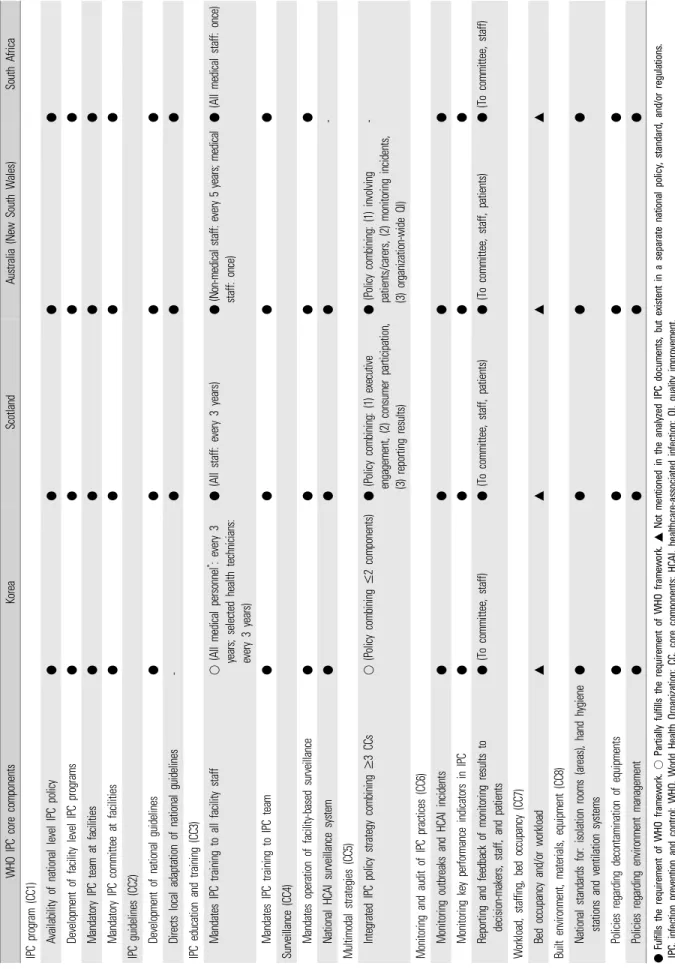
In the comparative analysis of the four countries, all four national policies included action plans that were relevant to CC1, which included development of national- and facility-level IPC programs and establishing IPC teams and committees at health care facilities (Table 4). While national policies of Scotland, Australia (New South Wales), and South Africa emphasized empowering of IPC teams to adapt national-level guidelines to the local context, this was not mentioned explicitly in the national policy of Korea. While in Scotland and Australia (New South Wales) IPC training and education is mandated to all hospital staff (medical or non-medical), South Africa and Korea are currently requiring IPC training in more limited range of professions. Scotland and Australia embrace multimodal IPC strategies with a combination of more than three CCs, both of which include patient participation and active feedback of results. While monitoring disease outbreaks and key performance indicators in IPC were mentioned as one of the most important aspects in IPC programs in all four countries, only Scotland and Australia have explicitly stated that its results should be reported to patients as well. CC7 (workload, staffing, bed occupancy) was not included in the national policies in any of the four countries, whereas CC8 (built environment, materials, equipment) was included in all of them.
3. Analysis of coronavirus disease 2019 infection prevention and control recommendations and associated infection prevention and control policies in Korea
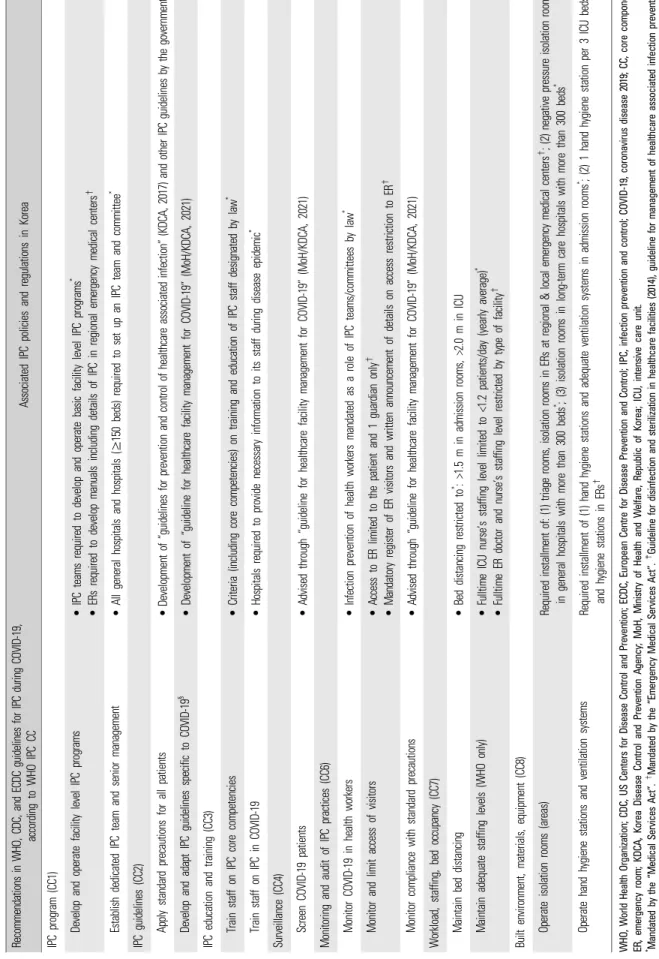
IPC recommendations in the context of COVID-19, provided in the WHO, CDC, and ECDC guidelines are similar to a great extent, in terms of WHO CC (Table 5). Three guidelines equally recommended that facilities should have a dedicated IPC team in place to develop and operate facility level COVID-19 response programs as well as senior management involvement for timely decision-making (CC1). It was advised that at the facility level, general IPC measures, including standard precautions be practiced, supported by development of relevant guidelines at the national level (CC2). Monitoring and screening of COVID-19 should be conducted in both the patients and health workers (CC4, CC6), and training of staff on COVID-19 should be actively performed (CC3). Recommendations on adequate utilization of isolation rooms, hand hygiene, and ventilation (CC8) were also made in all three guidelines. None of the guidelines made
any clear recommendations regarding multimodal strategies (CC5).
In Korea, through the Medical Services Act, all general hospitals and hospitals with more than 150 beds are currently required to operate an IPC team and committee (CC1), which is also mandated to function in disease outbreak situations such as the current COVID-19 pandemic.
Previously developed “guidelines for prevention and control of healthcare associated infection” and other IPC guidelines by the government provide guidance to IPC measures, including standard precautions (CC2). IPC measures specific to COVID-19, such as screening of COVID-19, universal masking, source control, isolation of suspected or confirmed COVID-19 cases, contact tracing, etc., are included in the recently developed “guideline for healthcare facility management on COVID-19” [29]. Heads of hospitals are required to provide necessary information to all in-house staff, medical or non-medical, during a disease outbreak, according to the Medical Services Act (CC3). Limiting access of hospital visitors is actively being conducted through several measures based on the Emergency Medical Services Act. However, these measures mostly limit access to ERs and certain functions of the hospital only. As for structural elements, such as isolation rooms, hand hygiene stations, and bed distancing (CC7, CC8), legislation in Korea regulates them as basic standards in order for hospitals to attain approval for establishment.
DISCUSSION
“The national policy for prevention and management of
healthcare-associated infection 2018–2022” is significant as the first
standalone, overarching national policy on IPC in Korea. The policy
also upgraded and reflected all of the IPC policy fragments presented
in relevant, previous policies, such as “the national framework for
communicable disease control, 2013–2017”, so that existing policies
do not lose legitimacy and political drive. The policy was based on a
thorough analysis of the IPC situation in the country and inputs from
the working group of experts and a range of other policy actors. The
national policy encompasses elements of successful policy
development, such as situational analysis based on local epidemiology,
stakeholder participation, integration of international guidelines, and
strong political will. As it is evident that the support of key stakeholders
322
312-327W H O I PC co re co m pon en ts Kor ea Sc ot la nd A ust ra lia ( N ew S out h W al es ) Sout h A fr ic a IP C pr ogr am ( CC1) A va ila bilit y o f n at io na l le ve l IP C p ol ic y ● ● ● ● Dev el opm en t of f aci lit y l ev el I PC pr ogr am s ●● ● ● M an dat or y I PC t eam at f aci lit ie s ● ● ● ● M an dat or y I PC c om m itt ee at f aci lit ie s ●● ● ● IP C g uid elin es (C C2 ) Dev el opm en t of nat ional g ui del ines ●● ● ● Di re ct s l oc al ad apt at io n of n at ion al gui del ines - ● ● ● IP C e duc at io n an d t rai ni ng ( CC3) M an dat es I PC t rai ni ng t o al l f ac ili ty s taf f ○ (A ll m edi cal p er son nel
*: ev er y 3 ye ar s; sel ect ed h eal th t ec hni ci ans : ev er y 3 y ea rs)
● (A ll s taf f: ev er y 3 y ear s) ● (N on -m ed ic al s taf f: ev er y 5 y ear s; m edi ca l st af f: onc e) ● (A ll m edi ca l s taf f: on ce) M an dat es I PC t rai ni ng t o I PC t eam ●● ● ● Su rve ill an ce (C C4 ) M an dat es op er at ion of f aci lit y- bas ed su rv ei lla nc e ●● ● ● Nat ion al HC AI su rv ei lla nc e sy st em ● ● ● - M ul tim odal s tr at egi es ( CC 5) In tegr at ed I PC pol ic y s tr at eg y c om bi ni ng ≥ 3 CCs ○ (P olic y c om bin in g ≤ 2 co m pon ent s) ● (P olic y c om bin in g: (1 ) e xe cu tiv e eng age m ent , ( 2) c ons um er pa rt ici pa tion, (3 ) r epo rti ng re su lts)
● (P ol ic y c om bin in g: (1 ) in vo lv in g pat ient s/ ca re rs , ( 2) m oni to rin g i nc ident s, (3 ) o rg an iz at io n- w id e Q I)
- M oni to rin g a nd a udi t of I PC pr act ic es ( CC6) M oni to ring out br eak s and HCAI i nc ident s ● ● ● ● M oni to ring k ey per fo rm anc e i ndi ca to rs i n I PC ●● ● ● Re por ting an d f eedb ac k of m oni to ring r es ul ts t o de ci si on- m ak er s, st af f, a nd p at ient s ● (To c om m itt ee, s taf f) ● (To c om m itt ee, s taf f, pat ie nt s) ● (T o co m m itt ee, s ta ff , pat ient s) ● (To c om m itt ee, s taf f) W or kl oad, st af fin g, bed occ upanc y ( CC7) Be d occ upanc y an d/ or w or kl oad ▲ ▲ ▲ ▲ Bu ilt e nvi ronm en t, m at er ial s, e qui pm en t ( CC8) Nat ion al s ta nda rd s f or : i sol at ion r oom s ( ar eas) , han d hy gi en e st at ions an d v ent ila tio n s ys te m s ● ● ● ● Pol ic ie s r ega rd in g dec ont am inat ion of eq ui pm ent s ●● ● ● Pol ic ie s r ega rd in g env ironm ent m ana gem en t ● ● ● ● ● Fu lfi lls t he r equi rem ent of W H O f ram ew or k. ○ Part ia lly f ul fil ls t he r equi rem ent of W H O f ram ew or k. ▲ N ot m ent io ned i n t he ana ly zed I PC do cum en ts , but exi st ent i n a separat e nat iona l pol ic y, st and ar d, and/ or r egul at ions. I P C, i nf ect io n prevent io n and c ont ro l; W H O , W orl d H eal th O rgan iz at ion; CC , core com pone nt s; H C A I, hea lthcare-associ at ed i nf ect io n; Q I, qua lit y i m provem ent .
*D esi gnat ed by M edi cal S er vi ces A ct as physi ci an , de nt is t, ori ent al m edi cal d oct or, m idw ife , and n ur se.
Tab le 4 . C o m p arat iv e an aly si s o f th e c o n ten ts o f th e n ati o n al I P C p o lic y i n fo u r c o u n tri es, u si n g t h e W H O I P C c o re c o m p o n en ts f ram ew o rk
Re co m m en da tion s i n W H O, C D C, and E CDC gu id el in es fo r I PC du ring C O VI D -19 , ac co rd in g t o W H O IP C C C Ass oc iat ed I PC pol ic ie s a nd r egul at ions i n Kor ea IP C pr ogr am ( CC1) Dev el op a nd o per at e f ac ili ty l ev el I PC pr og ra m s • IP C t ea m s r equi red t o dev el op an d op er at e b asi c f aci lit y l ev el I PC pr ogr am s
*• ERs r eq ui red t o d ev el op m anual s i nc ludi ng d et ai ls of I PC i n r egi on al em er genc y m edi ca l c ent er s
†Es ta bl is h d edi ca te d I PC t eam an d s eni or m ana gem en t • Al l g ener al hos pi ta ls a nd h os pi tal s ( ≥ 15 0 be ds) r equi red t o s et u p an I PC t ea m and co m m itt ee
*IP C g uid elin es (C C2 ) Appl y st and ar d pr ec au tions f or al l pat ient s • D ev el opm ent of “ gui del ines f or pr ev ent ion and c ont ro l of he al th ca re ass oci at ed i nf ec tion” (K DCA, 2017) a nd ot her I PC gui del in es by t he go Dev el op a nd a dapt I PC gui de lin es sp eci fic t o COVI D -19
§• D ev elo pm en t o f “ gu id elin e fo r h ea lth ca re fa cilit y m an ag em en t fo r C O VI D -1 9” (M oH /K D CA , 2 02 1) IP C e duc at io n an d t rai ni ng ( CC3) Tr ai n s taf f on I PC co re c om pet en ci es • Cr iter ia ( inc ludi ng co re c om pet en ci es ) on t ra in in g an d ed uc at io n of I PC s ta ff d esi gnat ed by l aw
*Tr ai n s taf f on I PC i n COVI D -19 • H ospi tal s r equi red t o pr ovi de nec es sa ry i nf or m at ion t o i ts st af f dur in g di seas e e pi dem ic
*Su rve ill an ce (C C4 ) Sc re en COVI D- 19 pat ie nt s • A dv is ed th ro ug h “ gu id elin e fo r h ea lth ca re fa cilit y m an ag em en t fo r C O VI D -1 9” (M oH /K D CA , 2 02 1) M oni to rin g a nd a udi t of I PC pr act ic es ( CC6) M oni to r COVI D -19 i n h eal th w or ker s • In fe ct io n pr ev en tion of h eal th w or ker s m anda te d as a r ol e of I PC t eam s/ co m m itt ees by l aw
*M oni to r and l im it ac ce ss of vi si to rs • A cc es s t o ER l im ited t o t he pat ient and 1 gu ar di an onl y
†• M and at or y r egi st er of ER v isi to rs and w rit te n an nou nc em ent of det ai ls on acc es s r est rict io n t o ER
†M oni to r co m pl ia nc e w ith s ta nda rd pr ec aut ions • A dv is ed th ro ug h “ gu id elin e fo r h ea lth ca re fa cilit y m an ag em en t fo r C O VI D -1 9” (M oH /K D CA , 2 02 1) W or kl oad, st af fin g, bed occ upanc y ( CC7) M ai nt ai n b ed di st an ci ng • Bed di st an ci ng r est rict ed t o
*: >1. 5 m i n a dm is si on r oom s, >2. 0 m i n I CU M ai nt ai n a deq uat e s taf fing l ev el s ( W HO onl y) • Ful lti m e I CU n ur se’ s st af fin g l ev el l im ite d t o < 1. 2 pat ient s/ da y ( ye ar ly av er ag e)
*• Ful lti m e ER doc to r an d nur se ’s s ta ff ing l ev el r es tr ic ted by t ype of f aci lit y
†Bu ilt e nvi ronm en t, m at er ial s, e qui pm en t ( CC8) Oper at e i sol at ion r oom s ( ar eas) Req ui red in st al lm ent of : ( 1) t riage r oom s, i sol at ion r oom s i n ERs at r egi onal & l oc al em er genc y m edi ca l c en ter s
†; ( 2) neg at iv e pr es su re i sol at in ge ner al hos pi ta ls w ith m or e t han 300 beds
*; ( 3) i sol at io n r oom s i n l ong- te rm c ar e ho spi tal s w ith m or e t han 30 0 be ds
*Oper at e han d hy gi en e s tat io ns and ve nt ila tion sy st em s Req ui red i nst al lm ent of ( 1) han d hy gi ene st at io ns and ad equ at e vent ila tio n sy st em s in a dm is si on r oo m s
*; ( 2) 1 ha nd hy gi ene s tat io n p er 3 I an d hy gi en e s tat io ns i n ERs
†W H O , W orl d H eal th O rga ni zat ion ; CD C , U S C ent ers f or D ise ase C ont ro l and P re vent ion; EC D C , Europe an C ent re fo r D isease Preve nt io n a nd C ont ro l; I P C , in fect io n preve nt ion a nd c ont ro l; CO VI D -19, c or onavi rus di seas e 20 19; C C , c or e ER , em ergen cy room ; KD CA , K orea D isease Co nt rol an d Preve nt ion A gen cy; M oH , M ini st ry of H eal th and W el fare, Re pub lic of Korea ; IC U , i nt ensi ve care uni t.
*M an da ted b y t he “M ed ic al Se rv ic es A ct ”.
†M and at ed by t he “Em erge ncy M ed ic al S er vi ces A ct ”.
‡G ui de line f or di si nf ec tio n a nd st eri liz at io n i n he al th care f ac ili ties ( 2014) , g ui de lin e for m ana ge m ent of he al thc are asso ci at ed i nf ec tio an d cont rol ( 2017) .
§Incl udi ng I P C m easur es suc h as scree ni ng CO V ID -19, uni ver sal m aski ng, source co nt rol , i so lat io n of susp ect ed or conf ir m ed C O VI D -19, c ont act t ra ci ng, et c.
Tab le 5 . R ec o m m en d at io n s i n W H O , C D C , a n d E C D C g u id el in es f o r I P C d u ri n g C O V ID -1 9 a n d a ss o ci at ed I P C p o lic ie s a n d r eg u la ti o n s i n K o re a
324 https://kshpa.jams.or.kr/co/main/jmMain.kci
Jeong Y et al ∙ Healthcare-Associated Infection Policy in South Korea and Implications in Coronavirus Disease 2019
Health Policy Manag 2021;31(3):312-327
is critical in the success of HCAI strategies [4], national policy is significant in that a wide range of stakeholders was involved in its development course. It is interesting to note that their respective interests vary to a certain extent. The health sector and the academia have emphasized “healthcare personnel and facilities” by highlighting policies that foster enabling environment for IPC activities in hospitals, e.g., training opportunities, pricing, and reimbursement schemes. CSOs have emphasized the participation of “patients” in IPC and patient safety policies and the Parliament has emphasized strengthening the role of the “government” in IPC. Such positions and interests of different policy players are similarly evident in the IPC policy environment of other countries as well [30]. It is the role of the government to shape such various policy needs into effective policy actions, as shown in the balanced disposition of four main policy areas and their action plans in the national policy.
The contents of the national policy in Korea covered most of the CCs as mentioned in the WHO guidelines, such as the establishment of IPC teams at hospitals, development of evidence-based guidelines on a national level, training and education of relevant health workers, and national surveillance programs. There are several notable aspects of the national policy that require further speculations. First, it is evident that the national policy placed a high emphasis on IPC personnel and programs (CC1). WHO recommends one full-time infection preventionist per 250 beds [4]. However, in Korea, this standard was adapted to the local context and with a higher standard of full-time infection preventionist in all general hospitals regardless of size and hospitals more than 150 beds. (Here, “hospital” refers to facilities with more than 30 beds and providing mostly inpatient services and “general hospital” refers to hospitals with more than 100 beds and at least 7–9 specialized departments, based on the Medical Services Act.) The full-time infection preventionist is backed up by members of the IPC team, of which the number and composition are different according to the number of beds. In addition to this current standard, MoH stipulated in the national policy, a part-time infection preventionist (IPC focal point) in hospitals with less than 150 beds, long-term hospitals, and clinics. Also relevant to CC1 are action plans such as developing a national level expert committee and operating monitoring framework for policy goals, through which it is evident that the government sought sustainable grounds for policy roll-out.
On the other hand, it is worth noting that the roles and responsibilities
of IPC teams and committees, such as conducting local adaptation of national guidelines, are not explicitly and clearly described. In this regard, policy measures to support IPC teams carry out their roles, such as the provision of a detailed manual of roles and responsibilities, will be beneficial. These manuals should include examples of program management, tailored to different types of facilities.
WHO CC, as well as all of the IPC COVID-19 guidelines of the three institutions, recommends IPC education and training to all facility staff, medical or non-medical. This is based on the background that all staff, irrespective of their roles in the facility, may inadvertently be involved in the influx and spread of HCAI and also be important actors in preventing it. In Korea, IPC was designated as an essential training course for medical personnel and several health technicians’
groups in 2018. Further consideration should be made to expand IPC training to other professions, as is done in Scotland and Australia.
Recommendations on multimodal strategies were not very clear-cut in the national policy of Korea and did not exactly fulfill WHO definitions. WHO mentions that the most commonly used strategies are (1) monitoring infrastructures, processes, and outcomes; (2) providing feedback to patients; (3) leadership engagement; (4) education and training of health workers and executives, and so forth [4]. The national policy includes linking IPC outcomes with quality assessment and conducting IPC awareness campaigns aimed at behavior change, which are both associated with multimodal strategies to some extent. However, these individual elements are not suggested as integrated program bundles, compared to multimodal strategies in Scotland and Australia. This is also in line with the relative scarcity of IPC policies targeting and/or involving patients in Korea. It is encouraging that the new national policy includes plans to establish IPC-self reporting that allows patients to report HCAI incidents, as well as plans to provide training to executives and managers of healthcare facilities, who have not been a regular target audience of IPC training so far. Future policies should more actively encourage the participation of various players in IPC programs and integrate effective IPC measures to achieve behavior change and establish a safety climate in IPC.
In terms of IPC in COVID-19, it is evident that sustainable IPC
structure (IPC teams, in-facility IPC programs, training on IPC core
competencies, etc.) and institutional memory that derives from it are
critical for timely and efficient response to disease outbreaks.
Accordingly, WHO, CDC, and ECDC have recommended all of these elements in their respective guidelines, and IPC policies in Korea have generally worked its way to have hospitals equipped with them.
COVID-19 specific IPC recommendations such as universal masking, source control, physical distancing, were included in a newly developed guideline by the government to support healthcare facilities [29].
Special consideration should be made about measures regarding monitoring COVID-19 in health workers, work leave, and return to work policies. ECDC particularly puts high emphasis on the safety of healthcare workers and other staff. This is significant not only for the well-being of the health workers themselves but also to minimize disease spread and to maintain the adequate performance of the healthcare system in the long run. However, such health workforce programs are difficult to establish amidst disease outbreaks, and thus should be established as part of the institution’s general IPC policy.
The Medical Services Act designates IPC of health workers as one of the roles of IPC teams but does not provide detailed policy measures or program direction. Development of detailed regulations and recommendations on health workforce policies associated with HCAI, which may include workplace safety, maintaining adequate staffing levels and workload, risk assessment, dismissal from and return to work policies should be considered in future IPC policies. As maintaining an adequate level of staffing and workload at times of long-standing outbreaks is difficult due to lack of resources at most facilities, such policies should actively be linked to district and national level outbreak response systems for efficient resource sharing and support.
Some of the recommendations in the IPC COVID-19 guidelines were previously mandated by law and had already gone into effect in Korea. One of these is the limitation of access to ER, which includes limiting access to only one guardian and a mandatory register of visitors to the ER. Having it regulated by law since 2017, many hospitals were already practicing these measures. However, many of the existing standards mostly target special functions of hospitals, such as ERs, partly owing to the previous experience with the MERS outbreak when ER was the ground for in-facility and inter-facility spread of the virus [7,8]. Future strategies should consider strengthening IPC measures in other functions of health facilities, such as the general in-patient wards and outpatient areas, as
recommended in the guidelines. In addition, as existing IPC regulations are generally geared towards hospitals, considerations should be made to expand such measures to long-term care facilities and clinics, as well. When considering statutory measures to those resource-limited institutions, special consideration should be made to balance such legal liabilities with enabling policy support. While it has been revealed that the influence of relevant legislature is critical in the establishment of IPC components in healthcare facilities [19,20], this may not be readily applicable to all aspects of IPC, of which true success is inevitably bound to establishing a sound, spontaneous, and sustainable safety culture.
Limitations of this study pertain to the aspects of a qualitative approach, in that the result of the analysis may be susceptible to subjective and open interpretation. The significance of this study is that it allowed in-depth analysis of the IPC policies developed and rolled out in Korea, in comparison with the national policies of other countries and also in the context of COVID-19, to reveal its strengths, weaknesses, and future policy implications, which will be useful in the development of the subsequent version of the national policy in the coming year.
ACKNOWLEDGMENTS
The views and opinions expressed in this study are those of the authors and do not necessarily reflect the official position of the Ministry of Health and Welfare or any other government agencies.
ORCID
Yoolwon Jeong: https://orcid.org/0000-0001-8179-4620;
Kinam Kim: https://orcid.org/0000-0003-4143-3796
REFERENCES
1. World Health Organization. Report on the burden of endemic health
care-associated infection worldwide. Geneva: World Health Organi-
326 https://kshpa.jams.or.kr/co/main/jmMain.kci
Jeong Y et al ∙ Healthcare-Associated Infection Policy in South Korea and Implications in Coronavirus Disease 2019
Health Policy Manag 2021;31(3):312-327
![Figure 1. Policy analysis triangle applied to this study. Adapted from Walt G, et al. Health Policy Plan 1994;9(4):353-370 [15]](https://thumb-ap.123doks.com/thumbv2/123dokinfo/5442541.432467/2.918.125.776.578.1046/figure-policy-analysis-triangle-applied-adapted-health-policy.webp)