D I A B E T E S & M E T A B O L I S M J O U R N A L D I A B E T E S & M E T A B O L I S M J O U R N A L
This is an Open Access article distributed under the terms of the Creative Commons Attribution Non-Commercial License (https://creativecommons.org/licenses/by-nc/4.0/) which permits unrestricted non-commercial use, distribution, and reproduction in any medium, provided the original work is properly cited.
Independent Impact of Diabetes on the Severity of Coronavirus Disease 2019 in 5,307 Patients in South Korea: A Nationwide Cohort Study
Sun Joon Moon1,*, Eun-Jung Rhee1,*, Jin-Hyung Jung2, Kyung-Do Han3, Sung-Rae Kim4, Won-Young Lee1, Kun-Ho Yoon5
1 Division of Endocrinology and Metabolism, Department of Internal Medicine, Kangbuk Samsung Hospital, Sungkyunkwan University School of Medicine, Seoul,
2Department of Medical Statistics, College of Medicine, The Catholic University of Korea, Seoul,
3Department of Statistics and Actuarial Science, Soongsil University, Seoul,
4Department of Endocrinology and Metabolism, Bucheon St. Mary’s Hospital, College of Medicine, The Catholic University of Korea, Bucheon,
5Department of Endocrinology and Metabolism, Seoul St. Mary’s Hospital, College of Medicine, The Catholic University of Korea, Seoul, Korea
Background: Inconsistent results have been observed regarding the independent effect of diabetes on the severity of coronavirus disease 2019 (COVID-19). We conducted a nationwide population-based cohort study to evaluate the relationship between dia- betes and COVID-19 severity in South Korea.
Methods: Patients with laboratory-confirmed COVID-19 aged ≥30 years were enrolled and medical claims data were obtained from the Korean Health Insurance Review and Assessment Service. Hospitalization, oxygen treatment, ventilator application, and mortality were assessed as severity outcomes. Multivariate logistic regression analyses were performed after adjusting for age, sex, and comorbidities.
Results: Of 5,307 COVID-19 patients, the mean age was 56.0±14.4 years, 2,043 (38.5%) were male, and 770 (14.5%) had diabetes.
The number of patients who were hospitalized, who received oxygen, who required ventilator support, and who died was 4,986 (94.0%), 884 (16.7%), 121 (2.3%), and 211 (4.0%), respectively. The proportion of patients with diabetes in the abovementioned outcome groups was 14.7%, 28.1%, 41.3%, 44.6%, showing an increasing trend according to outcome severity. In multivariate analyses, diabetes was associated with worse outcomes, with an adjusted odds ratio (aOR) of 1.349 (95% confidence interval [CI], 1.099 to 1.656; P=0.004) for oxygen treatment, an aOR of 1.930 (95% CI, 1.276 to 2.915; P<0.001) for ventilator use, and an aOR of 2.659 (95% CI, 1.896 to 3.729; P<0.001) for mortality.
Conclusion: Diabetes was associated with worse clinical outcomes in Korean patients with COVID-19, independent of other co- morbidities. Therefore, patients with diabetes and COVID-19 should be treated with caution.
Keywords: COVID-19; Diabetes mellitus; Mortality; Prognosis; Risk factors
Corresponding authors: Won-Young Lee https://orcid.org/0000-0002-1082-7592 Division of Endocrinology and Metabolism, Department of Internal Medicine, Kangbuk Samsung Hospital, Sungkyunkwan University School of Medicine, 29 Saemunan-ro, Jongno-gu, Seoul 03181, Korea
E-mail: [email protected]
Kun-Ho Yoon https://orcid.org/0000-0002-9109-2208
Department of Endocrinology and Metabolism, Seoul St. Mary’s Hospital, College of Medicine, The Catholic University of Korea, 222 Banpo-daero, Seocho-gu, Seoul 06591, Korea
E-mail: [email protected]
INTRODUCTION
Coronavirus disease 2019 (COVID-19), which is caused by a
novel virus severe acute respiratory syndrome coronavirus 2 (SARS-CoV-2), has had major effects worldwide [1]. Since the first case was reported in Wuhan, China in December 2019, CO- https://doi.org/10.4093/dmj.2020.0141
pISSN 2233-6079 · eISSN 2233-6087
VID-19 has spread globally, and as of on June 4, 2020 the total number of COVID-19 cases reached 6,416,828 with 382,867 fa- talities according to the World Health Organization (WHO) [2].
According to previous studies, risk factors for the severity of COVID-19 are old age, male sex, high body mass index, and chronic disease [3-5]. Since diabetes is a major risk factor for other diseases caused by coronaviruses, such as severe acute respiratory syndrome (SARS) and the Middle East respiratory syndrome (MERS), special attention has been given to diabetes [6,7]. Increased expression of angiotensin converting enzyme 2 (ACE2), the receptor of SARS-CoV-2, impairs innate and adaptive immunity, and the presence of comorbidities other than diabetes has been suggested to be a potential mechanism of diabetes to affect the poor clinical outcomes of patients with COVID-19 [8-11].
To date, several studies from different countries evaluated the impact of diabetes on COVID-19 outcomes [3,5,12-20].
Without considering other comorbidities, most studies showed a significant association between critical illness or death and diabetes. However, in some of those studies, no such associa- tion was found after adjusting for other risk factors [3,5,14,18].
Among the studies showing significant associations, the haz- ard ratios varied substantially [16,17]. Most of these studies were not conducted across different geographic areas and only included hospitalized patients who had relatively severe condi- tions. To better evaluate the impact of diabetes on the severity of COVID-19, studies with larger and nationwide data are nec- essary.
South Korea is regarded as a country that has successfully coped with COVID-19 through accurate and aggressive testing;
more than one million tests were performed, revealing a 1.2%
positive rate and 2.4% mortality rate (as of June 4, 2020), which implies that most cases were detected [21]. A retrospective study of COVID-19 in South Korea has assessed the clinical outcomes of patients with diabetes; however, it was conducted at a single center and included a relatively small number pa- tients (n=117) [19]. Therefore, we conducted a nationwide population-based cohort study to evaluate the impact of diabe- tes on severity outcomes among patients with COVID-19 in South Korea.
METHODS
Study subjects
In South Korea, the national health coverage system covers ap-
proximately 98% of the total national population, and the Ko- rean Health Insurance Review and Assessment Service (HIRA) is the government agency that reviews medical claims. For re- search purposes, the South Korean government has shared de- identified nationwide HIRA data on patients with COVID-19 with the public and researchers [22]. This contains data on all patients who were thought to be infected with COVID-19 after January 2020, including data on examinations, prescription drugs, and diagnostic codes. The Korean Classification of Dis- eases seventh revision (KCD-7), a modified version of the In- ternational Classification of Disease (ICD-10), was used as the diagnostic code. All patients with COVID-19 aged ≥30 years were enrolled in this retrospective study, regardless of hospital- ization. Among 11,018 patients with COVID-19 confirmed prior to May 15, 2020, 7,590 patients were eligible after exclud- ing subjects with missing claims data, and 5,307 patients aged 30 years or more were finally included in this cohort (Fig. 1) [23].
COVID-19 tests
In South Korea, COVID-19 screening tests are performed with a nasopharyngeal swab or sputum sample using a diagnostic kit and real-time polymerase chain reaction. The South Korean government guidelines on indications for the screening test are as follows: (1) a person exhibiting a fever (≥37.5°C) or respira- tory symptoms (such as cough and shortness of breath) within 14 days of contact with a patient with confirmed COVID-19 during their symptom-exhibiting period; (2) a person suspect- ed of COVID-19 according to a physician’s opinion, for rea- sons such as pneumonia of unknown etiology; (3) a person with an overseas travel history exhibiting a fever (≥37.5°C) or respiratory symptoms (such as cough and shortness of breath) within 14 days of entry into South Korea; or (4) a person ex- hibiting fever (≥37.5°C) or respiratory symptoms (such as cough and shortness of breath) within 14 days who has an epi- demiological link to a domestic COVID-19 cluster [24]. As of May 15, 2020, of the 726,747 tests performed, 11,018 test re- sults were positive for COVID-19.
Disease definitions
Patients with diabetes were defined as those who had a pre- scription of antidiabetic drugs in the year prior to diagnosis of COVID-19. The following diagnostic codes were used to de- fine other comorbidities: hypertension (HTN), I10-13 and I15;
dyslipidemia, E78; chronic kidney disease (CKD), N18-19;
chronic obstructive pulmonary disease (COPD), J41-J44; isch- emic heart disease (IHD), I20-25; stroke, I121-122; congestive heart failure (CHF), I150; atrial fibrillation (AF), I48; end-stage renal disease (ESRD), rare and incurable disease claim codes V001, V003, V005. Cardiovascular disease (CVD) was defined as a composite of IHD, stroke, and CHF. Hospitalization, oxy- gen treatment, ventilator use, and mortality were evaluated as outcomes.
Statistical analysis
Continuous variables are presented as mean±standard devia- tion, and categorical variables are presented as number and proportion. Baseline characteristics were compared between the diabetes and non-diabetes groups using the t-test and chi- square test. To evaluate the association between diabetes and the severity of outcomes, multivariate logistic regression analy- ses was performed using several models: (1) Model 1, unad- justed; (2) Model 2, age+sex; (3) Model 3: age+sex+HTN+dysli pidemia+CKD+COPD+CVD+AF+ESRD+cancer. In addi- tion, we performed subgroup analyses stratified by sex, age (65 years), and CVD status. For all tests, a P value of <0.05 was considered statistically significant. Statistical analyses were per- formed using SAS version 9.4 (SAS Institute, Cary, NC, USA).
Ethical statement
This study was approved by the Institutional Review Board
(IRB) of Kangbuk Samsung Hospital (IRB No. KBSMC 2020- 04-040). Patient data were de-identified and based on the Bio- ethics and Safety Act in South Korea, the need for informed consent from subjects was waived.
RESULTS
Baseline characteristics and clinical outcomes
The mean patient age was 56.0±14.4 years and 2,043 (38.5%) were male. A total of 770 (14.5%) patients had diabetes. The diabetes group included more older (65.4±11.8 years vs. 54.4±
14.2 years) and male (49.7% vs. 36.6%) patients than the non- diabetes group (Table 1). All comorbidities, including HTN, dyslipidemia, CKD, COPD, CVD, AF, ESRD, and cancer, were more prevalent in the diabetes group than in the non-diabetes group. In total, 4,986 (94.0%) patients were hospitalized, 884 (16.7%) patients underwent oxygen treatment, 121 (2.3%) pa- tients required ventilator support, and 211 (4.0%) patients died (Table 2). With the exception of hospitalization (P=0.118), all severe outcomes were significantly higher in patients with dia- betes than in those without diabetes (all P<0.001).
Clinical outcomes according to age group and comorbidities
Patients with poor outcomes were significantly older than those with good outcomes (all P<0.001), and age showed a Fig. 1. Study enrollment of patients with coronavirus from Korean Health Insurance Review and Assessment Service (HIRA) data. COVID-19, coronavirus disease 2019; RT-PCR, real-time polymerase chain reaction.
11,018 COVID-19 patients confirmed by RT-PCR on May 15, 2020
3,428 Missing claim data
2,283 Age <30 years 7,590 COVID-19 patients whose claim data
were available in HIRA on May 15, 2020
5,307 COVID-19 patients aged 30 years or more
770 Patients with diabetes
(14.5%) 4,537 Patients without diabetes (85.5%)
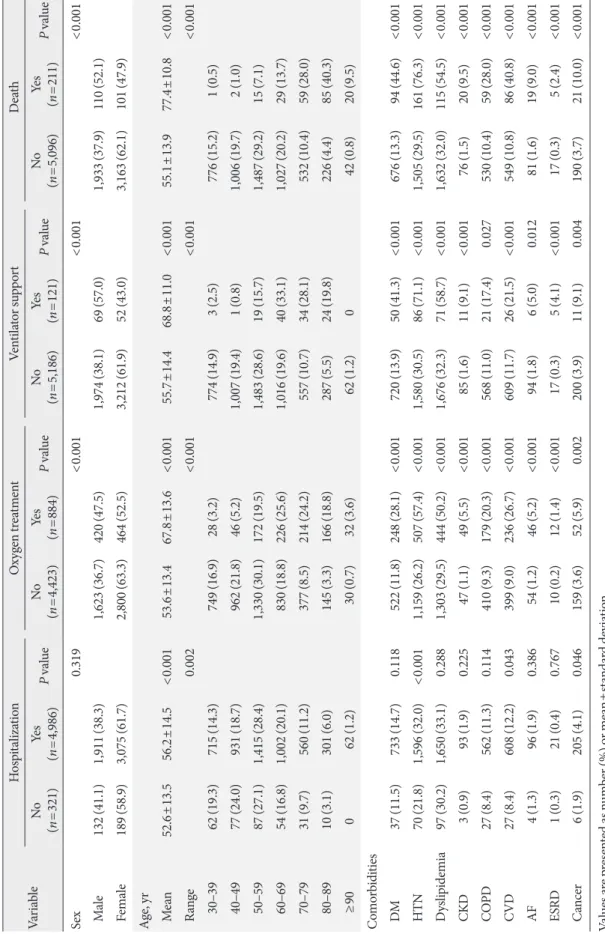
tendency toward increasing as outcomes worsened from sim- ple hospitalization to death (56.2±14.5, 67.8±13.6, 68.8±11.0, and 77.4±10.8 years, respectively) (Table 3). There were more male subjects in groups with poor outcomes than in groups with good outcomes.
The number of patients with HTN, CVD, and cancer was higher in the hospitalized group, but there was no correlation with other comorbidities. With regard to other severe out- comes (oxygen, ventilator support, and death), all comorbidi- ties were associated with worse clinical outcomes. The propor- Table 1. Baseline characteristics of patients with coronavirus disease 2019 according to diabetes status
Characteristic Total (n=5,307) Non-DM (n=4,537) DM (n=770) P value
Sex <0.001
Male 2,043 (38.5) 1,660 (36.6) 383 (49.7)
Female 3,264 (61.5) 2,877 (63.4) 387 (50.3)
Age, yr
Mean 56.0±14.4 54.4±14.2 65.4±11.8 <0.001
Range <0.001
30–39 777 (14.6) 763 (16.8) 14 (1.8)
40–49 1,008 (19.0) 961 (21.2) 47 (6.1)
50–59 1,502 (28.3) 1,316 (29.0) 186 (24.2)
60–69 1,056 (19.9) 813 (17.9) 243 (31.6)
70–79 591 (11.1) 409 (9.0) 182 (23.6)
80–89 311 (5.9) 221 (4.9) 90 (11.7)
≥90 62 (1.2) 54 (1.2) 8 (1.0)
Comorbidities
DM 770 (14.5) 0 770 (100) <0.001
HTN 1,666 (31.4) 1,137 (25.1) 529 (68.7) <0.001
Dyslipidemia 1,747 (32.9) 1,148 (25.3) 599 (77.8) <0.001
CKD 96 (1.8) 46 (1.0) 50 (6.5) <0.001
COPD 589 (11.1) 471 (10.4) 118 (15.3) <0.001
CVD 635 (12.0) 415 (9.2) 220 (28.6) <0.001
AF 100 (1.9) 71 (1.6) 29 (3.8) <0.001
ESRD 22 (0.4) 11 (0.2) 11 (1.4) <0.001
Cancer 211 (4.0) 166 (3.7) 45 (5.8) 0.004
Values are presented as number (%) or mean±standard deviation.
DM, diabetes mellitus; HTN, hypertension; CKD, chronic kidney disease; COPD, chronic obstructive pulmonary disease; CVD, cerebrovascu- lar disease; AF, atrial fibrillation; ESRD, end-stage renal disease.
Table 2. Clinical outcomes of patients with coronavirus disease 2019 according to diabetes status
Variable Total (n=5,307) Non-DM (n=4,537) DM (n=770) P value
Hospitalization 4,986 (94.0) 4,253 (93.7) 733 (95.2) 0.118
Oxygen treatment 884 (16.7) 636 (14.0) 248 (32.2) <0.001
Ventilator support 121 (2.3) 71 (1.6) 50 (6.5) <0.001
Death 211 (4.0) 117 (2.6) 94 (12.2) <0.001
Values are presented as number (%).
DM, diabetes mellitus.
Table 3. Comorbidities of patients with coronavirus disease 2019 according to clinical outcomes VariableHospitalizationOxygen treatmentVentilator supportDeath No (n=321)Yes (n=4,986)P valueNo (n=4,423)Yes (n=884)P valueNo (n=5,186)Yes (n=121)P valueNo (n=5,096)Yes (n=211)P value Sex0.319<0.001<0.001<0.001 Male132 (41.1)1,911 (38.3)1,623 (36.7)420 (47.5)1,974 (38.1)69 (57.0)1,933 (37.9)110 (52.1) Female189 (58.9)3,075 (61.7)2,800 (63.3)464 (52.5)3,212 (61.9)52 (43.0)3,163 (62.1)101 (47.9) Age, yr Mean52.6±13.556.2±14.5<0.00153.6±13.467.8±13.6<0.00155.7±14.468.8±11.0<0.00155.1±13.977.4±10.8<0.001 Range0.002<0.001<0.001<0.001 30–3962 (19.3)715 (14.3)749 (16.9)28 (3.2)774 (14.9)3 (2.5)776 (15.2)1 (0.5) 40–4977 (24.0)931 (18.7)962 (21.8)46 (5.2)1,007 (19.4)1 (0.8)1,006 (19.7)2 (1.0) 50–5987 (27.1)1,415 (28.4)1,330 (30.1)172 (19.5)1,483 (28.6)19 (15.7)1,487 (29.2)15 (7.1) 60–6954 (16.8)1,002 (20.1)830 (18.8)226 (25.6)1,016 (19.6)40 (33.1)1,027 (20.2)29 (13.7) 70–7931 (9.7)560 (11.2)377 (8.5)214 (24.2)557 (10.7)34 (28.1)532 (10.4)59 (28.0) 80–8910 (3.1)301 (6.0)145 (3.3)166 (18.8)287 (5.5)24 (19.8)226 (4.4)85 (40.3) ≥900 62 (1.2)30 (0.7)32 (3.6)62 (1.2)0 42 (0.8)20 (9.5) Comorbidities DM37 (11.5)733 (14.7)0.118522 (11.8)248 (28.1)<0.001720 (13.9)50 (41.3)<0.001676 (13.3)94 (44.6)<0.001 HTN70 (21.8)1,596 (32.0)<0.0011,159 (26.2)507 (57.4)<0.0011,580 (30.5)86 (71.1)<0.0011,505 (29.5)161 (76.3)<0.001 Dyslipidemia97 (30.2)1,650 (33.1)0.2881,303 (29.5)444 (50.2)<0.0011,676 (32.3)71 (58.7)<0.0011,632 (32.0)115 (54.5)<0.001 CKD3 (0.9)93 (1.9)0.22547 (1.1)49 (5.5)<0.00185 (1.6)11 (9.1)<0.00176 (1.5)20 (9.5)<0.001 COPD27 (8.4)562 (11.3)0.114410 (9.3)179 (20.3)<0.001568 (11.0)21 (17.4)0.027530 (10.4)59 (28.0)<0.001 CVD27 (8.4)608 (12.2)0.043399 (9.0)236 (26.7)<0.001609 (11.7)26 (21.5)<0.001549 (10.8)86 (40.8)<0.001 AF4 (1.3)96 (1.9)0.38654 (1.2)46 (5.2)<0.00194 (1.8)6 (5.0)0.01281 (1.6)19 (9.0)<0.001 ESRD1 (0.3)21 (0.4)0.76710 (0.2)12 (1.4)<0.00117 (0.3)5 (4.1)<0.00117 (0.3)5 (2.4)<0.001 Cancer6 (1.9)205 (4.1)0.046159 (3.6)52 (5.9)0.002200 (3.9)11 (9.1)0.004190 (3.7)21 (10.0)<0.001 Values are presented as number (%) or mean±standard deviation. DM, diabetes mellitus; HTN, hypertension; CKD, chronic kidney disease; COPD, chronic obstructive pulmonary disease; CVD, cerebrovascular disease; AF, atrial fibrillation; ESRD, end-stage renal disease.
tion of patients with diabetes showed a positive correlation with severity of outcomes, accounting for 14.7%, 28.1%, 41.3%, and 44.6% in the hospitalization, oxygen, ventilator support, and death groups, respectively.
Risk of poor clinical outcomes according to diabetes status The results of logistic regression analyses for severe outcomes according to diabetes status are shown in Table 4. In both uni- variate and multivariate analyses, the presence of diabetes did not increase risk for hospitalization. In contrast, the presence of diabetes significantly increased the risks for all other poor clinical outcomes, even after adjustment for covariates and co-
morbidities, although the odds ratios (ORs) were attenuated after full adjustment, with an adjusted odds ratio (aOR) of 1.349 (95% confidence interval [CI], 1.099 to 1.656; P=0.004) for oxygen treatment, an aOR of 1.930 (95% CI, 1.913 to 1.946;
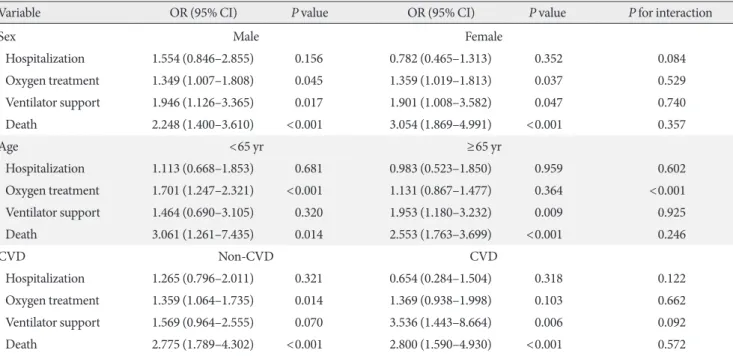
P<0.001) for ventilator support, and an aOR of 2.659 (95% CI, 1.896 to 3.729; P<0.001) for mortality. In subgroup analyses stratified by sex, age (65 years), and CVD status, death was sig- nificantly associated with diabetes in all subgroups, and there was no significant difference in the association between mor- tality and diabetes in male and female patients, those aged <65 and ≥65 years, or non-CVD and CVD groups (Table 5).
Table 4. Logistic regression analyses for the risk of clinical outcomes according to diabetes status
Variable Model 1 Model 2 Model 3
OR (95% CI) P value OR (95% CI) P value OR (95% CI) P value
Hospitalization 1.323 (0.931–1.879) 0.119 1.102 (0.763–1.592) 0.603 1.071 (0.722–1.588) 0.735 Oxygen supply 2.914 (2.452–3.464) <0.001 1.586 (1.314–1.915) <0.001 1.349 (1.099–1.656) 0.004 Ventilator apply 4.369 (3.017–6.327) <0.001 2.542 (1.734–3.725) <0.001 1.930 (1.276-2.915) <0.001 Death 5.254 (3.958–6.974) <0.001 2.906 (2.129–3.966) <0.001 2.659 (1.896–3.729) <0.001 Model 1: Unadjusted; Model 2: Adjusted for age+sex; Model 3: Adjusted for age+sex+hypertension+dyslipidemia+chronic kidney disease+
chronic obstructive lung disease+cardiovascular disease+atrial fibrillation+end-stage renal disease+cancer.
OR, odds ratio; CI, confidence interval.
Table 5. Associations between diabetes and COVID-19 severity across subgroups stratified by sex, age, and CVD status
Variable OR (95% CI) P value OR (95% CI) P value P for interaction
Sex Male Female
Hospitalization 1.554 (0.846–2.855) 0.156 0.782 (0.465–1.313) 0.352 0.084
Oxygen treatment 1.349 (1.007–1.808) 0.045 1.359 (1.019–1.813) 0.037 0.529
Ventilator support 1.946 (1.126–3.365) 0.017 1.901 (1.008–3.582) 0.047 0.740
Death 2.248 (1.400–3.610) <0.001 3.054 (1.869–4.991) <0.001 0.357
Age <65 yr ≥65 yr
Hospitalization 1.113 (0.668–1.853) 0.681 0.983 (0.523–1.850) 0.959 0.602
Oxygen treatment 1.701 (1.247–2.321) <0.001 1.131 (0.867–1.477) 0.364 <0.001
Ventilator support 1.464 (0.690–3.105) 0.320 1.953 (1.180–3.232) 0.009 0.925
Death 3.061 (1.261–7.435) 0.014 2.553 (1.763–3.699) <0.001 0.246
CVD Non-CVD CVD
Hospitalization 1.265 (0.796–2.011) 0.321 0.654 (0.284–1.504) 0.318 0.122
Oxygen treatment 1.359 (1.064–1.735) 0.014 1.369 (0.938–1.998) 0.103 0.662
Ventilator support 1.569 (0.964–2.555) 0.070 3.536 (1.443–8.664) 0.006 0.092
Death 2.775 (1.789–4.302) <0.001 2.800 (1.590–4.930) <0.001 0.572
Model adjusted for age+sex+hypertension+dyslipidemia+chronic kidney disease+chronic obstructive lung disease+cardiovascular disease+
atrial fibrillation+end-stage renal disease+cancer.
COVID-19, coronavirus disease 2019; CVD, cardiovascular disease; OR, odds ratio; CI, confidence interval.
DISCUSSION
We performed a nationwide population-based cohort study evaluating the impact of diabetes on the severity of COV- ID-19. Among 5,307 patients with COVID-19 aged ≥30 years, 14.5% had diabetes, and a gradual increasing tendency was shown in the proportion of diabetes with increasing severity of outcomes. Despite a non-significant association with hospital- ization, diabetes was significantly associated with the need for oxygen treatment, ventilator support, and mortality even after adjusting for other comorbidities, with ORs of 1.349, 1.930, and 2.659, respectively.
COVID-19 is caused by SARS-CoV-2, which is a single- strand enveloped RNA virus and the seventh known human coronavirus [25]. Other human coronaviruses include SARS coronavirus (SARS-CoV) and MERS coronavirus (MERS- CoV), which caused SARS in 2002 and MERS in 2012, respec- tively [26]. Similar to SARS-CoV and MERS-CoV, the primary source of SARS-CoV-2 is thought to be bats; it is believed to have moved to an intermediate host (probably a pangolin) be- fore transmission to humans [27]. In all pandemic diseases caused by coronaviruses, diabetes was associated with worse outcomes [6,7]. Several potential mechanisms by which diabe- tes affects poor outcomes in patients with COVID-19 have been suggested [8,28]. These include (1) increased expression of ACE2 (the receptor of SARS-CoV-2) in diabetes, which has been confirmed in animal studies [11]; (2) poor glycemic con- trol [28]; (3) decreased viral clearance due to impaired innate and adaptive immunity [10]; (4) vulnerability to cytokine storm syndrome [9]; and (5) the presence of other comorbidi- ties, such as CVD.
Hence, international diabetes associations have suggested strict glycemic control to defend against COVID-19, and the American Diabetes Association has created a platform for health professionals to share and discuss their COVID-19 ex- perience [29]. The United States Centers for Disease Control and Prevention classified patients with diabetes as a high-risk group for severe COVID-19 [30]. The Korean Diabetes Asso- ciation (KDA) has proposed prioritizing COVID-19 screening in elderly (aged ≥70 years) patients with diabetes, based on data that showed a high proportion of patients with diabetes among patients with COVID-19.
Recently, several previous studies have assessed the associa- tion between diabetes and poor prognosis in patients with COVID-19. Most results of univariate analyses have shown a
positive association between diabetes and severe outcomes [3,5,12-17,19,20]. However, after adjusting for comorbidities, this association disappeared in many studies (Supplementary Table 1). In a large prospective cohort study of 2,729 hospital- ized patients with COVID-19 in the United States, the multi- variate aOR of diabetes for mortality was 1.23 (95% CI, 0.99 to 1.50), which was not significant [3]. In another United States study conducted in 257 critically-ill patients with COVID-19, no significant association between diabetes and mortality was shown, with an adjusted hazard ratio (aHR) for mortality of 1.31 (95% CI, 0.81 to 2.10) [5]. Furthermore, another United States study involving 200 hospitalized patients with COV- ID-19 also failed to show a significant association between dia- betes and mortality, with an aHR of 1.16 (95% CI, 0.55 to 2.44) [18]. In a large prospective cohort study in the United King- dom, the multivariate aHR for death was 1.06 (95% CI, 0.99 to 1.14) among 15,194 hospitalized patients with COVID-19;
however, no significant association was found [20]. In China, one study including 306 age- and sex-matched hospitalized patients with COVID-19 showed no significant aHR for mor- tality (1.58; 95% CI, 0.84 to 2.99) [14].
In contrast, in another multivariate study in China, diabetes was significantly associated with a composite outcome of in- tensive care unit (ICU) admission, ventilator use, and mortali- ty among 1,590 hospitalized patients with COVID-19 (aHR, 1.59; 95% CI, 1.03 to 2.45) [16], while another Chinese study of 453 hospitalized patients with COVID-19 showed a relative- ly high aHR of 4.63 (95% CI, 1.02 to 21.0) for mortality in pa- tients with diabetes compared to normoglycemic patients [17].
A study conducted in Italy of 59 hospitalized patients with COVID-19 also showed a relatively strong association between diabetes and a composite outcome of ICU admission, ventila- tor use, and death, with an aHR of 5.81 (95% CI, 1.74 to 19.61) [13]. Moreover, a study of 117 hospitalized patients with COV- ID-19 in South Korea showed a significant association between diabetes and severe outcomes (composite of acute respiratory distress syndrome, septic shock, and ICU care), with an aOR of 10.77 (95% CI, 3.00 to 38.73) [19].
Despite these discrepancies, most large cohort studies in various countries have shown no significant association be- tween diabetes and severe outcomes (Supplementary Table 1).
However, the present study suggested a significant indepen- dent association between diabetes and the severity of COV- ID-19. This difference may be due to the lower mortality rate of COVID-19 in South Korea (3.98% in this study) than in
other countries and the fact that more patients with relatively non-severe COVID-19 were included in this cohort. Given the global, large-scale outbreak of COVID-19, the high mortality rates seen in several studies may be because the patients in- volved were hospitalized at advanced stages of COVID-19, and limited medical resources may have prevented adequate treat- ment. In this case, it can be assumed that many deaths occur regardless of comorbidities. On the other hand, studies with low mortality, including this study, are conducted in relatively stable situations, and we believe that they better reflect the ef- fects of comorbidities on disease severity. As shown in Supple- mentary Table 1, the mortality rate in studies that showed no significant findings was as high as 15.4% to 39% [3,5,14,18,20].
However, other studies reporting a positive association have shown a substantially lower mortality rate of 3.1% to 10.2%
[13,16,17,19], which supports our hypothesis to some extent.
To the best of our knowledge, this South Korean study is the first study conducted in a national population evaluating the impact of diabetes on the severity of COVID-19 outcomes.
Moreover, South Korea is regarded as one of the most success- ful countries with regard to managing the COVID-19 pan- demic, and national data can be interpreted as originating from a relatively well-controlled and stable situation. Since a substantial number of COVID-19 tests were performed in South Korea, and aggregate national data were included, we believe that the results of the present study are more reflective of the real-life situation.
Several limitations should be considered. Due to the nature of claims data, laboratory results were absent, and disease defi- nitions were based solely on the diagnostic codes or prescrip- tion data. Since we defined patients with diabetes as those who had a prescription for anti-diabetes drugs, patients with diabe- tes who were not on medication may have been assigned to the non-diabetes group in this study. However, we expect the number of these patients to be small. In addition, since there was a time lag between actual medical practice and medical claims, there is a possibility that non-collected claims data were missed. However, we believe that missing claims data will oc- cur randomly and are not likely to significantly affect our find- ings. In addition, due to policy in South Korea, most patients with confirmed COVID-19 are hospitalized for treatment re- gardless of severity, and the proportion of hospitalization was high. Therefore, this should be taken into account when inter- preting the results, especially regarding the outcome of hospi- talization.
In conclusion, in this nationwide population-based cohort study of patients with COVID-19 in South Korea, diabetes was associated with worse clinical outcomes in patients with COV- ID-19 independent of other comorbidities. After full adjust- ment for comorbidities, the OR for mortality in patients with diabetes was 2.66, which was higher than reported in previous observational studies conducted in other countries with higher mortality rates. Therefore, the importance of caution regarding patients with diabetes, who are vulnerable to COVID-19, can- not be overemphasized, and gathering further experience and knowledge globally will improve our understanding of how comorbidities affect COVID-19 severity and will facilitate the development of more effective treatment strategies in vulnera- ble patients.
SUPPLEMENTARY MATERIALS
Supplementary materials related to this article can be found online at https://doi.org/10.4093/dmj.2020.0141.
CONFLICTS OF INTEREST
No potential conflict of interest relevant to this article was re- ported.
AUTHOR CONTRIBUTIONS
Conception or design: S.R.K., W.Y.L, K.H.Y.
Acquisition, analysis, or interpretation of data: S.J.M., E.J.R., J.H.J., K.D.H.
Drafting the work or revising: S.J.M., E.J.R., W.Y.L., K.H.Y.
Final approval of the manuscript: S.J.M., E.J.R., J.H.J., K.D.H., S.R.K., W.Y.L., K.H.Y.
ORCID
Sun Joon Moon https://orcid.org/0000-0002-6286-7254 Eun-Jung Rhee https://orcid.org/0000-0002-6108-7758 Won-Young Lee https://orcid.org/0000-0002-1082-7592 Kun-Ho Yoon https://orcid.org/0000-0002-9109-2208
ACKNOWLEDGMENTS
The present study was supported and funded by the Korea Di- abetes Association.
REFERENCES
1. Lu R, Zhao X, Li J, Niu P, Yang B, Wu H, Wang W, Song H, Huang B, Zhu N, Bi Y, Ma X, Zhan F, Wang L, Hu T, Zhou H, Hu Z, Zhou W, Zhao L, Chen J, Meng Y, Wang J, Lin Y, Yuan J, Xie Z, Ma J, Liu WJ, Wang D, Xu W, Holmes EC, Gao GF, Wu G, Chen W, Shi W, Tan W. Genomic characterisation and epi- demiology of 2019 novel coronavirus: implications for virus origins and receptor binding. Lancet 2020;395:565-74.
2. World Health Organization: Coronavirus disease (COV- ID-2019) situation reports 136. Available from: https://www.
who.int/docs/default-source/coronaviruse/situation-reports/
20200604-covid-19-sitrep-136.pdf?sfvrsn=fd36550b_2 (cited 2020 Jun 4).
3. Petrilli CM, Jones SA, Yang J, Rajagopalan H, O’Donnell L, Chernyak Y, Tobin KA, Cerfolio RJ, Francois F, Horwitz LI.
Factors associated with hospital admission and critical illness among 5279 people with coronavirus disease 2019 in New York City: prospective cohort study. BMJ 2020;369:m1966.
4. Guan WJ, Ni ZY, Hu Y, Liang WH, Ou CQ, He JX, Liu L, Shan H, Lei CL, Hui DSC, Du B, Li LJ, Zeng G, Yuen KY, Chen RC, Tang CL, Wang T, Chen PY, Xiang J, Li SY, Wang JL, Liang ZJ, Peng YX, Wei L, Liu Y, Hu YH, Peng P, Wang JM, Liu JY, Chen Z, Li G, Zheng ZJ, Qiu SQ, Luo J, Ye CJ, Zhu SY, Zhong NS;
China Medical Treatment Expert Group for Covid-19. Clinical characteristics of coronavirus disease 2019 in China. N Engl J Med 2020;382:1708-20.
5. Cummings MJ, Baldwin MR, Abrams D, Jacobson SD, Meyer BJ, Balough EM, Aaron JG, Claassen J, Rabbani LE, Hastie J, Hochman BR, Salazar-Schicchi J, Yip NH, Brodie D, O’Donnell MR. Epidemiology, clinical course, and outcomes of critically ill adults with COVID-19 in New York City: a pro- spective cohort study. Lancet 2020;395:1763-70.
6. Allard R, Leclerc P, Tremblay C, Tannenbaum TN. Diabetes and the severity of pandemic influenza A (H1N1) infection.
Diabetes Care 2010;33:1491-3.
7. Assiri A, Al-Tawfiq JA, Al-Rabeeah AA, Al-Rabiah FA, Al-Haj- jar S, Al-Barrak A, Flemban H, Al-Nassir WN, Balkhy HH, Al- Hakeem RF, Makhdoom HQ, Zumla AI, Memish ZA. Epide- miological, demographic, and clinical characteristics of 47 cases of Middle East respiratory syndrome coronavirus disease from Saudi Arabia: a descriptive study. Lancet Infect Dis 2013;13:752- 61.
8. Muniyappa R, Gubbi S. COVID-19 pandemic, coronaviruses, and diabetes mellitus. Am J Physiol Endocrinol Metab 2020;
318:E736-41.
9. Bornstein SR, Dalan R, Hopkins D, Mingrone G, Boehm BO.
Endocrine and metabolic link to coronavirus infection. Nat Rev Endocrinol 2020;16:297-8.
10. Hodgson K, Morris J, Bridson T, Govan B, Rush C, Ketheesan N. Immunological mechanisms contributing to the double burden of diabetes and intracellular bacterial infections. Im- munology 2015;144:171-85.
11. Wysocki J, Ye M, Soler MJ, Gurley SB, Xiao HD, Bernstein KE, Coffman TM, Chen S, Batlle D. ACE and ACE2 activity in dia- betic mice. Diabetes 2006;55:2132-9.
12. Zhou F, Yu T, Du R, Fan G, Liu Y, Liu Z, Xiang J, Wang Y, Song B, Gu X, Guan L, Wei Y, Li H, Wu X, Xu J, Tu S, Zhang Y, Chen H, Cao B. Clinical course and risk factors for mortality of adult inpatients with COVID-19 in Wuhan, China: a retrospective cohort study. Lancet 2020;395:1054-62.
13. Sardu C, D’Onofrio N, Balestrieri ML, Barbieri M, Rizzo MR, Messina V, Maggi P, Coppola N, Paolisso G, Marfella R. Out- comes in patients with hyperglycemia affected by COVID-19:
can we do more on glycemic control? Diabetes Care 2020;43:
1408-15.
14. Shi Q, Zhang X, Jiang F, Zhang X, Hu N, Bimu C, Feng J, Yan S, Guan Y, Xu D, He G, Chen C, Xiong X, Liu L, Li H, Tao J, Peng Z, Wang W. Clinical characteristics and risk factors for mortal- ity of COVID-19 patients with diabetes in Wuhan, China: a two-center, retrospective study. Diabetes Care 2020;43:1382- 91.
15. Chen Y, Yang D, Cheng B, Chen J, Peng A, Yang C, Liu C, Xiong M, Deng A, Zhang Y, Zheng L, Huang K. Clinical char- acteristics and outcomes of patients with diabetes and COV- ID-19 in association with glucose-lowering medication. Diabe- tes Care 2020;43:1399-407.
16. Guan WJ, Liang WH, Zhao Y, Liang HR, Chen ZS, Li YM, Liu XQ, Chen RC, Tang CL, Wang T, Ou CQ, Li L, Chen PY, Sang L, Wang W, Li JF, Li CC, Ou LM, Cheng B, Xiong S, Ni ZY, Xiang J, Hu Y, Liu L, Shan H, Lei CL, Peng YX, Wei L, Liu Y, Hu YH, Peng P, Wang JM, Liu JY, Chen Z, Li G, Zheng ZJ, Qiu SQ, Luo J, Ye CJ, Zhu SY, Cheng LL, Ye F, Li SY, Zheng JP, Zhang NF, Zhong NS, He JX; China Medical Treatment Expert Group for COVID-19. Comorbidity and its impact on 1590 patients with COVID-19 in China: a nationwide analysis. Eur Respir J 2020;55:2000547.
17. Li H, Tian S, Chen T, Cui Z, Shi N, Zhong X, Qiu K, Zhang J, Zeng T, Chen L, Zheng J. Newly diagnosed diabetes is associat- ed with a higher risk of mortality than known diabetes in hos-
pitalized patients with COVID-19. Diabetes Obes Metab 2020;
10:1897-906.
18. Palaiodimos L, Kokkinidis DG, Li W, Karamanis D, Ognibene J, Arora S, Southern WN, Mantzoros CS. Severe obesity, in- creasing age and male sex are independently associated with worse in-hospital outcomes, and higher in-hospital mortality, in a cohort of patients with COVID-19 in the Bronx, New York. Metabolism 2020;108:154262.
19. Chung SM, Lee YY, Ha E, Yoon JS, Won KC, Lee HW, Hur J, Hong KS, Jang JG, Jin HJ, Choi EY, Shin KC, Chung JH, Lee KH, Ahn JH, Moon JS. The risk of diabetes on clinical out- comes in patients with coronavirus disease 2019: a retrospec- tive cohort study. Diabetes Metab J 2020;44:405-13.
20. Docherty AB, Harrison EM, Green CA, Hardwick HE, Pius R, Norman L, Holden KA, Read JM, Dondelinger F, Carson G, Merson L, Lee J, Plotkin D, Sigfrid L, Halpin S, Jackson C, Gamble C, Horby PW, Nguyen-Van-Tam JS, Ho A, Russell CD, Dunning J, Openshaw PJ, Baillie JK, Semple MG; ISARIC4C investigators. Features of 20 133 UK patients in hospital with covid-19 using the ISARIC WHO clinical characterisation protocol: prospective observational cohort study. BMJ 2020;
369:m1985.
21. Ministry of Health and Welfare of Republic of Korea: Corona- virus disease-19, Republic of Korea. Available from: http://
ncov.mohw.go.kr/en/ (cited 2020 Jun 2).
22. Korean Health Insurance Review and Assessment Service:
#opendata4covid19. Available from: https://hira-covid19.net/
(cited 2020 Jun 14).
23. Central Disease Management Headquarters: Coronavirus dis-
ease-19, Republic of Korea. Updates on COVID-19 in Republic of Korea (as of 15 May). Available from: http://ncov.mohw.
go.kr/en/tcmBoardView.do?brdId=12&brdGubun=125&data Gubun=&ncvContSeq=2384&contSeq=2384&board_
id=&gubun= (cited 2020 Sep 8).
24. Central Disease Management Headquarters: Coronavirus dis- ease-19, Republic of Korea. Case definition and people subject to testing. Available from: http://ncov.mohw.go.kr/en/baroV- iew.do?brdId=11&brdGubun=112&dataGubun=&ncvContSe q=&contSeq=&board_id= (cited 2020 Jun 14).
25. Clerkin KJ, Fried JA, Raikhelkar J, Sayer G, Griffin JM, Masou- mi A, Jain SS, Burkhoff D, Kumaraiah D, Rabbani L, Schwartz A, Uriel N. COVID-19 and cardiovascular disease. Circulation 2020;141:1648-55.
26. Wong ACP, Li X, Lau SKP, Woo PCY. Global epidemiology of bat coronaviruses. Viruses 2019;11:174.
27. Zhang T, Wu Q, Zhang Z. Probable pangolin origin of SARS- CoV-2 associated with the COVID-19 outbreak. Curr Biol 2020;30:1346-51.
28. Rhee EJ, Kim JH, Moon SJ, Lee WY. Encountering COVID-19 as endocrinologists. Endocrinol Metab (Seoul) 2020;35:197- 205.
29. American Diabetes Association: AD: diabetes and COVID-19.
Available from: https://procommunity.diabetes.org/home (cit- ed 2020 Jun 14).
30. Centers for Disease Control and Prevention: COVID-19:
groups at higher risk for severe illness. Available from: https://
www.cdc.gov/coronavirus/2019-ncov/need-extra-precautions/
groups-at-higher-risk.html (cited 2020 Jun 14).