Original Article
Received: Jul 2, 2020 Accepted: Jul 19, 2020 Address for Correspondence:
Myoung-don Oh, MD
Department of Internal Medicine, Seoul National University College of Medicine, 101 Daehak-ro, Jongno-gu, Seoul 03080, Korea.
E-mail: [email protected]
© 2020 The Korean Academy of Medical Sciences.
This is an Open Access article distributed under the terms of the Creative Commons Attribution Non-Commercial License (https://
creativecommons.org/licenses/by-nc/4.0/) which permits unrestricted non-commercial use, distribution, and reproduction in any medium, provided the original work is properly cited.
ORCID iDs Ho Kyung Sung
https://orcid.org/0000-0002-1207-0298 Jin Yong Kim
https://orcid.org/0000-0002-4306-1597 Jeonghun Heo
https://orcid.org/0000-0002-9534-2921 Haesook Seo
https://orcid.org/0000-0002-3554-6172 Young soo Jang
https://orcid.org/0000-0003-3586-9446 Hyewon Kim
https://orcid.org/0000-0003-3491-1059 Bo Ram Koh
https://orcid.org/0000-0002-8810-1417 Neungsun Jo
https://orcid.org/0000-0003-4622-9655 Hong Sang Oh
https://orcid.org/0000-0002-4535-6305
Clinical Course and Outcomes of 3,060 Patients with Coronavirus Disease
2019 in Korea, January–May 2020
Ho Kyung Sung ,
1Jin Yong Kim ,
2Jeonghun Heo ,
3Haesook Seo ,
4Young soo Jang ,
5Hyewon Kim ,
6Bo Ram Koh ,
7Neungsun Jo ,
8Hong Sang Oh ,
9Young Mi Baek ,
10Kyung-Hwa Park ,
11Jeung A Shon ,
12Min-Chul Kim ,
13Joon Ho Kim ,
14Hyun-Ha Chang ,
15Yukyung Park ,
16Yu Min Kang ,
17Dong Hyun Lee ,
18Dong Hyun Oh ,
19Hyun Jung Park ,
20Kyoung-Ho Song ,
21Eun Kyoung Lee ,
22Hyeongseok Jeong ,
23Ji Yeon Lee ,
24Ja-Young Ko ,
25Jihee Choi ,
26Eun Hwa Ryu ,
27Ki-hyun Chung ,
28Myoung-don Oh ,
29and The Korea National Committee for Clinical Management of COVID-19
1National Emergency Medical Center, National Medical Center, Seoul, Korea
2Division of Infectious Diseases, Department of Internal Medicine, Incheon Medical Center, Incheon, Korea
3Department of Pulmonology, Busan Medical Center, Busan, Korea
4Department of Tuberculosis, Seoul Metropolitan Seobuk Hospital, Seoul, Korea
5Department of Orthopedic Surgery, Seoul Metropolitan Seonam Hospital, Seoul, Korea
6Department of Laboratory Medicine, Chungju Medical Center, Chungju, Korea
7Department of Internal Medicine, Gyeonggi Provincial Medical Center Ansung Hospital, Anseong, Korea
8Department of Infection Control, Chungcheongnam-do Gongju Medical Center, Gongju, Korea
9 Division of Infectious Disease, Department of Internal Medicine, Armed Forces Capital Hospital, Seongnam, Korea
10Department of Infection Control, Chungcheongnam-do Seosan Medical Center, Seosan, Korea
11Department of Infectious Diseases, Chonnam National University Medical School, Gwangju, Korea
12Department of Nursing, Yeongju Red Cross Hospital, Yeongju, Korea
13 Division of Infectious Diseases, Department of Internal Medicine, Chung-Ang University Hospital, Seoul, Korea
14Department of Surgery, Gyeonggi Provincial Medical Center Uijeongbu Hospital, Uijeongbu, Korea
15 Division of Infectious Disease, Department of Internal Medicine, Kyungpook National University Hospital, Daegu, Korea
16 Department of Internal Medicine, Korea Workers’ Compensation & Welfare Services Daegu Hospital, Daegu, Korea
17Division of Infectious Diseases, Department of Internal Medicine, Myongji Hospital, Goyang, Korea
18Department of Internal Medicine, Chungcheongnam-do Cheonan Medical Center, Cheonan, Korea
19Division of Infectious Diseases, Department of Internal Medicine, Seoul Medical Center, Seoul, Korea
20Department of Internal Medicine, Jeonllanam-do Suncheon Medical Center, Suncheon, Korea
21 Division of Infectious Diseases, Department of Internal Medicine, Seoul National University Bundang Hospital, Seongnam, Korea
22Infection Control Team, Cheongju Medical Center, Cheongju, Korea
23 Division of Infectious Diseases, Department of Internal Medicine, Chungnam National University School of Medicine, Daejeon, Korea
24 Division of Infectious Diseases, Department of Internal Medicine, Keimyung University Dongsan Hospital, Daegu, Korea
25Intensive Care Team, Gyeonggi Provincial Medical Center Paju Hospital, Paju, Korea
26Infection Control Team, Gyeonggi Provincial Medical Center Icheon Hospital, Icheon, Korea
27 Infection Control Team, Korea Worker's Compensation & Welfare Service Changwon Hospital, Changwon, Korea
28National Medical Center, Seoul, Korea
29 Department of Internal Medicine, Seoul National University Hospital, Seoul National University College of Medicine, Seoul, Korea
Infectious Diseases,
Microbiology & Parasitology
Young Mi Baek
https://orcid.org/0000-0002-8314-6317 Kyung-Hwa Park
https://orcid.org/0000-0003-2836-6963 Jeung A Shon
https://orcid.org/0000-0001-9515-7665 Min-Chul Kim
https://orcid.org/0000-0003-4410-5608 Joon Ho Kim
https://orcid.org/0000-0003-4127-2312 Hyun-Ha Chang
https://orcid.org/0000-0002-9405-2121 Yukyung Park
https://orcid.org/0000-0002-0660-9867 Yu Min Kang
https://orcid.org/0000-0002-4368-9878 Dong Hyun Lee
https://orcid.org/0000-0003-1179-1664 Dong Hyun Oh
https://orcid.org/0000-0002-9990-6042 Hyun Jung Park
https://orcid.org/0000-0003-4104-9583 Kyoung-Ho Song
https://orcid.org/0000-0002-4517-3840 Eun Kyoung Lee
https://orcid.org/0000-0003-1104-268X Hyeongseok Jeong
https://orcid.org/0000-0002-4539-079X Ji Yeon Lee
https://orcid.org/0000-0002-2788-1392 Ja-Young Ko
https://orcid.org/0000-0002-1044-644X Jihee Choi
https://orcid.org/0000-0002-5255-1352 Eun Hwa Ryu
https://orcid.org/0000-0001-5814-7636 Ki-hyun Chung
https://orcid.org/0000-0002-7100-2519 Myoung-don Oh
https://orcid.org/0000-0002-2344-7695 Funding
This work was supported by the Korea Centers for Disease Control and Prevention (grant No.
4838-330-320-01).
Disclosure
The authors have no potential conflicts of interest to disclose.
Author Contributions
Conceptualization: Sung HK, Kim JY, Oh M.
Methodology: Sung HK, Kim JY, Oh M. Formal analysis: Sung HK, Oh M. Data curation: Sung HK. Writing - original draft: Oh M, Sung HK, Kim JY. Writing - review & editing: Sung HK, Kim JY, Heo J, Seo H, Jang YS, Kim H, Koh BR,
ABSTRACT
Background: The fatality rate of patients with coronavirus disease 2019 (COVID-19) varies
among countries owing to demographics, patient comorbidities, surge capacity of healthcare systems, and the quality of medical care. We assessed the clinical outcomes of patients with COVID-19 during the first wave of the epidemic in Korea.
Methods: Using a modified World Health Organization clinical record form, we obtained
clinical data for 3,060 patients with COVID-19 treated at 55 hospitals in Korea. Disease severity scores were defined as: 1) no limitation of daily activities; 2) limitation of daily activities but no need for supplemental oxygen; 3) supplemental oxygen via nasal cannula; 4) supplemental oxygen via facial mask; 5) non-invasive mechanical ventilation; 6) invasive mechanical ventilation; 7) multi-organ failure or extracorporeal membrane oxygenation therapy; and 8) death. Recovery was defined as a severity score of 1 or 2, or discharge and release from isolation.
Results: The median age of the patients was 43 years of age; 43.6% were male. The median
time from illness onset to admission was 5 days. Of the patients with a disease severity score of 3–4 on admission, 65 (71.5%) of the 91 patients recovered, and 7 (7.7%) died due to illness by day 28. Of the patients with disease severity scores of 5–7, 7 (19.5%) of the 36 patients recovered, and 8 (22.2%) died due to illness by day 28. None of the 1,324 patients who were
< 50 years of age died; in contrast, the fatality rate due to illness by day 28 was 0.5% (2/375), 0.9% (2/215), 5.8% (6/104), and 14.0% (7/50) for the patients aged 50–59, 60–69, 70–79, and
≥ 80 years of age, respectively.
Conclusion: In Korea, almost all patients of < 50 years of age with COVID-19 recovered
without supplemental oxygen. In patients of ≥ 50 years of age, the fatality rate increased with age, reaching 14% in patients of ≥ 80 years of age.
Keywords: COVID-19; SARS-CoV-2; Prognosis; Cohort Study; Korea
INTRODUCTION
Coronavirus disease 2019 (COVID-19), caused by severe acute respiratory syndrome virus 2 (SARS-CoV-2), was first reported in China on December 31, 2019. Since then, it has spread throughout the world; consequently, the World Health Organization declared the COVID-19 outbreak as a pandemic on March 12. As of June 13, the pandemic disease had spread to 215 countries, resulting in approximately 7.5 million cases and over 423,000 deaths.
1In Korea, the first case of COVID-19 was confirmed on January 20.
2As of June 15, there were 12,121 confirmed cases of COVID-19, with 277 deaths.
3The clinical spectrum of COVID-19 encompasses asymptomatic infection, mild upper
respiratory tract illness, pneumonia that may result in respiratory failure, multi-organ failure,
and death. Most infections are non-severe: of 44,500 laboratory-confirmed cases, 81% were
mild (no or mild pneumonia) disease.
4However, the clinical outcomes of patients with
severe pneumonia vary widely. For example, in China, the case-fatality ratio (CFR) among
critical cases was 49.0% (1,023/2,087).
4In the Lombardi region of Italy, 26% (405/1,581)
patients admitted to the intensive care unit died.
5In New York City, 24.3% (665/2,741)
patients were discharged to hospice care or died.
6In contrast, the overall CFR in Korea is
2.3%. The observed differences in clinical outcomes and CFRs in patients with COVID-19 in
various countries may be related to patient demographics, surge capacity of the healthcare
system, and medical care quality, as well as the case definition of COVID-19.
Jo N, Oh HS, Baek YM, Park KH, Shon JA, Kim MC, Kim JH, Chang HH, Park YK, Kang YM, Lee D, Oh D, Park HJ, Song KH, Lee EK, Jeong H, Lee JY, Choi J, Ko JY, Chung KH, Ryu EH, Oh M.
Towards a better response to the next wave of the pandemic, the clinical course and outcomes of COVID-19 patients need to be defined. Here, we have described the clinical characteristics, temporal progression, and fatality rate of COVID-19 in a large cohort of patients hospitalized during the first wave of the epidemic in Korea.
METHODS
Data sources
On February 3, 2020, to cope with the public health crisis caused by the COVID-19 pandemic, the Korea National Committee for Clinical Management of COVID-19 (KNCCMC) was founded. The KNCCMC consisted of 59 infectious disease specialists and attending physicians of patients with COVID-19 in Korea. In collaboration with the Korea Centers for Disease Control and Prevention (KCDC), the KNCCMC constructed a registry to collect clinical data of patients hospitalized with COVID-19. The KCDC requested that all of the designated hospitals for COVID-19 treatment were to submit clinical data to the registry.
For the registry, we developed a standardized clinical record form (CRF) that was modified from the World Health Organization Global 2019-novel coronavirus clinical characterization CRF.
7Clinical severity, based on an eight-category ordinal scale (described below), was also assessed every day. Based on the standardized CRF, the attending physicians of each participating hospital extracted data from medical records and entered them into a web-based, clinical research management system of the KCDC (http://icreat.nih.go.kr). If the core data were missing, requests for clarification were sent to the attending physicians. Given the high workload of the physicians, the laboratory results were not included in the data extraction request.
For this study, we extracted data from the registry for patients who had been confirmed to have COVID-19 between January 21, 2020 and May 31, 2020; the data cutoff point was June 1, 2020. For national epidemiologic data, we used publicly available data from the KCDC.
8Study definitions
According to the definition of the KCDC,
8a confirmed case was defined as a patient with a positive result in the real-time reverse transcription polymerase chain reaction (rRT-PCR) assay based test for SARS-CoV-2 in upper respiratory specimens (nasopharyngeal and oropharyngeal swabs), with or without a lower respiratory specimen (sputum), regardless of symptoms. The criteria for discharge from hospital and ending isolation were: 1) symptomatic improvement and afebrile; and 2) rRT-PCR negative tests at 24 hours intervals.
To measure the clinical progression and recovery of a patient with COVID-19, we modified an ordinal scale and defined the severity scores as follows
9: 1) no limitation of daily activities;
2) limitation of daily activities but no need for supplemental oxygen therapy; 3) need for
supplemental oxygen therapy via nasal cannula; 4) need for supplemental oxygen therapy via
facial mask; 5) need for high-flow supplemental oxygen therapy or noninvasive mechanical
ventilation; 6) need for invasive mechanical ventilation; 7) multi-organ failure or the need for
extracorporeal membrane oxygenation (ECMO) therapy; 8) death. Recovery was defined as a
score of 1 or 2, or discharge to home and release from isolation.
Statistical analysis
Baseline patient characteristics, treatments, and clinical course were presented as
frequencies with percentages for categorical variables, and as the median with interquartile range (IQR; 25th, 75th percentiles) for continuous variables.
As data collection is ongoing, we provided the number of patients for whom information was collected in each variable as denominator. Categorical variables were compared using the χ
2test, although Fisher's exact test was used when the data were sparse. Continuous variables were compared using the Kruskal-Wallis test. All tests were two-tailed, and results with P values of < 0.05 were considered statistically significant. All data preparation and statistical analyses were conducted by using SAS 9.4 (SAS Institute, Inc., Cary, NC, USA).
Ethics statement
The present study protocol was reviewed and approved by the Institutional Review Board of the Seoul National University Hospital (E-2006-006-1129); a waiver of informed consent was obtained for the use of the retrospective data.
RESULTS
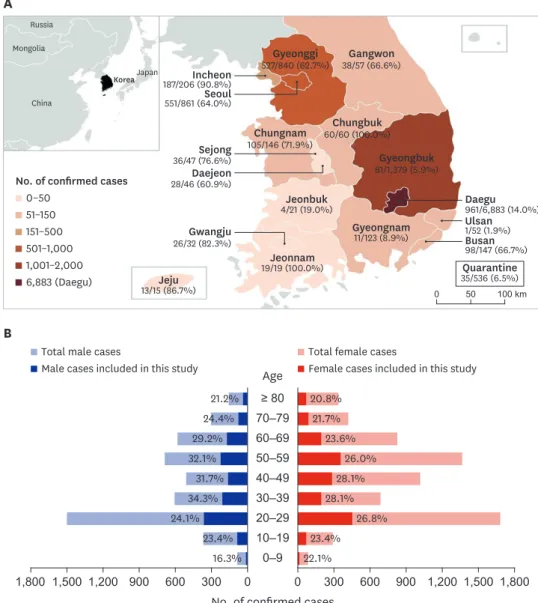
In total, 11,503 patients were confirmed to have COVID-19 before May 31, 2020; of these, 3,060 (26.6%) patients were included in this study. Of the 8,262 patients in Daegu city and Gyeongbuk province, where a large cluster of cases related to a religious group had occurred, only 1,042 (12.6%) patients were included (Fig. 1A). For each age group, approximately 20%–30% of the total number of patients in each age group was included (Fig. 1B).
The median age of the patients was 43 years; 64 (2.1%), 1,515 (49.5%), 1,081 (35.4%), and 398 (13.0%) of the 3,058 patients were < 15 years of age, 15–44 years of age, 45–64 years age, and 65 years of age and older, respectively. In total, 1,334 (43.6%) patients were male (Table 1).
The median time from illness onset to hospital admission was 5 days. The median time from illness onset to diagnosis was 4 days.
On the day of admission, disease severity scores for patients were 1–2, 3–4, and 5–7 in 2,585 (93.0%), 141 (5.0%), and 55 (2.0%) patients, respectively (total 2,781 patients). The median ages of the patients with disease severity scores of 1–2, 3–4, and 5–7 were 40, 63, and 70 years, respectively. In patients of 45–64 years of age, 1.7% (16/967) presented with a disease severity score of 5–8, whereas in patients of 65 years of age or older, 10.9% (38/349) patients presented with a disease severity score of 5–8.
The most common symptoms on admission were cough (40.8%), sputum (25.9%), and sore throat (20.3%). Only 851 (28.8%) of the 2,954 patients had a history of fever; diarrhea was rather uncommon (7.1%). Chest radiography showed no abnormality in 1,749 (68.4%) of the 2,557 patients. The most common comorbid conditions were hypertension (15.8%), diabetes (8.4%), and smoking (7.0%).
Antiviral agents were administered to 1,471 (48.1%) of the 3,060 patients: 1,108 (36.2%)
received lopinavir/ritonavir, and 652 (21.3%) received hydroxychloroquine (Table 2). Sixty
(2.0%) patients were treated with invasive mechanical ventilation. The median time from
illness onset to the initiation of invasive mechanical ventilation was 8 days (IQR, 4–11 days).
One-hundred and forty-eight (4.8%) patients were admitted to the intensive care unit. At the time of data cutoff (June 1, 2020), 2,421 (79.1%) of the 3,060 patients had been discharged, and 32 (1.1%) patients had died. The median time from illness onset to death was 5 days (IQR, 4–9 days).
Of the 1,905 patients with a disease severity score of 1–2 on admission, by illness day 28, the severity score had progressed to 3–7 in only 8 (0.4%) patients, and none died (Table 3). Of the patients with a disease severity score of 3–4, 42 (38.9%) of the 108 patients and 65 (71.4%) of the 91 patients had recovered by illness day 14 and day 28, respectively. Of the patients with a disease severity score of 5–7, by illness day 28, only 7 (19.4%) of the 36 patients recovered, and 8 (22.2%) patients died. None of the 1,324 patients of < 50 years of age died, whereas 0.5%
A
Russia Mongolia
Korea Incheon
China
Japan
187/206 (90.8%) Seoul 551/861 (64.0%)
Sejong 36/47 (76.6%) Daejeon 28/46 (60.9%)
Gwangju 26/32 (82.3%) 13/15 (86.7%)Jeju
Jeonnam
19/19 (100.0%) Quarantine
35/536 (6.5%) Gyeongnam
11/123 (8.9%) Gyeongbuk 81/1,379 (5.9%) Chungbuk
60/60 (100.0%) Gangwon 38/57 (66.6%) Gyeonggi
527/840 (62.7%)
Chungnam 105/146 (71.9%)
Jeonbuk
4/21 (19.0%) Daegu
961/6,883 (14.0%) Ulsan 1/52 (1.9%) Busan 98/147 (66.7%)
0 50 100 km
No. of confirmed cases 0–50
51–150 151–500 501–1,000 1,001–2,000 6,883 (Daegu)
B
≥ 80 Age
70–79 60–69 50–59 40–49 30–39 20–29 10–19 0–9
No. of confirmed cases
16.3% 22.1%
Total male cases
Male cases included in this study
Total female cases
Female cases included in this study
0 0
600 300 300 600
1,200 900 900 1,200
1,500 1,500
1,800 1,800
23.4% 23.4%
24.1% 26.8%
34.3% 28.1%
31.7% 28.1%
32.1% 26.0%
29.2% 23.6%
24.4% 21.7%
21.2% 20.8%
Fig. 1. Geographic and demographic distribution of patients with COVID-19 in Korea, as of May 31, 2020. (A) The map shows geographical distribution of patients with COVID-19 in Korea, as of May 31, 2020. The numerator denotes the number of patients who were included in this study and the denominator denotes the number of laboratory-confirmed COVID-19 cases for each city and province. (B) Age and sex distribution. Dark bars and proportions denote cases included in this study.
COVID-19 = coronavirus disease 2019.
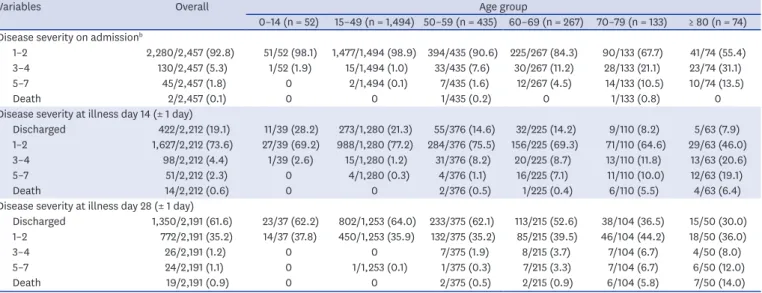
(2/375), 0.9% (2/215), 5.8% (6/104), and 14.0% (7/50) of patients of 50–59, 60–69, 70–79, and ≥ 80 years of age died, respectively, by illness day 28 (Table 4). The clinical outcomes at hospital day 28 according to disease severity on admission are shown in Supplementary Table 1.
DISCUSSION
In this report, we have described the clinical characteristics and disease progression of 3,060 patients hospitalized with laboratory-confirmed COVID-19 in Korea, between January and
Table 1. Baseline demographic and clinical characteristicsCharacteristics Overall cohort
(n = 3,060) Disease severity on admissiona P value
1–2 (n = 2,585) 3–4 (n = 141) 5–8 (n = 55)
Age, yrb 43 (26–57) 40 (25–54) 63 (55–76) 70 (61–79) < 0.001
< 5 15/3,058 (0.5) 13/2,583 (0.5) 1/141 (0.7) 0/55 (0.0) < 0.001d
5–14 49/3,058 (1.6) 46/2,583 (1.8) 0/141 (0.0) 0/55 (0.0)
15–44 1,515/3,058 (49.5) 1,392/2,583 (53.9) 10/141 (0.4) 1/55 (1.8)
45–64 1,081/3,058 (35.4) 885/2,583 (34.3) 66/141 (46.8) 16/55 (29.1)
≥ 65 398/3,058 (13.0) 247/2,583 (9.6) 64/141 (45.4) 38/55 (69.1)
Male 1,334/3,059 (43.6) 1,122/2,584 (43.4) 82/141 (58.2) 30/55 (54.6) 0.001
Time from illness onset to hospital admission, daysc n = 2,710 n = 2,280 n = 130 n = 45 0.546
5 (2–9) 4 (2–9) 4 (1–9) 7 (3–10)
Vital signs on admission
Respiratory rate, ≥ 22 per min 194/2,895 (6.5) 121/2,525 (4.8) 18/139 (13.0) 36/53 (67.9) < 0.001
Pulse, ≥ 120 beats per min 77/3,009 (2.6) 61/2,546 (2.4) 3/140 (2.1) 6/55 (10.9) < 0.001d
Systolic blood pressure, ≤ 100 mmHg 121/2,992 (4.0) 89/2,529 (3.5) 5/140 (3.6) 7/55 (12.7) 0.002d
Symptoms on admission
Altered mental status 7/2,944 (0.2) 1/2,515 (0.0) 2/132 (2.3) 2/34 (5.9) < 0.001d
History of fever 851/2,954 (28.8) 652/2,516 (25.9) 88/131 (67.2) 30/42 (70.4) < 0.001
Cough 1,204/2,949 (40.8) 999/2,518 (39.7) 70/131 (53.4) 20/35 (57.1) 0.001
Sputum 761/2,943 (25.9) 636/2,515 (25.3) 55/130 (42.3) 15/34 (44.1) < 0.001
Rhinorrhea 357/2,933 (12.2) 322/2,513 (12.8) 8/127 (6.3) 3/31 (9.7) 0.085d
Sore throat 592/2,923 (20.3) 515/2,504 (20.6) 22/125 (17.6) 7/33 (21.2) 0.720
Dyspnea 217/2,939 (7.4) 121/2,508 (4.8) 46/130 (35.4) 26/37 (70.3) < 0.001
Myalgia 570/2,929 (19.5) 467/2,510 (18.6) 39/126 (31.0) 13/32 (40.6) < 0.001
Diarrhea 209/2,927 (7.1) 173/2,506 (6.9) 16/128 (12.5) 3/34 (8.8) 0.054
Nausea or vomiting 80/2,926 (2.7) 61/2,505 (2.4) 7/128 (5.5) 2/32 (6.3) 0.049d
Comorbidity
Diabetes 253/3,015 (8.4) 161/2,551 (6.3) 35/140 (25.0) 20/55 (36.4) < 0.001
Hypertension 477/3,014 (15.8) 331/2,551 (13.0) 61/139 (46.0) 27/55 (49.1) < 0.001
Chronic heart disease 68/2,898 (2.3) 52/2,506 (2.1) 6/138 (4.4) 5/54 (9.3) 0.004d
Asthma 56/2,958 (1.9) 45/2,550 (1.8) 5/140 (3.6) 3/55 (5.5) 0.048d
Chronic kidney disease 28/3,013 (0.9) 10/2,549 (0.4) 12/140 (8.6) 2/55 (3.6) < 0.001d
Malignancy 47/3,012 (1.6) 30/2,549 (1.2) 8/140 (5.7) 6/55 (10.9) < 0.001d
Dementia 65/2,621 (2.5) 31/2,187 (1.4) 20/127 (15.8) 7/55 (12.7) < 0.001d
Obesity (BMI, ≥ 30 kg/m2) 152/2,976 (5.1) 133/2,519 (5.3) 6/138 (4.4) 755 (12.7) 0.084
Underweight (BMI, < 18.5 kg/m2) 336/2,976 (11.3) 288/2,519 (11.4) 18/138 (13.0) 9/55 (16.4)
Current smoker 195/2,769 (7.0) 184/2,359 (7.8) 6/112 (5.4) 2/43 (4.7) 0.483
Infiltration in chest X-ray on admission < 0.001
None 1,749/2,557 (68.4) 1,541/2,131 (72.3) 22/119 (18.5) 2/52 (3.9)
Unilateral 356/2,557 (13.9) 293/2,131 (13.8) 36/119 (30.3) 1/52 (1.9)
Bilateral 452/2,557 (17.7) 297/2,131 (13.9) 61/119 (51.3) 49/52 (94.2)
Data are presented as median (interquartile range) or number (%), unless otherwise indicated.
BMI = body mass index, ECMO = extracorporeal membrane oxygenation.
a1, no limitation of daily activities; 2, limitation of daily activities but no need for supplemental oxygen therapy; 3, need for supplemental oxygen therapy via nasal cannula; 4, need for supplemental oxygen therapy via facial mask; 5, need for high-flow supplemental oxygen therapy or non-invasive mechanical ventilation;
6, need for invasive mechanical ventilation; 7, multi-organ failure or need for ECMO therapy; 8, death. Patients with no disease severity score on admission day (279, 9.1%) were excluded from this analysis; bData regarding age were missing for 2 patients (0.1%); cData regarding illness onset were missing for 350 patients (11.4%); dFisher's exact test.
May 2020, inclusive. The median age of the patients was 43 years of age. Almost all patients of < 50 years of age with COVID-19 recovered without supplemental oxygen, whereas by illness day 28, 0.5%, 0.9%, 5.8%, and 14% of patients of 50–59, 60–69, 70–79, and 80 years of age and older, respectively, died. Of the patients who needed noninvasive or invasive mechanical ventilation, 24.5% died.
Table 2. Treatments and clinical outcomes according to disease severity on admissiona
Variables Overall cohort
(n = 3,060) Disease severity on admissionb P value
1–2 (n = 2,585) 3–4 (n = 141) 5–7 (n = 53) Treatments
Use of any antiviral agent 1,471/3,060 (48.1) 1,211/2,585 (46.9) 125/141 (88.7) 49/53 (92.5) < 0.001
Lopinavir/ritonavir 1,108/3,060 (36.2) 891/2,585 (34.5) 104/141 (73.8) 40/53 (75.5) < 0.001
Hydroxychloroquine 652 (21.3) 530/2,585 (20.5) 58/141 (41.1) 32/53 (60.4) < 0.001
Use of any steroid 71/3,060 (2.3) 13/2,585 (0.5) 22/141 (15.6) 29/53 (54.7) < 0.001d
Use of any renal-replacement therapy 20/1,290 (1.6) 6/1,027 (0.6) 7/97 (7.2) 6/44 (13.6) < 0.001d Noninvasive mechanical ventilation 61/3,060 (2.0) 13/2,585 (0.5) 15/141 (11.4) 30/53 (56.6) < 0.001d Invasive mechanical ventilation 60/3,060 (2.0) 6/2,585 (0.2) 12/141 (5.1) 33/53 (62.3) < 0.001d Use of extracorporeal membrane oxygenation 20/3,058 (0.7) 3/2,585 (0.1) 5/141 (3.6) 9/53 (17.0) < 0.001d Admission to intensive care unit 148/3,060 (4.8) 32/2,585 (1.2) 43/141 (30.5) 51/53 (96.2) < 0.001
Length of hospital stay, day 19 (12–32) 19 (12–31) 29 (17–64) 38 (23–74) < 0.001
Outcomes on 28 days (± 1 day) after admission < 0.001d
Discharged 1,964/2,524 (77.8) 1,731/2,201 (78.7) 57/96 (59.4) 9/39 (23.1)
Hospitalizedc 533/2,524 (21.1) 469/2,201 (21.3) 30/96 (31.3) 19/39 (48.7)
Death 27/2,524 (1.1) 1/2,201 (0.1) 9/96 (9.4) 11/39 (28.2)
Outcomes at the time of data cutoff < 0.001d
Discharged 2,421/3,060 (79.1) 2,141/2,585 (82.9) 76/141 (53.9) 20/53 (37.7)
Hospitalizedc 607/3,060 (19.8) 441/2,585 (17.1) 54/141 (38.3) 20/53 (37.7)
Death 32/3,060 (1.1) 2/2,585 (0.1) 11/141 (7.8) 13/53 (24.5)
Data are presented as median (interquartile range) or number (%), unless otherwise indicated.
ECMO = extracorporeal membrane oxygenation.
aPercentages may not total 100 owing to rounding. Patients with no disease severity score on admission day (279, 9.1%) or who died on admission day (2, 0.1%) were excluded from this analysis; b1, no limitation of daily activities; 2, limitation of daily activities but no need for supplemental oxygen therapy; 3, need for supplemental oxygen therapy via nasal cannula; 4, need for supplemental oxygen therapy via facial mask; 5, need for high-flow supplemental oxygen therapy or non-invasive mechanical ventilation; 6, need for invasive mechanical ventilation; 7, multi-organ failure or need for ECMO therapy; cIncluding the patients hospitalized for isolation purposes, even if their severity score had improved to 1 or 2; dFisher's exact test.
Table 3. Clinical outcomes according to disease severity on admissiona
Variables Overall
(n = 2,710) Disease severity on admissionb
1–2 (n = 2,280) 3–4 (n = 130) 5–7 (n = 45) Disease severity at illness day 14 (± 1 day)
Discharged 422/2,212 (19.1) 380/1,940 (19.6) 4/108 (3.7) 1/44 (2.3)
1–2 1,627/2,212 (73.5) 1,516/1,940 (78.1) 38/108 (35.2) 2/44 (4.6)
3–4 98/2,212 (2.3) 36/1,940 (1.8) 52/108 (48.2) 5/44 (11.4)
5–7 51/2,212 (2.3) 8/1,940 (0.4) 10/108 (9.3) 29/44 (65.9)
Death 14/2,212 (0.6) 0/1,940 (0.0) 4/108 (3.7) 7/44 (15.9)
Disease severity at illness day 28 (± 1 day)
Discharged 1,350/2,191 (61.6) 1,181/1,905 (62.0) 38/91 (41.8) 5/36 (13.9)
1–2 772/2,191 (35.2) 716/1,905 (37.6) 27/91 (29.7) 2/36 (5.6)
3–4 26/2,191 (1.2) 4/1,905 (0.2) 16/91 (17.6) 6/36 (16.7)
5–7 24/2,191 (1.1) 4/1,905 (0.2) 3/91 (3.3) 15/36 (41.7)
Death 19/2,191 (0.9) 0/1,905 (0.0) 7/91 (7.7) 8/36 (22.2)
Data are presented number (%).
ECMO = extracorporeal membrane oxygenation.
aPercentages may not total 100 because of rounding. Patients without a disease severity score on admission day (279, 9.1%) or died on admission day (2, 0.1%) were also excluded from this analysis; b1, no limitation of daily activities; 2, limitation of daily activities but no need for supplemental oxygen therapy; 3, need for supplemental oxygen therapy via nasal cannula; 4, need for supplemental oxygen therapy via facial mask; 5, need for high-flow supplemental oxygen therapy or non-invasive mechanical ventilation; 6, need for invasive mechanical ventilation;
7, multi-organ failure or need for ECMO therapy.
The most common symptoms on admission were cough (40.8%), sputum (25.9%), and sore throat (20.3%). Only 28.8% of the enrolled patients had a history of subjective fever, and diarrhea was uncommon (7.1%). Radiologic pneumonia was not evident on simple chest radiography in 68.4% of patients. Our previous study also showed that patients with radiologic pneumonia did not feel unwell and were able to carry on their daily activities (“walking pneumonia”).
10As the presenting symptoms were non-specific, the early detection and isolation of patients with COVID-19 was challenging.
11Disease severity on hospital admission was mild in 91% of patients, and almost all of them recovered without supplemental oxygen. In China, the proportion of mild disease (i.e., no pneumonia and mild pneumonia) was 81% (in a study of 44,415 patients
4), and they recovered within approximately 2 weeks.
12Previous studies showed that the severity of COVID-19 increased with age.
6,13In our study, half of the patients were 15–44 years of age;
and only 13% were 65 years of age or older. This age distribution may reflect aggressive contact tracing and the comprehensive testing of a cluster of members in the Shincheonji religious group, of which the majority comprised young adults.
14Our study showed that disease severity on hospital admission increased with age. The fatality rate also increased with age. These results were in line with the estimated case fatality rates in China, which was 6.4% in patients of ≥ 60 years of age, and increased to 13.4% in patients of
≥ 80 years of age.
13In contrast, in the New York City area, the fatality rate in patients of ≥ 65 years of age who did not receive mechanical ventilation was 26.6%.
15In the Lombardy region in Italy, the fatality rate in patients of 64 years of age and older admitted to the intensive care unit was 36%.
5The differences in mortalities among the countries may be explained by the differences in the prevalence of the comorbid conditions of the patients, as well as overwhelmed healthcare systems.
Table 4. Clinical outcomes according to age groupa
Variables Overall Age group
0–14 (n = 52) 15–49 (n = 1,494) 50–59 (n = 435) 60–69 (n = 267) 70–79 (n = 133) ≥ 80 (n = 74) Disease severity on admissionb
1–2 2,280/2,457 (92.8) 51/52 (98.1) 1,477/1,494 (98.9) 394/435 (90.6) 225/267 (84.3) 90/133 (67.7) 41/74 (55.4) 3–4 130/2,457 (5.3) 1/52 (1.9) 15/1,494 (1.0) 33/435 (7.6) 30/267 (11.2) 28/133 (21.1) 23/74 (31.1)
5–7 45/2,457 (1.8) 0 2/1,494 (0.1) 7/435 (1.6) 12/267 (4.5) 14/133 (10.5) 10/74 (13.5)
Death 2/2,457 (0.1) 0 0 1/435 (0.2) 0 1/133 (0.8) 0
Disease severity at illness day 14 (± 1 day)
Discharged 422/2,212 (19.1) 11/39 (28.2) 273/1,280 (21.3) 55/376 (14.6) 32/225 (14.2) 9/110 (8.2) 5/63 (7.9) 1–2 1,627/2,212 (73.6) 27/39 (69.2) 988/1,280 (77.2) 284/376 (75.5) 156/225 (69.3) 71/110 (64.6) 29/63 (46.0)
3–4 98/2,212 (4.4) 1/39 (2.6) 15/1,280 (1.2) 31/376 (8.2) 20/225 (8.7) 13/110 (11.8) 13/63 (20.6)
5–7 51/2,212 (2.3) 0 4/1,280 (0.3) 4/376 (1.1) 16/225 (7.1) 11/110 (10.0) 12/63 (19.1)
Death 14/2,212 (0.6) 0 0 2/376 (0.5) 1/225 (0.4) 6/110 (5.5) 4/63 (6.4)
Disease severity at illness day 28 (± 1 day)
Discharged 1,350/2,191 (61.6) 23/37 (62.2) 802/1,253 (64.0) 233/375 (62.1) 113/215 (52.6) 38/104 (36.5) 15/50 (30.0) 1–2 772/2,191 (35.2) 14/37 (37.8) 450/1,253 (35.9) 132/375 (35.2) 85/215 (39.5) 46/104 (44.2) 18/50 (36.0)
3–4 26/2,191 (1.2) 0 0 7/375 (1.9) 8/215 (3.7) 7/104 (6.7) 4/50 (8.0)
5–7 24/2,191 (1.1) 0 1/1,253 (0.1) 1/375 (0.3) 7/215 (3.3) 7/104 (6.7) 6/50 (12.0)
Death 19/2,191 (0.9) 0 0 2/375 (0.5) 2/215 (0.9) 6/104 (5.8) 7/50 (14.0)
Data are presented number (%).
ECMO = extracorporeal membrane oxygenation.
aPercentages may not total 100 because of rounding. Patients with no data on illness onset (350, 11.4%), disease severity score on admission day (279, 9.1%), or age (2, 0.1%) were excluded from this analysis; b1, no limitation of daily activities; 2, limitation of daily activities but no need for supplemental oxygen therapy;
3, need for supplemental oxygen therapy via nasal cannula; 4, need for supplemental oxygen therapy via facial mask; 5, need for high-flow supplemental oxygen therapy or non-invasive mechanical ventilation; 6, need for invasive mechanical ventilation; 7, multi-organ failure or need for ECMO therapy.
Few natural history studies have reported the clinical progression of patients with COVID-19.
In our study, 98% of the patients who did not need supplemental oxygen on admission recovered by illness day 14, and no patients died. Of the patients requiring supplemental oxygen via nasal cannula or facial mask, 71.5% recovered and 7.7% died. This recovery rate was congruent with that from the ACTT-1 remdesivir trial,
16which reported that 70.2% of the patients in the placebo arm who required supplemental oxygen recovered. Our data suggested that patients of < 50 years of age and those who did not need supplemental oxygen at presentation may safely be treated at outpatient clinics. Indeed, during the height of the COVID-19 epidemic in Korea, the government decided to prioritize treatment of severe cases at hospitals,
17and mild cases were successfully managed at the designated/repurposed facilities in the community.
18There are several limitations in this study. First, we were not able to extract laboratory data for this study, as many clinicians from the participating hospitals were overburdened owing to the heavy burden of clinical activities. There were also many missing values for clinical progression data. However, before the sudden increase of the epidemic curve in Korea, we compiled detailed laboratory, radiologic, and virus shedding data from the first 28 patients with COVID-19 and reported these data.
10Second, in Korea, a huge cluster of cases related to a religious group had occurred in Daegu city and Gyeongbuk province, and health system in the region was overwhelmed during late February to March. But, only 12.6% of the patients were included in this study, therefore our study might under-represent severe cases from the region. Third, some of our patients were treated with hydroxychloroquine and lopinavir/
ritonavir; however, these were later proven to be of little benefit.
19,20Approximately half of the severe patients received steroid treatment, and this might affect the outcomes. Lastly, most people wore face masks in Korea, and this practice might reduce inoculum size of infecting viruses and therefore the severity of pneumonia.
In conclusion, during the first wave of the COVID-19 epidemic in Korea, patients with COVID-19 who were of < 50 years of age recovered without supplemental oxygen. Among patients of ≥ 50 years of age, the fatality rate increased with age, reaching 14% in patients of ≥ 80 years of age. Our results may help to better prepare health system and clinical management for the next waves of the COVID-19 pandemic.
ACKNOWLEDGMENTS
We thank all the members of the National Committee for Clinical Management of COVID-19
for their tireless efforts in data collection. We also thank the doctors and nurses of the
following participating hospitals: Chonnam National University Bitgoeul Hospital, Hanil
General Hospital, The Catholic University of Korea Seoul St. Mary Hospital, Wonkwang
University Hospital, Jeollanam-do Gangjin Medical Center, Chosun University Hospital,
Samsung Medical Center, Wonju Severance Christian Hospital, Gangnam Severance
Hospital, Yeongwol Medical Center, Kyunghee University Hospital, Asan Medical Center,
Inje University Busan Paik Hospital, Konkuk University Medical Center, Kosin University
Gospel Hospital, National Health Insurance Service Ilsan Hospital, Hallym University
Kangnam Sacred Heart Hospital, Kangbuk Samsung Hospital, Soonchunhyang University
Bucheon Hospital, Dongguk University Gyeongju Hospital, Gangwon-do Wonju Medical
Center, Gyeonggi provincial Medical Center Pocheon Hospital, and Hallym University
Sacred Heart Hospital.
SUPPLEMENTARY MATERIAL
Supplementary Table 1
Demographic and clinical characteristics according to disease severity on admission and outcomes at 28 days (± 1 day) after admission
aClick here to view
REFERENCES
1. World Health Organization. Coronavirus disease (COVID-2019) situation report-143. https://www.who.int/
emergencies/diseases/novel-coronavirus-2019/situation-reports. Updated 2020. Accessed 15 June, 2020.
2. Kim JY, Choe PG, Oh Y, Oh KJ, Kim J, Park SJ, et al. The First Case of 2019 Novel Coronavirus Pneumonia Imported into Korea from Wuhan, China: Implication for Infection Prevention and Control Measures. J Korean Med Sci 2020;35(5):e61.
PUBMED | CROSSREF
3. Korea Centers for Disease control and Prevention. Coronavirus disease-19 main website. http://ncov.
mohw.go.kr/en. Updated 2020. Accessed June 15, 2020.
4. Wu Z, McGoogan JM. Characteristics of and important lessons from the coronavirus disease 2019 (COVID-19) outbreak in china: summary of a report of 72 314 cases from the Chinese Center for Disease Control and Prevention. JAMA 2020;323(13):1239-42.
PUBMED | CROSSREF
5. Grasselli G, Zangrillo A, Zanella A, Antonelli M, Cabrini L, Castelli A, et al. Baseline characteristics and outcomes of 1591 patients infected with SARS-CoV-2 admitted to ICUs of the Lombardy region, Italy.
JAMA 2020;323(16):1574-81.
PUBMED | CROSSREF
6. Petrilli CM, Jones SA, Yang J, Rajagopalan H, O'Donnell L, Chernyak Y, et al. Factors associated with hospital admission and critical illness among 5279 people with coronavirus disease 2019 in New York City: prospective cohort study. BMJ 2020;369:m1966.
PUBMED | CROSSREF
7. World Health Organization. I.S.A.R.E.I.C., Global COVID-19: clinical platform: novel coronavius (COVID-19): rapid version. Geneva: World Health Organization; 2020.
8. Korea Centers for Disease control and Prevention. Press release. Coronavirus disease-19, Republic of Korea. http://ncov.mohw.go.kr/en/tcmBoardList.do?brdId=12&brdGubun=125&dataGubun=&ncvContSeq
=&contSeq=&board_idhttp://ncov.mohw.go.kr/en/tcmBoardList.do?brdId=12&brdGubun=125&data Gubun=&ncvContSeq=&contSeq=&board_id=. Updated 2020. Accessed June 12, 2020.
9. WHO Working Group on the Clinical Characterisation and Management of COVID-19 Infection. A minimal common outcome measure set for COVID-19 clinical research. Lancet Infect Dis. Forthcoming 2020.
PUBMED | CROSSREF
10. Kim ES, Chin BS, Kang CK, Kim NJ, Kang YM, Choi JP, et al. Clinical course and outcomes of patients with severe acute respiratory syndrome coronavirus 2 infection: a preliminary report of the first 28 patients from the Korean cohort study on COVID-19. J Korean Med Sci 2020;35(13):e142.
PUBMED | CROSSREF
11. Kim NJ, Choe PG, Park SJ, Lim J, Lee WJ, Kang CK, et al. A cluster of tertiary transmissions of 2019 novel coronavirus (SARS-CoV-2) in the community from infectors with common cold symptoms. Korean J Intern Med 2020;35(4):758-64.
PUBMED | CROSSREF
12. World Health Organization. Report of the WHO-China Joint Mission on Coronavirus Disease 2019 (COVID-19). Geneva: World Health Organization; 2020.
13. Verity R, Okell LC, Dorigatti I, Winskill P, Whittaker C, Imai N, et al. Estimates of the severity of coronavirus disease 2019: a model-based analysis. Lancet Infect Dis 2020;20(6):669-77.
PUBMED | CROSSREF
14. Korean Society of Infectious Diseases; Korean Society of Pediatric Infectious Diseases; Korean Society of Epidemiology; Korean Society for Antimicrobial Therapy; Korean Society for Healthcare-associated Infection Control and Prevention; Korea Centers for Disease Control and Prevention. Report on the epidemiological features of coronavirus disease 2019 (COVID-19) outbreak in the Republic of Korea from
January 19 to March 2, 2020. J Korean Med Sci 2020;35(10):e112.
PUBMED | CROSSREF
15. Richardson S, Hirsch JS, Narasimhan M, Crawford JM, McGinn T, Davidson KW, et al. Presenting characteristics, comorbidities, and outcomes among 5700 patients hospitalized with COVID-19 in the New York City area. JAMA 2020;323(20):2052.
PUBMED | CROSSREF
16. Beigel JH, Tomashek KM, Dodd LE, Mehta AK, Zingman BS, Kalil AC, et al. Remdesivir for the treatment of Covid-19 - Preliminary report. N Engl J Med. Forthcoming 2020.
PUBMED | CROSSREF
17. Kang E, Lee SY, Jung H, Kim MS, Cho B, Kim YS. Operating protocols of a community treatment center for isolation of patients with coronavirus disease, South Korea. Emerging. Emerg Infect Dis. Forthcoming 2020.
PUBMED | CROSSREF
18. Lee YH, Hong CM, Kim DH, Lee TH, Lee J. Clinical course of asymptomatic and mildly symptomatic patients with coronavirus disease admitted to community treatment centers, South Korea. Emerg Infect Dis.
Forthcoming 2020.
PUBMED | CROSSREF
19. Geleris J, Sun Y, Platt J, Zucker J, Baldwin M, Hripcsak G, et al. Observational study of hydroxychloroquine in hospitalized patients with Covid-19. N Engl J Med 2020;382(25):2411-8.
PUBMED | CROSSREF
20. Cao B, Wang Y, Wen D, Liu W, Wang J, Fan G, et al. A trial of lopinavir-ritonavir in adults hospitalized with severe Covid-19. N Engl J Med 2020;382(19):1787-99.
PUBMED | CROSSREF