Risk Factors Associated with Disease Recurrence among Patients with Low-Risk Papillary Thyroid Cancer Treated at the University of the Philippines-Philippine General Hospital
Maria Cristina Magracia Jauculan, Myrna Buenaluz-Sedurante, Cecilia Alegado Jimeno
Section of Endocrinology, Diabetes and Metabolism, Department of Medicine, Philippine General Hospital, University of the Philippines College of Medicine, Manila, Philippines
Background: The management of papillary thyroid carcinoma (PTC) in high-risk patients is well-standardized. However, this is not the case for low-risk patients. Filipinos show a high incidence of recurrence of thyroid cancer. Thus, the identification of risk factors for recurrence in this population could potentially identify individuals for whom radioactive iodine (RAI) therapy might be beneficial.
Methods: We reviewed the medical records of adult Filipinos with low-risk PTC who underwent near-total or total thyroidecto- my at the University of the Philippines-Philippine General Hospital. Multivariate logistic regression analysis was used to deter- mine risk factors for recurrence.
Results: Recurrence was documented in 51/145 of patients (35.17%) included in this study. Possible risk factors such as age, sex, family history, smoking history, tumor size, multifocality, prophylactic lymph node dissection, initial thyroglobulin (Tg) level, initial anti-thyroglobulin (anti-Tg) antibody concentration, suppression of thyroid stimulating hormone production, and RAI ther- apy were analyzed. Multivariate analysis revealed that a tumor diameter 2 to 4 cm (odds ratio [OR], 9.17; 95% confidence inter- val [CI], 1.62 to 51.88; P=0.012), a tumor diameter >4 cm (OR, 16.46; 95% CI, 1.14 to 237.31; P=0.04), and a family history of PTC (OR, 67.27; 95% CI, 2.03 to 2228.96; P=0.018) were significant predictors of recurrence. In addition, RAI therapy (OR, 0.026; 95% CI, 0.01 to 0.023; P≤0.005), an initial Tg level ≤2 ng/mL (OR, 0.049; 95% CI, 0.01 to 0.23; P≤0.005), and an anti- Tg antibody level ≤50 U/mL (OR, 0.087; 95% CI, 0.011 to 0.67; P=0.019) were significant protective factors.
Conclusion: A tumor diameter ≥2 cm and a family history of PTC are significant predictors of recurrence. RAI therapy and low initial titers of Tg and anti-Tg antibody are significant protective factors against disease recurrence among low-risk PTC patients.
Keywords: Thyroid neoplasms; Thyroid cancer, papillary; Recurrence
Received: 16 July 2015, Revised: 3 September 2015, Accepted: 22 October 2015 Corresponding author: Maria Cristina Magracia Jauculan
Section of Endocrinology, Diabetes and Metabolism, Department of Medicine, Philippine General Hospital, University of the Philippines College of Medicine, Taft Avenue, Manila 1000, Philippines
Tel: +63-2-872-8627, Fax: +63-2-526-4372, E-mail: [email protected]
Copyright © 2016 Korean Endocrine Society
This is an Open Access article distributed under the terms of the Creative Com- mons Attribution Non-Commercial License (http://creativecommons.org/
licenses/by-nc/4.0/) which permits unrestricted non-commercial use, distribu- tion, and reproduction in any medium, provided the original work is properly cited.
INTRODUCTION
Thyroid carcinoma is the most common endocrine malignancy and it has increased 2- to 4-fold in incidence over the past de- cade. Well-differentiated thyroid cancer, of either the papillary or follicular type, is the most common form, making up 90% of all thyroid malignancies [1,2].
Among patients with papillary thyroid carcinoma (PTC), those stratified as low-risk make up 80% of cases [3]. Manage- ment of patients with PTC includes thyroidectomy with or without RAI therapy. The treatment strategy is well-established and has been proven to successfully enhance the outcomes and prognoses of most patients [4,5]. However, recommendations for the management of low-risk thyroid cancer patients have been contradictory [4,5]. Currently, our local Philippine guide- lines state that certain low-risk patients may not be receive RAI therapy [5]. Although such patients generally have good prog- noses, recurrence develops in up to 13% of them [6,7].
The well-established risk factors for disease recurrence in- clude age >45 years, a family history of PTC, being male, mul- tifocality, nodal involvement at the time of presentation, and having tumors >4 cm. Recent studies have also shown that never-smoking status reduces the risk of thyroid cancer (risk ra- tio [RR], 0.71; 95% confidence interval [CI], 0.60 to 0.83) [5,8].
Soyluk et al. [9] showed that low- to intermediate-risk PTC pa- tients were at an increased risk of recurrence if their initial post- ablative thyroglobulin (Tg) level in serum was ≥0.3 ng/mL or if they were positive for anti-thyroglobulin (anti-Tg) antibody.
There are currently no international or local data on factors af- fecting disease recurrence among low-risk PTC patients.
The prognosis of PTC is optimal when the diagnosis, stag- ing, treatment, and the risk of recurrence are timely and care- fully managed. As disease-specific mortality is low (1%), the most relevant oncological outcome is disease recurrence [9,10].
As most patients present with low-risk disease, the develop- ment of measures predicting the risk of recurrence in this sub- group is warranted. We identified predictors of disease recur- rence among Filipinos with low-risk PTC. Our results can be used to further individualize treatment plans, avoid unneces- sary costs, and improve quality of life.
METHODS
Study design
This was a retrospective cohort study of patients diagnosed with low-risk PTC treated at the thyroid outpatient clinic of the
University of the Philippines-Philippine General Hospital (UP- PGH). This tertiary hospital is the National University Hospital of the Philippines.
Inclusion criteria
Adult patients (≥19 years of age at the time of diagnosis) diag- nosed with PTC after near-total or total thyroidectomy, who developed recurrence at any time or who underwent at least 5 years of follow-up without recurrence, and who were classified as low-risk based on the American Thyroid Association (ATA) 2009 guidelines were enrolled. The low-risk classification is based on the following: absence of local or distant metastases, resection of all macroscopic tumors, absence of tumor invasion of locoregional tissues, absence of aggressive tumor histology (tall cells, insular cells, columnar cells) or vascular invasion, and uptake of 131I (if given) limited to the thyroid bed on the first post-treatment whole-body radioactive iodine (RAI) scan.
Exclusion criteria
Patients for whom data were lacking in terms of either initial Tg or anti-Tg antibody levels or post-therapy whole-body scans were excluded.
Chart retrieval
The outpatient charts of all patients who met the inclusion cri- teria were retrieved from the UP-PGH medical records section and from the database of the Section of Endocrinology. Charts that were in active circulation, thus both available and retriev- able, were included.
Data collection
Age at diagnosis, sex, any family history of thyroid cancer, smoking history, date of surgery, tumor size, prescription (or not) of post-surgical RAI therapy, initial post-ablative and post- surgical Tg and anti-Tg antibody levels in serum, and the ex- tent of thyroid stimulating hormone (TSH) suppression were all descriptively documented (means, standard deviations, per- centages). Then these variables were analyzed to determine if they constituted risk factors for disease recurrence.
Recurrent or distant metastatic disease was defined as dis- ease developing >6 months after total thyroidectomy, with or without RAI treatment. Locoregional recurrence was defined (as by the ATA) as cervical/superior mediastinal disease identi- fied on imaging and ideally proven by biopsy. Distant meta- static disease was defined as disease developing outside the neck region identified by imaging or proven by biopsy. Bio-
chemical recurrent disease was defined as elevated stimulated (>2 ng/mL) or unstimulated (>1 ng/mL) Tg levels in patients with previously undetectable Tg levels, diagnosed >6 months after total thyroidectomy with or without RAI therapy, and as- sociated with normal anti-Tg antibody levels (≤50 U/mL).
Disease recurrence was defined as recurrent or new-onset lymphadenopathy, or distant metastases proven to originate from thyroid cancer by biopsy or RAI whole-body scan [4].
The subsequent management and monitoring of low-risk pa- tients who did not undergo RAI therapy differed from those who underwent RAI therapy. Follow-up of the former patients typically includes evaluation of TSH suppression by levothy- roxine, neck ultrasonography, and measurement of recombi- nant human TSH (rhTSH)-stimulated Tg levels. At our institu- tion, measurement of rhTSH-stimulated Tg levels in this group of patients is not recommended; the cost is prohibitive [4,5].
Notably, the absence of RAI therapy renders monitoring of Tg levels challenging in such patients, as remnant thyroid tissue is almost always present after surgery, rendering Tg detectable.
Currently, no particular Tg level is accepted as a reliable cut- off for accurate prediction of disease recurrence. Rather, the trend in Tg level over time is monitored; increases over time are suggestive of recurrence and a need for work-up [4].
Statistical analysis
Patients were grouped into those who did or did not suffer re- currences. The baseline characteristics of the two groups were compared using Fisher exact test for qualitative variables and the two-sample t test for continuous quantitative variables.
Then multivariate logistic regression analysis was performed to identify significant risk factors for disease recurrence. The pre-
dictive power of each variable was calculated and expressed as an odds ratio (OR) with the 95% CI. A P≤0.05 was considered to indicate statistical significance.
This study was approved by the Technical Review Board of the Department of Medicine and the University of the Philip- pines Manila Research Ethics Board (approval number: IRB [MED] 2015-055-01).
RESULTS
A total of 906 PTC patients were listed in the outpatient data- base; 649 charts (72%) were available for review, and 188 pa- tients (29%) were considered low-risk. Of these, 145 patients fulfilled the inclusion criteria and were included in the study (Fig. 1).
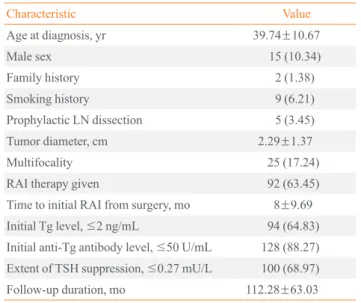
The mean age at diagnosis of the 145 low-risk PTC patients was 39.74±10.67 years; 5 (10.34%) were males. Most patients had no family history of thyroid cancer and were non-smokers.
Prophylactic lymph node (LN) dissection was performed in five patients (3.45%). The mean tumor diameter was 2.29±
1.37 cm. Multifocality was evident in 25 patients (17.24%).
Ninety-two patients (63.45%) underwent RAI therapy after thyroidectomy, at a median interval of 8±9.69 months after surgery. Ninety-four patients (64.83%) had initial Tg levels ≤2 ng/mL. A total of 128 patients (88.27%) had initial anti-Tg an-
906 PTC
649 PTC
188 Low-risk PTC
145 Included
257 Unavailable charts
461 with intermediate/high risk features
43 Excluded
follow-up <5 years, lost to follow-up, Tg/anti-Tg unavailable
Fig. 1. Inclusion and exclusion flow chart. PTC, papillary thyroid cancer; Tg, thyroglobulin; Anti-Tg, anti-thyroglobulin.
Table 1. Demographic and Clinical Characteristics of Filipino Patients with Low-Risk Papillary Thyroid Cancer (n=145)
Characteristic Value
Age at diagnosis, yr 39.74±10.67
Male sex 15 (10.34)
Family history 2 (1.38)
Smoking history 9 (6.21)
Prophylactic LN dissection 5 (3.45)
Tumor diameter, cm 2.29±1.37
Multifocality 25 (17.24)
RAI therapy given 92 (63.45)
Time to initial RAI from surgery, mo 8±9.69
Initial Tg level, ≤2 ng/mL 94 (64.83)
Initial anti-Tg antibody level, ≤50 U/mL 128 (88.27) Extent of TSH suppression, ≤0.27 mU/L 100 (68.97)
Follow-up duration, mo 112.28±63.03
Values are expressed as mean±SD or number (%).
LN, lymph node; RAI, radioactive iodine; Tg, thyroglobulin; Anti-Tg, anti-thyroglobulin; TSH, thyroid-stimulating hormone.
tibody levels ≤50 U/mL, and 100 patients (68.97%) exhibited adequate TSH suppression (≤0.27 mU/L). The mean follow-
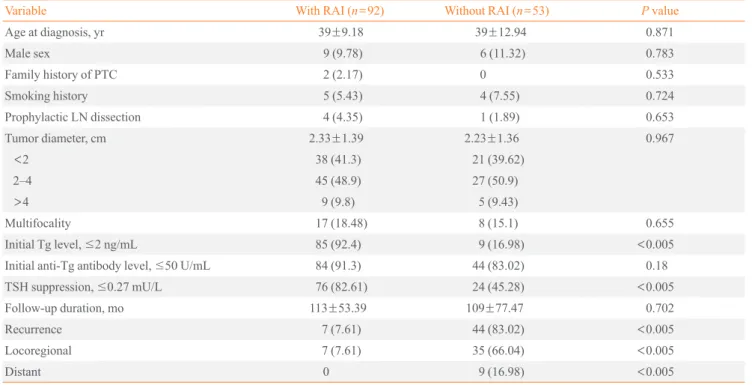
up duration was 112.28±63.03 months from diagnosis. Dis- ease recurrence was noted in 51 patients (35.17%) at a median Table 2. Comparison of Baseline Characteristics among Patients Who Did and Did Not Undergo RAI
Variable With RAI (n=92) Without RAI (n=53) P value
Age at diagnosis, yr 39±9.18 39±12.94 0.871
Male sex 9 (9.78) 6 (11.32) 0.783
Family history of PTC 2 (2.17) 0 0.533
Smoking history 5 (5.43) 4 (7.55) 0.724
Prophylactic LN dissection 4 (4.35) 1 (1.89) 0.653
Tumor diameter, cm 2.33±1.39 2.23±1.36 0.967
<2 38 (41.3) 21 (39.62)
2–4 45 (48.9) 27 (50.9)
>4 9 (9.8) 5 (9.43)
Multifocality 17 (18.48) 8 (15.1) 0.655
Initial Tg level, ≤2 ng/mL 85 (92.4) 9 (16.98) <0.005
Initial anti-Tg antibody level, ≤50 U/mL 84 (91.3) 44 (83.02) 0.18
TSH suppression, ≤0.27 mU/L 76 (82.61) 24 (45.28) <0.005
Follow-up duration, mo 113±53.39 109±77.47 0.702
Recurrence 7 (7.61) 44 (83.02) <0.005
Locoregional 7 (7.61) 35 (66.04) <0.005
Distant 0 9 (16.98) <0.005
Values are expressed as mean±SD or number (%).
RAI, radioactive iodine; PTC, papillary thyroid carcinoma; LN, lymph node; Tg, thyroglobulin; anti-Tg antibody, anti-thyroglobulin antibody; TSH, thyroid- stimulating hormone.
Table 3. Univariate Logistic Regression Analysis of Risk Factors for Disease Recurrence among Patients with Low-Risk Papillary Thyroid Cancer
Variable With recurrence (n=51) Without recurrence (n=94) Relative risk P value (95% CI)
Age at diagnosis, yr 38.98±12.66 40.15±9.46 0.99 0.528 (0.95–1.02)
Male sex 6 (11.76) 9 (9.57) 1.26 0.68 (0.42–3.76)
Family history of PTC 1 (1.96) 1 (1.06) 1.86 0.663 (0.11–30.37)
Smoking history 4 (7.84) 5 (5.32) 1.51 0.550 (0.39–5.91)
Prophylactic LN dissection 2 (3.92) 3 (3.19) 1.24 0.818 (0.20–7.66)
Tumor diameter, cm
<2 2–4
>4
2.59±1.32 14 (27.45) 31 (60.8)
6 (11.76)
2.13±1.38 45 (47.87) 41 (43.62) 8 (8.51)
2.43 2.41
0.022 (1.14–5.19) 0.156 (0.71–8.14)
Multifocality 8 (15.69) 17 (18.08) 0.843 0.715 (0.34–2.11)
Initial Tg level, ≤2 ng/mL 8 (15.7) 86 (91.5) 0.017 <0.005 (0.01–0.049)
Initial anti-Tg antibody level, ≤50 U/mL 41 (80.39) 87 (92.55) 0.329 0.036 (0.117–0.93)
TSH suppression, ≤0.27 mU/L 22 (43.14) 78 (82.98) 0.16 <0.005 (0.07–0.34)
RAI therapy 7 (13.73) 85 (90.43) 0.02 <0.005 (0.01–0.05)
Values are expressed as mean±SD or number (%).
CI, confidence interval; PTC, papillary thyroid carcinoma; LN, lymph node; Tg, thyroglobulin; anti-Tg, anti-thyroglobulin; TSH, thyroid-stimulating hormone; RAI, radioactive iodine.
interval of 60±65.28 months after thyroidectomy (Table 1).
Demographic and clinical characteristics did not differ sig- nificantly between the two groups in terms of mean age at di- agnosis, the proportion of males, a family history of thyroid cancer, smoking history, prophylactic LN dissection, tumor size, multifocality, initial anti-Tg antibody level, or follow-up duration. The initial Tg level, the extent of TSH suppression, and the frequency of recurrence did differ significantly. More patients in the RAI group had Tg levels ≤2 ng/mL, adequate TSH suppression, and less disease recurrence (Table 2).
Univariate logistic regression showed that a tumor diameter 2 to 4 cm (OR, 2.43; 95% CI, 1.14 to 5.19; P=0.022) predicted disease recurrence. An initial Tg level ≤2 ng/mL (OR, 0.017;
95% CI, 0.01 to 0.049; P≤0.005), initial anti-Tg antibody-pos- itivity (OR, 0.329; 95% CI, 0.117 to 0.93; P=0.036), adequate TSH suppression, and RAI therapy significantly protected against disease recurrence among low-risk PTC patients: TSH suppression (OR, 0.16; 95% CI, 0.07 to 0.34; P≤0.005) and RAI vs. no RAI (OR, 0.02; 95% CI, 0.01 to 0.05; P≤0.005) (Table 3).
Multivariate logistic regression analysis of all risk factors re- vealed that a tumor diameter 2 to 4 cm (OR, 9.17; 95% CI, 1.62 to 51.88; P=0.012) or >4 cm (OR, 16.46; 95% CI, 1.14 to 237.31; P=0.04) and a family history of PTC (OR, 67.27; 95%
CI, 2.03 to 2,228.96; P=0.018) were significant predictors of disease recurrence. RAI therapy (OR, 0.01; 95% CI, 0.001 to 0.033; P≤0.005), an initial Tg level ≤2 ng/mL (OR, 0.049;
95% CI, 0.01 to 0.23; P≤0.005), and an initial anti-Tg antibody level ≤50 U/mL (OR, 0.087; 95% CI, 0.011 to 0.67; P=0.019) significantly protected against disease recurrence (Table 4).
DISCUSSION
The incidence of disease recurrence in our cohort of low-risk PTC patients was 35.17%, thus higher than noted in other re- ports (up to 13%) [6,7]. This may be attributable to the higher incidence of disease and higher risk of recurrence among Fili- pinos. The age-adjusted incidence rate of PTC in Filipinas (fe- males) is more than double that of Japanese females [11], and Filipinos (male or female) are at significantly higher risk of thyroid cancer recurrence than non-Filipino patients [12]. In addition, the definition of “low-risk PTC” may vary among re- ports, rendering comparisons difficult. We used the criteria proposed by the 2009 ATA guidelines to define low-risk PTC.
A comparison of the groups who received and did not re- ceive RAI therapy revealed significant differences in initial Tg levels, attainment of adequate TSH suppression, and disease recurrence. The significant difference in the initial Tg level was attributable to the difference in follow-up monitoring between the groups. Patients who do not undergo RAI therapy tend to have detectable Tg levels; some remnant thyroid tissue is near- ly always present after surgery. The between-group difference in TSH suppression may be explained by variation in the rec- ommended levels of TSH suppression for the two groups.
These levels are 0.1 to 0.27 mU/L and 0.1 to 0.5 mU/L for pa- tients who have and have not undergone RAI, respectively [4,5]. Furthermore, differences in monitoring and assessment of recurrence among patients who have and have not under- gone RAI therapy may be associated with detection bias. Only patients who had undergone RAI were scheduled for whole- body scans, allowing disease to be detected earlier and more frequently.
Prophylactic LN dissection is currently not recommended at our institution unless suspicious LNs are noted on routine pre- operative ultrasound. This explains the low frequency of such procedures at our hospital [5].
Multivariate analysis showed that large tumor size (≥2 cm) and a family history of PTC were significant predictors of dis- ease recurrence. These data are similar to data obtained in other countries (RR, 2.69; 95% CI, 2.06 to 3.50) [13]. RAI therapy, an initial Tg level ≤2 ng/mL, and an initial anti-Tg antibody level ≤50 U/mL were also significant predictors of disease re- currence, again consistent with foreign data [9,14]. The protec- tive effect of RAI therapy is consistent with the results of a study on papillary thyroid microcarcinoma patients, which may also be considered to be low-risk PTC patients. Recurrence was higher among those who did not undergo RAI therapy Table 4. Multivariate Logistic Regression Analysis of Risk
Factors for Recurrence in Filipinos with Low-Risk Papillary Thyroid Cancer
Significant risk factor Relative risk P value (95% CI) Tumor diameter, cm
2–4
>4
9.17 16.46
0.012 (1.62–51.88) 0.04 (1.14–237.31) Family history of PTC 67.27 0.018 (2.03–2,228.96)
RAI therapy 0.026 <0.005 (0.01–0.023)
Initial Tg level, ≤2 ng/mL 0.049 <0.005 (0.01–0.23) Initial anti-Tg antibody level,
≤50 U/mL 0.087 0.019 (0.011–0.67)
CI, confidence interval; PTC, papillary thyroid carcinoma; RAI, ra- dioactive iodine; Tg, thyroglobulin; anti-Tg, anti-thyroglobulin.
post-surgery (RR, 8.6; 95% CI, 4.4 to 17.1) [15]. However, most published data do not indicate that RAI therapy protects significantly against disease recurrence [16,17]. These large studies were performed on ethnic groups that did not include Filipinos, and the definition of “low-risk” differed from that which we employed in the present study. The more prevalent prescription of RAI therapy among this group is attributable to the preferences of healthcare providers which is mainly influ- enced by the poor patient follow-up in our setting.
We limited our study population to those with PTC, because prognoses may differ between PTC patients and those with fol- licular thyroid carcinoma. We thus eliminated any possible dif- ference in disease behavior that may have contributed to the different outcomes of other studies. The major limitation of our study is the unavailability of some medical records. To further strengthen the predictive utilities of the risk factors that we have defined, work with larger cohorts is required.
In conclusion, we found that the incidence of low-risk PTC recurrence among Filipinos was 35.17%, similar to the figure reported by Kus et al. [12]. A large tumor diameter ≥2 cm and a family history of PTC were significant predictors of disease recurrence. RAI therapy, an initial Tg level ≤2 ng/mL, and an initial anti-Tg antibody level ≤50 U/mL significantly protected against disease recurrence, consistent with previously pub- lished data. We focused on patients with low-risk PTC, as de- fined by the ATA. Information on risk factors for disease recur- rence in this group are still lacking, and reports on the benefits afforded by RAI ablative therapy are conflicting. We found that a lack of such therapy increased the incidence of recurrence, and suggest that more aggressive initial management (includ- ing RAI therapy) should be considered even for low-risk pa- tients. In addition, tumor size should be included when assess- ing the risk of disease recurrence. We suggest that low-risk PTC should be redefined to include patients with tumors <2 cm in diameter, at least in the Filipino population. Our data may have important practical implications. Most cases encoun- tered in clinical practice have low-risk PTC. The identification of risk factors for disease recurrence may help guide the provi- sion of specific treatments tailored specifically toward low-risk PTC Filipino patients.
CONFLICTS OF INTEREST
No potential conflict of interest relevant to this article was re- ported.
REFERENCES
1. Tsirona S, Vlassopoulou V, Tzanela M, Rondogianni P, Ioan- nidis G, Vassilopoulos C, et al. Impact of early vs late post- operative radioiodine remnant ablation on final outcome in patients with low-risk well-differentiated thyroid cancer.
Clin Endocrinol (Oxf) 2014;80:459-63.
2. Sherman SI. Thyroid carcinoma. Lancet 2003;361:501-11.
3. Davies L, Welch HG. Increasing incidence of thyroid cancer in the United States, 1973-2002. JAMA 2006;295:2164-7.
4. American Thyroid Association (ATA) Guidelines Taskforce on Thyroid Nodules and Differentiated Thyroid Cancer, Cooper DS, Doherty GM, Haugen BR, Kloos RT, Lee SL, et al. Revised American Thyroid Association management guidelines for patients with thyroid nodules and differenti- ated thyroid cancer. Thyroid 2009;19:1167-214.
5. Sison CM, Obaldo J, Matsuo J, Uy GL, Jaring C. Universi- ty of the Philippines-Philippine General Hospital revised clinical practice guidelines for the management of well-dif- ferentiated thyroid carcinoma of follicular cell origin. J ASEAN Fed Endocr Soc 2012;27:49-61.
6. Shaha AR, Shah JP, Loree TR. Low-risk differentiated thy- roid cancer: the need for selective treatment. Ann Surg On- col 1997;4:328-33.
7. Tuttle RM, Brokhin M, Omry G, Martorella AJ, Larson SM, Grewal RK, et al. Recombinant human TSH-assisted radioactive iodine remnant ablation achieves short-term clinical recurrence rates similar to those of traditional thy- roid hormone withdrawal. J Nucl Med 2008;49:764-70.
8. Kreiger N, Parkes R. Cigarette smoking and the risk of thy- roid cancer. Eur J Cancer 2000;36:1969-73.
9. Soyluk O, Boztepe H, Aral F, Alagol F, Ozbey NC. Papillary thyroid carcinoma patients assessed to be at low or interme- diary risk after primary treatment are at greater risk of long term recurrence if they are thyroglobulin antibody positive or do not have distinctly low thyroglobulin at initial assess- ment. Thyroid 2011;21:1301-8.
10. Hay ID. Management of patients with low-risk papillary thyroid carcinoma. Endocr Pract 2007;13:521-33.
11. Horn-Ross PL, McClure LA, Chang ET, Clarke CA, Keegan TH, Rull RP, et al. Papillary thyroid cancer inci- dence rates vary significantly by birthplace in Asian Ameri- can women. Cancer Causes Control 2011;22:479-85.
12. Kus LH, Shah M, Eski S, Walfish PG, Freeman JL. Thyroid cancer outcomes in Filipino patients. Arch Otolaryngol Head Neck Surg 2010;136:138-42.
13. Guo K, Wang Z. Risk factors influencing the recurrence of papillary thyroid carcinoma: a systematic review and meta- analysis. Int J Clin Exp Pathol 2014;7:5393-403.
14. Bohm J, Kosma VM, Eskelinen M, Hollmen S, Niskanen M, Tulla H, et al. Non-suppressed thyrotropin and elevated thy- roglobulin are independent predictors of recurrence in differ- entiated thyroid carcinoma. Eur J Endocrinol 1999;141:460- 7.
15. Creach KM, Siegel BA, Nussenbaum B, Grigsby PW. Ra- dioactive iodine therapy decreases recurrence in thyroid pap-
illary microcarcinoma. ISRN Endocrinol 2012;2012:816386.
16. Schvartz C, Bonnetain F, Dabakuyo S, Gauthier M, Cueff A, Fieffe S, et al. Impact on overall survival of radioactive io- dine in low-risk differentiated thyroid cancer patients. J Clin Endocrinol Metab 2012;97:1526-35.
17. Jonklaas J, Sarlis NJ, Litofsky D, Ain KB, Bigos ST, Brier- ley JD, et al. Outcomes of patients with differentiated thyroid carcinoma following initial therapy. Thyroid 2006;16:1229- 42.