D I A B E T E S & M E T A B O L I S M J O U R N A L D I A B E T E S & M E T A B O L I S M J O U R N A L
This is an Open Access article distributed under the terms of the Creative Commons Attribution Non-Commercial License (https://creativecommons.org/licenses/by-nc/4.0/) which permits unrestricted non-commercial use, distribution, and reproduction in any medium, provided the original work is properly cited.
The Clinical Characteristics and Outcomes of Patients with Moderate-to-Severe Coronavirus Disease 2019 Infection and Diabetes in Daegu, South Korea
Mi Kyung Kim1,*, Jae-Han Jeon2,*, Sung-Woo Kim3, Jun Sung Moon4, Nan Hee Cho1, Eugene Han1, Ji Hong You1, Ji Yeon Lee1, Miri Hyun1, Jae Seok Park1, Yong Shik Kwon1, Yeon-Kyung Choi2, Ki Tae Kwon2, Shin Yup Lee2, Eon Ju Jeon3, Jin-Woo Kim3, Hyo-Lim Hong3, Hyun Hee Kwon3, Chi Young Jung3, Yin Young Lee4, Eunyeoung Ha4, Seung Min Chung4, Jian Hur4, June Hong Ahn4, Na-young Kim5, Shin-Woo Kim5, Hyun Ha Chang5, Yong Hoon Lee5, Jaehee Lee5, Keun-Gyu Park5, Hyun Ah Kim1, Ji-Hyun Lee3
1Department of Internal Medicine, Keimyung University Dongsan Hospital, Keimyung University School of Medicine, Daegu,
2Department of Internal Medicine, Kyungpook National University Chilgok Hospital, School of Medicine, Kyungpook National University, Daegu,
3Department of Internal Medicine, Daegu Catholic University Hospital, Daegu Catholic University School of Medicine, Daegu,
4Department of Internal Medicine, Yeungnam University Hospital, Yeungnam University College of Medicine, Daegu,
5Department of Internal Medicine, Kyungpook National University Hospital, School of Medicine, Kyungpook National University, Daegu, Korea
Background: Coronavirus disease 2019 (COVID-19) is a global pandemic that had affected more than eight million people worldwide by June 2020. Given the importance of the presence of diabetes mellitus (DM) for host immunity, we retrospectively evaluated the clinical characteristics and outcomes of moderate-to-severe COVID-19 in patients with diabetes.
Methods: We conducted a multi-center observational study of 1,082 adult inpatients (aged ≥18 years) who were admitted to one of five university hospitals in Daegu because of the severity of their COVID-19-related disease. The demographic, laboratory, and radiologic findings, and the mortality, prevalence of severe disease, and duration of quarantine were compared between patients with and without DM. In addition, 1:1 propensity score (PS)-matching was conducted with the DM group.
Results: Compared with the non-DM group (n=847), patients with DM (n=235) were older, exhibited higher mortality, and re- quired more intensive care. Even after PS-matching, patients with DM exhibited more severe disease, and DM remained a prog- nostic factor for higher mortality (hazard ratio, 2.40; 95% confidence interval, 1.38 to 4.15). Subgroup analysis revealed that the presence of DM was associated with higher mortality, especially in older people (≥70 years old). Prior use of a dipeptidyl pepti- dase-4 inhibitor or a renin-angiotensin system inhibitor did not affect mortality or the clinical severity of the disease.
Conclusion: DM is a significant risk factor for COVID-19 severity and mortality. Our findings imply that COVID-19 patients with DM, especially if elderly, require special attention and prompt intensive care.
Keywords: COVID-19; Diabetes mellitus; Mortality; Prognosis
Corresponding authors: Hyun Ah Kim https://orcid.org/0000-0002-9125-7156 Department of Internal Medicine, Keimyung University Dongsan Hospital, Keimyung University School of Medicine, 1035 Dalgubeol-daero, Dalseo-gu, Daegu 42601, Korea E-mail: [email protected]
Ji-Hyun Lee https://orcid.org/0000-0002-5671-0875
Department of Internal Medicine, Daegu Catholic University Hospital, Daegu Catholic University School of Medicine, 33 Duryugongwon-ro 17-gil, Nam-gu, Daegu 42472, Korea E-mail: [email protected]
INTRODUCTION
Within a few weeks of the first report of coronavirus disease 2019 (COVID-19) in Wuhan, China, the first case of COV-
ID-19 was confirmed in South Korea [1]. Subsequently, there was an exponential increase in the number of COVID-19 cases in South Korea during February and March 2020 [2]. In May 2020, of the 11,344 virus-positive patients in the whole of Ko- https://doi.org/10.4093/dmj.2020.0146
pISSN 2233-6079 · eISSN 2233-6087
rea, 65% (6,880 patients) were in the fourth-largest city, Daegu, because of a large outbreak that was attributed to a religious as- sembly. Among the patients, those whose symptoms were mild were primarily cared for at “therapeutic living centers,” where- as acutely and severely ill patients were admitted to five univer- sity hospitals in Daegu [3]. These hospitals had readily avail- able high-flow nasal cannulae, mechanical ventilation, contin- uous renal replacement therapy (CRRT), extracorporeal mem- brane oxygenation (ECMO), and intensive care units (ICUs), the provision of which was managed by mutual cooperation among the staff of the hospitals. Therefore, patients with COV- ID-19 in the Daegu region who were admitted to these hospi- tals were moderately-to-severely ill, but were cared for appro- priately and in a timely fashion.
Patients with diabetes mellitus (DM) or hyperglycemia are susceptible to infection because of defects in their innate im- munity that result in defective phagocytosis and neutrophil chemotaxis [4,5]. Moreover, among several risk factors, DM per se is considered to be a major contributor to the severity and mortality rate associated with previously identified respiratory viral infections, including Middle East respiratory syndrome coronavirus and severe acute respiratory syndrome coronavirus 2 [6,7]. Therefore, DM is considered to be an important risk factor for the severity of and mortality associated with COV- ID-19. Furthermore, some previous studies have shown that DM increases the mortality rate of patients with COVID-19 [8,9], although others did not show a difference in mortality be- tween COVID-19 patients with or without DM [10,11]. Be- cause individuals with DM tend to be older and have more co- morbidities than those without DM, the assessment of DM as an independent risk factor for COVID-19 outcomes is chal- lenging. In addition, because COVID-19 infection, as its no- menclature suggests, is a novel viral disease, the impact of DM on the outcome of resulting disease has yet to be fully and ap- propriately assessed.
Therefore, in the present study, we determined whether the presence of DM affected the severity or mortality of COV- ID-19 by comparing patients with or without DM, and patients who were matched 1:1 using propensity score (PS)-matching.
METHODS
Study design and participants
We conducted a multi-center, retrospective, observational study. The study protocol was approved by the Institutional Re-
view Board of Keimyung University Dongsan Hospital (2020- 04-111) and individually by the Institutional Review Boards of each collaborating hospital. The necessity for informed con- sent was waived by the ethics boards of the hospitals because of the retrospective study design.
The study participants comprised adult patients (age >18 years) with COVID-19 that was laboratory-confirmed between 18 February 2020 and 31 March 2020. They were recruited from university hospitals (Daegu Catholic University Hospital, Keimyung University Dongsan Medical Center [Dongsan Hos- pital and Daegu Dongsan Hospital], Kyungpook National Uni- versity Hospital, Kyungpook National University Chilgok Hos- pital, and Yeungnam University Hospital) in Daegu.
COVID-19 was diagnosed using a reverse transcription- polymerase chain reaction (RT-PCR) assay of nasal or pharyn- geal swab specimens, and a confirmed case of COVID-19 was defined using a positive result on RT-PCR, irrespective of the clinical signs and symptoms present. A total of 1,100 patients were included in the study. Patients who were diagnosed with re-positive COVID-19 were excluded from the study. Patients who were admitted to more than two hospitals because of re- ferral within the cohort were counted as a single case. After the exclusion of 18 patients, 1,082 were enrolled and allocated to a DM (n=235) or a non-DM (n=847) group. After PS-match- ing, 235 DM patients and 235 non-DM patients who had been matched for age, sex, and the presence of underlying disease (hypertension, cerebrovascular disease, cardiovascular disease, chronic kidney disease, chronic pulmonary disease, and can- cer) were also compared (Fig. 1).
Data collection and definitions
We collected data from electronic medical records regarding the age, sex, vital signs, co-morbidities (hypertension, cerebro- vascular disease, cardiovascular disease, chronic kidney dis- ease, chronic pulmonary disease, and cancer), medication, lab- oratory findings, presence of pneumonia on chest radiographs or computed tomography (CT), treatment modality, and out- comes during hospitalization for all the participants. The ma- jor symptoms present (fever, cough, sputum, rhinorrhea, sore throat, myalgia, diarrhea, and shortness of breath) were also recorded. The laboratory findings included routine blood tests, glycosylated hemoglobin (HbA1c), C-reactive protein (CRP), procalcitonin, and serum indicators of liver or kidney injury.
The presence of DM was defined on the basis of the participants’
medical history and the diagnostic criteria for DM of the Kore-
an Diabetes Association [12]. Release from quarantine was de- fined using the instructions from the Korean Central Disease Control Headquarters: (1) clinically, the absence of a fever, without the necessity for an anti-pyretic agent, and an im- provement in symptoms; (2) negative results of PCR tests per- formed twice at a 24-hour interval [13]; (3) severe disease de- fined as the necessity for the use of a high-flow nasal cannula, mechanical ventilation, CRRT, or ECMO, or admission to an ICU.
Quantification and statistical analysis
Statistical analyses were performed using SPSS Statistics ver- sion 18.0 (SPSS Inc., Chicago, IL, USA). Continuous data are presented as means and standard deviations, and categorical data as frequency rates and percentages. Comparisons between two groups were made using Student’s t-tests for continuous data and chi-square tests for categorical data. The risk of death
and the corresponding hazard ratio (HR) were analyzed using the Kaplan-Meier method and a Cox proportional hazard model. Multivariate logistic analysis of the initial laboratory findings was performed to identify prognostic factors for se- vere disease and death from COVID-19. The relationships of severe disease and death with the current medication of pa- tients with DM were also evaluated using multivariate logistic analysis. Differences with a two-sided α<0.05 were considered to be statistically significant.
RESULTS
Baseline characteristics of patients with COVID-19 on admission
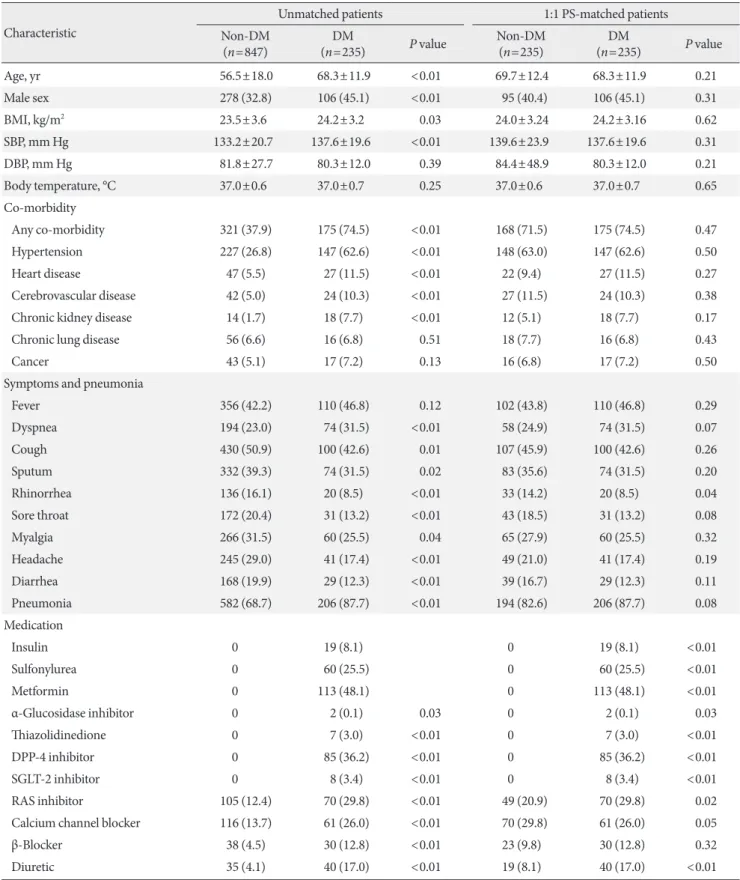
The baseline characteristics of unmatched and PS-matched pa- tients are shown in Table 1. A total of 1,082 patients with con- firmed COVID-19 were enrolled, and 235 (21.81%) of these had Fig. 1. Flow chart of the study. COVID-19, coronavirus disease 2019; KNUH, Kyungpook National University Hospital; DSMC, Dongsan Medical Center; KNUCH, Kyungpook National University Chilgok Hospital; DCMC, Daegu Catholic Medical Center;
PCR, polymerase chain reaction; DM, diabetes mellitus; PS, propensity score.
1,100 Patients with confirmed COVID-19 who admitted in university hospitals
(Daegu Catholic University Hospital, Keimyung University Dongsan Medical Center, Kyungpook National University Hospital, Kyungpook National University Chilgok Hospital, Yeungnam University Hospital)
between February 18th, 2020 and March 31th, 2020
1,082 Patients
PS matching
235 PatientsDM
Matched DM 235 Patients Non-DM
847 Patients
Matched Non-DM 235 Patients Exclusion because of referred patients
From KNUH to DSMC: 10 patients From KNUH to KNUCH: 1 patient From DSMC to DCMC: 1 patient Re-positive PCR of COVID-19: 6 patients
Table 1. Baseline characteristics of the full group of participants and of propensity score-matched patients with coronavirus dis- ease 2019
Characteristic
Unmatched patients 1:1 PS-matched patients
Non-DM
(n=847) DM
(n=235) P value Non-DM
(n=235) DM
(n=235) P value
Age, yr 56.5±18.0 68.3±11.9 <0.01 69.7±12.4 68.3±11.9 0.21
Male sex 278 (32.8) 106 (45.1) <0.01 95 (40.4) 106 (45.1) 0.31
BMI, kg/m2 23.5±3.6 24.2±3.2 0.03 24.0±3.24 24.2±3.16 0.62
SBP, mm Hg 133.2±20.7 137.6±19.6 <0.01 139.6±23.9 137.6±19.6 0.31
DBP, mm Hg 81.8±27.7 80.3±12.0 0.39 84.4±48.9 80.3±12.0 0.21
Body temperature, °C 37.0±0.6 37.0±0.7 0.25 37.0±0.6 37.0±0.7 0.65
Co-morbidity
Any co-morbidity 321 (37.9) 175 (74.5) <0.01 168 (71.5) 175 (74.5) 0.47
Hypertension 227 (26.8) 147 (62.6) <0.01 148 (63.0) 147 (62.6) 0.50
Heart disease 47 (5.5) 27 (11.5) <0.01 22 (9.4) 27 (11.5) 0.27
Cerebrovascular disease 42 (5.0) 24 (10.3) <0.01 27 (11.5) 24 (10.3) 0.38
Chronic kidney disease 14 (1.7) 18 (7.7) <0.01 12 (5.1) 18 (7.7) 0.17
Chronic lung disease 56 (6.6) 16 (6.8) 0.51 18 (7.7) 16 (6.8) 0.43
Cancer 43 (5.1) 17 (7.2) 0.13 16 (6.8) 17 (7.2) 0.50
Symptoms and pneumonia
Fever 356 (42.2) 110 (46.8) 0.12 102 (43.8) 110 (46.8) 0.29
Dyspnea 194 (23.0) 74 (31.5) <0.01 58 (24.9) 74 (31.5) 0.07
Cough 430 (50.9) 100 (42.6) 0.01 107 (45.9) 100 (42.6) 0.26
Sputum 332 (39.3) 74 (31.5) 0.02 83 (35.6) 74 (31.5) 0.20
Rhinorrhea 136 (16.1) 20 (8.5) <0.01 33 (14.2) 20 (8.5) 0.04
Sore throat 172 (20.4) 31 (13.2) <0.01 43 (18.5) 31 (13.2) 0.08
Myalgia 266 (31.5) 60 (25.5) 0.04 65 (27.9) 60 (25.5) 0.32
Headache 245 (29.0) 41 (17.4) <0.01 49 (21.0) 41 (17.4) 0.19
Diarrhea 168 (19.9) 29 (12.3) <0.01 39 (16.7) 29 (12.3) 0.11
Pneumonia 582 (68.7) 206 (87.7) <0.01 194 (82.6) 206 (87.7) 0.08
Medication
Insulin 0 19 (8.1) 0 19 (8.1) <0.01
Sulfonylurea 0 60 (25.5) 0 60 (25.5) <0.01
Metformin 0 113 (48.1) 0 113 (48.1) <0.01
α-Glucosidase inhibitor 0 2 (0.1) 0.03 0 2 (0.1) 0.03
Thiazolidinedione 0 7 (3.0) <0.01 0 7 (3.0) <0.01
DPP-4 inhibitor 0 85 (36.2) <0.01 0 85 (36.2) <0.01
SGLT-2 inhibitor 0 8 (3.4) <0.01 0 8 (3.4) <0.01
RAS inhibitor 105 (12.4) 70 (29.8) <0.01 49 (20.9) 70 (29.8) 0.02
Calcium channel blocker 116 (13.7) 61 (26.0) <0.01 70 (29.8) 61 (26.0) 0.05
β-Blocker 38 (4.5) 30 (12.8) <0.01 23 (9.8) 30 (12.8) 0.32
Diuretic 35 (4.1) 40 (17.0) <0.01 19 (8.1) 40 (17.0) <0.01
(Continued to the next page)
DM (Table 1, Fig. 1). The mean ages of the participants were 56.5±18.0 and 68.3±11.9 years in the non-DM and DM group, respectively. Patients in their 50s were most common in the non- DM group, whereas in the DM group, patients in their 60s were most common, followed by those in their 70s (Supplemen- tary Fig. 1). Five hundred and sixty-nine participants (67.2%) in the non-DM group and 129 (54.9%) in the DM group were women (P<0.01) (Table 1). After PS-matching, the percentag- es of women were 59.6% and 54.9%, respectively (P>0.05). As expected, patients with DM (73.7%) had more co-morbidities than those without DM (37.8%) (Table 1). After PS-matching, however, the prevalences of co-morbidities, such as hyperten- sion, cerebrovascular accident, heart disease, chronic kidney disease, and cancer, did not differ between the two groups (Ta- ble 1). Among the participants with DM, 8.1% were using in- sulin. Metformin was the most commonly used oral antidia- betic drug (48.1%), followed by a dipeptidyl peptidase-4 (DPP-
4) inhibitor (36.2%). With regard to antihypertensive drugs, renin-angiotensin system (RAS) inhibitors were the most commonly prescribed type of drug in the DM group, whereas calcium channel blockers were the most commonly prescribed type of drug in the non-DM group (Table 1).
Approximately 16% of the participants did not present with any symptoms. Cough, sputum, rhinorrhea, sore throat, myal- gia, headache, and diarrhea, which are indicative of upper re- spiratory tract infection or viral infection, were more prevalent in the non-DM group of the unmatched cohort (Table 1). By contrast, dyspnea and radiographically diagnosed pneumonia were significantly more prevalent in the DM group (Table 1).
Although PS-matching abrogated the differences in the preva- lence of the majority of the symptoms listed above, rhinorrhea remained more common in the non-DM group (Table 1). Two- thirds of the participants were diagnosed as having pneumonia by radiologic examination following their admission. Pneumo- Table 1. Continued
Characteristic
Unmatched patients 1:1 PS-matched patients
Non-DM
(n=847) DM
(n=235) P value Non-DM
(n=235) DM
(n=235) P value Laboratory findings on admission
HbA1c, % 5.79±0.70 7.70±1.79 <0.01 5.72±0.44 7.70±1.79 <0.01
Glucose, mg/dL 109.9±30.6 186.7±101.1 <0.01 118.6±34.4 186.7±101.1 <0.01
WBCs, 103/μL 5.50±2.45 6.86±3.62 <0.01 5.99±3.06 6.86±3.62 <0.01
Neutrophils, % 60.4±14.6 69.0±15.1 <0.01 64.5±15.0 69.0±15.1 <0.01
Lymphocytes, % 28.8±12.5 21.5±12.1 <0.01 24.9±12.3 21.5±12.1 <0.01
Hb, g/dL 12.7±1.8 12.2±1.7 <0.01 12.7±4.0 12.2±1.7 0.11
Hct, % 38.1±4.6 36.4±4.9 <0.01 37.0±5.1 36.4±4.9 0.15
PLTs, 103/μL 226.2±83.3 234.0±104.3 0.23 223.9±84.3 234.0±104.3 0.25
CRP, mg/dL 7.2±21.2 10.6±18.8 0.03 9.0±22.6 10.6±18.8 0.38
Albumin, g/dL 3.93±0.49 3.64±0.56 <0.01 3.75±0.52 3.64±0.56 0.02
BUN, mg/dL 15.1±9.8 21.0±17.6 <0.01 19.1±12.6 21.0±17.6 0.18
Cr, mg/dL 0.91±1.16 1.27±1.70 <0.01 1.12±1.45 1.27±1.70 0.28
eGFR, mL/min/1.73 m2 98.8±36.0 79.7±35.1 <0.01 85.7±34.9 79.7±35.1 0.06
AST, IU/L 44.4±216.8 40.8±42.6 0.80 51.9±311.9 40.8±42.6 0.59
ALT, IU/L 33.2±107.0 30.4±33.0 0.69 33.7±145.6 30.4±33.0 0.74
LDH, IU/L 458.8±260.8 552.6±432.1 <0.01 471.2±197.2 552.6±432.1 0.01
Procalcitonin, ng/mL 0.29±2.19 0.58±3.01 0.19 0.56±3.70 0.58±3.01 0.95
Values are presented as mean±standard deviation or number (%). P values were calculated using Student’s t-test or the chi-square test.
PS, propensity score; DM, diabetes mellitus; BMI, body mass index; SBP, systolic blood pressure; DBP, diastolic blood pressure; DPP-4, dipepti- dyl peptidase-4; SGLT-2, sodium glucose cotransporter-2; RAS, renin-angiotensin system; HbA1c, glycosylated hemoglobin; WBC, white blood cell; Hb, hemoglobin; Hct, hematocrit; PLT, platelet; CRP, C-reactive protein; BUN, blood urea nitrogen; Cr, creatinine; eGFR, estimated glo- merular filtration rate; AST, aspartate aminotransferase; ALT, alanine aminotransaminase; LDH, lactate dehydrogenase.
nia was more prevalent on X-ray or chest CT in the DM group than in the non-DM group, although this difference was not significant in the PS-matched cohort (P=0.08). Analysis of the laboratory findings on admission showed higher HbA1c, se- rum glucose concentration, white blood cell (WBC) count, se- rum CRP, lactate dehydrogenase (LDH) activity, blood urea ni- trogen, and creatinine; and lower lymphocyte count and serum albumin in participants with DM in the unmatched cohort.
Furthermore, even after PS-matching, there were significantly higher serum glucose, HbA1c, LDH, and neutrophil count;
and significantly lower lymphocyte count and serum albumin concentration. However, the serum CRP and creatinine con- centrations were not significantly different (Table 1).
In-hospital management and outcomes
The number of deaths in the entire cohort was 85 (mortality rate, 7.85%) (Table 2). During hospitalization, 152 participants (14.04%) had severe disease, which was defined as a reliance on one or more of ICU care, high-flow O2 nasal cannulae, me- chanical ventilation, CRRT, or ECMO (Table 2). In the PS- matched cohort, more of the participants with DM developed severe disease than those without DM (Table 2). The preva- lence of quarantine release was also significantly lower in the
DM group (Table 2). In addition, in the unmatched cohort, the period of time between COVID-19 confirmation and quaran- tine release, and the duration of stay in hospital, were signifi- cantly longer in participants with DM than in those without DM (Table 2). However, after PS-matching, these differences were not statistically significant (Table 2).
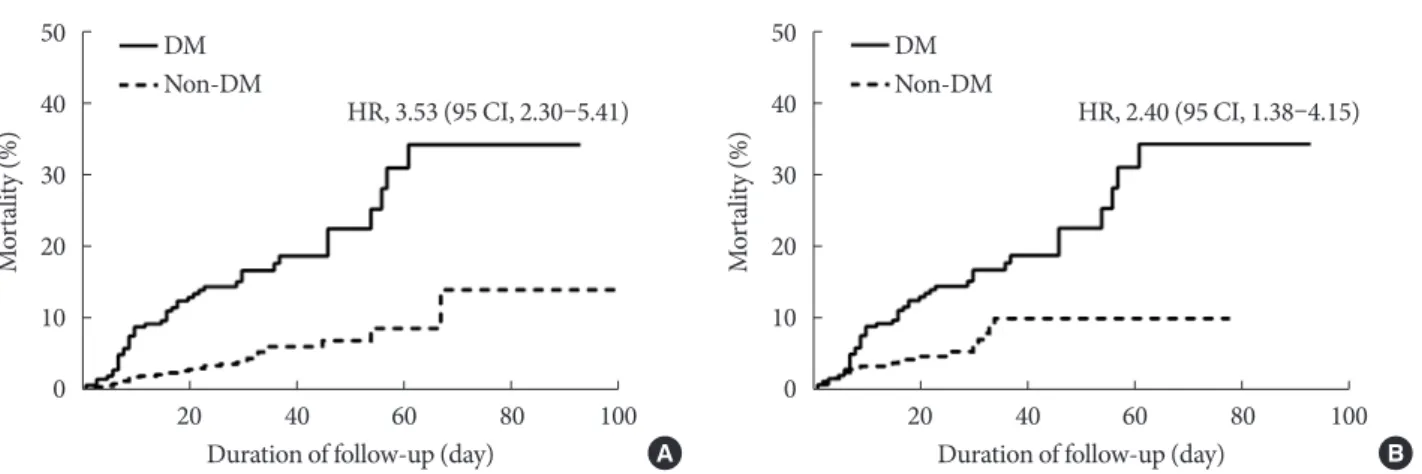
The mortality rate was significantly higher in the DM group than in the non-DM group (18.7% vs. 7.7%) (Table 2). Not only in the entire cohort (Fig. 2A), but also in PS-matched par- ticipants, the DM group exhibited higher mortality than the non-DM group, as illustrated by the cumulative death rate (HR, 2.40; 95% confidence interval [CI], 1.38 to 4.15) (Fig. 2B).
We also stratified the PS-matched cohort according to their age and sex. Subgroup analysis showed that DM significantly increased the risk of mortality in participants aged ≥70 years (HR, 3.29; 95% CI, 1.72 to 6.32) (Fig. 3B), whereas DM did not increase this risk in participants aged <70 years (HR, 1.06;
95% CI, 0.36 to 3.32) (Fig. 3A). DM was associated with higher mortality, irrespective of sex (Fig. 3C and D).
Identification of the baseline laboratory parameters that influence the severity of COVID-19-related disease and death Multivariate logistic analysis showed that high baseline WBC Table 2. In-hospital management and outcomes of patients with coronavirus disease 2019
Variable Unmatched patients 1:1 PS-matched patients
Non-DM DM P value Non-DM DM P value
Treatment
ICU 73 (8.6) 57 (24.3) <0.01 34 (14.5) 57 (24.3) <0.01
High flow O2 52 (6.1) 35 (14.9) <0.01 23 (9.8) 35 (14.9) 0.06
Ventilator 38 (4.5) 37 (15.7) <0.01 18 (7.7) 37 (15.7) <0.01
CRRT 8 (0.9) 15 (6.4) <0.01 3 (1.3) 15 (6.4) <0.01
ECMO 5 (0.6) 10 (4.3) <0.01 3 (1.3) 10 (4.3) 0.04
Duration
Confirmation-releasea, day 29.4±13.6 33.2±14.3 <0.01 31.9±13.4 33.2±14.3 0.39
Hospital lengtha, day 24.6±13.3 29.3±15.1 <0.01 27.5±13.9 29.3±15.1 0.22
Outcome
Release 759 (89.6) 182 (77.4) <0.01 207 (88.1) 182 (77.4) <0.01
Severe disease 94 (11.1) 65 (27.7) <0.01 45 (19.1) 65 (27.7) 0.02
Death 41 (4.8) 44 (18.7) <0.01 18 (7.7) 44 (18.7) <0.01
Values are presented as number (%) or mean±standard deviation. All P values were calculated using Student’s t-test or the chi-square test.
PS, propensity score; DM, diabetes mellitus; ICU, intensive care unit; CRRT, continuous renal replacement therapy; ECMO, extracorporeal membrane oxygenation.
aOnly includes patients who had been released from quarantine.
Fig. 2. Mortality due to coronavirus disease 2019 in all patients (A) and propensity score-matched patients (B). The data were an- alyzed using the Kaplan-Meier method, and hazard ratios were calculated using a Cox proportional hazards model. Data are ex- pressed as hazard ratio (HR) (95% confidence intervals [CI]). DM, diabetes mellitus
Fig. 3. Mortality of coronavirus disease 2019 patients in subgroups defined according to age and sex. Patients aged <70 years (A) and >70 years (B); and male (C) and female (D) patients. Data were analyzed using a Cox proportional hazards model. Data are expressed as hazard ratio (HR) (95% confidence intervals [CI]). The model was adjusted for age, sex, and the presence of underly- ing diseases.
50 40 30 20 10 0
0.6 0.5 0.4 0.3 0.2 0.1 0
0.6 0.5 0.4 0.3 0.2 0.1 0 0.6 0.5 0.4 0.3 0.2 0.1 0
0.6 0.5 0.4 0.3 0.2 0.1 0
50 40 30 20 10 0
Mortality (%) Cumulative risk Cumulative riskCumulative risk
Cumulative risk Mortality (%)
20 40 60 80 100
0 10 20 30 40 50 60
0 10 20 30 40 50 60 0 10 20 30 40 50 60 70
0 10 20 30 40 50 60 70
20 40 60 80 100 Duration of follow-up (day)
Duration of follow-up (day)
Duration of follow-up (day) Duration of follow-up (day)
Duration of follow-up (day)
Duration of follow-up (day) HR, 3.53 (95 CI, 2.30–5.41)
HR, 1.09 (95 CI, 0.36–3.32)
HR, 3.71 (95 CI, 1.51–9.08) HR, 3.29 (95 CI, 1.72–6.32)
HR, 2.29 (95 CI, 1.10–4.73)
HR, 2.40 (95 CI, 1.38–4.15) DM
DM
DM DM
DM
DM Non-DM
Non-DM
Non-DM Non-DM
Non-DM
Non-DM
A
A
D B
C
B
count, high hemoglobin concentration, low platelet count, low albumin concentration, and high aspartate aminotransferase (AST) activity were associated with a higher risk of death in
participants with DM (Table 3). Low platelet count, high AST activity, low alanine aminotransaminase (ALT) activity, and high LDH activity were associated with severe disease (Table
3). Among participants with DM, the baseline random serum glucose and CRP concentrations were not associated with se- vere disease or death (Table 3). However, among non-DM par- ticipants, high CRP concentration, low albumin concentration, high AST activity, and low ALT activity were predictors of se- vere disease. Of these, only high AST activity was also a predic- tor of death (Table 3).
Analysis of the relationships between the use of particular medications and in-hospital mortality
Angiotensin-converting enzyme 2 (ACE2) inhibitor and DPP- 4 inhibitor use appear to affect the pathogenesis of coronavi- ruses [14,15]. Therefore, we next investigated whether the pri- or use of such medications affected the prognosis or mortality rate of participants with COVID-19, after adjustment for age, sex, and the presence of underlying diseases. As shown in Sup- plementary Table 1, the use of neither a RAS inhibitor nor a DPP-4 inhibitor was associated with higher prevalence of se- vere disease or death. Instead, the use of metformin or insulin tended to be associated with less severe disease and lower mor- tality, although these findings did not achieve statistical signifi- cance (Supplementary Table 1).
DISCUSSION
In the present study, we showed that patients with DM are at
higher risk of severe COVID-19-related disease and mortality.
Given the importance of the relationship between COVID-19 and DM, an international panel of experts has recently made practical recommendations for the management of DM in pa- tients with COVID-19 [16]. Our findings underscore the im- portance of taking extra care of patients with DM who contract COVID-19.
In the present study, 21.8% of patients with COVID-19 had DM. A previous meta-analysis showed a mean prevalence of DM of 11% among patients with COVID-19 [9]. Because of the exponential increase in COVID-19 infections, doctors from the Daegu Medical Associations performed telephone consul- tations to check the status of patients who were confined at home and classified them on the basis of their disease severity.
They were hospitalized if they exceeded a threshold score on a scoring system that consisted of the severity of disease, age, the presence of underlying disease, and social factors. Asymptom- atic or mild cases were admitted to a “therapeutic living center”
and closely monitored, whereas those with moderate-to-severe disease were admitted to university hospitals [3]. On the basis of the scoring system, most of the participants in the present study were classified as having moderate-to-severe disease.
The prevalence of DM in the present study cohort was al- most twice that of the general population, presumably because individuals with severe disease who were at high risk of severe disease or death were preferentially admitted to the university Table 3. Multivariate model for the prediction of severe disease or death in coronavirus disease 2019 patients
Variable Non-DM patients DM patients
Severe disease Death Severe disease Death
Glucose, mg/dL 1.01 (1.00–1.02) 1.02 (1.00–1.04) 1.00 (1.00–1.01) 1.00 (0.99–1.00)
WBCs, 103/μL 1.01 (0.86–1.18) 1.02 (0.78–1.34) 1.12 (1.00–1.28) 1.22 (1.06–1.41)a
Hb, g/dL 1.13 (0.93–1.36) 0.97 (0.55–1.74) 1.14 (0.82–1.59) 1.55 (1.07–2.26)b
PLT, 103/μL 1.00 (0.99–1.01) 0.99 (0.97–1.00) 0.99 (0.99–1.00)b 0.99 (0.99–1.00)b
CRP, mg/dL 1.03 (1.01–1.05)a 1.03 (0.99–1.07) 0.99 (0.96–1.01) 0.99 (0.96–1.02)
Albumin, g/dL 0.15 (0.04–0.55)a 0.53 (0.04–7.76) 0.38 (0.14–1.02) 0.19 (0.06–0.56)a eGFR, mL/min/1.73 m2 1.00 (0.99–1.02) 1.00 (0.98–1.03) 0.99 (0.97–1.00) 0.99 (0.98–1.01) AST, IU/L 1.09 (1.04–1.14)a 1.10 (1.02–1.19)b 1.05 (1.02–1.08)a 1.03 (1.00–1.06)b
ALT, IU/L 0.93 (0.88–0.98)a 0.93 (0.85–1.01) 0.96 (0.92–0.99)a 0.96 (0.92–1.01)
LDH, IU/L 1.00 (1.00–1.01) 1.00 (0.99–1.00) 1.00 (1.00–1.01)b 1.00 (1.00–1.00)
Data were analyzed using multivariate logistic regression, and all data are expressed as odds ratios (95% confidence intervals). The model was adjusted for age, sex, and the presence of underlying diseases.
DM, diabetes mellitus; WBC, white blood cell; Hb, hemoglobin; PLT, platelet; CRP, C-reactive protein; eGFR, estimated glomerular filtration rate; AST, aspartate aminotransferase; ALT, alanine aminotransaminase; LDH, lactate dehydrogenase.
aP<0.01, bP<0.05.
hospitals. Notably, unlike in other recently published studies [17,18], female patients made up the larger proportions of both the non-DM and DM groups in the present study. This is in contrast to the Chinese data [18] and data from another region of Korea [19]. This difference might be attributable to a specific demographic characteristic: the exponential spread of the virus in Daegu was initiated in a female-dominated religious group.
DM is an independent risk factor for the severity of and mortality associated with COVID-19 [9,20]. A previous large cohort study (a cohort of 7,336 COVID-19 patients with or without DM) showed that DM increases the mortality of pa- tients and that strict glucose control improves the outcomes of COVID-19 [17]. An analysis of 1,950 COVID-19 patients also revealed that DM is a risk factor (HR, 1.59; 95% CI, 1.03 to 2.45) [8]. In addition, a meta-analysis showed that DM in pa- tients with COVID-19 is associated with two-fold higher mor- tality compared with patients without DM [9]. These findings are highly suggestive that DM is an important factor in the prognosis of COVID-19. Nevertheless, several COVID-19 studies have not shown significant differences in disease sever- ity or mortality in patients with or without DM, presumably because of the small numbers of participants [10,21]. In addi- tion, a recent observational study showed that DM is not an independent risk factor for COVID-19-related mortality [11].
The findings of the present study also show that DM is asso- ciated with a higher risk of severe disease and mortality, re- gardless of sex. Furthermore, we identified a relationship be- tween the presence of DM and higher mortality due to COV- ID-19 in older patients, but this relationship was not present in younger patients. A series of recent studies suggest that old age is a risk factor for mortality in patients with DM [11,22], but this evidence is insufficient to conclude that DM is not a risk factor for COVID-19-related mortality in young patients.
However, on the basis of the results of the present study, it is possible to surmise that DM is more likely to be a risk factor in older patients than in younger patients.
In the present study, we did not identify any relationships between the use of specific medications and the outcomes as- sociated with COVID-19 in DM patients. DPP-4 is a receptor for the human coronavirus-Erasmus Medical Center (hCoV- EMC) [15]. Although it is not clear whether this is also the case for COVID-19, and early studies have failed to identify rela- tionships between the exposure to DPP-4 inhibitors and the outcomes of COVID-19 [23], an upregulation of DPP-4 in pa- tients with type 2 DM remains a plausible explanation for the
greater severity of COVID-19 in patients with DM [24]. Fur- thermore, it has been suggested that the ACE2 receptor is the primary receptor for coronavirus spike protein [16,25]. Greater glycosylation of both the spike protein and the ACE2 receptor, secondary to hyperglycemia, may modulate the binding of the virus and therefore might account for the greater severity of COVID-19 in hyperglycemic patients. In the present study, the disease was slightly less severe in patients who were adminis- tering metformin or insulin, but this trend did not achieve sta- tistical significance. Furthermore, the use of RAS inhibitors did not affect mortality. The effect of medication on the mor- tality associated with COVID-19 remains controversial [23,26- 28]. Therefore, our findings are in line with recent recommen- dations that unless contraindicated, the continuation of cur- rent medication is strongly recommended [17,29].
The present study had some limitations. First, after the diag- nosis of the 31st case of COVID-19 in South Korea, there was an exponential increase in the number of COVID-19 diagno- ses in Daegu. Because of a shortage of infrastructure and train- ing of medical staff, there was incomplete documentation re- garding exposure history and laboratory testing conducted in the patients. In particular, and as previously documented [22], HbA1c values for a considerable proportion of the participants were missing; therefore, our analysis of the impact of the de- gree of baseline glycemic control (i.e., HbA1c on admission) on the severity and mortality associated with COVID-19 was limited. Second, of the confirmed cases of COVID-19 in Dae- gu, 65.6% were associated with a single religious group, so it is unlikely that the data collected are representative of the general population. Furthermore, these patients were admitted to uni- versity hospitals because of their moderate-to-severe disease, and therefore the data are not representative of COVID-19 pa- tients with mild disease. However, in spite of these limitations, the present study has a substantial strength: it is the first multi- center study to investigate the association between COVID-19 and DM in Daegu, Korea, the site of the first outbreak of COV- ID-19 outside Wuhan, China.
Our findings regarding severe COVID-19 patients corrobo- rate a series of recent observations that DM is a risk factor for severe COVID-19-related disease, as well as mortality. Accu- mulating evidence and our own data both also suggest that old age is an independent risk factor for COVID-19 infection and the severity of the disease. The present findings strongly sug- gest that DM contributes to higher COVID-19-related mortal- ity, especially in the elderly. Therefore, special attention should
be paid to older patients with DM during the treatment of CO- VID-19.
SUPPLEMENTARY MATERIALS
Supplementary materials related to this article can be found online at https://doi.org/10.4093/dmj.2020.0146.
CONFLICTS OF INTEREST
No potential conflict of interest relevant to this article was re- ported.
AUTHOR CONTRIBUTIONS
Conception or design: J.S.M.
Acquisition, analysis, or interpretation of data: M.K.K., J.H.J., S.W.K., J.S.M., N.H.C., E.H., J.H.Y., J.Y.L., M.H., J.S.P., Y.S.K., Y.K.C., K.T.K., S.Y.L., E.J.J., J.W.K., H.L.H., H.H.K., C.Y.J., Y.Y.L., E.H., S.M.C., J.H., J.H.A., N.K, S.W.K., H.H.C., Y.H.L., J.L., K.G.P., H.A.K., J.H.L.
Drafting the work or revising: M.K.K., J.H.J.
Final approval of the manuscript: M.K.K., J.H.J., S.W.K., J.S.M.
ORCID
Mi Kyung Kim https://orcid.org/0000-0001-5750-3598 Jae-Han Jeon https://orcid.org/0000-0002-9217-968X Hyun Ah Kim https://orcid.org/0000-0002-9125-7156 Ji-Hyun Lee https://orcid.org/0000-0002-5671-0875
ACKNOWLEDGMENTS
This study was supported by a research grant from the Daegu Medical Association COVID-19 Scientific Committee. We also would like to express sincere gratitude to all the members of the Daegu-Gyeongbuk Diabetes and Endocrinology Society who actively participated in the study.
REFERENCES
1. COVID-19 National Emergency Response Center, Epidemiol- ogy and Case Management Team, Korea Centers for Disease Control and Prevention. Coronavirus disease-19: summary of 2,370 contact investigations of the first 30 cases in the Republic
of Korea. Osong Public Health Res Perspect 2020;11:81-4.
2. COVID-19 National Emergency Response Center, Epidemiol- ogy and Case Management Team, Korea Centers for Disease Control and Prevention. Coronavirus disease-19: the first 7,755 cases in the Republic of Korea. Osong Public Health Res Per- spect 2020;11:85-90.
3. Kim SW, Lee KS, Kim K, Lee JJ, Kim JY; Daegu Medical Asso- ciation. A brief telephone severity scoring system and thera- peutic living centers solved acute hospital-bed shortage during the COVID-19 outbreak in Daegu, Korea. J Korean Med Sci 2020;35:e152.
4. Jafar N, Edriss H, Nugent K. The effect of short-term hypergly- cemia on the innate immune system. Am J Med Sci 2016;351:
201-11.
5. Turina M, Fry DE, Polk HC Jr. Acute hyperglycemia and the innate immune system: clinical, cellular, and molecular as- pects. Crit Care Med 2005;33:1624-33.
6. Cristelo C, Azevedo C, Marques JM, Nunes R, Sarmento B.
SARS-CoV-2 and diabetes: new challenges for the disease. Dia- betes Res Clin Pract 2020;164:108228.
7. Memish ZA, Perlman S, Van Kerkhove MD, Zumla A. Middle East respiratory syndrome. Lancet 2020;395:1063-77.
8. Guan WJ, Liang WH, Zhao Y, Liang HR, Chen ZS, Li YM, Liu XQ, Chen RC, Tang CL, Wang T, Ou CQ, Li L, Chen PY, Sang L, Wang W, Li JF, Li CC, Ou LM, Cheng B, Xiong S, Ni ZY, Xiang J, Hu Y, Liu L, Shan H, Lei CL, Peng YX, Wei L, Liu Y, Hu YH, Peng P, Wang JM, Liu JY, Chen Z, Li G, Zheng ZJ, Qiu SQ, Luo J, Ye CJ, Zhu SY, Cheng LL, Ye F, Li SY, Zheng JP, Zhang NF, Zhong NS, He JX; China Medical Treatment Expert Group for COVID-19. Comorbidity and its impact on 1590 patients with COVID-19 in China: a nationwide analysis. Eur Respir J 2020;55:2000547.
9. Kumar A, Arora A, Sharma P, Anikhindi SA, Bansal N, Singla V, Khare S, Srivastava A. Is diabetes mellitus associated with mortality and severity of COVID-19?: a meta-analysis. Diabe- tes Metab Syndr 2020;14:535-45.
10. Guo W, Li M, Dong Y, Zhou H, Zhang Z, Tian C, Qin R, Wang H, Shen Y, Du K, Zhao L, Fan H, Luo S, Hu D. Diabetes is a risk factor for the progression and prognosis of COVID-19. Diabe- tes Metab Res Rev 2020 Mar 31 [Epub]. https://doi.org/10.1002/
dmrr.3319.
11. Docherty AB, Harrison EM, Green CA, Hardwick HE, Pius R, Norman L, Holden KA, Read JM, Dondelinger F, Carson G, Merson L, Lee J, Plotkin D, Sigfrid L, Halpin S, Jackson C, Gam- ble C, Horby PW, Nguyen-Van-Tam JS, Ho A, Russell CD, Dun-
ning J, Openshaw PJ, Baillie JK, Semple MG; ISARIC4C investi- gators. Features of 20 133 UK patients in hospital with COVID-19 using the ISARIC WHO Clinical Characterisation Protocol:
prospective observational cohort study. BMJ 2020;369:m1985.
12. Kim MK, Ko SH, Kim BY, Kang ES, Noh J, Kim SK, Park SO, Hur KY, Chon S, Moon MK, Kim NH, Kim SY, Rhee SY, Lee KW, Kim JH, Rhee EJ, Chun S, Yu SH, Kim DJ, Kwon HS, Park KS; Committee of Clinical Practice Guidelines, Korean Diabe- tes Association. 2019 Clinical practice guidelines for type 2 dia- betes mellitus in Korea. Diabetes Metab J 2019;43:398-406.
13. Ministry of Health and Welfare: Central Disaster Management Headquarters. Available from: http://ncov.mohw.go.kr (cited 2020 Jul 8).
14. Hoffmann M, Kleine-Weber H, Pohlmann S. A multibasic cleavage site in the spike protein of SARS-CoV-2 is essential for infection of human lung cells. Mol Cell 2020;78:779-84.
15. Raj VS, Mou H, Smits SL, Dekkers DH, Muller MA, Dijkman R, Muth D, Demmers JA, Zaki A, Fouchier RA, Thiel V, Dro- sten C, Rottier PJ, Osterhaus AD, Bosch BJ, Haagmans BL. Di- peptidyl peptidase 4 is a functional receptor for the emerging human coronavirus-EMC. Nature 2013;495:251-4.
16. Bornstein SR, Rubino F, Khunti K, Mingrone G, Hopkins D, Birkenfeld AL, Boehm B, Amiel S, Holt RI, Skyler JS, DeVries JH, Renard E, Eckel RH, Zimmet P, Alberti KG, Vidal J, Gel- oneze B, Chan JC, Ji L, Ludwig B. Practical recommendations for the management of diabetes in patients with COVID-19.
Lancet Diabetes Endocrinol 2020;8:546-50.
17. Guan WJ, Ni ZY, Hu Y, Liang WH, Ou CQ, He JX, Liu L, Shan H, Lei CL, Hui DSC, Du B, Li LJ, Zeng G, Yuen KY, Chen RC, Tang CL, Wang T, Chen PY, Xiang J, Li SY, Wang JL, Liang ZJ, Peng YX, Wei L, Liu Y, Hu YH, Peng P, Wang JM, Liu JY, Chen Z, Li G, Zheng ZJ, Qiu SQ, Luo J, Ye CJ, Zhu SY, Zhong NS;
China Medical Treatment Expert Group for Covid-19. Clinical characteristics of coronavirus disease 2019 in China. N Engl J Med 2020;382:1708-20.
18. Zhu L, She ZG, Cheng X, Qin JJ, Zhang XJ, Cai J, Lei F, Wang H, Xie J, Wang W, Li H, Zhang P, Song X, Chen X, Xiang M, Zhang C, Bai L, Xiang D, Chen MM, Liu Y, Yan Y, Liu M, Mao W, Zou J, Liu L, Chen G, Luo P, Xiao B, Zhang C, Zhang Z, Lu Z, Wang J, Lu H, Xia X, Wang D, Liao X, Peng G, Ye P, Yang J, Yuan Y, Huang X, Guo J, Zhang BH, Li H. Association of blood glucose control and outcomes in patients with COVID-19 and pre-existing type 2 diabetes. Cell Metab 2020;31:1068-77.
19. Korean Society of Infectious Diseases; Korean Society of Pediat- ric Infectious Diseases; Korean Society of Epidemiology; Kore-
an Society for Antimicrobial Therapy; Korean Society for Healthcare-associated Infection Control and Prevention; Korea Centers for Disease Control and Prevention. Report on the epi- demiological features of coronavirus disease 2019 (COVID-19) outbreak in the Republic of Korea from January 19 to March 2, 2020. J Korean Med Sci 2020;35:e112.
20. Katulanda P, Dissanayake HA, Ranathunga I, Ratnasamy V, Wijewickrama PSA, Yogendranathan N, Gamage KKK, de Sil- va NL, Sumanatilleke M, Somasundaram NP, Matthews DR.
Prevention and management of COVID-19 among patients with diabetes: an appraisal of the literature. Diabetologia 2020;
63:1440-52.
21. Chung SM, Lee YY, Ha E, Yoon JS, Won KC, Lee HW, Hur J, Hong KS, Jang JG, Jin HJ, Choi EY, Shin KC, Chung JH, Lee KH, Ahn JH, Moon JS. The risk of diabetes on clinical out- comes in patients with coronavirus disease 2019: a retrospec- tive cohort study. Diabetes Metab J 2020;44:405-13.
22. Cariou B, Hadjadj S, Wargny M, Pichelin M, Al-Salameh A, Allix I, Amadou C, Arnault G, Baudoux F, Bauduceau B, Borot S, Bourgeon-Ghittori M, Bourron O, Boutoille D, Cazenave- Roblot F, Chaumeil C, Cosson E, Coudol S, Darmon P, Disse E, Ducet-Boiffard A, Gaborit B, Joubert M, Kerlan V, Laviolle B, Marchand L, Meyer L, Potier L, Prevost G, Riveline JP, Robert R, Saulnier PJ, Sultan A, Thebaut JF, Thivolet C, Tramunt B, Vatier C, Roussel R, Gautier JF, Gourdy P; CORONADO in- vestigators. Phenotypic characteristics and prognosis of inpa- tients with COVID-19 and diabetes: the CORONADO study.
Diabetologia 2020;63:1500-15.
23. Fadini GP, Morieri ML, Longato E, Bonora BM, Pinelli S, Sel- min E, Voltan G, Falaguasta D, Tresso S, Costantini G, Sparaci- no G, Di Camillo B, Tramontan L, Cattelan AM, Vianello A, Fioretto P, Vettor R, Avogaro A. Exposure to dipeptidyl-pepti- dase-4 inhibitors and COVID-19 among people with type 2 diabetes: a case-control study. Diabetes Obes Metab 2020 May 28 [Epub]. https://doi.org/10.1111/dom.14097.
24. Bassendine MF, Bridge SH, McCaughan GW, Gorrell MD.
COVID-19 and comorbidities: a role for dipeptidyl peptidase 4 (DPP4) in disease severity? J Diabetes 2020;12:649-58.
25. Brufsky A. Hyperglycemia, hydroxychloroquine, and the CO- VID-19 pandemic. J Med Virol 2020;92:770-5.
26. Ursini F, Ciaffi J, Landini MP, Meliconi R. COVID-19 and dia- betes: is metformin a friend or foe? Diabetes Res Clin Pract 2020;164:108167.
27. Luo P, Qiu L, Liu Y, Liu XL, Zheng JL, Xue HY, Liu WH, Liu D, Li J. Metformin treatment was associated with decreased mor-
tality in COVID-19 patients with diabetes in a retrospective analysis. Am J Trop Med Hyg 2020;103:69-72.
28. Chatterjee S. SGLT-2 inhibitors for COVID-19: a miracle wait- ing to happen or just another beat around the bush? Prim Care Diabetes 2020 May 28 [Epub]. https://doi.org/10.1016/j.pcd.
2020.05.013.
29. Pal R, Bhadada SK. Should anti-diabetic medications be recon- sidered amid COVID-19 pandemic? Diabetes Res Clin Pract 2020;163:108146.
Supplementary Table 1. Odds ratios for severe disease and death in diabetes patients, according to their medication
Severe disease Death
Odds ratio P value Odds ratio P value
Insulin 0.24 (0.04–1.39) 0.11 0.26 (0.03–2.63) 0.25
Sulfonylurea 1.16 (0.47–2.89) 0.74 0.84 (0.23–3.09) 0.79
Metformin 0.48 (0.19–1.24) 0.13 0.36 (0.10–1.23) 0.10
DPP-4 inhibitor 1.05 (0.44–2.49) 0.92 1.47 (0.45–4.78) 0.52
SGLT-2 inhibitor 1.75 (0.23–13.50) 0.59 5.05 (0.48–53.26) 0.18
RAS inhibitor 0.66 (0.24–1.76) 0.40 1.37 (0.37–5.07) 0.64
Data were analyzed using multivariate logistic regression and are expressed as odds ratios (95% confidence intervals). The model was adjusted for age, sex, and the presence of underlying diseases.
DPP-4, dipeptidyl peptidase-4; SGLT-2, sodium glucose cotransporter-2; RAS, renin-angiotensin system.
Supplementary Fig. 1. Age distribution of patients with or without diabetes mellitus (DM).
40 30 20 10 0
Percentage (%)
≤30 31−40 41−50 51−60 61−70 71−80 >80
11.6%
8.5%
13.8%
23.8%
17.9%
15.6%
8.7%
0.9% 1.3% 3.8%
17.4%
32.7%
29.8%
15.3%
Age (yr) DM Non-DM