
2007-11권 1호
273
0
0
전체 글
(2)
(3) 목차. 比較文化硏究. • 경영학 학문목적 학습자를 위한 교재개발 방안. 2007. 7. 강현화. 77. 홍혜란. 77. • • • • • • • • • • • • • • • 고급 한국어 학습자의 문법적 연어 오류 분석.
(4)
(5) 경영학 학문목적 학습자를 위한 교재개발 방안 강 현 화* 1). 목. I. 도 입. 차.
(6) 2 比較文化硏究.
(7) 경영학 학문목적 학습자를 위한 교재개발 방안. 3.
(8) 4 比較文化硏究. II. 선행 연구 및 이론.
(9) 경영학 학문목적 학습자를 위한 교재개발 방안. III. 학문목적 학습자를 위한 교재 분석 III.1. 교재의 유형 및 선행 교재 분석류 분석의 대상 및 기준. 5.
(10) 6 比較文化硏究.
(11) 경영학 학문목적 학습자를 위한 교재개발 방안. 7.
(12) 8 比較文化硏究.
(13) 경영학 학문목적 학습자를 위한 교재개발 방안. III.2. 학문 목적 교재의 방향성. 9.
(14) 10 比較文化硏究. V. 학문목적 학습자를 위한 교육과정의 설계.
(15) 경영학 학문목적 학습자를 위한 교재개발 방안. 11.
(16) 12 比較文化硏究. IV.1 경영학 학문목적 학습자를 위한 교재의 설계.
(17) 경영학 학문목적 학습자를 위한 교재개발 방안. 13.
(18) 14 比較文化硏究.
(19) 경영학 학문목적 학습자를 위한 교재개발 방안. 4과 마케팅 <듣기 지문>의 예시. 15.
(20) 16 比較文化硏究.
(21) 경영학 학문목적 학습자를 위한 교재개발 방안. V. 맺음말. 17.
(22) 18 比較文化硏究. 참고문헌.
(23) 경영학 학문목적 학습자를 위한 교재개발 방안. 19.
(24) 20 比較文化硏究. A Study on New Program for Textbook Development for Korean Learners with a Business Major. Khang Hyoun-Hwa. . . . . . . .
(25) 고급 한국어 학습자의 문법적 연어 오류 분석 - 학습자 말뭉치와 고급 한국어 학습자의 작문 자료를 중심으로 -. 홍 혜 란* 1). 목. I. 서 론. 차.
(26) 2 比較文化硏究.
(27) 고급 한국어 학습자의 문법적 연어 오류 분석. Ⅱ. 이론적 배경 II.1. 어휘적 접근법. 3.
(28) 4 比較文化硏究.
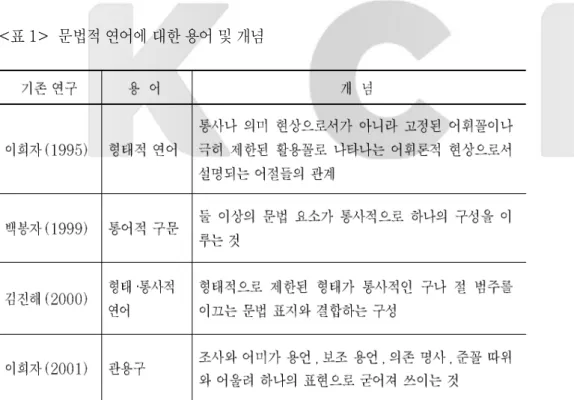
(29) 고급 한국어 학습자의 문법적 연어 오류 분석. II.2. 문법적 연어의 개념 정의. <표 1> 문법적 연어에 대한 용어 및 개념. 5.
(30) 6 比較文化硏究.
(31) 고급 한국어 학습자의 문법적 연어 오류 분석. 7.
(32) 8 比較文化硏究.
(33) 고급 한국어 학습자의 문법적 연어 오류 분석. <표 2> 문법적 연어 구성 항목. 9.
(34) 10 比較文化硏究. Ⅲ. 연구 대상 및 방법 Ⅲ.1. 연구 대상.
(35) 고급 한국어 학습자의 문법적 연어 오류 분석. Ⅲ.2. 분석 기준. 11.
(36) 12 比較文化硏究.
(37) 고급 한국어 학습자의 문법적 연어 오류 분석. Ⅳ. 문법적 연어 오류의 유형. 13.
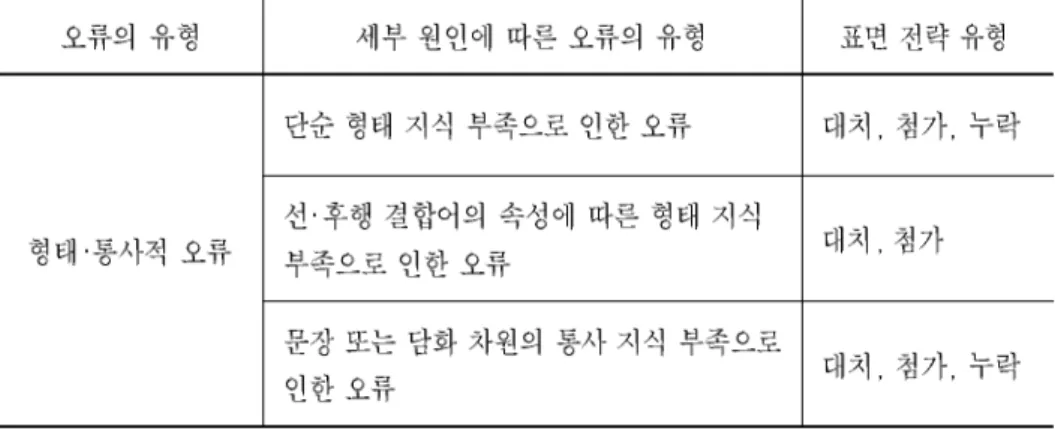
(38) 14 比較文化硏究. <표 3> 문법적 연어 오류의 유형. Ⅳ.1. 단순 형태 지식 부족으로 인한 오류.
(39) 고급 한국어 학습자의 문법적 연어 오류 분석. 15.
(40) 16 比較文化硏究. Ⅳ.2. 선・후행 결합어의 속성에 따른 형태 지식 부족으로 인한 오류.
(41) 고급 한국어 학습자의 문법적 연어 오류 분석. 17.
(42) 18 比較文化硏究. Ⅳ.3. 문장 또는 담화 차원의 통사 지식 부족으로 인한 오류.
(43) 고급 한국어 학습자의 문법적 연어 오류 분석. 19.
(44) 20 比較文化硏究. Ⅳ.4. 분석 결과에 대한 논의.
(45) 고급 한국어 학습자의 문법적 연어 오류 분석. 60. 21. 51.96. 오류 발생률(%). 50 40. 대치 첨가 누락. 30 20 10. 11.74. 13.04 8.04. 6.3. 4.35. 3.91. 단순 형태 지식 부족으로 인한 오류. 선후행 결합어의 속성에 따른 형태 지식 부족으로 인한 오류. 0. 0.65. 0 문장 또는 담화 차원의 통사 지식 부족으로 인한 오류. 오류 유형. <그림 1> 형태・통사적 오류의 유형별 오류 발생률.
(46) 22 比較文化硏究.
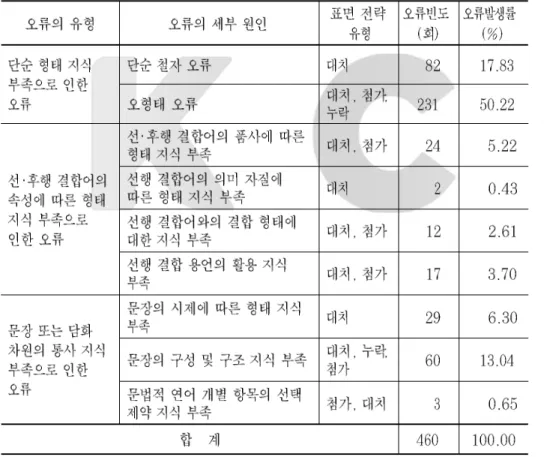
(47) 고급 한국어 학습자의 문법적 연어 오류 분석. <표 4> 형태・통사적 오류의 세부 원인별 오류 빈도 및 오류율. 23.
(48) 24 比較文化硏究. Ⅴ. 결 론.
(49) 고급 한국어 학습자의 문법적 연어 오류 분석. 25.
(50) 26 比較文化硏究. 참고문헌.
(51) 고급 한국어 학습자의 문법적 연어 오류 분석. 27.
(52) 28 比較文化硏究.
(53) 고급 한국어 학습자의 문법적 연어 오류 분석. 29. Error Analysis in Grammatical Collocation of KFL Learners - Focusing on Learner's Corpus and Advanced Korean Learners' Composition -. Hong Hye-Ran.
(54) 30 比較文化硏究.
(55) Suturing Mechanisms and Silence as a Speech in Herman Melville’s Benito Cereno. Bong-Hee OH * 1). Department of English University at Albany, SUNY.
(56) 2 比較文化硏究.
(57) Suturing Mechanisms and Silence as a Speech in Herman Melville’s Benito Cereno. 3.
(58) 4 比較文化硏究. At home, he had often taken rare satisfaction in sitting in his door, watching some free man of color at his work or play. If on a voyage he chanced to have a black sailor, invariably he was on chatty and half-gamesome terms with him. In fact, like most men of a good, blithe heart, Captain Delano took to negroes, not philanthropically, but genially, just as other men to Newfoundland dogs. (279).
(59) Suturing Mechanisms and Silence as a Speech in Herman Melville’s Benito Cereno. 5.
(60) 6 比較文化硏究. But if the whites had dark secrets concerning Don Benito, could then Don Benito be any way in complicity with the blacks? But they were too stupid. Besides, who ever heard of a white so far a renegade as to apostatize from his very species almost, by leaguing in against it with negroes? (270).
(61) Suturing Mechanisms and Silence as a Speech in Herman Melville’s Benito Cereno. 7.
(62) 8 比較文化硏究.
(63) Suturing Mechanisms and Silence as a Speech in Herman Melville’s Benito Cereno. As master and man stood before him, the black upholding the white. Captain Delano could not but bethink him of the beauty of that relationship which could present such a spectacle of fidelity on the one hand and confidence on the other. (250). 9.
(64) 10 比較文化硏究.
(65) Suturing Mechanisms and Silence as a Speech in Herman Melville’s Benito Cereno. . . . just then the razor drew blood, spots of which stained the creamy lather under the throat: immediately the black barber drew back his steel, and, remaining in his professional attitude, back to Captain Delano, and face to Don Benito, held up the trickling razor, saying with a sort of half humorous sorrow, “See, master— you shook so — here’s Babo’s first blood.” (281). 11.
(66) 12 比較文化硏究.
(67) Suturing Mechanisms and Silence as a Speech in Herman Melville’s Benito Cereno. 13.
(68) 14 比較文化硏究. All this is very queer now, thought Captain Delano, with a qualmish sort of emotion; but, as one feeling incipient seasickness, he strove, by ignoring the symptoms, to get rid of the malady. Once more he looked off for his boat. To his delight, it was now again in view, leaving the rocky spur astern. (271).
(69) Suturing Mechanisms and Silence as a Speech in Herman Melville’s Benito Cereno. 15.
(70) 16 比較文化硏究.
(71) Suturing Mechanisms and Silence as a Speech in Herman Melville’s Benito Cereno. 17.
(72) 18 比較文化硏究.
(73) Suturing Mechanisms and Silence as a Speech in Herman Melville’s Benito Cereno. If the Deposition have served as the key to fit into the lock of the complications which precede it, then, as a vault whose door has been flung back, the San Dominick’s hull lies open to-day. (313). 19.
(74) 20 比較文化硏究. “You are saved,” cried Captain Delano, more and more astonished and pained; “you are saved: what has cast such a shadow upon you?” “The negro.” (314).
(75) Suturing Mechanisms and Silence as a Speech in Herman Melville’s Benito Cereno. 21.
(76) 22 比較文化硏究. Seeing all was over, he uttered no sound, and could not be forced to. His aspect seemed to say, since I cannot do deeds, I will not speak words. (315).
(77) Suturing Mechanisms and Silence as a Speech in Herman Melville’s Benito Cereno. 23.
(78) 24 比較文化硏究. Bibliography Bernstein, John. “Benito Cereno and the Spacnish Inquisition.” NineteenthCentury Fiction. 16. 4 (Mar., 1962): 345-350. Bhabha, Homi K. The Location of Culture. London: Routledge, 1994. Davis, Clark. After the Whale: Melville in the Wake of Moby-Dick. Tuscaloosa: U of Alabama P, 1995. Dillingham, William B. Melville’s Short Fiction 1853-1856. Athens: U of Georgia Press, 1977. Emery, Allan Moore. “The Topicality of Depravity in ‘Benito Cereno.’” American Literature. 55. 3 (Oct., 1983): 316-331. . “‘Benito Cereno’ and Manifest Destiny.” Nineteenth-Century Fiction. 39. 1 (Jun., 1984): 48-68. Franklin, H. Bruce. “Slavery and Empire: Melville’s ‘Benito Cereno.’” Melville’s Evermoving Dawn: Centennial Essays. Ed. John Bryant & Robert Milder. Kent: Kent State UP, 1997. 147-161. Hattenhauer, Darryl. “‘Follow Your Leader’: Knowing One’s Place in ‘Benito Cereno.’” Rocky Mountain Review of Language and Literature. 45. 1/2 (1991): 7-17. Horsley-Meacham, Gloria. “Bull of the Nile: Symbol, History, and Racial Myth of ‘Benito Cereno.’” The New England Quarterly. 64. 2 (Jun., 1991): 225-242. Johnson, Paul David. “American Innocence and Guilt: Black-White Destiny in ‘Benito Cereno.’” Phylon. 36. 4 (4th Qtr., 1975): 426-434. Kamuf, Peggy. The Division of Literature or the University in Deconstruction. Chicago: U of Chicago P, 1997. Lee, Maurice S. “Melville’s Subversive Political Philosophy: ‘Benito Cereno’ and the Fate of Speech.” American Literature. 72. 3 (Sep., 2000): 495-519..
(79) Suturing Mechanisms and Silence as a Speech in Herman Melville’s Benito Cereno. 25. Leslie, Joshua & Sterling Stuckey. “The Death of Benito Cereno: A Reading of Herman Melvi’’e on Slavery. The Journal of Negro History. 67. 4 (Winter, 1982): 287-301. Melvill, Herman. “Benito Cereno.”Great Short Works of Herman Melville. New York: Harper & Row, 1969. 238-315. Nielsen, Aldon Lynn. Reading Race: White American Poets and the Racial Discourse in the Twentieth Century. Athens: U of Georgia Press, 1988. Rampersad, Arnold. “Slavery and Empire: Melville’s ‘Benito Cereno.’” Melville’s Evermoving Dawn: Centennial Essays. Ed. John Bryant & Robert Milder. Kent: Kent State UP, 1997. 162-177. Rogin, Michael Paul. Subversive Genealogy: The Politics and Art of Herman Melville. New York: Alfred A. Knopf, 1983. Sanborn, Geoffrey. The Sign of the Cannibal: Melville and the Making of a Postcolonial Reader. Durham: Duke UP, 1998. Sundquist, Eric J. “Benito Cereno and New World Slavery.” Reconstructing American Literary History. Ed. Sacvan Bercovitch. Cambridge: Harvard UP, 1986. 93-122. Yellin, Jean Fagan. “Black Masks: Melvill’s ‘Benito Cereno.’” American Quarterly. 22. 3 (Autumn, 1970): 678-689..
(80) 26 比較文化硏究. < 요약문> 허먼 멜빌의 『베니토 세레노』에서 발화로서의 침묵과 기제들을 봉합하기.... 오 봉 희 폴 길로이(Paul Gilroy)에 따르면 배는 고정된 장소들을 연결하면서 그것들 사이 에 있는 유동적인 장소들을 대변한다. 그러나 허먼 멜빌의 베니토 세레노 에서는 항해 중인 배가 아니라 난파되어 그 이동성을 상실한 배가 그 시공성(chronotope) 을 구성하고 있다. 그렇다면, 배가 이동성을 상실한다는 것, 즉 배의 난파라는 사건 은 무엇을 의미하는가? 노예선인 산 도미닉은 단순히 그 물리적인 이동성을 잃었 다는 의미에서만이 아니라 백인주인(돈 베니토)—흑인노예(바보)에 기반한 상징체 계가 전복되었다는 의미에서 난파된 상태에 있다. 문제는 그 효력을 유지하기 위해 서는 상징체계의 난파, 구체적으로 말하면, 흑인노예들의 선상 반란이라는 사건이 지속적으로 위장되어야만 하고, 따라서 바보로 대변되는 흑인들은 그들이 획득한 권력을 공개적으로 주장하거나 누릴 수 없다는 것이다. 들라노 선장을 속이기 위해 서 바보는 노예처럼 행동하고 말하지만, 그의 말과 행동은 돈 베니토에게 복종하는 노예의 말과 행동이 아니라 필요한 상황에서는 즉시 그를 죽일 수 있다고 위협하 는 주인의 말과 행동이다. 그러나 아무리 강력한 힘을 행사한다고 하더라도, 들라 노 선장이 산 도미닉에 머무르는 한, 바보가 그를 속이기 위해서 위장극을 계속 상 연하는 한, 그는 진정한 의미에서 주인이 될 수 없다. 위장극은 이전 상징체계의 전복 위에서 있는 새로운 체계로 하여금 그 전복적 효력을 계속 발휘할 수 있게 하지만, 동시에로 그 전복적 효력에 제약을 가하는 역할을 수행한다. 그런데 산 도미닉을 떠나기 직전까지 들라노 선장으로 하여금 그 배 위에서 벌어 지고 있는 위장극을 간파하지 못하도록 하는 것은 무엇인가? 그것은 무엇보다도 인종에 대한 들라노의 상투적인 전형화이다. 그에게 흑인은 기껏해야 고분고분하고 충직한 하인일 뿐 백인주인에게 대항하는 것은 고사하고 백인과 공모를 하기에도 너무 우둔하다. 만일 누군가가 음모를 꾸미고 있다면 그것은 백인이지 흑인일 수.
(81) Suturing Mechanisms and Silence as a Speech in Herman Melville’s Benito Cereno. 27. 없다. 이러한 백인과 흑인 사이의 우열관계에 기반한 그의 인종차별적인 상투적 전 형화는 산 도미닉의 위장극을 읽지 못하도록 할뿐만 아니라 간헐적으로 들라노를 사로잡는 불안을 효과적으로 제거해주는데, 이것은 상투적 전형화가 그의 인식과 실제상황 사이의 불일치를 망각하도록 해주기 때문이다. 그리고 위장극이 밝혀진 후 그러한 불일치를 봉합하는 역할은 산 도미닉의 노예반란을 재판하는 백인의 법 이 수행한다. 들라노의 상투적 전형화와 백인의 법은 그(것)들이 보는 것을 보지 않음으로써 그 체계가 서 있는 틈새를 봉합한다. 그러나 그러한 봉합을 불완전하게 만드는 것이 있는데, 그것은 바로 참수당해서도 백인들의 시선을 빤히 바라보는 바 보의 시선, 그 시선이 침묵으로 말하는 노예반란의 이야기이다..
(82)
(83) Seeking China’s New Identity : the Myth of Chinese Nationalism Yiwei Wang * 1). Ⅰ. Introduction: Nationalism Used as a Hegemonic Discourse. Fudan University.
(84) 2 比較文化硏究. 1) Zhi Yuan: ‘The Origination, Development and End of Chinese Nationalism’, see http://www.mlcool.com/html/01488.htm.
(85) Seeking China’s New Identity : the Myth of Chinese Nationalism. 3. 2) Lin Zhibo: ‘Don’t Misrepresent Nationalism’, Global Times, Jan. 19 2005; Huang Qing: ‘Nationalism Should Have a Limitation’, Global Times 2005.Jan 24. 3) Some says that ‘nation’in the Chinese Language first appears in South Qi Book, but it is only a coincidence, but not equal to the modern concept of nations. Referring to Di Yongjun: ‘The item ‘nation’ First Appears in South Qi Book’, National Studies, March 2004.
(86) 4 比較文化硏究. 4) Wu Xiufu: ‘Analysis of the Concept of Nationalism’. The article can found at http://www.htang-idc.com/webfriend/mzzy-1.htm.
(87) Seeking China’s New Identity : the Myth of Chinese Nationalism. 5. 5) Liang Qichao: Collected Works of Liang Qichao, The 1st brochure, Beijing, Beijing Publishing House, 1999, p.456. p.459 6) Feng YouLan: ‘History of Chinese Philosophy’, translated by Zhao Fusan, Beijing, New World Publishing House, 2004, p.163, p.283 7) Zhao Tingyang: Tianxia System (All under Heaven): Introduction of the Philosophy of World Institutions, Nanjing, Jiangshu Higher Education Publishing House, 2005, p.13.
(88) 6 比較文化硏究. 8) Zhao Tingyang: Introduction of the Philosophy of World Institutions, p.51.
(89) Seeking China’s New Identity : the Myth of Chinese Nationalism. 09) Minxin Pei, “The Paradoxes of American Nationalism”, Foreign Policy, May/June, 2003. 7.
(90) 8 比較文化硏究. Ⅱ. Three Dimensions of Nationalism. ChartⅠ: Multilevel Analysis of Nationalism11) Item. Dimensions Claim Definition Manifestation Developing Phase. Assimilation. Legitimacy History Of nation. National feeling. Nationalization. Alienation. Rationality Present By nation National identity. Modernization. 10) Jonathan Unger “Introduction” Chinese Nationalism, edited by Jonathan Unger, New York: M. E. Sharpe,1996 11) Translators’preface to John J. Mearsheimer: The Tragedy of Great Power Politics, translated by Wang Yiwei, Tang Xiaosong, Shanghai, Shanghai People Publishing House, 2003, p.7~p.33 Yiwei Wang: “The Dimensions of China’s Peaceful Rise”, Asia Times, May 14, 2004..
(91) Seeking China’s New Identity : the Myth of Chinese Nationalism. Fundamentalism. Matching objective. Future. For nation National will. 9. Internationalization.
(92) 10 比較文化硏究. 12) Friedrich Engels (1884), “The Origin of Family, Private Property and State”. 13) Yongnian Zheng, Discovering Chinese Nationalism in China., United Kingdom: Cambridge University Press, 1999, preface x-x i..
(93) Seeking China’s New Identity : the Myth of Chinese Nationalism. 11. 14) Zheng Ruoling: “Toward to Rebalancing World: Interview of Former French Defense Minster”, Wenhui Daily May 15, 2003.
(94) 12 比較文化硏究.
(95) Seeking China’s New Identity : the Myth of Chinese Nationalism. 13. Ⅲ. The Western Logic of the Myth of Chinese Nationalism. 15) Elie Kedourie, Nationalism, translated by Zhang Mingming, Beijing, Central Compilation & Translating Press, 2002, p.1..
(96) 14 比較文化硏究. Ⅲ.1. Source of knowledge. 16) David Kang, “Getting Asia Wrong: The Need for New Analytical Frameworks”, International Security, March 2003, vol. 27, no. 4, pp. 57~85..
(97) Seeking China’s New Identity : the Myth of Chinese Nationalism. 15. 17) Huang Zhangkai: ‘TH Dilemma of Chinese Nationalism ’, Lianhe Zaobao, April 20, 2001 18) Gan Yang: ‘Explaining China with the Western Logic: Harsh Nagging’, The 21st Century World Report, June 27th, 2005..
(98) 16 比較文化硏究. Ⅲ. 2. Political source. Ⅲ.3. Globalization Source. 19) Mark M. Lowenthal, Intelligence: From Security to Policy (Washington, D.C.: Congressional Quarterly Inc., 2000), p. 80. 20) Refer to Hegel, Philosophy of History, translated by Wang Zhaoshi, Shanghai Bookstore Publishing House, 2001 21) Howard W. French, “By Playing at ‘Rage,’ China Dramatizes Its Rise”, New York Times, April 21, 2005..
(99) Seeking China’s New Identity : the Myth of Chinese Nationalism. 22) Yongnian Zheng,. ibid, p. 2.. 17.
(100) 18 比較文化硏究. 23) Zhang Baijia: ‘Changing Ourselves and Changing the World: An Introduction of the Clue of Chinese Diplomacy in the 20th Century’, Chinese Social Science, Vol. 1, p.6.
(101) Seeking China’s New Identity : the Myth of Chinese Nationalism. Ⅳ. Seeking China’s New Identity from ‘New Nationalism’?. 24) Yu Yingshi: ‘Democracy and Nationalism’, the article can be found at http://www.confuchina.com/03%20lunlizhengzhi/minzhu%20yu%20minzu.htm 25) Quansheng Zhao, Interpreting Chinese Foreign Policy, Oxford Press, 1996, p.185. 26) Yongnian Zheng,. ibid, p.21.. 19.
(102) 20 比較文化硏究. 27) Yongnian Zheng,. ibid, p.18..
(103) Seeking China’s New Identity : the Myth of Chinese Nationalism. 21. 28) http://www.usinfo.org/USIA/usinfo.state.gov/regional/ea/mgck/archive01/0711powell.htm 29) Mao Zedong, “In Memory of Sun Yet San”, Selective Works of Mao Zedong (II), Beijing: People Publishing House, 1986, p.755..
(104) 22 比較文化硏究. 30) Minxin Pei, “The Paradoxes of American Nationalism”, Foreign Policy, May/June, 2003.
(105) Seeking China’s New Identity : the Myth of Chinese Nationalism. 23. 31) Lucian Pye: ‘Nationalism and Modernization’, 21st Century, Feb. 1992 32) Wang Xiaodong: ‘Chinese Nationalism in the Western People’s Eyes’, in Fang Ning, Wang Xiaodong, Song Qiang: China’s Road in the Shadow of Globalization, Beijing: Chinese Social Science Publishing House, 1999.
(106) 24 比較文化硏究. 33) See Joshua Cooper Ramo, “The Beijing Consensus”, The Foreign Policy Centre, Spring 2004. See http://fpc.org.uk/fsblob/244.pdf.
(107) Seeking China’s New Identity : the Myth of Chinese Nationalism. 25. Ⅴ. Conclusion and Implication. 34) The analysis of the concept of ‘Harmonious World’, See Yiwei Wang: “Harmonious World Changes the Perspective of International Politics”, Global Times, Feb 2, 2005.
(108) 26 比較文化硏究.
(109) Bibliography.
(110) 28 比較文化硏究.
(111) Seeking China’s New Identity : the Myth of Chinese Nationalism. 29.
(112) 30 比較文化硏究. < 요약문> 중국의 새로운 정체성을 찾아서: 중국 민족주의의 신화 王 義 桅.
(113) A Study of the Reflexive ‘ziji’and Pronoun ‘ta’ in Mandarin Chinese. Xiaoxiang Chen, Ruya Li, Caimei Yang, Jun Xu * 1). 1. Introduction In the framework of the Principles and Parameters Theory (PPT), the binding principles are viewed as part of human genetic endowment and are thus expected to manifest themselves early in linguistic behavior. Various experiments have been designed to investigate the emergence of Principle A, usually together with the emergence of Principle B since these two principles are in complementary distribution with respect to their binding domain: where a reflexive must be bound, a pronoun must be free. Cross-linguistic studies reveal that children interpret sentences including reflexives in an adult-like way earlier than sentences including pronouns. Chien and Wexler (1987) find that English-speaking children demonstrate knowledge that a reflexive must be locally bound by age 6. At the same age, however, they don’t seem to know a pronoun may not be locally bound. Chien and Wexler (1987) reported that Mandarin -speaking childrenolder than 4 years old have the knowledge that the reflexive must be bound to a local antecedent and the pronoun may not have a local antecedent. To prove Chien and Wexler’s (1987) results, we have designed an experiment. Linguistics Department, Hunan University, P.R.China.
(114) 2 比較文化硏究. to investigate the relationship between the reflexive and the pronoun with their possible antecedents in Mandarin Chinese. This paper is concerned with two studies. One is about the c-commanding relationship between a reflexive or a pronoun and its possible antecedent, the obedience properties of Principle A and Principle B. The other involves the influence of the lexical properties on the co-reference between the reflexive ‘ziji’ or the pronoun ‘ta’ and its possible antecedent.. 2. Subjects In our study, we have tested 64 Mandarin -speaking children in the Day Care Center of Hunan University in Changsha, Hunan between the mean ages of 3922 and 5;911by using a picture-identification task. The children subjects were divided into 3 age groups of about one-year intervals. The mean ages of the children in G1, G2 and G3 were 3;9;22, 4;8;8 and 5;8;13 respectively. At the same time, we have also tested 80 adults who are students of Hunan University. There are 19 subjects chosen from the English training program, 14 freshmen, 22 sophomores and 25 juniors of the English -majors from the College of Foreign Languages in Hunan University in this test. The adults form G4. The whole research was conducted in 2004.. 3. Methods The methods used in this experiment are picture-identification and questionnaires in the classroom. In the process of picture-identification, the data was video and audio-taped, each child subject was tested individually. He or she was first presented with a pair of pictures (see Appendix I). In each of the.
(115) A Study of the Reflexive ‘ziji’ and Pronoun ‘ta’ in Mandarin Chinese. 3. pictures, there were two characters corresponding to the names which would later be mentioned in the test sentence. One of the pictures matched the test sentence whereas the other didn’t. The child was asked to identify the picture by pointing at it according to the test sentence spoken to him/her. For instance, when a child heard the following sentence ‘xiao xiang de mama zai gei ziji xizao’ (the little elephant’s mother is taking a bath for himself/herself’, he or she was asked to point at the picture which he thought that it matched the sentence. The seven pairs of test sentences used in our experiment are given in Appendix II. In the questionnaire process, the subjects were tested collectively in the classroom. First the experimenter wrote the test sentences and questions such as “What does ‘ta’ refer to?” and “What does ‘ziji’ refer to?” on the blackboard. The experimenters cannot give any hints to the test. Then the subjects would answer the question proposed by the experimenter about the test sentences on a piece of paper. They can write more than one answer to each question. Listed in the appendix, sentences 1, 2, 5, and 6 were experimented with 22 sophomores of the English- majors. Sentences 3, 4, 7 and 8 were experimented with 19 subjects from the English training center. Sentences 9, 10, 11 and 12 were experimented with 25 juniors of the English- majors. Sentences 13 and 14 were experimented with 14 freshmen of the English- majors. At last, the questionnaire forms were collected and the experimenters figured out the data significant for the project. The results of the questionnaire were illustrated with tables and figures.. 3. Study 1 In this study, we aimed to examine Mandarin Chinese -speaking children’s knowledge of Principle A and Principle B, especially concerning the c-command antecedent possibilities for the reflexive and the pronoun either in the possessive form or in the non-possessive form. We designed eight pairs of test sentences,.
(116) 4 比較文化硏究. with the sentence including a reflexive and the sentence including a pronoun forming a pair. The picture-identification method wasused in the test and all the four groups of the subjects were involved.. 3.1. Results The following pair of sentences demonstrates the c-commanding relationship between a non-possessive reflexive ‘ziji’ and a non-possessive pronoun ‘ta’ with their antecedents. (1) a. xiao xiang de mama zai gei ziji xizao little elephant DE1) mother being give self bathe ‘The little elephant’s mother is bathing himself or herself .’ b. xiao xiang de mama zai gei ta. xizao. little elephant DE mother being give him/her bathe ‘The little elephant’s mother is bathing him or her .’. In each of the two test sentences, there are two potential antecedents for the reflexive ‘ziji’ or the pronoun ‘ta’. The subject NP ‘mama’ c-commands the reflexive or the pronoun, but the possessor NP ‘xiao xiang’ (little elephant) does not. The c-commanding NP is a local antecedent while the non-commanding NP is a long-distance one. The results about the reflexive are given in the following : Table 1. Number of subjects 18. A. B. C. G1. Mean age Year/month/date 3;9;22. 56%. 44%. 0. G2. 4;8;21. 25. 0. 100%. 0. G3. 5;9;11. 21. 37.14%. 62.86%. 0. G4. adults. 25. 9.09%. 81.81%. 13.64%. Group. 1) DE : a possessor marker..
(117) Percentage. A Study of the Reflexive ‘ziji’ and Pronoun ‘ta’ in Mandarin Chinese. 120. 00% 110. 00% 100. 00% 90. 00% 80. 00% 70. 00% 60. 00% 50. 00% 40. 00% 30. 00% 20. 00% 10. 00% 0. 00%. 5. A B C. 3; 9; 22. 4; 8; 21. 5; 9; 11. adul t s. Year / Mont h/ Day. Figure 1. [Notes: A refers to “xiao xiang” (little elephant). B refers to “xiao xiang de mama” (little elephant’s mother). C refers to others except “xiao xiang” (little elephant) and “xiao xiang de mama” (little elephant’s mother)].. The correct c-commanding percentages for the reflexive in G1,G2,G3, and G4 are 44%,100%, 62.86%, 81.81 % respectively. And 13.64 % of the adults thought ‘ziji’ could refer to someone else except for‘xiao xiang’(little elephant) and ‘xiao xiang de mama’(little elephant’s mother). This result is similar to that in Chien and Wexler (1987), which indicates that children older than 4 demonstrate the knowledge that a reflexive must bec-commanded by its antecedent. The results about the pronoun are given in the following :. Table 2. Group. Mean age Year/month/date. Number of subjects. A. B. C. G1. 3;9;22. 18. 56%. 44%. 0. G2. 4;8;21. 25. 92%. 8%. 0. G3. 5;9;11. 21. 100%. 0. 0. G4. adults. 25. 90.9%. 9.09%. 18.18%.
(118) Per cent age. 6 比較文化硏究. 120. 00% 110. 00% 100. 00% 90. 00% 80. 00% 70. 00% 60. 00% 50. 00% 40. 00% 30. 00% 20. 00% 10. 00% 0. 00%. A B C. 3; 9; 22. 4; 8; 21. 5; 9; 11. adul t s. Year / Mont h/ Day. Figure 2. [Notes: A refers to “xiao xiang” (little elephant).B refers to “xiao xiang de mama” (little elephant’s mother). C refers to others except “xiao xiang” (little elephant) and “xiao xiang de mama” (little elephant’s mother)]. The percentages of taking the non-commanding NP as the antecedent of the pronoun in G1, G2, G3, and G4 are 56%, 92%, 100%, 90.9% respectively. And 18.18 % of the adults thought ‘ziji’ could refer to someone else except for‘xiao xiang’ (little elephant) and ‘xiao xiang de mama’ (little elephant’s mother). This result is also similar to that in Chien and Wexler (1987), which indicates that children older than 4 have the knowledge that a pronoun may have a local c-commanding antecedent. Now consider the pair of the sentences with a possessive ‘ziji-de’ and a possessive pronoun ‘ta-de’ respectively: (2) a. xiao tuoniao de mama zai zuo ziji de jiao. little ostrich DE mother being peck self DE foot ‘The little ostrich’s mother is pecking her or his own foot.’ b. xiao tuoniao de mama zai zuo ta. de jiao.. little ostrich DE mother being peck his / her DE foot ‘The little ostrich’s mother is pecking her or his foot.’.
(119) A Study of the Reflexive ‘ziji’ and Pronoun ‘ta’ in Mandarin Chinese. 7. The results about the pronoun are given in the following : Table 3. Mean age Year/month/date. Number of subjects. A. B. C. G1. 3;9;22. 18. 27.78%. 72.22%. 0. G2. 4;8;21. 25. 16%. 84%. 0. G3. 5;9;11. 21. 4.76%. 95.24%. 0. G4. adults. 25. 21.05%. 94.74%. 15.79%. Per cent age. Group. 120. 00% 110. 00% 100. 00% 90. 00% 80. 00% 70. 00% 60. 00% 50. 00% 40. 00% 30. 00% 20. 00% 10. 00% 0. 00%. A B C. 3; 9; 22. 4; 8; 21. 5; 9; 11. adul t s. Year / Mont h/ Day. Figure 3. [Notes: A refers to “xiao tuoniao”(the little ostrich). B refers to “xiao tuoniao de mama” (the little ostrich’s mother).C refers to others except “xiao tuoniao” (the little ostrich) and “xiao tuoniao de mama” (the little ostrich’s mother), such as the speaker, another animal, and the prey of the ostrich]. The correct c-commanding percentages for the reflexive in G1, G2, G3, and G4 are 72.22%, 84%, 95.24% and 94.74% respectively. In G4, 15.79% of the adults think that ‘ziji’could refer to something else outside the sentence. The.
(120) 8 比較文化硏究. results indicate that children have the knowledge that the possessive reflexive ‘ziji-de’should also have a c-commanding antecedent though the correct percentage fluctuates between 72.22% and 94.74%. The results about the pronoun are given in the following : Table 4. Mean age Year/month/date. Number of subjects. A. B. C. G1. 3;9;22. 18. 50%. 50%. 0. G2. 4;8;21. 25. 80%. 20%. 0. G3. 5;9;11. 21. 66.67%. 33.33%. 0. G4. adults. 25. 68.42%. 68.42%. 31.58%. Per cent age. Group. 100. 00% 90. 00% 80. 00% 70. 00% 60. 00% 50. 00% 40. 00% 30. 00% 20. 00% 10. 00% 0. 00%. A B C. 3; 9; 22. 4; 8; 21. 5; 9; 11. adul t s. Year / Mont h/ Day. Figure 4. [Notes:A refers to “xiao tuoniao”(the little ostrich). B refers to “xiao tuoniao de mama” (the little ostrich’s mother).C refers to others except “xiao tuoniao” (the little ostrich) and “xiao tuoniao de mama” (the little ostrich’s mother), such as the speaker, another animal, and the prey of the ostrich]..
(121) A Study of the Reflexive ‘ziji’ and Pronoun ‘ta’ in Mandarin Chinese. 9. The percentages of taking the non-commanding NP as the antecedent of the pronoun in G1, G2, G3, and G4 are 50%, 80%, 66.67% and 68.42% respectively. What is interesting is that there is a balance between the c-commanding antecedents and the non-c-commanding antecedents in G1 of the children with the mean age of 3;90and G4 of the adults. Generally speaking, our results support Chien and Wexler’s (1987) findings. Now let’s consider the sentences within which there is only one possible antecedent for the reflexive or the pronoun both in non-possessive forms. (3) a. neizhi tuoniao zai zuo ziji that ostrich being pecking self ‘That ostrich is pecking himself or herself.’ b. neizhi tuoniao zai zuo. ta. that ostrich being pecking him/her ‘That ostrich is pecking him or her .’. The results about the reflexive in non-possessive form are illustrated in the following . Table 5. Group. Mean age Year/month/date. Number of subjects. A. C. G1. 3;9;22. 18. 66.67%. 33.33%. G2. 4;8;21. 25. 88%. 12%. G3. 5;9;11. 21. 100%. 0. G4. adults. 25. 95.45%. 18.18%.
(122) 10 比較文化硏究. 120.00% 110.00% 100.00% e 90.00% g 80.00% a t 70.00% n 60.00% e c 50.00% r 40.00% e P 30.00% 20.00% 10.00% 0.00%. A C. 3;9;22. 4;8;21 5;9;11 Year/Month/Day. adults. Figure 5. [Notes: A refers to “xiao tuoniao” (the little ostrich). C refers to others except “xiao tuoniao” (the little ostrich), such as the speaker, another animal, and the prey of the ostrich]. Most of the subjects associated the reflexive ‘ziji’ with the only NP, i.e. ‘neizhi tuoniao’ (that ostrich) in the sentence. The percentages for G1, G2, G3 and G4 are 66.67%, 88%, 100% and 95.45% ofthe time respectively. But there are other possible antecedents beyond the sentence. The percentages of taking an antecedent beyond the sentence for the reflexive in G1, G2 and G4 are 33.33%, 12% and 18.18% respectively. This result indicates that Mandarin Chinese bare reflexive does not so strongly obey Principle A. The results about the pronoun in non-possessive forms are illustrated in the following :.
(123) A Study of the Reflexive ‘ziji’ and Pronoun ‘ta’ in Mandarin Chinese. 11. Table 6. Mean age Year/month/date. Number of subjects. A. C. G1. 3;9;22. 18. 27.78%. 72.22%. G2. 4;8;21. 25. 28%. 72%. G3. 5;9;11. 21. 33.33. 66.67%. G4. adults. 25. 40.9%. 90.9%. Percentage. Group. 120. 00% 110. 00% 100. 00% 90. 00% 80. 00% 70. 00% 60. 00% 50. 00% 40. 00% 30. 00% 20. 00% 10. 00% 0. 00%. A C. 3; 9; 22. 4; 8; 21. 5; 9; 11. adul t s. Year /Mont h/ Day. Figure 6 [Notes:A refers to “xiao tuoniao”(the little ostrich). C refers to others except “xiao tuoniao” (the little ostrich), such as the speaker, another animal, and the prey of the ostrich]. As expected by Principle B, most of the subjects associated the pronoun ‘ta’ with an NP outside the sentence. The percentages in G1,G2,G3 and G4 are 72.22%, 72%, 66.67% and 90.9% respectively. But there is a violation of Principle B. The percentages for the groups are 27.28%, 28%, 33.33% and 40.9% respectively. Now consider the sentence within which there is only one possible antecedent for the reflexive or the pronoun in possessive forms:.
(124) 12 比較文化硏究. (4) a. neizhi tuoniao zai zuo. ziji de jiao.. that ostrich being peck self DE foot ‘That ostrich is pecking his or her own foot.’ b. neizhi tuoniao zai zuo. ta de jiao.. that ostrich being peck him/her DE foot ‘That ostrich is pecking his or her foot.’. The results about the reflexive in possessive forms are shown in the following : Table 7. Mean age Year/month/date. Number of subjects. A. C. G1. 3;9;22. 18. 66.67%. 33.33%. G2. 4;8;21. 25. 100%. 0. G3. 5;9;11. 21. 95.24%. 4.76%. G4. adults. 25. 100%. 57.89%. Per cent age. Group. 120. 00% 110. 00% 100. 00% 90. 00% 80. 00% 70. 00% 60. 00% 50. 00% 40. 00% 30. 00% 20. 00% 10. 00% 0. 00%. A C. 3; 9; 22. 4; 8; 21. 5; 9; 11. adul t s. Year / Mont h/ Day. Figure 7. [Notes: A refers to “xiao tuoniao”(the little ostrich). C refers to others except “xiao tuoniao” (the little ostrich), such as the speaker, another animal, and the prey of the ostrich)]..
(125) A Study of the Reflexive ‘ziji’ and Pronoun ‘ta’ in Mandarin Chinese. 13. The correct percentages for the reflexive to refer to the c-commanding NP in the sentence in G1, G2, G3 and G4 are 66.67%, 100%, 95.24% and 100% respectively. Children over aged 4 show an adult-like percentage of taking the antecedent in the local domain. But it is interesting that children younger than four-year old exhibit an adult-like violation of Principle A, with the percentages of 33.33% and 57.89% respectively. The results about the pronoun in possessive forms are illustrated in the following : Table 8. Mean age Year/month/date. Number of subjects. A. C. G1. 3;9;22. 18. 61.11%. 38.99%. G2. 4;8;21. 25. 32%. 68%. G3. 5;9;11. 21. 47.62%. 52.38%. G4. adults. 25. 94.74%. 57.89%. Percentage. Group. 120. 00% 110. 00% 100. 00% 90. 00% 80. 00% 70. 00% 60. 00% 50. 00% 40. 00% 30. 00% 20. 00% 10. 00% 0. 00%. A C. 3; 9; 22. 4; 8; 21. 5; 9; 11. adul t s. Year / Mont h/ Day. Figure 8. [Notes:A refers to “xiao tuoniao” (the little ostrich). C refers to others except “xiao tuoniao”(the little ostrich), such as the speaker, another animal, and the prey of the ostrich]..
(126) 14 比較文化硏究. The results about the pronoun in possessive forms are illustrated in Table 8. The results show that the pronoun can choose either the local antecedent in the sentence or a remote antecedent beyond the sentence. The percentages of the remote antecedent in G1, G2, G3 and G4 are only 38.99%, 68%, 52.38% and 57.89% of the time respectively. But the percentages of the local antecedent in these four groups are 61.11%, 32%, 47.62% and 94.74% respectively.. 3.2. Analysis and discussion Our results concerning the test sentences in (1) and (2) constitutea contrast between the reflexives and the pronouns with respect to the c-command binding. While the reflexives either in possessive form or in non-possessive form tend to seek local, i.e. c-command antecedent binding, the pronouns in non-possessive form tend to seek long-distance, i.e. non-command antecedent binding. There is also a contrast between the pronoun in possessive form ‘ta-de’and the pronoun in non-possessive form. The former can seek either the command antecedent or the non-c-command antecedent binding while the latter tends to seek the non-command antecedent binding. Our results show that c-command condition is relevant to the reflexive either in the possessive or non-possessive form, but irrelevant to the pronoun though the possessive marker ‘DE’can draw closer the relationship between the pronoun and its local antecedent, as the percentages are indicated in Table 2 and Table 4. Although English reflexives must obey c-command condition, Mandarin Chinese reflexives may not strictly obey it. Since Mandarin Chinese is a discourse-oriented language whereas English is a sentence-oriented language (Tsao 1977), the difference between these two languages with respect to the binding properties of anaphors is expected. We argue that while English reflexives can only be interpreted within a sentence,.
(127) A Study of the Reflexive ‘ziji’ and Pronoun ‘ta’ in Mandarin Chinese. 15. Chinese reflexives can be interpreted either within a sentence or in discourse. That is to say, in English the reflexives are interpreted in syntax and therefore the syntactic constraints must be obeyed. Since c-command condition is a syntactic constraint, it must be observed in English. In Mandarin Chinese, however, not only the syntactic constraints, but the semantic and pragmatic factors also play a role in the interpretation of the reflexive (Hu 1995, 1998; Hu & Pan 2002; Pan 1998; Y. Huang 1994). The obedience of the c-command condition in Mandarin Chinese is affected by the semantic or pragmatic factors. Chomsky (1981) proposes that the relationship between a reflexive and its antecedent is characterized by a locality condition and a syntactic prominence condition. Locality is defined in terms of governing category (GC) and syntactic prominence is defined in terms of c-command. But different languages may have different definitions of locality and prominence. Pan (1998) suggests that Chinese employ the animacy hierarchy rather than c-command in defining its prominence condition, and the locality condition should be regulated by a closeness condition. Hu & Pan (2002) argued that in Mandarin Chinese, prominence is prior to locality in the interpretation of the reflexive. In (1a) and (2a), since both NPs preceding the reflexive are equally prominent , they have the same features of person and number, locality condition will play the decisive role in choosing the local antecedent for the reflexive. In (1b) and (2b), although the NPs preceding the pronoun are also equally prominent, the pronoun tends to take the long-distance antecedent since ‘ta’ usually refers to a remote NP, rather than a local one. During our experiment, from children’s behavior we can see clearly that even the younger children at the age of two know the different properties of the reflexive ‘ziji’ and the pronoun ‘ta’. For instance, when they heard“ mo(touch) jizi(self) DE(possessive-marker) tou(head)”, they touched their own heads, and when they heard “mo(touch) ta (his/her) DE(possessive-marker) tou (head)”, they.
(128) 16 比較文化硏究. turned to touch other people’s heads. They showed a strong self-oriented action when the reflexive was used. It seems that there is a contrast between the reflexive and the pronoun. The former prefers proximity whereas the latter prefers remoteness. In each of the (a) sentences in (3) and (4), since the only NP preceding the reflexive is naturally prominent, it can be the antecedent of the reflexive. In (3b) and (4b), however, there is a tension between prominence and remoteness. NPs both inside the sentence and outside the sentence can be the antecedents of the pronoun. Notice that there is a contrast between the possessive pronoun ‘ta-de’ and the non-possessive one ‘ta’. Compare the data given in Table 6 and Table 8, we can see that the use of the possessive marker will draw closer the relationship between the pronoun and the NP within the sentence, especially in G1 and G4. In G1 of the children with the mean age of 3;90, the percentages change from 27.78% of the non-possessive pronoun to 61;11% of the possessive pronoun. In G4 of the adults, the percentages change from 40.9% of the non-possessive pronoun to 94.74% of the possessive pronoun. But why there is a difference between the possessive pronoun and the non-possessive pronoun is an open question which deserves further exploration. Lust (1986) argues that young children do not have knowledge of Principle B of the binding theory. But Grimshaw and Rosen (1990) argue that the evidence merely shows that children do not reliably obey Principle B, but it does not show that they do not know it. Other studies suggest that children know the binding principles quite early in acquisition. A number of acquisition studies, however, reported that children will violate Principle B. Principle B is acquired later than Principle A. Chien and Wexler (1990) conclude that children know the grammatical principles of binding but do not know a relevant pragmatic principle (Principle P). It is the missing of the pragmatic principle that results in the delay of the acquisition of Principle B..
(129) A Study of the Reflexive ‘ziji’ and Pronoun ‘ta’ in Mandarin Chinese. 17. 4. Study 2 This study is aimed to investigate the influence of the lexical properties on the coindexation between a reflexive or a pronoun and its possible antecedent. Picture-identification method was used in the test of the children subjects. The question-answer method was used in the test of the adult subjects. In this study, we attempted to test the difference between the say-type and let-type verbsin the interpretation of the reflexive ‘ziji’ and the pronoun ‘ta’. We used the control verb ‘bang’ (help) in the test sentence including ‘rang’ (let). We also tried some other control verbs such as ‘qing’ (ask), and ‘guli’ (encourage). The say-type verbs are usually followed by a tensed complement clause. The let-type verbs are control verbs, which are usually followed by an infinitive clause. Based on the fact there is no distinction between finiteness and non-finiteness in Mandarin Chinese ( Hu, Pan & Xu 2001), we will just consider the lexical effects on the interpretation of the reflexive ‘ziji’ and the pronoun ‘ta’ in Mandarin Chinese. First consider the following English examples containing the verb ‘say’: (5) a. The little elephant says Mother is bathing herself/*himself. b. The little elephant says Mother is bathing him/*her.. In (5), although both the matrix subject and the embedded subject c-command the reflexive and the pronoun, the reflexive must take the embedded subject, i.e. the local NP as its antecedent in accordance with the binding Principle A, whereas the pronoun must take the matrix subject, i.e. the long-distance antecedent as its antecedent in accordance with the binding Principle B. In Mandarin Chinese, however, the reflexive ‘ziji’ and the pronoun ‘ta’ can take either the embedded subject or the matrix subject as their antecedents. Consider the following Chinese counterparts:.
(130) 18 比較文化硏究. (6) a. Xiao xiang shuo mama zai gei ziji xizao. little elephant say Mother being give self bathe ‘The little elephant says Mother is bathing herself/himself.’ b. Xiao xiang shuo mama zai gei ta. xizao.. little elephant say mother being give him/her bathe ‘The little elephant says that Mother is bathing him/her.’. The results about the reflexive are illustrated in the following : Table 9. Mean age Year/month/date. Number of subjects. A. B. G1. 3;9;22. 18. 60%. 40%. G2. 4;8;21. 25. 24%. 76%. G3. 5;9;11. 21. 50%. 50%. G4. adults. 25. 56%. 92%. Per cent age. Group. 100. 00% 90. 00% 80. 00% 70. 00% 60. 00% 50. 00% 40. 00% 30. 00% 20. 00% 10. 00% 0. 00%. A B. 3; 9; 22. 4; 8; 21. 5; 9; 11. adul t s. Year / Mont h/ Day. Figure 9. [Notes:A refers to “xiao xiang” (the little elephant).B refers to “xiao xiang de mama” (the little elephant’s mother)]..
(131) A Study of the Reflexive ‘ziji’ and Pronoun ‘ta’ in Mandarin Chinese. 19. The percentages of taking the local NP, i.e. ‘mama’ (mother) as the antecedent of the reflexive ‘ziji’ are 40%, 76%, 50% and 92% for G1, G2, G3 and G4 respectively. The percentages of taking the long-distance NP, i.e. ‘xiao xiang’ (little elephant) as the antecedent of the reflexive are 60%, 24%, 50% and 56% for G1, G2, G3 and G4 respectively. The results show that the Mandarin Chinese reflexive ‘ziji’ can take either the local NP or the long-distance NP as its antecedent. The number 92% of the time indicates that adults prefer to take the local NP as the antecedent of the reflexive, which seems to abide by Principle A. At the same time, 56% of the adults thought the long-distance NP could also be the antecedent of the reflexive. It is interesting that there is a balance of choice between the long-distance antecedent and the local antecedent for the reflexive in G3 with the mean age of 5;90. Half of the subjects chose the local antecedent and the other half chose the long-distance antecedent for the reflexive. Children with the mean age of 4;80in G2 show an adult-like tendency of taking the local NP as the antecedent of the reflexive, as the percentage of 76% indicates. But children with the mean age of 3;90in G1 tend to take the long-distance NP as the antecedent of the reflexive, as the percentage of 60% indicates. The results about the pronoun are illustrated in the following: Table 10. Group. Mean Age Year/month/date. Number of subjects. A. B. G1. 3;9;22. 18. 52%. 48%. G2. 4;8;21. 25. 76%. 24%. G3. 5;9;11. 21. 47%. 53%. G4. adults. 25. 96%. 4%.
(132) Per cent age. 20 比較文化硏究. 100. 00% 90. 00% 80. 00% 70. 00% 60. 00% 50. 00% 40. 00% 30. 00% 20. 00% 10. 00% 0. 00%. A B. 3; 9; 22. 4; 8; 21. 5; 9; 11. adul t s. Year / Mont h/ Day. Figure 10. [Notes: A refers to “xiao xiang”(the little elephant).B refers to “xiao xiang de mama” (the little elephant’s mother)]. The percentages of taking the long-distance NP, i.e. ‘xiao xiang’ (little elephant) as the antecedent of the pronoun ‘ta’ are 52%, 76%, 47% and 96% for G1, G2, G3 and G4 respectively. But there are still 48%, 24%, 53% and 4% for G1, G2, G3 and G4 taking the local NP, i.e. ‘mama’ (mother) as the antecedent of the pronoun. The results show that theMandarin Chinese pronoun ‘ta’ can also take either the local NP or the long-distance NP as its antecedent. The percentage of 96% indicates that adults prefer to take the long-distance NP as the antecedent of the pronoun ‘ta’, which accords with Principle B. Children in G2 with the mean age of 4;80also show an adult-like tendency of taking the long-distance NP as the antecedent of the pronoun though the percentage is 76. But children with mean ages of 3;90 and 5;90 tend to choose both the local and long-distance NPs as the antecedents of the pronoun. Chien and Wexler (1987) reported that Chinese children older than 3-and-a-half approximated the adults’ responses and consistently chose thelocal antecedent for the reflexive ‘ziji’ in the ‘say-reflexive’sentences. They did this.
(133) A Study of the Reflexive ‘ziji’ and Pronoun ‘ta’ in Mandarin Chinese. 21. more than 90% of the time. But the lower percentages (see Table 9) of the local antecedent choice in the say-type of sentences exhibited in our experiment do not mean that children do not know that a reflexive must be locally bound. For instance, we tested 25 children with the mean age of 4;80 and 27 undergraduates using the following simple sentence cited from Chien and Wexler (1987): (7) Xiao xiang de mama bang ziji xizao. little elephant DE mother help self bathe ‘The little elephant’s mother helps bathe herself/himself.’. The results in Chien and Wexler (1987) show that the average percentage of taking the c-commanding NP, i.e. the local NP as the antecedent of the reflexive,is over 90%. In our experiment, the relevant percentage is 81%. This demonstrates that our children have the knowledge of Principle A. But in our experiment, only 55.56% of the time of the adults took the local NP as the antecedent of the reflexive, 48.15% of the time took the long-distance NP as the antecedent of the reflexive. This result is different from that in the say-type sentence. Lexically speaking, it is more likely to help someone else do something instead of helping oneself to do something, as suggested in Chien and Wexler (1987). The adults know the property of the verb ‘bang’. Therefore, they took the long-distance NP as the antecedent for the reflexive. Children may not know the lexical property of ‘bang’. Therefore, they resort to locality condition for interpreting the reflexive. Chien, Wexler & Chang (1995) discuss the subject-orientation property of the Chinese reflexive ‘ziji’ and other pro-forms. We argue that the so-called subject-/object-orientation for the interpretation of the reflexive is associated with the lexical properties of the control verbs as well as the pragmatic factors. In our experiment, we tested several control verbs, such as ‘rang’ (let), ‘qing’ (ask) and ‘guli’ (encourage). Consider the following example including the.
(134) 22 比較文化硏究. verbs ‘rang’ (let) and ‘bang’ (help): (8) Xiao xiang rang mama bang ziji xizao. little elephant let Mother help self bathe ‘The little elephant lets Mother help bathe himself/herself.’. The results are given in the following: Table 11. Mean age Year/month/date. Number of subjects. A. B. G1. 3;9;22. 18. 27.78%. 72.22%. G2. 4;8;21. 25. 44%. 56%. G3. 5;9;11. 21. 0. 100%. G4. adults. 25. 100%. 0. Per cent age. Group. 120. 00% 110. 00% 100. 00% 90. 00% 80. 00% 70. 00% 60. 00% 50. 00% 40. 00% 30. 00% 20. 00% 10. 00% 0. 00%. A B. 3; 9; 22. 4; 8; 21. 5; 9; 11. adul t s. Year /Mont h/ Day. Figure 11. [Notes:A refers to “xiao xiang”(the little elephant).B refers to “xiao xiang de mama” (the little elephant’s mother)]..
(135) A Study of the Reflexive ‘ziji’ and Pronoun ‘ta’ in Mandarin Chinese. 23. There is a sharp contrast between the adults and the children in G3 with the mean age of 5;90 in choosing the antecedent for the reflexive ‘ziji’. While 100% of the adults took the matrix subject as the antecedent of the reflexive, 100% of the children took the object of the control verb as the antecedent of the reflexive, thus exhibiting an object-orientation, rather than a subject-orientation in choosing the antecedent for the reflexive. As for the children in G1 and G2, the percentages of the object-orientation are 72.22% and 56% respectively. As previously discussed, we usually help somebody else do something. The adults know clearly the meaning of the relevant lexical items. Therefore, they took the matrix subject as the antecedent of the reflexive. Why do children demonstrate the object-orientation property of the reflexive ‘ziji’? The reason may lie in the fact that they do not quite understand the meaning ofthe relevant lexical items. In the test sentence, two control verbs are involved, which may create difficulties for children to interpret the reflexive. Since children fail to interpret the reflexive ‘ziji’ by virtue of the lexical meaning, they can stillinterpret the reflexive by the locality condition though the interpretation is less acceptable in pragmatics. However, when we substituted the reflexive ‘ziji’ with the pronoun ‘ta’, the results show a consistent subject-orientation for the interpretationof the pronoun with the percentages of 66.67%, 92%, 95.24% and 92% for G1, G2, G3 and G4 respectively as indicated in the following : Table 12. Group. Mean age Year/month/date. Number of subjects. A. B. C. G1. 3;9;22. 18. 60%. 40%. 0. G2. 4;8;21. 25. 24%. 76%. 0. G3. 5;9;11. 21. 50%. 50%. 0. G4. adults. 25. 56%. 92%. 0.
(136) Percentage. 24 比較文化硏究. 100. 00% 90. 00% 80. 00% 70. 00% 60. 00% 50. 00% 40. 00% 30. 00% 20. 00% 10. 00% 0. 00%. A B C. 3; 9; 22. 4; 8; 21. 5; 9; 11. adul t s. Year / Mont h/ Day. Figure 12. [Notes:A refers to “xiaoxiang”(the little elephant).B refers to “xiaoxiang de mama” (the little elephant’s mother)]. Table 13. S. G1 (3;09;22). G2 (4;08;21). G3 (5;09;11). G4 (adults). A % B % C % A % B % C % A % B % C % A % B % C %. S1. 56. 44. 0. 100. S2. 56. 44. 92. 8. 100. *3 27.78 72.22. 16. 84. 4.76 95.24. 21.05 94.47 15.79. *4. 80. 20. 66.67 33.33. 68.42 68.42 31.58. 50. 50. 37.14 62.86. S5 66.67. 33.33. 88. 12. 100. S6 27.78. 72.22. 28. 72. *7 66.67. 33.33. 100. *8 61.11. 38.99. 32. 9.09 81.88 13.64. 0. 90.9. 0. 9.09 18.18. 95.45. 18.18. 33.33. 66.67 40.9. 90.9. 0. 95.24. 4.76. 57.89. 68. 47.62. 52.38 94.74. 100. 57.89. S9. 60. 40. 24. 76. 50. 50. 56. 92. 0. 10. 52. 48. 76. 24. 47. 53. 96. 4. 16. S11 27.78 72.22. 44. 56. 0. 100. 100. 0. 0. S12 66.67 33.33. 92. 8. 95.24 4.76. 92. 4. 28. S13. 19. 81. 48.15 55.56. S14. 94. 6. 96.3. 3.7. 3.7 29.63.
(137) A Study of the Reflexive ‘ziji’ and Pronoun ‘ta’ in Mandarin Chinese. 25. [Notes: A refers to “xiao xiang” (the little elephant) or “xiao tuoniao” (the little ostrich). B refers to “xiao xiang de mama” (the little elephant’s mother) or “xiao tuoniao de mama” (the little ostrich’s mother). C refers to others except “xiaoxiang” (the little elephant) and “xiao tuoniao” (the little ostrich), “xiao xiang de mama” (the little elephant’s mother) or “xiao tuoniao de mama” (the little ostrich’s mother), such as the speaker, another animal, and the prey of the ostrich]. Consider the following test sentence including the control verb ‘guli’ (encourage): (9) Mama guli. Xiaoming gei ziji jiang gushi.. Mother encourage Xiaoming give self tell story ‘Mother encourages Xiaoming to tell herself a story.’. It is a natural interpretation for the reflexive if we coindex ‘ziji’ with the subject ‘mama’ (mother) since people usually tell somebody else a story. We tested 24 children in G3 about the sentence by speaking to them the sentence and asking them to answer whom ‘ziji’ refers to. The answer of all the subjects is ‘mama’. This indicates that children with the mean age of 5;90 understand the meaning of ‘guli’ (encourage), and the phrase ‘gei mouren jiang gushi’ (tell sb. a story). Therefore, they could give a correct interpretation for the reflexive. But notice that if the context is changed, an object-orientation arises. Consider the following test sentence: (10) Mama guli. Xiaoming ziji chuan yifu.. mother encourage Xiaoming self dress ‘Mother encourages Xiaoming to dress himself/*herself.’. Among the twenty-one children tested in G3 by the question-and-answer method, nineteen of them took the object ‘Xiaoming’as the antecedent of the.
(138) 26 比較文化硏究. reflexive, which is a correct interpretation according to our intuition. This demonstrates that pragmatic properties also play a role in the interpretation of the reflexive ‘ziji’ in Mandarin Chinese. We have tested twenty-five children in G3 with the following sentence including the pronoun in the possessive form and the control verb ‘qing’ (ask) by the question-and-answer method. (11) Laoshi qing xiao pengyou qu na ta de fenbi. teacher ask little friend go-to take him DE chalk ‘The teacher asks children to take his chalk.’. In (11), although the pronoun can take either of the two NPs preceding it as its antecedent, 96% of the subjects took the local NP as the antecedent of it. Again, we observe the tendency that the possessive marker draws closer the relationship between the pronoun and its local antecedent.. 5. Conclusion Mandarin Chinese reflexive and the pronoun can take either the local or the remote NP astheir antecedent. The remote NP can be either within or outside the sentence. Whether to take the local or the remote antecedent for the reflexive or the pronoun is determined by the interaction of prominence and locality. Locality can be understood as the closeness while prominence involves several factors such as syntactic constraints, semantic restrictions, lexical properties as well as pragmatic knowledge. The difference between the children and the adults in the interpretation of the reflexive and the pronoun may be due to the fact that children’s knowledge about prominence is not adult-like. But their knowledge of locality is adult-like. Children around 2 know the properties of.
(139) A Study of the Reflexive ‘ziji’ and Pronoun ‘ta’ in Mandarin Chinese. 27. the reflexive ‘ziji’ and the pronoun ‘ta’. Children basically depend on their knowledge of locality and the lexical properties of the reflexive and the pronoun in interpreting the reflexive and the pronoun in Mandarin Chinese. Locality is assumed to be the unmarked condition which is assumed to be first acquired by children. There are some interesting findings in our experiment. There is a contrast between the possessive pronoun ‘ta-de’ and the non-possessive pronoun ‘ta’in co-referring to the local antecedent. The possessive pronoun is bound to the local antecedent at a higher percentage than the non-possessive pronoun. The data in Table 11 exhibit a contrast between the adults and the children, especially between the adults and the children in G3 with the mean age of 5;9. While 100% of the adults chose the long-distance antecedent for the reflexive ‘ziji’, 100% of the children in G3 chose the local antecedent. This may suggest that in children’s grammar, locality is prior to prominence..
(140) 28 比較文化硏究. References Chien, Yu-Chin. 1992. Theoretical implications of the principles and parameters model for language acquisition in Mandarin Chinese. In: Language processing in Mandarin Chinese. Hsuan-Chih Chen and Ovid J. L. Tzeng (eds.)., Elsvier Science Publishers B. V. North-Holland: 313-345. Chien, Yu-Chin, K. Wexler and Chang Hsingwu. 1993. Children’s development of longdistance binding in Mandarin Chinese. Journal of East Asian Linguistics 2: 229-259. Chien, Yu-chen, K. Wexler and H. wu Chang, 1995. “children’s Acquisition of the subjectorientation property of the Chinese Reflexives ziji. The 6th North American conference on Chinese Linguistics NACCL 6 Vol. 2. Chien, Y. and K. Wexler. 1987. “A comparison between Chinese-speaking and Englishspeaking children’s acquisition of reflexives and pronouns”, paper presented at the 1987 Boston University Conference on Language Development. Chien, Y. and K. Wexler. 1990. “children’s knowledge of locality conditions in binding as evidence for the modularity of syntax and pragmatics”, Language acquisition 1, 225-95. Chomsky, N. 1981. Lectures on government and binding. Dordrecht: Foris. Grimshaw, J. and S. Rosen. 1990. “Knowledge and obedience: the developmental status of the binding theory”, Linguistic Inquiry 21.2 Hu, Jianhua. 1995. Control and interpretation of ziji: some parametric variations between English and Chinese. Modern Foreign Language 4: 1-6. Hu, Jianhua. 1998. The syntactic study of long-distance relativization in Mandarin Chinese. Contemporary Linguistics 3: 33-40. Hu, Jianhua and Haihua, Pan. 2002. NP prominence and the Chinese reflexive ziji. Contemporary Linguistics 1: 46-60. Hu, Jianhua, Pan Haihua & Xu Liejiong. 2001. Is there a finite vs. nonfinite distinction in Mandarin Chinese? Linguistics 39-6: 1117-1148. Huang, Y. 1994. The syntax and pragmatics of anaphora: A study with special reference to Chinese. Cambridge University Press..
(141) A Study of the Reflexive ‘ziji’ and Pronoun ‘ta’ in Mandarin Chinese. 29. Kenneth Wexler and Rita Manzini. 1987. “Parameters and learnability in binding theory”, in T. roeper and E. Williams (eds) Parameter setting, dordrecht: reidel, 41-76. Pan, Haihua. 1998. Closeness, prominence and binding theory. Natural Language and Linguistic Theory 16: 771-815. Solan, L. 1987. “Parameter setting and the development of pronouns and reflexives in Parameter setting, T. roeper and E. Williams (eds) Tsao, F. A. 1977. Functional study of topic in Mandarin Chinese: the first step toward discourse analysis. Doctoral dissertation. USC, Los Angeles, California..
(142) 30 比較文化硏究. Appendix I The picture.
(143) A Study of the Reflexive ‘ziji’ and Pronoun ‘ta’ in Mandarin Chinese. Appendix II Test Sentences (1) a. xiao xiang de mama zai gei ziji xizao little elephant DE mother being to self take-a bath ‘Little elephant’s mother is taking a bath for himself/herself.’ b. xiao xiang de mama zai gei ta. xizao. little elephant DE mother being to him/her take-a bath Lit. ‘Little elephant’s mother is taking a bath for him/her.’ (2) a. xiao tuoniao de mama zai zuo ziji de jiao. little ostrich DE mother being beck self DE foot ‘The little ostrich’s mother is pecking the foot of herself/*himself.’ b. xiao tuoniao de mama zai zuo ta de jiao. little ostrich DE mother being peck self DE foot ‘The little ostrich’s mother is pecking his/*her foot.’ (3) a. neizhi tuoniao zai zuo ziji that ostrich being pecking self ‘That ostrich is peckinghimself or herself.’ b. neizhi tuoniao zai zuo. ta. that ostrich being pecking him/her/it ‘That ostrich is pecking him, her or it.’ (4) a. neizhi tuoniao zai zuo. ziji de jiao.. that ostrich being pecking self DE foot ‘That ostrich is pecking the foot of himself or herself.’ b. neizhi tuoniao zai zuo. ta de jiao.. that ostrich being pecking him/her DE foot ‘That ostrich is pecking his or her foot.’. 31.
(144) 32 比較文化硏究. (5) a. Xiao xiang shuo mama zai gei ziji xizao. little elephant say mother being to self take-a-bath ‘The little elephant says that (his) mother is bathing herself/*himself.’ b. Xiao xiang shuo mama zai gei ta. xizao.. little elephant say mother being to him/her take-a-bath ‘The little elephant says that (his) mother is bathing him/*her.’ (6) a. Xiao xiang de mama bang ziji xizao. little elephant DE mother help self take-a-bath ‘The little elephant’s mother helps bath herself/*himself.’ b. Xiao xiang de mama bang ta xizao. little elephant DE mother help him/her take-a-bath ‘The little elephant’s mother helps him/her bath. (7) a. Xiao xiang rang mama bang ziji xizao. little elephant let mother help self take-a-bath ‘cf. The little elephant asks (his) mother to help bathe himself/herself.’ b. Xiao xiang rang mama bang ta xizao. little elephant let mother help him/her take-a-bath ‘cf. The little elephant asks (his) mother to help him/her bathe.’. Appendix III Data Transcription (2) @Begin @CD-R location: No.1 @Participants: INA Li Ruya INB Jun Xu TEA Lin Fang @Time duration: 10:00—10:40 @Situation: the children aged four years old are playing indoors.
(145) A Study of the Reflexive ‘ziji’ and Pronoun ‘ta’ in Mandarin Chinese. *Li: www, ta1 zai4 gan4 ma2 ne? %men: 3p being do what Q %eng: What is he doing? *CHI: Ta1 zai4 jiang3: hua4[!]. %men: 3p being speak words %eng: He is speaking. *Li: Ta1 zai4 gen1 ta1 jiang3 hua4 a. Hai2 you3 ne? %men: 3p being with 3p speak words Q still. Q. %eng: He is speaking to him. Anything else? *Li: Nei3 ge4 shi4 tuo2niao3 ba4ba[!] ya? %men: which CL be ostrich. father Q. %eng: Which one is the father ostrich? *TEA: www *Li:. Na3 ge4 ?. %men: which CL %eng: Which one is the father ostrich? *CHI: Zhe4 liang3 ge4. %men: the two CL %eng: These two are father ostriches. *Li: www, zhe4 liang3 ge4 shi4 tuo2niao3 ba4ba. %men: the two CL be ostrich father %eng: These two are father ostriches. *Li: Hai2 you3 ne? %men: still have Q. 33.
(146) 34 比較文化硏究. %eng: What else? *CHI: Tuo2 niao3 zai3zai. %men: ostrich baby %eng: They are baby ostriches. *Li: Na3 ge4 shi4 tuo2niao3 zai3zai -? %men: which CL be ostrich baby %eng: Which is the baby ostrich? *CHI: 0[=! Pointing at the picture] *Li: Tuo2niao3 zai3zai,www. %men: ostrich. baby. %eng: It is a baby ostrich. *Li: O3, ta1men zai4 gan4 ma2 ne? %men: Q 3p. being do what Q. %eng: Oh, what are they doing? *CHI: Ta1men zai4 shuo1 hua4 :. %men: 3p be/at speak words %eng: They are talking. %sit: Several children are saying together. *Li: O3, ni3 kan4 zhe4 ge4, tuo2niao3 ma1ma zai4 gan4 shen2me ya? %men: Q 2p look the CL ostrich mother being do what %eng: Oh, look at this! What is the mother ostrich doing? *CHI: Tuo2niao3 ma1ma <zai4 shuo1 hua4>[>] *CHI:. Zai4 zhuo1 chong2zi.. %men: ostrich mother being speak words. Q.
(147) A Study of the Reflexive ‘ziji’ and Pronoun ‘ta’ in Mandarin Chinese. %men:. being catch worms. %eng: The mother ostrich is speaking. %eng: The mother ostrich is catching worms. *Li: www, Zhe4 ge4 zai4 gan4 ma2 ne? %men: this oneCL being do what Q %eng: Then, how about this one? What is he doing? *CHI: Φ Zai4 jiang3 hua4. %men: Φbeing speak words %eng: He is speaking. %sit: Several children answered together. *CHI: Φ Wan2 you2xi4. %men: Φplay game %eng: He is playing games. *Li: www, na4 zhe4 ge4 ne? %men: then this one CL Q %eng: Then how about this one? *CHI: <Tuo2niao3 ma1ma>[/] tuo2niao3 ma1ma. %men: ostrich. mother. ostrich mother. %eng: She is a mother ostrich. *Li: www *CHI: www *Li:. Ta1 zai4 gan4 ma2 ne?. %men: 3p being do what Q %eng: What is he doing?. 35.
(148) 36 比較文化硏究. *CHI: Φ Zhuo2 zi4ji3. %men: Φ peck Reflexive %eng: He is pecking himself. *Li: ΦZhuo2 zi4ji3 ya. %men: Φ peck Reflexive Q %eng: He is pecking himself. *Li: Ta1 zhuo2 zi4ji3. de jiao3 a.. %men: 3p peck Reflexive DE foot Q %eng: He is pecking his own foot. *CHI: Φ Nao2 yang3yang. %men: Φ scratch %eng: He is scratching himself. %sit: Children answered together. www *CHI: Tuo2niao3 zai4 zhuo2 zi4ji3 de jiao3. %men: ostrich being peck Reflexive DE foot %eng: The ostrich is pecking his own foot..
수치
관련 문서
household indebtedness: Causes and consequences", Reserve Bank of Australia Conference 2007 - The structure and resilience of the financial system on August 20-21,
암호가 설정된 문서를 열면 열기 암호와 쓰기 암호를 묻는 창이 나타난다... 다음과
Она живёт на у'лице Ле'нина.. Он живёт
Development of Bulgaria Граждани за европейско развитие на България.. Rosen Asenov Plevneliev
도시의 PV시스템 적용 뿐만 아니라 산업용, 공공 건물, 방음벽, 여러 유형의 구조물에 통합하여 적용하는 방법 개발. 도시나 단지 개발차원에서의 종합적인
문제는
그 동안 APEC과 ASEM을 통하여 축적된 다 자 협력의 경험과 공통 이해에 대한 인식을 비롯하여 비록 소지역이긴 하지만 성공적 인 ASEAN의 지역 협력체로서의
The inhibition pattern of microbial growth is analogous to enzyme inhibition..
