• 검색 결과가 없습니다.

JSUJournal of Surgical Ultrasound

N/A
N/A
Protected

Academic year: 2021

Share "JSUJournal of Surgical Ultrasound"

Copied!
7
0
0

로드 중.... (전체 텍스트 보기)

전체 글

(1)

Duplex Protocol to Avoid the Vascular Complications before the Anterior Lumbar Interbody Fusion Surgery

Yoon Sun Eo, Jin Hyun Joh

1

, Ho-Chul Park

1

Noninvasive Vascular Laboratory, Kyung Hee University Hospital at Gangdong,

1

Department of Surgery, Kyung Hee University Hospital at Gangdong, Kyung Hee University School of Medicine, Seoul, Korea

Received October 3, 2016 Revised December 8, 2016 Accepted December 8, 2016

Purpose: Anterior exposure has become increasingly popular for the management of lumbar degenerative diseases. Arterial thrombosis or embolization can be a dangerous complication with this approach; however, preoperative assessment of arterial pathology can help reduce it. This study was conducted to investigate the duplex protocol and its usefulness to evaluate the vascular pathology before application of the anterior approach.

Methods: Patients who were referred to the vascular laboratory consecutively from January 2015 to February 2016, were included in the study. All patients underwent standardized du- plex ultrasonography (DUS), including measurement of the ankle-brachial index (ABI) and evaluation of the arterial pathology. The pathology of the aorta and iliac arteries was charac- terized using the findings of duplex scanning.

Results: This study included 99 patients with a mean age of 70.4 ± 7.6 years (range, 49–86 years). We detected the arterial pathology in 29 (29.3%) patients: calcified plaques on aorta or iliac artery in 21 (72.4%) patients, calcified plaques on the tibial artery in six (20.7%) pa- tients, unilateral iliac artery occlusion in one (3.4%) patient, and abdominal aortic aneurysm in one (3.4%) patient. The last two patients were referred to the vascular surgery for definite treatment of vascular problem. Abnormal ABI (<0.9) was detected in four limbs of three patients.

Conclusion: Preoperative assessment with DUS was a simple and useful strategy to evaluate the vascular pathology surrounding the operative fields before anterior approach. One-third of patients had a vascular problem in this study. Further study is needed to analyze its bene- fits and cost-effectiveness.

Keywords: Ultrasonography, Anterior approach, Interbody fusion, Aneurysm, Atherosclerosis Correspondence to:

Jin Hyun Joh

Department of Surgery, Kyung Hee University Hospital at Gangdong, Kyung Hee University School of Medicine, 892 Dongnam-ro, Gangdong-gu, Seoul 05278, Korea Tel: +82-2-440-6261

Fax: +82-2-440-6296 E-mail: [email protected]

INTRODUCTION

Since the anterior approach to treat lumbar spinal disorders was first described in 1933 using a trans- peritoneal approach for a case of L5-S1 spondylolis- thesis, Lane and Moore reported the first series of anterior lumbar interbody fusion (ALIF) procedures performed for degenerative changes.(1) With more

recent progress in anterior instrumentation and lumbar total disk replacements, anterior exposure has become more popular for the management of lumbar degenerative diseases.(2-4) Even more, the anterior approach offers significant advantages over the posterior approach such as less muscle damage, absence of nerve root manipulation, and better bio- mechanical conditions for interbody bone graft.(5)

ORIGINAL ARTICLE

J Surg Ultrasound 2016;3:53-59 JSU Journal of Surgical Ultrasound

(2)

J Surg Ultrasound Vol. 3, No. 2, 2016

In spite of these advantages, numerous complica- tions associated with the anterior approach in the lumbar spine have been described in the literature, including abdominal wall complications, hematoma, visceral and nerve injuries, retroperitoneal lympho- cele, and vascular complications.(6,7) Among these complications, the vascular complications are rare but are considered the most serious complications.

Most vascular injuries consist of vein laceration dur- ing disk exposure and may result in life-threatening bleeding. Other reported complications include deep venous thrombosis, arterial thrombosis, and rarely arterial injury.(8)

Preoperative assessment of vascular anatomy and pathology surrounding the operative field could be helpful to reduce perioperative vascular complications.

This preoperative anatomic evaluation has been done using computed tomography (CT) or magnetic reso- nance imaging angiography.(9,10) Duplex ultra- sonography (DUS) can be a useful modality to eval- uate the vascular abnormalities without use of the contrast or radiation hazard. However, there has been no report about the utilization of DUS to assess the vascular pathology before anterior approach to treat lumbar spinal disorders. The purpose of this study was to report the duplex protocol and its use- fulness to evaluate the vascular pathology before ALIF.

METHODS

From January 2015 to February 2016, the consec- utive patients who were referred to the noninvasive vascular laboratory from the spine center were in- cluded in the study. All patients underwent the fol- lowing duplex protocol. Firstly, the patient was laid in a supine position for at least five minutes.

Afterwards, a standard blood pressure cuff of a wall model sphygmometer (Rudolf Reister, Jungingen, Germany) was placed above right brachial artery

(BA). The linear probe was applied on it. The spectral Doppler waveform was obtained from right BA.

During the scanning of right BA with the mode of spectral Doppler imaging, the blood pressure cuff was inflated until the arterial wave disappeared.

Then, deflation of the pressure cuff was done. During the deflation, the systolic blood pressure (SBP) was tested at the point of resumed wave. With this man- ner, the SBP was measured in left BA and bilateral posterior tibial arteries (PTA). If the PTA wave could not be obtained, the SBP was obtained in dorsalis pedis artery (DPA). The higher one of the measured ankle pressures (PTA or DPA) for each ankles and BA’s were used to calculate the ratio of each ankle to brachial pressure (ABI). The ABI was calculated with dividing the ankle SBP by the higher brachial one.

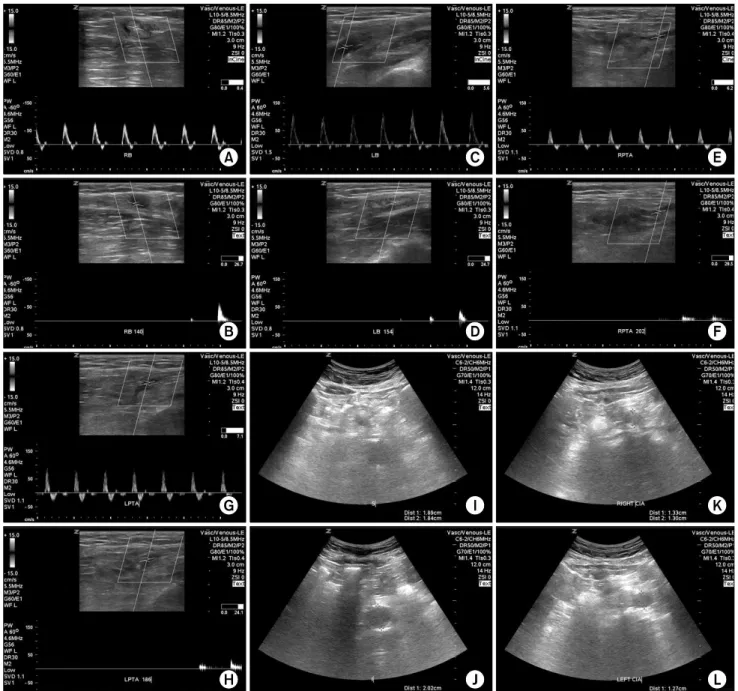
PAD was defined as an ABI lower than 0.9 in either lower extremity (Fig. 1A-H).

After ABI was calculated, DUS was done to evaluate the vascular anatomy or presence of pathology in abdomen. Scanning was started from the Xiphoid process along the course of abdominal aorta. We evaluated the presence of mural thrombus, calcified plaques, or abdominal aortic aneurysm. Scanning was continued to right and left iliac arteries. During the scanning, the maximal diameter of abdominal aorta and bilateral iliac arteries was measured to elucidate the presence of abdominal aortic or iliac arterial aneurysm (Fig. 1I-L).

The demographics and comorbidities were obtained in all patients. The presence of pathology on abdomi- nal aorta and iliac arteries was evaluated. If there was the significant pathology in these vessels to cor- rect, we referred the patients to the department of vascular surgery.

The institutional Review Board of Kyung Hee University Hospital at Gangdong waived the patients’

informed consent because all records were anony-

mized and we surveyed data retrospectively.

(3)

Fig. 1. Standardized protocol. The spectral Doppler waveform and systolic blood pressure were measured at bilateral brachial and posterior tibial arteries. It shows the normal ankle-brachial indeces (right; 202/154 = 1.3, left; 186/154 = 1.2). Duplex scanning was performed to evaluate the presence of pathology in abdominal aorta and iliac arteries. (A–H) Spectral Doppler waveform and systolic blood pressure at each arteries, (I, J) gray-scale images of the abdominal aortra and its diameter, and (K, L) gray-scale images of bilateral common iliac arteries and and its diameter.

RESULTS

During the study period, the ninety-nine patients were included in this study. The mean age was 70.4

± 7.6 years (range, 49-86 years). There were 62 (62.6%) women. The reasons to refer were the suspi-

cious vascular claudication in 20 patients and no pul-

sation on DPA or PTA in 79 patients. Table 1 shows

the detail demographics. Diabetes was the most com-

mon comorbidity. We detected the arterial pathology

in 29 (29.3%) patients: calcified plaques on abdomi-

nal aorta or iliac artery in 21 (72.4%) patients, calci-

(4)

J Surg Ultrasound Vol. 3, No. 2, 2016

Table 1. Demographics of the Patients (N = 99)

Characteristics No. (%) or mean ± SD

Age (years) 70.4 ± 7.6 (49-86)

Sex (male : female) 37 (37.4) : 62 (62.6) Comorbidities

Diabetes 45 (45.4)

Hypertension 11 (11.1)

Cerebrovascular disease 4 (4.0)

COPD 1 (1.0)

Smoking 1 (1.0)

Arterial pathology 29 (29.3)

Calcified plaques on abdominal aorta or iliac artery

21 (72.4)

Calcified plaques on PTA or DPA 6 (20.7) Total occlusion of the iliac artery 1 (3.4)

Abdominal aortic aneurysm 1 (3.4)

COPD = chronic obstructive pulmonary disease; DPA = dorsalis pedis artery; PTA = posterior tibial artery; SD = standard deviation.

Fig. 2. Duplex images and ankle brachial index of the patient with the calcified plaques on abdominal aorta. (A–D) It shows the normal ankle-brachial index (right; 142/130 = 1.1, left; 144/130 = 1.1). (E) Calcified plaque and concomitant acoustic shadowing were shown. (F, G) fied plaques on PTA or DPA in 6 (20.7%) patients, to-

tal occlusion of unilateral iliac artery occlusion in one (3.4%) patient, and abdominal aortic aneurysm in one (3.4%) patient.

The typical patient with calcified plaques on ab- dominal aorta or iliac artery was shown in Fig. 2.

Although there was the calcified plaque on abdominal aorta, the pressure measurement showed the normal ABI because the lesion was not significant. This pa-

tient underwent the spine surgery without any treat- ment for this lesion.

Unilateral common iliac artery occlusion was shown in Fig. 3. The ABI was significantly decreased.

The power Doppler image showed the total occlusion of right common iliac artery. This patient was re- ferred to the division of vascular surgery. Before the spine surgery, the patient underwent the stent placement in right common iliac artery. In spite of the stent placement, the patient symptoms were continued. Therefore, transperitoneal spine surgery was performed after stent placement.

Abdominal aortic aneurysm was seen in one

patient. Fig. 4 showed the gray-scale image of the

abdominal aortic aneurysm, measuring 5.37 × 5.66

cm. The maximal diameter of bilateral common iliac

arteries was increased. In spite of the presence of

abdominal aortic aneurysm, ABI was normal because

there was no steno-occlusive lesion. This patient was

referred to the vascular surgery. The endovascular

abdominal aortic aneurysm repair (EVAR) was done

without any complications. After EVAR, the definite

spine surgery was performed in the same session of

admission.

(5)

Fig. 3. Duplex images and ankle brachial index of the patient with iliac arterial occlusion. (A–D) It shows the decreased ankle-brachial index (right; 42/114 = 0.4, left; 82/114 = 0.7). (E) Normal abdominal aorta, (F) power Doppler image of the total occluison on right common iliac artery, and (G) normal spectral Doppler image of left common iliac artery.

Fig. 4. Duplex images and ankle brachial index of the patient with abdominal aortic aneurysm. (A–D) It shows the normal ankle-brachial index (right; 164/126 = 1.3, left; 144/126 = 1.1). (E) Gay scale image shows the abdominal aortic aneurysm, measuring 5.37 cm × 5.66 cm. (F, G) Gray scale images and diameter measurement show the slightly enlarged bilateral common iliac artereis.

DISCUSSION

There was a variety of arterial pathology in the patients with spine problem. In this study, almost one-third of patients had the arterial problems. The calcified plaques on the abdominal aorta and iliac ar- teries were the most common vascular pathology.

This pathology was not contraindicated to the spine surgery. Therefore, the patients with this pathology

underwent the definite spine surgery. But there were two type of serious pathology such as total occlusion of iliac artery and abdominal aortic aneurysm.

Unless this pathology was evaluated before surgery, the ALIF procedure could not be done with safety.

The CT image can display the vascular pathology and the anatomic data before ALIF procedure.

Inamasu J et al acquired three-dimensional (3-D)

images of the abdominal great vessels pertinent to

(6)

J Surg Ultrasound Vol. 3, No. 2, 2016

the L4-L5 ALIF, and to better define the radiological vascular anatomy.(10) The 3-D images of the ab- dominal great vessels together with the lumbar spi- nal column were reliably depicted. They concluded that the anatomic data obtained using CT image can serve as a versatile tool for preoperative evaluation for the ALIF candidates. The CT image can contribute to the reduction of surgical time and perioperative vascular complications in spite of no paper to eval- uate the incidence of arterial pathology.

Vascular injuries are relatively rare complications ranging from 1.9 to 18% in the literature, with the highest rates being reported in the early 1990s.(11-13) The reported risk factors to increase the vascular in- jury included the current or previous osteomyelitis or discogenic infection, spondylolisthesis, osteophyte formation which is deemed to be an indicator for in- flammatory reaction in the vessel-surrounding area, previous anterior surgery, transitional lumbo-sacral vertebra and cage migration. Interestingly, athero- sclerosis is not a direct contraindication for anterior surgery.(14) But L4/5 or L5/S1 intervertebral ex- posure seems to increase the risk of vascular in- juries, putting the common iliac artery at particular risk in patient shown in Fig. 2.

The incidence of arterial thrombosis is reported to be very low (0.45-0.9%).(15) However, the con- sequences are dramatic. Severe complications like rhabdomyolysis, compartment syndrome with fas- ciotomy, and eventual patient loss can occur if diag- nosis of an embolic event was delayed.(14,16,17).

Most patients had thrombosis of the left common iliac artery. Clinical signs of acute arterial embolism like pain, pulselessness, paresthesia, paralysis or mottle of the leg may have delayed. Preoperative DUS can evaluate the presence of aortic or iliac arterial thrombus.

The presence of abdominal aortic aneurysm can be another concern. The mural thrombus is common finding of the abdominal aortic aneurysm. It can be

expected to develop the two serious complications such as distal embolization and rupture during the ALIF in the patients with abdominal aortic aneurysm.

In this study, there was one patient with abdominal aortic aneurysm. The presence of aneurysm was suc- cessfully evaluated with the preoperative DUS. The patient underwent EVAR, then, spine surgery with- out any complication. There is no general consensus as to whether the primary access surgeon needs to remain present for the entirety of these spine proce- dures or whether the presence of prior EVAR should alter such practices. Ulley et al. reported the first successful anterior spine exposure in a patient un- dergoing ALIF prior EVAR.(18) This strategy might have an advantage such as concomitant treatment of possible cause of all type I and III endoleak with sur- gical ligation at the time of spine exposure. However, it can be more effective and rational to treat all types of endoleak during ALIF after EVAR.

The serious vascular complication is the venous laceration after the retraction of great vessels.(12) The consequences might be dramatic. The massive bleeding and circulatory collapse may inevitable un- less the urgent control was achieved. The DUS might reduce the venous injury due to the elucidation detail vascular anatomy.

CONCLUSION

Preoperative assessment with DUS was simple and useful strategy to evaluate the vascular pathology surrounding the operative fields before ALIF.

One-third of patients had the vascular problem in this study. Further study is needed to analyze its benefit and cost-effectiveness.

CONFLICTS OF INTEREST

None.

(7)

REFERENCES

1. Lane JD Jr, Moore ES Jr. Transperitoneal approach to the intervertebral disc in the lumbar Area. Ann Surg 1948;127:537-51.

2. D'Aliberti G, Talamonti G, Villa F, Debernardi A, Sansalone CV, LaMaida A, et al. Anterior approach to thoracic and lumbar spine lesions: results in 145 con- secutive cases. J Neurosurg Spine 2008;9:466-82.

3. Garg J, Woo K, Hirsch J, Bruffey JD, Dilley RB.

Vascular complications of exposure for anterior lum- bar interbody fusion. J Vasc Surg 2010;51:946-50.

4. Gumbs AA, Bloom ND, Bitan FD, Hanan SH. Open anterior approaches for lumbar spine procedures. Am J Surg 2007;194:98-102.

5. Barrey C, Ene B, Louis-Tisserand G, Montagna P, Perrin G, Simon E. Vascular anatomy in the lumbar spine investigated by three-dimensional computed tomography angiography: the concept of vascular window. World Neurosurg 2013;79:784-91.

6. Inamasu J, Guiot BH. Vascular injury and complica- tion in neurosurgical spine surgery. Acta Neurochir (Wien) 2006;148:375-87.

7. Rajaraman V, Vingan R, Roth P, Heary RF, Conklin L, Jacobs GB. Visceral and vascular complications re- sulting from anterior lumbar interbody fusion. J Neurosurg 1999;91(1 Suppl):60-4.

8. Kulkarni SS, Lowery GL, Ross RE, Ravi Sankar K, Lykomitros V. Arterial complications following ante- rior lumbar interbody fusion: report of eight cases.

Eur Spine J 2003;12:48-54.

9. Capellades J, Pellisé F, Rovira A, Grivé E, Pedraza S, Villanueva C. Magnetic resonance anatomic study of iliocava junction and left iliac vein positions related to L5-S1 disc. Spine (Phila Pa 1976) 2000;25:1695- 700.

10. Inamasu J, Kim DH, Logan L. Three-dimensional computed tomographic anatomy of the abdominal great vessels pertinent to L4-L5 anterior lumbar in- terbody fusion. Minim Invasive Neurosurg 2005;48:

127-31.

11. Brau SA, Delamarter RB, Schiffman ML, Williams LA, Watkins RG. Vascular injury during anterior lumbar surgery. Spine J 2004;4:409-12.

12. Wood KB, Devine J, Fischer D, Dettori JR, Janssen M.

Vascular injury in elective anterior lumbosacral surgery. Spine (Phila Pa 1976) 2010;35(9 Suppl):S66- 75.

13. Bingol H, Cingoz F, Yilmaz AT, Yasar M, Tatar H.

Vascular complications related to lumbar disc surgery.

J Neurosurg 2004;100(3 Suppl Spine):249-53.

14. Brau SA, Delamarter RB, Schiffman ML, Williams LA, Watkins RG. Left iliac artery thrombosis during an- terior lumbar surgery. Ann Vasc Surg 2004;18:48-51.

15. König MA, Leung Y, Jürgens S, MacSweeney S, Boszczyk BM. The routine intra-operative use of pulse oximetry for monitoring can prevent severe thromboembolic complications in anterior surgery.

Eur Spine J 2011;20:2097-102.

16. Marsicano J, Mirovsky Y, Remer S, Bloom N, Neuwirth M. Thrombotic occlusion of the left common iliac artery after an anterior retroperitoneal approach to the lumbar spine. Spine (Phila Pa 1976) 1994;

19:357-9.

17. Hackenberg L, Liljenqvist U, Halm H, Winkelmann W.

Occlusion of the left common iliac artery and consec- utive thromboembolism of the left popliteal artery following anterior lumbar interbody fusion. J Spinal Disord 2001;14:365-8.

18. Ullery BW, Thompson P, Mell MW. Anterior Retrope- ritoneal Spine Exposure following Prior Endovascular Aortic Aneurysm Repair. Ann Vasc Surg 2016;35:

207.e5-9.

수치

Fig. 1. Standardized protocol. The spectral Doppler waveform and systolic blood pressure were measured at bilateral brachial and posterior tibial arteries
Fig. 2. Duplex images and ankle brachial index of the patient with the calcified plaques on abdominal aorta
Fig. 3. Duplex images and ankle brachial index of the patient with iliac arterial occlusion

참조

관련 문서

association management guidelines for adult patients with thyroid nodules and differentiated thyroid can- cer: the American thyroid association guidelines task force on

Among the patients, a total of 30 IGM lesions, including re- current and multifocal lesions, were managed by intralesional triamcinolone injection with or without

Comparative Study between the Wells Score and Ultrasonography Screening Test in Patients Hospitalized with Suspected Deep Vein Thrombosis.. Doosan Baek, Byeongwook

Maintaining patency of vascular access is of great importance in ensuring adequate dialysis in chronic kidney disease patients, and subsequent complications of access represent

In breast cancer surgery, IOUS offers many benefits, including localization of small palpable or non-palpable lesions for patients desiring breast conserving

Pre-operative evaluation of axillary lymph node status in patients with suspected breast cancer using shear wave elastography. Vreugdenburg TD, Willis CD, Mundy

Thyroid Association management guidelines for adult patients with thyroid nodules and differentiated thy- roid cancer: The American Thyroid Association guide- lines task

Our results showed similar resolution rate with others pro- spective study in which after 3 months anticoagulation 42.86% of provoked proximal DVT patients