• 검색 결과가 없습니다.

JSUJournal of Surgical Ultrasound

N/A
N/A
Protected

Academic year: 2021

Share "JSUJournal of Surgical Ultrasound"

Copied!
7
0
0

로드 중.... (전체 텍스트 보기)

전체 글

(1)

Duplex Surveillance after Primary Balloon Angioplasty or Directional Atherectomy for Treating Infrainguinal Arterial Disease

Kyung Pyo Hong, Sungsin Cho, Jin Hyun Joh

Department of Surgery, Kyung Hee University Hospital at Gangdong, Kyung Hee University School of Medicine, Seoul, Korea

Received October 5, 2019 Revised November 18, 2019 Accepted November 26, 2019

Purpose: Percutaneous transluminal angioplasty (PTA) shows an attractive outcome for treating infrainguinal arterial occlusive disease (IAOD). However, this procedure requires repeated revascularization and additional stenting. Directional atherectomy (DA) has been reported to be a modality that requires less frequent use of stenting. The aim of this study was to compare the duplex-based outcomes between PTA and DA for treating IAOD.

Methods: A retrospective review of consecutive patients with IAOD treated with PTA and DA was completed. The demographics and procedural data were obtained. A provisional stent was placed in those cases with flow-limiting dissection and residual stenosis after PTA or DA. Technical success was defined as a residual stenosis < 30%. The primary patency rate was evaluated by performing duplex scanning. The clinical outcomes and frequency of stent placement for each procedure were evaluated. For statistical analysis, the data was ana- lyzed using SPSS 22.0 software (IBM Corp, Chicago, Ill). All P values were considered sig- nificant if less than 0.05.

Results: Seventy-one patients were included in the study. Their mean age was 71.5 ± 10.2 years. The male-to-female ratio was 49:22. Thirty-three patients underwent PTA. DA was performed in 38 patients (42 limbs). Technical success was achieved in all the patients. The duplex-based clinical outcome and limb salvage rate were similar in the two groups. Bailout stent placement was performed in 8 of 33 patients (24.2%) in the PTA group and in no pa- tient in the DA group.

Conclusion: The clinical outcomes were similar for both the DA and primary PTA groups.

Atherectomy reduced the need for bailout stent placement as compared with bailout stent placement in primary PTA.

Keywords: Transluminal angioplasty, Percutaneous atherectomy, Atherosclerosis, Stent, Duplex scan

Correspondence to:

Jin Hyun Joh

Department of Surgery, Kyung Hee University Hospital at Gangdong, Kyung Hee University School of Medicine, 892 Dongnam-ro, Gangdong-gu, Seoul 05278, Korea Tel: +82-2-440-6261

Fax: +82-2-440-6296 E-mail: [email protected]

INTRODUCTION

Infrainguinal arterial occlusive disease (IAOD) is a common vascular problem. It carries the decreased quality of life and possible major limb loss.(1)

Traditionally, the open bypass surgery has been a standard for its treatment. However, a variety of en- dovascular procedure is an increasingly performed for its treatment.(2,3) At many centers, the pre- ferred treatment of infrainguinal occlusive disease J Surg Ultrasound 2019;6:46-52

https://doi.org/10.46268/jsu.2019.6.2.46 JSU Journal of Surgical Ultrasound

(2)

has undergone a paradigm shift from open bypass surgery to endovascular intervention as the first- line therapeutic modality.

The percutaneous transluminal angioplasty (PTA) can be a core of endovascular therapy. PTA can be a definite treatment modality or be performed as an initial procedure for other endovascular procedure.

Although PTA can dilate the steno-occlusive arterial lesion, the plaque itself may be split or fractured, but otherwise does not change significantly in volume or shape.(4) Therefore, PTA showed provisional stent placement rates ranges up to 50%.(5) Although the newer nitinol-self expanding stents have increased conformability and low fracture rates, in-stent restenosis (ISR) remains a common clinical problem, with an estimated rate of 19%-37%.(6,7) Directional atherectomy has been used to treat the infrainguinal PAOD as the strategies ‘NOTHING LEFT BEHIND’.(8) There has not been reported the detailed or com- prehensive strategies that specified the optimal ap- proaches with regard to testing methods after the endovascular revascularization for the IAOD. The Clinical Practice Council of the Society for Vascular Surgery suggested that ankle-brachial index (ABI) and duplex ultrasound (DUS) within the first month to provide a post-treatment baseline and to evaluate for residual stenosis after intervention of IAOD and continued surveillance at 3 months and then every 6 months.(9) The purpose of this study was to compare the clinical outcomes after PTA and DA for IAOD.

METHODS

Consecutive patients from the Kyung Hee University Hospital at Gangdong (Seoul, Korea) were selected during the study period. Written informed consent for the procedure was obtained from all the patients or their families. Each patient had disabling claudication or critical limb ischemia (Rutherford category 2 to 6) and underwent revascularization by

PTA or DA. The patients were retrospectively ana- lyzed using a prospectively collected database.

Demographic and clinical characteristics of the patients were recorded, including comorbidities (hypertension, diabetes, smoking, coronary artery disease, cerebrovascular disease, chronic obstructive pulmonary disease, hyperlipidemia and chronic renal failure), clinical presentation, and the clinical out- comes on last follow‑up. Preoperatively, all patients underwent computed tomography‑angiography (CTA) for the evaluation of lower extremity arterial occlu- sive lesions. Treatment modality was determined by the vascular surgeon based on the CTA images.

All subjects underwent revascularization of target lesions of the femoropopliteal and/or tibial-peroneal arteries with PTA or DA using a DA device. If the DA device could not initially pass through the lesion, pre-dilation was performed to facilitate DA device passage. Adjunctive procedures including PTA was performed per physician discretion; however, if re- sidual stenosis was < 30%, additional post-dilation was not performed.

Technical success for an endovascular procedure

was defined as a patent vessel with < 30% residual

stenosis, following postdilatation with restoration of

rapid antegrade perfusion. Postoperative surveil-

lance was performed in outpatient clinics within one

month and at 3, 6 months and every 6 months

thereafter. Clinical assessments of the femoral and

distal pulses, ABI measurements and DUS were

performed. Primary patency was defined as duplex

ultrasonography measurement of the peak systolic

velocity ratio (PSVR) < 2.5 at the target lesion. The

occlusion of the target lesion was defined as the no

color flow image and no signal by the spectral

Doppler image.The independent t-test for con-

tinuous variables, Fisher’s exact test for categorical

variables, and Log-rank test for patency rate using

SPSS 22.0 software (IBM Corp, Chicago, Ill) were

used for statistical analysis. All P values were

(3)

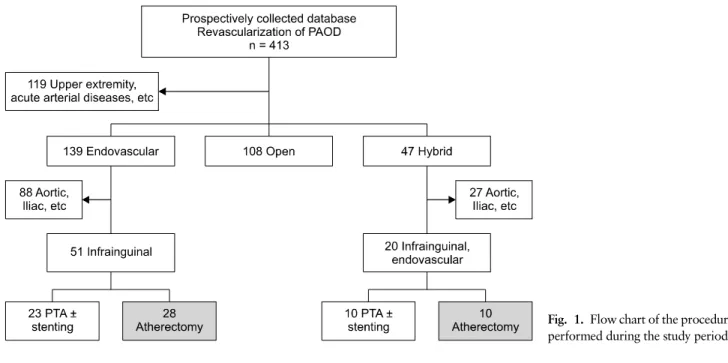
Fig. 1. Flow chart of the procedures performed during the study period.

2-tailed, and P < 0.05 was considered to be statisti- cally significant.

RESULTS

A total of 71 patients were included in the study.

The flow chart for the enrollment of patients was shown in Fig. 1. We analyzed the patients who under- went the endovascular revascularization of IAOD from the prospectively collected database of periph- eral arterial occlusive disease of 413 patients. The patients with upper extremity disease or acute arte- rial disease were excluded. And the aortic and iliac arterial procedures were excluded. Then, the re- maining 71 patients who underwent endovascular procedures for the IAOD were included to this study.

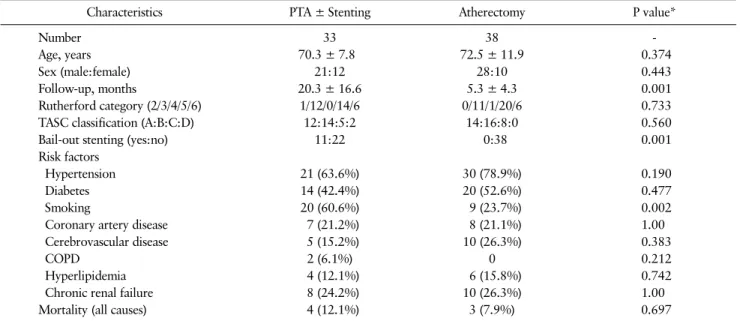
Demographic and preoperative characteristics of the patients are shown in Table 1. The mean age was 70.3 ± 7.8 years in PTA and/or stenting group and 72.5 ± 11.9 years in DA group, respectively. The male‑to‑female ratio was 49:22. The most common indication for revascularization was Rutherford cat- egory V (minor tissue loss) and hypertension was the most common comorbidity in both groups. The length

of follow-up period was significantly longer in PTA group than DA group (20.3 months versus 5.3 months, P = 0.001). The most common anatomic characteristics according to the TASC classification showed the TASC B lesion. Technical success was achieved in all patients. One of interesting point was that there was no case of bail-out stenting in DA group.

The duplex surveillance was performed within one months and at 3, 6 months and every 6 months thereafter. Primary patency rate defined as a peak systolic velocity ratio < 2.4 was shown in Fig. 2.

One-year primary patency rate was 78.1% in PTA group and 89.8% in DA group (P = 0.125). Two-year primary patency rate was 71.6% in PTA group. The primary patency rate according to the lesion length was shown in Fig. 3.

DISCUSSION

We report on the short-term results of a retro-

spective cohort patients with infrainguinal lesions

treated with PTA and DA. Technical success rate was

100%. Although the follow-up period was relatively

(4)

Fig. 2. Primary patency rate measured by duplex scanning of two

groups. PTA = percutaneous transluminal angioplasty. Fig. 3. Primary patency rate measured by duplex scanning depending on the lesion length.

Table 1. Patient Characteristics

Characteristics PTA ± Stenting Atherectomy P value*

Number 33 38 -

Age, years 70.3 ± 7.8 72.5 ± 11.9 0.374

Sex (male:female) 21:12 28:10 0.443

Follow-up, months 20.3 ± 16.6 5.3 ± 4.3 0.001

Rutherford category (2/3/4/5/6) 1/12/0/14/6 0/11/1/20/6 0.733

TASC classification (A:B:C:D) 12:14:5:2 14:16:8:0 0.560

Bail-out stenting (yes:no) 11:22 0:38 0.001

Risk factors

Hypertension 21 (63.6%) 30 (78.9%) 0.190

Diabetes 14 (42.4%) 20 (52.6%) 0.477

Smoking 20 (60.6%) 9 (23.7%) 0.002

Coronary artery disease 7 (21.2%) 8 (21.1%) 1.00

Cerebrovascular disease 5 (15.2%) 10 (26.3%) 0.383

COPD 2 (6.1%) 0 0.212

Hyperlipidemia 4 (12.1%) 6 (15.8%) 0.742

Chronic renal failure 8 (24.2%) 10 (26.3%) 1.00

Mortality (all causes) 4 (12.1%) 3 (7.9%) 0.697

PTA = percutaneous transluminal angioplasty; TASC = transathlantic inter-societal consensus; COPD = chronic obstructive pulmonary disease.

*Statistical analysis was done using independent t-test for comparison of continuous variables and Fisher’s exact test for comparison of nominal variables.

short, the primary patency rate was 78.1% in in PTA group and 89.8% in DA group. In most of cases in DA group, additional ballooning was performed to ach- ieve the better angiographic appearance. Zeller et al .(10) also reported that atherectomy alone in the

majority (96%) of cases was technically successful,

but additional balloon dilation in; 60% of cases

served to visually improve the angiographic appear-

ance of the recanalized artery. Only about 24% re-

quired dilation to achieve primary treatment success.

(5)

From a technical view, the DA catheter could easily be controlled in both antegrade and crossover use, despite wire guidance of the monorail system over only a short distance. The few occasions in which the blade became temporarily locked in the forward posi- tion occurred primarily when the vessel had a bend or turn. For the case of up-and-over technique to cross the aortic bifurcation, this sort of situation occurred.

This problem was managed by the change of sheath with a stiffer sheath such as a 7F Balkin sheath (Cook Inc., Bloomington, IN, USA). The blade could always be easily freed. The atherectomy catheter we tested in this study was limited to lesions with slight degree of calcification because the rotating stainless steel blade did not cut through pure calcium.(10)

One of troublesome complication was the distal embolization at the beginning of our experience. The DEFINITIVE Ca

++

study showed the 2.3% of this complication. They recommended the use of distal embolic protection device.(11) The value of using of embolic protection with atherectomy is controversial and varies by lesion characteristics and disease severity. The presence of embolization has been shown across all endovascular modalities (PTA, stent, laser and atherectomy) using embolic filters (12,13) or by continuous monitoring of the down- stream artery with duplex ultrasound.(14) Furthermore, calcification was shown to increase the risk of clin- ically significant embolism.(15)

DUS is commonly used to evaluate the clinical out- comes or primary patency ate after endovascular procedure of IAOD. Investigators at the University of Pittsburgh Medical Center conducted a retrospective review of 330 limbs that underwent stenting of the superficial femoral artery. These patients were seen in follow-up at 1 month, 3 months, 6 months, and every 6 months thereafter. Follow-up included clin- ical evaluation, ABI measurement, and DUS. Criteria for high-grade restenosis were PSV > 300 cm/s and Vr > 3.5.(16) Shrikhande et al .(17) reported a similar

surveillance protocol with follow-up at 1 month, 3 months, and 6 months and yearly thereafter. They concluded that a PSV > 223 cm/s had both high spe- cificity and sensitivity in the femoropopliteal seg- ment to detect a > 70% stenosis. Using a Vr > 2.5 also identified a high percentage of patients with a

> 70% angiographic stenosis. Bui et al .(18) inves- tigated the natural history of restenosis in the femo- ropopliteal segment after EVT. Ninety-four limbs were entered into a DUS surveillance protocol after EVT, and the mean follow-up was 22 months.

Moderate stenosis was defined by a PSV of 200 to 300 cm/s or a Vr of 2 to 3, and severe stenosis was defined by a PSV > 300 cm/s or a Vr > 3.

The endovascular procedure in the tibial arteries is associated with low patency rates and high reste- nosis rates.(19,20) Saqib et al. (21) reported on the outcomes and predictors of restenosis for EVT of the tibial arteries. A PSV > 300 cm/s and Vr of > 3.5 were used as indicators of severe restenosis. There have been conflicting reports about the utility of DUS after EVT in the tibial arteries, with some authors finding poor correlation to angiographic findings,(17) whereas others have found it to be reliable for sur- veillance after interventions.(22)

Our analysis has several limitations. This is the

retrospective data collection based on administrative

database. Another limitation is short-term fol-

low-up period. Furthermore, this is the relatively

small sample size. Further studies have to examine

the best use of the Silverhawk atherectomy device

regarding long term patency. Potential biases could

have occurred in that clinicians at the practice sites

were aware of the goals of the study and therefore

may have preferentially overenrolled patients with

known PAOD. Also patients with leg symptoms may

have been more willing to participate.

(6)

CONCLUSION

The directional atherectomy is an effective treat- ment modality at 12 months for the patients with IAOD. The procedural success can be achieved with- out a provisional stent placement after DA.

CONFLICTS OF INTEREST

None.

REFERENCES

1. Hirsch AT, Criqui MH, Treat-Jacobson D, Regen- steiner JG, Creager MA, Olin JW, et al. Peripheral arterial disease detection, awareness, and treatment in primary care. JAMA 2001;286:1317-24.

2. Goodney PP, Beck AW, Nagle J, Welch HG, Zwolak RM. National trends in lower extremity bypass sur- gery, endovascular interventions, and major ampu- tations. J Vasc Surg 2009;50:54-60.

3. Park YY, Joh JH, Han SA, Kim SH, Cho S, Park HC, et al. National trends for the treatment of peripheral arterial disease in Korea between 2004 and 2013. Ann Surg Treat Res 2015;89:319-24.

4. Gardiner GA Jr, Bonn J, Sullivan KL. Quantification of elastic recoil after balloon angioplasty in the iliac arteries. J Vasc Interv Radiol 2001;12:1389-93.

5. Shammas NW, Coiner D, Shammas GA, Dippel EJ, Christensen L, Jerin M. Percutaneous lower-ex- tremity arterial interventions with primary balloon angioplasty versus Silverhawk atherectomy and ad- junctive balloon angioplasty: randomized trial. J Vasc Interv Radiol 2011;22:1223-8.

6. Schillinger M, Sabeti S, Loewe C, Dick P, Amighi J, Mlekusch W, et al. Balloon angioplasty versus im- plantation of nitinol stents in the superficial femoral artery. N Engl J Med 2006;354:1879-88.

7. Laird JR, Katzen BT, Scheinert D, Lammer J, Carpenter J, Buchbinder M, et al.; RESILIENT Inves- tigators. Nitinol stent implantation versus balloon angioplasty for lesions in the superficial femoral ar- tery and proximal popliteal artery: twelve-month re- sults from the RESILIENT randomized trial. Circ Cardiovasc Interv 2010;3:267-76.

8. Garcia LA, Lyden SP. Atherectomy for infrainguinal peripheral artery disease. J Endovasc Ther 2009;16(2 Suppl 2):II105-15.

9. Zierler RE, Jordan WD, Lal BK, Mussa F, Leers S, Fulton J, et al. The Society for Vascular Surgery prac- tice guidelines on follow-up after vascular surgery ar-

terial procedures. J Vasc Surg 2018;68:256-84.

10. Zeller T, Rastan A, Schwarzwälder U, Frank U, Bürgelin K, Amantea P, et al. Percutaneous periph- eral atherectomy of femoropopliteal stenoses using a new-generation device: six-month results from a single-center experience. J Endovasc Ther 2004;11:

676-85.

11. Roberts D, Niazi K, Miller W, Krishnan P, Gammon R, Schreiber T, et al. Effective endovascular treatment of calcified femoropopliteal disease with directional atherectomy and distal embolic protection: final re- sults of the DEFINITIVE Ca

++

trial. Catheter Cardiovasc Interv 2014;84:236-44.

12. Shammas NW, Dippel EJ, Coiner D, Shammas GA, Jerin M, Kumar A. Preventing lower extremity distal embolization using embolic filter protection: results of the PROTECT registry. J Endovasc Ther 2008;15:

270-6.

13. Shammas NW, Coiner D, Shammas GA, Christensen L, Dippel EJ, Jerin M. Distal embolic event protection using excimer laser ablation in peripheral vascular interventions: results of the DEEP EMBOLI registry. J Endovasc Ther 2009;16:197-202.

14. Lam RC, Shah S, Faries PL, McKinsey JF, Kent KC, Morrissey NJ. Incidence and clinical significance of distal embolization during percutaneous interventions involving the superficial femoral artery. J Vasc Surg 2007;46:1155-9.

15. Davies MG, Bismuth J, Saad WE, Naoum JJ, Mohiuddin IT, Peden EK, et al. Implications of in situ thrombosis and distal embolization during superficial femoral artery endoluminal intervention. Ann Vasc Surg 2010;24:14-22.

16. Baril DT, Rhee RY, Kim J, Makaroun MS, Chaer RA, Marone LK. Duplex criteria for determination of in-stent stenosis after angioplasty and stenting of the superficial femoral artery. J Vasc Surg 2009;49:

133-8; discussion 139.

17. Shrikhande GV, Graham AR, Aparajita R, Gallagher KA, Morrissey NJ, McKinsey JF, et al. Determining criteria for predicting stenosis with ultrasound duplex after endovascular intervention in infrainguinal lesions. Ann Vasc Surg 2011;25:454-60.

18. Bui TD, Mills JL Sr, Ihnat DM, Gruessner AC, Goshima KR, Hughes JD. The natural history of du- plex-detected stenosis after femoropopliteal endo- vascular therapy suggests questionable clinical utility of routine duplex surveillance. J Vasc Surg 2012;55:

346-52.

19. Smolock CJ, Anaya-Ayala JE, Kaufman Y, Bavare CS, Patel MS, El-Sayed HF, et al. Current efficacy of open and endovascular interventions for advanced su- perficial femoral artery occlusive disease. J Vasc Surg 2013;58:1267-75.e1-2.

20. Graziani L, Piaggesi A. Indications and clinical out-

comes for below knee endovascular therapy: review

(7)

article. Catheter Cardiovasc Interv 2010;75:433-43.

21. Saqib NU, Domenick N, Cho JS, Marone L, Leers S, Makaroun MS, et al. Predictors and outcomes of restenosis following tibial artery endovascular inter- ventions for critical limb ischemia. J Vasc Surg

2013;57:692-9.

22. Fernandez N, McEnaney R, Marone LK, Rhee RY,

Leers S, Makaroun M, et al. Predictors of failure and

success of tibial interventions for critical limb

ischemia. J Vasc Surg 2010;52:834-42.

수치

Fig. 1. Flow chart of the procedures  performed during the study period.
Fig. 2. Primary patency rate measured by duplex scanning of two

참조

관련 문서

 Figuring out the dynamics involved in highway operations including tradeoffs among toll charges, service level,. volume of traffic,

Should a module be used with any of the absolute maximum ratings exceeded, the characteristics of the module may not be recovered, or in an extreme case, the module

 Switching allophones of different phonemes will change the meaning of the word or result in a nonsense word: [skIt] and [stIt] do not mean 'spit'..  Different languages

• The molar volume at given pressure and temperature can be calculated by solving the equation of state or the cubic equation for V. • Compared to the Z equations

3) A comparison of the stoichiometric equation with the experimental kinetic expression can suggest whether or not we are dealing with an elementary reaction. 4) If one

All disputes, controversies, or differences which may arise between the parties out of or in relation to or in connection with this contract, or for the breach thereof,

No part of this publication may be reproduced, stored in a retrieval system, or transmitted in any form or by any means — electronic, mechanical, photocopying, recording,

Additional reasons which may result in the termination of the development, launch or operation of the Platform includes, but is not limited to, (aa) an unfavorable fluctuation