• 검색 결과가 없습니다.

JSUJournal of Surgical Ultrasound

N/A
N/A
Protected

Academic year: 2021

Share "JSUJournal of Surgical Ultrasound"

Copied!
5
0
0

로드 중.... (전체 텍스트 보기)

전체 글

(1)

Evaluation of the Femoral Artery IMT as a Risk Factor of Cardiovascular Disease

KyoungJea Lee, Teahyeon Kong, Keun-Myoung Park, Yong Sun Jeon

1

, Soon Gu Cho

1

, Kee Chun Hong Departments of Surgery and

1

Radiology, Inha University Hospital, Incehon, Korea

Received September 15, 2019 Revised October 9, 2019 Accepted October 14, 2019

Purpose: The carotid artery intima-media thickness (IMT) is a risk factor for atherosclerosis that can predict the association of cardiovascular disease. Despite this, there have been few studies on the femoral artery IMT. This study examined the correlation between the carotid and femoral IMT. The findings suggest that both the carotid and femoral IMT need to be measured for a proper evaluation of early arterial disease.

Methods: This retrospective study included 39 patients who underwent carotid artery du- plex, lower extremity duplex, and coronary artery angiography or CT for a health checkup in the authors’ health promotion center from January 2015 to December 2017. The carotid and femoral IMT were measured at three places from bifurcation using B-mode. The coro- nary artery disease (CAD), carotid artery stenosis (CAS), and peripheral artery occlusive dis- ease (PAD) were defined by stenosis over 50% in duplex and CT angiogram. The maximum and sum of the IMT in both the arterial disease group and no arterial disease group were compared.

Results: This study included 25 patients with arterial diseases from 39 enrolled patients 22 patients with CAD (51.2%), eight patients with CAS (20.5%), and seven patients with PAOD (17.9%). The total arterial disease including any one of the above three arterial dis- eases correlated with the maximum values of the femoral IMT (R = 0.322, P = 0.023) and the sum of the femoral IMT (R = 0.346, P = 0.015).

Conclusion: The femoral artery IMT correlated with the carotid artery IMT. In addition, the femoral artery IMT correlated with the occurrence of total arterial disease, including coro- nary, carotid, and peripheral artery occlusive disease, but the correlation was lower than that of the carotid IMT.

Keywords: Femoral artery, Intima media thickness (IMT), Cardiovascular disease

Correspondence to:

Keun-Myoung Park

Department of Surgery, Inha uni- versity Hospital, 27 Inhang-ro, Jung-gu, Incheon 22332, Korea Tel: +82-32-890-2738 Fax: +82-32-890-3549 E-mail: [email protected]

INTRODUCTION

Atherosclerosis is known to be a complex in- flammatory process of vascular cells by risk factors of cardiovascular disease such as diabetes or hypertension.(1) The atherosclerotic atheroma thus formed causes rupture and thrombosis leading to acute myocardial infarction or stroke. Atherosclerosis

is a major cause of cardiovascular disease, peripheral vascular disease, and cerebrovascular disease.(2)

Using a B-mode (Brightness mode) of the ultra- sound imaging system, atherosclerosis and vascular status can be easily confirmed by ultrasonography.

Carotid IMT (Intima-media Thickness) is a clinical prognostic factor using an easily accessible and non-invasive ultrasound imaging system. The role of J Surg Ultrasound 2019;6:53-57

https://doi.org/10.46268/jsu.2019.6.2.53 JSU Journal of Surgical Ultrasound

(2)

carotid IMT in coronary artery stenosis has been proven in various studies over the last several decades.(3)

However, if atherosclerosis of the femoral artery is expressed more frequently than the carotid ar- tery,(4) the measurement of intimal-medial thick- ness using only carotid artery may be misdiagnosed as asymptomatic atherosclerosis as a predictor of atherosclerosis or cardiovascular disease.(5) In ad- dition, during carotid ultrasound examination, the internal carotid artery and the external carotid ar- tery were not anatomic in all patients and the femoral artery test was more reproducible.(6) Femoral artery IMT is associated with atherosclerosis of the coro- nary arteries, as well as carotid IMT. It is also asso- ciated with cardiovascular mortality and myocardial infarction and is a predictor of cardiovascular disease.(6) In order to better define the IMT cut-off value of cardiovascular disease, it is recommended that a combination of carotid IMT and femoral artery IMT be measured.(7)

We investigated whether carotid IMT and femoral artery IMT as a screening test were useful factors for the detection of cardiovascular disease by using each factor or its sum and maximum value.

METHODS

From January 2015 to December 2017, we con- ducted a study at a university hospital. The subjects were healthy adults who visited the health promotion center and ultrasound examination of carotid artery and femoral artery was performed. A total of 39 pa- tients who underwent coronary angiography or coro- nary artery CT angiogram ere studied. This study was approved by the Institutional Bioethics Committee (INHA IRB2016-07-001).

A total of 39 examinees were identified through questionnaires prepared at the Health Promotion Center and pre interview information. Based on

medical records, electronic medical records, and pa- perwork, the results were as follows: the presence of hypertension, presence of diabetes mellitus, pres- ence of hyperlipidemia, and waist circumference, systolic and diastolic blood pressure, fasting blood glucose, cholesterol, high density lipoprotein (HDL), low density lipoprotein (LDL), triglyceride. Metabolic syndrome is based on electronic medical record. The waist circumference is more than 90 cm for males, more than 85 cm for females, more than 150 mg/dl for triglycerides, less than 40 mg/dl for men and 50 mg/dl for women, more than 100 mg/dl of fasting glucose and we defined the metabolic syndrome as having three or more of these.

The ultrasound imaging device was a single device, Z.ONE (Zonare medical systems Inc., USA). We used a 5–15 MHz linear probe as transducer. The test was performed by a trained One Vascular Technologist (RVT).

In this study, we defined carotid artery stenosis (CAS) and peripheral artery disease (PAD) is defined as increased peak systolic velocity (PSV > 150 cm/s) or diminished PSV (< 45 cm/s) distal to the stenotic lesion with over 50% stenotic lesion. The coronary artery stenosis was defined by stenosis over 50% in 3D CT angiogram. Thirty one of 39 patients under- went coronary artery 3D CTA and 8 patients under- went coronary angiography.

In this study, SPSS statistics ver. 20 (IBM, USA) were used. The patients were classified as total arte- rial disease of at least one arterial disease among three arterial diseases and no arterial disease group.

The chi-square and T test was used to compare the characteristics between two groups. We also per- formed the correlation analysis between maximum and sum of both IMT with total arterial disease.

RESULTS

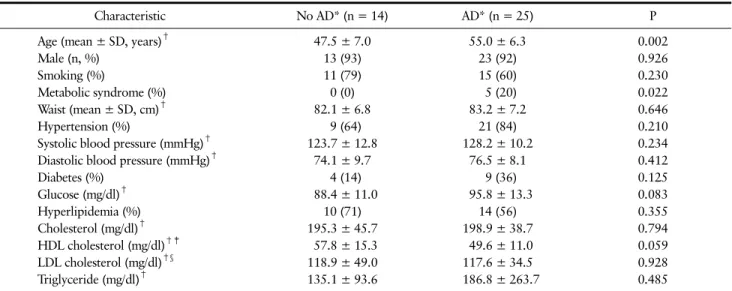
There were 25 patients with arterial diseases in 39

(3)

Table 1. Characteristic of the Study Population for with or without Total Arterial Disease Separately

Characteristic No AD* (n = 14) AD* (n = 25) P

Age (mean ± SD, years)

47.5 ± 7.0 55.0 ± 6.3 0.002

Male (n, %) 13 (93) 23 (92) 0.926

Smoking (%) 11 (79) 15 (60) 0.230

Metabolic syndrome (%) 0 (0) 5 (20) 0.022

Waist (mean ± SD, cm)

82.1 ± 6.8 83.2 ± 7.2 0.646

Hypertension (%) 9 (64) 21 (84) 0.210

Systolic blood pressure (mmHg)

123.7 ± 12.8 128.2 ± 10.2 0.234

Diastolic blood pressure (mmHg)

74.1 ± 9.7 76.5 ± 8.1 0.412

Diabetes (%) 4 (14) 9 (36) 0.125

Glucose (mg/dl)

88.4 ± 11.0 95.8 ± 13.3 0.083

Hyperlipidemia (%) 10 (71) 14 (56) 0.355

Cholesterol (mg/dl)

195.3 ± 45.7 198.9 ± 38.7 0.794

HDL cholesterol (mg/dl)

†‡

57.8 ± 15.3 49.6 ± 11.0 0.059

LDL cholesterol (mg/dl)

†§

118.9 ± 49.0 117.6 ± 34.5 0.928

Triglyceride (mg/dl)

135.1 ± 93.6 186.8 ± 263.7 0.485

*AD = Arterial Disease,

Mean ± standard deviation,

HDL = High density lipoprotein,

§

LDL = Low density lipoprotein.

Table 2. IMT Analysis of with and without Total Arterial Disease

IMT* (mm) No AD

(n = 14) AD

(n = 25) t P

Carotid maximum

0.707 ± 0.121 0.824 ± 0.148 -2.518 0.016

Femoral maximum

0.543 ± 0.041 0.624 ± 0.123 -2.134 0.039

Carotid sum

1.307 ± 0.209 1.520 ± 0.275 -2.509 0.017

Femoral sum

0.979 ± 0.153 1.132 ± 0.216 -2.348 0.024

IMT* average

0.579 ± 0.058 0.660 ± 0.100 -3.220 0.003

*IMT = Intima-media Thickness,

tAD = Total Arterial Disease,

Mean ± standard deviation.

enrolled patients. There were 22 patients with coro- nary artery disease, 8 patients with carotid artery disease and 7 patients with peripheral artery disease. There were older and more metabolic syn- dromes in arterial disaes group comparing no arte- rial disease group (Table 1).

There was a significant difference between any ar- terial disease groups and no arterial groups in the any values of both the carotid artery and femoral ar- tery IMT (Table 2).

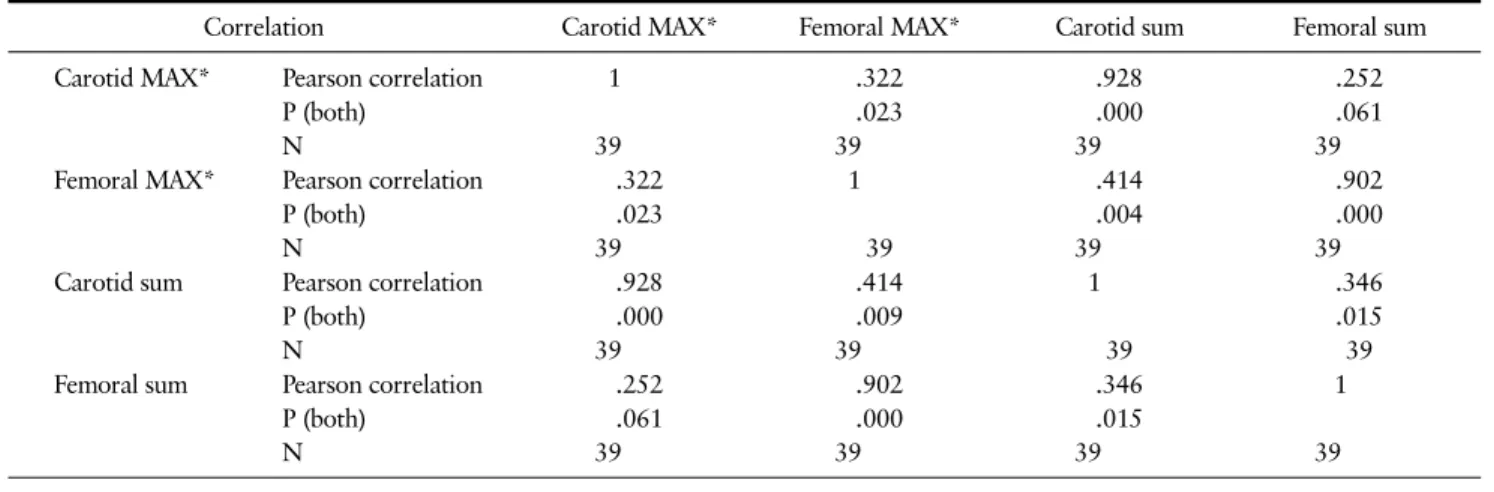
There was a significant correlation between all value of carotid IMT and femoral artery IMT except the maximum of the carotid IMT and the sum of the femoral artery IMT (Table 3). The maximum values of carotid IMT was correlative with maximum values of the femoral IMT (R = 0.322, P = 0.023) and the sum

of carotid IMT was also correlative sum of femoral IMT (R = 0.346, P = 0.015) (Fig. 1).

DISCUSSION

The carotid IMT was relatively simple because of the absence of fasting or contrast media, and it was found to be highly correlated with high mortality ar- terial disease such as cardiovascular disease and cerebrovascular disease.(8) In the past several deca- des, various studies have confirmed the association between carotid IMT and cardiovascular disease, and carotid IMT has been used as an independent pre- dictor of vascular disease as an independent factor.

However, the internal carotid artery and the ex-

ternal carotid artery are difficult to perform in all

(4)

Fig. 1. The relation between femoral artery IMT and carotid artery IMT. The maximum of femoral artery IMT is correlative with that of carotid artery IMT (A, P = 0.023), The sumof femoral artery IMT is correlative with that of carotid artery IMT (B, P = 0.015).

Table 3. Correlation Coefficient of Catorid Intima-media Thickness (IMT) and Femoral IMT

Correlation Carotid MAX* Femoral MAX* Carotid sum Femoral sum

Carotid MAX* Pearson correlation 1 .322 .928 .252

P (both) .023 .000 .061

N 39 39 39 39

Femoral MAX* Pearson correlation .322 1 .414 .902

P (both) .023 .004 .000

N 39 39 39 39

Carotid sum Pearson correlation .928 .414 1 .346

P (both) .000 .009 .015

N 39 39 39 39

Femoral sum Pearson correlation .252 .902 .346 1

P (both) .061 .000 .015

N 39 39 39 39

*MAX = Maximum.

patients due to the anatomic structure during carotid ultrasound examination, so that the reproducibility of the test is less accurate than that of the femoral artery.(6) This may lead to errors in the location of the IMT measurement of the carotid artery because the branches cann’t be observed accurately. In addi- tion, the carotid artery may cause vascular bending due to an increase in age, and the IMT may be changed by the examiner. The direction of the femo- ral artery mainly run straight, and the IMT was measured at the distal portion of the femoral artery, which is the most commonly used puncture site for

angiography. For this reason, few studies have re- ported the use of IMT of the carotid artery and femo- ral artery, or IMT of the femoral artery alone as pre- dictors of arterial disease.(9) Ultrasound imaging of femoral arteries is cost-effective, non-invasive and reproducible method of assessment comparing car- otid arteries but there is some concern regarding the difficulty of the examination of femoral artery, es- pecially in overweight patients.(7)

The correlation between the IMT of the carotid ar-

tery and the femoral artery was correlated with

Framingham heart study risk values when combined

(5)

with each other.(10) There was a strong correlation between the femoral artery IMT and moderate CAD expressed in Gensini numbers.(9)

As mentioned above, studies on IMT, athero- sclerosis and arterial disease have been studied for many years since the 1980’s, and the research is still underway. Based on these various studies, we ana- lyzed the correlation between carotid artery disease, peripheral arterial disease and total arterial disease as well as coronary artery disease which has under- gone study about correlations of IMT of carotid artery and femoral artery.

In our study with patients with arterial disease with at least one of the three arterial diseases, the maximum value and sum of IMT of both carotid ar- teries and femoral arteries were analyzed. Though this study carried out on a small number of patients that visited health promotion center, there was a significant difference in all IMT between the patients with three arterial disease and those without arterial disease. There is strong evidence suggesting angio- graphic finding arterial disease with large sample size is correlated with femoral IMT. Furthermore, the authors consider that a follow-up study of the pa- tients could bring more information about the pro- gression of arterial disease and might link the femo- ral arterial ultrasonographic finding to arterial dis- ease such as carotid arterial plaque.

The maximum and the sum of carotid artery and femoral artery IMT were significant factors in evalu- ating the early arterial disease.

CONCLUSION

The IMT of the carotid artery and the femoral ar- tery were closely correlated with each other. The maximum values and sum of IMT of the carotid artery

and femoral artery were significantly correlated with each other. Therefore, it may be necessary to addi- tionally examine the IMT of femoral artery as pre- dictors of early arterial disease like carotid IMT.

REFERENCES

1. Ross R. Atherosclerosis is an inflammatory disease.

Am Heart J 1999;138:S419-20.

2. Beckman JA, Creager MA, Libby P. Diabetes and atherosclerosis: epidemiology, pathophysiology, and management. JAMA 2002;287:2570-81.

3. Craven TE, Ryu JE, Espeland MA, Kahl FR, McKinney WM, Toole JF, et al. Evaluation of the associations between carotid artery atherosclerosis and coronary artery stenosis. A case-control study. Circulation 1990;82:1230-42.

4. Kröger K, Kucharczik A, Hirche H, Rudofsky G.

Atherosclerotic lesions are more frequent in femoral arteries than in carotid arteries independent of in- creasing number of risk factors. Angiology 1999;50:

649-54.

5. Lucatelli P, Fagnani C, Tarnoki AD, Tarnoki DL, Stazi MA, Salemi M, et al. Femoral artery ultrasound examination. Angiology 2017;68:257-65.

6. Sosnowski C, Pasierski T, Janeczko-Sosnowska E, Szulczyk A, Dabrowski R, Woźniak J, et al. Femoral rather than carotid artery ultrasound imaging pre- dicts extent and severity of coronary artery disease.

Kardiol Pol 2007;65:760-6; discussion 767-8.

7. Bernetti M, Abbate R, Cerini G, Gensini GF, Poggesi L, Boddi M. [Carotid and femoral intima-media thickness as an early atherosclerotic marker. advan- tages and limits]. G Ital Cardiol (Rome) 2011;12:

72-81. Italian.

8. Johnsen SH, Mathiesen EB. Carotid plaque compared with intima-media thickness as a predictor of coro- nary and cerebrovascular disease. Curr Cardiol Rep 2009;11:21-7.

9. Kirhmajer MV, Banfic L, Vojkovic M, Strozzi M, Bulum J, Miovski Z. Correlation of femoral in- tima-media thickness and the severity of coronary artery disease. Angiology 2011;62:134-9.

10. Kieltyka L, Urbina EM, Tang R, Bond MG, Srinivasan SR, Berenson GS. Framingham risk score is related to carotid artery intima-media thickness in both white and black young adults: the Bogalusa heart study.

Atherosclerosis 2003;170:125-30.

수치

Table 1. Characteristic of the Study Population for with or without Total Arterial Disease Separately
Table 3. Correlation Coefficient of Catorid Intima-media Thickness (IMT) and Femoral IMT

참조

관련 문서

The gall- bladder and bile duct were still filled with contrast medium despite 3 days after ERCP (Fig. 2A) and gallbladder wall thick- ness measuring 4.8 mm, gallbladder