45(2) : 113∼ 120 (2014)
113
LC-MS/MS 를 이용한 藿香正氣散 추출물 중 20종 성분의 함량분석
서창섭·신현규*
한국한의학연구원 한약방제연구그룹
Quantitative Analysis of the Twenty Marker Components in Gwakhyangjeonggi-san using Ultra-Performance Liquid
Chromatography with Mass Spectrometer
Chang-Seob Seo and Hyeun-Kyoo Shin*
Herbal Medicine Formulation Research Group, Korea Institute of Oriental Medicine, 1672 Yuseong-daero, Yuseong-gu, Daejeon 305-811, Korea
Abstract − Generally, Gwakhyangjeonggi-san has been used for treatment of diarrhea-predominant irritable bowel syndrome.
In this study, an ultra-performance liquid chromatography-electrospray ionization-mass spectrometer method was established for the simultaneous quantification of marker compounds 1-20 in Gwakhyangjeonggi-san water extract. All analytes were sep- arated by gradient elution using two mobile phases on a UPLC BEH C18 (100×2.1 mm, 1.7µm) column and maintained at 45oC. The injection volume was 2.0µL and the flow rate was 0.3 mL/min with detection at mass spectrometer. Regression equations of the compounds 1-20 were acquired with r2 values ≥ 0.9950. The values of limit of detection and quantification of all analytes were 0.01-2.79 ng/mL and 0.03-8.37 ng/mL, respectively. The amounts of the compounds 1-20 in Gwa- khyangjeonggi-san water extract were not detected -3,236.67µg/g. The established LC-MS/MS methods will be valuable to improve quality control of traditional herbal formula, Gwakhyangjeonggi-san.
Key words − Gwakhyangjeonggi-san, Quantitative analysis, LC-MS/MS
藿香正氣散은 宋대 陳師文의『太平惠民和劑局方』에 최 초로 수록된 처방으로 藿香(Agastachis Herba), 紫蘇葉 (Perillae Folium), 白芷(Angelicae Dahuricae Radix), 大腹皮 (Arecae Pericarpium), 白茯 (Poria), 厚朴(Magnoliae Cortex), 白朮(Atractylodis Rhizoma Alba), 陳皮(Citri Unshius Pericarpium), 半夏(Perillae Tuber), 桔梗(Platy- codonis Radix), 甘草(Glycyrrhizae Radix et Rhizoma), 生薑 (Zingiberis Rhizoma Crudus) 및 大棗(Zizyphi Fructus) 등 13종의 한약재로 구성되어 있으며, 傷寒으로 인한 두통, 오 한, 발열, 기침, 소화불량, 체증, 설사, 복명 등 傷寒症에 사 용되는 처방으로 알려져 있으나, 실제로는 토사, 설사, 곽란, 복통, 어지러움, 허로 등에 주로 사용되었다.1-4)
본 처방은 김과 이5)가 뇌허혈 후 藿香正氣散이 신경세포 손상에 미치는 영향에 대해 조사한 실험적 연구와 급성 중 풍 환자와 만성설사환자에 대한 藿香正氣散의 효과6,7)및 소
아 간질 환자와 전염성 연속종(molluscum contagiosum) 환 자에게 加味藿香正氣散의 효과8,9) 등에 대한 증례보고가 보 고되었다.
藿香正氣散에 대한 이화학적 연구는 Wang 등10)과 Han 등11)이 본 처방의 구성 생약인 후박의 honokiol과 magnolol 에 대하여 HPLC와 capillary electrophoresis를 이용하여 함 량 분석을 실시하였으며, Li 등12)은 곽향정기수에서 liquiritin, naringin, hesperidin, thymol, imperatorin, honokiol, isoim- peratorin 및 magnolol 등의 주요 성분에 대하여 HPLC를 이 용하여 분석한 결과가 보고되었다. 그러나 이러한 연구 결 과들은 藿香正氣散을 이루는 일부 구성 생약의 성분에 대 해서만 분석이 이루어진 한계점을 가지고 있다. 따라서 본 연구자들은 藿香正氣散을 구성하는 생약의 주요 성분, 즉 藿香의 rosmarinic acid(8), 紫蘇葉의 luteolin(10), 白芷의 imperatorin(16), 大腹皮의 (+)-catechin(2)과 (-)-epicatechin(3), 厚朴의 honokiol(17)과 magnolol(19), 白朮의 atractylenolide III(15), atractylenolide II(18) 및 atractylenolide I(20), 陳皮
*교신저자(E-mail):[email protected] (Tel): +82-42-868-9464
glycyrrhizin(13), 大棗의 spinosin(5) 및 生薑의 6-gingerol (14) 등 20종 성분에 대하여 electrospray ionization(ESI) 방 식의 질량분석기가 결합된 초고성능 액체크로마토그래피 (ultra-performance liquid chromatography-mass spectrometer;
UPLC-MS)를 이용하여 분석함으로써 한약 처방의 품질관 리에 대한 기초 자료를 제공하고자 본 연구를 실시하였다.
재료 및 방법
실험재료 − 본 실험에 사용된 藿香正氣散을 구성하는 13 종의 구성 생약은 모두 광명당제약(Ulsan, Korea)에서 구입 하여 동국대학교 이제현 교수(Gyeongju, Korea)로부터 감정 후 사용하였다. 藿香正氣散 구성 생약들의 표본(2012-KE32- 1~KE32-13)은 한국한의학연구원 한약방제연구그룹에 보관 하였다.
시약 및 기기 −본 연구에 사용된 표준물질인 homogentisic acid, 3,4-dihdroxybenzaldehyde 및 rosmarinic acid는 Sigma-Aldrich(St. Louis, MO, USA)에서 구입하였으며, (+)- catechin, (-)-epicatechin, spinosin, hesperidin, liquiritigenin, luteolin 및 platycodin D2는 Chengdu Biopurify Phyto- chemicals(Chengdu, China)에서 구입하였다. Liquiritin, glycyrrhizin 및 6-gingerol은 Wako(Osaka, Japan), platycodin D, honokiol 및 magnolol은 ChemFaces(Wuhan, China) 및 atractylenolide I, atractylenolide II, atractylenolide III 및 imperatorin은 KOC Biotech(Daejeon, Korea)에서 각각 구입 하여 사용하였다. 이들 표준물질의 순도는 모두 97.0%이었
20종의 성분 분리를 위해 pump, digasser, column oven 및 autosampler로 구성된 Waters의 ACQUITY UPLC(Milford, MA, USA)를 사용하였으며, 질량분석기는 ESI source가 장 착된 탠덤 사중극자 질량분석기(ACQUITY TQD LC-MS/
MS, Waters, Milford, MA, USA)를 사용하여 분석하였다.
데이터는 Waters MassLynx software(version 4.1, Milford, MA, USA)를 사용하여 수집 및 처리하였다.
藿香正氣散 물 추출물 조제 − Table I과 같이 구성되는 藿 香正氣散 물 추출물을 조제하기 위하여 13종 한약재 약 5.0 kg(33.75 g×148)을 분쇄한 후 10배수의 물을 넣어 초고속진 공저온추출기(Cosmos 660, Kyungseo Machine Co., Incheon, Korea)를 이용하여 100oC에서 2시간 전탕 한 후 표준체(No. 270, 53 µm, Chung Gye Sang Gong Sa, Seoul, Korea)를 이용하여 여과한 후 동결건조기(PVTFD100R, IlShinBioBase, Dongduchun, Korea)를 사용하여 동결 건조 하였다. 동결 건조 결과 644.5 g(수득율 12.9%)의 추출물을 얻었다.
표준액의 조제 − 藿香正氣散 구성 생약의 주요 성분들인 20종의 표준물질에 대한 표준용액은 1.0 mg/mL의 농도로 메탄올에 녹여 조제하였으며, 4oC에 보관하면서 사용 전에 희석하여 사용하였다.
검액의 조제 − LC-MS/MS 정량분석을 위하여 동결 건조 된 藿香正氣散 물 추출물100 mg을 정확히 취한 후 물을 넣 어 5 mL로 맞춘 후 5분간 초음파 추출하였다. 그 후 추출 액 100 µL를 물을 이용하여 10 mL로 100배 희석한 후 0.22µm 멤브레인 여과하여 검액으로 하였다.
Table I. Composition of Gwakhyangjeonggi-san
Scientific name Herbal medicine Original region Amount(g)
Agastache rugosa (Fischer et Meyer) O. Kuntze Agastachis Herba Andong, Korea 5.625 Perilla frutescens Britton var. crispa Decaisne Perillae Folium Yeongcheon, Korea 3.750 Angelica dahurica Bentham et Hooker f. Angelicae Dahuricae Radix Uljin, Korea 1.875
Areca catechu Linné Arecae Pericarpium China 1.875
Poria cocos Wolf Poria Pyeongchang, Korea 1.875
Magnolia officinalis Rehder et Wilson Magnoliae Cortex China 1.875
Atractylodes macrocephala Koidzumi Atractylodis Rhizoma Alba China 1.875 Citrus unshiu Markovich Citri Unshius Pericarpium Jeju, Korea 1.875
Pinellia ternata Breitenbach Pinelliae Tuber China 1.875
Platycodon grandiflorum A. De Candolle Platycodonis Radix Andong, Korea 1.875 Glycyrrhiza uralensis Fisch. Glycyrrhizae Radix et Rhizoma China 1.875 Ziziphus jujuba var. inermis Rehder Zizyphi Fructus Yeongcheon, Korea 3.750 Zingiber officinale Roscoe Zingiberis Rhizoma Crudus Ulsan, Korea 3.750
Total amount(g) 33.750
Fig. 1. Chemical structures of 20 marker compounds of Gwakhyangjeonggi-san.
Table II. Conditions for LC-MS/MS analysis of Gwakhyangjeonggi-san HPLC condition
Column ACQUITY UPLC BEH C18(100×2.1 mm, 1.7µm)
Flow rate 0.3 mL/min
Injection volume 2.0µL
Column temperature 45oC
Sample temperature 5oC
Mobile phase
MS condition
Capillary voltage(kV) 3.3
Extract voltage(V) 3.0
Source temperature(°C) 120
RF lens(V) 0.3
Desolvation temperature(°C) 300
Desolvation gas(L/h) 600
Cone gas(L/h) 50
Collision gas(mL/min) 0.14
10.1% (v/v) formic acid in water
2Acetonitrile
Time(min) A(%)1 B(%)2
0 80 20
0.1 80 20
14.0 5 95
15.0 0 100
15.1 80 20
18.1 80 20
사용하여 분석하였다. 성분의 분리를 위하여 ACQUITY UPLC BEH C18(2.1×100.0 mm, 1.7µm) 칼럼을 사용하였으 며, 이동상은 0.1% 개미산이 함유된 물과 아세토나이트릴 을 사용하여 기울기 용매 조건으로 흘려주었다(Table II). 칼 럼은 45oC를 유지하였으며, 유속은 분당 0.3 mL 및 주입량 은 2.0 µL였다. 또한 정량분석을 위하여 ACQUITY TQD MS를 사용하여 양이온과 음이온 모드에서 검출하였다. 최 적의 검출을 위해 3.3 kV의 capillary voltage, 3 V의 extract voltage, 120oC의 source temperature, 0.3 V의 RF lens, 300oC의 desolvation temperature, 600 L/h의 desolvation gas, 50 L/h의 cone gas 및 0.14 mL/min의 collision gas 등 (Table II)과 각 성분의 precuusor ion, product ion, cone voltage 및 collision energy 등에 대한 최적의 조건을 Table III과 같이 설정하여 다중반응탐색법(multiple reaction monitoring; MRM) 모드를 적용하여 정량을 실시하였다.
검량선 작성 − 20종의 표준품에 대한 검량선은 10, 50, 100 및 500 ng/mL의 농도로 작성하였으며, 작성된 검량선 의 직선성은 상관계수(r2)를 구하여 판단하였다. 검출한계와 정량한계는 신호 대 잡음 비인 3과 10으로 계산하였다.
요 성분인 rosmarinic acid(Agastachis Herba), luteolin (Perillae Folium), imperatorin(Angelicae Dahuricae Radix), (+)-catechin과 (-)-epicatechin(Arecae Pericarpium), pachymic acid(Poria), honokiol과 magnolol(Magnoliae Cortex), atractylenolide I, atractylenolie II 및 atractylenolide III (Atractylodis Rhizoma Alba), hesperidin(Citri Unshius Pericarpium), homogentisic acid와 3,4-dihydroxybenzaldehyde (Pinelliae Tuber), platycodin D와 platycodin D2(Platycodonis Radix), liquiritin, liquiritigenin 및 glycyrrhizin(Glycyrrhizae Radix et Rhizoma), 6-gingerol(Zingiberis Rhizoma Crudus) 및 spinosin(Zizyphi Fructus) 등 21종에 대하여 LC-MS/MS 를 이용하여 선택성과 감도가 우수한 MRM 방법으로 함량 분석을 실시하였다. ACQUITY TQD LC-MS/MS를 이용하 여 ESI 방법의 MRM모드를 이용하여 물(A)과 아세토나이 트릴(B)의 이동상으로 성분의 분리 및 검출을 실시하였다.
또한 꼬리 끌림 현상을 줄이고 MS 검출 시 이온의 검출 감 도를 높이고자 이동상 A에 0.1%(v/v) 개미산을 추가하여 분 석을 실시하였다. 이러한 조건을 토대로 주요 성분에 대한 분석을 실시한 결과 복령의 주요 성분인 pachymic acid는 Table III. Mass detection condition of marker compounds
Analyte Molecular weight (Da)
Ionization Mode
Retention time (min)
Precursor ion (m/z)
Product ion (m/z)
Cone voltage (V)
Collision energy (eV)
1 168.1 [M-H]− 1.03 167.0 123.0 20 10
2 290.3 [M+H]+ 1.10 291.3 139.0 25 15
3 290.3 [M+H]+ 1.20 291.3 139.0 25 15
4 138.1 [M-H]− 1.32 137.0 108.0 35 20
5 608.5 [M+H]+ 1.37 609.5 327.2 40 25
6 418.4 [M-H]− 1.65 417.4 255.2 30 15
7 610.6 [M+H]+ 2.13 611.5 303.2 20 15
8 360.3 [M-H]− 2.16 359.3 161.0 30 15
9 256.3 [M+H]+ 2.99 257.2 137.0 35 25
10 286.2 [M+H]+ 3.07 287.2 153.0 45 30
11 1387.5 [M-H]− 3.29 1386.4 843.6 45 48
12 1225.3 [M-H]− 3.38 1224.3 469.4 45 48
13 822.9 [M-H]− 5.20 821.9 351.2 45 40
14 294.4 [M+H]+ 6.16 295.3 177.1 13 10
15 248.3 [M+H]+ 6.73 249.3 231.2 25 10
16 270.3 [M+H]+ 7.33 271.2 203.0 25 15
17 266.3 [M-H]− 7.85 265.3 224.2 45 25
18 232.3 [M+H]+ 8.26 233.3 187.1 35 15
19 266.3 [M-H]− 8.68 265.3 247.2 45 20
20 230.3 [M+H]+ 9.34 231.2 185.1 35 20
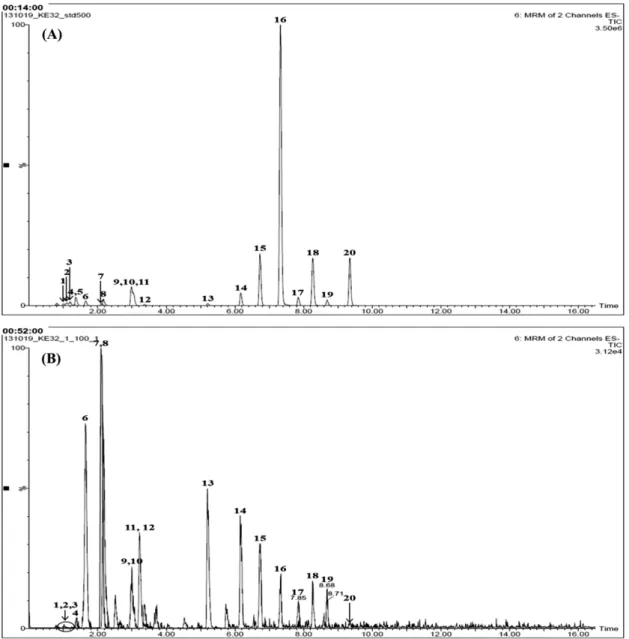
UPLC와 양이온 및 음이온 모드의 MS에서 모두 검출이 되 지 않아 본 정량법 설정에서 제외하였다. Pachymic acid를 제외한 20종의 성분은 양이온 모드에서 11종 및 음이온 모 드에서 9종이 10분 이내로 양호하게 분리 및 검출되었다 (Table III 및 Fig. 2). MS 분석 결과 물질 2, 3, 5, 7, 9, 10, 1416, 18 및 20이 [M+H]+ 형태로 m/z 291.3, 291.3, 609.5, 611.5, 257.2, 287.2, 295.3, 249.3, 271.2, 233.3 및 231.2에 서 분자이온 피크를 확인하였으며, 물질 1, 4, 6, 8, 1113, 17 및 19는 m/z 167.0, 137.0, 417.4, 359.3, 1386.4, 1224.3, 821.9, 265.3 및 265.3에서 [MH] 형태의 분자이온 피크를 각각 확인하였다(Table III).
검량선 − LC-MS/MS를 이용하여 ESI 방법의 MRM 방식 에서 20종 성분의 농도에 따른 피크 면적을 이용하여 검량 선을 작성한 결과 상관 계수(r2) 값이 0.9950 이상으로 양호 한 직선성을 나타내었다(Table IV). 또한 검출한계와 정량 한계는 0.01-2.79 ng/mL와 0.03-8.37 ng/mL의 범위로 각각 나타났다(Table IV).
藿香正氣散 중 주요성분의 함량분석 − 藿香正氣散 추출 물을 확립된LC-MS/MS 분석법을 이용하여 20종의 성분에 대한 토탈이온크로마토그램(total ion chromatogram; TIC)으 로 특정 분자량에 대한 크로마토그램을 추출하여 지표물질 에 대한 함량 분석을 실시하였다. Table III과 Fig. 2에서 보
Fig. 2. Chromatogram of reference compounds 1–20(A) and Gwakhyangjeonggi-san extract(B) by LC-MS/MS MRM mode.
Homogentisic acid(1), (+)-catechin(2), (-)-epicatechin(3), 3,4-dihydroxybenzaldehyde(4), spinosin(5), liquiritin(6), hesperidin(7), ros- marinic acid(8), liquiritigenin(9), luteolin(10), platycodin D2(11), platycodin D(12), glycyrrhizin(13), 6-gingerol(14), atractylenolide III(15), imperatorin(16), honokiol(17), atractylenolide II(18), magnolol(19), and atractylenolide I(20).
듯이 이들 20종의 성분들은 모두 10분 이내에 분리 및 검 출되었다. LC-MS/MS에서 정량분석을 위한 성분 1의 MRM 조건은 m/z 167.0(precursor ion)에서 COO−가 떨어진 [M- COO−-H] 형태의 m/z 123.0(product ion),13) 성분 2와 3은 m/z 291.3(precursor ion)에서 [M-C8H8O3+H]+ 형태의 m/z 139.0(product ion),14,15) 성분 4는 m/z 137.0(precursor ion) 에서 aldehyde기가 떨어져 나간 [M-COH−-H]− 형태의 m/z 108.0(product ion),16) 성분 5는 m/z 609.5(precursor ion)에 서 [M-Glu-C4H6O4+H]+ 형태의 m/z 327.2(product ion),17) 성분 6은 m/z 417.4(precursor ion)에서 glucose가 떨어진 [M-Glu-H]− 형태의 m/z 255.2(product ion),18) 성분 7은 m/z 611.5(precursor ion)에서 rhamnose와 glucose가 떨어진 [M- Rham-Glu+H]+ 형태의 m/z 303.2(product ion),19) 성분 8은 m/z 359.3(precursor ion)에서 [M-C9H9O5-H]− 형태의 m/z 161.0(product ion),20) 성분 9는 m/z 257.2(precursor ion)에 서 [M-C8H8O8+H]+형태의 m/z 137.0(product ion),18) 성분 10은 m/z 287.2(precursor ion)에서 [MC8H6O2+H]+ 형태의 m/z 153.0(product ion),21) 성분 11과 12는 precursor ion이 각각 m/z 1386.4와 1224.3에서 product ion이 m/z 843.6과 469.4,22) 성분 13은 m/z 821.9(precursor ion)에서 glucose 2 분자가 떨어진 [M-2Glu-H]− 형태의 m/z 351.2(product ion),23) 성분 14는 m/z 295.3(precursor ion)에서 [M- C6H12O2+H]+ 형태의 m/z 177.1(product ion),23)성분 15는 m/z 249.3(precursor ion)에서 1개의 물 분자가 떨어진 [M-
2 10–500 y = 4.91x + 2.34 0.9998 0.25 0.74
3 10–500 y = 6.91x 51.75 0.9991 0.22 0.67
4 10–500 y = 1.43x + 2.51 0.9997 1.10 3.31
5 10–500 y = 14.68x – 34.25 0.9999 0.17 0.51
6 10–500 y = 8.27x – 3.25 0.9999 0.13 0.38
7 10–500 y = 3.67x – 7.30 0.9997 0.34 1.03
8 10–500 y = 10.95x – 26.97 0.9999 0.41 1.22
9 10–500 y = 31.97x + 19.72 1.0000 0.06 0.18
10 10–500 y = 17.06x – 17.01 1.0000 0.07 0.20
11 10–500 y = 0.33x – 3.70 0.9950 2.79 8.37
12 10–500 y = 2.13x – 4.15 1.0000 0.77 2.32
13 10–500 y = 3.59x – 25.81 0.9993 0.46 1.38
14 10–500 y = 20.59x – 49.72 0.9995 0.04 0.13
15 10–500 y = 75.18x – 28.76 1.0000 0.28 0.85
16 10–500 y = 474.04x + 3616.00 0.9986 0.01 0.03
17 10–500 y = 12.85x – 26.60 1.0000 0.16 0.47
18 10–500 y = 81.02x + 521.36 0.9989 0.12 0.37
19 10–500 y = 8.65x + 8.60 0.9999 0.15 0.46
20 10–500 y = 76.33x + 168.66 0.9999 0.06 0.17
Table V. Amount of the 20 marker compounds in Gwakhyangjeonggi-san
Compound Amount(µg/g)
Mean SD RSD(%)
1 15.50 1.00 6.45
2 4.40 0.05 1.14
3 3.82 0.08 2.00
4 36.33 0.76 2.10
5 ND1 – –
6 1058.17 24.29 2.30
7 3236.67 23.63 0.73
8 874.67 28.92 3.31
9 55.67 5.51 9.89
10 250.50 6.87 2.74
11 63.83 4.31 6.75
12 413.33 4.80 1.16
13 1467.83 52.25 3.56
14 197.17 8.13 4.12
15 41.67 1.53 3.67
16 1.90 0.13 6.96
17 82.67 6.37 7.71
18 11.63 0.71 6.10
19 125.83 10.89 8.65
20 1.25 0.25 20.00
1ND means not detected.
H2O]+ 형태의 m/z 231.2(product ion),24) 성분 16은 m/z 271.2(precursor ion)에서 [M-C5H9+H]+ 형태의 m/z 203.0 (product ion),25) 성분 17은 m/z 265.3(precursor ion)에서 [M-C3H5-H]− 형태의 m/z 224.2(product ion),26)성분 18은 m/z 233.3(precursor ion)에서 1개의 물 분자와 CO가 떨어 진 [M-H2O-CO+H]+ 형태의 m/z 187.1(product ion),24) 성분 19는 m/z 265.3(precursor ion)에서 물 분자 1개가 떨어진 [M-H2O-H]−형태의 m/z 247.2(product ion)26)및 성분 20은 m/z 231.2(precursor ion)에서 1개의 물 분자와 CO가 떨어 진 [M-H2O-CO+H]+ 형태의 m/z 185.1(product ion)24)로 설 정한 후 정량을 실시하였다. 함량 분석 결과 藿香正氣散 추 출물 중 spinosin(5)은 검출되지 않았으며, 이를 제외한 19 종의 성분은 1.25-3,267.67 µg/으로 검출이 되었다(Table V).
결 론
藿香正氣散의 주요 성분인 homogentisic acid(1), (+)- catechin(2), (-)-epicatechin(3), 3,4-dihydroxybenzaldehyde(4), spinosin(5), liquiritin(6), hesperidin(7), rosmarinic acid(8), liquiritigenin(9), luteolin(10), platycodin D2(11), platycodin D(12), glycyrrhizin(13), 6-gingerol(14), atractylenolide III (15), imperatorin(16), honokiol(17), atractylenolide II(18), magnolol(19) 및 atractylenolide I(20) 등 20종에 대하여 LC- MS/MS를 이용한 함량분석을 실시하였다. 분석 결과 감초의 주요 성분인 liquiritin과 glycyrrhizin 및 진피의 hesperidin 함 량이 1,058.17±24.29, 1467.83±23.63 및 3236.67±52.25 µg/g 으로 다른 성분에 비해 많이 함유되어 있음을 확인하였다.
이러한 결과는 藿香正氣散 또는 이와 관련된 한약제제의 품 질관리를 위한 기초 자료로 활용될 수 있을 것으로 사료된다.
사 사
본 연구는 한국한의학연구원에서 지원하는 ‘한약 처방의 과학적 근거 기반 구축사업(K14030)’에 의해 수행되었으며 이에 감사 드린다.
인용문헌
1. Koo, C. M., Sun, J. K., Kim, H. H. and Nam, C. G. (2003) Effect of GwakHyangJungGiSan on the arterial contraction in rabbit. Korean J. Orient. Int. Med. 24: 260-268.
2. Yun, H. S., Ryu, B. H., Park, D. W. and Ryu, K. W. (1998) Experimental comparative studies on the effects of Kwa- khyangjeonggisan and Souminkwakhyang-jeonggisan. K. H.
Univ. O. Med. J. 1: 197-211.
3. Park, S., Ahn, S. and Lee, S. (2007) Heo jun’s traditional tales connected with Gwakhyangjeonggisan. Korean J Orient.
Med. 13: 69-75.
4. Lu, Y., Li, D. and Tang, F. (2011) Mechanism of huoxiang zhengqi extract for regulating the intestinal motility in rat model of diarrhea-predominant irritable bowel syndrome.
Zhongguo Zhong Xi Yi Jie He Za Zhi 31: 941-945.
5. Kim, S. Y. and Lee, W. C. (2001) The effects of Sunghy- angjunggi-san and Gwackhyangjunggi-san extracts on cere- bral ischemia following the MCA occlusion in rat. J. Korean Oriental Med. 22: 142-150.
6. Woo, S. K., Leem, J. T., Park, S. K., Kwak, S. H., Jung, W.
S., Moon, S. K., Cho, K. H., Park, S. W. and Ko, C. N. (2010) Study on characteristics of acute stroke patient with Gwa- khyangjeonggisan. Korean J. Joongpoong 11: 26-35.
7. Han, J. H., Kim, G. B., Han, I. S., Shim, Y. S. and Kim, E.
G. (2005) A clinical report of chronic diarrhea treated with Gwakhyang-junggisan. Korean J. Orient. Int. Med. 26: 889- 896.
8. Na, W. K., Han, K. H., Lee, H. J. and Park, E. J. (2004) A case report of epileptic children. J. Korean. Orient. Pediatrics 28: 131-138.
9. Kim, S. M., Ha, K. S., Ha, S. Y., Kim, H. Y., Song, I. S., Park, S. K. and Chun, S. C. (2006) Three cases report of mol- luscum contagiosum children treated by Gwakhyangjeong- gisangamibang. J. Korean Oriental Pediatrics 20: 11-22.
10. Wang, X. Y., Chen, X., Quan, H. and Bai, X. H. (2008) Determination of magnolol and honokiol in traditional Chi- nese medicine Magnolia officinalis and its preparations by liquid-phase microextraction-back extraction combined with high performance liquid chromatography. J. Chinese Pharm.
Sci. 17: 163-166.
11. Han, P., Luan, F., Yan, X., Gao, Y. and Liu, H. (2012) Sep- aration and determination of honokiol and magnolol in Chi- nese traditional medicines by capillary electrophoresis with the application of response surface methodology and radial basis function neural network. J. Chromatogr. Sci. 50: 71-75.
12. Li, K., Yuan, J. and Su, W. (2006) Determination of liquiritin, naringin, hesperidin, thymol, imperatorin, honokiol, isoimperatorin, and magnolol in the traditional Chinese medicinal preparation Huoxiang-zhengqi liquid using high- performance liquid chromatography. Yakugaku Zasshi 126:
1185-1190.
13. Elgstoen, K. B., Zhao, J. Y., Anacleto, J. F. and Jellum, E.
(2001) Potential of capillary electrophoresis, tandem mass spectrometry and coupled capillary electrophoresis-tandem mass spectrometry as diagnostic tools. J. Chroamtogr. A 914:
265-275.
14. Benavides, A., Montoro, P., Bassarello, C., Piacente, S. and Pizza, C. (2006) Catechin derivatives in Jatropha macrantha stems: characterization and LC/ESI/MS/MS quali-quantita- tive analysis. J. Pharm. Biomed. Anal. 40: 639-647.
15. Mulder TP, van Platerink CJ, Wijnand Schuyl PJ, van Amels- voort JM. (2001) Analysis of theaflavins in biological fluids
YI-QI” dropping pill by high-performance liquid chroma- tography coupled with diode array detection-electrospray ion- ization tandem mass spectrometry. J. Pharm. Biomed. Anal.
47: 407-412.
17. Ren, Y., Wang, P., Wu, C., Zhang, J. and Niu, C. (2013) Iden- tification of the metabolites after oral administration of extract of Ziziphi Spinosae Semen to rats or dogs by high- performance liquid chromatography/linear ion trap FTICR hybrid mass spectrometry. Biomed. Chromatogr. 27: 17-26.
18. Wang, Y., Yang, L., He, Y. Q., Wang, C. H., Welbeck, E. W., Bligh, S. W. and Wang, Z. T. (2008) Characterization of fifty- one flavonoids in a Chinese herbal prescription Longdan Xie- gan Decoction by high-performance liquid chromatography coupled to electrospray ionization tandem mass spectrometry and photodiode array detection. Rapid Commun. Mass Spec- trom. 22: 1767-1778.
19. Zhou, D., Xu, Q., Xue, X., Zhang, F. and Liang, X. (2006) Identification of O-diglycosyl flavanones in Fructus Aurantii by liquid chromatography with electrospray ionization and collision-induced dissociation mass spectrometry. J. Pharm.
Biomed. Anal. 42: 441-448.
20. Mitra, M., Nasrolah, G., Ebrahim, S., Alireza, G. and Moham- madreza, S. A. (2005) Main phenolic compound of petals of Echium amoenum Fisch. And C. A. Mey., a famous medic- inal plant of Iran. Daru 13: 65-69.
21. Fabre, N., Rustan, I., de Goffmann, E. Quetin-Leclercg, J.
22. Na, Y. C., Ha, Y. W., Kim, Y. S. and Kim, K. J. (2008) Struc- tural analysis of platycosides in Platycodi Radix by liquid chromatography/electrospray ionization-tandem mass spec- trometry. J. Chromatogr. A 1189: 467-475.
23. Tan, G., Zhu, Z., Jing, J., Lv, L., Lou, Z., Zhang, G. and Chai, Y. (2005) Characterization of constituents in Sini decoction and rat plasma by high-performance liquid chromatography with diode array detection coupled to time-of-flight mass spectrometry. Biomed. Chromatogr. 25: 913-924.
24. Chen, L., Qi, J., Chang, Y., Zhu, D. and Yu, B. (2009) Iden- tification and determination of the major constituents in Tra- ditional Chinese Medicinal formula Danggui-Shaoyao-San by HPLC-DAD-ESI-MS/MS. J. Pharm. Biomed. Anal. 50:
127-137.
25. Yang, W., Ye, M., Liu, M., Kong, D., Shi, R., Shi, X., Zhang, K., Wang, Q. and Lantong, Z. (2010) A practical strategy for the characterization of coumarins in Radix Glehniae by liquid chromatography coupled with triple quadrupole-linear ion trap mass spectrometry. J. Chromatogr. A 1217: 4587-4600.
26. Yu, Q., Xiang, J., Tang, W. F., Liang, M. Z., Qin, Y. P. and Nan, F. (2009) Simulataneous determination of the 10 major components of Da-Cheng-Qi decoction in dog plasma by liq- uid chromatography tandem mass spectrometry. J. Chro- matogr. B 877: 2025-2031.
(2014. 4. 1 접수; 2014. 5. 16 심사; 2014. 5. 27 게재확정)