224
©The Korean Society of Food Science and Technology
곡류가공품 중 제랄레논 오염도 조사
장미란*·이창희·최인선·신춘식·김진희·장영미·김동술·안동현
1부산지방식품의약품안전청 시험분석센터, 1부경대학교 식품공학과
Analysis of Zearalenone Contamination in Cereal-Based Products Using
High Performance Liquid Chromatography-Fluorescence Detector and
Ultra Performance Liquid Chromatography-Tandem Mass Spectrometry
Mi-Ran Jang*, Chang-Hee Lee, In-Sun Choi, Choon-Shik Shin, Jin-Hee Kim, Young-mi Jang, Dong Sul Kim, and Dong-Hyun Ahn1
Test & Analytical Center, Busan Regional KFDA
1Department of Food Science and Technology, Pukyong National University
Abstract Zearalenone (ZEA) is an estrogenic mycotoxin mainly produced by Fusarium graminerum, a species which colonizes a wide variety of cereals, including wheat, barley and processed products. A survey of ZEA contamination was conducted on 141 dried confectioneries, 59 breads and rice cakes, 135 noodles and 101 other products, for a total of 432 commercial samples. Samples were analyzed by high performance liquid chromatography with fluorescence detection (HPLC-FLD) after immunoaffinity clean-up and was confirmed by liquid chromatography tandem mass spectrometry (LC-MS/MS). The limits of detection and quantification were 2.0 and 6.0µg/kg, respectively. The recovery ranged from 80.2% to 98.4% in the cereal based product. ZEA was detected in 38 samples (8.8% incidence), including 3 snack, 2 biscuit and 33 other cereal products. The ZEA contamination levels were in the range of 5.38-53.76 µg/kg. Finally, LC-MS/MS analysis of the contaminated samples was conducted to confirm the detected ZEA, and all 38 samples showing ZEA by HPLC-FLD were confirmed by LC-MS/MS.
Keywords: mycotoxin, zearalenone, immunoaffinity column, cereal
Fusarium 속 곰팡이는 토양균류로서 자연계에 널리 분포하고 있으며 그 중 몇 종은 식물병원균으로 벼의 Bakanae 병을 비롯 하여 식물의 뿌리 섞음병, 줄기 섞음병, 잎마름병, 과실 부패병 등을 일으킨다고 알려져 있다(1). 과거에는 이들 Fusarium 속 곰 팡이는 주로 식물성 병원균으로만 취급되었지만 최근 zearalenone, deoxynivalenol, fumonisin 등 곰팡이독소를 생성하는 것으로 알려 져 식품위생상 문제가 대두되고 있다(2-4). 곰팡이독소는 화학물 질로 분류되지만 살아있는 생물로부터 생성되기 때문에 수확 전 후 저장, 유통 등 여러 단계에서 발생할 수 있으므로 원료 생산 에서 유통, 소비에 이르기까지 매우 중요한 위해요소로 작용한 다. 또한 대부분의 곰팡이독소들은 물리적·화학적으로 안정한 저분자 물질이기 때문에 세척 및 가열 등의 일반적인 가공조건 으로는 제거되기 어렵다(5). 이들 중 비스테로이드성 에스트로겐으로 알려진 제랄레논은 Fusarium graminearum, Fusarium moniliforme 등에 의해 주로 생 성되며 옥수수, 밀, 보리 등 농산물과 같이 탄수화물 함량이 높
은 기질에서 잘 발생된다(6). 국제발암연구소(International Agency for Research on Cancer, IARC)는 제랄레논을 인체 발암성으로 분 류할 수 없는 group 3로 분류하였지만 제랄레논은 체내에 흡수 되면 대부분 배출되나 일부는 자궁, 고환, 난소 등에 전달되어 과 에스트로렌증, 유산, 불임 등 생식에 관련된 독성을 유발하는 것 으로 알려져 있다(7-9). Lee 등(10)의 보고에 따르면 제랄레논은 동물의 에스트로겐에 영향을 주는 것으로 알려져 있고 에스트로 겐에 영향을 주는 에스트로겐수용체는 핵의 사본에 달려있으며 제랄레논에 의해 손상된 수용체는 쥐 유방조직에서 에스트로겐 호르몬을 억제하는 것으로 나타났다. 그리고 제랄레논이 에스트 로겐 반응 수용체를 포함하는 인간 유방암세포의 성장을 자극하 는 것으로 보고하여 유방암 발생 가능성이 증가되고 있으며, 제 랄레논은 구조적으로 estradiol과 유사한 구조로 estrogen 수용체 와 결합함으로써 내분비교란 작용을 한다. 그 작용은 다른 환경 내분비교란 물질인 polychrorinated biphenol(PCB)과 bisphenol A 보다 강하다. 이에 유럽연합에서는 제랄레논의 식품 및 사료 중 함량을 최저 20 mg/kg-최고 200 mg/kg으로 규격관리하고 있으며 JECFA(The Joint FAO/WHO Export Committee on Food Addi-tives)에서는 잠정적 최대 허용 일일 섭취량(provisional maximum tolerable daily intake, PMTDI)을 0.5 mg/kg body weight/day로, 유럽식품과학위원회(EU Scientific committee for food)에서는 0.2 mg/kg body weight/day으로 제안하였다(11,12).
제랄레논에 대한 국내외 연구보고는 오염가능성이 높은 식품 군인 옥수수, 밀, 보리 등을 중심으로 조사되었다. 1999년 Placinta *Corresponding author: Mi-Ran Jang, Hazard Substances Analysis
Team, Test & Analytical Center, Busan Regional KFDA, Busan 608-829, Korea
Tel: 82-51-610-6181 Fax: 82-51-610-6199
E-mail: [email protected]
Received January 5, 2010; revised March 18, 2010; accepted December 12, 2010
등(13)은 곡류 중 제랄레논 오염량을 밀에서 최고 8.04 mg/kg, 보 리에서 최고 15 mg/kg 검출되었다고 보고하였으며 캐나다 Scott(14) 은 옥수수 126건 중 87건에서 5-647 µg/kg 검출을 보고하였고 JECFA의 보고(15)에 의하면 밀에서 69% 검출(최대 120 µg/kg), 옥수수 30% 검출(최대 2,000 µg/kg) 되었다. 국내에서는 Kim 등 (16)이 보리에서 287 µg/kg의 제랄레논 검출사례를 보고하였고 Hyun 등(17)의 연구에 의하면 2005년부터 2006년까지 생산된 옥 수수 14건 중 9건에서 평균 42.8 µg/kg, 최고 174.9 µg/kg 검출되 었다. 가공식품에 대한 연구보고로 Park 등(18)은 2002년에 보리 가공품(보리밀, 가루, 보리차, 비스킷) 및 옥수수가공품(옥수수밀, 가루, 옥수수차, 비스킷)을 검사한 결과 각각 38%(3.4-120 µg/kg), 19%(3.6-84µg/kg)의 제랄레논 검출율을 보고하였다. 이처럼 제랄 레논에 대한 연구가 지속적으로 진행되고 있으나 주로 곡류, 두 류 등 농산물에 대한 연구가 대부분이고 그 가공식품에 대한 연 구는 제한적으로 진행되어 가공식품에 대한 연구는 부족한 실정 이다. 농산물유통공사에 따르면 우리나라는 쌀을 제외한 곡물의 식량자급률(옥수수 3.3%, 밀 0.6%)이 매우 낮은 실정이므로 옥수 수, 밀 등 곡물수입량[2001년(11,553 천 ton), 2007년(12,138 천 ton)]이 지속적으로 증가하고 있다. 특히, 밀을 주원료로 가공한 라면, 빵, 국수는 2005년 국민영양조사에 따른 다소비식품으로 분 류되며, 어린이, 청소년과 같은 특정집단에서 주로 섭취되는 과 자류 또한 밀, 옥수수 등으로 제조되므로 그 원료에 대한 안전관 리가 강조된다. 따라서 본 연구에서는 제랄레논 오염이 우려되는 식품군인 과자, 빵, 떡 및 면류 등을 대상으로 HPLC 형광검출기 분석법을 이용하여 오염실태를 조사하고자 하였다.
재료 및 방법
실험재료 식품 중 제랄레논 오염실태조사를 위해 2008년 4월부터 10월 까지 서울, 부산, 대전, 대구, 광주, 인천광역시 및 원주시 백화 점, 대형 할인마트 및 재래시장에서 빵류(도넛, 식빵, 케이크 기 타 빵류), 떡류, 면류(유탕면류, 건면류, 생면류, 숙면류 등 5품 목), 과자류(스낵과자류, 비스킷류, 파이류), 밀가루, 맥주, 선식, 음료, 전분 및 시리얼류 등 총 432건을 구입하였다. 모든 시료는 포장단위로 균질화하여 −20oC 냉동 보관하면서 사용하였다. 표준물질 및 시약실험에 사용한 제랄레논 표준품은 Sigma(St Louis, MO, USA) 에서 구입하였으며, 추출 및 분석에 사용된 acetonitrile, methanol 은 HPLC용으로 Merck Co.(Darmstadt, Germany) 제품을 사용하 였다. Sodium chloride(Merck Co.), n-hexane(Merck) 등 분석 사 용된 모든 시약 및 용매는 특급 및 그 이상의 수준으로 사용하 였다. 표준용액 조제 제랄레논 표준품 25 mg을 acetonitrile 10 mL에 녹여 표준원액 으로 하고 최종 농도가 5, 10, 25, 50, 75, 100 ng/mL가 되도록 75% acetonitrile로 희석하여 검량선용 표준용액으로 사용하였다. 정제용 칼럼 및 분석장비
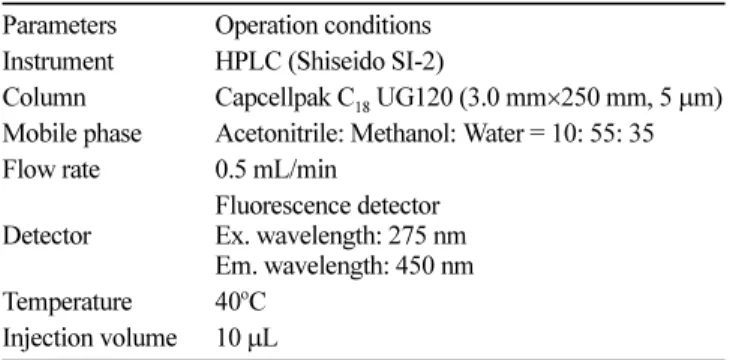
시료 정제용 Immunoaffinity column(ZearalaTest, Watertown, MA, USA)을 Vicam으로부터 구입하였다. 정량분석을 위하여 3023 pump, 3023 autoinjector 그리고 형광검출기가 장착된 HPLC (Shiseido SI-2, Tokyo, Japan) 및 ultra performance liquid chro-matography(UPLC) ACQUITYTM/Micromass Quattro Premier XE API triple-quadrupole mass spectrometer(UPLC-MS/MS, Micro-Table 1. HPLC conditions for the determination of zearalenone in cereal products
Parameters Operation conditions Instrument HPLC (Shiseido SI-2)
Column Capcellpak C18 UG120 (3.0 mm×250 mm, 5 µm) Mobile phase Acetonitrile: Methanol: Water = 10: 55: 35 Flow rate 0.5 mL/min
Detector Fluorescence detector Ex. wavelength: 275 nm Em. wavelength: 450 nm Temperature 40oC Injection volume 10 µL
Table 2. LC-MS/MS conditions for the confirmation of zearalenone in cereal products
Instrument Parameter Condition
Liquid chromatography
Column ACQUITY UPLCTH BEH C18 (Waters, 2.1 mm×50 mm, 1.7 µm) Mobile phase Solvent A (80%): 10 mM ammonium acetate in water
Solvent B (20%): 10 mM ammonium acetate in acetonitrile
Flow rate 0.25 mL/min
Injection volume 10 µL
MS/MS
Ionization mode ESI(-)
Capillary (kV) 3.0 Source temp. (oC) 120 Desolvation temp. (oC) 300 LM/HM resolution 14.0/14.0 Ion energy 1.0 Entrance/ Exit 1 / 1 MRM mode Precursor ion (m/z) 317 Product ion (m/z) 175, 131, 273 Dwell time (s) 0.1 Con voltage (V) 45
mass, Manchester, UK)를 사용하였다. 시료분쇄기, 균질기(OMNI International, Vernon, USA), 원심분리기, vacuum system 등으로 시료를 전처리하였다.
시료의 전처리
제랄레논을 추출하기 위하여 포장단위(0.5 kg 또는 1 kg)별로 분 쇄하여 균질화한 시료 25 g과 sodium chloride 2 g에 75% aceto-nitrile 추출용액 100 mL를 가하여 균질기로 10,000 rpm에서 20분 간 추출하였다. 다만, 지방함량이 높은 시료는 헥산으로 지방을 제거하여 추출액으로 하였다. 추출액을 여과지(Adantec No.4)로 여과한 후 상등액 10 mL을 50 mL conical tube에 넣고 증류수 40 mL 을 혼합하여 희석하였다. 이 때 혼합액이 현탁 할 경우 원심 분리(6,000 rpm, 10 min)하여 사용하였다. 시료 정제를 위해 혼합 액 25 mL을 immunoaffinity column에 유속 1-2방울/sec을 초과하 지 않도록 통과시켰다. 25 mL 증류수로 세척한 후 5 mL methanol 로 제랄레논을 용출시킨 다음 3 mL 공기를 통과시켜 column에 남은 액을 모두 용출시킨 다음 그 액을 모아 질소가스(40oC, 수
욕상)로 농축시켰다. 이를 1 mL 이동상 용매로 녹인 다음 0.45 µm membrane filter로 여과하여 HPLC 및 UPLC-MS/MS 시험용 액으로 사용하였다.
HPLC 및 LC-MS/MS 분석조건
제랄레논 정량분석을 위해 fluorescence detector(Excitation 275 nm, Emission 450 nm)가 장착된 Shiseido SI-2 시스템을 사용하였 다. 칼럼은 Capcellpak C18 UG120(3.0 mm×250 mm, 5 µm), 이동
상은 acetonitrile:methanol:water(10:55:35, v/v/v)로 분석하였다 (Table 1). 또한 제랄레논이 검출된 시료는 LC-MS/MS(UPLC ACQUITYTM/Micromass Quattro Premier XE API triple-quadru-pole mass spectrometer(Micromass, Manchester, UK))를 이용하여 확인시험을 하였다. ESI negative ion mode로 설정하여 con volt-age 45 collision energy 25로 분석하였다. HPLC 및 UPLC-MS/ MS 분석조건을 요약하여 Table 2로 나타내었다.
결과 및 고찰
검량선 및 검출한계, 정량한계
표준용액을 5, 10, 25, 50, 75, 100 ng/mL 농도로 조제하여 검 량선을 구한 결과, 결정계수(R2)가 0.999 이상으로 양호한 직선성
을 나타내었다. 검출한계(limit of detection)는 signal 대 noise 비 가 3대 1일 때의 농도로 하였고 정량한계(limit of quantification) 는 LOD×3일 때의 농도로 구하여 각각 2, 6 µg/kg이었다. 본 연구 에서 구한 검출한계는 Urraca 등(19)의 검출한계(3-6 µg/kg), Mateo 등(20) 및 Jimenez와 Mateo(21)가 제시한 4 µg/kg이나 3 µg/kg보다 낮은 검출한계를 보였다. 회수율 및 재현성 검체별 회수율을 검토하기 위해 제랄레논에 오염되지 않은 스 낵, 비스킷, 빵 및 케이크에 최종농도가 5, 25, 50, 250, 500 µg/ kg이 되게 제랄레논을 첨가하여 각 시료에 대한 회수율을 측정 한 결과, 스낵 및 비스킷에서 각각 86.2-98.4%, 88.7-94.7%로 나 Table 3. Recoveries (n=5) of zearalenone from cereal products spiked with standard solution at the levels of 0.1, 0.5, 1.0, 5.0, and 10.0 µg/ mL, respectively
Measured level (µg/kg)
Recoveries (%) ± RSD (%)
Snack Biscuit Bread Cake
5 86.2±1.46 88.7±6.40 82.5±3.41 81.7±3.29
25 91.2±1.69 90.2±1.89 80.2±2.54 83.9±1.72
50 93.1±5.97 89.7±0.82 93.7±1.61 87.9±3.40
250 98.4±4.11 94.7±1.75 90.9±1.33 93.3±2.46
500 95.8±1.45 91.6±1.64 85.8±3.75 94.5±2.03
Table 4. The incidence and levels of zearalenone in various cereal products by HPLC/FLD
Type of foods
Incidence (positive/
analysed samples) zearalenoneRange of levels (µg/kg) No. % Dried confectioneries Snack 3/66 4.5 6.02-11.82 Biscuit 2/75 2.8 14.78-17.83 Total 5/141 3.5 6.02-17.83 Breads and Rice cakes
Loaf bread 0/13 - N.D. 1) Cake 0/10 - N.D. Donut 0/5 - N.D. Other bread 0/27 - N.D. Rice cake 0/4 - N.D. Total 0/59 - N.D. Noodles Dried noodle 0/39 - N.D. Uncooked noodle 0/12 - N.D. Cooked noodle 0/21 - N.D. Fried noodle 0/43 - N.D.
Improved cooked noodle 0/20 - N.D.
Total 0/135 - N.D. Other products Wheat flour 0/9 - N.D. Beer 0/6 - N.D. Infusion tea2) 14/34 41.1 6.38-53.76 Starch 2/6 33.3 5.553)-8.56 Beverage 0/5 - N.D. Sunshik 16/24 66.7 5.383)-42.72 Breakfast cereal 0/5 - N.D. Other 1/12 8.3 10.26 Total 33/101 33.7 5.38-53.76 Cereal products Total 38/432 8.8 5.38-53.76 1)Not detected (below the quantitation limit)
2)Barley tea, corn tea, etc.
3)Sample amount and dilution factor were applied to calculate the
amount. The raw data before being processed were above the instrumental LOQ.
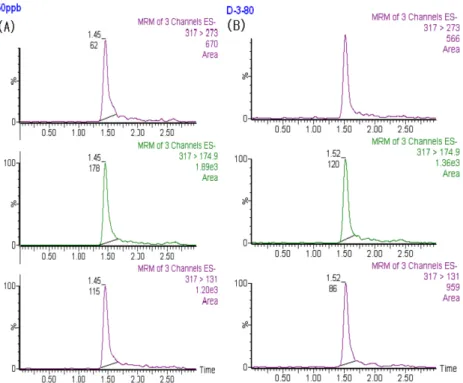
타났고 빵 및 케이크는 각각 80.2-93.7%, 81.7-94.5%이었다. 최종 농도가 5, 10, 25, 50, 75, 100 µg/kg 농도가 되게 제랄레논 표준 용액을 비스킷에 첨가하여 하루에 5번 반복 실험하여 정밀성(%, RSD로 표시)을 검토한 결과 상대표준편자가 4.38% 이하를 나타 냈다(Table 3). 시료 중 제랄레논 오염도 조사 시중 유통되는 식품인 과자류(스낵과자류, 비스킷류, 파이류) 141건, 빵류(도넛, 식빵, 케이크 기타 빵류) 55건, 떡류 4건, 면류 (유탕면류, 건면류, 생면류, 숙면류, 개량숙면류) 135건 및 기타식 품(밀가루, 맥주, 선식, 음료, 전분 및 시리얼류 등) 101건으로 총 432건을 대상으로 제랄레논 오염량을 분석한 결과, 과자류 중 스 낵과자류 3건(총 66건, 검출율: 4.5%)에서 6.02-11.82 µg/kg 검출 되었고 비스킷 2건(총 71건, 검출율: 2.8%)에서 14.78-17.83 µg/kg 검출되었다. 면류, 빵류 및 떡류에서는 제랄레논이 모두 검출되 지 않았고 기타식품 중 침출차 34건 중 14건(검출율 41.1%)에서 6.38-53.76µg/kg 검출되었다. 침출차는 식품 특성상 그대로 섭취 하는 것이 아니라 티백을 일정량의 물에 침지시킨 후 그 물을 음 용하기 때문에 실질적으로 물에 얼마나 제랄레논이 용출되는 지 를 분석하였다. 검출된 침출차를 대상으로 침출시간(5-30분)별, 침 출횟수(1-4회)별로 제랄레논을 분석한 결과 모두 검출되지 않았 다. 이는 제랄레논이 물에 대한 용해성이 떨어지기 때문이라고 생각되며 본 연구결과 중 음료와 맥주에서 제랄레논이 검출되지 않은 결과와 일치하였다. 선식의 경우 24건 중 16건에서 제랄레 논이 검출되어 그 오염수준은 5.38-42.72 µg/kg이었으며 다른 가 공식품에 비해 높은 검출율(66.7%)을 보였다. 이것은 제품의 특 성상 다양한 곡물을 섞어 분말화하기 때문에 한 종류라도 오염 되면 최종제품에 영향을 주기 때문에 개별 원료에 대한 엄격한 선별 작업이 중요하다고 생각된다. 전분 2건 및 씨리얼두유 1건 에서는 제랄레논이 각각 5.55-8.56, 10.26 µg/kg 검출되었고 나머 지 시료에서는 검출되지 않았다(Table 4). 선식 및 전분 각 1건은 크로마토그래프에서 정량한계(선식: 6.72 µg/kg, 전분: 6.94 µg/kg) 이상의 농도로 검출되었으나 검체량과 희석배수를 고려함에 따 라 제랄레논 농도가 선식 5.38 µg/kg, 전분 5.55 µg/kg이였다. 제랄 레논의 표준용액 및 검출된 선식의 HPLC-FLD 크로마토그램을 Fig. 1에 나타냈다. 제랄레논이 검출된 시료를 확인하기 위해 LC/MS/MS로 분석 한 결과 product ion 175 m/z, 131 m/z 및 273 m/z를 MRM (Multiple Reaction Monitoring) mode로 분석하여 과자류 5건, 기 타식품(밀가루, 침출차, 전분, 선식 등) 33건에서 product ion 175 m/z, 131 m/z 및 273 m/z을 확인하였다. 따라서 검출 시료 36건 모두 제랄레논임을 확인하였고 LC/MS/MS 표준용액 크로마토그 램 및 검출시료 크로마토그램을 Fig. 2으로 나타냈다. 곡류를 주원료로 가공한 식품에 대한 제랄레논 연구보고는 곡 류에 비해 제한적이었다. Park 등(18)은 2002년에 보리가공품(보 리밀, 가루, 보리차, 비스킷) 및 옥수수가공품(옥수수밀, 가루, 옥 수수차, 비스킷)을 검사한 결과 각각 38%(3.4-120 µg/kg), 19%(3.6-84µg/kg)의 제랄레논 검출율을 보고하였고 Hyun 등(17)은 아침 식사대용 시리얼류 및 밀가루를 각각 7건 검사한 결과 모두 검 출되지 않았다고 보고하여 본 연구결과와 유사한 결과를 보였다. 2003년 영국의 식품규격청(FSA)의 연구보고(22)에 따르면 제랄레 논은 아침식사대용 시리얼류(10.0-231.8 µg/kg)에서 18%, 비스킷 (10.7-11.8µg/kg)에서 3%, 빵류(15.8 µg/kg)에서 2%검출되었고 옥 수수가루(8-7.3 µg/kg) 및 곡류스낵(10.5-55.8 µg/kg)에서는 각각 50, 30%로 높은 검출율을 보여 본 연구결과의 비스킷보다 다소 높 았으며 스낵류는 대체적으로 낮은 수준이었다. 본 연구에서 아침 식사대용 시리얼류 및 빵류에서 제랄레논이 검출되지 않았으나 영국 연구보고에서는 시리얼류에서 유럽연합 기준을 초과하는 오 Fig. 1. HPLC/FLD chromatograms of zearalenone standard at 50 µg/kg (A) and biscuit sample contaminated with zearalenone at 38.98 µg/kg (B).
염수준을 보였다. 본 연구결과에서 제랄레논 검출빈도가 높은 선 식의 경우 곡류뿐 아니라 두류, 유지식물류 등 다양한 곡물을 혼 합하여 만든 제품으로 국내외 모니터링 결과와 직접적으로 비교 는 어려우나 제품의 특성이 유사한 보리 및 옥수수가루와 비교 한 결과 그 오염수준 다소 낮음을 확인하였다. 따라서 본 모니터 링의 제랄레논 오염수준은 유럽연합(곡류분말: 75 µg/kg, 빵, 비 스킷, 스낵, 아침식사대용 시리얼류: 50 µg/kg, 영아 및 유아용 시 리얼류: 20 µg/kg)의 기준 이하로 오염수준이 높지 않았으나 지구 온난화로 기후변화에 민감한 곰팡이독소와 같은 자연독소의 발 생 증가가 우려되므로 선제적으로 대응하는 안전관리가 요구된 다. 더욱이 본격적 고령화 사회를 맞이하여 만성질환이 현실적인 문제로 인식되고 있으므로 만성중독이 우려되는 곰팡이독소에 대 한 대응을 재인식해야 할 것 같다.
요
약
시중 유통 중인 과자류, 빵, 떡류, 면류 및 선식 등 432건을 immunoaffinity column으로 정제하여 HPLC-FLD로 제랄레논에 대 한 오염실태를 조사하였다. 제랄레논의 검량선은 결정계수(R2)가 0.999 이상으로 양호한 직선성을 보였고 검출한계 및 정량한계는 각각 2.0, 6.0 µg/kg, 회수율 80.2-98.4%이었으며 RSD가 0.82-6.40%로 양호한 재현성을 나타내었다. 제랄레논 모니터링 결과, 과자류 중 스낵과자류 66건 중 3건에서 6.02-11.82 µg/kg 검출되 었고 비스킷 71건 중 2건에서는 14.78-17.83 µg/kg 검출되었다. 면 류, 빵류 및 떡류에서는 제랄레논이 검출되지 않았으며 침출차 14건에서 최고 53.76 µg/kg 검출, 선식 24건 중 16건에서 가장 높 은 검출율(66.7%)을 나타내었다. 전분 2건, 시리얼두유 1건에서 제랄레논이 각각 5.55-8.56, 10.26 µg/kg 검출되었다. 제랄레논 모 니터링 결과는 기준이 설정되어 있는 유럽연합(곡류분말: 75 µg/ kg, 빵, 비스킷, 스낵, 아침식사대용 시리얼류: 50 µg/kg, 영아 및 유아용 시리얼류: 20 µg/kg) 기준이하의 수준이었으며 국내외 연 구보고와 비교한 결과 낮거나 비슷한 수준으로 검토되었다. 연구결과 곡류가공품에 대한 제랄레논 오염수준은 높지 않았 으나 지구 온난화로 기후변화에 민감한 곰팡이독소와 같은 자연 독소의 발생 증가가 우려되므로 선제적으로 대응하는 안전관리 가 요구된다.문
헌
1. Wyllie TD, Morehouse LG. The Genus Fusarium. pp. 59-66. In: Mycotoxic Fungi, Mycotoxins, Mycotoicoses. Mercel Dekker, Inc., New York, NY, USA (1977)
2. Leslie JF, Plattner RD, Desjardins PA, Klittich CJR. Fumonisin B1 production by strains from different mating populations of Gibberrella fujikuroi (Fusarium section liseola). Phytopathology 82: 341-345 (1992)
3. Marasas WFO, Lelson PE, Tousson TA. Toxigenic Fusarium spe-cies identity and mycotoxicology. Pennsylvania State University Press, University Park, PA, USA (1984)
4. Yoshizawa T, Morooka N. Deoxynivalenol and its monoacetate new mycotoxins from Fusarium roseum and mouldy barley. Agric. Biol. Chem. 37: 2993-2934 (1973)
5. Martins ML, Marins HM. Influence of water activity, temperature and incubation time on the simultaneous production of deoxyni-valenol and zearalenone in corn (Zea mays) by Fusarium graminearum. Food Chem. 79: 315-318 (2002)
6. Yolanda A, Juan RC, Susana M, Javier G. Evaluation of a fluoro-metric-enzymatic method based on 3a-hydroxysteroid dehydroge-nase for the mycotoxin zearalenone determination in corn. Talanta 64: 196-201 (2004)
7. D’Mello JPF, Placinta CM, Macdonald AMC. Fusarium myc-otoxins-a review of global implications for animal health, welfare, and productivity. Anim. Feed Sci. Tech. 80: 183-205 (1999) 8. Cole RJ, Cox RH. Handbook of TFM. Academic Press, New
York, NY, USA. pp. 152-263 (1981)
9. Ito Y, Ohtsuo KI. Effects of neonatal administration of zearale-none on the reproductive physiology of female mice. J. Vet. Med. Sci. 56: 1155-1159 (1994)
10. Lee HK, Hwang YH, Kim MJ, Kim MG, Lee SE, Lee HS.
Tox-Fig. 2. The MRM chromatograms of zearalenone standard solution at 50 µg/kg (A) and sunshik sample (B). Mass transitions include m/z 319→273, 174.9, 131 for zearalenone.
icity and metabolism of mycotoxin co-occurrence in food and feed. J. Korean Soc. Agric. Chem Biotechnol. 45: 1-10 (2002) 11. Maximum levels for certain contaminants in foodstuffs (1),
Commis-sion Regulation (EC) No 1881/2006 (available at: http://services. leatherheadfood.com/mycotoxins/European Mycotoxins Aware-ness Network, Mycotoxin Legislation within the European Union (revised October 2007). Accessed Mar. 17, 2008.
12. Worldwide regulations for mycotoxins in food and feed in 2003, FAO Food and Nutrition Paper 81(available at: http://www.fao.org/ docrep/007/y5499e/y5499e00. htm). Accessed Mar. 2, 2009. 13. Placinta CM, D’Mello JPF, Macdonald AMC. A review of
world-wide contamination of cereal grains and animal feed with Fusar-ium mycotoxins. Anim. Feed Sci. Tech. 78: 21-37 (1999)
14. Scott PM. Multi-year monitoring of Canadian grains and grain-based foods for trichothecenes and zearalenone. Food Addit. Con-tam. 14: 333-339 (1997)
15. JECFA (Joint FAO/WHO Expert Committee on Foods and Addi-tives) 53rd Report, Safety evaluation of certain food additives and
contaminants. WHO Food Additives Series, No. 44, 2000, nos 965-986 on INCHEM (available at: http://www.inchem.org/pages/ jecfa.html) Accessed Mar. 12, 2009.
16. Kim C, Kang HJ, Lee DH, Lee YW, Yoshizawa T. Natural occurrence of Fusarium mycotoxins (trichothecenes and
zearale-none) in barley and corn in Korea. Appl. Environ. Microbiol. 59: 3798-3802 (1993)
17. Hyun EO, Hyun JC, Sung WC, Nari L, Hyun JK, Min SK, Hyang SC. Co-occurrence of Deoxynivalenol and Zearalenone in cereals and their products, J. Fd. Hyg. Safety 22: 375-381 (2007) 18. Park JW, Kim EK, Shon DH, Kim YB. Natural co-occurrence of
aflatoxin B1, fumonisin B1, and ochratoxin A in barley and corn foods from Korea, Food Addit. Contam. 19: 1073-1080 (2002) 19. Urraca JL, Marazuela MD, Moreno-Bondi MC. Analysis for
zearalenone and α-zearalenol in cereals and swine feed using accelerated solvent extraction and liquid chromatography with fluorescence detection, Anal. Chim. Acta 524: 175-183 (2004) 20. Mateo JJ, Mateo R, Hinojo MJ, Llorens A, Jimenez M. Liquid
chromatographic determination of toxigenic secondary metabolites producted by Fusarium strains. J. Chromatogr. 955: 245-256 (2002)
21. Jimenez M, Mateo R. Determination of mycotoxins produced by Fusarium isolated from banana fruits by capillary gas chromatog-raphy and high performance liquid chromatogchromatog-raphy. J. Chro-matogr. 778: 363-372 (1997)
22. Food Standard Agency: Survey of retail cereal products for tri-chothecenes and zearalenone. Available from: http://www.food. gov.uk. Accessed Mar. 12, 2009.