INTRODUCTION
The gobiid fishes of genus Luciogobius Gill 1859, are characterized by absent first dorsal fin, elongated body and depressed head, which are suitable for their habitats including gravel beach, tide pools and brackish water (Gill, 1859; Okiyama, 2001). With the addition of L.
yubai (Ikeda et al., 2019) there have been total 18 species in genus and these species are distributed in Eastern Asi- atic region including China, Hong Kong, Japan, Korea, Russia, and Taiwan (Yamada et al., 2009; Cho and Choi, 2014; Dyldin et al., 2020).
In Korea, seven species of Luciogobius have been re- ported; L. elongatus Regan, 1905; L. grandis Arai, 1970;
L. guttatus Gill, 1859; L. koma (Snyder, 1909); L. palli- dus Regan, 1940; L. platycephalus Shiogaki and Dotsu, 1976; L. saikaiensis Dôtu, 1957 (Kim, 2012; Cho and Choi, 2014).
During fish survey of intertidal zones we collected Lu- ciogobius species from rocky coast with intertidal grav- el sediment in Wando-gun, Jeollanam-do, Korea. These specimens were identified as Luciogobius parvulus by
lack of pelvic fin. Therefore, we described this species as the first record from Korea.
MATERIALS AND METHODS
All specimens were founded in gravel beach areas with unaffected by fresh water. They are fixed in 5% formalin thereafter preserved in 70% ethanol. Methods of count- ing and measurements followed Hubbs and Lagler (2004) and are expressed in percentage of standard length
(SL) or head length (HL). The vouchers are deposited at the SOKN Institute of Ecology and Conservation, Inc., Korea.
TAXONOMIC ACCOUNTS Luciogobius parvulus (Snyder, 1909) (New Korean name: Min-mi-kken-mang-dug)
(Figs. 1, 2; Table 1)
Expedio parvulus, Snyder, 1909: 606 (type locality: Mi- saki, Japan); Dôtu, 1957: 70 (Japan); Koumans, 1940:
128 (Japan); Lindberg and Krasyukova, 1975: 520 (Ja- pan).
—191 — http://www.fishkorea.or.kr
저자 직위: 김민수(주임연구원), 라혜강(박사과정), 최승호(학술이사), 최윤 (교수)* Corresponding author: Seong-Ho Choi Tel: 82-31-5176-9803,
Fax: 82-31-774-2284, E-mail: [email protected]
ISSN: 1225-8598(Print), 2288-3371(Online). DOI: https://doi.org/10.35399/ISK.33.3.5
Accepted: September 15, 2021
First Record of Gobiid Fish, Luciogobius parvulus (Perciformes: Gobiidae) from Wando Island, Korea
By Min-Soo Kim
1,2, Hye-Kang Ra
2, Seong-Ho Choi
1,* and Youn Choi
21SOKN Institute of Ecology and Conservation, Inc., Yangpyeong 12563, Republic of Korea
2Department of Marine Biotechnology, Kunsan National University, Gunsan 54150, Republic of Korea
ABSTRACT
Ten specimens of Luciogobius parvulus (42.8~49.0 mm SL) were collected from the coast of Wando-gun, Chollanam-do, Korea. This species is characterized by having 10~11 second dorsal fin rays, 11~13 anal fin rays, 11~12 pectoral fin rays, pelvic fin rays and free rays on pectoral fin absent. All specimens were collected from intertidal zone, rocky shore with gravel. It burrowed among moistened sediment composed of pebble. We propose the new Korean name, “Min-mi-kken- mang-dug”, for the species.
Key words: Gobiidae, Luciogobius parvulus, first record, Korea
Luciogobius parvulus: Akihito, 1984: 283 (Japan); Okiya- ma, 2001: 147 (Japan); Chen et al., 2008: 253 (Japan);
Kanagawa et al., 2011: 67 (Japan); Akihito et al., 2013:
1376 (Japan); Shibukawa et al., 2019: 29 (Shizuoka, Japan).
Material examined. SOKN-P1001, 1 specimen, 48.4 mm SL, Jeongdo-ri, Wando-eup, Wando-gun, Jeollanam-do, Korea (34°17′48.9″N 126°42′06.4″E), 5 June 2020;
SOKN-P1002~P1010, 9 specimens, 42.9~49.0 mm SL, Mira-ri, Soan-myeon, Wando-gun, Jeollanam-do, Korea
(34°07′03.6″N 126°39′48.7″E), 6 June 2020, collected by Seung-Ho Choi and Min-Soo Kim, hand net at gravel beaches.
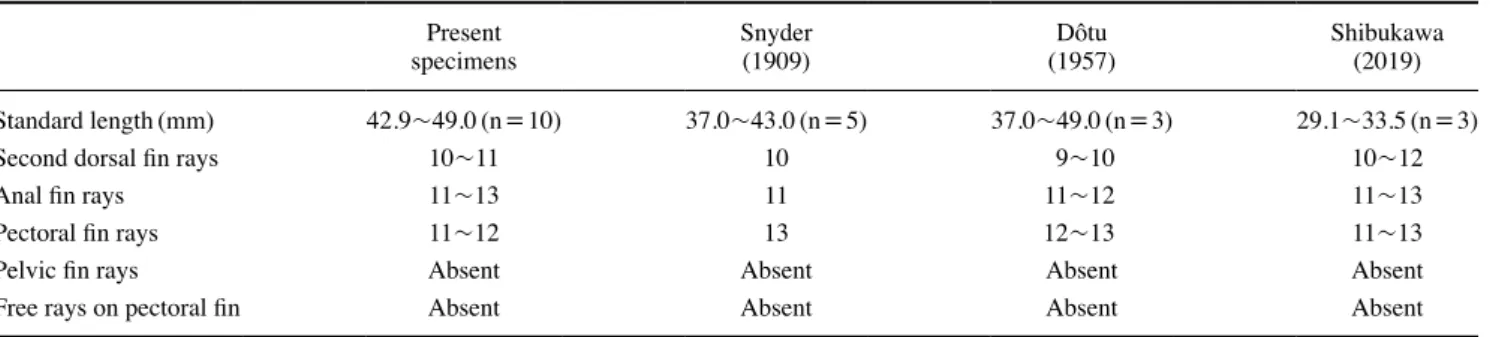
Description. Counts and measurements are shown in Table 1. Second dorsal fin rays 10~11; anal fin rays 11~13;
pectoral fin rays 11~12. Measurements in % of SL: head length 16.0~18.7; body depth 5.9~7.3; pre-dorsal length 67.7~72.5; pre-anal length 64.4~66.9; second dorsal fin base 10.8~13.2; anal fin base 13.1~16.7; caudal peduncle length 18.2~20.0; caudal peduncle depth 5.5~6.8. Mea- surements in % of HL: snout length 21.5~26.4; eye dia-
Fig. 1. Luciogobius parvulus, SOKN-P1001, 48.4mm SL., from the Jongdo-ri, Wando-eup, Wando-gun, Jeollanam-do, Korea.
Fig. 2. Ventral(a) and lateral(b) view of head in L. parvulus, SOKN-P1001.
A B
Table 1. Comparison of meristic counts of Luciogobius parvulus Present
specimens Snyder
(1909) Dôtu
(1957) Shibukawa
(2019)
Standard length(mm) 42.9~49.0(n=10) 37.0~43.0(n=5) 37.0~49.0(n=3) 29.1~33.5(n=3)
Second dorsal fin rays 10~11 10 9~10 10~12
Anal fin rays 11~13 11 11~12 11~13
Pectoral fin rays 11~12 13 12~13 11~13
Pelvic fin rays Absent Absent Absent Absent
Free rays on pectoral fin Absent Absent Absent Absent
meter 4.8~6.2; interorbital width 16.5~23.7.
Body very elongated, naked, same depth throughout and overall cylindrical. No cephalic sensory pore on head.
Mouth terminal; maxilla extending to posterior border of eye. Lower jaw more prominent than upper jaw. Small conical teeth on both jaws. Pectoral fin shape with rounded contour and small. Pelvic fin absent. First dorsal fin absent.
Origin of anal fin in front of that of second dorsal fin. Cau- dal fin round.
Coloration when fresh. The body background color yel- lowish white with small dots of dark brown very densely covered to look brown. Head light brownish. Ventral area spotless. Dark brown spots increase at the caudal pedun- cle. Pectoral and anal fins transparent.
Coloration after preserved specimen. Generally body brown gray. Dorsum darker than ventral surface. The edge of the caudal fin white.
Ecological notes. This species inhabited intertidal zone, rocky shore with gravel. It burrowed among moistened sediment composed of pebble without water (Fig. 3).
Distribution. Known from Japan (Shibukawa et al., 2019) and Korea (Wando-gun, Jeollanam-do: present study).
Remarks. The present specimens agree precisely with the description on L. parvulus presented by Snyder (1909), Dôtu (1957) and Shibukawa et al. (2019). Therefore we identified it as Luciogobius parvulus (Snyder, 1909). L.
parvulus is the most similar to L. elongatus than other con- generic species in morphology, but easily distinguished by absent pelvic fin. Also L. parvulus having more number of second dorsal fin rays 11~12 (vs. 7~8), anal fin rays 11~13 (vs. 8~9) and pectoral fin rays 11~12 (vs. 6~8) (Cho and Choi, 2014). Additionally L. parvulus is well differentiated from L. adapel as presence of second dorsal
fin and anal fin (vs. absence of those) and lives in intertidal zone of rocky shore (vs. 20~50 m water depth) (Okiyama, 2001).
Genus Expedio was established by Snyder (1909) on account of lacking pelvic fin. After that Koumans (1940) suggested that Expedio parvulus be considered a subspe- cies of L. guttatus. However, Okiyama (2001) suggested that genus Expedio was not valid because pelvic fin of E. parvulus was sometimes vestigal or highly reduced, so genus Expedio was not qualified in generic definition.
Also except for the absence of pelvic fin, L. parvulus well matched morphological features of Luciogobius (i.e., slen- der and elongated body, scaleless, lacking first dorsal fin, depressed head) (Gill, 1859; Okiyama, 2001). Therefore, it is considered that the genus Luciogobius is more valid than the genus Expedio.
We proposed a new Korean name, “Min-mi-kken-mang- dug” for L. parvulus referring to its absent of pelvic fin.
REFERENCES
Akihito, P. 1984. Suborder Gobioidei. In: Masuda, H., K. Amaoka, C.
Araga, T. Uyeno and T. Yoshino(eds.), The fishes of the Jap- anese Archipelago. Tokai Univ. Press, Tokyo, Japan, pp. 281- Akihito, P., K. Sakamoto, Y. Ikeda and M. Aizawa. 2013. Gobioidei. 283.
In: Nakabo, T.(ed.), Fishes of Japan with pictorial keys to the species, 3rd ed. Tokai Univ. Press, Kanagawa, Japan, pp.
1373-1378.
Chen, I.-S., T. Suzuki and H. Senou. 2008. A new species of gobiid fish, Luciogobius from Ryukyus, Japan(Teleostei: Gobii- dae). J. Mar. Sci. Technol., 16: 248-252. https://doi.org/10.
51400/2709-6998.2005.
Fig. 3. Habitat of L. parvulus, gravel beach. A. Jongdo-ri, Wando-eup, Wando-gun, Jeollanam-do, Korea. B. Mira-ri, Soan-myeon, Wando-gun, Jeollanam-do, Korea.
A B
dae) from Korea. Anim. Syst. Evol. Divers., 30: 22-25.
https://doi.org/10.5635/ASED.2014.30.1.022.
Dôtu, Y. 1957. A new species of a goby with a synopsis of the species of the genus Luciogobius Gill and its allied genera. J. Fac.
Agric. Kyushu Univ., 11: 69-76.
Dyldin, Y.V., L. Hanel, R. Fricke, A.M. Orlov, V.I. Romanov, J. Ple- snik, E.A. Interesova, D.S. Vorobiev and M.O. Kochetkova.
2020. Fish diversity in freshwater and brackish water eco- systems of Russia and adjacent waters. Publ. Seto Mar. Biol.
Lab., 45: 47-116. https://doi.org/10.5134/251251.
Gill, T.N. 1859. Notes on a collection of Japanese fishes, made by Dr.
J. Morrow. Proc. Acad. Nat. Sci. Philadelphia, 11: 144-150.
Hubbs, C.L. and K.F. Lagler. 2004. Fishes of the Great Lake region, revised ed. Michigan Univ. Press, Ann Arbor, U.S.A., 332pp.
Ikeda, Y., K. Tamada and K. Hirashima. 2019. Luciogobius yubai, a new species of gobioid fish(Teleostei: Gobiidae) from Japan.
Zootaxa, 4657: 565-572. https://doi.org/10.11646/zootaxa.
4657.3.8.
Kanagawa, N., T. Itai and H. Senou. 2011. Two new species of fresh- water gobies of the genus Luciogobius(Perciformes: Gobi- idae) from Japan. Bull. Kanagawa Prefect. Mus.(Nat. Sci.), 40: 67-74.
306-310.
Koumans, F.P. 1940. Results of a reexamination of types and speci- mens of gobioid fishes, with notes on the fish fauna of the surroundings of Batavia. Zool. Mededel., 22: 121-210.
Lindberg, G.U. and Z.V. Krasyukova. 1975. Fishes of the Sea of Japan and adjacent territories of the Okhotsk and Yellow Sea. Part 4.
Nauka, Leningrad, Russia, pp. 512-521.
Okiyama, M. 2001. Luciogobius adapel, a new species of gobiid fish from Japan. Bull. Natl. Sci. Mus. Ser. A., 27: 141-149.
Shibukawa, K., M. Aizawa, T. Suzuki, N. Kanagawa and F. Muto.
2019. Preliminary review of earthworm gobies of the genus Luciogobius(Gobiiformes, Oxudercidae) from Shizuoka Pre- fecture, Japan. Bull. Mus. Nat. Env. Hist. Shizuoka, 12: 29- 96.
Snyder, J.O. 1909. Descriptions of new genera and species of fishes from Japan and the Riu Kiu Islands. Proc. U. S. Natl. Mus., 36: 597-610. https://doi.org/10.5479/si.00963801.1688.597.
Yamada, T., T. Sugiyama, N. Tamaki, A. Kawakita and M. Kato.
2009. Adaptive radiation of gobies in the interstitial habitats of gravel beaches accompanied by body elongation and ex- cessive vertebral segmentation. BMC Evol. Biol., 9: 1-14.
https://doi.org/10.1186/1471-2148-9-145.
우리나라 완도 연안에서 채집된 망둑어과 (농어목) 한국 첫기록종 , Luciogobius parvulus
김민수1,2
·
라혜강2·
최승호1·
최윤2
1SOKN생태보전연구소, 2군산대학교 해양생물공학과
요 약 :
우리나라 전라남도 완도군 연안의 조간대 조사에서 Luciogobius parvulus 10개체(체장 42.8~49.0mm) 를 채집하였다. 본 종은 제 2등지느러미의 기조수 10~11개, 뒷지느러미 기조수 11~12개, 가슴지느러미 기조수 11~12개, 가슴지느러미 상부의 유리기조와 배지느러미가 부재하는 특징이 있다. 본 조사에서 확인된 모든 개체는조간대의 자갈해안에서 채집되었으며, 물이 고여 있지 않은 자갈틈에서 서식하였다. 본 종의 한국명으로 ‘민미끈망
둑’을 제안한다.