Introduction
Expressed sequence tags (ESTs) are single pass sequences generated from random sequencing of cDNA clones (Adams et al., 1991). Large scale EST analysis is also an efficient way for identifi- cation of genes and for analysis of their expres- sion by means of expression profiling (Franco et al., 1995; Azam et al., 1996; Lee et al., 2000). It offers a rapid and valuable first look at genes
expressed in specific tissue types, under specific physiological conditions, or during specific devel- opmental stages. ESTs have also been great re- sources for genomic mapping (Boguski and Schu- ler, 1995; Hudson et al., 1995; Schuler et al., 1996). Currently, the number of fish-related ESTs in the public databases is still small compared with mammalian sequences and there are rela- tively few tissue-specific cDNA libraries (Ton et al., 2000). ESTs have been shown to be an excel- lent and proven method of identification and cha- racterizing novel genes. Furthermore, compre- hensive information on steady state mRNA levels
Expressed Sequence Tags of Expression Profiles of Olive Flounder (Paralichthys olivaceus) Testis
Jeong-Ho Lee, Jong-Hyun Kim, Jae Koo Noh, Hyun Chul Kim, Young-Ok Kim1, Woo-Jin Kim1, Kyu-Won Kim2and Kyung-Kil Kim*
Genetics and Breeding Research Center, National Fisheries Research and Development Institute, Geoje 656-842, Korea
1Biotechnology Research Institute, National Fisheries Research and Development Institute, Busan 619-900, Korea
2Research Institute of Pharmaceutical Sciences, College of Pharmacy, Seoul National University, Seoul 151-742, Korea
We constructed a cDNA library of testis from olive flounder (Paralichthys olivaceus) and a total of 248 expressed sequence tag (EST) clones were generated. In order to understand the molecular compositions of the olive flounder testis organs, the ex- pression profiles of the identified clones in the cDNA library were analyzed. Gene annotation procedures and homology searches of the sequenced ESTs were locally done by BLASTX for amino acid similarity comparisons. Of the 248 EST clones, 156 ESTs showed significant homology to previously described genes while 92 ESTs were unidentified or novel. Comparative analysis of the 156 identified ESTs showed that 6 (3.8%) clones were representing 5 unique genes identified as homologous to the pre- viously reported olive flounder ESTs, 100 (64.1%) clones representing 94 unique genes were identified as orthologs of known genes from other organisms, and ortho- logs were established for 50 (32.1%) clones representing 44 genes of known sequences with unknown functions. Furthermore, the testis library showed a more even distri- bution of cDNA clones with relatively fewer abundant clones that tend to contribute redundant clones in EST projects; thus, the testis library can supply more unique and novel cDNA sequences in olive flounder EST project.
Key words : Expressed sequence tags (ESTs), expression profile, olive flounder (Paralichthys olivaceus), testis
*Corresponding author: [email protected]
─
─ 257 ──
is not known for most known fish transcripts (Vir- lon et al., 1999).
The olive flounder (Paralichthys olivaceus) is one of the most significant fish species in Korea and Japan due to human interests in aquaculture and fisheries. The olive flounder stocks currently used in aquaculture have become appreciably different to their wild counterparts and it seems likely that genetics will play an increasingly more important role in achieving further improve- ments in the performance of the brood stocks (Lie et al., 1994). Traits that may be amenable to gene- tic improvement include growth, delayed maturi- ty, sex determination, disease resistance and temperature tolerance. Despite this interest, relatively little information is available about olive flounder genes and their sequences with less than 100 typical nuclear-encoded olive floun- der gene sequences currently deposited in the international DNA sequence databases in the dbEST (Boguski et al., 1993). This lack of knowl- edge may represent one obstacle to the effective use of genetics in aiding both olive flounder aqua- culture and conservation activities. Therefore, in order to increase the current database of olive flounder genes, we investigated olive flounder gene identification and expression analysis pro- ject following the EST-based strategy (Adams et al., 1991) now commonly used for the identifica- tion of large numbers of genes in species of inter- est (Marra et al., 1998).
In this study, the 5′-terminal DNA sequences of 248 cDNA clones were analyzed and used to search the international protein databases for significant homology to genes previously identi- fied in other species. The results showed that orthologs for 156 genes plus 92 unknown ESTs were established from the olive flounder testis cDNA library. These ESTs will be useful for com- parative genomics by determination of their orthologous counterparts through evolution, for mapping by PCR analysis using radiation hybrid panels, and for identification of polymorphic markers in genes of known functions (type I mark- ers).
Materials and Methods
Olive flounders were obtained from Koje Hatch- ery of National Fisheries Research and Develop- ment Institute (NFRDI) and maintained in 6 tons flow-through tank at 12±1�C under a natural
photoperiod. Testis tissues from 10 fish were collected and cut into as small pieces as possible.
Pooled testis tissues were rapidly frozen with liquid nitrogen and were ground with a mortar/
pestle, and then homogenized with a hand-held tissue tearor in RNA extraction buffer following the guanidium thiocyanate method (Chomczynski and Sacchi, 1987).
Total RNA was extracted using the TRIzol rea- gent (Gibco BRL Life Technologies Ltd., Ren- frewshire, UK), and mRNA was enriched by oligo- (dT) cellulose chromatography using the Poly A Tract mRNA isolation kit (Promega, WI, USA).
cDNA synthesis was carried out using an oligo- (dT)18primer for the reverse transcription of approx- imately 5µg of mRNA, and the library was con- structed by directional cloning approach using Stratagene’s Uni-ZAP XR cloning systems.
Single-pass sequencing of the 5′-termini of select- ed testis cDNA clones in phagemid form was per- formed using the ABI 3100 automatic DNA sequen- cer (PE Applied Biosystems, CA, USA) and the ABI Prism Big Dye Terminator Cycle Sequenc- ing Ready Reaction kit (PE Applied Biosystems).
Bioinformatic analysis was conducted to deter- mine gene identities using GeneMaster software (Ensoltek, Korea). Briefly, vector sequences were removed and database search were limited to ESTs¤100 bp in length. ESTs were then assem- bled in clusters of contiguous sequences (contig) using ICAtools program (Parsons, 1995). Gene annotation procedures and homology searches of the sequenced ESTs have been locally done by BLASTX for amino acid similarity comparisons (Altschul et al., 1997). Matches with e-values less than 1.0×10⁻³were considered to be significant.
After the BLAST searches, a visual inspection was made to determine if the significant similar- ity was caused by simple sequences. ESTs with significant similarities in searches were consid- ered orthologs of known genes only when the similarities were not caused by simple sequences.
All ESTs that were not identified as orthologs of known genes were designated as unknown EST clones.
Results and Discussion
1. EST sequencing, clustering and similarity search of ESTs
A total of 248 randomly selected clones were single-pass sequenced from the 5′ end, resulting
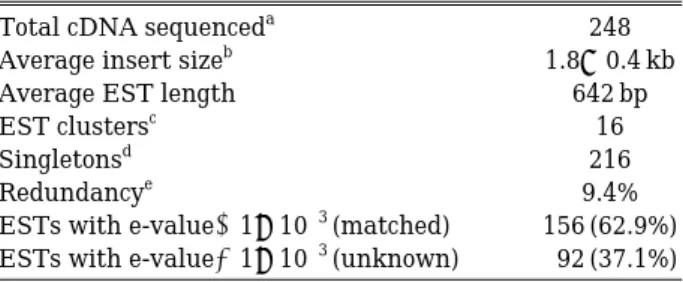
in the characterization of cDNA clones that were longer than 100 bp after elimination of vector sequence. The number of clones sequenced from the cDNA library, the average size of inserts, and the redundancy of the obtained sequences, are given in Table 1. The average insert size was estimated to be 1.8±0.4 kb by PCR amplification of inserts from 20 randomly selected clones. We used the assembly program ICAtools software (Parsons, 1995) to organize the redundant ESTs into overlapping contigs. The results showed that the 248 testis ESTs were composed of 16 clusters and 216 singletons, suggesting that the overall redundancy of the library was 9.4%.
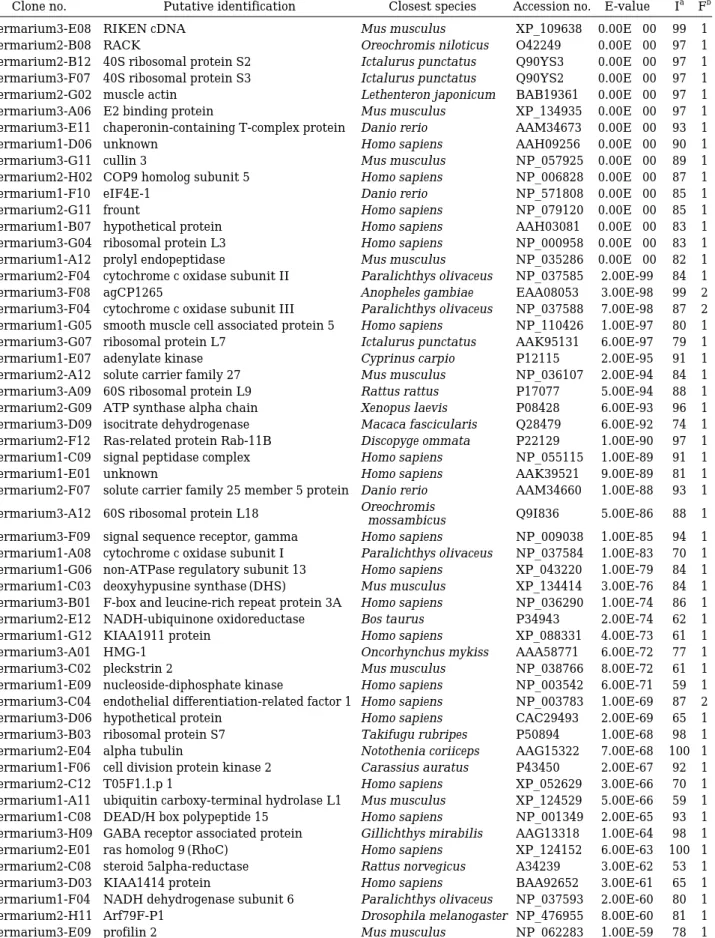
Due to the comparative lack of identified fish genes and as protein sequences have been shown to be more suitable to detect homology over long periods of evolutionary time (Pearson, 1997), a protein-based homology strategy was used to screen for homologous genes in the international databases. Gene annotation procedures and homo- logy searches of the sequenced ESTs have been locally done by BLASTX for amino acid similar- ity comparisons. BLASTX analysis was perfor- med using the substitution matrix BLOSUM62 (Henikoff and Henikoff, 1992). The ESTs with significant similarities (E⁄1×10⁻³) to known proteins were evaluated to determine if the signi- ficant similarities were caused by simple amino acid matches (Table 2). Of the 248 clones, 156 (62.9%) were identified as orthologues of known genes from other organisms. The remaining 92 (37.1%) clones could not be identified by similari- ty comparisons (E›1×10⁻³); most of them are
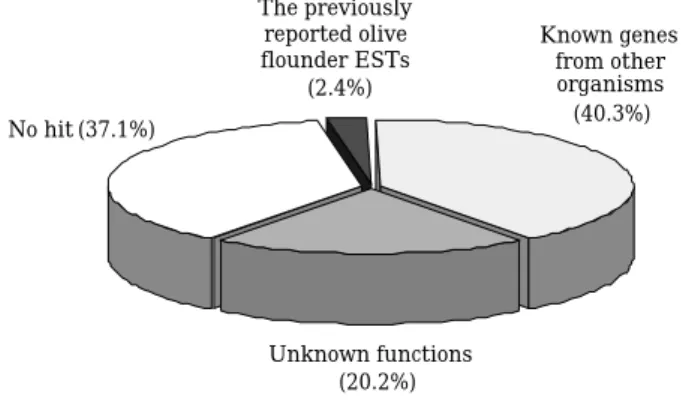
expected to derive from hitherto uncharacterized or novel genes, whereas some of them may be due to the fact that the homology is too low to detect in the sequenced region. Among the 156 EST clones, 6 (3.8%) clones were representing 5 unique genes identified as homologous to the previously reported olive flounder ESTs, 100 (64.1%) clones representing 94 unique genes were identified as orthologs of known genes from other organisms (Fig. 1). The fact that the majority of EST clones could be identified by similarity com- parisons suggests that high-quality EST analysis is an efficient way for gene annotation in less- well studied species. Fifty (32.1%) clones repre- senting 44 unique genes showed significant sim- ilarities to known sequences of unknown func- tions from model systems such as Homo sapiens, Mus musculus, Rattus norvegicus, Drosophila melanogaster, Anopheles gambiae and Caenor- habditis elegans. Although functions are not yet known, their conservation in fish demonstrated the existence of many gene families through evolution. Once a gene is characterized in any one of these species, comparative functional ge- nomics will allow annotation to these orthologous genes.
2. Expression profile and gene identification
Expression profiles of the EST clones identified from the olive flounder testis is shown in Fig. 2.
Of the 248 EST clones identified by BLASTX, 216 (87.1%) were singletons. Although redundancy will increase as the number of sequenced clones increases, the high percentage of singletons indi- cated that the complexity and coverage of this olive flounder testis cDNA library were good.
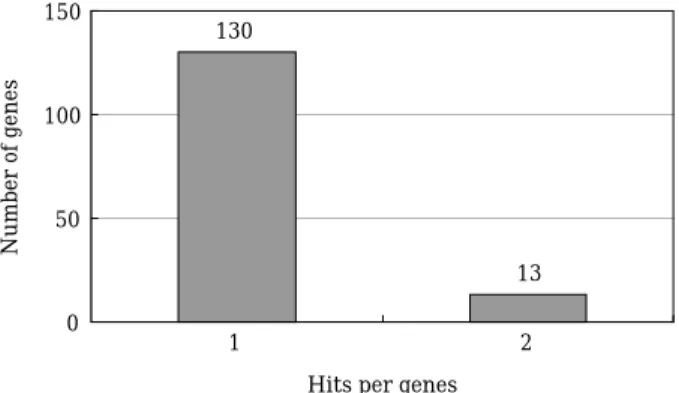
Among 156 identified distinct known genes, 130 genes (83.3%) were sequenced only once. The remaining 26 genes (16.7%) were sequenced 2 times. These results suggest that the testis libra- ry has a more even distribution of cDNA clones with relatively fewer abundant clones that tend to contribute redundant clones in EST projects;
thus, the testis library can supply more unique and novel cDNA sequences in a olive flounder EST project.
In the testis library, the hsp90βclone is one of the most abundant clones. As a member of the heat shock protein (HSP) family, HSP90 is a component of the inactive and metastable hetero- oligomeric structure of steroid receptors and func-
Table 1. General characteristics of olive flounder testis ESTs
Total cDNA sequenceda 248
Average insert sizeb 1.8±0.4 kb
Average EST length 642 bp
EST clustersc 16
Singletonsd 216
Redundancye 9.4%
ESTs with e-value⁄1×10⁻³(matched) 156 (62.9%) ESTs with e-value›1×10⁻³(unknown) 92 (37.1%)
aLength of sequence used for comparison after editing (inserts
⁄100 base pairs were excluded).
bThe average insert size was calculated for 20 randomly selected cDNA clones.
cESTs with 90% or greater identity over a 100 bp region were clustered together forming 16 EST clusters.
d216 sequences did not sufficiently match any sequence in the data set to allow assembly.
eRedundancy==The number of genes/total ESTs.
Table 2. List of identified ESTs from testis cDNA of olive flounder
Clone no. Putative identification Closest species Accession no. E-value Ia Fb
germarium3-E08 RIKEN cDNA Mus musculus XP_109638 0.00E++00 99 1
germarium2-B08 RACK Oreochromis niloticus O42249 0.00E++00 97 1
germarium2-B12 40S ribosomal protein S2 Ictalurus punctatus Q90YS3 0.00E++00 97 1 germarium3-F07 40S ribosomal protein S3 Ictalurus punctatus Q90YS2 0.00E++00 97 1 germarium2-G02 muscle actin Lethenteron japonicum BAB19361 0.00E++00 97 1 germarium3-A06 E2 binding protein Mus musculus XP_134935 0.00E++00 97 1 germarium3-E11 chaperonin-containing T-complex protein Danio rerio AAM34673 0.00E++00 93 1
germarium1-D06 unknown Homo sapiens AAH09256 0.00E++00 90 1
germarium3-G11 cullin 3 Mus musculus NP_057925 0.00E++00 89 1
germarium2-H02 COP9 homolog subunit 5 Homo sapiens NP_006828 0.00E++00 87 1
germarium1-F10 eIF4E-1 Danio rerio NP_571808 0.00E++00 85 1
germarium2-G11 frount Homo sapiens NP_079120 0.00E++00 85 1
germarium1-B07 hypothetical protein Homo sapiens AAH03081 0.00E++00 83 1 germarium3-G04 ribosomal protein L3 Homo sapiens NP_000958 0.00E++00 83 1 germarium1-A12 prolyl endopeptidase Mus musculus NP_035286 0.00E++00 82 1 germarium2-F04 cytochrome c oxidase subunit II Paralichthys olivaceus NP_037585 2.00E-99 84 1
germarium3-F08 agCP1265 Anopheles gambiae EAA08053 3.00E-98 99 2
germarium3-F04 cytochrome c oxidase subunit III Paralichthys olivaceus NP_037588 7.00E-98 87 2 germarium1-G05 smooth muscle cell associated protein 5 Homo sapiens NP_110426 1.00E-97 80 1 germarium3-G07 ribosomal protein L7 Ictalurus punctatus AAK95131 6.00E-97 79 1
germarium1-E07 adenylate kinase Cyprinus carpio P12115 2.00E-95 91 1
germarium2-A12 solute carrier family 27 Mus musculus NP_036107 2.00E-94 84 1 germarium3-A09 60S ribosomal protein L9 Rattus rattus P17077 5.00E-94 88 1 germarium2-G09 ATP synthase alpha chain Xenopus laevis P08428 6.00E-93 96 1 germarium3-D09 isocitrate dehydrogenase Macaca fascicularis Q28479 6.00E-92 74 1 germarium2-F12 Ras-related protein Rab-11B Discopyge ommata P22129 1.00E-90 97 1 germarium1-C09 signal peptidase complex Homo sapiens NP_055115 1.00E-89 91 1
germarium1-E01 unknown Homo sapiens AAK39521 9.00E-89 81 1
germarium2-F07 solute carrier family 25 member 5 protein Danio rerio AAM34660 1.00E-88 93 1 germarium3-A12 60S ribosomal protein L18 Oreochromis
mossambicus Q9I836 5.00E-86 88 1
germarium3-F09 signal sequence receptor, gamma Homo sapiens NP_009038 1.00E-85 94 1 germarium1-A08 cytochrome c oxidase subunit I Paralichthys olivaceus NP_037584 1.00E-83 70 1 germarium1-G06 non-ATPase regulatory subunit 13 Homo sapiens XP_043220 1.00E-79 84 1 germarium1-C03 deoxyhypusine synthase (DHS) Mus musculus XP_134414 3.00E-76 84 1 germarium3-B01 F-box and leucine-rich repeat protein 3A Homo sapiens NP_036290 1.00E-74 86 1 germarium2-E12 NADH-ubiquinone oxidoreductase Bos taurus P34943 2.00E-74 62 1
germarium1-G12 KIAA1911 protein Homo sapiens XP_088331 4.00E-73 61 1
germarium3-A01 HMG-1 Oncorhynchus mykiss AAA58771 6.00E-72 77 1
germarium3-C02 pleckstrin 2 Mus musculus NP_038766 8.00E-72 61 1
germarium1-E09 nucleoside-diphosphate kinase Homo sapiens NP_003542 6.00E-71 59 1 germarium3-C04 endothelial differentiation-related factor 1 Homo sapiens NP_003783 1.00E-69 87 2 germarium3-D06 hypothetical protein Homo sapiens CAC29493 2.00E-69 65 1 germarium3-B03 ribosomal protein S7 Takifugu rubripes P50894 1.00E-68 98 1 germarium2-E04 alpha tubulin Notothenia coriiceps AAG15322 7.00E-68 100 1 germarium1-F06 cell division protein kinase 2 Carassius auratus P43450 2.00E-67 92 1
germarium2-C12 T05F1.1.p 1 Homo sapiens XP_052629 3.00E-66 70 1
germarium1-A11 ubiquitin carboxy-terminal hydrolase L1 Mus musculus XP_124529 5.00E-66 59 1 germarium1-C08 DEAD/H box polypeptide 15 Homo sapiens NP_001349 2.00E-65 93 1 germarium3-H09 GABA receptor associated protein Gillichthys mirabilis AAG13318 1.00E-64 98 1 germarium2-E01 ras homolog 9 (RhoC) Homo sapiens XP_124152 6.00E-63 100 1 germarium2-C08 steroid 5alpha-reductase Rattus norvegicus A34239 3.00E-62 53 1
germarium3-D03 KIAA1414 protein Homo sapiens BAA92652 3.00E-61 65 1
germarium1-F04 NADH dehydrogenase subunit 6 Paralichthys olivaceus NP_037593 2.00E-60 80 1 germarium2-H11 Arf79F-P1 Drosophila melanogaster NP_476955 8.00E-60 81 1
germarium3-E09 profilin 2 Mus musculus NP_062283 1.00E-59 78 1
germarium1-B09 HSPC176 Homo sapiens AAF29139 2.00E-59 78 1 germarium2-B02 aldehyde reductase 1 Rattus norvegicus NP_036630 8.00E-59 66 1
germarium2-A09 peroxiredoxin 3 Homo sapiens NP_006784 7.00E-58 79 1
germarium1-E04 histone H2A.F/Z variant Homo sapiens NP_036544 1.00E-56 99 2
germarium2-E08 ISCU2 Mus musculus XP_132287 6.00E-56 74 1
germarium1-E08 transformer-2b Oryzias latipes BAC06514 2.00E-55 93 1
germarium1-D09 nucleoside diphosphate kinase homolog 5 Homo sapiens XP_063164 4.00E-55 42 1
germarium1-B10 RIKEN cDNA Mus musculus XP_127600 1.00E-54 45 1
germarium3-A04 testis specific protein A14 Homo sapiens NP_061188 3.00E-54 55 2 germarium3-A08 human general transcription factor Tfib unknown 1TFB 8.00E-54 83 1
germarium1-C05 P7D11 Xenopus laevis BAB79596 2.00E-52 52 2
germarium3-B04 pendulin Oreochromis niloticus AAD51751 2.00E-51 67 1
germarium3-G01 TBP-associated factor 13 Mus musculus NP_005636 1.00E-47 97 2 germarium1-E11 unknown (protein for MGC:41163) Mus musculus AAH27526 2.00E-47 60 1 germarium2-D08 Ras-related protein O-Krev Discopyge ommata P22123 2.00E-47 95 1 germarium3-A05 deoxycytidine kinase Mus musculus NP_031858 9.00E-47 58 1 germarium3-G06 NADH dehydrogenase subunit 4 Paralichthys olivaceus NP_037591 2.00E-46 71 1
germarium3-G05 RIKEN cDNA Mus musculus NP_077153 3.00E-46 61 1
germarium1-A07 dynein light chain 2; RIKEN cDNA Mus musculus NP_080832 1.00E-45 96 1 germarium3-E03 transforming protein B-myb Xenopus laevis S33643 2.00E-45 72 1 germarium3-D10 ornithine decarboxylase antizyme Danio rerio Q9YI98 2.00E-45 73 1 germarium1-H03 testis specific protein Rattus norvegicus NP_620220 2.00E-45 54 1 germarium3-H07 TdT binding protein Homo sapiens NP_443183 7.00E-45 61 1
germarium3-G12 RIKEN cDNA Homo sapiens XP_059468 1.00E-44 51 1
germarium3-D08 diaphanous homolog 3 Homo sapiens NP_112194 3.00E-44 56 1 germarium3-B07 hypothetical protein Homo sapiens NP_112577 3.00E-44 92 2 germarium2-C01 BBP-like protein 2 isoform b Homo sapiens NP_079417 2.00E-41 56 1
germarium1-E12 RIKEN cDNA Mus musculus AAH26136 4.00E-41 76 1
germarium3-E02 cytochrome b5 Homo sapiens 1513199A 1.00E-40 65 1
germarium3-A11 33 kDa Inner dynein arm light chain Strongylocentrotus
purpuratus Q26630 2.00E-37 50 1
germarium1-F02 CG12314 gene product Homo sapiens XP_113904 3.00E-36 50 1
germarium1-F01 RIKEN cDNA Mus musculus NP_077152 7.00E-36 83 1
germarium3-E05 hypothetical protein Homo sapiens AAH13194 3.00E-35 59 1 germarium1-C10 homeodomain-interacting protein kinase 2 Homo sapiens AAG35710 8.00E-34 42 1 germarium1-A06 hypothetical protein Homo sapiens NP_061911 4.00E-33 44 1 germarium2-A01 heat shock protein 90 beta Platichthys flesus CAC27523 9.00E-33 93 2 germarium2-D12 RIKEN cDNA 4921507O14 Mus musculus XP_130840 3.00E-32 31 1 germarium3-G10 protein phosphatase 1 Rattus norvegicus NP_002700 2.00E-29 93 1 germarium3-E04 unnamed protein product Homo sapiens BAB71463 2.00E-28 34 1
germarium3-D04 RIKEN cDNA Mus musculus XP_109996 2.00E-28 39 1
germarium3-E10 COP9 homolog, subunit 6 Mus musculus XP_132437 3.00E-28 95 1 germarium2-H07 beta-carotene 15, 15-dioxygenase Danio rerio NP_571873 1.00E-27 79 1 germarium2-B01 hypothetical protein Homo sapiens CAB66805 1.00E-26 43 1 germarium2-C04 NADH dehydrogenase Homo sapiens NP_002480 2.00E-26 72 1 germarium3-G09 acetylhydrolase Ib-alpha subunit Xenopus laevis AAK52334 2.00E-25 98 1
germarium3-D07 SPTR Mus musculus BAB31913 5.00E-25 50 1
germarium3-C05 beta-carotene 15, 15’-dioxygenase Gallus gallus CAB90825 8.00E-25 52 1
germarium1-F08 RW1 protein Mus musculus XP_123646 3.00E-24 38 1
germarium3-B05 proteolipid protein 2 Mus musculus NP_062729 3.00E-24 40 1 germarium3-H06 Sad1/unc-84-like protein 2 Homo sapiens Q9UH99 5.00E-24 56 1 germarium1-G03 growth arrest-specific 11 Homo sapiens NP_001472 2.00E-23 42 1 germarium1-G10 protein transport protein Canis familiaris P38384 4.00E-22 77 1
germarium2-C03 SPTR Mus musculus XP_134222 8.00E-21 38 2
germarium3-C07 TBC domain containing protein Mus musculus BAB30630 9.00E-21 61 1 germarium3-F10 endoplasmic reticulum protein 1 Homo sapiens AAH29067 9.00E-21 75 1 Table 2. Continued
Clone no. Putative identification Closest species Accession no. E-value Ia Fb
tions as a molecular chaperone. It has been re- ported in rats that hsp90 is highly expressed in primordial germ cells and continues to be express- ed in both male and female premeiotic germ cells (Ohsako et al., 1995). Thus, it is likely that hsp90 plays an important role in development of germ cells. Another clone, germarium2-B08, showed homology to RACK (receptor of activated protein kinase C) of tilapia with identities of 97%. PKC has been reported to be involved in spermatogo- nium proliferation in vitro and it may act as the physiological regulators of spermatogonium devel- opment in vivo (Li et al., 1997). In addition, two kind of testis-specific protein are thought to play apparent roles in the olive flounder testis. The putative amino acid sequences deduced from two cDNA clone, germarium1-H03 and germarium3-
germarium3-F01 unnamed protein product Homo sapiens BAC05158 7.00E-20 82 1
germarium1-B12 RIKEN cDNA Mus musculus AAH04765 2.00E-18 41 1
germarium2-D05 RIKEN cDNA Homo sapiens XP_114126 7.00E-18 43 2
germarium3-B06 chromosome 11 open reading frame 5 Homo sapiens NP_055020 9.00E-18 32 1
germarium1-A03 lyncein Bos taurus CAA76943 2.00E-17 50 1
germarium2-E03 G protein pathway suppressor 2 Homo sapiens NP_004480 2.00E-17 48 1 germarium3-D05 sentrin/SUMO-specific protease 7 Homo sapiens NP_065705 5.00E-17 67 1 germarium2-G04 hypothetical protein Homo sapiens XP_058897 1.00E-16 37 1
germarium3-H01 U2 snRNA Xenopus laevis CAA24954 1.00E-16 65 1
germarium2-E10 hypothetical protein Homo sapiens NP_115688 4.00E-15 67 1 germarium1-F09 SH3-containing protein Homo sapiens NP_057093 7.00E-15 63 1 germarium3-F06 ataxin-1 ubiquitin-like interacting protein Mus musculus NP_277068 1.00E-14 57 1 germarium1-B01 carbonic anhydrase Platichthys flesus AAC64172 1.00E-14 87 1 germarium3-F12 hypothetical protein Homo sapiens XP_059540 8.00E-14 41 1 germarium1-G09 translation initiation factor eIF-4 gamma Homo sapiens S49172 4.00E-13 53 1 germarium1-D03 CG8607 gene product Drosophila melanogaster NP_648100 9.00E-13 48 1
germarium1-C04 hypothetical protein Homo sapiens T50634 8.00E-11 46 1
germarium3-C01 SPTR Mus musculus BAB24507 7.00E-10 51 1
germarium1-G11 5OT-EST protein Mus musculus XP_130464 8.00E-10 67 1
germarium3-A10 protein phosphatase 1 Homo sapiens NP_116222 5.00E-09 29 2 germarium1-B08 transcription factor Tcf3b Danio rerio AAD41491 5.00E-09 42 1 germarium2-B10 14S cohesin RAD21 subunit Xenopus laevis AAC26809 6.00E-09 42 1
germarium3-B09 NaDC-2 Xenopus laevis AAB97879 1.00E-07 69 1
germarium1-H08 cytochrome c oxidase Mus musculus NP_031776 1.00E-06 37 1
germarium3-C03 agCP4537 Anopheles gambiae EAA14698 2.00E-05 35 1
germarium1-F12 casein kinase II, alpha chain (CK II) Gallus gallus P21868 3.00E-05 60 1
germarium2-G01 agCP8854 Anopheles gambiae EAA14543 4.00E-05 67 1
germarium1-G02 KPL2 protein Rattus norvegicus NP_072142 7.00E-05 51 1
germarium3-F03 myosin Mizuhopecten yessoensis BAB00612 7.00E-05 25 1
germarium3-H04 Y39B6A.n.p Caenorhabditis elegans NP_507706 1.00E-04 23 2 germarium3-B12 PE_PGRS family protein Mycobacterium
tuberculosis NP_335725 2.00E-04 31 1
germarium1-E03 SPTR Mus musculus XP_133552 2.00E-04 49 1
germarium2-C10 synovial sarcoma associated SS18-delta Mus musculus AAL17749 8.00E-04 85 1
aIdentity (%), bFrequency of the clones in the sequenced pool.
Table 2. Continued
Clone no. Putative identification Closest species Accession no. E-value Ia Fb
130
13 0
50 100 150
1 2
Hits per genes
Number of genes
Fig. 1. Expression profiles and sequencing redundancy in the analysis of ESTs from the olive flounder (Para- lichthys olivaceus) testis. Among 156 identified distinct known genes, 130 genes (83.3%) were se- quenced only once; The remaining 26 genes (16.7%) were sequenced 2 times.
A04, were identified as testis-specific protein.
The alignment revealed that these putative sequences showed homology to testis-specific protein of human and rat, with identities of 55%
and 54%, respectively. Although functions are not yet known, their conservation in fish demon- strated the existence of many gene families throu- gh evolution. Once a gene is characterized in any one of these species, comparative functional geno- mics will allow annotation to these orthologous genes.
3. Microsatellite containing genes
Microsatellites represent another class of genet- ic markers. They are short tandem repeats of 2~
6 nucleotides. Markers generated from these re- peats are known to be highly polymorphic because of length variation of these repeats, and conse- quently, they exhibit multiple alleles, which makes them very informative for genetic studies.
Polymorphism can be evaluated by PCR, which requires only a small amount of DNA, and allele sizing can be achieved with fluorescent primers and an automatic sequencer which assures relia- bility of the results. Microsatellites are commonly believed to occur primarily in noncoding DNA.
However, surveys of other cDNA libraries have indicated that up to 8% of clones may contain microsatellites (Khan et al., 1992). A high per- centage of clones containing repetitive sequences have been observed from eight olive flounder cDNA libraries. Among 248 random clones, 22 unique EST clones have obvious repetitive se-
quences, including di-, tri-, penta- and hexa-nu- cleotide repetitive. Single nucleotide repeats were not included since they are not very useful for polymorphic markers. Table 3 details the num- bers of microsatellite containing ESTs found in the olive flounder testis. These microsatellites can be potentially useful for genomic mapping if they are polymorphic. It was reported that target- ing microsatellite regions within cDNAs is an efficient way to develop type I molecular markers representing genes of known functions (O’Brien, 1991). Because of the evolutionary conservation, mutation rates within gene-coding sequences are lower than those in non-coding genomic sequen- ces. As a result, type I polymorphic markers are often more difficult to be identified. By tagging the highly polymorphic microsatellites to known genes, the efficiency for the development of type I markers can be dramatically enhanced. Type I markers can serve as anchor points to allow the transfer of gene map information from a ‘map- rich’ model species to a ‘map-poor’ species, such as fish, and also facilitate physical mapping.
Markers with known functions can also provide gene candidates for production traits. Thus, ESTs are important components in genome mapping projects (e.g., human, Adams et al., 1991; rice, Aliyeva et al., 1996; catfish, Liu et al., 1999). It is interesting to note that EST analysis may be one of the most efficient ways for the development of polymorphic type I markers as well as through tagging of microsatellites existing within cDNAs.
In conclusion, this study reports an expressed sequence tag (EST)-based gene identification analysis of 248 ESTs derived from olive flounder testis cDNA library. These ESTs will be useful for comparative genomics by determination of their orthologous counterparts through evolution, for mapping by PCR analysis using radiation hybrid panels, and for identification of polymor- phic markers in genes of known functions (type I markers). Therefore, the testis has a potentially larger diversity of transcript profile and thus a
No hit (37.1%)
Known genes from other organisms (40.3%) The previously
reported olive flounder ESTs
(2.4%)
Unknown functions (20.2%)
Fig. 2. Classification of 248 ESTs from the testis cDNA lib- rary of Paralichthys olivaceus. ESTs with BLASTX E⁄1×10⁻³were classified: the previously reported olive flounder ESTs, known genes from other organ- isms and known sequences of unknown functions.
ESTs with E›1×10⁻³were classified as novel.
Table 3. Analysis of microsatellite regions identified ESTs from testis cDNA of olive flounder. Numbers in parentheses are percentages of the number of microsatellites
No. of No. of microsatelites
cDNA clones Total (%) di tri tetra penta hexa
248 22 (8.9) 9 8 1 2 2
more efficient gene discovery could be carried out in a testis cDNA library.
Acknowledgements
This work is funded by a grant from the Nation- al Fisheries Research and Development Institute (RP-2007-AQ-064).
References
Adams, M.D., J.M. Kelley, J.D. Gocayne, M. Dubnick, M.H.
Polymeropoulos, H. Xiao, C.R. Merril, A. Wu, B. Olde, R.F. Moreno, A.R. Kerlavage, W.R. McCombie and J.C.
Venter. 1991. Complementary DNA sequencing: ex- pressed sequence tags and human genome project. Sci- ence, 252 : 1651~1656.
Aliyeva, E., A.M. Metz and K.S. Browning. 1996. Sequences of two expressed sequence tags (EST) from rice encoding different cap-binding proteins. Gene, 21(180) : 221~223.
Altschul, S.F., T.L. Madden, A.A. Schaffer, J. Zhang, Z.
Zhang, W. Miller and D.J. Lipman. 1997. Gapped BLAST and PSI-BLAST: a new generation of protein database search programs. Nucleic Acids Res., 25 : 3389
~3402.
Azam, A., J. Paul, D. Sehgal, J. Prasad, S. Bhattacharya and A. Bhattacharya. 1996. Identification of novel genes from Entamoeba histolytica by expressed sequence tag analysis. Gene, 181 : 113~116.
Boguski, M.S., T.M. Lowe and C.M. Tolstoshev. 1993. dbEST -database for expressed sequence tags. Nat. Genet., 4 : 332~333.
Boguski, M.S. and G.D. Schuler. 1995. ESTablishing a human transcript map. Nat. Genet., 10 : 369~371.
Chomczynski, P. and N. Sacchi. 1987. Single-step method of RNA isolation by acid guanidinium thiocyanate-phe- nol-chloroform extraction. Analyt. Biochem., 162 : 156
~159.
Franco, G.R., M.D. Adams, S.M. Bento, A.J.G. Simpson, J.C. Venter and S.D.J. Pena. 1995. Identification of new Schistosoma mansoni genes by the EST strategy using a directional cDNA library. Gene, 152 : 141~147.
Henikoff, S. and J.G. Henikoff. 1992. Amino acid substitu- tion matrices from protein blocks. Proc. Natl. Acad. Sci.
U.S.A., 89 : 10915~10919.
Hudson, T.J., L.D. Stein, S.S. Gerety, J. Ma, A.B. Castle, J.
Silva, D.K. Slonim, R. Baptista, L. Kruglyak, S.H. Xu et
al. 1995. An STS-based map of the human genome.
Science, 270 : 1945~1954.
Khan, A.S., A.S. Wilcox, M.H. Polymeropoulos, J.A. Hop- kins, T.J. Stevens, M. Robinson, A.K. Orpana and J.M.
Sikela. Single pass sequencing and physical and genetic mapping of human brain cDNAs. Nat. Genet., 2 : 180~ 185.
Lee, C.K., R. Weindruch and T.A. Prolla. 2000. Gene-expres- sion profile of the aging skin in mice. Nat. Genet., 25 : 294~297.
Li, H., V. Papadopoulos, B. Vidic, M. Dym and M. Culty.
1997. Regulation of rat testis gonocyte proliferation by platelet-derived growth factor and estradiol: identifica- tion of signaling mechanisms involved. Endocrinology, 138 : 1289~1298.
Lie, O., A. Slettan, U. Grimholt, M. Lundin, M. Syed and I.
Olsaker. 1994. Fish gene maps and their implications for aquaculture. Anim. Biotech., 5 : 209~218.
Liu, Z., G. Tan, P. Li and R.A. Dunham. 1999. Transcribed dinucleotide microsatellites and their associated genes from channel catfish Ictalurus punctatus. Biochem.
Biophys. Res. Commun., 259 : 190~194.
Marra, M.A., L. Hillier and R.H. Waterston. 1998. Express- ed sequence tags-ESTablising bridges between genomes.
Trends Genet., 14 : 4~7.
O’Brien, S.J. 1991. Molecular genome mapping lessons and prospects. Curr. Opin. Genet. Dev., 1 : 105~111.
Ohsako, S., D. Bunick and Y. Hayashi. 1995. Immunocyto- chemical observation of the 90 KD heat shock protein (HSP90): high expression in primordial and pre-meiotic germ cells of male and female rat gonads. J. Histochem.
Cytochem., 43 : 67~76.
Parsons, J.D. 1995. Improved tools for DNA comparison and clustering. Comp. Appl. Biosci., 11 : 603~613.
Pearson, W.R. 1997. Identifying distantly related protein sequences. Comput. Appl. Biosci., 13 : 325~332.
Sambrook, J., E.F. Frisch and T. Maniatis. 1989. Molecular Cloning, A Laboratory Manual, Cold Spring Harbor Laboratory Press, Cold Spring Harbor, New York.
Schuler, G.D. et al., 1996. Genome maps 7. The human transcript map. Wall chart. Science, 274 : 547~562.
Ton, C., D.M. Hwang, A.A. Dempsey, H.-C. Tang, J. Yoon, M. Lim, J.D. Mably, M.C. Fishman and C.C. Liew. 2000.
Identification, characterization, and mapping of ex- pressed Sequence tags from an embryonic zebrafish heart cDNA library. Genome Res., 10 : 1915~1927.
Virlon, B., L. Cheval, J.M. Buhler, E. Billon, A. Doucet and J.M. Elalouf. 1999. Serial microanalysis of renal trans- criptomes. Proc. Natl. Acad. Sci. U.S.A., 96 : 15286~ 15291.
Received : October 1, 2007 Accepted : November 22, 2007
ESTs (Expressed Sequence Tags)를 통한 넙치(Paralichthys olivaceus) 정소의 유전자 발현 패턴 분석
이정호∙김종현∙노재구∙김현철∙김영옥1 김우진1∙김규원2∙김경길*
국립수산과학원 육종연구센터, 1국립수산과학원 생명공학연구소,
2서울대학교 약학대학
본 연구에서는 넙치(Paralichthys olivaceus ) 정소에 대한 cDNA library를 제작하여 총 248개 의 EST (Expressed sequence tag)를 분석을 하였다. 넙치 정소의 유전자 발현 패턴을 조사하기 위하여 염기서열의 유사성 분석을 한 결과 248개의EST 중 156개의EST는 이미 밝혀진 유전자 와 유사성이 있는 것으로 나타났으며, 92개의 EST는 새로운 유전자로 밝혀졌다. 유전자의 기능 이 밝혀진250개의 EST 중 6개(3.8%)의 EST는 이미 알려진 넙치 EST와 상동성이 있는 유전자 로 확인되었고, 100개(64.1%)의 EST는 다른 생물에서 알려진 유전자와 상동성이 있는 것으로 나타났다. 그러나 50개(32.1%)의 EST는 전혀 기능이 알려지지 않은 새로운 유전자로 밝혀졌다. 이상의 결과에서 넙치 정소에서 발현되는 유전자는 다른 조직에 비해 일부 유전자의 상대적인 발현정도가 많지 않고, 대부분의 유전자가 골고루 발현함으로써 다양한 유전자의 발현패턴이 확 인되었다. 따라서 넙치 정소에 대한 cDNA library는 특이하고 새로운 발현 유전자의 탐색에 좋 은 재료로 사용될 것으로 추측된다.