Introduction
The expressed sequence tag (EST) approach, first demonstrated in the human genome project (Adams et al., 1991), is powerful in massive clon- ing of cDNAs as well as in large scale charac- terization of cDNA sequences for deciphering genome sequence. This approach is also valuable in studies of mRNA expression profiles at a single gene level from unbiased cDNA libraries.
In general, two types of information can be ob- tained by this approach: the composition of ex- pressed transcripts and the relative abundance of these transcripts. Both types of information are important to the understanding of molecular composition and function of source tissues and cells.
Recently, EST analysis has become a com- monly used approach to identify genes involved in specific biological functions, and especially in organisms where genomic data are not available, like for instance, tolerance to osmotic stress in plant (Zhang et al., 2001) or gene profiling during
Immune Gene Discovery by Expressed Sequence Tags Generated from Olive Flounder
(Paralichthys olivaceus) Kidney
Jeong-Ho Lee, Young-Ok Kim1, Jong-Hyun Kim, Jae Koo Noh, Hyun Chul Kim, Kyung-Kil Kim* and Kyu-Won Kim2
Fish Genetics and Breeding Research Center, National Fisheries Research and Development Institute, Geoje 656-842, Korea
1Biotechnology Research Center, National Fisheries Research and Development Institute, Busan 619-900, Korea
2Research Institute of Pharmaceutical Sciences, College of Pharmacy, Seoul National University, Seoul 151-742, Korea
Expressed sequence tag (EST) analysis was conducted using a complementary DNA (cDNA) library made from the kidney mRNA of olive flounder (Paralichthys olivaceus). In the survey of 390 ESTs chosen from the kidney cDNA library, 250 ESTs showed significant homology to previously described genes while 140 ESTs were unidentified or novel. Comparative analysis of the 250 identified ESTs showed that 14 (5.6%) clones were representing 11 unique genes identified as homologous to the previously reported olive flounder ESTs, 198 (79.2%) clones representing 160 unique genes were identified as orthologs of known genes from other organisms, and orthologs were established for 38 (15.2%) clones representing 37 genes of known sequences with unknown functions. We also identified several kinds of immune associated proteins, indicating EST as a powerful method for identifying immune- related genes of fish as well as identifying novel genes. Further studies using cDNA microarrays are needed to identify the differentially expressed transcripts after disease infection.
Key words : expressed sequence tags (ESTs), expression profile, olive flounder (Paralichthys olivaceus), kidney, immune gene
*Corresponding author: [email protected]
─
─ 283 ──
embryogenesis in ascidians (Satou et al., 2002).
The EST approach was used to identify genetic markers in salmon (Davey et al., 2001), environ- mental stress indicators in American oyster (Jenny et al., 2002) or to characterize immune genes in flounder (Aoki et al., 1999; Nam et al., 2000) and shrimp (Gross et al., 2001). Indeed, in such marine organisms with economical interest, the access to genomic data may provide new insight into the management of aquaculture activ- ities.
Infectious diseases in fish cause major losses in aquaculture industry. As olive flounder is one of the most widely cultured fish species and con- sidered to be a major source of protein in Korea and Japan, investigations into the immuno- logical mechanisms are required for the estab- lishment of new methods for prevention of dis- eases and its sustainable production. Gene cata- loguing and profiling of the kidney is an essen- tial part in EST analysis of immune organs. The immune system of fish is similar to that of mam- mals (Secombes et al., 1983) consisting of non- specific defense barriers and specific immune functions; the latter includes T- and B-cell medi- ated cellular and humoral immunity (Partula et al., 1995; Yamaguchi et al., 1996; Passer et al., 1996; Nishimura et al., 1997). In addition to the thymus and spleen, which are also present in higher vertebrates, another lymphoid organ, the kidney, exists in fish (Pichappan, 1980; Chil- moczyk, 1992) and is the functional counterpart of mammalian bone marrow. The objectives of this study were to identify genes and their expres- sion profiles in the kidney, and to develop EST resources for functional genomic studies. As part of immune gene discovery by expressed sequence tag analysis, we report analysis of 390 clones from the olive flounder (Paralichthys olivaceus) kidney.
Materials and Methods
1. Fish and tissue preparation
Olive flounders used in this study were main- tained in 6 tons flow-through tank at 12±1�C under a natural photoperiod. Kidney tissues from 10 fishes were collected and cut into as small pieces as possible. Pooled kidney tissues were rapidly frozen with liquid nitrogen and were ground with a mortar/pestle, and then
homogenized with a hand-held tissue tearor in RNA extraction buffer following the guanidium thiocyanate method (Chomczynski and Sacchi, 1987).
2. Construction of kidney cDNA library Total RNA was extracted using the TRIzol rea- gent (Gibco BRL Life Technologies Ltd., Renfrew- shire, UK), and mRNA was enriched by oligo- (dT) cellulose chromatography using the PolyA Tract mRNA isolation kit (Promega, WI, USA).
cDNA synthesis was carried out using an oligo- (dT)18 primer for the reverse transcription of approximately 5µg of mRNA, and the library was constructed by directional cloning approach using Stratagene’s Uni-ZAP XR cloning systems.
The primary library was amplified to a titer of 1.0×10⁷pfu/mL and stored at both 4 and -70�C.
Mass excision was performed and the cDNA inserts from the amplified Uni-ZAP XR library were rescued as pBluescript phagemids in SOLR Escherichia coli. A total of 1,000 colonies were randomly picked and rearranged in 96-well pla- tes.
3. Plasmid preparation and sequencing The plasmid cDNA library was plated to a den- sity appropriate for picking individual colonies.
Random clones were grown in 1.5 mL LB medium overnight in 12×75 mm culture tubes. Plasmid DNA was prepared by the alkaline lysis method (Sambrook et al., 1989) using the Qiagen Spin Column Mini-plasmid kits. Three microliters of plasmid DNA (about 0.5~1.0µg) were used in sequencing reactions. Single-pass sequencing of the 5′-termini of selected kidney cDNA clones in phagemid form was performed using the ABI 3,100 automatic DNA sequencer (PE Applied Biosystems, CA, USA) and the ABI Prism Big Dye Terminator Cycle Sequencing Ready Reac- tion kit (PE Applied Biosystems).
4. Bioinformatic analysis
Bioinformatic analysis was conducted to deter- mine gene identities using GeneMaster software (Ensoltek, Korea). Briefly, vector sequences were removed and database search were limited to ESTs ¤100 bp in length. ESTs were then assem- bled in clusters of contigous sequences (contig) using ICAtools program (Parsons, 1995). Gene annotation procedures and homology searches of
the sequenced ESTs have been locally done by BLASTX for amino acid similarity comparisons (Altschul et al., 1997). Matches with e-values less than 1.0×10⁻³were considered to be significant.
After the BLAST searches, a visual inspection was made to determine if the significant simi- larity was caused by simple sequences. ESTs with significant similarities in searches were considered orthologs of known genes only when the similarities were not caused by simple sequen- ces. All ESTs that were not identified as ortho- logs of known genes were designated as unknown EST clones.
Results and Discussion
1. EST sequencing and general characteristics
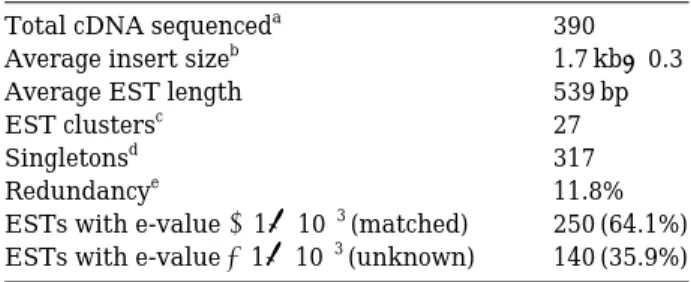
The kidney cDNA library was constructed from the poly-adenylated fraction of mRNA from the olive flounder kidney. The number of clones sequenced from the cDNA library, the average size of inserts, and the redundancy of the obtained sequences, are given in Table 1. A total of 390 randomly selected clones, in phagemid form, were single-pass sequenced from the 5′ end, resulting in the characterization of cDNA clones that were longer than 100 bp after elimination of vector sequence. The average insert size was estimated to be 1.7±0.3 kb by PCR amplification of inserts from 20 randomly selected clones. We used the assembly program ICAtools software (Parsons, 1995) to organize the redundant ESTs into overlapping contigs. The results showed that the 390 kidney ESTs were composed of 27 clus- ters and 317 singletons, suggesting that the over- all redundancy of the library was 11.8%.
Gene annotation procedures and homology searches of the sequenced ESTs have been local- ly done by BLASTX for amino acid similarity comparisons. The ESTs with significant similari- ties (E⁄1×10⁻³) to known proteins were evalu- ated to determine if the significant similarities were caused by simple amino acid matches. Of the 390 clones, 250 (64.1%) were identified as orthologues of known genes from other organ- isms. The remaining 140 (35.9%) clones could not be identified by similarity comparisons (E›1×
10-3). Among the 250 EST clones, 14 (5.6%) clones were representing 11 unique genes identified as homologous to the previously reported olive floun-
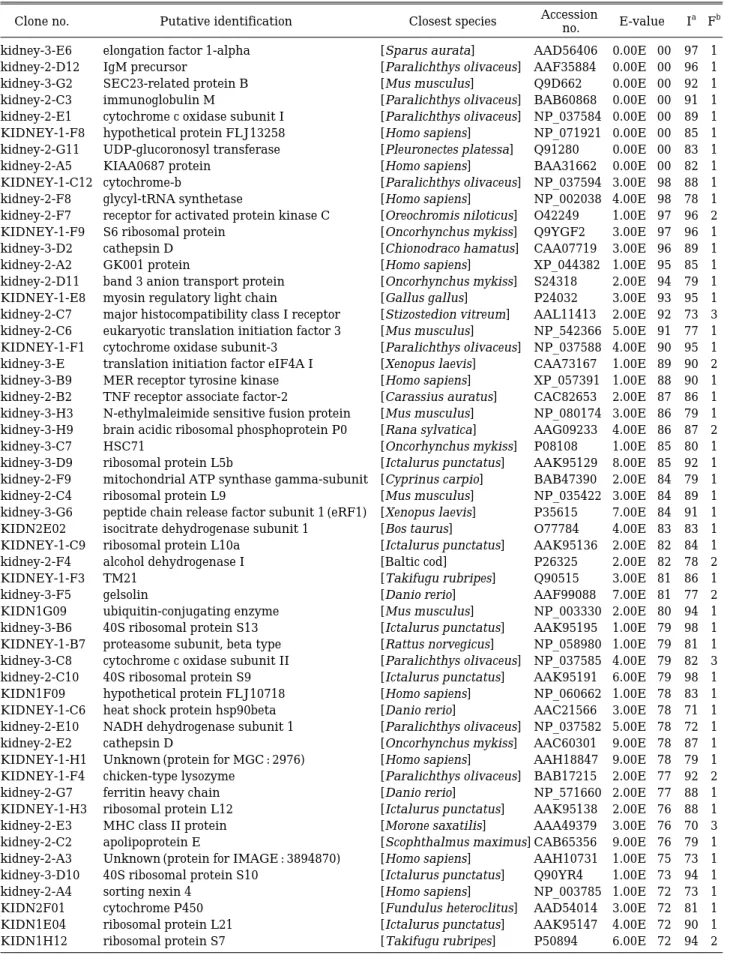
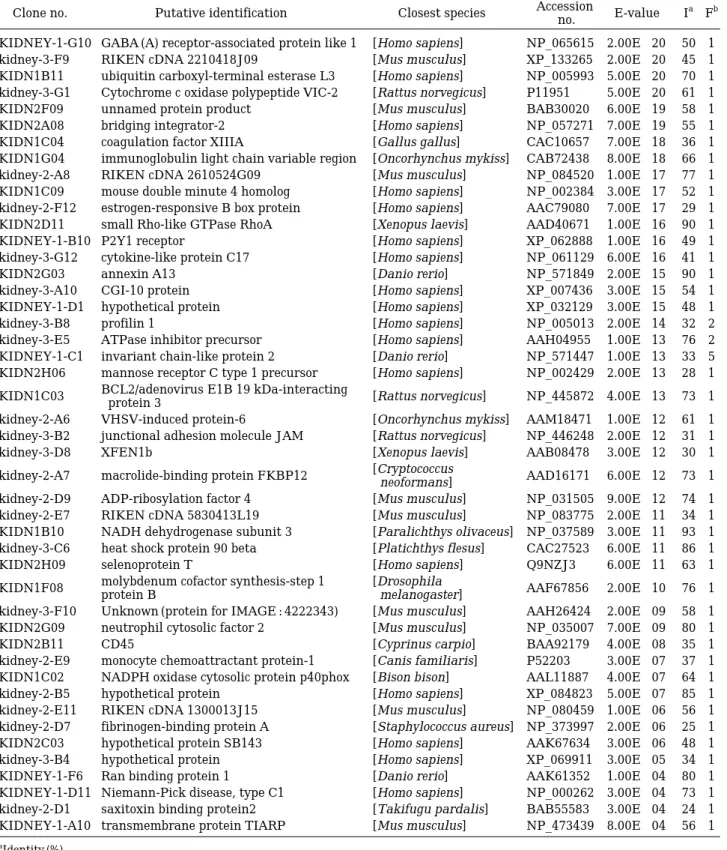
der ESTs, 198 (79.2%) clones representing 160 unique genes were identified as orthologs of kno- wn genes from other organisms (Table 2). The fact that the majority of EST clones could be iden- tified by similarity comparisons suggests that high-quality EST analysis is an efficient way for gene annotation in less-well studied species. Thir- ty-eight (15.2%) clones representing 37 unique genes showed significant similarities to known sequences of unknown functions from model sys- tems such as Homo sapiens and Mus musculus.
Although functions are not yet known, their con- servation in fish demonstrated the existence of many gene families through evolution. Once a gene is characterized in any one of these species, comparative functional genomics will allow anno- tation to these orthologous genes.
2. Expression profile and gene identification
Expression profiles of the EST clones identified from the olive flounder kidney is shown in Fig. 1.
Of the 390 EST clones identified by BLASTX, 317 (81.3%) were singletons. Although redun- dancy will increase as the number of sequenced clones increases, the high percentage of single- tons indicated that the complexity and coverage of this olive flounder liver cDNA library was good. Among 250 identified distinct known genes, 183 genes (73.2%) were sequenced only once; 57 genes (22.8%) were sequenced 2~5 times; 10 genes (4.0%) were sequenced over five times.
The putative amino acid sequence deduced from
Table 1. General characteristics of olive flounder kidney ESTs
Total cDNA sequenceda 390
Average insert sizeb 1.7 kb±0.3
Average EST length 539 bp
EST clustersc 27
Singletonsd 317
Redundancye 11.8%
ESTs with e-value ⁄1×10⁻³(matched) 250 (64.1%) ESTs with e-value ›1×10⁻³(unknown) 140 (35.9%)
aLength of sequence used for comparison after editing (inserts
⁄100 base pairs were excluded).
bThe average insert size was calculated for 20 randomly selected cDNA clones.
cESTs with 90% or greater identity over a 100 bp region were clustered together forming 27 EST clusters.
d317 sequences did not sufficiently match any sequence in the data set to allow assembly.
eRedundancy==The number of genes/total ESTs.
Table 2. List of identified ESTs from liver cDNA of olive flounder
Clone no. Putative identification Closest species Accession
E-value Ia Fb no.
kidney-3-E6 elongation factor 1-alpha [Sparus aurata] AAD56406 0.00E++00 97 1 kidney-2-D12 IgM precursor [Paralichthys olivaceus] AAF35884 0.00E++00 96 1 kidney-3-G2 SEC23-related protein B [Mus musculus] Q9D662 0.00E++00 92 1 kidney-2-C3 immunoglobulin M [Paralichthys olivaceus] BAB60868 0.00E++00 91 1 kidney-2-E1 cytochrome c oxidase subunit I [Paralichthys olivaceus] NP_037584 0.00E++00 89 1 KIDNEY-1-F8 hypothetical protein FLJ13258 [Homo sapiens] NP_071921 0.00E++00 85 1 kidney-2-G11 UDP-glucoronosyl transferase [Pleuronectes platessa] Q91280 0.00E++00 83 1 kidney-2-A5 KIAA0687 protein [Homo sapiens] BAA31662 0.00E++00 82 1 KIDNEY-1-C12 cytochrome-b [Paralichthys olivaceus] NP_037594 3.00E-98 88 1 kidney-2-F8 glycyl-tRNA synthetase [Homo sapiens] NP_002038 4.00E-98 78 1 kidney-2-F7 receptor for activated protein kinase C [Oreochromis niloticus] O42249 1.00E-97 96 2 KIDNEY-1-F9 S6 ribosomal protein [Oncorhynchus mykiss] Q9YGF2 3.00E-97 96 1
kidney-3-D2 cathepsin D [Chionodraco hamatus] CAA07719 3.00E-96 89 1
kidney-2-A2 GK001 protein [Homo sapiens] XP_044382 1.00E-95 85 1
kidney-2-D11 band 3 anion transport protein [Oncorhynchus mykiss] S24318 2.00E-94 79 1 KIDNEY-1-E8 myosin regulatory light chain [Gallus gallus] P24032 3.00E-93 95 1 kidney-2-C7 major histocompatibility class I receptor [Stizostedion vitreum] AAL11413 2.00E-92 73 3 kidney-2-C6 eukaryotic translation initiation factor 3 [Mus musculus] NP_542366 5.00E-91 77 1 KIDNEY-1-F1 cytochrome oxidase subunit-3 [Paralichthys olivaceus] NP_037588 4.00E-90 95 1 kidney-3-E translation initiation factor eIF4A I [Xenopus laevis] CAA73167 1.00E-89 90 2 kidney-3-B9 MER receptor tyrosine kinase [Homo sapiens] XP_057391 1.00E-88 90 1 kidney-2-B2 TNF receptor associate factor-2 [Carassius auratus] CAC82653 2.00E-87 86 1 kidney-3-H3 N-ethylmaleimide sensitive fusion protein [Mus musculus] NP_080174 3.00E-86 79 1 kidney-3-H9 brain acidic ribosomal phosphoprotein P0 [Rana sylvatica] AAG09233 4.00E-86 87 2
kidney-3-C7 HSC71 [Oncorhynchus mykiss] P08108 1.00E-85 80 1
kidney-3-D9 ribosomal protein L5b [Ictalurus punctatus] AAK95129 8.00E-85 92 1 kidney-2-F9 mitochondrial ATP synthase gamma-subunit [Cyprinus carpio] BAB47390 2.00E-84 79 1 kidney-2-C4 ribosomal protein L9 [Mus musculus] NP_035422 3.00E-84 89 1 kidney-3-G6 peptide chain release factor subunit 1 (eRF1) [Xenopus laevis] P35615 7.00E-84 91 1 KIDN2E02 isocitrate dehydrogenase subunit 1 [Bos taurus] O77784 4.00E-83 83 1 KIDNEY-1-C9 ribosomal protein L10a [Ictalurus punctatus] AAK95136 2.00E-82 84 1 kidney-2-F4 alcohol dehydrogenase I [Baltic cod] P26325 2.00E-82 78 2
KIDNEY-1-F3 TM21 [Takifugu rubripes] Q90515 3.00E-81 86 1
kidney-3-F5 gelsolin [Danio rerio] AAF99088 7.00E-81 77 2
KIDN1G09 ubiquitin-conjugating enzyme [Mus musculus] NP_003330 2.00E-80 94 1 kidney-3-B6 40S ribosomal protein S13 [Ictalurus punctatus] AAK95195 1.00E-79 98 1 KIDNEY-1-B7 proteasome subunit, beta type [Rattus norvegicus] NP_058980 1.00E-79 81 1 kidney-3-C8 cytochrome c oxidase subunit II [Paralichthys olivaceus] NP_037585 4.00E-79 82 3 kidney-2-C10 40S ribosomal protein S9 [Ictalurus punctatus] AAK95191 6.00E-79 98 1 KIDN1F09 hypothetical protein FLJ10718 [Homo sapiens] NP_060662 1.00E-78 83 1 KIDNEY-1-C6 heat shock protein hsp90beta [Danio rerio] AAC21566 3.00E-78 71 1 kidney-2-E10 NADH dehydrogenase subunit 1 [Paralichthys olivaceus] NP_037582 5.00E-78 72 1 kidney-2-E2 cathepsin D [Oncorhynchus mykiss] AAC60301 9.00E-78 87 1 KIDNEY-1-H1 Unknown (protein for MGC : 2976) [Homo sapiens] AAH18847 9.00E-78 79 1 KIDNEY-1-F4 chicken-type lysozyme [Paralichthys olivaceus] BAB17215 2.00E-77 92 2 kidney-2-G7 ferritin heavy chain [Danio rerio] NP_571660 2.00E-77 88 1 KIDNEY-1-H3 ribosomal protein L12 [Ictalurus punctatus] AAK95138 2.00E-76 88 1 kidney-2-E3 MHC class II protein [Morone saxatilis] AAA49379 3.00E-76 70 3 kidney-2-C2 apolipoprotein E [Scophthalmus maximus] CAB65356 9.00E-76 79 1 kidney-2-A3 Unknown (protein for IMAGE : 3894870) [Homo sapiens] AAH10731 1.00E-75 73 1 kidney-3-D10 40S ribosomal protein S10 [Ictalurus punctatus] Q90YR4 1.00E-73 94 1
kidney-2-A4 sorting nexin 4 [Homo sapiens] NP_003785 1.00E-72 73 1
KIDN2F01 cytochrome P450 [Fundulus heteroclitus] AAD54014 3.00E-72 81 1 KIDN1E04 ribosomal protein L21 [Ictalurus punctatus] AAK95147 4.00E-72 90 1 KIDN1H12 ribosomal protein S7 [Takifugu rubripes] P50894 6.00E-72 94 2
KIDNEY-1-D3 Aromatic-L-amino-acid decarboxylase [Cavia porcellus] P22781 8.00E-72 71 1 KIDNEY-1-A5 hemoglobin beta-A chain [Seriola quinqueradiata] Q9PVM2 3.00E-71 87 2 kidney-2-H6 high mobility group protein [Mus musculus] CAA56631 1.00E-70 74 1 KIDNEY-1-D8 hypothetical protein CAB56184 [Homo sapiens] AAH14592 8.00E-70 78 1 kidney-2-C9 carbonic anhydrase [Danio rerio] NP_571185 8.00E-70 74 1 KIDNEY-1-B3 unnamed protein product [Mus musculus] BAB28647 1.00E-69 66 1 KIDNEY-1-C10 Similar to hypothetical protein FLJ10856 [Mus musculus] AAH18491 3.00E-68 62 1
KIDNEY-1-E5 cyclin G1 [Homo sapiens] NP_004051 3.00E-68 59 1
kidney-3-E7 protein tyrosine kinase 9 [Mus musculus] XP_110123 2.00E-67 67 1
kidney-2-B8 aldose reductase [Homo sapiens] AAA51714 1.00E-66 60 1
kidney-2-C8 ribosomal protein L18 [Oreochromis
AAF64457 2.00E-66 85 1 mossambicus]
KIDNEY-1-G7 proline dehydrogenase [Mus musculus] XP_110168 2.00E-66 61 1 KIDN2E09 aldehyde dehydrogenase [Danio rerio] AAK49120 8.00E-66 76 1 kidney-2-F3 unnamed protein product [Homo sapiens] BAB13861 1.00E-65 75 1 kidney-3-E2 palmitoyl-protein thioesterase [Mus musculus] NP_032943 4.00E-65 73 1 KIDNEY-1-A8 ribosomal protein L27a [Epinephelus coioides] AAM27202 1.00E-64 86 1 KIDN1E08 N-ethylmaleimide sensitive fusion protein [Rattus norvegicus] NP_542152 1.00E-63 86 1 KIDN1E06 glutathione S-transferase [Pleuronectes platessa] CAA64495 2.00E-63 79 1 KIDN1H05 steroid dehydrogenase [Anas platyrhynchos] O57314 3.00E-63 68 1 kidney-3-A12 chaperonin subunit 7 [Mus musculus] NP_031664 1.00E-62 92 1 KIDNEY-1-F11 dendritic cell protein [Homo sapiens] XP_034431 1.00E-62 89 1 KIDN1B05 ubiquitin polyprotein (heat shock related) [Gallus gallus] I50438 2.00E-61 95 3
kidney-2-E12 peroxiredoxin 5 [Homo sapiens] NP_036226 2.00E-61 68 1
KIDN2B03 unnamed protein product [Mus musculus] BAB22439 2.00E-60 83 1 KIDNEY-1-E1 immunoglobulin light chain precursor [Seriola quinqueradiata] BAB59086 5.00E-60 75 1 kidney-2-E4 NADH dehydrogenase subunit 2 [Paralichthys olivaceus] NP_037583 8.00E-59 62 1 KIDNEY-1-D4 IQ motif containing GTPase activating
[Mus musculus] NP_057930 8.00E-59 61 1 protein 1
KIDNEY-1-H2 beta-tubulin [Bombyx mori] BAB86852 5.00E-58 98 1
KIDNEY-1-A11 hypothetical protein [Mus musculus] XP_143698 5.00E-58 59 1 kidney-2-C11 phospholipase C, gamma 2 [Mus musculus] AAH19654 6.00E-58 63 1 kidney-2-C12 proteasome 26S subunit, non-ATPase [Homo sapiens] NP_002800 6.00E-57 79 1
KIDN1D07 cathepsin B [Homo sapiens] AAH10240 4.00E-56 72 1
kidney-2-G6 translationally controlled tumor protein [Labeo rohita] Q98SJ7 6.00E-56 59 1
KIDN2C01 DGCR6 protein [Gallus gallus] O73770 1.00E-55 75 2
kidney-3-A1 major histocompatibility class I receptor [Stizostedion vitreum] AAL11412 1.00E-55 67 2 KIDN1G02 nephrosin precursor [Cyprinus carpio] AAB62737 1.00E-55 67 2
KIDNEY-1-B12 CGI-49 protein [Homo sapiens] NP_057086 2.00E-54 52 1
KIDNEY-1-B1 glutathione peroxidase [Platichthys flesus] CAC27424 3.00E-53 91 1 KIDN2D12 ribosomal protein L34 [Homo sapiens] NP_000986 9.00E-53 88 1
kidney-3-A9 DSPA alpha-1 [Desmodus rotundus] P98119 1.00E-52 53 1
KIDNEY-1-H4 NADPH--ferrihemoprotein reductase [Salmo trutta] A28577 2.00E-52 78 1 KIDN2F03 Glycine cleavage system H protein [Gallus gallus] P11183 1.00E-51 70 1 kidney-2-G1 RIKEN cDNA 2610001E01 [Mus musculus] NP_080194 1.00E-51 54 1 KIDN2F06 matrix metalloproteinase [Oncorhynchus mykiss] BAB19131 9.00E-51 58 1 KIDN1A09 ribosomal protein L6 [Ictalurus punctatus] AAK95130 4.00E-50 78 1 KIDNEY-1-H7 alpha hemoglobin B [Seriola quinqueradiata] Q9PVM3 4.00E-50 68 10 KIDN2D06 acidic ribosomal protein P0 [Rattus rattus] R5RT10 3.00E-49 93 1 kidney-2-G8 alpha-l-fucosidase fucohydrolase [Homo sapiens] CAB53746 5.00E-49 57 1 kidney-3-G10 Integral membrane protein 2B [Gallus gallus] O42204 3.00E-48 75 2 KIDN2B05 transgelin; SM-22 alpha [Mus musculus] NP_035656 8.00E-48 65 1
KIDNEY-1-H11 PAS1 [Takifugu rubripes] AAC34392 2.00E-47 72 1
KIDN1E03 Similar to CGI-36 protein [Mus musculus] AAH13538 4.00E-47 62 1 KIDN1B06 Ubiquitin-protein ligase G2 [Mus musculus] XP_036087 2.00E-46 87 1 Table 2. Continued.
Clone no. Putative identification Closest species Accession
E-value Ia Fb no.
KIDNEY-1-H5 protein-tyrosine-phosphatase [Mus musculus] S17671 7.00E-46 55 1
kidney-3-B1 Catalase [Danio rerio] Q9PT92 1.00E-44 83 1
KIDNEY-1-H6 hsp90 binding protein [Oryctolagus cuniculus] AAA31439 1.00E-44 47 1 kidney-2-H10 hypothetical protein MGC3133 [Homo sapiens] NP_112577 2.00E-44 92 1 KIDN1F06 capping protein, gelsolin-like [Mus musculus] AAH03480 3.00E-44 54 1
KIDN1C05 c-src kinase [Gallus gallus] P41239 4.00E-44 82 1
kidney-3-D3 RIKEN cDNA 1500005J14 gene [Homo sapiens] XP_060025 2.00E-43 53 1 kidney-2-B1 RIKEN cDNA 1110014J22 [Mus musculus] NP_079647 2.00E-41 68 1
KIDN2B10 keratin [Carassius auratus] AAC38007 7.00E-41 61 1
KIDNEY-1-H10 tetraspan 3 [Homo sapiens] AAH00704 2.00E-40 73 1
KIDN1D10 peptidyl-prolyl cis-trans isomerase [Xenopus laevis] O42123 1.00E-39 68 1 KIDNEY-1-G4 40S ribosomal protein S26-2 [Ictalurus punctatus] AAK95209 6.00E-39 97 1 KIDNEY-1-D2 H3 histone, family 3A [Homo sapiens] NP_002098 6.00E-38 100 1
KIDN2A02 target of myb1 [Homo sapiens] NP_005479 2.00E-37 78 1
kidney-2-D4 sirtuin 5, isoform 1 [Homo sapiens] NP_036373 2.00E-37 78 1 KIDNEY-1-C5 Calcineurin-like phosphoesterase precursor [Caenorhabditis elegans] NP_506191 2.00E-36 40 1 KIDN1G12 Unknown (protein for MGC : 9788) [Homo sapiens] AAH11964 1.00E-35 52 1
kidney-2-G10 granzyme A [Mus musculus] NP_034500 6.00E-35 42 1
KIDN2H05 CD97 protein [Bos taurus] CAC94754 7.00E-35 46 1
KIDNEY-1-E10 RIKEN cDNA 3110001A13 [Mus musculus] NP_079902 2.00E-34 61 1 KIDNEY-1-A1 Unknown (protein for MGC : 37327) [Mus musculus] AAH26598 5.00E-34 46 1 KIDNEY-1-C7 renal organic anion transporter [Pseudopleuronectes
CAB09724 8.00E-34 50 1 americanus]
KIDNEY-1-E2 RIKEN cDNA 2700085M18 gene [Homo sapiens] AAH05879 4.00E-33 74 1 kidney-3-G11 ribosomal protein P1 [Ictalurus punctatus] AAK95124 1.00E-32 64 1
KIDN1C11 desmoplakin [Homo sapiens] XP_004463 5.00E-31 71 1
kidney-3-D5 uncharacterized bone marrow protein BM046 [Homo sapiens] XP_059419 9.00E-31 55 1 KIDNEY-1-G9 unnamed protein product [Mus musculus] BAB25109 1.00E-30 87 2 KIDN2E06 beta-2 microglobulin precursor [Ictalurus furcatus] AAC64994 1.00E-30 61 4 kidney-2-G5 eukaryotic translation elongation factor 1 [Danio rerio] AAM21716 2.00E-30 86 1 KIDN1B02 unnamed protein product [Homo sapiens] BAB71093 4.00E-30 51 1 KIDN2A11 aspartyl aminopeptidase [Mus musculus] NP_077296 2.00E-29 66 2 KIDNEY-1-A12 Unknown (protein for IMAGE : 5102170) [Mus musculus] AAH21603 2.00E-29 63 1 KIDN1H08 transferrin receptor [Canis familiaris] AAG24850 5.00E-29 52 1
KIDN1E10 NRD2 convertase [Homo sapiens] NP_002516 1.00E-28 55 1
kidney-3-C12 simple type I keratin [Oncorhynchus mykiss] CAA74664 2.00E-28 77 1 KIDN2A01 beta-galactoside-binding lectin [Electrophorus electricus] A28302 4.00E-28 46 1 KIDNEY-1-D7 selectin, lymphocyte [Rattus norvegicus] NP_062050 6.00E-28 48 2 kidney-2-H4 beta-2 microglobulin precursor [Ictalurus lupus] AAC64992 7.00E-28 60 2 KIDN1E02 x-box binding protein 1B [Danio rerio] AAL05527 7.00E-28 51 1 KIDNEY-1-D10 hypothetical protein MGC11242 [Homo sapiens] NP_077296 1.00E-26 66 1
KIDNEY-1-E7 My021 protein [Homo sapiens] AAG43135 1.00E-26 65 1
KIDN1F12 cis-retinol/androgen dehydrogenase type 3 [Mus musculus] AAM21318 3.00E-26 60 1 KIDN1F05 bromodomain containing protein 3 [Homo sapiens] NP_031397 4.00E-26 58 1 KIDNEY-1-A2 receptor tyrosine kinase flk-1/VEGFR-2 [Danio rerio] AAL16381 6.00E-26 67 1
kidney-3-E12 neuropsin type2 [Homo sapiens] BAA82666 1.00E-25 42 1
KIDN1G11 CRSP70 [Danio rerio] AAK61395 8.00E-25 77 1
KIDN2D05 SET domain, bifurcated 1 [Homo sapiens] NP_036564 2.00E-24 39 1 KIDN2F07 RIKEN cDNA 2600013N14 [Mus musculus] XP_131301 3.00E-24 52 1
KIDN1A12 HSPC267 [Homo sapiens] AAF28945 3.00E-23 65 1
KIDN2C06 Carboxypeptidase A2 precursor [Rattus norvegicus] P19222 3.00E-23 51 1
KIDN1A07 unknown [Homo sapiens] AAG17266 4.00E-23 75 1
kidney-3-A5 alpha hemoglobin B [Seriola quinqueradiata] BAA86219 4.00E-23 50 1 kidney-3-D7 Chain H, Cytochrome Bc1 Complex [Gallus gallus] 1BCC 5.00E-22 71 1 KIDNEY-1-E3 Similar to CGI-49 protein [Homo sapiens] AAH26185 4.00E-21 74 1 Table 2. Continued.
Clone no. Putative identification Closest species Accession
E-value Ia Fb no.
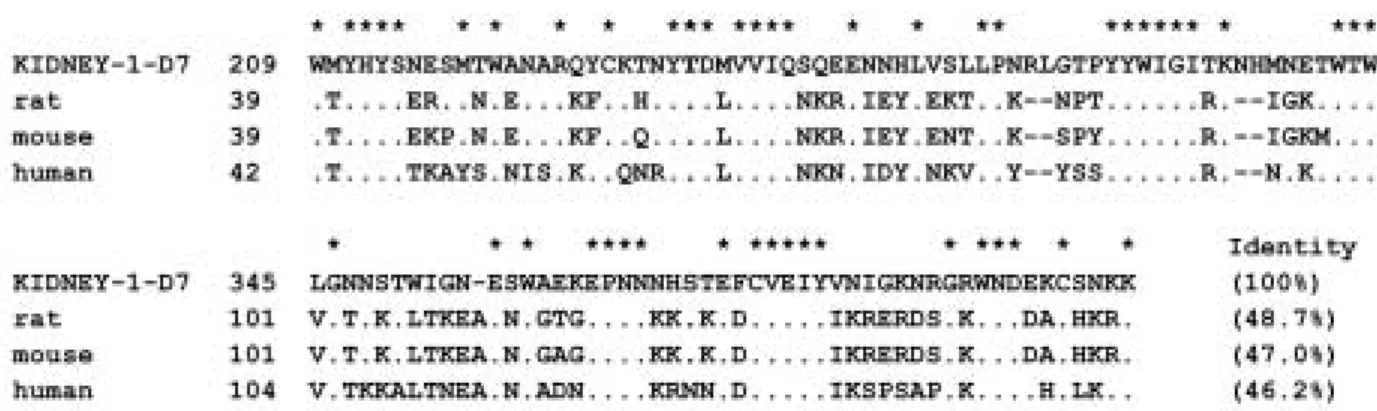
one cDNA clone, KIDNEY-1-D7, was identified as selectin, a superfamily of C-type lectin. The
alignment showed that the putative sequence is 48.7, 47.0 and 46.2% identical to the carbohy-
KIDNEY-1-G10 GABA (A) receptor-associated protein like 1 [Homo sapiens] NP_065615 2.00E-20 50 1 kidney-3-F9 RIKEN cDNA 2210418J09 [Mus musculus] XP_133265 2.00E-20 45 1 KIDN1B11 ubiquitin carboxyl-terminal esterase L3 [Homo sapiens] NP_005993 5.00E-20 70 1 kidney-3-G1 Cytochrome c oxidase polypeptide VIC-2 [Rattus norvegicus] P11951 5.00E-20 61 1 KIDN2F09 unnamed protein product [Mus musculus] BAB30020 6.00E-19 58 1 KIDN2A08 bridging integrator-2 [Homo sapiens] NP_057271 7.00E-19 55 1 KIDN1C04 coagulation factor XIIIA [Gallus gallus] CAC10657 7.00E-18 36 1 KIDN1G04 immunoglobulin light chain variable region [Oncorhynchus mykiss] CAB72438 8.00E-18 66 1 kidney-2-A8 RIKEN cDNA 2610524G09 [Mus musculus] NP_084520 1.00E-17 77 1 KIDN1C09 mouse double minute 4 homolog [Homo sapiens] NP_002384 3.00E-17 52 1 kidney-2-F12 estrogen-responsive B box protein [Homo sapiens] AAC79080 7.00E-17 29 1 KIDN2D11 small Rho-like GTPase RhoA [Xenopus laevis] AAD40671 1.00E-16 90 1
KIDNEY-1-B10 P2Y1 receptor [Homo sapiens] XP_062888 1.00E-16 49 1
kidney-3-G12 cytokine-like protein C17 [Homo sapiens] NP_061129 6.00E-16 41 1
KIDN2G03 annexin A13 [Danio rerio] NP_571849 2.00E-15 90 1
kidney-3-A10 CGI-10 protein [Homo sapiens] XP_007436 3.00E-15 54 1
KIDNEY-1-D1 hypothetical protein [Homo sapiens] XP_032129 3.00E-15 48 1
kidney-3-B8 profilin 1 [Homo sapiens] NP_005013 2.00E-14 32 2
kidney-3-E5 ATPase inhibitor precursor [Homo sapiens] AAH04955 1.00E-13 76 2 KIDNEY-1-C1 invariant chain-like protein 2 [Danio rerio] NP_571447 1.00E-13 33 5 KIDN2H06 mannose receptor C type 1 precursor [Homo sapiens] NP_002429 2.00E-13 28 1 KIDN1C03 BCL2/adenovirus E1B 19 kDa-interacting
[Rattus norvegicus] NP_445872 4.00E-13 73 1 protein 3
kidney-2-A6 VHSV-induced protein-6 [Oncorhynchus mykiss] AAM18471 1.00E-12 61 1 kidney-3-B2 junctional adhesion molecule JAM [Rattus norvegicus] NP_446248 2.00E-12 31 1
kidney-3-D8 XFEN1b [Xenopus laevis] AAB08478 3.00E-12 30 1
kidney-2-A7 macrolide-binding protein FKBP12 [Cryptococcus
AAD16171 6.00E-12 73 1 neoformans]
kidney-2-D9 ADP-ribosylation factor 4 [Mus musculus] NP_031505 9.00E-12 74 1 kidney-2-E7 RIKEN cDNA 5830413L19 [Mus musculus] NP_083775 2.00E-11 34 1 KIDN1B10 NADH dehydrogenase subunit 3 [Paralichthys olivaceus] NP_037589 3.00E-11 93 1 kidney-3-C6 heat shock protein 90 beta [Platichthys flesus] CAC27523 6.00E-11 86 1
KIDN2H09 selenoprotein T [Homo sapiens] Q9NZJ3 6.00E-11 63 1
KIDN1F08 molybdenum cofactor synthesis-step 1 [Drosophila
AAF67856 2.00E-10 76 1
protein B melanogaster]
kidney-3-F10 Unknown (protein for IMAGE : 4222343) [Mus musculus] AAH26424 2.00E-09 58 1 KIDN2G09 neutrophil cytosolic factor 2 [Mus musculus] NP_035007 7.00E-09 80 1
KIDN2B11 CD45 [Cyprinus carpio] BAA92179 4.00E-08 35 1
kidney-2-E9 monocyte chemoattractant protein-1 [Canis familiaris] P52203 3.00E-07 37 1 KIDN1C02 NADPH oxidase cytosolic protein p40phox [Bison bison] AAL11887 4.00E-07 64 1 kidney-2-B5 hypothetical protein [Homo sapiens] XP_084823 5.00E-07 85 1 kidney-2-E11 RIKEN cDNA 1300013J15 [Mus musculus] NP_080459 1.00E-06 56 1 kidney-2-D7 fibrinogen-binding protein A [Staphylococcus aureus] NP_373997 2.00E-06 25 1 KIDN2C03 hypothetical protein SB143 [Homo sapiens] AAK67634 3.00E-06 48 1 kidney-3-B4 hypothetical protein [Homo sapiens] XP_069911 3.00E-05 34 1 KIDNEY-1-F6 Ran binding protein 1 [Danio rerio] AAK61352 1.00E-04 80 1 KIDNEY-1-D11 Niemann-Pick disease, type C1 [Homo sapiens] NP_000262 3.00E-04 73 1 kidney-2-D1 saxitoxin binding protein2 [Takifugu pardalis] BAB55583 3.00E-04 24 1 KIDNEY-1-A10 transmembrane protein TIARP [Mus musculus] NP_473439 8.00E-04 56 1
aIdentity (%)
bFrequency of the clones in the sequenced pool.
Table 2. Continued.
Clone no. Putative identification Closest species Accession
E-value Ia Fb no.
drate recognition domains (CRDs) of rat, mouse and human selectin, respectively (Fig. 2). In addi- tion, it indicates the novel protein shares invari- ant and highly conserved amino acids used to define C-type lectin (Drickamer, 1988). These results suggest that the novel protein is indeed a C-type lectin, which represents the first time, this has been identified in olive flounder. Lectins are believed to mediate pathogen recognition, which can lead to neutralization of the invading organism during the early stages of an infection (Ni and Tizard, 1996). In spite of their apparent ubiquity, and vast publications on their occur- rence, structure and specificity, natural functions have not been fully understood. Therefore differ- ent biological roles have been proposed for lec- tins, including the cellular and tissue transport of carbohydrates, glycoproteins and calcium (Gold-
stein et al., 1980), cytolytic and cytotoxic factors (Komano and Natori, 1985; Armstrong et al., 1996), cell adhesion, migration and apoptosis (Perillo et al., 1995; Kasai and Hirabayashi, 1996; Ni and Tizard, 1996; Vasta et al., 1999). As lower vertebrates and invertebrates do not pos- sess a strong adaptive immunity as that of high- er vertebrates, their survival depends on the strong non-self recognition molecules. Most re- cent works have emphasized the possible role of lectins as non-self-recognition molecules in ver- tebrate and invertebrate immunity (Vasta et al., 1999; Wilson et al., 1999). It has been suggested that lectins have acquired similar immunoglobin like properties by being able to recognize and bind various microorganisms that invade the host.
We have also cloned a S-type lectin (now widely known as galectin) with substantial homology (46%) toβ-galactoside-binding lectin found in electric eels (Electrophorus electricus). The galec- tins have been intensively studied and are thou- ght to play key roles in immune cell homeostasis during innate and adaptive immune responses by modulating T-cell apoptosis, proliferation, cell adhesion, chemotaxis and synthesis of inflamma- tory mediators such as cytokines, nitric oxide and prostaglandins (Kasai and Hirabayashi, 1996; Perillo et al., 1998).
Another clone, KIDNEY-1-C1, showed homol- ogy to MHC class II-invariant chain like proteins (li) of zebrafish and mouse, with identities of 33.5 and 31.4%, respectively. Expression of li is required for an efficient presentation of antigens by MHC II molecules and a normal immune. Li is an integral membrane protein which associates
317
18 6 1 1 1
0 50 100 150 200 250 300 350
1 2 3 4 5 10
Hits per genes
Number of genes
Fig. 1. Expression profiles and sequencing redundancy in the analysis of ESTs from the olive flounder (Para- lichthys olivaceus) kidney. While 317 genes were singletons, the remaining clones were sequenced 2~10 times.
Fig. 2. Alignment of deduced amino acid sequence of clone KIDNEY-1-D7 with rat, mouse and human selectin, a family of c-type lectin. Identical amino acid residues with clone KIDNEY-1-D7 are indicated by dots (.). Dashes indicate gaps that are introduced for optimal alignment. Asterisk (*) indicates the invariant and conserved residues in C-type lectins. The percentages in parentheses indicate the overall amino acid identities.
with MHC class IIα/β molecules in endoplasmic reticulum (Wright et al., 1990). It is thought to play a role in antigen presentation by binding to the antigenic peptide-binding groove of theαand βchains shortly after their synthesis in the endo- plasmic reticulum (ER). This association has multiple effects on class II molecules, all of which optimize the binding and presentation of foreign peptides derived from extra-cellular environment (Sant and Miller, 1994). This indicates the impor- tance of li in immune regulation that may also be functioning in fish.
In conclusion, this work identified 250 known genes and 140 novel clones from the olive floun- der kidney. Expression profiles of these genes were revealed by their frequency in a cDNA lib- rary. We also identified several kinds of immune associated proteins, indicating EST as a powerful method for identifying immune-related genes of fish as well as identifying novel genes. Further studies using cDNA microarrays are needed to identify the differentially expressed transcripts after disease infection.
Acknowledgments
This work is funded by a grant from the Nation- al Fisheries Research and Development Institute (RP-2006-BT-011)
References
Adams, M.D., J.M. Kelley, J.D. Gocayne, M. Dubnick, M.H.
Polymeropoulos, H. Xiao, C.R. Merril, A. Wu, B. Olde, R.F. Moreno, A.R. Kerlavage, W.R. McCombie and J.C.
Venter. 1991. Complementary DNA sequencing: expres- sed sequence tags and human genome project. Science, 252 : 1651~1656.
Aoki, T., B.H. Nam, I.I. Hirono and E. Yamamoto. 1999.
Sequences of 596 cDNA Clones (565, 977 bp) of Japanese Flounder (Paralichthys olivaceus) Leukocytes Infected with Hirame Rhabdovirus. Mar. Biotechnol., 1 : 477~ 488.
Altschul, S.F., T.L. Madden, A.A. Schaffer, J. Zhang, Z.
Zhang, W. Miller and D.J. Lipman. 1997. Gapped BLAST and PSI-BLAST: a new generation of protein database search programs. Nucleic Acids Res., 25 : 3389~3402.
Armstrong, P.B., S. Swarnakar, S. Srimal, S. Misquith, E.A. Hahn, R.T. Aimes and J.P. Quigley. 1996. A cyto- lytic function for a sialic acid-binding lectin that is a member of the pentraxin family of proteins. J. Biol.
Chem., 271 : 4717~14721.
Chilmoczyk, S. 1992. The thymus in fish: development and
possible function in the immune response. Annu. Rev.
Fish Dis., 2 : 181~200.
Chomczynski, P. and N. Sacchi. 1987. Single-step method of RNA isolation by acid guanidinium thiocyanate-phe- nol-chloroform extraction. Analyt. Biochem., 162 : 156~159.
Davey, G.C., N.C. Caplice, S.A. Martin and R. Powell. 2001.
A survey of genes in the Atlantic salmon (Salmo salar) as identified by expressed sequence tags. Gene, 263 : 121~130.
Drickamer, K. 1988. Two distinct classes of carbohydrage- recognition domains in animal lectins. J. Biol. Chem., 263 : 9557~9560.
Goldstein, I.J., R.C. Hughes, M. Monsigny, T. Osawa and N. Sharon. 1980. What should be called a lectin? Na- ture, 285 : 66.
Gross, P.S., T.C. Bartlett, C.L. Browdy, R.W. Chapman and G.W. Warr. 2001. Immune gene discovery by ex- pressed sequence tag analysis of hemocytes and hepa- topancreas in the Pacific White Shrimp, Litopenaeus vannamei, and the Atlantic White Shrimp, L. setiferus.
Dev. Comp. Immunol., 25 : 565~577.
Jenny, M.J., A.H. Ringwood, E.R. Lacy, A.J. Lewitus, J.W.
Kempton, P.S. Gross, G.W. Warr and R.W. Chapman.
2002. Potential indicators of stress response identified by expressed sequence tag analysis of hemocytes and embryos from the American oyster, Crassostrea vir- ginica. Mar. Biotechnol., 4 : 81~93.
Kasai, K. and J. Hirabayashi. 1996. Galectins: a family of animal lectins that decipher glycocodes. J. Biochem., 119 : 1~8.
Komano, K. and S. Natori. 1985. Participation of Sarcopha- ga peregrina lectin in the lysis of sheep red blood cells injected into the abdominal cavity of larvae. Dev. Comp.
Immunol., 9 : 31~40.
Nam, B.H., E. Yamamoto, I. Hirono and T. Aoki. 2000. A survey of expressed genes in the leukocytes of Japanese flounder, Paralichthys olivaceus, infected with Hirame rhabdovirus. Dev. Comp. Immunol., 24 : 13~24.
Ni, Y. and I. Tizard. 1996. Lectin-carbohydrate interaction in the immune system. Vet. Immunol. Immunopathol., 55 : 205~223.
Nishimura, H., M. Ikemoto, K. Kawai and R. Kusuda. 1997.
Cross-reactivity of anti-yellowtail thymic lymphocyte monoclonal antibody (YeT-2) with lymphocytes from other fish species. Arch. Histol. Cytol., 60 : 113~119.
Parsons, J.D. 1995. Improved tools for DNA comparison and clustering. Comp. Appl. Biosci., 11 : 603~613.
Partula, S., A. De Guerra, J.S. Fellah and J. 1995. Charle- magne, Structure diversity of the T cell antigen recep- torβ-chain in a teleost fish. J. Immunol., 155 : 699~ 706.
Passer, B.J., C.H. Chen, N. Miller and M.D. Cooper. 1996.
Identification of a T lineage antigen in the catfish. Dev.
Comp. Immunol., 20 : 441~450.
Perillo, N.L., K.E. Pace, J.J. Seilhamer and L.G. Baum.
1995. Apoptosis of T cells mediated by galactin-1.
Nature, 378 : 736~739.
Perillo, N.L., M.E. Marcus and L.G. Baum. 1998. Galectins:
versatile modulators of cell adhesion, cell proliferation
and cell death. J. Mol. Med., 76 : 402~412.
Pichappan, R.M. 1980. Review on the phylogeny of splenic structure and function. Dev. Comp. Immunol., 4 : 395~ 416.
Sambrook, J., E.F. Frisch and T. Maniatis. 1989. Molecular Cloning, A Laboratory Manual, Cold Spring Harbor Laboratory Press, Cold Spring Harbor, New York.
Sant, A.J. and J. Miller. 1994. MHC class II antigen process- ing: biology of invariant chain. Curr. Opin. Immunology, 6 : 57~63.
Satou, Y., N. Takatori, S. Fujiwara, T. Nishikata, H. Saiga, T. Kusakabe, T. Shin-i, Y. Kohara and N. Satoh. 2002.
Ciona intestinalis cDNA projects: expressed sequence tag analyses and gene expression profiles during em- bryogenesis. Gene, 287 : 83~96.
Secombes, C.J., J.J.M. Van Groningen and E. Egberts.
1983. Separation of lymphocyte subpopulations in carp Cyprinus carpio L. by monoclonal antibodies: immuno- histochemical studies. Immunology, 48 : 165~175.
Vasta, G.R., M. Quesenberry, H. Ahmed and N. O’Leary.
1999. C-type lectins and galectins mediate innate and adaptive immune functions: their roles in the comple-
ment activation pathway. Dev. Comp. Immunol., 23 : 401~420.
Wilson, R., C. Chen and N.A. Ratcliffe. 1999. Innate immu- nity in insects: the role of multiple, endogenous serum lectins in the recognition of foreign invaders in the cockroach, Blaberus discoidalis. J. Immunol., 162 : 1590~1596.
Wright, K.L., T.L. Moore, B.J. Vilen, A.M. Brown and J.P.-Y. Ting. 1990. Major Histocompatibility Complex Class II-associated Invariant Chain Gene Expression Is Up regulated by Cooperative Interactions of Sp1 and NF-Y. J. Biol. Chem., 270 : 20978~20986.
Yamaguchi, K., H. Kodama, M. Miyoshi, J. Nishi, M.
Mukamoto and T. Baba. 1996. Inhibition of cytotoxic activity of carp lymphocytes (Cyprinus carpio) by anti- thymocyte monoclonal antibodies. Vet. Immunol. Immu- nopathol., 51 : 211~221.
Zhang, L., X.L. Ma, Q. Zhang, C.L. Ma, P.P. Wang, Y.F.
Sun, Y.X. Zhao and H. Zhang. 2001. Expressed sequen- ce tags from a NaCl-treated Suaeda salsa cDNA library.
Gene, 267 : 193~200.
넙치 (Paralichthys olivaceus) 신장에서 생성된ESTs (Expressed Sequence Tags)로부터 면역관련 유전자의 탐색
이정호∙김영옥1∙김종현∙노재구 김현철∙김경길*∙김규원2
국립수산과학원 어류육종연구센터, 1국립수산과학원 생명공학연구단,
2서울대학교 약학대학
넙치 (Paralichthys olivaceus) 신장에서 추출한 mRNA로부터 cDNA library를 제작하고 이를 이용하여EST (Expressed sequence tag) 분석을 하였다. 넙치의 신장 cDNA library에서 무작위로 선별한 390개의EST를 조사한 결과, 250개의 EST는 이미 밝혀진 유전자와 유사성이 있는 것으 로 나타났으며, 140개의 EST는 새로운 유전자로 밝혀졌다. 유전자의 기능이 밝혀진 250개의 EST 중 14 (5.6%)개의 EST는 이미 알려진 넙치EST와 상동성이 있는 유전자로 확인되었고, 198 (79.2%)개의 EST는 다른 생물에서 알려진 유전자와 상동성이 있는 것으로 나타났다. 그러나 38 (15.2%)개의 EST는 전혀 기능이 알려지지 않은 새로운 유전자로 밝혀졌다. EST 분석은 새로운 유전자 뿐만 아니라 기능적으로 중요한 유전자를 탐색하는데도 아주 강력한 연구 방법이다. 이에 따라 본 연구에서는 넙치 신장 EST 분석을 통해 C-, L-type lectin과 MHC class II-invariant chain like proteins (li) 같은 면역기능과 관련이 있는 여러 개의 유전자를 확인하였고, 이들 유전 자들은 질병감염 후 유전자 발현에서 나타나는 차이를 분석하는데 이용되는 cDNA microarray 연구에 유용하게 사용될 것으로 보인다.
Received : November 20, 2006 Accepted : December 18, 2006