* Corresponding author
Phone: +82-51-720-2452, Fax: +82-51-720-2456 E-mail: [email protected]
지질다당질로 자극한 넙치 백혈구의 발현유전자의 분석
남보혜1*․문지영1․김영옥1․김우진1․공희정1․이상준1․최태진1,2
1국립수산과학원 생명공학연구소, 2부경대학교 자연과학대학 미생물학과
Gene Expression Profiles in the Peripheral Blood Leukocytes (PBL) of Olive Flounder
Paralichthys olivaceus
after Stimulation with Lipoolysaccharide (LPS)in vitro
. Bo-Hye Nam1*, Ji-Young Moon1, Young-Ok Kim1, Woo Jin Kim1, Hee Jeong Kong1, Sang-Jun Lee1, Tae-Jin Choi1,2. 1Biotechnology Research Institute, National Fisheries Research & Development Institute, 408-1 Sirang-ri, Gijang-eup, Gijang-gun, Busan 619-705, Korea
2
Department of Microbioligy, Pukyong National University, Busan 608-737, Korea
Abstract
Suppression subtractive hybridization (SSH) was performed to construct an cDNA library of olive flounder Paralichthys olivaceus peripheral blood leukocytes (PBL) stimulated with lipopolysaccharide (LPS). Total 470 clones were randomly selected and sequenced, 214 out of 470 sequences showed identities with known genes and 252 sequences were unknown genes.Among the 218 known genes, 34 sequences were found to be homologous to IL-1RII gene, and 14 sequences were identified as IL-1β. RT-PCR analysis showed that IL-1β mRNA was induced 1h after LPS-stimulation, and IL-1RII was increased from 3h after stimulation, indicating that most of SSH clones are associated with inflammatory responses in fish, and this SSH cDNA library would be useful to identify bio-defense and immuno-related genes in fish.
Key words : Suppression subtractive hybridization, peripheral blood leukocytes, lipopolysaccharide, Paralichthys olivaceus
서 론
현존하는 어류의 대부분을 차지하는 경골어류의 생체방어기구는 고등동물의 면역체계와 비교하여 손색이 없을 만큼 발달되어져 있다 [3,15]. 어류의 면역계 역시 자연면역계와 획득면역계로 이루어져 있으며, 이는 또한 체액성 면역기작 및 세포매개성 면역기작을 통하여 감염성 질병에 대하여 저항성을 가진다. 세포매개성 면역기작을 담당하는 백혈구는 호중구, 호산구, 호염기구, 임파구 및 단구로 이루어 져 있으며, 탐식작용을 통하여 외부로부터 침입한 미생물로부터 개체를 방어한다. 따라서 몸 구석구석 을 순환하면서 외부 이물질로부터 개체를 지키는 말 초혈액의 백혈구로부터 발현되어 생산되어지는 인 자들에 대한 분자레벨에서의 분석은 어류의 생체방 어 및 면역계에 대한 한층 더 심화된 이해를 가능하
게 한다.
분자레벨에서의 분석을 효과적으로 수행하기 위
해서는 목적 생물의 생명 기능을 암호화하고 있는
유전자 발현 정보의 수집이 선행되어야 하는데, 현
재 대량의 발현 유전자 정보를 확보하는 방법으로
1991년 Adams에 의해 개발된 Expressed sequence tag
(EST) 분석법이 주로 이용되고 있다 [1]. EST 분석
기술은 생명체의 게놈으로부터 특정 시점 혹은 특정
조직 및 세포에 발현하는 유전자 정보를 대량 수집
할 수 있는 기법이며, 유전체 지도 작성 및 발현유전
자 다형성 확보 등에도 유용하게 사용되어져 왔다
[9,14]. 최근에는 좀 더 효율적인 EST 분석을 위하여,
in vivo 혹은 in vitro 상에서 LPS, ConA, PMA 등과
같은 외래 독소 혹은 mitogen 혹은 생균등을 이용한
인위적인 자극으로 면역 관련 유전자의 발현을 유도
한 후 Suppression Subtractive Hybridization (SSH) 방
법으로 발현이 유도되어진 유전자만을 선택적으로 분석하는 방법 등이 응용되고 있다 [2,5,6,11-13].
넙치는 우리나라의 주요 양식어종으로써 해산어 류양식 생산량의 약 50%(5만톤)를 차지한다. 그러나 매년 양식장에서 발생하는 바이러스성, 세균성, 기 생충성 및 스트레스성으로 인한 양식넙치의 대량폐 사는 양식 산업에 큰 경제적 손실을 가져온다. 따라 서 질병저항성 품종 혹은 백신 등과 같은 예방차원 의 기술 개발이 절실히 요구되어지는 상황이다. 이 에 본 연구에서는 넙치의 생체방어 및 면역 관련 유 전자의 대량 확보를 위하여 세균의 세포벽 성분인 지질다당질로 넙치의 백혈구를 자극하여 발현이 유 도된 유전자만을 SSH방법을 이용하여 선택적으로 분리하여 cDNA library를 제작하고 그 발현 양상 및 특이성을 분석하여 질병저항성 품종 개발 및 새로운 백신 연구의 기초를 마련하고자 한다.
재료 및 방법
백혈구 분리 및 LPS 처리
헤파린이 처리된 주사기를 이용하여 건강한 넙치 로부터 말초혈액을 채취한 후 2배 볼륨의 RPMI1640 배지로 희석하였다. 51% Percoll을 이용한 density gradient centrifugation로 말초혈액에서 백혈구를 분 리하였다. 분리된 백혈구는 지질다다질 자극 실험을 위하여 10% fetal bovine serum (FBS, Gibco BRL)에 1%의 penicillin 및 streptomycin (Gibco BRL)이 포함 된 RPMI1640 배지 1×10
8cells/ml이 되도록 분주한 후 20 ℃ 배양기에 24시간 방치하였다. 그 후 500 ㎍/
㎖의 지질다당질로 1시간, 3시간, 6시간 동안 처리한 후 대조구와 함께 total RNA를 분리하였다.
RNA의 분리 및 Suppression Subtractive Hyb ridization (SSH) library 제작
TRIzol reagent (Invitrogen)을 이용하여 Total RNA 를 분리하였다. PolyATrack kit (Promega)를 이용하 여 Total RNA로부터 messenger RNA (mRNA)만을 순수분리하였다. 지질다당질을 처리하지 않은 대조 구 및 지질다당질을 처리한 실험구 (1시간, 3시간, 6 시간 동안 지질다당질을 처리한 백혈구로부터 동량 의 mRNA를 모아서 섞었음)로부터 2 ㎍의 polyA
+RNA 를 취하여 사용하였다. SSH는 PCR-Select cDNA sub-
raction kit (Clontech)를 이용하여 수행하였다. 마지 막으로 증폭된 cDNA 단편들은 pGEM-T Easy Vector System (Promega)을 이용하여 subcloning 시켰다.
염기서열 분석
무작위로 선별된 470개의 클론을 ABI PRISM ge- netic analyzer 3100을 이용하여 염기서열을 분석한 후, GeneMaster 3.0 (엔솔테크사) 프로그램을 이용하 여 BLAST 검색을 실시하였다.
RT-PCR에 의한 mRNA 발현의 분석
SSH cDNA library 제작에 사용된 동일 샘플로부터 Total RNA를 분리한 후 Transcriptor First Strand cDNA Synthesis Kit (Roche)를 이용하여 cDNA를 합성 하였다. 이 cDNA를 주형으로 하여 β-actin (forward;
5'-TGA GAC TTT CAA CAG CCC TG-3', reverse;
5'-ATC TCC TGC TCG AAG TCC AG-3'), IL-1β (for- ward; 5'-ATG GAA TCC AAG ATG GAA TGC-3', reverse; 5'-TTA ACT CTG ATG ATG GAT GTT-3'), IL-1RII (forward; 5'-CTC TGT GGA CAT AGA GAA AGT GT-3', reverse; 5'-TTA GAA GGT GCT GTT CTG TCG-3')를 polymerase chain reaction (PCR) 방법 으로 증폭하였다. PCR 증폭 조건은 95 ℃에서 5분간 전처리 후, 95 ℃에서 30초간 denature, 55℃에서 30초 간 annealing, 72 ℃에서 1분간 extension 과정을 30회 거친 후 72 ℃에서 7분간 마지막 extension이 일어나 도록 프로그램화하였다. 각 PCR 산물들을 1.5%
agarose gel을 이용하여 전기영동 하고 ethidium bro- mide (EtBr, Sigma)로 염색한 후 UV하에서 확인하였다.
결과 및 고찰
SSH library의 제작 효율
특정 조건에서 차등 발현되는 유전자의 확보에는
subtractive hybridization, mRNA differential display,
reverse screening 등 여러 가지 방법들이 현재까지
이용되어 왔다. 하지만 위의 방법들은 false positive
들이 많으며, 실험을 복잡하게 하고, 실험기간을 장
기화하는 단점이 있다. 그러나 SSH 방법은 이러한
단점이 적으며, 단기간에 많은 유전자를 확보할 수
있는 장점이 있다. 먼저 cDNA library를 제작하기 전
Table 1. Overview of this study
Total clones sequenced, n 470
Putative identified clones, n (%) 218 (46.4)
Unique gene, n (%) 135 (61.9)
Homology with fish species, n (%) 71 (52.6) Putative immune-related genes, n (%) 41 (29.6)
Unidentified clones, n (%) 252 (53.6)
에 subtraction이 잘 이루어졌는지를 RT-PCR로 확인 하였다. 대조구의 cDNA를 이용하여 subtraction이 끝 난 실험구와 subtraction에 사용된 대조구의 cDNA를 주형으로 하여 대표적인 housekeeping 유전자인 β -actin에 대하여 RT-PCR을 수행하였다. 그 결과 대조 구에서는 β-actin이 대량 증폭되었지만, 실험구에서 는 거의 증폭되지 않아 실험구와 대조구에 공통으로 존재하는 유전자들은 subtraction을 통하여 대부분 제거되었음을 확인할 수 있었다 (Fig. 1).
고빈도 발현유전자
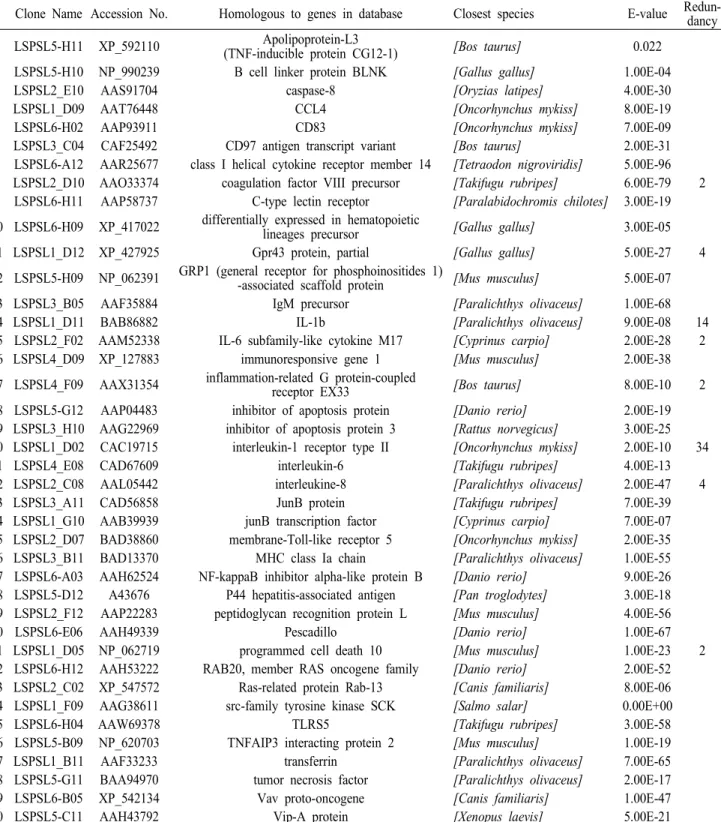
총 470개의 SSH 클론 중 기존에 밝혀진 유전자와 상동성을 보인 218개의 클론을 분석한 결과, 34개의 클론이 IL-1RII와의 상동성을 보였으며, 14개의 클 론은 IL-1β와 높은 상동성을 보이며 높은 발현 빈도 를 보였다 (Table 1). IL-1는 원형전염증성사이토카 인(prototypic pro-inflammatory cytokine)으로써 IL-1 와 결합하는 수용체로는 type I IL-1 receptor (IL-1RI) 과 type II IL-1 receptor (IL-1RII) 두 종류가있다. 모든 IL-1의 생물학적 효과는 type I IL-1 수용체와의 결합 하여 세포 내 시호전달 과정을 통하여 이루어지지 만, IL-1RII는 매우 짧은 cytoplasmic domain을 가지 고 있어 이 수용체에 IL-1β가 결합하더라도 신호 전 달이 안 되어 기능을 나타내지 못하는 유인수용체 (decoy receptor)로 작용하여, IL-1의 활성을 저해하 는 역할을 한다 [8]. 즉, 유인수용체는 매우 높은 친 화성과 특이성으로 특정 염증사이토카인을 인식하 지만 구조적으로 신호전달 등이 불가능하기 때문에 agonist나 신호전달수용체 구성원에 대한 분자트랩 으로 작용하는 것이다. 이러한 유인수용체는 일반적 으로 일차적 전염증사이토카인 혹은 케모카인을 조 절하기 위한 수법으로 이용되어진다 [7]. IL-1RI은 매우 낮은 레벨로 거의 모든 세포에서 발현되지만 [4], IL-1RII는 호중구, 단구 그리고 B 임파구에서 주 로 발현된다 [10].
Fig. 1. Evaluation of the subtraction efficiency of the sub-
tracted cDNA. PCRs with β-actin specific primers were per- formed on unsubtracted and subtracted cDNAs for 30 cycles.The amount of β-actin transcript was hardly detectable in the subtracted library comparing with that in the unsubtracted sample, suggesting that SSH procedure successfully sup- pressed cDNA common to the unstimulated- and stimu- lated-PBL sample. M; 1kb Plus DNA ladder, 1; unsubtracted cDNA, 2; subtracted cDNA.
Fig. 2. Expression patterns of flounder IL-1β and IL-1RII
depended on LPS-stimulated time-course. RT-PCR analysis of flounder IL-1β and IL-1RII expression were maintained in primary culture of PBL stimulated with LPS for 0h, 1h, 3h and 6h. The expression of flounder IL-1β transcript was induced 1h after stimulation, and IL-1RII transcript was in- creased from 3h after stimulation.LPS로 자극한 넙치의 말초혈액백혈구에서의 IL-1
β와 IL-1RII의 발현양상을 RT-PCR을 이용하여 확인
하여 보았다 (Fig. 2). IL-1β의 경우 LPS 처리 직후부
터 시간 경과에 따라 mRNA의 발현양이 점차적으로
증가하였으며, IL-1RII의 경우 LPS 처리 후 3시간째
부터 mRNA의 발현양이 증가함을 알 수 있었다. 이
는 LPS 처리에 의한 패혈성 쇼크로부터 숙주를 보호
하고자 하는 넙치의 생체방어기작의 일부라고 생각
되어지며, 이에 대해서는 좀 더 깊은 연구가 수행되
어야 할 것으로 사료된다.
Table 2. Putative immune-related genes of flounder PBL-SSH cDNA library
Clone Name Accession No. Homologous to genes in database Closest species E-value Redun- dancy
1 LSPSL5-H11 XP_592110 Apolipoprotein-L3
(TNF-inducible protein CG12-1)
[Bos taurus]
0.022 2 LSPSL5-H10 NP_990239 B cell linker protein BLNK[Gallus gallus]
1.00E-043 LSPSL2_E10 AAS91704 caspase-8
[Oryzias latipes]
4.00E-304 LSPSL1_D09 AAT76448 CCL4
[Oncorhynchus mykiss]
8.00E-195 LSPSL6-H02 AAP93911 CD83
[Oncorhynchus mykiss]
7.00E-096 LSPSL3_C04 CAF25492 CD97 antigen transcript variant
[Bos taurus]
2.00E-31 7 LSPSL6-A12 AAR25677 class I helical cytokine receptor member 14[Tetraodon nigroviridis]
5.00E-96 8 LSPSL2_D10 AAO33374 coagulation factor VIII precursor[Takifugu rubripes]
6.00E-79 2 9 LSPSL6-H11 AAP58737 C-type lectin receptor[Paralabidochromis chilotes]
3.00E-19 10 LSPSL6-H09 XP_417022 differentially expressed in hematopoieticlineages precursor
[Gallus gallus]
3.00E-0511 LSPSL1_D12 XP_427925 Gpr43 protein, partial
[Gallus gallus]
5.00E-27 412 LSPSL5-H09 NP_062391 GRP1 (general receptor for phosphoinositides 1)
-associated scaffold protein
[Mus musculus]
5.00E-0713 LSPSL3_B05 AAF35884 IgM precursor
[Paralichthys olivaceus]
1.00E-6814 LSPSL1_D11 BAB86882 IL-1b
[Paralichthys olivaceus]
9.00E-08 1415 LSPSL2_F02 AAM52338 IL-6 subfamily-like cytokine M17
[Cyprinus carpio]
2.00E-28 216 LSPSL4_D09 XP_127883 immunoresponsive gene 1
[Mus musculus]
2.00E-3817 LSPSL4_F09 AAX31354 inflammation-related G protein-coupled
receptor EX33
[Bos taurus]
8.00E-10 218 LSPSL5-G12 AAP04483 inhibitor of apoptosis protein
[Danio rerio]
2.00E-19 19 LSPSL3_H10 AAG22969 inhibitor of apoptosis protein 3[Rattus norvegicus]
3.00E-25 20 LSPSL1_D02 CAC19715 interleukin-1 receptor type II[Oncorhynchus mykiss]
2.00E-10 3421 LSPSL4_E08 CAD67609 interleukin-6
[Takifugu rubripes]
4.00E-1322 LSPSL2_C08 AAL05442 interleukine-8
[Paralichthys olivaceus]
2.00E-47 423 LSPSL3_A11 CAD56858 JunB protein
[Takifugu rubripes]
7.00E-3924 LSPSL1_G10 AAB39939 junB transcription factor
[Cyprinus carpio]
7.00E-0725 LSPSL2_D07 BAD38860 membrane-Toll-like receptor 5
[Oncorhynchus mykiss]
2.00E-35 26 LSPSL3_B11 BAD13370 MHC class Ia chain[Paralichthys olivaceus]
1.00E-55 27 LSPSL6-A03 AAH62524 NF-kappaB inhibitor alpha-like protein B[Danio rerio]
9.00E-26 28 LSPSL5-D12 A43676 P44 hepatitis-associated antigen[Pan troglodytes]
3.00E-18 29 LSPSL2_F12 AAP22283 peptidoglycan recognition protein L[Mus musculus]
4.00E-5630 LSPSL6-E06 AAH49339 Pescadillo
[Danio rerio]
1.00E-6731 LSPSL1_D05 NP_062719 programmed cell death 10
[Mus musculus]
1.00E-23 232 LSPSL6-H12 AAH53222 RAB20, member RAS oncogene family
[Danio rerio]
2.00E-52 33 LSPSL2_C02 XP_547572 Ras-related protein Rab-13[Canis familiaris]
8.00E-06 34 LSPSL1_F09 AAG38611 src-family tyrosine kinase SCK[Salmo salar]
0.00E+0035 LSPSL6-H04 AAW69378 TLRS5
[Takifugu rubripes]
3.00E-5836 LSPSL5-B09 NP_620703 TNFAIP3 interacting protein 2
[Mus musculus]
1.00E-1937 LSPSL1_B11 AAF33233 transferrin
[Paralichthys olivaceus]
7.00E-6538 LSPSL5-G11 BAA94970 tumor necrosis factor
[Paralichthys olivaceus]
2.00E-1739 LSPSL6-B05 XP_542134 Vav proto-oncogene
[Canis familiaris]
1.00E-4740 LSPSL5-C11 AAH43792 Vip-A protein
[Xenopus laevis]
5.00E-21면역관련유전자
기존에 보고된 유전자와 상동성을 보이는 218개 의 SSH클론에는 135종류의 유전자가 존재하였고 그 중 71개의 유전자가 이미 어류로부터 보고된 유 전자였으며, 또한 40개는 면역관련유전자였다 (Table
2). 고빈도로 발현을 보인 IL-1RII과 IL-1β 이외에도
Gpr43 단백질 (6 클론), 그리고 인터루킨 6 subfamily-
like cytokine M17과 인터루킨 8 각각 4클론씩 존재하
였다. 그 중 펩티도글리칸 인식 단백질(Peptidoglycan
recognition protein L) 및 혈관활성 장 펩타이드
(Vasoactive intestinal peptide, VIP) 유전자는 어류에 서는 처음으로 보고되는 것이다.
본 연구에서 제작된 LPS로 자극한 넙치 말초혈액 백혈구 SSH library는 다양한 넙치 면역관련 혹은 생 체방어관련 유용유전자를 포함하고 있음을 확인할 수 있었으며, 53.6%의 미지의 유전자 중에는 어류 특이적인 면역관련 유전자가 존재할 것으로 기대된 다. 그러므로 본 SSH library를 이용한 발현유전자의 대량확보 및 분석 연구는 어병세균의 내독소 인식 메카니즘 및 항염증 반응 연구에 중요한 매개인자를 확보하는 데 큰 역할을 할 것으로 기대된다.
요 약
넙치의 생체방어 및 면역관련 유전자의 대량확보 를 위하여, 지질다당질로 자극한 넙치의 말초백혈구 cDNA library를 suppression subtractive hybridization 방법으로 제작하여 발현유전자의 발현 양상 및 특성 을 분석하였다. 총 470개의 SSH 클론 중 기존에 밝 혀진 유전자와 상동성을 보인 218개의 클론을 분석 한 결과, 대표적인 전염증사이토카인 IL-1의 유인수 용체인 IL-1RII가 34번의 가장 높은 빈도로 발현되 었으며, IL-1β가 14번의 높은 발현 빈도를 보였다.
그 중 펩티도글리칸 인식 단백질및 혈관활성 장 펩 타이드 유전자는 어류에서는 처음으로 보고되는 것 으로, 지질다당질로 자극한 넙치의 말초백혈구 SSH cDNA library는 다양한 생체방어 및 면역관련 유전 자를 포함하고 있었다.
감사의 글
본 연구는 국립수산과학원의 연구개발사업 지원 에 의해 수행되었습니다.
참 고 문 헌
1. Adams, M. D., Kelley, J. M., Gocayne, J. D., Dubnick, M., Polymeropoulos, M H., Xiao, H., Merril, C. R., Wu, A., Olde, B., Moreno, R. F., Kerlavage, A. R., McCombie, W. R., and Venter, J. C. 1991. Complementary DNA se- quencing: Expressed sequence tags and human genome project. Science 252, 1651-1656.
2. Bayne, C. J., Gerwick, L., Fujiki, K., Nakao, M., and Yano, T. 2001. Immune-relevant (including acute phase) genes identified in the livers of rainbow trout,
Oncorhynchus mykiss, by means of suppression sub-
tractive hybridization. Dev. Comp. Immunol. 25, 205-217.3. Chistiakov, D. A., Hellemans, B., and Volckaert, F. A. M.
2007. Review on the immunology of European sea bass
Dicentrarchus labrax. Veter. Immunol. Immnopathol. 117,
1-16.4. Dower, S. K., Kronheim, S. R., March, C. J., Conlon, P. J., Hopp, T. P., Gillis, S., and Urdal, D. L. 1985.
Detection and characterization of high affinity plasma membrane receptors for human interleukin 1. J. Exp.
Med. 162, 501-515.
5. Fujiki, K., Bayne, C. J., Shin, D. H., Nakao, M., and Yano, T. 2001. Molecular cloning of carp (Cyprinus car-
pio) C-type lectin and pentraxin by use of suppression
subtractive hybridization. Fish & Shellfish Immunol. 11, 275-279.6. Getz, F. W., Iliev, D. B., McCauley, L. A. R., Liarte, C. Q., Tort, L. B., Planas, J. V., MacKenzie, S. 2004.
Analysis of genes isolated from lipopolysaccharide-stimu- lated rainbow trout (Oncorhynchus mykiss) macrophges.
Mol. Immunol. 41, 1199-1210.
7. López-Castejón, G., Sepulcre, M., P., Roca, F. J., Castellana, B., Planas, J. V., Meseguer, J., and Mulero, V. 2007. The type II interleukin-1 receptor (IL-1RII) of the bony fish gilthead seabream Sparus aurata is strongly induced after infection and tightly regulated at transcrip- tional and post-transcriptional levels. Mol. Immunol. 44, 2772-2780.
8. Mantovani, A., Locati, M., Vecchi, A., Sozzani, S., and Allavena, P. 2001. Decoy receptors: a strategy to regulate inflammatory cytokines and chemokines. Trends in
Immunol. 22, 328-336.
9. Marra G., Iaccarino, I., Lettieri, T., Roscilli, G., Delmastro, P., and Jiricny, J. 1998. Mismatch repair defi- ciency associated with over expression of the MSH3 gene. Proc. Natl. Acad. Sci. USA 95, 8568-8573.
10. McMahan, C. J., Slack, J. L., Mosley, B., Cosman, D., Lupton, S. D., Brunton, L. L., Grubin, C. E., Wignall, J.
M., Jenkins, N. A., Brannan, C. I., et al. 1991. A novel Il-1 receptor, cloned from B cells by mammalian expression, is expressed in many cell types. EMBO J. 10, 2821-2832.
11. Nam, B. H., Hirono, I., and Aoki, T. 2003. Bulk isolation of immune response-related genes by expressed se- quenced tag of Japanese flounder Paralichthys olivaceus leukocytes stimulated with Con A/PMA. Fish & Shellfish
Immunol. 14, 467-476.
12. Pan, D., He, N., Yang, Z., Liu, H., and Xu, X. 2005.
Differential gene expression profile in hepatopancreas of WSSV-resistant shrimp (Penaeus japonicus) by sup- pression subtractive hybridization. Dev. Comp. Immunol.
29, 103-112.
13. Sangrador-Vegas, A., Lennington, J. B., and Smith, T.
J. 2002. Molecular cloning of and IL-8-like CXC chemo- kine and tissue factor in rainbow trout (Oncorhyncus my-
kiss) by use of suppression subtractive hybridization.
Cytokine 17, 66-70.
14. Serapion, J., Kucuktas, H., Feng, J. N., and Liu, Z. J.
2004. Bioinformatic mining of type I microsatellites from expressed sequence tags of channel catfish (Ictalurus
punctatus). Mar. Biotechnol. 6, 364-377.
15. Whyte, S. K. 2007. The innate immune response of fin- fish - A review of current knowledge. Fish & Shellfish