Introduction
Nomeidae have three genus such as Nomeus, Cubiceps and Psenes and widely distributed in tropical-subtropical waters of Indian, Pacific and Atlantic Ocean (Abe, 1959; Ahlstrom et al., 1976; Masuda et al., 1984). In the Korean water, 3 species (Cubiceps squamiceps (Lloyd), Psenes pellucidus Lütken and Psenes arafurensis Günther) were recorded (The Korean Society of Systematic Zoology, 1997; Lee et al., 2000).
Young Psenes maculatus and young P.
cyanophrys live beneath of drifting seaweed patches or jellyfish and move to mid or bottom layer with growth (Haedrich, 1967; Nakabo, 2000).
In the study of fish fauna associated with drift- ing seaweed in the coastal area of Tongyeong, we collected two unrecorded species of the family Nomeidae. In this paper, we provide morphologi- cal information of these two species, and present the key to the species the family Nomeidae in Korea waters.
Specimens of these species were collected off
the coast of Tongyeong-si, Gyeongsangnam-do, Korea (Fig. 1). Specimens were measured by stereo microscope and caliper (1/10 mm). Counts and measurements follow Chyung (1977). The
─
─ 195 ──
First Record of the Two Driftfish, Psenes maculatus, and Psenes cyanophrys (Nomeidae: Perciformes),
from Korea
Jung-Goo Myoung, Sun-Hyung Cho, Jong Man Kim and Yong Uk Kim*
Marine Resources Laboratory, KORDI Ansan P.O. Box 29, 425-600, Korea,
*Department of Marine Biology, Pukyong National University, Busan, 608-737, Korea
Psenes maculatus and P. cyanophrys of family Nomeidae were collected for the first time off the coast of Tongyeong, Kyongsangnam-do, Korea. Specimens were catched with drifting seaweed patches on June and July, 1998.
Young Psenes maculatus has six black bands (‘⁄⁄’ shape) on the body, and ‘Tti- mul-reung-dom’ is proposed as the Korean name.
Psenes cyanophrys differs from P. pellucidus in having a compressed oval body shape scales on the check, and 16 longitudinal lines on the body. ‘Jul-mu-nui-mul- reung-dom’ is proposed as the Korean name.
Key words : Nomeidae, Psenes maculatus, P. cyanophrys
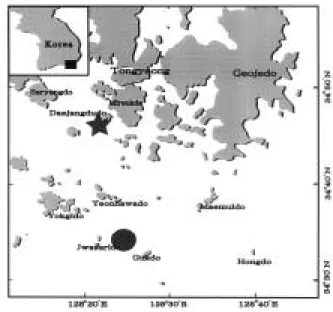
Fig. 1. A sampling sites of Psenes maculatus (★) and Psenes cyanophrys (●).
Psenes maculatus
examined specimens were deposited at the Department of Marine Biology, Pukyong Nation- al University (MBPNU), Busan, Korea.
Psenes maculatus Lütken, 1880 (New Korean name: Tti-mul-reung-dom)
(Fig. 2)
Psenes maculatus Lütken, 1880: 409-603, 5pls.
(Central Atlantic Ocean)
Psenes nigrescens Lloyd, 1909: 139-180, 7pls.
Material examined : MBPNU 980617, 1 spe- cimen 46.7 mm in total length (TL), collected by the surrounding net (length 30 m, depth 7~10 m) with the drifting seaweeds. Tongyeong-si, Gyeongsangnam-do, Korea (34�43′19′′N, 128�
21′07′′E), June 17, 1998 (Fig. 1).
Description : Dorsal f in rays X-I, 22; anal f in rays III, 22; pelvic f in rays I, 5; pectoral f in rays 20; caudal f in rays 17.
In percentage to body length, head length 37.4%; body depth 46.0%; preanal length 61.1%;
caudal peduncle length 8.0%; caudal peduncle depth 10.1%; eye diameter 11.9%.
In percentage to head length, eye diameter
31.7%; snout length 15.1%; interorbital space 34.9%; upper jaw length 35.7%; caudal peduncle depth 27.0% (Table 1).
Body compressed ellipse in shape with vertical bands (‘⁄’shape) on trunk and tail in young stage. Head large with big eyes and small mouth.
Scales very small. Lateral line high along sides following dorsal profile. Pelvic fins are large in young stage. This species has rows of melano-
Fig. 2. Psenes maculatus Lütken, 46.7 mm in total length, collected from Tongyeong-si, Gyeongsangnam-do, Korea, lateral view.
Table 1. Morphometric and meristic characters of Psenes maculatus collected from Tongyeong-si, Gyeongsangnam-do, Korea in June, 1998
Characters Present study Lütken (1880) Ahlstrom et al. (1976) Nakabo (2000)
Number of Specimens 1 1
Total length (mm) 46.7 50.0
Fork length (mm) 42.9
Body length (mm) 33.7 22.8
% of Body length
Head length 37.4 33.8
Body depth 46.0 50.4
Preanal length 61.1 57.0
Caudal peduncle length 8.0 Caudal peduncle depth 10.1
Eye diameter 11.9 13.6
% of Head length
Eye diameter 31.7 40.3
Snout length 15.1 22.1
Interorbital space 34.9
Upper jaw length 35.7
Caudal peduncle depth 27.0 Meristic characters
Dorsal fin rays X, I-22 IX-XI, I-22~24 XI, I-22 X, I-22
Anal fin rays III, 22 III, 21~23 III, 22 III, 21~22
Pelvic fin rays I, 5 I, 5 I, 5
Pectoral fin rays 20 20~21 22 21~22
Caudal fin rays 17 9±8
Scales in lateral series 67~70
Vertetrae 15±18~20 12±23 16±19
Gill rakers 10±1±17 10±19
phores followed the origin of dorsal f in rays and melanophores at the base of pectoral fin.
Body color in 5% formalin : Brown with darken brown vertical bands on the body.
Distribution : South sea of Korea (Tongyeong), Pacific ocean, Atlantic ocean and Indian ocean.
From this study, Psenes maculatus extended the species geographical range to the southern Korean waters.
Remarks : During young stage of this species residents in the drifting seaweeds or lives with jelly f ish. Young P. maculatus is similar to P.
arafurensis and P. pellucidus. But this species is distinguished from P. arafurensis by having 6 vertical bands on the body and P. pellucidus is differ from P. maculatus in having large number of dorsal f in rays (D. IX~XII-I~II, 27~32), lower number of anal fin rays (A. III, 20~21), smaller melanophores scattered on the body and none pigment at the base of pectoral fin (Kimura and Suzuki, 1982).
Body form changes from rounded ellipse in young stage to elongate ellipse in adult stage.
Pelvic f ins large in young, small in adult (Nakabo, 2000).
Psenes cyanophrys Cuvier and Valenciennes, 1833
(New Korean name: Jul-mu-nui-mul -reung-dom) (Fig. 3)
Psenes cyanophrys Cuvier and Valenciennes, 1833: 193~196, f ig. 265 (New-Irlande)
Fig. 3. Psenes cyanophrys Cuvier and Valenciennes, 179.0 mm in total length, collected from Tongyeong-si, Kyungsangnam-do, Korea, lateral view.
Table 2. Morphometric and meristic characters of Psenes cyanophrys collected from Tongyeong-si, Gyeongsangnam-do, Korea in July, 1998
Characters Present study Cuvier and Valenciennes Kamohara
Nakabo (2000)
(1833) (1942)
Number of Specimens 1 1
Total length (mm) 179.0 103.0 130.0
Fork length (mm) 147.0
Body length (mm) 124.0
% of Body length
Head length 30.0 33.3
Body depth 55.2 52.6
Preanal length 48.5
Caudal peduncle length 10.2 Caudal peduncle depth 10.7
Eye diameter 8.3
% of Head length
Eye diameter 27.3 23.8
Snout length 25.2 23.8
Interorbital space 35.0 32.3
Upper jaw length 33.4
Caudal peduncle depth 35.3 32.3
Meristic characters
Dorsal fin rays IX, I-26 IX, I-25 X, I-27 IX~XI-I, 23~28
Anal fin rays II, 25 III, 25 III, 28 II~III, 24~28
Pelvic fin rays I, 5 I, 5
Pectoral fin rays 16 19
Caudal fin rays 17 17
Scales in lateral series 62 60 60~63
Gill rakers 10±18
Psenes champmani Fowler, 1906: 114~122 Psenes cyanophrys Kamohara, 1942: 165~166 Psenes kamoharai (Abe, Kojima & Kosakai),
1963: 31~35
Material examined : MBPNU 980717, 1 spe- cimen, 179.0 mm in total length (TL), collected by the surrounding net (length 30 m, depth 7~10 m) with the drifting seaweeds. Jwasari Islands, Tongyeong-si, Gyeongsangnam-do, Korea (34�
33′93′′N, 128�24′66′′E), July 17, 1998 (Fig. 1).
Description : Dorsal fin rays IX-I, 26; anal fin rays II, 25; pelvic fin rays I, 5; pectoral fin rays 16; caudal fin rays 8±7; scales in lateral series 62; gill rakers 10±18.
In percentage to head length, eye diameter 27.3%; snout length 25.2%; interorbital space 35.0%; upper jaw length 33.4%; caudal peduncle depth 35.3% (Table 2).
Body deep, oval and compressed. Shape surface of body had about 16 longitudinal lines. Scales very small. Scales on top of head anterior to eyes.
Small mouth located the anterior of snout. Eye relatively smaller than young P. maculatus and post-orbital distance more than eye diame-ter.
Body color in life : Body uniform green, abdomen slightly paler than back. P. maculatus had lomgitudinal dark-green line which were formed by the spots on each scales under lateral line. Color of dorsal and anal fin are dark-green.
Body color changed from green to yelloish-grey in 10% formalin.
Distribution : South sea of Korea (Tongyeong), southern Japan, Pacific Ocean involved Hawaii, Atlantic Ocean, Indian Ocean.
Remark : This species is differ from ‘Psenes pellucidus’ in having scales on the interorbital of the head and 62 scales on the lateral line (120 scales in Psenes pellucidus) (Fig. 4). Young P.
cyanophrys is usually resident in the drifting seaweeds or lives with jelly fish. This species differ from the fishes of genera Cubiceps (Abe et al., 1963) and Nomeus in having deep body (Nakabo, 1993) and distinguish from the other species of genus Psenes in having the scales on upper part of opercle and oval shape body (Legaspi, 1956). Young Psenes cyanophrys has almost the same in body form in adult (20 cm in total length, Nakabo, 2000). Although it was known that adult P. cyanophrys occurred at mid or bottom layer (Nakabo, 2000), the specimen used in this study (179.0 mm in total length) was captured with drifting seaweeds. Therefore,
detailed ecological studies of this species should be necessary to understand those life history in Korean waters.
Because of longitudinal lines on the body, we propose “Jul-mu-nui-mul-reung-dom” as a Korean name of P. cyanophrys.
Key to the species of the family Nomeidae from Korea
1a. More than 100 scales on the lateral line
∙∙∙∙∙∙∙∙∙∙∙∙∙∙∙∙∙Psenes pellucidus (mul-reung-dom) 1b. Less than 100 scales on the lateral line ∙∙∙∙∙∙2 2a. No scale area on the head reaching the top of gill cover ∙∙∙∙∙P. maculatus (Tti-mul-reung-dom :
new korean name)
2b. Scales on top of head anterior to eyes (Fig.4)
∙∙∙∙∙∙∙∙∙∙∙∙∙∙∙∙∙∙∙∙∙∙∙∙∙∙∙∙∙∙∙∙∙∙∙∙∙∙∙∙∙∙∙∙∙∙∙∙∙∙∙∙∙∙∙∙∙∙∙∙∙∙∙∙∙∙∙∙∙∙∙∙∙∙∙∙∙3 3a. Body deep and rounded ellipse in shape
∙∙∙∙∙∙P. cyanophrys (Jul-mu-nui-mul-reung-
dom: new korean name)
3b. Body elongate ellipse in shape ∙∙∙∙∙∙∙∙∙Cubic squamiceps (Dong-gang-yeon-chi)
Acknowledgement
The authors give their thanks to Mr. Y.J.Park, Mr. T.J.Kang and Mr. T.H.Jyeong in the Marine Resources Laboratory of KORDI for thier help
Fig. 4. Diagram showing the scales on the head of Psenes cyanophrys. L. S., large scale; S. S., small scale; N.
S., none scale part.
with the field work. Comments from an anony- mous reviewers substantially improved the pre- sentation of this work. This study was supported by the research project ‘Studies on the develop- ment of marine ranching program in Tongyeong, Korea’ of MOMAF (BSPM00065-00-1284-3).
References
Abe, T. 1959. On the presence of at least two species of Cubiceps (Nomeidae, Pisces) in the path of the
“Kuro-Shio”. Rec. Oceanogr. Works Japan., Spec., (3) : 225~229.
Abe, T., S. Kojima and T. Kosakai. 1963. Descrip- tion of a new Nomeid fish from Japan. Jap. J.
Ichthy., 11(1/2) : 31~35.
Ahlstrom, E.H., J.L. Butler and B.Y. Sumida. 1976.
Pelagic Stromateoid fishes (Pisces, Perciformes) of the eastern Pacific : kinds, distribution, and early life histories and observations on five of these from the Northwest Atlantic. Bull. Mar.
Sci., 26(3) : 285~402.
Chyung, M.K. 1977. The Fishes of Korea. Iljisa.
Seoul, 727 pp. (in Korean)
Cuvier, M.B. et M. Valenciennes. 1833. Histoire Naturelle des Poissons, 9, Paris. 193~196, 265 pls. (in French)
Flower, H.W. 1906. New, rare or little known scom- broids, no.3. Proc. Acad. Nat. Sci. Philadelphia, 58 : 114~122. 3 f igs.
Haedrich, R.L. 1967. The Stromateoid f ishes: sys- tematics and a classif ication. Bull. Mus. Comp.
Zool., 135(2) : 31~139.
Kamohara, T. 1942. Twelve unrecorded species of fishes from Kii peninsula. Annot. Zool. Japan, 12(3) : 163~168.
Kimura, S. and K. Suzuki. 1982. Fish fauna of Ago bay and its adjacent waters, Mie Prefecture, Japan. Supplement-I. Rep. Fish. Res. Lab., Mie Univ., (3) : 1~20.
Lee, S.K., Y.U. Kim, J.G., Myoung, and J.M. Kim.
2000. Dictionary of Korean Fish Names.
Jeonginsa, Seoul. 222pp.
Legaspi, V.A. 1956. A contribution to the life history of the Nomeid fish Psenes cyanophrys Cuvier and Valenciennes. Bull. Mar. Sci. Gulf and Carib, 6(3) : 179~199.
Lütken, C.F. 1880. Spolia Atlantica. Bidrag til Kun- dskab om Formforandringer hos Fiske under deres V xt og Udvikling, S rligt hos nogle af Atlanterhavets Hφjsφfiske. Dansk. Vidensk.
Selsk. Skr., (5) Nat. Math. Afd., 12(6) : 409~613, 5pls.
Lloyd, R.E. 1909. A description of the deepsea fish caught by the R.I.M.S. ship “Investigator” since the year 1900, with supposed evidence of muta- tion in Malthopsis. Mem. Indian Mus. Calcutta, 2 : 139~180, 7pls.
Masuda, H., K. Amaoka, C. Arage, T. Uyeno and T.
Yoshino. 1984. The Fish Fauna of the Japanese Archipelago. Tokai Univ. Press, Tokyo. Text 437pp. 370pls.
Nakabo, T. 2000. Fishes of Japan with Pictorial Keys to the Species (second edition). Tokai Univ.
Press. Tokyo, 1748 pp. (in Japanese)
The Korean Society of Systematic Zoology. 1997.
List of Animals in the Korean (excluding insects).
Academy Press. Seoul, 489 pp. (in Korean)
Received : June 29, 2001 Accepted : September 11, 2001
경남 통영해역에서 발견된 한국 미기록 노메치과 어류2종 Psenes maculatus와 Psenes cyanophrys(노메치과, 농어목)에 대하여
명정구∙조선형∙김종만∙김용억*
한국해양연구소 해양자원본부, *부경대학교 해양생물학과
1998년 6월과 7월에 경상남도 통영해역에서 떠다니는 해조(drifting seaweeds)를 채집하던 중 Nomeidae과의 우리 나라 미기록 어종인 Psenes maculatus와 Psenes cyanophrys각각 1개체가 채집되었다.
Psenes maculatus는 유어기에 6개의「⁄」모양의 흑점띠가 체측에 존재하는 특징으로 “띠물릉 돔”으로 명명한다.
Psenes cyanophrys는 눈 뒤에 비늘이 존재하는 점, 체형이 난형인 점 등의 특징으로 같은 속의 물릉돔과 구분되었으며, 옆줄 아래에 16줄의 세로무늬가 나타나는 특징으로서 “줄무늬 물릉돔”으 로 명명하였다.