Introduction
The fishes of the family Zoarcidae (eelpouts) are known to constitute a diverse group com- posed of about 240 species in 46 genera from continental shelves and slopes of boreal seas (Anderson and Fedorov, 2004). Among Zoarcidae, the genus Lycodes Reinhardt includes about 60 species distributed primary in temperate and Arctic waters of the northern hemisphere. The genus is diagnosed by the presence of a dentary bone, with a cartilaginous submental crest (Anderson, 1994).
Although there have been numerous system- atic studies of the family Zoarcidae (Lindberg and Krasyukova, 1975; Anderson, 1982, 1994;
Toyoshima, 1985; Anderson and Fedorov, 2004), this group has attracted little attention in Korea.
Since Jordan and Starks (1905) described the first zoarcid fish, Zoarces gilli from Korea, the family was listed as having seven species living in Korean waters (Mori, 1952; Chyung and Kim,
1959). The suborder Zoarcoidei was reported with new records from Korea (Kim and Kang, 1991a, b; Kim et al., 2005) and the family Zoarcidae was reviewed with a provisional key (Kim, 2006).
In the course of investigating the coastal fish collections, we recognized four species of the genus Lycodes as new records for Korea. In this paper we record these species and provide a key to the species of the family Zoarcidae in Korea with their distributions.
Materials and Methods
Measurements and counts were made accord- ing to Toyoshima (1985): measurements were made to the nearest 0.1 mm with dial calipers.
Radiographs by soft x-ray were used in counting the number of vertebrae. Fish specimens exam- ined in the present study were deposited in the fish collections of the Department of Biology, Chonbuk National University, Chonju (CNUC) and from the bottom trawl surveys of the East Sea Fisheries Research Institute, Korea. The holotype and paratype of Lycodes pectoralis were
Four New Records of Genus Lycodes (Perciformes:
Zoarcidae) from Korea
IK-Soo Kim*, Seong-Yong Kim and Seon-Jae Hwang
1 Faculty of Biological Sciences and Institute for Biodiversity,Chonbuk National University, Jeonju 561-756, Korea
1National Fisheries Research and Development Institute, Busan 619-902, Korea
A taxonomic study of the family Zoarcidae was conducted using fish collections deposited in the Department of Biology, Chonbuk National University, Jeonju, Korea and the East Sea Fisheries Research Institute, Korea. Among these collec- tions, the following four species of the genus Lycodes are recognized as the first records for Korea; L. sadoensis, L. japonicus, L. pectoralis, and L. sigmatoides. These species are here redescribed and figured, with their distributions and a provisional key to five genera and eleven species of the family Zoarcidae from Korea.
Key words : Zoarcidae, Lycodes, eelpout, new record, Korean
*Corresponding author: [email protected]
─
─ 273 ──
examined in the Laboratory of Marine Zoology, Faculty of Fisheries, Hokkaido University, Japan (HUMZ). The classification follows that of Anderson (1994).
Taxonomic accounts
Family Zoarcidae Genus Lycodes Reinhardt, 1831 (Korean name: meok-gal-chi-sok)
1. Lycodes sadoensis Toyoshima and Honma, 1980
(Fig. 1 and Table 1)
(New Korean name: sa-do-meok-gal-chi)
Lycodes sadoensis Toyoshima and Honma, 1980:
48 (type locality: off Ishikawa Pref, Japan);
Toyoshima, 1985: 189.
Material examined. CNUC 36593, one spec- imen, 160.4 mm in total length (TL), 27 Mar. 2006, Chuksan-myeon, Yeongdok-gun, Gyeongsangbuk- do, Korea, collected S. J. Hwang, 200~300 m depth.
Diagnosis. This species is distinguished from other members of the genus by the following com- bination of characters: lateral line anterolateral in position, body and head brownish in dorsal half and light in ventral half. Dorsal fin with somewhat dark margin and three spots anteri- orly.
Description. Counts and measurements are given in Table 1. Body moderate elongate and deep. Head somewhat depressed. Interorbital space narrow and convex. Mouth moderate in size, lower jaw completely included. Teeth small and conical those on upper jaw in a single row laterally and two rows anteriorly; those on lower jaw in irregular two rows. Lateral line anterolat- eral. Small isolated scales covering body except for head, belly, and base of base of pectoral fin.
Dorsal fin originating above vertebrae, anal fin inserted below 13 th dorsal ray. Pectoral fin short, fan like, with round margin, its length half of
head length. Pelvic fin very short.
Color in formalin. Brownish in dorsal half and light in ventral half of body and head. Irre- gular three vertical lines on side of body near caudal fin. Dorsal fin having a somewhat dark margin and three dark spots anteriorly. Peri- toneum blackish brown.
Distribution. Japan (Sado Island, off Ishigawa Prefecture) and Korea (off coast of Yeongdok- gun, Gyeongsanbuk-do).
Remarks. The specimen of Lycodes collected from the east coast of Korea here reported agrees precisely with the original description and fig- ures of L. sadoensis (Table 1). Lycodes sadoensis was described from waters near Sado Island, Niigata, Japan. The species resembles L. teraoi in proportional measurements and counts, but differs from in having a brownish dorsal half of the head and body, some vertical lines on the body near the caudal fin and three or more dark spots on the dorsal fin (Toyoshima and Honma, 1980). This record is the first time from Korea and also from outside of Japan.
2. Lycodes japonicus Matsbara and Iwai, 1951
(Fig. 2 and Table 1)
(New Korean name: mu-ni-ga-si-chi)
Lycodes japonicus Matsubara and Iwai, 1951: 368 (type locality: Toyama Bay, Japan); Toyoshima, 1985: 191.
Material examined. CNUC 36505, one speci- men 125.05 mm in TL, Mat 21, 2005, about 300 m depth, Samchok-si, Gangwon-do, Korea, col- lected by S. J. Hwang.
Diagnosis. Lycodes japonicus is distinguished from most other members of the genus by the longer pelvic fin, an anteroventral lateral line, and 14 pectoral-fin rays.
Description. Counts and measurements are given in Table 1. Body elongate, compressed, tapering to tail. Head moderately large with round snout and very large mouth. Teeth conical those on upper jaw in a single row and those of
Fig. 1. Lycodes sadoensis Toyoshima and Honma, 1980, CNUC 36593, 160.3 mm TL, from off Yeongdok-gun, Gyeongsangbuk-do, Korea.
lower jaw in a broad band anteriorly. Dorsal fin originating above middle of pectoral fin. Pectoral fin rounded, moderately large. Pelvic fin small, longer than eye diameter. Body covered with small cycloid scales head and belly naked. Lateral line anteroventral,
Color in formalin. Brownish body with irreg- ular dark brown blotches on body side, head and dorsal fin. Vertical fins and anterior half of pec- toral fin dark grey. Oral cavity and peritoneum dark brown.
Distribution. Japan (Toyama Bay and off Sado Island) and Korea (Samchok-si, Gangwon- do).
Remarks. Compared to the original descrip- tion and figures of L. japonicus, the present specimen of Lycodes collected from Samchok, Korea is well assignable to L. japonicus. The species differs from most other species of Lycodes in having a fewer number of dorsal, anal, and pectoral rays. This species is a dwarf species among the eelpouts, the largest only about 137
mm in total length (Matsubara and Iwai, 1951).
3. Lycodes pectoralis Toyoshima, 1985 (Fig. 3 and Table 1)
(New Korean name: buk-gal-chi)
Lycodes pectoralis Toyoshima, 1985: 228 (type locality: southern Okhotsk Sea).
Materials examined. Holotype HUMZ 49083, 346.2 mm TL, 45� 37 ′ N, 143� 53 ′ E, southern Okhotsk Sea, 290~480 m October 8, 1975; Para- type HUMZ 33951, 266.7 mm TL, 44� 47 ′ N, 144�
015 ′ E, S. Okhotsk Sea, 200 m, October 31, 1974;
CNUC 36493~36497, (5) Specimens, 217.3~
329.4 mm TL, Jukbyeon-myon, Uljin-gun, Gyeong- sangbuk-do, Korea, collected by S. J. Hwang.
Diagnosis. Lycodes pectoralis is distinguished from other members of the genus by the fol- lowing combination of characters: small head, developed submental crest, deeply emerginate pectoral fin, ventral lateral line, and no blotches or bars on body and fins.
Table 1. Comparison of counts and measurements between the Korean specimens and the type specimens of four Lycodes species
L. sadoensis L. japonicus L. pectoralis L. sigmatoides
Counts
Dorsal fin rays 77 (72~78) 81 (79~84) 108~112 (106~115) 96 (92~96)
Anal fin rasy 65 (62~65) 72 (69~73) 94~96 (91~101) 76 (72~83)
Pectoral fin rays 15 (15) 15 (14~15) 17~18 (17~18) 19 (18~20)
Vertebrae 84 (82~87) 92 (87~93) 113~116 (112~123) 103 (99~106)
Gill-rakers 12 11 12 14~15
Proportions in TL
Body depth 10.7 (9.92~11.63) 11.34 10.8~11.2 (10.7~12.5) 11.9 (11.2~12.6)
Predorsal length 3.7 4.0 (3.64~4.25) 4.3~4.6 (4.9~5.5) 3.7 (26.6~27.6)
Preanal length 2.3 (2.16~2.65) 2.8 (2.51~2.96) 2.7~2.8 (2.8~3.2) 2.2 (44.3~50.0)
Head length (HL) 4.9 (4.33~5.21) 5.4 (4.48~5.67) 5.8~6.1 (5.7~6.4) 4.3
Proportions in HL
Head width 2.6 (1.76~2.26) 2.6 (1.70~2.63) 2.2~2.6 (1.7~2.0) 3.6
Snout length 3.5 (2.31~3.29) 3.6 (3.50~4.09) 2.9~3.4 (2.6~3.1) 0.8
Eye diameter 5.3 (3.97~5.36) 4.0 (3.63~4.28) 5.5~5.7 (4.0~5.9) 2.3
Interorbital width 9.7 5.4 (4.97~6.06) 4.5~5.2 (3.7~4.7) 4.3
Upper jaw length 2.3 (1.86~2.36) 2.6 (2.38~3.39) 2.4~2.7 (2.4~2.7) 0.6
Lower jaw length 3.0 (2.11~3.08) 3.2 3.0~3.1 (2.6~3.2) 0.7
Numbers in parentheses are those of type specimens of the original descriptions.
Fig. 2. Lycodes japonicus Matsubara and Iwai, 1951, CNUC 36505, 125.0 mm TL, from off Samcheok-si, Gangwon-do, Korea.
Description. Counts and measurements are given in Table 1. Body rather elongate and moderately deep. Head relatively small. Mouth small, posterior end of upper jaw reaching ante- rior half of eye. Snout somewhat pointed. Nostril tube very short. Teeth small and conical. Body densely covered with cycloid scales. Lateral line ventral, very distinct, starting from apex of gill opening, descending toward anus and then run- ning along base of anal fin almost to base of cau- dal fin. Pelvic fin small, shorter than eye diame- ter.
Color in formalin. No bars and markings on body and fins. Margins of vertical fins blackish.
Oral and peritoneum blackish.
Distribution. Okhotsk Sea and Korea
Remarks. Although this species was known from the Okhotsk Sea only since the original description of the species by Toyoshima (1985), these specimens of Lycodes collected from off Uljin coast, Gyeonsangbuk-do, Korea are confi- dently assignable to L. pectoralis based on the records of type specimens (Toyoshima, 1985). The specimens represent the first record of the species from Korea. This species is most closely related to L. nakamurae in having numerous vertical fin rays and an emarginate pectoral fin, however, it differs from the latter by lacking scales on the dorsum before the dorsal fin origin and lacking black blotches on anterior part of
dorsal fin or upper margin of the pectoral fin.
4. Lycodes sigmatoides Lindberg and Krasyukova, 1975
(Fig. 4 and Table 1)
(New Korean name: gul-gok-mu-ni-chi)
Lycodes sigmatoides Lindberg and Krasyukova, 1975: 161 (type locality: Okhotsk Sea).
Lycodes schmidti Soldatov, 1917: 115 fig. 2 (Preoccupied by Lycodes schmidti Grazianov, 1907; Okhotsk Sea).
Material examined. CNUC 36537, one spec- imen 506.2 mm TL, Nov. 27, 1989, Mukho fish market, Donghae-si, Gangwon-do, Korea.
Diagnosis. A species of Lycodes distinguished by its unique colour pattern consisting of S- shaped or worm-like spots on the dorsal fin and upper part of body sides.
Description. Counts and measurements are given in Table 1. Body elongate, compressed, tapering to tail. Head moderately large. Snout pointed. Submental crest well developed. Nasal tube long, reach upper lip. Gill slit extending ventrally to below lower pectoral fin margin.
Teeth sharp, canine-shaped, arranged in single row on upper jaw. Midlateral system. Body cov- ered with small cycloid scales except nape, abdomen, and pectoral fin base.
Color in formalin. Characteristic light-col-
Fig. 4. Lycodes sigmatoides Lindberg and Krasyukova, 1975, CNUC 36537, 506.2 mm TL, from Donghae-si, Gangwon-do, Korea.
Fig. 3. Lycodes pectoralis Toyoshima, 1985, CNUC 36493, 343.3 mm TL, from Uljin-gun, Gyeongsangbuk-do, Korea.
ored S-shaped spots located on back, which continue on dorsal fin. Back and dorsal fin with- out dark oblique stripes. Margin of dorsal and anal fin light-colored. Occiput with a few spots (Soldatov, 1917).
Distribution. Okhotsk Sea and off Gangwon- do coast, Korea.
Remarks. This species was described under the name of Lycodes schmidti by Sodatov (1918), but the species name was preoccupied treated as a homonym of Lycodes schmidti Grazianov, 1907.
Lindberg and Krasyukova (1975) erected it as valid name, L. sigmatoides, based on specimens collected from the Okhotsk Sea. L. sigmatoides is similar with L. tanakae in external shape, how- ever Kim (2006) reported that L. sigmatoides differs from L. tanakae in having light-colored S- shaped spots on the back and dorsal fin, 92-96 dorsal fin rays (vs. 96-98), 72~76 anal fin rays (vs. 77~79), and 103 vertebrae (vs. 104~107).
Discussions
The family Zoarcidae was comprised four sub- families, Zoarcinae, Lycozoarcinae, Gymnelinae, and Lycodinae, of which the Lycodinae is the largest subfamily with 32 genera and 120 species (Anderson and Fedorov 2004). The taxonomic studies of the Lycodine fishes have been carried out by many ichthyologists (Schmidt, 1950;
Toyoshima, 1985; Anderson, 1994; Anderson and Fedorov, 2004; Shinohara and Shirai, 2005), and Hatooka (2002) recognised 22 species of the genus Lycodes from Japanese waters with their pictoral keys and illustrations. After Mori (1952) reported two species of Lycodes tanakae and L.
nakamurae from Korea, Petrochmidtia toyamen- sis was also included as recorded species in Korea (Chyung and Kim, 1959; Kim et al., 2005).
Subsequently P. toyamensis was transferred to the genus Lycodes by the osteological study of the species (Anderson, 1994), and Kim (2006)
also recognised it as the genus Lycodes by the observation of the Korean specimens.
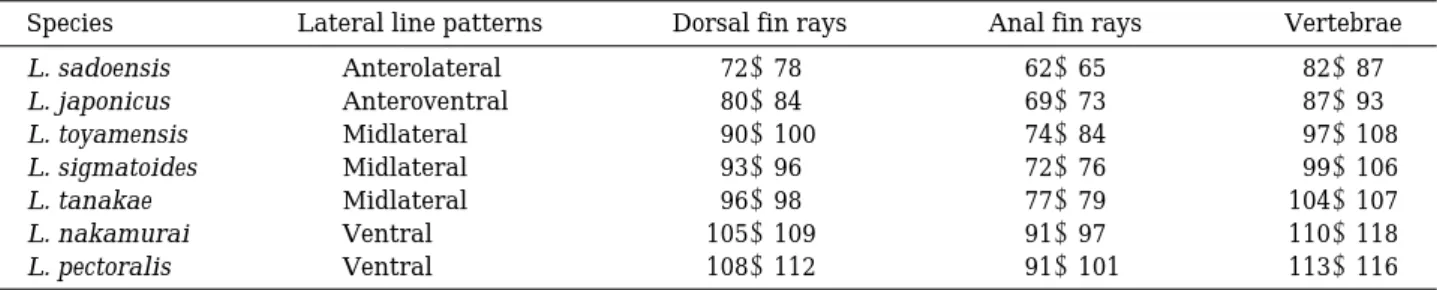
The genus Lycodes contains a large number of species that exhibit profound character plasticity (Anderson, 1994) and it is very difficult to iden- tify them. However the specimens observed in this paper were confirmed as the first Korean records of Lycodes based on their original descrip- tions and recent taxonomic revisions (Katayama, 1941; Matsubara and Iwai, 1951; Lindberg and Krasyukova, 1975; Toyoshima, 1985; Anderson, 1994; Anderson and Fedorov, 2004). The follow- ing characters were ascertained to be very useful for the separation of species: fin ray and verte- bral counts and lateral line patterns. Four species of Lycodes were specific in their lateral line forms, as follows: anterolateral in L. sadoensis, anteroventral in L. japonicus, midlateral in L.
sigmatoides, ventral in L. pectoralis (Table 2).
Fishes of the family Zoarcidae primarily inhab- it mud bottoms of the continental shelves and slope of northern boreal seas and most species in the West Pacific Boreal Region are found in the Okhotsk and Kuril Provinces (Anderson, 1994).
Although Lycodes sadoensis and L. japonicus were previously known to be distributed only in the Japanese waters and L. pectoralis and L.
sigmatoides from only the Okhotsk Sea, it is remarked that the four species of Lycodes were found from off the east cost of Korea. Therefore the genus Lycodes of Korea contains 7 species including 4 species newly recorded in this time and the eelpout fishes of the family Zoarcidae known Korean waters are classified by 11 species in 5 genera as the following provisional keys.
Key to genera and species of family Zoarcidae from Korea
1a. No pelvic fin
∙∙∙∙∙∙∙∙∙∙∙∙∙∙∙∙∙∙∙∙∙∙∙∙∙∙∙∙∙∙∙∙∙∙∙∙∙∙∙∙∙∙∙∙∙∙∙∙∙∙∙∙∙∙2 1b. Pelvic fin present
∙∙∙∙∙∙∙∙∙∙∙∙∙∙∙∙∙∙∙∙∙∙∙∙∙∙∙∙∙∙∙∙∙∙∙∙∙∙∙∙∙∙∙∙∙3 2a. Head and body with scales; oval scales present of body
∙∙∙∙∙∙∙∙∙∙∙∙∙∙Bothrocara hollandi
Table 2. Lateral line patterns, number of dorsal and anal rays, and vertebrae in the species of Lycodes in Korea
Species Lateral line patterns Dorsal fin rays Anal fin rays Vertebrae
L. sadoensis Anterolateral 72~78 62~65 82~87
L. japonicus Anteroventral 80~84 69~73 87~93
L. toyamensis Midlateral 90~100 74~84 97~108
L. sigmatoides Midlateral 93~96 72~76 99~106
L. tanakae Midlateral 96~98 77~79 104~107
L. nakamurai Ventral 105~109 91~97 110~118
L. pectoralis Ventral 108~112 91~101 113~116
2b. Head and body without scales round scales present only in caudal part of body
∙∙∙∙∙∙∙∙∙∙∙∙∙∙∙∙∙∙∙∙∙∙∙∙∙∙∙∙∙∙∙∙∙∙∙∙∙∙∙∙∙∙∙∙∙∙∙∙
Gymnelopsis brashinikovi 3a. Posterior part of dorsal fin without short spiny rays. No dark spot on anterior part of dorsal fin
∙∙∙∙∙∙∙∙∙∙∙∙∙∙∙∙∙∙∙∙∙∙∙∙∙∙∙∙∙∙∙∙∙∙∙∙∙∙∙∙∙∙∙∙∙∙∙∙∙∙∙∙∙∙∙∙∙∙∙∙4 3b. Posterior part of dorsal fin with short spiny rays. Dark spot on anterior part of dorsal fin
∙∙∙∙∙∙∙∙∙∙∙∙∙∙∙∙∙∙∙∙∙∙∙∙∙∙∙∙∙∙∙∙∙∙∙∙∙∙∙∙∙∙∙∙∙∙∙∙∙∙Zoarces gillii 4a. Mental crest present on lower side of head, without H-shaped dark brown marks along sides of body
∙∙∙∙∙∙∙∙∙∙∙∙∙∙∙∙∙∙∙∙∙∙∙∙∙∙∙∙∙∙∙∙∙∙∙∙∙∙∙∙∙∙∙∙∙∙∙∙∙∙∙∙∙∙5 4b. Mental crest absent on lower side of head,
with H-shaped dark brown marks along sides of body
∙∙∙∙∙∙∙Davidijordania poecilimon 5a. Palatine teeth present, body with some markings
∙∙∙∙∙∙∙∙∙∙∙∙∙∙∙∙∙∙∙∙∙∙∙∙∙∙∙∙∙∙∙∙∙∙∙∙∙∙∙∙∙∙∙∙∙∙∙∙∙∙∙∙∙∙∙∙∙∙∙∙6 5b. Palatine teeth absent, body without mark- ings
∙∙∙∙∙∙∙∙∙∙∙∙∙∙∙∙∙∙∙∙∙∙∙∙∙∙∙∙∙∙∙∙∙∙∙∙Lycodes toyamensis 6a. Lateral line restricted to preanal region
∙∙∙∙7 6b. Lateral line extending onto caudal region
∙∙∙∙∙∙∙∙∙∙∙∙∙∙∙∙∙∙∙∙∙∙∙∙∙∙∙∙∙∙∙∙∙∙∙∙∙∙∙∙∙∙∙∙∙∙∙∙∙∙∙∙∙∙∙∙∙∙∙∙∙∙∙∙∙∙∙∙∙∙∙∙∙∙∙∙∙
8 7a. Three irregular vertical lines on side of
body near caudal fin and dorsal fin with 3 or more dark spots
∙∙∙∙∙∙∙∙∙∙∙∙∙∙∙∙∙∙∙∙∙∙L. sadoensis 7b. No vertical lines, body with irregular blotch- es and dark markings dorsal fin with irreg- ular dark spots
∙∙∙∙∙∙∙∙∙∙∙∙∙∙∙∙∙∙∙∙∙∙∙∙∙∙∙∙∙L. japonicus 8a. Pectoral fin rounded
∙∙∙∙∙∙∙∙∙∙∙∙∙∙∙∙∙∙∙∙∙∙∙∙∙∙∙∙∙∙∙∙∙∙∙∙∙10 8b. Pectoral fin deeply emarginate
∙∙∙∙∙∙∙∙∙∙∙∙∙∙∙∙∙∙∙∙9 9a. Spot present on anterior margin of dorsal fin and upper part of pectoral fin
∙∙∙∙∙∙∙∙∙∙∙∙∙∙∙∙∙∙∙∙∙∙∙∙∙∙∙∙∙∙∙∙∙∙∙∙∙∙∙∙∙∙∙∙∙∙∙∙∙∙∙∙∙∙∙∙∙∙∙∙∙∙∙∙∙∙∙∙∙∙∙∙∙
L. nakamurae 9b. No markings on anterior margin of dorsal fin and upper part of pectoral fin
∙∙∙∙∙∙∙∙∙∙∙∙∙∙∙∙∙∙∙∙∙∙∙∙∙∙∙∙∙∙∙∙∙∙∙∙∙∙∙∙∙∙∙∙∙∙∙∙∙∙∙∙∙∙∙∙∙∙∙∙∙∙∙∙∙∙∙∙∙∙∙∙∙∙∙∙∙
L. pectoralis 10a. Body with O, I-shaped brown marking. D 96~98
∙∙∙∙∙∙∙∙∙∙∙∙∙∙∙∙∙∙∙∙∙∙∙∙∙∙∙∙∙∙∙∙∙∙∙∙∙∙∙∙∙∙∙∙∙L. tanakae 10b. Body with S-shaped white marking. D 93~96
∙∙∙∙∙∙∙∙∙∙∙∙∙∙∙∙∙∙∙∙∙∙∙∙∙∙∙∙∙∙∙∙∙∙∙∙∙∙L. sigmatoides
Acknowledgement
We express our sincere thanks to Dr. Tomio Iwamoto (California Academy of Sciences, USA) for critically review a draft manuscript and providing important comments. We are indebted to Drs. Kazuhiro Nakaya and Mamoru Yabe (Hokkaido University, Japan) for providing opportunity to examine comparative materials and also Dr. M. Eric Anderson (J.L.B. Smith Institute of Ichthyology, South Africa) for his
comments on the specimen identification.
References
Anderson, M.E. 1982. A new eelpout (Teleostei: Zoarcidae) from the eastern tropical Pacific Ocean. Biological results of the University of Miami Deep-Sea Ex- peditions. 136. Bull. Mar. Sci., 32 : 207~212.
Anderson, M.E. 1994. Systematics and osteology of the Zoarcidae (Teleostei: Perciformes). Ichthyol. Bull. J. L.
B. Smith Inst. Ichthyol., 60 : 1~120.
Anderson, M.E. and V.V. Fedorov 2004. Family Zoarcidae Swainson 1839 eelpouts. California Academy of Scien- ces, Annotated checklists of fishes, 34 : 1~58.
Chyung, M.K. and K.H. Kim. 1959. Thirteen unrecorded species of fish from Korean waters. Korean J. Zool., 2 : 1~10.
Grazianov, V.I. 1907. A synoptic essay of the taxonomy and geography of the fishes of the Russian Empire. Trudy Otdela Ikhtiol. Russ. Obsc. Akklimat. Zhiv. Moskva, 4 : i~xxx++1~567. (in Russian).
Jordan, D.S. and E.C. Starks. 1905. On a collection of fishes made in Korea by Pierre Louis Jouy, with descri- ptions of new species. Proc. U. S. Natl. Mus, 25 : 212.
Katayama, M. 1941. A new ophidioid fish from Toyama Bay. Zool. Mag, Tokyo, 53 : 593~594, fig. 1.
Kim, I.S., Y. Choi, C.L. Lee, Y.J. Lee, B.J. Kim and J.H.
Kim. 2005. Illustrated book of Korean fishes. Kyo-Hak Publishing Seoul, Korea, pp. 1~613 (in Korean).
Kim, I.S. and E.J. Kang. 1991a. Taxonomic revision of the suborder Blennioidei and Zoarcoidei (Pisces: perci- formes) from Korea. Korean J. Zool., 34 : 500~525. (in Korean).
Kim, I.S. and E.J. Kang. 1991b. Six unrecorded fishes of the suborder Zoarcoidei (Pisces: Perciformes) from Korea. Korean J. Ichthyol., 3 : 89~97.
Kim, S.Y. 2006. Taxonomic study of the Family Zoarcidae (Perciformes, Pisces) in Korea. Master’s Thesis of Graduate School, Chonbuk National University, pp.
1~56 (in Korean).
Lindberg, G.U. and Z.V. Krasyukova 1975. Fishes of the Sea of Japan and adjacent areas of the Sea of Okhotsk and the Yellow Sea. Keys to the Fauna of the USSR Part 4. Teleostomi, XXIX. Perciformes. 2. Blennioidei- 13. Gobioidei. Nauka, Moskow, Leningrad. (Translated from Russian by the Smithonian Institution Libraries and the National Science Foundation, Washington, DC, 1989).
Matsubara, K. and T. Iwai 1951. Lycodes japonicus, a new Ophidioid fish from Toyama Bay. Jpn. J. Ichthyol., 1 : 368~375.
Mori, T. 1952. Check list of the fishes of Korea. Mem.
Hyogo Univ. Agr. 1(3). Biol. Ser., pp. 1~228.
Hatooka, K. 2002. Zoarcidae. In Nakabo, T. (ed). Fishes of Japan with pictoral keys to the species, English edn.
Tokai University Press, Tokyo, pp. 1028~1044.
Reinhardt, J.C.H. 1831. Preliminary report. overs. K.
Danske Vidensk. Selsk. Forh., 1830~1831 : 1~40.
Schmidt, P. Yu. 1950. Fishes of the Sea of Okhotsk. Trans.
Pacif. Comn. Acad. Sci. U.S.S.R. 6 : 1~370, Pls. 1~20.
Shinohara, G. and S.M. Shirai. 2005. Lycodes nishimurai, a new deep-sea eelpout (Teleostei: Zoarcidae) from the Sea of Japan. Ichthyol. Res., 52 : 171~175.
Soldatov, V.K. 1917. Notes on two new species of Lycodes from Okhotsk Sea. ann. Mus. Zool. Acad, Sci. Petrograd,
22 : 112~117.
Toyoshima, M. 1985. Taxonomy of the subfamily Lycodinae (family Zoarcidae) in Japan and adjacent waters. Mem.
Fac. Fish. Hokkaido Univ., 32 : 131~243.
Toyoshima, M. and Y. Honma. 1980. Description of a new zoarcid fish, Lycodes sadoensis, from the Sea of Japan.
Jpn. J. Ichthyol., 27 : 48~50.
Received : July 15, 2006 Accepted : August 11, 2006
한국산 먹갈치속
Lycodes (
농어목,
등가시치과)
어류4
미기록종 김 익 수∙김 성 용∙황 선 재1전북대학교 생물과학부∙생물다양성연구소, 1국립수산과학원
우리나라 동해안에서 채집된 등가시치과 어류 표본을 검토한 과정에서 먹갈치속(Lycodes)에 포함되는 다음4종 Lycodes sadoensis (국명신칭: 사도먹갈치), L. japonicus (국명신칭: 무늬가시치), L. pectoralis (국명신칭: 북갈치), L. sigmatoides (국명신칭: 굴곡무늬치)는 한국미기록종으로 확인 되어 사진과 함께 재기재하고 한국 등가시치과 (Zoarcidae) 5속 11종의 속 및 종검색표를 제시하 였으며 지리적 분포에 대하여 기록하였다.