—289—
INTRODUCTION
A total of 360 species in 56 genera are recognized in the family Blenniidae in the order Perciformes (Nelson, 2006), and 14 of these species in 8 genera have been recognized in Korea to date (Kim and Endo, 2009; Kim et al., 2009; Kim and An, 2010). The genus Xiphasia Swainson, 1839, belongs to the family Blenniidae, con- taining only two species worldwide (Xiphasia setifer Swainson, 1839 and X. matsubarai Okada and Suzuki, 1952), but there has been no report of them in Korea, except by Yamada et al. (2009), who suggested a new Korean name for X. setifer. In the present study, a single specimen of X. setifer was collected from Korea for the first time, and we describe the genus and species as the first record, based on this specimen.
The counts and measurements follow Hubbs and Lag- ler (2004), and the vertebrae were counted from a radio- graph (SOFTEX HA-100, Japan). The specimen has been deposited at Pukyong National University (PKU), Korea.
Xiphasia Swainson, 1839
(New Korean name: Gal-chi-be-do-ra-chi-sok) Xiphasia Swainson, 1839: 259 (type species: Xiphasia
setifer Swainson, 1839).
Description. D. XI~XIV, 99-119; A. II, 97~119; P
1.
10~14; P
2. I, 3; Vert. 113-135.
Body slender, elongated, and eel like, gill openings small. All fin rays unbranched, origin of the dorsal fin located on the head. Pelvic fin composed of one embed- ded spine and three soft rays. Membrane of the last dor- sal and anal fins connected to the caudal fin. Swim blad- der absent. Only two species are recognized worldwide (Smith-Vaniz, 1976; Springer, 1986; Aizawa, 2002; Nel- son, 2006).
Xiphasia setifer Swainson, 1839 (Korean name: Gal-chi-be-do-ra-chi)
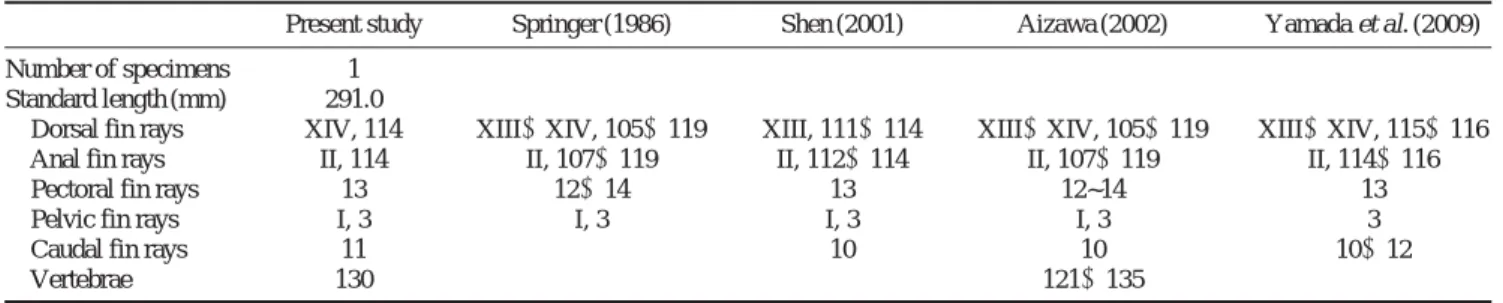
(Fig. 1; Table 1)
Xiphasia setifer Swainson, 1839: 259 (type locality: Viza- gapatam, India); Smith-Vaniz, 1976: 70 (Indo-Pacific);
Springer, 1986: 755 (Indo-Pacific); Kuiter, 1996: 332 (Australia); Shen, 2001: 496 (Taiwan); Aizawa, 2002:
1119 (Japan); Yamada et al., 2009: 575 (East China Sea).
Material examined. PKU 4212, one specimen, 291.0 mm SL, Sangju, Namhae, both sides fyke net, depth 10 m, 5 Sep. 2010, collected by Jin Koo Kim.
Description. Counts are shown in Table 1. Proportion of Standard length (%): body depth 2.6; head length 6.5;
head width 2.1; snout length 1.6; eye diameter 1.6; inter- orbital width 1.3; postorbital length 3.3; upper jaw length 1.8; predorsal length 2.0; preanal length 13.3; pectoral fin length 3.2; pelvic fin length 3.1.
Body very elongated, ribbon like, with low depth. Con-
First Record of Hairtail Blenny
Xiphasia setifer (Perciformes: Blenniidae) from Korea
By Hyuck Joon Kwun, Jung Hwa Ryu
1and Jin Koo Kim*
Department of Marine Biology, Pukyong National University, Busan 608-737, Korea
1Ryu Jung Hwa Marine Research Institute, Busan 614-811, Korea
ABSTRACT
Xiphasia setifer is reported for the first time from the South Sea of Korea based on asingle specimen (291.0 mm SL) collected in September 2010. This species is characterized by the origin of the dorsal fin located vertically above the anterior margin of the eye; dorsal fin rays XIV, 114; anal fin soft rays 114, and vertebrae 130. The new Korean name of the genus Xiphasia is proposed as “Gal- chi-be-do-ra-chi-sok” and the Korean name of X. setifer as “Gal-chi-be-do-ra-chi”, following Yamada
et al. (2009).Key words : First record, Xiphasia setifer, Blenniidae, Korea
*Corresponding author: Jin Koo Kim Tel: 82-51-629-5927, Fax: 82-51-629-5931, E-mail: [email protected]
KOREAN JOURNAL OF ICHTHYOLOGY, Vol. 22, No. 4, 289-292, December 2010 ISSN: 1225-8598
Received : October 2, 2010 Revised : December 8, 2010 Accepted : December 16, 2010
http://www.fishkorea.or.kr
tour of the head round and slightly compressed. Mouth rather small. Posterior tip of the maxilla reaches the ante- rior margin of the eye. Small conical teeth anteriorly in a single row on both jaws; four small canine and two enlarged curved canine posteriorly on each side of the upper and lower jaws (Fig. 2). Interorbital region con- vex. Gill cover opened in the middle of the pectoral fin base. Origin of the dorsal fin located vertically at the anterior margin of the eye, and origin of the anal fin located vertically at the second dorsal soft ray. Dorsal and anal fin bases long, membrane of the posteriormost portion connected to the caudal fin. Caudal fin slightly pointed.
Coloration. When fresh, the head and body are green- ish brown. Approximately 26~27 dark greenish brown bands. Black dot on part of the sixth dorsal spine and black blotch on portion between the 11th and 14th dor- sal spines (Fig. 2). Many small melanophores present on the dorsal and anal fin membranes, and the dorsal and anal fin bases are greenish yellow. Posterior margin of the caudal fin darkish. After fixation, the head and body are grayish green, and the membranes of the dorsal and anal fins are darkish.
Distribution. Xiphasia setifer was collected in Sangju, Namhae from Korea (present study). It occurs in the Indo- Pacific (Smith-Vaniz, 1976; Springer, 1986), Australia (Kuiter, 1996), East China Sea (Yamada et al., 2009) and Japan (Aizawa, 2002).
Remarks. The present specimen belongs to the genus Xiphasia based on its small gill openings and elongated body. It was identified as X. setifer by its numbers of dorsal fin rays, anal fin rays, pectoral fin rays, and verte- brae (Table 1). It corresponds well with X. setifer in that
the origin of the dorsal fin is located on the head, and a black dot occurs on a portion of the dorsal spine (Smith- Vaniz, 1976; Kuiter, 1996; Aizawa, 2002; Yamada et al., 2009; Fig. 2). When compared with the original descrip- tion, the present specimen corresponds well in having an elongated and linear body, but there is no detailed description in the original paper. Therefore, we compared it with specimens cited in other references. Xiphasia seti- fer has a sexual dimorphism in that the central caudal fin rays are elongated in the male (Okada and Suzuki, 1952;
Aizawa, 2002; Yamada et al., 2009). According to this feature, our specimen is thought to be female. Yamada et al. (2009) mentioned that X. setifer has three pelvic fin rays, differing from our specimen and those reported by other ichthyologists (P
2. I, 3). This discrepancy may be the result of embedded pelvic spines counted incor- rectly by Yamada et al. (2009). Xiphasia setifer is easily distinguishable from the congeneric species, X. matsub- arai, by the location of the origin of the dorsal fin (at the
290 Hyuck Joon Kwun, Jung Hwa Ryu and Jin Koo Kim
Fig. 1. Xiphasia setifer, PKU 4212, 291.0 mm SL.
Table 1. Comparison of counts and measurements of Xiphasia setifer
Present study Springer (1986) Shen (2001) Aizawa (2002) Yamada et al. (2009)
Number of specimens 1 - - - -
Standard length (mm) 291.0 - - - -
Dorsal fin rays XIV, 114 XIII~XIV, 105~119 XIII, 111~114 XIII~XIV, 105~119 XIII~XIV, 115~116
Anal fin rays II, 114 II, 107~119 II, 112~114 II, 107~119 II, 114~116
Pectoral fin rays 13 12~14 13 12~14 13
Pelvic fin rays I, 3 I, 3 I, 3 I, 3 3
Caudal fin rays 11 - 10 10 10~12
Vertebrae 130 - - 121~135 -
Fig. 2. Head of Xiphasia setifer showing a distinctive black dot on part of the sixth dorsal spine.
First Record of Xiphasia setifer from Korea 291
anterior margin of the eye in X. setifer vs. in the middle of the eye in X. matsubarai), and the numbers of dorsal fin rays (XIII~XIV, 105~119 vs. XI, 99~104, respec- tively), anal fin soft rays (107~119 vs. 97~104, respec- tively), and vertebrae (121~135 vs. 113~117, respec- tively). We propose a new Korean genus name “Gal-chi- be-do-ra-chi-sok” for the genus Xiphasia, and the Kor- ean name “Gal-chi-be-do-ra-chi” for X. setifer, follow- ing Yamada et al. (2009).
ACKNOWLEDGMENTS
The authors would like to thank the anonymous referee.
This work was supported by the National Investigation of Marine Ecosystem-Nekton Division of the National Fisheries Research and Development Institute (NFRDI), and Pukyong National University.
REFERENCES
Aizawa, M. 2002. Blenniidae. In: Nakabo, T. (ed.), Fishes of Japan with Pictorial Keys to the Species. English ed.
Tokai Univ. Press, Tokyo, pp. 1090-1119.
Hubbs, C.L. and K.F. Lagler. 2004. Fishes of the great lakes region. Revised ed. Michigan Univ. Press, Ann Ar- bor., 332pp.
Kim, B.J. and H. Endo. 2009. First reliable record of the Maned blenny Scartella emarginata (Perciformes:
Blenniidae) from Jeju Island, Korea. Korean J. Ich- thyol., 21: 125-128.
Kim, B.J., I.S. Kim, K. Nakaya, M. Yabe, Y. Choi and H.
Imamura. 2009. Checklist of the fishes from Jeju Is- land, Korea. Bull. Fish. Sci. Hokkaido Univ., 59: 7- 36.
Kim, B.J. and J.H. An. 2010. New record of Blenny Ombran-
chus loxozonus (Perciformes: Blenniidae) from JejuIsland, Korea. Korean J. Ichthyol., 22: 61-64.
Kuiter, R.H. 1996. Guide to sea fishes of Australia. New Holland Publishers (Australia) Pty Ltd., Sydney, New South Wales, 434pp.
Nelson, J.S. 2006. Fishes of the world. 4
thed. John Wiley and Sons, Inc., Hoboken, New Jersey, 601pp.
Okada, Y. and K. Suzuki. 1952. A new blennioid fish from the Sea of Japan. Pref. Univ. Mie, 1: 75-77.
Shen, S.C. 2001. Blenniidae. In: Shen, S.C. (ed.), Fishes of Taiwan. Rev. ed. Nat. Taiwan Univ. Press, Taipei, pp. 493-508.
Smith-Vaniz, W.F. 1976. The saber-toothed blennies, tribe nemophini (Pisces: Blenniidae). Fulton Press Inc.
Lancaster, Pennsylvania, 196pp. (Online access: 15 Sepember 2010, http://books.google.co.kr/books?id=
HSnRp1m3DI4C&pg=PA1&dq=the+saber+toothed +blennies,+tribe+nemophini&hl=ko&ei=gUugTIbD EM63cfW79N4J&sa=X&oi=book_result&ct=result
&resnum=2&ved=0CCkQ6AEwAQ#v=onepage&q
&f=false)
Springer, V.G. 1986. Blenniidae. In: Smith, M.M. and P.C.
Heemstra (eds.), Smith’s Sea Fishes. Southern Book, Johannesburg, pp. 742-755.
Swainson, W. 1839. On the naural history and classification of fishes, amphibians, and reptiles. vol. 2. Longman’s, London, 448pp.
Yamada, U., M. Tokimura, K. Hoshino, S. Deng, Y. Zheng, S. Li, Y.S. Kim and J.K. Kim. 2009. Names and illus- trations of fishes from the East China Sea and the Yellow Sea. -Japanese
∙Chinese
∙Korean-. New ed.
2009. Overseas Fishery Cooperation Foundation of
Japan, Tokyo, 784pp.
한국 남해에서 채집된 청베도라치과(Blenniidae) 어류 1 미기록종, Xiphasia setifer
권혁준∙유정화1∙김진구
부경대학교 자원생물학과, 1유정화 해양연구소
요 약 :
2010년 9월, 우리나라 남해 상주에서 처음으로 Xiphasia setifer 1개체(291.0 mm 표준체장)가 채집되어 형태 특징을 상세히 보고한다. 본 종은 등지느러미가 눈의 앞 가장자리와 동일선상에서 시작되며, 등지느러미는 극조 14개, 연조 114개, 뒷지느러미는 연조 114개, 척추골은 130개를 가지는 점에서 X. setifer로 확인되었다. 본 종의 새로운 국명으로 속명은 “갈치베도라치속”을 제안하며, 종명은 Yamada et al. (2009)을 따라 “갈치베도라 치”로 명명한다.찾아보기 낱말 : 미기록종, Xiphasia setifer, 청베도라치과, 한국
292 Hyuck Joon Kwun, Jung Hwa Ryu and Jin Koo Kim