The monospecific genus Kaochiaoja (Aphididae: Aphidinae) was elected by Tao (1963) based on the type species Kaochiaoja arthraxonis (Takahashi, 1921) from Taiwan. Subsequently, this species has been recorded in India as Micromyzus granotiae (Ghosh et al., 1970) and Japan as K. pollinae (Miyazaki, 1971).
Later, both species were synonymyzed as K. arthraxonis (Eastop and Blackman, 2005; Remaudière and Remaudière, 1997). This species is associated with various host-plants belonging to the family Poaceae such as Arthraxon sp., Digitaria adscendens, Garnotia sp. and Microstegium vimineum.
In this study, the genus Kaochiaoja is newly reported in Korea, based on K. arthraxonis collected on Arthraxon hispidius. A diagnostic note, biometric data and illustrations are given for apterous viviparous females.
Materials and Methods
Aphid samples were collected in Korea in 2014. Samples were preserved in 90% ethanol for a month, and then mounted in Canada balsam, following the method of Blackman and Eastop (2000) and Martin’s (1983) methods. Illustrations for the species were taken by a digital camera attached to the microscope (Leica 400B, Leica Microsystems, Germany) at a resolution of 600 dpi. Measurements for each specimen are taken from the digital images by using image analysis software (Active measure ver. 3.0.3 from Mitani Co. Ltd, Japan). All specimens were preserved in the College of Agriculture and Life sciences, Seoul National University Korea (CALS).
Abbreviations used for diagnosis and biometric data are:
ANT I-VI, antennal segments I-VI; BASE, base of the last antennal segment; PT, processus terminalis of the last antennal segment; BD III, basal diameter of antennal segment III; Ls
Short communication KOREAN JOURNAL OF APPLIED ENTOMOLOGY
한국응용곤충학회지 ⓒ The Korean Society of Applied Entomology
Korean J. Appl. Entomol. 57(1): 15-18 (2018) pISSN 1225-0171, eISSN 2287-545X
DOI: https://doi.org/10.5656/KSAE.2017.04.1.078
First Record of the Genus Kaochiaoja Tao, 1963 (Hemiptera: Aphididae) in Korea
Yerim Lee and Seunghwan Lee*
Laboratory of Insect Biosystematics, Department of Agricultural Biotechnology, Research Institute of Agriculture and Life Sciences, Seoul National University, Seoul 08826, Korea
한국의 미기록 속 Kaochiaoja Tao, 1963 (노린재목: 진딧물과)에 대한 보고
이예림ㆍ이승환*
서울대학교 농업생명과학대학 응용생물화학부 곤충계통분류학실험실
ABSTRACT: The genus Kaochiaoja Tao, 1963 is newly recognized in Korea based on the type species Kaochiaoja arthraxonis (Takahashi, 1921). Diagnosis and illustrations for apterous viviparous females are given.
Key words: Aphids, Arthraxon sp., Macrosiphini, New record
초 록: 본 연구에서는 Kaochiaoja arthraxonis (Takahashi, 1921) 종을 기반으로 Kaochiaoja Tao, 1963 속을 국내 최초로 보고한다. 무시형 처녀생 식세대의 암컷 사진 형태 정보를 제시하였다.
검색어: 진딧물, 조개풀, 수염진딧물족, 미기록종
*Corresponding author: [email protected]
Received November 6 2016; Revised April 2 2017 Accepted January 19 2018
15
This is an Open-Access article distributed under the terms of the Creative Commons Attribution Non-Commercial License (http://creativecommons.org/licenses/by-nc/3.0) which permits unrestricted non-commercial use, distribution, and reproduction in any medium, provided the original work is properly cited.
16 Korean J. Appl. Entomol. 57(1): 15~18 (2018)
ANT III, longest setae on ANT III; HT II, second segment of hind tarsus; SIPH, siphunculus; URS, ultimate rostral segment.
Taxonomy
Genus Kaochiaoja Tao, 1963 조개풀수염진딧물속(신칭) Kaochiaoja Tao, 1963: 169.
Kaochiaoja Tao, 1963: Miyazaki, 1971: 134; Eastop and Hille Ris Lambers, 1976: 232; Remaudière and Remaudière, 1997:
105; Nieto Nafría et al., 2011: 232; Joshi and Blackman, 2017.
Type species: Myzus arthraxonis (Takahashi, 1921).
Diagnosis. This genus is morphologically very similar to Neomyzus Goot, 1915 by having blunted setae on head and distinct dark dorsal patches, but can be distinguished by having no secondary sensoria in apterous viviparae (Eastop and Blackman, 2005).
Remarks. Systematic position of this genus has been highly controversial. Hille Ris Lambers considered this genus as Neomyzus van der Goot, 1915 and Basu (1970) followed his suggestion. However, additional studies on comparing these two genera have not yet been conducted.
Kaochiaoja arthroxonis (Takahashi, 1921) 조개풀수염진딧물 (신칭) (Table 1; Figs. 1, 2)
Myzus arthroxoni Takahashi, 1921: 17, 22.
Myzus arthroxoni Takahashi, 1921: Takahashi, 1923: 83.
Kaochiaoja arthraxona Tao, 1963: 169.
Aulacorthum (Neomyzus) anthraxoni Basu, 1970: 357.
Kaochiaoja arthraxonis Eastop and Hille Ris Lambers, 1976:
232, 262, 296; Remaudière and Remaudière, 1997: 105.
Macrosiphum pollinae Shinji, 1924: 364.
Micromyzus granotiae Ghosh et al., 1970: 199.
Diagnosis. Apterous viviparous female. Body oval, 1.23- 1.39 mm. Head pigmented with strong spicules dorsally and ventrally, head dorsum with 6 short and blunted setae, antennal tubercle developed. Antenna 1.05-1.14 × body length, ANT I-VI imbricated, antennal setae blunted almost invisible, without secondary sensoria, PT 3.55-5.10 × BASE. Rostrum not reaching or barely reaching middle coxae, URS short with 6 pointed setae. Meso- and metanotum, abdominal tergites I-IV and
VI-VIII pigmented with reticulate pattern. SIPH 0.13-0.16mm long, broadly reticulated with distal flange. Cauda cornical shaped 0.13-0.16 mm with 6-7 pointed hairs.
Materials examined. 15 apterous viviparous females, Mt.
Chilgapsan, Cheongyang-gun, Chungcheongnam-do, South
Table 1. Biometric data of Kaochiaoja arthraxonia in Korea Characters Body part Apterae (n=15) Length
(mm)
Body length 1.30 (1.23-1.39) Whole Antennae 1.43 (1.36-1.46)
ANT I 0.07 (0.07-0.08)
ANT II 0.06 (0.05-0.06)
ANT III 0.32 (0.31-0.33)
ANT IV 0.23 (0.22-0.24)
ANT V 0.19 (0.18-0.20)
BASE 0.11 (0.10-0.11)
PT 0.47 (0.39-0.51)
URS 0.06 (0.05-0.06)
Hind femur 0.40 (0.37-0.43) Hind tibiae 0.73 (0.70-0.76)
HT II 0.07 (0.07-0.07)
SIPH 0.29 (0.25-0.32)
Cauda 0.14 (0.13-0.16)
Ls ANT III 0.01 (0.01-0.01) No. of
setae on
ANT I 5 (4-6)
ANT II 3 (2-3)
ANT III 6 (5-7)
URS 6 (6-6)
Cauda 7 (6-7)
No. of rhinaria on
ANT III 0
ANT IV 0
Ratio (times)
Whole Antenna / body 1.10 (1.05-1.14) PT / BASE 4.46 (3.55-5.10) PT / ANT III 1.44 (1.18-1.59) URS / HT II 0.80 (0.71-0.86) URS / BASE 0.54 (0.45-0.60) SIPH / body length 0.22 (0.20-0.24) SIPH / ANT III 0.90 (0.76-1.03) SIPH / hind femur 0.72 (0.68-0.79) SIPH / cauda 2.01 (1.67-2.29) Cauda / width of cauda 1.95 (1.75-2.14) Ls ANT III / BD III 0.05 (0.05-0.05) Abbreviations are explained in materials and methods.
Kaochiaoja in Korea 17 Korea, Hyoseok Lee leg., on Arthraxon hispidius (Poaceae),
26.vii.2014, no. 140726HS-2.
Host plant. Poacea: Arthraxon hispidius (Korea), Digitaria adscendens (Japan), Garnotia sp. (India) and Microstegium vimineum (Japan).
Distribution. Korea, Japan, Taiwan and India.
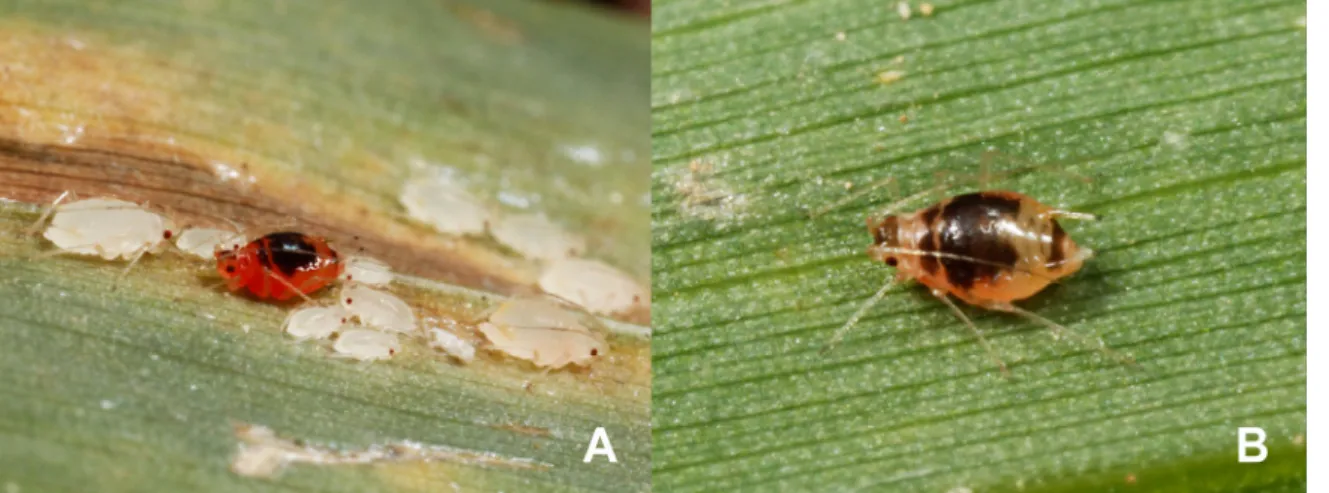
Remarks. This species is new to Korea. Currently, this species is only collected in Mt. Chilgapsan in Korea. According to Miyazaki (1971), body color is variable in life (salmon pink
to reddish brown with shine). Korean specimens also exhibit variable body color (Fig. 1). The only other congeneric species, K. sikkimensis Joshi and Blackman, 2017, has entirely shining black body (Joshi and Blackman, 2017).
Acknowledgements
We deeply thank to Mr. Hyoseok Lee for collecting specimens. This work was supported by a grant from the Fig. 1. Kaochiaja arthraxonis (A-B) in life. A, colony of K. arthraxonis ; B, salmon pink colored apterous viviparous female of K. arthraxonis.
Fig. 2. Apterous viviparous female of K. arthraxonis. A, body; B, SIPH; C, cauda; D, URS; E, head; F, Antenna.
18 Korean J. Appl. Entomol. 57(1): 15~18 (2018)
National Institute of Biological Resources (NIBR), funded by the Ministry of Environment (MOE) of the Republic of Korea (NIBR201701203) and the Basic Science Research Program through the National Research Foundation of Korea (NRF) funded by the Ministry of Education, Science (NRF-2015 R1D1A1A01059031).
Literature Cited
Basu, A.N., 1970. Further records of new and little known aphids (Homoptera) from West Bengal, India. Orient. Insects 3, 355-371.
Blackman, R.L., Eastop, V.F., 2000. Aphids on the world’s crops.
An Identification and Information guide, 2nd eds. John Wiley and Sons, London, 1460 pp.
Eastop, V.F., Blackman, R.L., 2005. Some new synonym in Aphididae (Hemiptera: Sternorrhyncha). Zootaxa 1089, 1-36.
Eastop, V.F., Hille Ris Lambers, D., 1976. Survey of the World’s Aphids. W. Junk, The Hague, 573 pp.
Ghosh, A.K., Ghosh, M.R., Raychaudhuri, D.N., 1970. Studies on the aphids (Homoptera: Aphididae) from Eastern India. Orient.
Insects 4, 193-203.
Joshi, S., Blackman, R.L., 2017. A new bamboo-feeding species of Kaochiaoja Tao (Hemiptera: Aphididae) from India. Zootaxa 4363(4), 569-575.
Miyazaki, M., 1971. A revision of the tribe Macrosiphini of Japan (Homoptera: Aphididae, Aphidinae). Insecta Matsumurana 34, 1-247.
Nieto Nafría, J.M., Favret, C., Akimoto, S., Barbagallo, S., Chakrabarti, S., Mier Durante, M.P., Miller, G.L., Qiao, G., Sano, M., Pérez Hidalgo, N., Stekolshchikov, A.V., Wegierek, P., 2011. Register of genus-group taxa of Aphidoidea, in: Nieto Nafría, J.M., Favret, C. (Eds.), Registers of Family-Group and Genus-Group Taxa of Aphidoidea (Hemiptera Sternorrhyncha).
Universidad de León, León, pp. 81-404.
Remaudière, G., Remaudière, M., 1997. Catalogue of the World’s Aphididae. INRA, Paris, pp. 473.
Shinji, O., 1924. New aphid species from Morioka. Dobuts. Zasshi (Zoological Magazine) 36, 343-373.
Takahashi, R., 1921. Aphididae of Formosa 1. Rep. Gov. Res. Inst.
Formosa. 20, 1-97.
Takahashi, R., 1923. Aphididae of Formosa 2. Rep. Gov. Res. Inst.
Formosa. 4, 1-173.
Tao, C.C., 1963. Revision of Chinese Macrosiphinae. Plant Protect.
Bull. 5, 162-205.