Korean J. Malacol. 28(4): 361-362, 2012
- 361 -
Received: December 10, 2012 ; Accepted: December 18, 2012
Corresponding author: Jun-Sang Lee
Tel: +82 (33) 250-7409 e-mail: [email protected] 1225-3480/24460
The first record of Bursa ( Bursa ) bufonia (Gmelin, 1791) (Caenogastropoda, Bursidae)
from Korea
Hyun-Jong Kil, Jun-Sang Lee1 and Dong-Bum Koh2 National Institute of Biological Resources, Incheon 404-708
1Institute of Environmental Research, Kangwon National University, Chunchon 200-701
2JeJu Hanbit Psychiatric Clinic, 560, Samdo-dong, Jeju-shi 690-031
ABSTRACT
The specimens of bursid snail, Bursa (Bursa) bufonia (Gmelin, 1791) were collected from Jeju Island, Korea and diagnostic characters were analysed. This is the first report of the family Bursidae and the genus Bursa in the Korean waters.
Key words: Caenogastropoda, Bursidae, Bursa (Bursa) bufonia.
INTRODUCTION
The family Bursidae is a marine gastropod called
"frog snail" due to the shell shape of dorsoventrally compressed form and strong nodulose pattern on the shell surface. Especially characteristic features of the family are the permanent anal siphon in the mantle edge, accommodated in the shell by a deep posterior canal in the outer lip. Periostracum usually absent or very thin. They are active predators feed on polychaetes. Many species of genus Bursa are found on tropical shallow water coral reefs and rocks. This family is extremely homogeneous group in which no subfamilies can be recognised (Beu, 1980).
A total of 55 species in 6 genera have been proposed for recent species and the genus Bursa consist of 25 species reported from the world (Abbott and Boss, 1989). There are 20 species include 10 Brusa species from Japan (Okutani, 2000) and 15 species include 5 Bursa species from China (Qi, 2004)
have been reported respectively, but there was no record in Korea. In this study, the unrecorded Bursa (Bursa) bufonia discovered from Jeju Island, at the subtidal zone 15 m in depth is redescribed.
SYSTEMATIC ACCOUNTS Class Gastropoda Cuvier, 1791 복족강
Superorder Caenogastropoda Cox, 1959 신생복족상목 Order Sorbeoconcha Ponder and Lindberg, 1997 흡강목 Family Bursidae Thiele, 1929 가시고둥과
Genus Bursa Röding, 1798 두꺼비고둥속 (신칭)
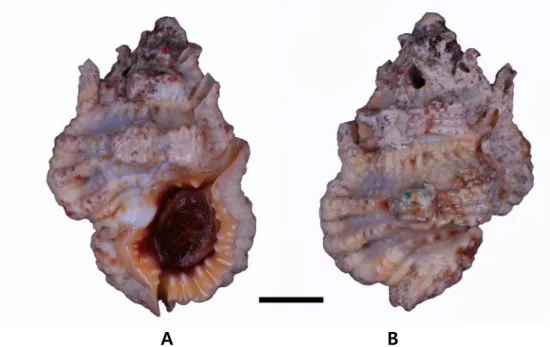
Bursa (Bursa) bufonia (Gmelin, 1791) 무사마귀두꺼비고 둥 (Fig. 1).
Murex bufonius Gmelin, 1791, p. 3534.
Ranella bufonia Reeve, 1844, p. 103.
Bursa bufonia Beu, 1986, p. 322. figs. 180, 181; Qi, 2004, p. 77, pl. 47, fig. c; Dharma, 2005, p. 194, pl.
72, fig. 15; Min and Lee, 2007, p. 160, fig. 651; Poppe, 2008, p. 620, pl. 225, fig. 5.
Bursa (Bursa) bufonia Higo et al., 1999, p. 160.
Bursa bufonia bufonia Okutani, 2000, p. 269, fig. 6.
Bursa tuberosissima Okutani, 2000, p. 269, fig. 10.
Type locality. No designated.
Materials examined. 1 individual, 16 November 2003, 15 m in depth, Munseom, Seogwipo-si, Jeju Island (33°13'38.6"N, 126°34'4.10"E).
Measurement. 47 mm in height; 33 mm in width.
http://dx.doi.org/10.9710/kjm.2012.28.4.361
The first record of Bursa (Bursa) bufonia (Gmelin, 1791) (Caenogastropoda, Bursidae) from Korea
- 362 -
A B
Fig. 1. Bursa (Bursa) bufonia. A. Ventral view, B. Dorsal view. Scale Bar = 10 mm.
Description. Shell medium size, thick and solid, dorsum and ventral compressed, with row of varices on both sides; outer surface sculptured by fine granulose spiral threads; a row of knobs on the shoulder of spire, and 3 row on the body whorl, first row strongest, other gradually weak; aperture nearly circular, yellow inside, outer lip expanded, with 4-5 pairs of heavy denticles on its margine, inner lip thick, expanded, umbilicus covered, anterior canal short, curved, posterior canal long, semi-tubular.
Habitat. Rocks and coral reefs in subtidal zone.
Distribution. Korea, Japan, China, Taiwan, Philippines, Indonesia.
Acknowledgment
This study was supported by Discovery of Korean Indigenous Species Project, NIBR (National Institute of Biological Resources).
REFERENCES
Abbott, R.T. and Boss, K.J. (1989) A classification of the living mollusca. American Malacologists, Inc.
Melbourne, Florida, USA.
Beu, A.G. (1980) Australian gastropods of the family
Bursidae: Part 1 - The families of Tonnacea, the genera of Bursidae, and revision of species previously assigned to Tutufa Jousseaume, 1881.
Records of the Australian Museum, 33: 248-324.
Beu, A.G. (1986) Taxonomy of gastropods of the families Renellidae (= Cymatiidae) and Bursidae.
Part 2. Descriptions of 14 new modern Indo-West Pacific species and subspecies, with revisions of related taxa. New Zealand Journal of Zoology, 13(3): 273-355.
Dharma, B. (2005) Recent & Fossil Indonesian Shells.
Conchbooks. Hackenheim, Germany. pp. 1-424.
Gmelin, J.F. (1791) Systema Nature. 13th edition. Vol.
1(6): 3021-3910. Leipzig, Germany.
Higo, S., Callomon, P. and Goto, Y. (1999) Catalogue and bibliography of the marine shell bearing mollusca of Japan. Elle Scientific Publications.
Osaka, Japan. pp. 1-749.
Okutani, T. (2000) Marine mollusks in Japan. Tokai.
Tokyo. pp. 1-1171. [In Japanese and English].
Min, D.K. and Lee, J.S. (2007). Shell of the World. Min Molluscan Research Institute. pp. 1-426. [In Korean].
Poppe, G.T. (2008) Philippine Marine Mollusks. Vol. Ⅰ.
Gastropoda - Part. 1. ConchBooks. Hackenheim, Germany. pp. 1-759.
Qi, Z. (Chief Editor). (2004) Seashells of China. China Ocean Press, Beijing, China. pp. 1-418. 193 pls.
Reeve, L.A. (1843) Conchologia Iconica. Vol. Ⅱ. London.
pp. 1-227, 22 pls.