저작자표시-비영리-동일조건변경허락 2.0 대한민국 이용자는 아래의 조건을 따르는 경우에 한하여 자유롭게
l 이 저작물을 복제, 배포, 전송, 전시, 공연 및 방송할 수 있습니다. l 이차적 저작물을 작성할 수 있습니다.
다음과 같은 조건을 따라야 합니다:
l 귀하는, 이 저작물의 재이용이나 배포의 경우, 이 저작물에 적용된 이용허락조건 을 명확하게 나타내어야 합니다.
l 저작권자로부터 별도의 허가를 받으면 이러한 조건들은 적용되지 않습니다.
저작권법에 따른 이용자의 권리는 위의 내용에 의하여 영향을 받지 않습니다. 이것은 이용허락규약(Legal Code)을 이해하기 쉽게 요약한 것입니다.
Disclaimer
저작자표시. 귀하는 원저작자를 표시하여야 합니다.
비영리. 귀하는 이 저작물을 영리 목적으로 이용할 수 없습니다.
동일조건변경허락. 귀하가 이 저작물을 개작, 변형 또는 가공했을 경우 에는, 이 저작물과 동일한 이용허락조건하에서만 배포할 수 있습니다.
BER-based Multipath Fading Effect Mitigation Technique for
Indoor Localization
August 2012
Graduate School of Seoul National University School of Engineering & Computer Science
Seunghwan Baek
i
Abstract
BER-based Multipath Fading Effect Mitigation Technique for
Indoor Localization
Seunghwan Baek
School of Engineering and Computer Science The Graduate School
Seoul National University
The proliferating use of wireless and mobile devices has provoked a widespread of research in location-aware technology for various services such as health, social network and general public services. Above all, indoor location-based service has been receiving an increasing amount of attention due to both its importance and limitations. WiFi-based indoor localization is an attractive solution for its open access and low installation cost. However, the received signal strength indication (RSSI) from the wireless Access Point (AP) is not a suitable metric for estimating the distance between the AP and the mobile device considering its vulnerability against multipath fading effect, which is a dominant source for distance estimation errors in indoor settings. In this work, we explain in depth how to overcome such multipath
ii
fading effect so as to enhance the distance estimation accuracy with the fine- grained information resulted from a channel measurement upon a packet transmission. Using confident information provided by the physical layer, we can accurately estimate the prevailing channel bit error rate (BER) per individual subcarriers thereby exploring frequency-selective fading with the goal of alleviating multipath fading effect. Moreover, accurate distance estimation is possible upon employing our BER-based subcarrier filtering technique in indoor localization. The experimental results indicate that the distance estimation accuracy enjoys significant improvement with our channel BER-based indoor localization approach compared to the traditional RSSI-based localization approach.
Keywords: Indoor Localization, OFDM, RSSI, BER, Multipath fading, Collision detection
Student Number: 2010-24081
iii
Contents
Abstract i
Contents iii
List of Figures iv
List of Tables v
I. Introduction 1
II. Related works 5
III. Background 8
3.1 Orthogonal Frequency Division Multiplexing 8 3.2 Channel Bit Error Rate estimation 10
IV. System design 12
V. Methodology 14
5.1 Subcarrier filtering 15
5.2 Collision detection 18
5.3 Location determination 19
VI. Experimental results 22
VII. Conclusion 28
References 29
iv
List of Figures
Figure 1. OFDM transmission system 9
Figure 2. System architecture 12
Figure 3. Received frame structure 16
Figure 4. Subcarrier with strong multipath effect 16
Figure 5. Predictable relationship between SNR and packet reception rate (PRR) for flat fading link 20
Figure 6. BER-based localization system overview 22
Figure 7. Performance evaluation overview 22
Figure 8. RSSI before and after filtering 24
Figure 9. Distance estimation before and after filtering 25
Figure 10. Distance error before and after filtering 26
v
List of Tables
Table 1. BER as a function of SNR for narrowband signals
and OFDM modulations 19
Table 2. Modulation and stream rates 20
Chapter 1. Introduction
Incorporating user's location information can offer enhancement in a variety of services, including security, navigation assistants, 911 emergency service, health-care related disability aids, and communication tools.
However, most of modern location-aware applications are restricted to outdoor operation; they depend upon GPS [1]. GPS receivers estimate locations of objects by applying trilateration method with government- managed satellites. GPS functions well in outdoor regions with sufficient sky visibility. However, it does not perform effectively in indoor environments due to its signal s inability to penetrate in-building materials. Therefore, researchers have been investigating the alternative means for indoor localization.
Today, most commercial and residential buildings in general have off-the-shelf wireless access-points (AP) installed. Also, most mobile WiFi- enabled devices are capable of measuring signal strength of received data, the received signal strength indication (RSSI), as a part of the standard communication operation. As a consequent, it has naturally occurred that many radio frequency (RF)-based indoor localization protocols nowadays attempt to determine positions based on RSSI measurement. Theoretically, it is possible to design a model to estimate the separating distance using RSSI.
According to propagation loss model [2], the received signal power
monotonically decreases as the distance between transmitter and receiver increases, which is the foundation of the model-based localization. However, RSSI measurements from RF signal at a per-packet level may vary over packet reception, calibration inaccuracy, corruptions due to deleterious effects of fading and shadowing. The previous study has shown that the variance of RSSIs collected from an immobile device during one minute of sampling is up to 5dB [8]. RSSI is easily varied by the multipath effect. The propagation of RF wave experiences attenuation during reflection over the surface of an obstacle. Thus, there are possibly multiple copies of signals besides the line-of-sight (LOS) signal arriving at the receiver along different paths. The multipath fading effect is especially severe in indoor areas where different degrees of obstacles are found. As a result, a theoretical formula that describes a simple relationship between received power and distance suffers undesirable localization measurement errors.
In this paper, we propose a new metric which has the capability to mitigate the negative effect of multipath fading in the distance estimation.
Wireless multicarrier communication systems, such as Orthogonal Frequency Division Multiplexing (OFDM), are designed to transmit data over multiple orthogonal subcarriers where data are modulated and transmitted simultaneously in different frequencies. Due to frequency selective fading, different subcarriers experience different degrees of fading which in turn result different signal qualities. Previous study has observed that there exists significant frequency diversity, and the SNRs across
different subcarriers reported by Channel State Information (CSI) measurement differ by more than 10 dB [7]. Unlike one RSSI value per packet, PHY layer provides CSI value for each individual subcarrier in the frequency domain which provides an opportunity to examine each subcarrier more closely for multipath effect. Here, one caveat to draw our attention is that the current 802.11n channel measurement tool [10] reports CSI measurements for 30 subcarrier groups, which is about one group for every two subcarriers in a 20 MHz channel according to the standard [11] (i.e. 4 groups have one subcarrier each, and the other 26 groups have two subcarriers each) [6, 7, 8]. Thus, CSI information in subcarrier-level is not directly obtainable from the channel measurement tool to analyze individual frequency selective fading per subcarrier. One way to examine the fading effect in subcarrier-level is to observe confident physical layer information available during the process of estimating the channel bit error rate (BER).
With outputs of the decoding stage at receiver, an error probability for individual bit in the received frame can be calculated. Furthermore, average bit error rate per each subcarrier can be estimated. Using this bit error probability information, we can filter out those subcarriers with strong multipath fading effect and derive a scheme that estimates distance with improved accuracy.
In this work, we describe the process of our BER-based localization metric in detail and compare its performance against the traditional RSSI- based localization approach in experiment. Thereby, we show that it is
possible to improve the indoor localization accuracy by removing those subcarriers with strong multipath fading from distance estimation process using our proposed scheme.
In a nutshell, the main contributions of this paper are as follows:
1) For indoor localization, we propose a more robust metric to alleviate multipath effect in the distance calculation using a cross layer approach that makes use of the information already available from physical layer during signal processing.
2) We evaluate the performance of our new approach against the traditional RSSI-based approach to show its outstanding performance in terms of localization accuracy.
Chapter 2. Related works
A cross layer localization approach, FILA [8], has recently been proposed in order to leverage the channel state information (CSI) for reducing multipath effect in the distance estimation. FILA presents a design architecture that exports the CSI value upon the demodulation process. By comparing the CSI values of 30 subcarrier groups in time domain, FILA selects a time duration of high channel response, that is, when the received signal is distorted by relatively small amount. After performing FFT to convert to frequency domain, FILA computes the weighted average of the CSI values among subcarriers to obtain the effective CSI and calculates the distance via their own devised propagation function. Their limitation would be: they rely on the assumption that the channel responses of signal transmissions would fluctuate by large amounts during the preamble transmission. However, since the duration of coherence time of channel in indoor settings with average walking speed is observed to be 10-100ms, it is likely that the degree of multipath effect will remain constant during the entire preamble transmission. Thus, their assumption of high dynamics in the level of channel responses during preamble period may not be appropriate. In addition, since the channel measurement tool reports CSI values of 30 subcarrier groups, FILA is not able to distinguish and filter out specific
subcarriers with high multipath effect in frequency domain. Thus, their choice was to simply average the CSI values among subcarriers.
SoftRate [5] is a cross-layer wireless bit rate adaptation protocol which is responsive to rapidly varying channel condition in short timescales.
SoftRate estimates the channel BER over each received packet to choose appropriate bit rates to improve the throughput. It uses per-bit confidence information, usually referred to as SoftPHY hints from previous work, which is computed by standard decoders such as Viterbi decoder. SoftRate demonstrates that the underlying channel BER can be accurately estimated using the SoftPHY hints. Here, SoftPHY hint is the log-likelihood ratio of a bit being correct to its being incorrect. By observing the pattern of bit error probabilities computed from SoftPHY hints, SoftRate performs collision detection in order to separate out portions of the frame with bit errors caused by the presence of strong interferers such as in case of collisions.
A study [6] was done for the sake of the limitation of RSSI as an indicator of wireless channel state. In this study, it was shown that SNRs computed among subcarriers vary by more than 10 dB in real links. Thus, RSSI-based approach which averages these SNRs among subcarriers is not a good measure of performance on real channels. It suggests an effective SNR derived from CSI values reported by channel measurement tool which provides CSIs of 30 subcarrier groups. The paper then converts SNRs into BERs using well-known SNR-BER relationship and computes the average Effective BER. The BEReff value is then converted back to produce effective
SNR. The authors argue that the SNReff value would be an accurate indicator that reflects how the transmission rate should be adjusted, since it is formulated from averaging the BER values among subcarriers.
Chapter 3. Background
In this section, we introduce the preliminary information of the OFDM system and the channel BER estimation process using the confident physical layer information.
3.1 Orthogonal Frequency Division Multiplexing
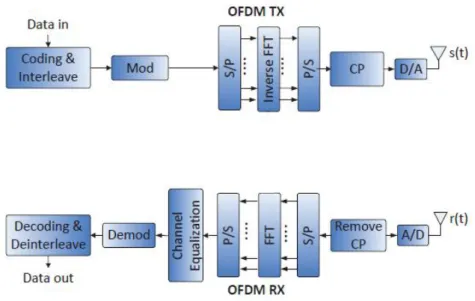
Orthogonal Frequency Division Multiplexing (OFDM) is a digital multicarrier modulation scheme used in IEEE 802.11a/g/n, WiMAX and 3GPP LTE. In OFDM, 20 or 40 MHz channels are divided into 312.5 kHz bands, namely, subcarriers. The subcarriers take parts in transmitting independent data simultaneously in different frequency. Figure 1 shows an overview of how OFDM transmission system operates. At the transmitter side, convolutional coding is performed on bits in the frame for error correction which are then interleaved across frequency. The next stage is the modulation using BPSK, QPSK, QAM-16 or 64, with 1, 2, 4, or 6 bits per symbol, respectively. Inverse Fast Fourier Transform (IFFT) is performed on data producing complex time domain samples. Digital-to-analog converter (DAC) converts the real and imaginary components of these samples into analog signals which are then summed to produce the transmission signal. At
the receiver side, basically the reverse operations are performed on the received signal. After digitizing them in ADC, FFT operation converts the data samples in time domain into frequency domain. During the demodulation stage, CSI estimation is performed. Next, the received data gets decoded according to the CSI estimation.
Figure 1: OFDM transmission system
3.2 Channel Bit Error Rate estimation
As was studied in previous work [5, 12], per-bit confidences, referred to as SoftPHY hints, are exported from the physical layer as outputs of decoders at the receiver. Any PHY that uses a linear convolutional or block code (including 802.11 a/b/g, Zigbee, WiMax) provides SoftPHY hints from maximum likelihood (ML) or maximum aposteriori probability (MAP) decoders (ie. Viterbi or BCJR). SoftPHY hints are the log-likelihood ratio of a bit being correct to its being incorrect for each bit in the received frame.
They can be used to accurately estimate the channel BER.
Consider a frame consisting of xk bits, k = 1 N, gets transmitted from the sender. With the received signal r at the receiver, a decoder provides LLR(k) for each received bit, where
As a normal operation, the decoder outputs the decoded output bit yk:
Given LLR(k) for each bit k, we can determine probability of bit error pk in a received frame.
Let sk = |LLR(k)| represent SoftPHY hint and pk = P(xk yk|r) represent probability of bit error for bit k.
sk is related to pk as following:
sk = |LLR(k)|
Thus, pk can be expressed in terms of sk as:
In summary, the SoftPHY hint from the decoder can be used to determine the probability of error for each bit in the received frame. Calculating the average probability of error for bits in the frame would give us a packet BER in the transmission which may then be used to estimate a channel BER.
Chapter 4. System design
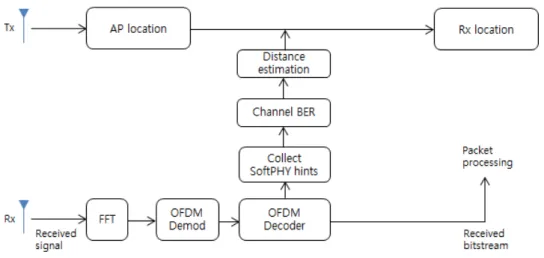
As shown in Figure 2, our scheme is compatible with existing network layer design for the current communication system. SoftPHY hints from the decoder are available to compute the probability of error for every bit in the received frame.
Figure 2: System architecture
These probabilities in the frame will then be averaged per subcarriers to discard those subcarriers with high BERs, that is, strong multipath fading effect, thereby considering frequency selective fading during the transmission. For the remaining subcarriers, the effective packet BER is computed by averaging their BERs in the transmission of a frame. Our
ultimate goal is to estimate the channel BER accurately via the computation of the effective packet BER in the face of multipath fading effect which subcarriers experience by different amounts during a packet transmission.
Here, we need to take into consideration the possibility of increase in the probabilities of error for those bits that have been entangled in collisions during the transmission. Therefore, we perform collision detection by observing the patterns of probabilities of bits within a frame. As was done in SoftRate [5], we apply a heuristic to identify and filter out those bits that have been affected by collision, thereby determining the true channel BER.
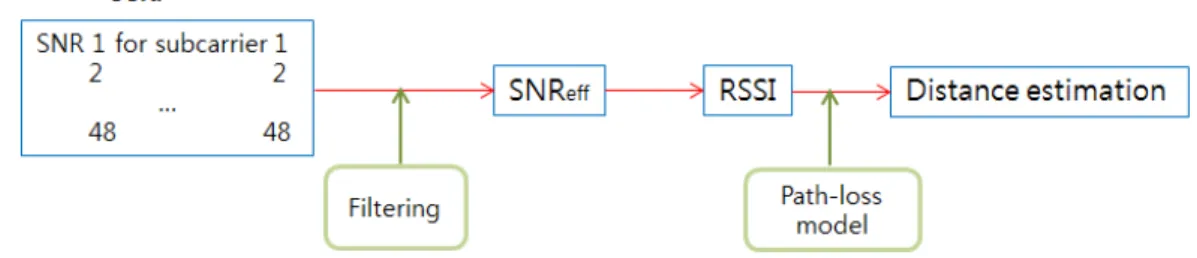
As was studied in previous work [6], after eliminating those subcarriers with high multipath fading, the result of refined channel BER (BEReff) is approximately the same as that of a flat fading channel. Thus, we can apply the formula that describes the standard SNR-BER relationship [3] to perform conversion from BER to SNR. By employing NIC noise level measurement, we assume the noise level is known, and we may then perform a conversion from SNR to RSSI. We can now apply a radio propagation model to calculate the separating distance. Finally, as the AP location information is obtained in the network layer, we can apply the trilateration method to obtain the location of the receiver, e.g., a mobile device.
5. Methodology
In our work, we apply the individual subcarrier s BER information which is available in the decoding step as a basis to perform accurate indoor localization. The process can be broken down to following steps:
1) Subcarrier filtering: Firstly, we need to observe frequency selective fading in subcarrier level and filter out those subcarriers with strong multipath fading effect.
2) Collision detection: By observing the patterns of probabilities of error for bits within a frame, we disregard those portions where bits have been involved in collision from BER computation.
3) Location determination: When the AP coordination information and distance calculation derived from BER estimation has been gathered, we apply the free space path loss model then trilateration method to determine the physical location of the target device.
5.1 Subcarrier filtering
As explained in section 3, the SoftPHY hints generated from the decoder are used to calculate the probability of error for each bit within the received frame. Upon averaging the error probabilities, thus computing BER, in subcarrier-level, we can perform a filtering procedure on those subcarriers with strong multipath fading effect which get reflected on their high BER values. Here, it is worth noting the following observation from previous study [6]: A simple average of the SNRs measured for subcarriers that make up the channel would be equivalent to RSSI value. In [6], it was demonstrated that the SNR values for those subcarriers with deep multipath fading are shown to be lower than others. Therefore, we may conclude that SNR values measured for individual subcarriers reflect approximately by how much the subcarriers have experienced multipath fading effect during the packet transmission. Furthermore, since there exists a one-to-one nonlinear mapping function between SNR and BER, we can conclude that lower SNRs and thus higher BERs for subcarriers indicate the presence of stronger multipath fading effect for these subcarriers.
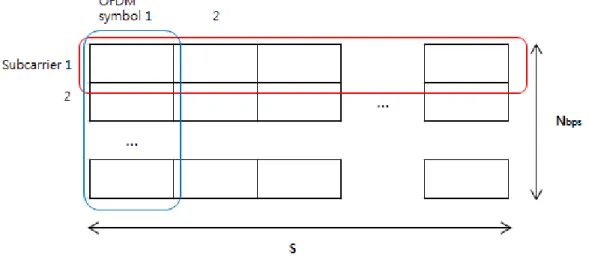
As in previous work [5], let us consider the reception of a frame of S OFDM symbols with each symbol containing Nbps bits. Thus, each frame contains a total of N = Nbps S bits with SoftPHY hints sk, where k = 1 N.
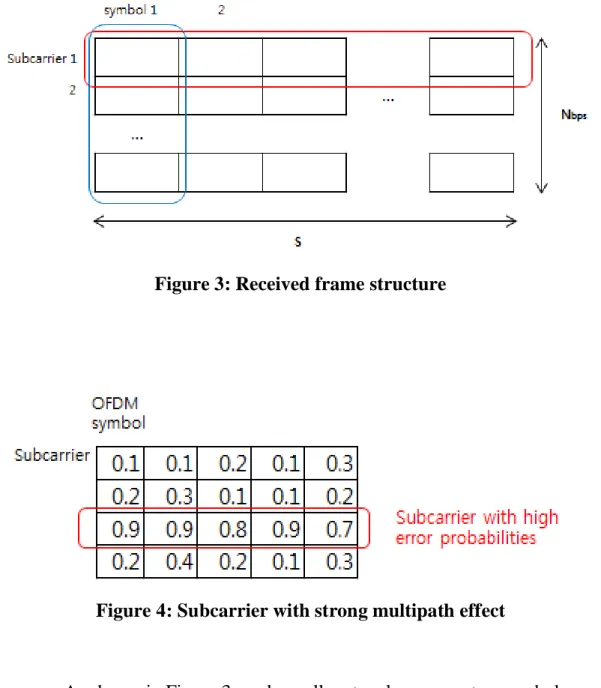
Figure 3: Received frame structure
Figure 4: Subcarrier with strong multipath effect
As shown in Figure 3, each small rectangle represents a symbol consisting of one or more bits. Each row represents one subcarrier, and each column represents one OFDM symbol. In OFDM, decoding is applied across the demodulated bits of subcarriers. If we assume frequency flat fading for the moment, then all the subcarriers would have the same SNR, thus the same BER, since there is a one-to-one nonlinear relationship between SNR
and BER. According to frequency selective fading, subcarriers will be affected by multipath fading by different degrees. Some subcarriers will be much more likely to have errors than others. This would result both different BERs and SNRs among subcarriers. By averaging the probabilities of error for each row, we can determine BERs that correspond to individual
subcarriers. In Figure 4, it illustrates an example of a subcarrier with high average probability of error. It indicates that this particular subcarrier has experienced a relatively stronger multipath fading than others. We may apply this intuition into our proposed scheme to filter out subcarriers with high BERs in order to disregard subcarriers with strong multipath fading effect from distance estimation.
We compute the average probability for each subcarrier as follows:
Then, we filter out those subcarriers with higher BERs than some threshold.
As a result, we are able to consider frequency selective fading to prevent those subcarriers experiencing strong multipath fading from lowering the channel BER measurement accuracy.
5.2 Collision detection
Since we consider the duration of an entire frame transmission, we must distinguish the portion of frames with bit errors due to collision rather than weak signal fading. Inability to detect collision will result inaccuracy in channel BER estimation. As was observed in [9], the packets in collision have larger bursts of contiguous symbols in error. In the paper, they designed a metric to detect such ambient patterns in symbol error burst lengths. For simplicity, our collision detection algorithm is performed by computing the average probability of error per each OFDM symbol as follows:
Then, we filter out those OFDM symbols with higher average BERs than some threshold. As a result, we are able to perform collision detection to disregard those portions of bits within the received frame from channel BER measurement.
5.3 Location determination
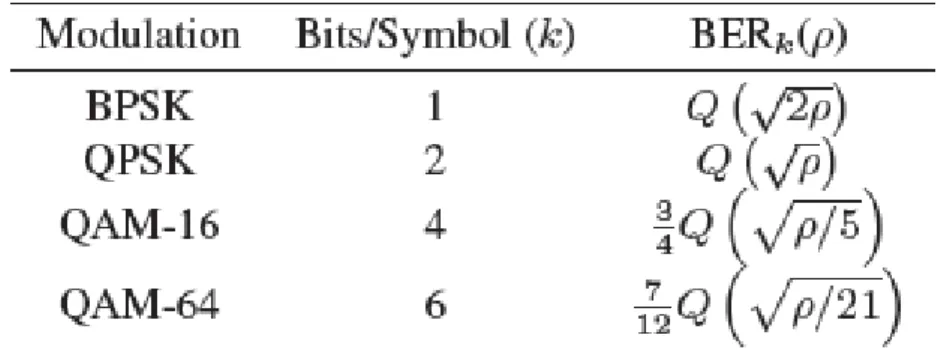
A channel BER can be calculated by taking the average probability of error for the remaining bits after the filtering processes as described in previous steps. Our next step is to perform the transformation between BER and SNR. Textbook analysis of modulation schemes provide delivery probability (BER) for a single signal in term of the SNR, which is typically expressed on a log scale in decibels [3]. This model holds its validity for narrowband channels with additive white Gaussian noise. Please refer to Table 1.
Table 1: BER as a function of SNR for narrowband signals and OFDM modulations
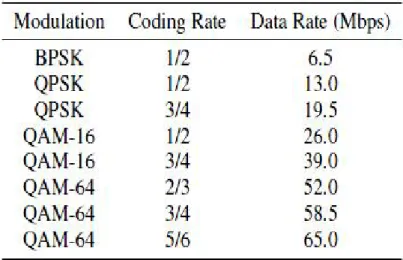
Table 2: Modulation and stream rates
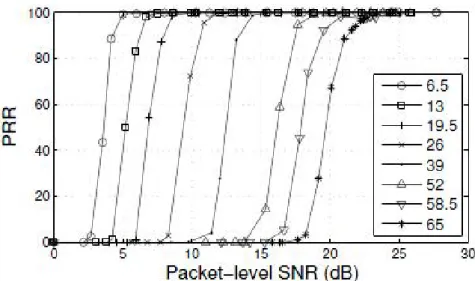
Figure 5: Predictable relationship between SNR and packet reception rate (PRR) for flat fading link
In short, previous researchers [6] argue that with multipath fading effect removed, bit errors in the stream should look no different from bit errors for flat fading channel, assuming perfect interleaving and robust coding.
Therefore, after the filtering processes, we may be able to treat the channel as a flat fading channel. Please refer to Table 2 and Figure 5. Our algorithm now proceeds as in the case of flat fading channel and obtains SNR value from the estimated channel BER.
Furthermore, with NIC noise measurement assumed to be performed on the receiver end, we can determine RSSI from the SNR value using their relationship expressed on a log scale in decibels.
Finally, the last step is to apply the radio propagation model to calculate the distance from the RSSI value. With multipath fading effect mitigated via our filtering technique in frequency domain, we propose to use the path loss model as our propagation model. Afterwards, we apply the trilateration method to locate the receiver assuming locations of APs are provided. We can obtain the unique coordinate of the location as the center of the three reference range intersection.
Chapter 6. Experimental results
To evaluate the performance of our channel BER-based approach, we performed an evaluation of our scheme on real data trace set from OFDM GNU software radio and the USRP hardware. At the transmitter, incoming data passes through a standard encoder after which it was punctured at 1/2 coding rate. The bits were mapped to OFDM subcarriers, using BPSK modulation. During the decoding steps at the receiver, we first demodulated the received data and then performed the subcarrier filtering process.
Figure 6: BER-based localization system overview
Figure 7: Performance evaluation overview
Figure 6 describes an overview of our BER-based indoor localization scheme.
Since the current 802.11n channel measurement tool [10] reports CSI information for 30 subcarrier groups, we cannot perform our filtering procedure directly with the channel information in subcarrier group-level via the channel measurement tool. The reason is that our scheme requires fine- grained channel state information in subcarrier-level. One way to overcome this is to estimate Bit Error Rate (BER) per each subcarrier from the SoftPHY hints already available at the decoder and perform the filtering procedure in subcarrier-level based on the individual subcarriers BER information. Then, we can determine BEReff and thus SNReff. After the filtering process based on BER information per subcarriers, we may assume that the remaining subcarriers are only those ones with relatively weak multipath fading effect. Considering the portion of the link which consists of only these remaining subcarriers would be like considering a flat fading narrowband link. Therefore, we may safely apply the standard SNR-BER relationship as described in textbook [3]. RSSI can then be derived from the resulting SNReff. Finally, we can estimate the distance using the propagation model as indicated in Figure 6.
Figure 7 describes an overview of the steps taken in our performance evaluation which is not exactly identical to our original BER-based localization system (Figure 6). First, our assumption should be stated clearly here: We assume that the BER information per subcarriers computed from SoftPHY hints provided by the decoder (ie. Viterbi decoder) is accurate. On
the other hand, the USRP system provides accurate SNR and RSSI information per individual subcarriers. In our performance evaluation using the USRP, we use the SNR information per subcarriers to perform filtering procedure instead of the BER information per subcarriers. We assume that BER information per subcarriers computed at the decoder would eventually be equally accurate as the SNR information per subcarriers provided by the USRP system. Therefore, the filtering procedure based on BER information at the decoder would be considered equivalent to the filtering procedure based on SNR information provided by the USRP. After the filtering process in Figure 7, SNReff is then computed by taking the average of SNRs for those remaining subcarriers. Then we can perform the distance estimation similarly as in our original BER-based localization scheme (Figure 6).
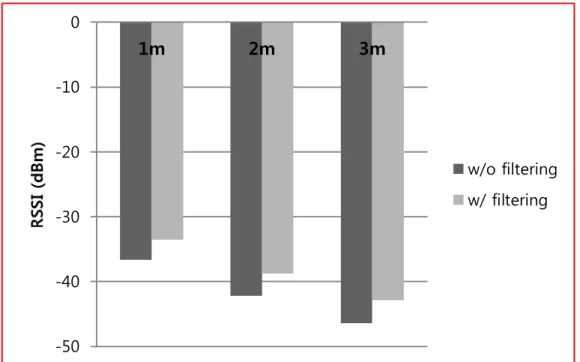
Figure 8: RSSI before and after filtering
-50 -40 -30 -20 -10 0
1m 2m 3m
w/o filtering w/ filtering
Figure 8 shows the resulting changes in RSSI by our filtering procedure.
After eliminating those subcarriers with low SNRs (thus, high multipath fading), the average SNR of the remaining subcarriers and the corresponding RSSI would better reflect the channel state information with reduced multipath fading effect.
Figure 9: Distance estimation before and after filtering
0 1 2 3 4 5 6 7
2m 3m
w/o filtering w/ filtering TRUE
Figure 10: Distance error before and after filtering
The log-normal path loss model is stated as follows:
where n is the path loss exponent, is the reference distance in meter and and are the reference received power strength and received power strength in dBm, respectively.
By manipulating this equation, we can reform it as follows:
Figure 9 shows the computed distance (d) in meter before and after the filtering procedure. Also, Figure 10 shows the error in distance estimation before and after the filtering procedure. It indicates that the distance
0 0.5 1 1.5 2 2.5 3 3.5
2m 3m
w/o filtering w/ filtering
estimation can be improved noticeably by employing the BER-based localization scheme compared to the traditional RSSI-based localization approach. For the best cases, the distance estimation error gets reduced by close to 50% compared to the traditional RSSI-based localization approach.
Chapter 7. Conclusion
Location-awareness and the underlying technology have the potential to bring improvements on services in various areas and change our daily living. Due to the presence of various factors that affect the measurement accuracy in indoor settings, current indoor localization techniques have not yet been able to fulfill our expectations and needs. As one of the most popular approaches, RSSI-based approach for providing indoor localization is a feeble metric against multipath fading causing inaccuracy in location estimation. In this paper, we propose a new metric that is robust against multipath fading in order to enhance the location estimation accuracy. While exploring frequency selective fading, the channel BER estimation is performed on the received frame which can be used to calculate the separating distance. The experimental results show that the accuracy of distance calculation can be significantly enhanced compared to the traditional RSSI-based approach.
References
[1] B. Hofmann-Wellenhof, H. Lichtenegger, and J. Collins. GPS Theory and Practice. Springer, 1997.
[2] -building rf-based user
Proc. of IEEE INFOCOM, 2000.
[3] A. Goldsmith. Wireless Communications. Cambridge University Press, 2005
[4] J. G. Proakis. Digital Communications, 4th ed. McGraw-Hill, 2000
[5] M. Vutukuru, H. Balakrishnan, and K. Jamieson. Cross-layer wireless bit rate adaptation. SIGCOMM Comput. Commun. Rev., 39(4):3 14, 2009.
[6] D. Halperin , W. Hu , A. Sheth , D. Wetherall, Predictable 802.11 packet delivery from wireless channel measurements, Proceedings of the ACM SIGCOMM 2010 conference on SIGCOMM, 2010
[7] A. Bhartia, Y.-C. Chen, S. Rallapalli, and L. Qiu. Harnessing frequency diversity in wi-fi networks. In Proc. of ACM MOBICOM, 2011
[8] K. Wu, J. Xiao, Y. Yi, M. Gao, L. Ni, FILA: Fine-grained indoor localization. INFOCOM 2012
[9] S. Rayanchu, A. Mishra, D. Agrawal, S. Saha, and S. Banerjee.
Diagnosing Wireless Packet Losses in 802.11: Separating Collision from Weak Signal. In Proc. of IEEE INFOCOM Conf., Phoenix, AZ, Apr. 2008.
[10] 802.11n channel measurement tool. http://ils.intel-research.net/projects/
80211n-channel-measurement-tool.
[11] LAN/MAN Standards Committee of the IEEE Computer Society. Part 11: Wireless LAN Medium Access Control and Physical Layer (PHY) Specifications. IEEE Standard 802.11, 2009.
[12] K. Jamieson and H. Balakrishnan. PPR: Partial Packet Recovery for Wireless Networks. In Proc. ACM SIGCOMM, pp. 409 420, Kyoto, Japan, August 2007.
(Location aware) , ,
.
. Wi-Fi
.
(AP) (RSSI)
.
(multipath fading)
. AP
Wi-Fi
. Physical layer subcarrier (Bit error rate)
subcarrier
.
.
: , , ,
, ,
: 2010-24081