저작자표시-비영리-변경금지 2.0 대한민국 이용자는 아래의 조건을 따르는 경우에 한하여 자유롭게
l 이 저작물을 복제, 배포, 전송, 전시, 공연 및 방송할 수 있습니다. 다음과 같은 조건을 따라야 합니다:
l 귀하는, 이 저작물의 재이용이나 배포의 경우, 이 저작물에 적용된 이용허락조건 을 명확하게 나타내어야 합니다.
l 저작권자로부터 별도의 허가를 받으면 이러한 조건들은 적용되지 않습니다.
저작권법에 따른 이용자의 권리는 위의 내용에 의하여 영향을 받지 않습니다. 이것은 이용허락규약(Legal Code)을 이해하기 쉽게 요약한 것입니다.
Disclaimer
저작자표시. 귀하는 원저작자를 표시하여야 합니다.
비영리. 귀하는 이 저작물을 영리 목적으로 이용할 수 없습니다.
변경금지. 귀하는 이 저작물을 개작, 변형 또는 가공할 수 없습니다.
이학석사 학위논문
Synthesis of Benzothiazoles from 2-
Aminobenzenethiols in the Presence of a Reusable Polythiazolium Precatalyst Under Atmospheric CO
21기압의 이산화탄소 하에서 재사용 가능한 폴리 싸이아졸륨 전촉매를 이용한 2-아미노벤젠싸이올
로부터 벤조싸이아졸의 합성
2017년 2월
서울대학교 대학원
화학부 무기화학전공
양 사 벽
Synthesis of Benzothiazoles from 2-
Aminobenzenethiols in the Presence of a Reusable Polythiazolium Precatalyst Under Atmospheric CO
2Supervisor: Professor Young Keun Chung
By Sabyuk Yang
A Thesis for M.S. Degree In Inorganic Chemistry
02
–2017
Department of Chemistry
Graduate School
Seoul National University
Synthesis of Benzothiazoles from 2-
Aminobenzenethiols in the Presence of a Reusable Polythiazolium Precatalyst Under Atmospheric CO
2지도 교수 정 영 근
이 논문을 이학석사 학위논문으로 제출함 2017년 2월
서울대학교 대학원 화학부 무기화학전공
양사벽
양사벽의 이학석사 학위논문을 인준함 2017년 2월
위 원 장 (인)
부위원장 (인)
위 원 (인)
2 Abstract
First, the functionalization of phenol was done in an aqueous medium. Phenol was halogenated, and followed by an in situ Suzuki cross coupling with benzeneboronic acid. The reaction conditions were mild (low temperature and no use of ligands) with high yields.
Next, synthesis of benzothiazoles from 2-aminobenzenethiols and carbon dioxide was carried out using poly(3,4-dimethyl-5-vinylthiazolium) iodide as a precatalyst. The reaction was successfully held under mild conditions (1 atm of CO2 and 60–70 ºC) with broad substrate scope and functional group tolerance. The precatalyst salt was recovered and reused for several times without any loss of activity.
Keywords: Phenol, Water, Suzuki Coupling, Benzothiazole, Poly (NHC), Carbon dioxide
3 Contents
Abstract ...2
1. Arylation of Phenol in an Aqueous Media 1.1. Introduction ...4
1.2. Results and Discussion ...5
2. Synthesis of Benzothiazoles from 2-Aminobenzenethiols in the Presence of a Reusable Polythiazolium Precatalyst Under Atmospheric CO2 2.1. Introduction ...9
2.2. Results and Discussion ...12
Conclusion ... 21
Reference ...37
국문초록 ...39
4
1. Arylation of Phenol in an Aqueous Media 1.1. Introduction
Phenol derivatives are widely found in natural products and pharmaceuticals.
Moreover, due to their low price and availability, phenol motifs serve as a useful building block in organic synthesis. For instance, phenol can be converted to aryl tosylates or triflates, which are typical substrates of cross coupling reactions.1 Further, these aryl halides of pseudohalides can undergo transition-metal-catalyzed coupling reactions with aryl compounds.
Nowadays, water is widely used as a solvent in organic reactions due to its low cost and non-toxicity.2 Even though many organic substrates are quite insoluble in water, some reactions seem to produce better results than in typical organic solvents. Some people claim that the effective concentration of the substrate and the reagents becomes high, facilitating the reaction. This is due to hydrophobic effect.3 Although the explanations to this phenomenon are controversial, it is still meaningful to investigate the value of using water as a solvent.
In 2006, Xin et al. developed a reaction of synthesis of biaryls and polyaryls by palladium-catalyzed Suzuki coupling in an aqueous condition.4 The reaction condition is mild (room temperature and low catalyst loading) without any ligands.
Simply employing acetone as a cosolvent dramatically improved the results. Based on this idea, I developed a reaction of in-situ arylation of phenol under aqueous media.
5
1.2. Results and Discussion
The results synthesizing poly-substituted phenol are listed in the following tables.
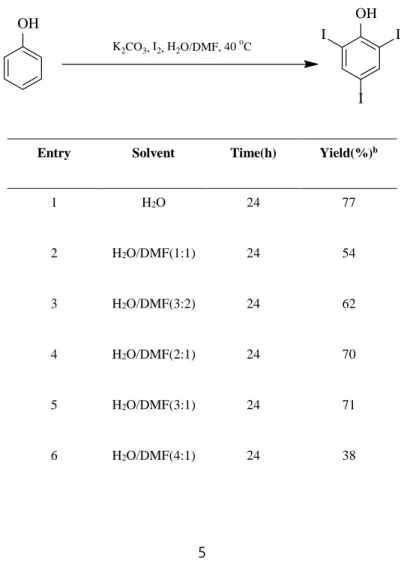
As the candidates for Suzuki couplings are aryl halide or pseudohalide, halogenation should be preceded. First, the optimal ratio of water and N, N- dimethylformamide (DMF) was examined (Table 1). As the most reactive substrate of cross coupling reaction is aryl iodide in general, iodine is used as a halogenating agent.5,6
Table 1. Synthesis of triiodophenola
Entry Solvent Time(h) Yield(%)b
1 H2O 24 77
2 H2O/DMF(1:1) 24 54
3 H2O/DMF(3:2) 24 62
4 H2O/DMF(2:1) 24 70
5 H2O/DMF(3:1) 24 71
6 H2O/DMF(4:1) 24 38
OH OH
I I
I
K2CO3, I2, H2O/DMF, 40 oC
6
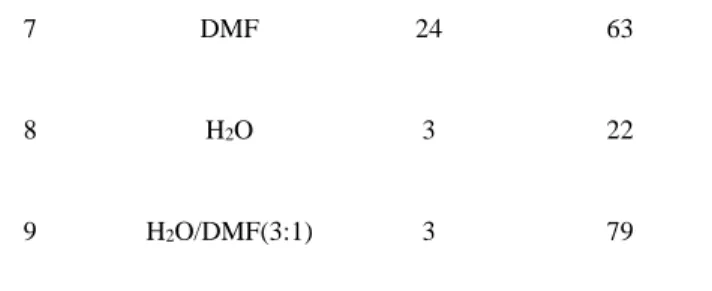
Using only water resulted in reasonable yield (77%, entry 1). Testing DMF as a cosolvent, no correlation of the ratio and the yields was found. Using only DMF was ineffective (63%, entry 7). Shortening the reaction time leads to poor yield in water (22%, entry 8). When the ratio of water and DMF was 3:1, the reaction time could be shortened to 3 hours with improved yield (79%, entry 9).
With this optimized condition in hand, functionalization of phenol with iodobenzene was examined (Table 2). Iodination was done for 3 hours. Then, a base, a palladium catalyst, and benzeneboronic acid were sequentially added to obtain the product.
Table 2. Synthesis of 2,4,6-triphenylphenol under aqueous media.
7 DMF 24 63
8 H2O 3 22
9 H2O/DMF(3:1) 3 79
a Reaction conditions: Phenol (0.5 mmol), base (1.5 mmol), iodine (1.5 mmol), H2O (3 mL), 40 ºC.
b Yields determined by 1H NMR spectroscopy, mesitylene used as an internal standard.
OH
Base, I2, H2O/DMF Base, Pd cat, PhB(OH)2
40 oC, 24 h
OH
Ph Ph
Ph 40 oC, 3 h
7
Entry Base Catalyst Solvent Yield(%)b
1 K2CO3 Pd(OAc)2 H2O n.r.c
2 K2CO3 Pd(OAc)2 H2O/DMF (3:1) 72
3 K2CO3 Pd(PPh3)4 H2O/DMF (3:1) 70
4 K2CO3 PdCl2(PPh3)2 H2O/DMF (3:1) 71
5 K2CO3 Pd(dppf)Cl2 H2O/DMF (3:1) 80
6 K2CO3 Pd(dba)2 H2O/DMF (3:1) 70
7 K2CO3 Pd(dppf)Cl2 H2O/DMF (2:1) 73
8 Na2CO3 Pd(dppf)Cl2 H2O/DMF (1:1) 81
9 Na2CO3 Pd(OAc)2 H2O/DMF (1:1) 84
a Reaction conditions: Phenol (0.5 mmol), base (1.5 mmol), iodine (1.5 mmol), H2O/DMF (3 mL:1–3 mL), 3 h, 40 ºC. And then, potassium carbonate (3 mmol), catalyst (3 mol%), benzeneboronic acid (3 mmol) , 24 h, 40 ºC.
b Isolated yields.
c Yields determined by gas chromatography.
As expected, using water without cosolvent resulted in no reaction, implying the ineffectiveness of the coupling reaction (entry 1). It is because the low solubility of some components made the stirring sluggish. Fortunately, when DMF was used as a cosolvent and palladium acetate as a catalyst, the yield rise dramatically (72%, entry 2). Other palladium catalysts were also tested (entries 3–6). It was puzzling
8
that the optimal combination of the base and the catalyst was different depending on the solvent ratio. Eventually, the optimized conditions, using sodium carbonate and palladium acetate, H2O/DMF 1:1 ratio, were established (84%, entry 9).
After optimization, some substrates such as 3-methoxyphenol, 3,5- dimethylphenol, were tested. First, 0.5 mmol of substrate, 3 equiv of sodium carbonate, 1.5 equiv of sodium iodide in H2O/DMF (3 mL/3 mL) were stirred at 60 ºC for 3 hours. Next, 6 equiv of sodium carbonate, 1.5 mol% palladium catalyst, 6 equiv of benzeneboronic acid were added to the mixture. The solution was stirred at 60 ºC for 24 hours. In the case of 3-methoxyphenol, only trace amount of triarylated product was detected by gas chromatography. However, for 3,5- dimethylphenol, the reaction was sluggish due to stirring problem and no arylated product was detected. There were mixtures of unidentified compounds and no expected product. Therefore, the arylated product was not isolated in a pure form.
Due to the reasons mentioned above, we had to quit this work.
9
2. Synthesis of Benzothiazoles from 2- Aminobenzenethiols in the Presence of a Reusable Polythiazolium Precatalyst Under Atmospheric CO
22.1. Introduction
Since it is a cheap and easily accessible C1 building block, CO2 has been used in various chemical bond forming reactions such as C–C7-9, C–N10-13, C–O14, to afford many important compounds. However, due to its intrinsic stability, rendering CO2
to participate in chemical reaction is quite challenging.15 Even though there are several ways to activate CO2, they usually require harsh reaction conditions, such as high pressure and temperature. Thus, finding a new route to employ this compound in a chemical reaction under mild conditions would be necessary.
Meanwhile, N-heterocyclic carbene is a versatile heterocyclic compound involved in various chemical transformations.16-19 It can be used as a ligand and can also serve as an organocatalyst.20 Recently, there has been a growing interest in the use of NHCs in CO2 activation. Since 1999, a number of works related to the use of imiadzolium NHCs in CO2 activation have been reported.21 The use of polymeric NHCs in CO2 fixation was also published.22 In 2009, Lu et al. developed an imidazolium polymer-based CO2 adsorbent under mild conditions.23 We have also reported the use of poly(4-vinylimidazolium) iodide as a recyclable organocatalyst for the synthesis of cyclic carbonates from epoxides.24 However, only few studies using thiazolium NHCs in organic synthesis have been reported. Very recently, we reported the thioesterification of benzaldehydes with thiols using 3,4-dimethyl-5-
10
vinylthiazolium iodide as a precatalyst.25 In 2016, Dyson et al. reported N- formylation of amines catalyzed by thiazolium carbene under CO2 at atmospheric pressure.26 Therefore, it would be highly challenging to develop a new reaction using thiazolium NHCs as the precatalyst and CO2 as the C1 source.
Benzothiazoles have diverse biological properties that are useful in pharmaceutical industries.27 Considering their importance, it would be meaningful to develop a simple synthetic method. Numerous approaches are available for the synthesis of benzothiazoles starting from 2-aminobenzenethiols. These include a copper-catalyzed condensation reaction of 2-aminobenzenethiols with nitriles28 or a reaction with β‑diketone.29 However, few works using CO2 as a C1 source in the synthesis of benzothiazole exist to date (Scheme 1). In 2014, Liu et al. synthesized benzothiazoles from 2-aminobenzenethiol using hydrosilane as a CO2 fixing agent.30 However, the harsh reaction conditions (50 atm and 150 ºC) and limited substrate scope diminished the synthetic utility in practical application. Later, in 2015, they also published the synthesis of benzothiazole under 0.5 MPa of carbon dioxide and triethoxysilane at 60 ºC, employing imidazolium-based ionic liquids as a catalyst (eq 2).31 However, this procedure still required a special reactor and a stoichiometric amount of catalyst. Our interest in the use of thiazolium-based catalysis prompted us to investigate the use of thiazolium-based NHCs as a catalyst in the formation of benzothiazoles from 2-aminobenzenethiols and carbon dioxide.
Herein we report our recent results, using poly(3,4-dimethyl-5-vinylthiazolium) iodide as a precatalyst and 1,8-diazabicyclo[5.4.0]undec-7-ene (DBU) as a base in the synthesis of benzothiazoles from 2-aminobenzenethiols and atmospheric carbon dioxide.
11 NH2
SH
CO2(50 atm), Et2SiH2, DBN
S N
NH2
SH
CO2(5 atm), (EtO)3SiH, [Bmim][OAc]
S N
60 oC, 24h NMP, 150 oC, 24h
NH2
SH
CO2(30 atm), PhSiH3, GVL
S N
80 oC, 5h
Scheme 1. Synthesis of benzothiazole using carbon dioxide as a building block.
12
2.2. Results and Discussion
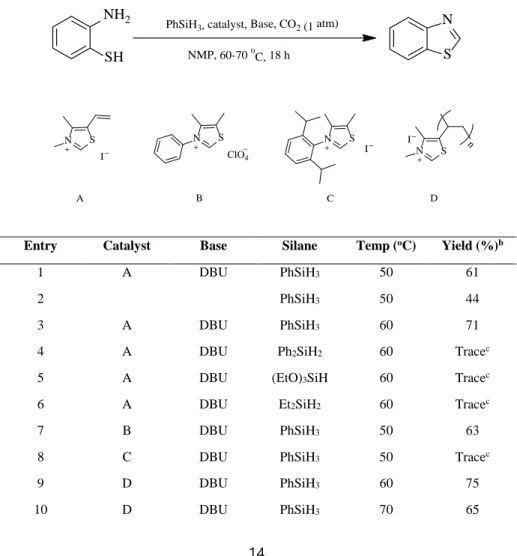
The results from the synthesis of benzothiazole under various conditions, using 2-aminobenzenethiol as a model substrate, are listed in Table 1. Referring to the above mentioned previous works, 3,4-dimethyl-5-vinylthiazolium iodide A, DBU, and PhSiH3 were used as a catalytic system. We envisioned that DBU and phenylsilane acted as a CO2 fixing agent and a hydride donor, respectively. All the reactions were conducted under atmospheric carbon dioxide (CO2 balloon). When the reaction was conducted in DMF, benzenethiazole was isolated in 71% yield. In DMA, the reaction afforded the product and 2-methylbenzothiazole in 53% and 10%
yields, respectively. Without A, the reaction of 2-aminobenzenethiol with phenylsilane and N,N-dimethylbenzamide afforded 2-phenylbenzothiazole in 48%
yield (Scheme 2).
Scheme 2. Reactions with DMF, DMA, N, N-dimethylbenzamide.
NH2
SH S
PhSiH3 (3 equiv), DBU (10 mol%), CO2(1 atm) N 50 oC, 18 h
NH2
SH
NH2 SH
+
+
+
H N
O
N O
N O
S N
S N PhSiH3 (3 equiv), DBU (10 mol%), CO2(1 atm)
50 oC, 18 h
PhSiH3(3 equiv) 100 oC, 24 h 0.5 mmol
0.5 mmol
0.5 mmol
1 mL
3.6 mL
6.5 mmol
71%
53%
48%
S N
53%
+
13
This observation suggested that the amidic solvents reacted with 2- aminobenzenethiol in the presence of phenylsilane to afford benzothiazoles. Thus, the use of amidic solvent was thought to diminish the efficiency of the formation of a specific benzenethiazole. However, no such problem was expected when a cyclic amide, N-methyl-2-pyrrolidone (NMP), was used as the solvent. As expected, the use of NMP as a reaction medium afforded a higher yield (61%, entry 1). Thus, NMP was chosen as the reaction solvent. When the reaction was carried out in the absence of A, benzothiazole was isolated in low yield (44 %, entry 2). We next screened different reaction conditions. Raising the temperature from 50 to 60 ºC improved the yield slightly (71%, entry 3). When other hydrosilanes such as Ph2SiH2, (EtO)3SiH, and Et2SiH2, were screened, only a trace amount of benzothiazole was detected (entries 4–6, respectively), implying the superiority of phenylsilane in the proposed reaction system. Other thiazolium compounds, 4,5- dimethyl-3-phenylthiazolium perchlorate B, 3-(2,6-diisopropylphenyl)-4,5- dimethylthiazolium iodide C, and poly(3,4-dimethyl-5-vinylthiazolium) iodide D, bearing different substituents and counteranions, were screened as precatalysts (entries 7–9, respectively).32 Thiazolium NHC B exhibited activity comparable to that of A. Covensely, C, with a sterically bulky substituent, only afforded a trace amount of the product. This indicated that the reaction was highly sensitive to the steric bulkiness of the substituent on the phenyl ring of the thiazolium NHC.
Interestingly, the highest yield was observed with polymeric thiazolium NHC D (75%, entry 9). Therefore, D was selected as the precatalyst. Using D as the precatalyst, we next screened different reaction conditions. Increasing the reaction temperature did not improve the yield (65%, entry 10). Conversely, reducing the amount (2 equiv) of phenylsilane significantly decreased the yield (entry 11), indicating the importance of the role of hydrosilane. Other organic and inorganic bases such as triethylamine and potassium carbonate did not prove to be as
14
efficient as DBU (entries 12 and 13). The yield was highly sensitive to the reaction time. Shortening the reaction time from 18 to 15 h led to a remarkable decrease in yield (59%, entry 14). The best GC yield (90%; 76% isolated yield, entry 15) was observed in the presence of D (9 mol%). From these results, the optimum conditions were established as follows: 0.5 mmol of 2-aminobenzenethiol, 9–10 mol% D, 3 equiv. of phenylsilane, 9 ~ 10 mol% DBU, 3.6 mL of NMP, 1 atm CO2, at 60 ºC, for 18 h.
Table 1. Optimization of reaction conditionsa
N S I
C N S
B ClO4 S
N
A
I N S
I n
D
Entry Catalyst Base Silane Temp (oC) Yield (%)b
1 A DBU PhSiH3 50 61
2 PhSiH3 50 44
3 A DBU PhSiH3 60 71
4 A DBU Ph2SiH2 60 Tracec
5 A DBU (EtO)3SiH 60 Tracec
6 A DBU Et2SiH2 60 Tracec
7 B DBU PhSiH3 50 63
8 C DBU PhSiH3 50 Tracec
9 D DBU PhSiH3 60 75
10 D DBU PhSiH3 70 65
NH2
SH S
PhSiH3, catalyst, Base, CO2(1 atm) N
NMP, 60-70 oC, 18 h
15
11 D DBU PhSiH3d 60 34
12 D K2CO3 PhSiH3 60 66
13 D Et3N PhSiH3 60 Tracec
14e D DBU PhSiH3 60 59
15f D DBU PhSiH3 60 76 (90c)
a Reaction conditions: 2-aminobenzenethiol (0.5 mmol), hydrosilane (1.5 mmol), catalyst (10 mol%), base (10 mol%), CO2 (1 atm), N-methyl-2-pyrrilidone (3.6 mL), 18 h.
b Isolated yields.
c Yields were determined by gas chromatography using mesitylene used as an internal standard.
d 1 mmol of PhSiH3.
e 15 h.
f 9 mol% of catalyst, 9 mol% of base.
With the optimized reaction condition in hand, other benzothiazoles bearing different substituents were tested (Table 2). All the substrates listed afforded the corresponding benzothiazoles under the standard conditions, in good to moderate yield. Reactions were held at 60 or 70 ºC depending on the substrate used.
However, temperatures higher than 70 ºC reduced the yield. The correlation between the electronic effect of the substrate and the yield was not clear. Reactions with substrates containing an alkoxy group (methoxy or ethoxy) proceeded well, affording alkoxybenzothiazole in good yield (entries 2 and 3). Moreover, 2-amino- 5-methylbenzenethiol and 2-amino-5-ethylbenzothiazole afforded moderate yield (entry 4 and 5, respectively). However, the reaction was sluggish when 2-amino-5- tert-butylbenzenethiol was employed. In the case of 2-aminobenzenethiols with electron withdrawing substrates, 2-amino-5-chlorobenzenethiol afforded the product in good yield (entry 9). Moreover, a trifluoromethoxy group was tolerable (entry 12). Fluoro, bromo, and iodo substituents exhibited an increase in yield when the temperature was raised from 60 to 70 ºC (entries 8, 10–11, respectively).
Contrary to the substrates bearing functional groups at the C5 position, the
16
reactions with substrates on the C3 position were relatively sluggish (entries 13– 17).33 For example, the reaction of 2-amino-3-methylbenzenethiol led to a lower yield than that of 2-amino-5-methylbenzenethiol (entries 4 and 14, respectively).
This result can be attributed to steric effects. Some additional factors were thought to affect the yield difference in the 3- or 5- methoxy and fluoro substituent groups.
In order to interpret these experimental data, the electron densities of the two substrates were investigated by density functional theory calculations. However, the outcome was similar. Fortunately, we discovered that the distance between the oxygen atom and the proton of the amino group was close, indicating the presence of hydrogen bonding. This hydrogen bonding is thought to stabilize 2-amino-3- methoxybenzenethiol, making it less likely to participate in the reaction. The yield difference became much larger in the case of the fluoro substituent. No reaction was observed with 2-amino-3-fluorobenzenethiol (entry 15). The explanation described above can be applied in this case too. However, to date we do not have any plausible explanation for the outcome of the substrate with the 4-fluoro group (entry 16).
Table 2. Substrate Scope of Benzothiazolesa
N S
I n
1
NH2
SH S
PhSiH3, 1, DBU, CO2(1 atm) N
NMP, 60-70 oC, 18-30 h
R R
17
Entry Substrate Product Yield (%)b
1 NH2
SH S
N 76 (90c, e)
2 NH2
SH
O S
N O
73c
3 NH2
SH
O S
N O
84c
4 NH2
SH S
N 63
5 NH2
SH S
N 60
6 NH2
SH S
N 34
7 NH2
SH S
N 53
8 NH2
F SH S
N F
62
9 NH2
SH
Cl S
N Cl
72c
10 NH2
SH
Br S
N Br
62
11 NH2
SH
I S
N I
66
18
12 NH2
SH F O
F F
S N O
F
F F 73d
13
NH2 SH O
S N
O 33
14 NH2
SH S
N
54
15
NH2 SH F
S N
F n.r.e
16 NH2
SH F
S
F N n.r.e
a Reaction conditions: 2-aminobenzenethiol (0.5 mmol), phenylsilane (1.5 mmol), NHC polymer 1 (9 mol%), DBU (9 mol%), CO2 (1 atm), N-methyl-2-pyrrolidone (3.6 mL), 70 ºC, 24 h.
b Isolated yields.
c 60 ºC, 18 h.
d 30 h.
e Yields were determined by gas chromatography using mesitylene as an internal standard.
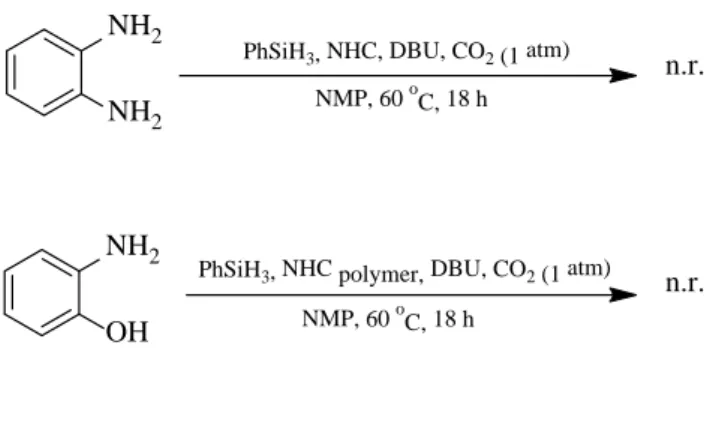
We tested diaminobenzene and 2-aminophenol, using thiazolium monomer or polymer (Scheme 3). Unfortunately, no benzimidazole and benzoxazole were isolated or detected.
19
Scheme 3. Reactions with other aminobenzenes
Reusability of the thiazolium polymer was tested. Considering the mechanical loss, the catalyst loading was raised to 12 mol%. The recovery of the precatalyst was successful achieved by adding excess hydroiodic acid. When methanol was added after eliminating the solvent, the precatalyst was precipitated. The recovered polymer precatalyst could be reused for 7 times without losing its activity (Figure 1, 84–93% yield).
Figure 1. Recycling experiment of poly (NHC) catalyst.
Based on these experimental results and previous studies, a possible reaction
0 20 40 60 80 100
1 2 3 4 5 6 7
GC Yield (%)
Run
NH2 NH2
PhSiH3, NHC, DBU, CO2(1 atm) NMP, 60 oC, 18 h
NH2 OH
PhSiH3, NHC polymer, DBU, CO2(1 atm) NMP, 60 oC, 18 h
n.r.
n.r.
20
mechanism is proposed in Scheme 4.34 First, a free carbene generated by DBU binds to carbon dioxide. Next, phenylsilane attacks the carbonyl carbon in CO2, to afford intermediate 1. The amino group of the substrate reacts with intermediate 1 to produce intermediate 2. After that, the thiol group condenses with the carbonyl group to form a heterocycle and a subsequent dehydration leads to the benzothiazole.
Scheme 4. Proposed mechanism.
N S
O O n +
CO2 N S n N
S
n DBU PhSiH3
O H
O
NH2 SH
HN
SH CHO S
HN
S N
-H2O OH
H2Si I
Ph
1
2
21
Conclusion
First, arylation of phenol under aqueous condition under low temperature was done. In contrast, due to the selectivity and reactivity issues of other substituted phenols, it was difficult to expand the substrate scope. However, this work was meaningful because the concept applied accords with the purpose of green chemistry.
Second, a polythiazolium-based organocatalytic system that displays high catalytic activities in the cyclization of 2-aminobenzenethiol to benzothiazole in the presence of DBU and atmospheric carbon dioxide is developed. The scope of the reaction is broad and its conditions are mild. Moreover, due to the feasibility of organocatalytic system D from commercially available A in one step, mild reaction conditions, and a simple purification procedure, together with the reusability of D, this method shows great potential for practical use in the synthesis of benzothiazoles from 2-aminobenzenethiols.
22
Experimental Section
General remarks. n-Hexanes and ethyl acetate were used without further purification. Other solvents were obtained by passing through activated alumina columns of solvent purification systems from Glass Contour. Reagents were purchased from Sigma-Aldrich, Alfa Aesar, Acros, and TCI and were used as received. H2O, DMF, NMP were used as a solvent. Reactions were carried out in a glassware equipped with a stirring under air conditions, unless otherwise indicated.
Elevated temperatures were maintained in thermostat-controlled oil baths. The TLC plate was carried out on 0.25 mm E. Merck silica gel plates (60F-254) visualized by UV-light (254 nm) and treatment with acidic p-anisaldehyde and KMnO4 stain followed by gentle heating. Workup procedures were done in air.
Flash chromatography was carried out on Merck 60 silica gel (230 – 400 mesh). 1H and 13C NMR spectra were recorded withVarian spectrometer (400 MHz) spectrometer. 1H NMR spectra were referenced to residual TMS(0 ppm) and reported as follows: chemical shift, multiplicity (s = singlet, d = doublet, t = triplet, q = quartet, dd = doublet of doublets, ddd = doublet of doublet of doublets, dt = doublets of triplets, td = triplet of doublets, qd = quartet of doublets, br s = broad singlet, m = multiplet). Chemical shifts of the 13C NMR spectra were measured relative to CDCl3 (77.16 ppm). Mass spectral data were obtained from the Korea Basic Science Institute (Daegu) on a Jeol JMS 700 high resolution mass spectrometer.
23 I. Arylation of Phenol in an Aqueous Media
A. Procedure for the Synthesis of 2,4,6-Triphenylphenol
A tube-type Schlenk flask was charged with phenol (0.5 mmol, 44μL), base (1.5 mmol), iodine (1.5 mmol, 380 mg), H2O (3 mL), N, N-dimethylformamide (3 mL).
The solution was stirred at 40 ºC for 3 hours. After 3 hours, potassium carbonate (3 mmol, 414 mg), palladium catalyst (3 mol%), benzeneboronic acid (3 mmol, 365 mg) were added to the mixture. The solution was stirred at 40 ºC for 24 hours. The mixture was extracted with ethyl acetate, filtered to remove catalyst residue, and finally evaporated under reduced pressure. The mixture was purified by flash chromatography on silica gel (n-hexane/ethyl acetate).
B. 1H NMR, 13C NMR data of 2,4,6-triphenylphenol
OH
2,4,6-triphenylphenol
24
1H NMR (400 MHz, CDCl3) δ 7.71 – 7.62 (m, 6H), 7.61 – 7.41 (m, 10H), 7.36 (t, J = 7.4 Hz, 1H), 5.49 (s, 1H) ppm. 13C NMR (100 MHz, CDCl3) δ 149.04, 140.64, 137.64, 133.95, 129.50, 129.25, 129.04, 128.90, 128.76, 127.93, 127.01, 126.91 ppm.
II. Synthesis of Benzothiazoles from 2-Aminobenzenethiols in the Presence of Reusable Polythiazolium Precatalyst Under Atmospheric CO2
1. Preparation of Monomeric & Polymeric Precatalysts25
A. Synthesis of Monomer 1.
4-Methyl-5-vinylthiazole (0.12 g, 1 mmol), iodomethane (0.2 mL, 6.5 mmol) and methanol (8 mL) were added to a Schlenk flask. The reaction mixture was stirred at 70 ºC for 24 hours. The solvent was evaporated from the filtrate. Then, the reaction mixture was purified by a flash chromatography on a silica gel column eluting with dichloromethane/methanol (v/v, 10:1).
B. Synthesis of Polymer Catalyst 2.
In a typical experiment, a 10 mL Schlenk flask was flame-dried and charged with 3 mmol of 1, 0.012 mmol of AIBN and 3 mL of methanol. The Schlenk tube was subjected to three freeze-pump-thaw cycles and placed in a thermostatted oil bath previously maintained at 80 ºC. The polymerization reaction was quenched after 24
25
h by a sudden cooling with liquid nitrogen. The resulting poly(3,4-dimethyl-5- vinylthiazolium) salt 2 was isolated by precipitation in acetone solution. After drying under vacuum, 2 was obtained as a light green powder. Yield: 39%.
2. Procedure for the Synthesis of Benzothiazole NH2
SH S
N
PhSiH3, 1 or2, DBU, CO2(1 atm)
NMP, 60-70 oC, 18h
N S
1 I
N S
I n
2
A tube-type Schlenk flask was charged with 0.05 mmol of precatalyst salt, 0.05 mmol of 1,8-diazabicyclo[5.4.0]undec-7-ene (7 μL), and 1 mL of N-methyl-2- pyrrolidone. The solution was stirred under nitrogen atmosphere at room temperature or 60 ºC (in the case of polymer) for 30 minutes. And, 2mL of N- methyl-2-pyrrolidone was added, followed by addition of a balloon charged with carbon dioxide gas. The solution was stirred at room temperature or 60 ºC (in the case of polymer) for 30 minutes. Then, 2-aminobenzenethiol (0.5 mmol, 54 μL), phenylsilane (1.5 mmol, 186 μL) dissolved in 0.5 mL of N-methyl-2-pyrrolidone were added to the mixture. Reaction was performed under 60 ºC for 18 hours. After the solution was cooled to room temperature, purification by flash chromatography on silica gel with n-hexane and ethyl acetate without any work up procedure
26
afforded benzothiazole. The benzothiazole products were characterized by 1H NMR, 13C NMR and HRMS.
3. Recycling Test
A tube-type Schlenk flask was charged with 0.06 mmol of poly(NHC) precatalyst salt (12 mol%, 16.0 mg), 0.06 mmol of 1,8-diazabicyclo[5.4.0]undec-7-ene (12 mol%, 9 μL), and 1 mL of N-methyl-2-pyrrolidone. The solution was stirred under nitrogen atmosphere at 60 ºC for 30 minutes. And, 2 mL of N-methyl-2- pyrrolidone was added, followed by adding a balloon charged with carbon dioxide gas. The solution was stirred at 60 ºC for 30 minutes. Then, 2-aminobenzenethiol (0.5 mmol, 54 μL), phenylsilane (1.5 mmol, 186 μL) dissolved in 0.5ml of N- methyl-2-pyrrolidone was added to the mixture. After 18 hours, mesitylene (0.5 mmol, 70 μL) was added as an internal standard to determine the GC yield. After that, the precatalyst salt was regenerated by adding 0.20 mmol of 47% hydroiodic acid (25 mol%, 36 μL). The solvent, product, silane, base were eliminated under reduced pressure at the same time. The precatalyst salt was precipitated by adding methanol. The catalytic performance of poly(NHC) was well maintained during the six times of recycling with 84–93% GC yields (1st run, 91%; 2nd run, 84%; 3rd run, 90%; 4th run, 89%, 5th run, 93%, 6th run, 88%, 7th run, 91%).
27
4. 1H NMR, 13C NMR and HRMS data of benzothiazole derivatives
S N
Benzothiazole
1H NMR (400 MHz, CDCl3) δ 8.98 (s, 1H), 8.14 (d, J = 8.1 Hz, 1H), 7.94 (d, J = 7.9 Hz, 1H), 7.51 (t, J = 7.7 Hz, 1H), 7.42 (t, J = 7.5 Hz, 1H) ppm. 13C NMR (100 MHz, CDCl3) δ 153.96, 153.30, 133.76, 126.21, 125.59, 123.69, 121.94 ppm.
HRMS (FAB) calc. for [C7H5NS]: 135.0143, found: 135.0141 ; pale yellow oil.
S N O
6-Methoxybenzothiazole
1H NMR (400 MHz, CDCl3) δ 8.75 (s, 1H), 7.94 (d, J = 9.0 Hz, 1H), 7.32 (d, J = 2.5 Hz, 1H), 7.05 (dd, J = 9.0, 2.5 Hz, 1H), 3.82 (s, 3H) ppm. 13C NMR (100 MHz, CDCl3) δ 158.14, 151.53, 147.98, 135.23, 124.13, 115.97, 104.11, 55.92 ppm.
HRMS (FAB) calc. for [C8H7NOS]: 165.0248, found: 165.0250 ; pale yellow solid;
28 MP 70 ºC.
S N O
6-Ethoxybenzothiazole
1H NMR (400 MHz, CDCl3) δ 8.80 (s, 1H), 7.99 (d, J = 8.9 Hz, 1H), 7.36 (d, J = 1.8 Hz, 1H), 7.10 (dd, J = 8.9, 2.0 Hz, 1H), 4.08 (q, J = 7.0 Hz, 2H), 1.45 (t, J = 7.0 Hz, 3H) ppm. 13C NMR (100 MHz, CDCl3) δ 157.47, 151.38, 147.87, 135.18, 124.07, 116.33, 104.81, 64.21, 14.92 ppm. HRMS (FAB) calc. for [C9H9NOS]:
179.0405, found: 179.0403 ; yellow oil.
S N
6-Methylbenzothiazole
1H NMR (400 MHz, CDCl3) δ 8.83 (s, 1H), 7.94 (d, J = 8.3 Hz, 1H), 7.67 (s, 1H), 7.25 (d, J = 8.3 Hz, 1H), 2.43 (s, 3H) ppm. 13C NMR (100 MHz, CDCl3) δ 152.97, 151.54, 135.82, 134.01, 127.96, 123.18, 121.66, 21.65 ppm. HRMS (FAB) calc.
29
for [C8H7NS]: 149.0299, found: 149.0302 ; yellow oil.
S N
6-Ethylbenzothiazole
1H NMR (400 MHz, CDCl3) δ 8.91 (s, 1H), 8.04 (d, J = 8.4 Hz, 1H), 7.77 (s, 1H), 7.36 (d, J = 8.4 Hz, 1H), 2.80 (q, J = 7.6 Hz, 2H), 1.31 (t, J = 7.6 Hz, 3H) ppm. 13C NMR (100 MHz, CDCl3) δ 153.08, 151.70, 142.24, 134.05, 126.92, 123.32, 120.46, 29.05, 15.97 ppm. HRMS (FAB) calc. for [C9H9NS]: 163.0456, found:
163.0456 ; pale yellow oil.
S N
6-Tert-butylbenzothiazole
1H NMR (400 MHz, CDCl3) δ 8.93 (s, 1H), 8.06 (d, J = 8.7 Hz, 1H), 7.95 (s, 1H), 7.59 (dd, J = 8.6, 1.5 Hz, 1H), 1.41 (s, 9H) ppm. 13C NMR (100 MHz, CDCl3) δ
30
153.40, 151.36, 149.20, 133.92, 124.61, 123.01, 117.96, 35.22, 31.71 ppm. HRMS (FAB) calc. for [C11H13NS]: 191.0769, found: 191.0766 ; yellow oil.
S N
5,6-Dimethylbenzothiazole
1H NMR (400 MHz, CDCl3)δ 8.87 (s, 1H), 7.90 (s, 1H), 7.70 (s, 1H), 2.42 (s, 3H), 2.40 (s, 3H) ppm. 13C NMR (100 MHz, CDCl3) δ 152.90, 152.22, 135.62, 135.23, 131.24, 123.77, 121.80, 20.36, 20.34 ppm. HRMS (FAB) calc. for [C9H9NS]:
163.0456, found: 163.0454 ; white solid; MP 108 ºC.
S N F
6-Fluorobenzothiazole
1H NMR (400 MHz, CDCl3) δ 8.88 (s, 1H), 8.01 (dd, J = 9.0, 4.8 Hz, 1H), 7.59 – 7.55 (m, 1H), 7.23 – 7.16 (m, 1H) ppm. 13C NMR (100 MHz, CDCl3) δ 160.89 (d, J = 246.1 Hz), 153.71 (d, J = 2.5 Hz), 150.07, 133.65 (d, J = 265.6 Hz), 124.70 (d,
31
J = 9.4 Hz), 115.18 (d, J = 25.0 Hz), 108.07 (d, J = 26.0 Hz) ppm. HRMS (FAB) calc. for [C7H4FNS]: 153.0048, found: 153.0046 ; white solid; MP 58 ºC.
S N Cl
6-Chlorobenzothiazole
1H NMR (400 MHz, CDCl3)δ 8.98 (s, 1H), 8.04 (d, J = 8.7 Hz, 1H), 7.94 (d, J = 1.7 Hz, 1H), 7.48 (dd, J = 8.7, 2.0 Hz, 1H) ppm. 13C NMR (100 MHz, CDCl3) δ 154.43, 151.97, 135.10, 131.81, 127.21, 124.50, 121.61 ppm. HRMS (FAB) calc.
for [C7H4ClNS]: 168.9753, found: 168.9752; pale yellow solid; MP 42 ºC.
S N Br
6-Bromobenzothiazole
1H NMR (400 MHz, CDCl3)δ 8.89 (s, 1H), 8.03 (d, J = 1.7 Hz, 1H), 7.92 (d, J = 8.7 Hz, 1H), 7.57 – 7.53 (m, 1H) ppm. 13C NMR (100 MHz, CDCl3) δ 154.45, 152.29, 135.59, 129.89, 124.87, 124.57, 119.50 ppm. HRMS (FAB) calc. for
32
[C7H4BrNS]: 212.9248, found: 212.9248; white solid; MP 55 ºC.
S N I
6-Iodobenzothiazole
1H NMR (400 MHz, CDCl3)δ 8.91 (s, 1H), 8.30 (d, J = 0.9 Hz, 1H), 7.87 (d, J = 8.6 Hz, 1H), 7.80 (dd, J = 8.6, 1.1 Hz, 1H) ppm. 13C NMR (100 MHz, CDCl3) δ 154.41, 152.79, 136.03, 135.45, 130.56, 125.23, 90.31 ppm. HRMS (FAB) calc.
for [C7H4INS]: 260.9109, found: 260.9107 ; white solid; MP 81 ºC.
S N F O
F F
6-Trifluoromethoxybenzothiazole
1H NMR (400 MHz, CDCl3)δ 9.03 (s, 1H), 8.14 (d, J = 8.9 Hz, 1H), 7.83 (s, 1H), 7.40 (d, J = 8.9 Hz, 1H) ppm. 13C NMR (100 MHz, CDCl3) δ 155.14, 151.88, 146.99 (d, J = 2.1 Hz), 134.78, 124.63, 120.65 (d, J = 257.8 Hz), 120.36, 114.49 (d, J = 0.5 Hz) ppm. HRMS (FAB) calc. for [C8H4F3NOS]: 218.9966, found:
33 218.9963 ; colorless oil.
S N O
4-Methoxybenzothiazole
1H NMR (400 MHz, CDCl3)δ 8.90 (s, 1H), 7.52 (d, J = 8.1 Hz, 1H), 7.38 (t, J = 8.0 Hz, 1H), 6.93 (d, J = 7.9 Hz, 1H), 4.06 (s, 3H) ppm. 13C NMR (100 MHz, CDCl3) δ 154.05, 152.43, 143.74, 135.65, 126.70, 113.87, 106.57, 56.11 ppm.
HRMS (FAB) calc. for [C8H7NOS]: 165.0248, found: 165.0249 ; white solid; MP 104 ºC.
S N
4-Methylbenzothiazole
1H NMR (400 MHz, CDCl3)δ 8.98 (s, 1H), 7.80 (d, J = 7.0 Hz, 1H), 7.37 – 7.31 (m, 2H), 2.80 (s, 3H) ppm. 13C NMR (100 MHz, CDCl3) δ 152.86, 152.71, 133.72,
34
133.62, 126.81, 125.62, 119.45, 18.53 ppm. HRMS (FAB) calc. for [C8H7NS]:
149.0299, found: 149.0297 ; yellow oil.
35 5. Computational details
The calculations were performed using the Gaussian 09 program package.1
All the results were obtained at the DFT level of theory using the RB3LYP/6- 31G(d) All geometries of stationary states were fully optimized without any symmetry restriction. Frequency calculations were perfomed to characterized the stationary points as minima and to obtain the zero-point energies(ZPE) and thermal corrections at 298.15K.
Reference
1. Gaussian 09, Revision A.02, M. J. Frisch, G. W. Trucks, H. B. Schlegel, G. E.
Scuseria, M. A. Robb, J. R. Cheeseman, G. Scalmani, V. Barone, B. Mennucci, G.
A. Petersson, H. Nakatsuji, M. Caricato, X. Li, H. P. Hratchian, A. F. Izmaylov, J.
Bloino, G. Zheng, J. L. Sonnenberg, M. Hada, M. Ehara, K. Toyota, R. Fukuda, J.
Hasegawa, M. Ishida, T. Nakajima, Y. Honda, O. Kitao, H. Nakai, T. Vreven, J. A.
Montgomery, Jr., J. E. Peralta, F. Ogliaro, M. Bearpark, J. J. Heyd, E. Brothers, K.
N. Kudin, V. N. Staroverov, R. Kobayashi, J. Normand, K. Raghavachari, A.
Rendell, J. C. Burant, S. S. Iyengar, J. Tomasi, M. Cossi, N. Rega, J. M. Millam, M.
Klene, J. E. Knox, J. B. Cross, V. Bakken, C. Adamo, J. Jaramillo, R. Gomperts, R.
E. Stratmann, O. Yazyev, A. J. Austin, R. Cammi, C. Pomelli, J. W. Ochterski, R. L.
Martin, K. Morokuma, V. G. Zakrzewski, G. A. Voth, P. Salvador, J. J. Dannenberg, S. Dapprich, A. D. Daniels, . Farkas, J. B. Foresman, J. V. Ortiz, J. Cioslowski, D. J. Fox, Gaussian, Inc., Wallingford CT, 2009.
36 Table S1. Atomic coordinates for stationary points
3-methoxyaminothiophenol 5-methoxyaminothiophenol
3-fluoroaminothiophenol 5-fluoroaminothiophenol
37
Reference
(1) Kozhushkov, S. I.; Potukuchi, H. K.; Ackermann, L. Catal. Sci. Tech. 2013, 3, 562.
(2) Narayan, S.; Muldoon, J.; Finn, M.; Fokin, V. V.; Kolb, H. C.; Sharpless, K. B.
Angew. Chem. Int. Ed. 2005, 44, 3275.
(3) Butler, R. N.; Coyne, A. G. Chem.Rev. 2010, 110, 6302.
(4) Liu, L.; Zhang, Y.; Xin, B. J. Org. Chem. 2006, 71, 3994.
(5) Do, H.-Q.; Daugulis, O. Org.Lett. 2008, 11, 421.
(6) Lang, R.; Shi, L.; Li, D.; Xia, C.; Li, F. Org.Lett. 2012, 14, 4130.
(7) Boogaerts, I. I.; Nolan, S. P. J. Am. Chem. Soc. 2010, 132, 8858.
(8) Wu, L.; Liu, Q.; Fleischer, I.; Jackstell, R.; Beller, M. Nat. Commun. 2014, 5.
3091.
(9) Jin, G.; Werncke, C. G.; Escudié, Y.; Sabo-Etienne, S.; Bontemps, S. J. Am.
Chem. Soc. 2015, 137, 9563.
(10) Yang, Z.-Z.; He, L.-N.; Gao, J.; Liu, A.-H.; Yu, B. Energy Environ Sci. 2012, 5, 6602.
(11) Jacquet, O.; Frogneux, X.; Gomes, C. D. N.; Cantat, T. Chem. Sci. 2013, 4, 2127.
(12) Das, S.; Bobbink, F. D.; Laurenczy, G.; Dyson, P. J. Angw. Chem., Int. Ed.
2014, 53, 12876.
(13) Lv, H.; Xing, Q.; Yue, C.; Lei, Z.; Li, F. Chem. Commun. 2016, 52, 6545.
(14) Darensbourg, D. J.; Holtcamp, M. W. Coord. Chem. Rev. 1996, 153, 155.
(15) Leitner, W. Angw. Chem., Int. Ed. Engl. 1995, 34, 2207.
(16) Herrmann, W. A. Angw. Chem., Int. Ed. 2002, 41, 1290.
(17) Enders, D.; Niemeier, O.; Henseler, A. Chem. Rev. 2007, 107, 5606.
(18) Marion, N.; Díez‐González, S.; Nolan, S. P. Angw. Chem., Int. Ed. 2007, 46, 2988.
38
(19) Díez-González, S.; Marion, N.; Nolan, S. P. Chem. Rev. 2009, 109, 3612.
(20) Hopkinson, M. N.; Richter, C.; Schedler, M.; Glorius, F. Nature. 2014, 510, 485.
(21) Yang, L.; Wang, H. ChemSusChem. 2014, 7, 962.
(22) Pinaud, J.; Vignolle, J.; Gnanou, Y.; Taton, D. Macromolecules. 2011, 44, 1900.
(23) Zhou, H.; Zhang, W.-Z.; Wang, Y.-M.; Qu, J.-P.; Lu, X.-B. Macromolecules.
2009, 42, 5419.
(24) Seo, U. R.; Chung, Y. K. Adv. Synth. Catal. 2014, 356, 1955.
(25) Chung, J.; Seo, U. R.; Chun, S.; Chung, Y. K. ChemCatChem 2016, 8, 318.
(26) Das, S.; Bobbink, F. D.; Bulut, S.; Soudani, M.; Dyson, P. J. Chem. Commun.
2016. 52, 2497.
(27) Raju, G. N. J. Chem. Pharm. Res. 2015, 7, 286.
(28) Sun, Y.; Jiang, H.; Wu, W.; Zeng, W.; Wu, X. Org.Lett. 2013, 15, 1598.
(29) Mayo, M. S.; Yu, X.; Zhou, X.; Feng, X.; Yamamoto, Y.; Bao, M. Org. Lett.
2014, 16, 764.
(30) Gao, X.; Yu, B.; Zhao, Y.; Hao, L.; Liu, Z. RSC Adv. 2014, 4, 56957.
(31) Gao, X.; Yu, B.; Yang, Z.; Zhao, Y.; Zhang, H.; Hao, L.; Han, B.; Liu, Z. ACS Catal. 2015, 5, 6648.
(32) Piel, I.; Pawelczyk, M. D.; Hirano, K.; Fröhlich, R.; Glorius, F. Eur. J. Org.
Chem. 2011, 28, 5475.
(33) Gao, X.; Yu, B.; Mei, Q.; Yang, Z.; Zhao, Y.; Zhang, H.; Hao, L.; Liu, Z. New J. Chem. 2016, 40, 8282.
(34) Hao, L.; Zhao, Y.; Yu, B.; Yang, Z.; Zhang, H.; Han, B.; Gao. X.; Liu, Z. ACS Catal. 2015, 5, 4989.
39
국문초록
수용액 조건 하에서 페놀에 페닐 작용기를 성공적으로 도입하였다. 할로 젠화된 페놀은 곧바로 인시츄로 벤젠보론산과 스즈키 반응을 통해 아릴 레이션된다. 이 반응은 조건이 온화하며 (낮은 온도, 리간드 미사용), 수율이 높다는 장점을 지니고 있다.
다음으로, DBU와 1기압의 이산화탄소 하에서 2-아미노벤젠싸이올의 고리화 반응을 해 벤조싸이아졸을 만들어내는 데에 촉매 활성이 높은 고 분자싸이아졸륨 기반의 유기촉매 시스템을 개발했다. 반응의 범용성은 넓으며, 조건은 온건하다. 게다가, 상업적으로 접근 가능한 A로부터 온 건한 조건 하에서 한 단계 만에 만들 수 있는 유기촉매 시스템 D는 2- 아미노벤젠싸이올로부터 벤조싸이올을 만들 수 있는 실용적인 길을 제공 할 수 있다.
주요어: 페놀, 물, 스즈키 반응, 벤조사이아졸, 고분자 (엔에이치씨), 이 산화탄소
학번: 2015-20390