저작자표시-비영리-변경금지 2.0 대한민국 이용자는 아래의 조건을 따르는 경우에 한하여 자유롭게
l 이 저작물을 복제, 배포, 전송, 전시, 공연 및 방송할 수 있습니다. 다음과 같은 조건을 따라야 합니다:
l 귀하는, 이 저작물의 재이용이나 배포의 경우, 이 저작물에 적용된 이용허락조건 을 명확하게 나타내어야 합니다.
l 저작권자로부터 별도의 허가를 받으면 이러한 조건들은 적용되지 않습니다.
저작권법에 따른 이용자의 권리는 위의 내용에 의하여 영향을 받지 않습니다. 이것은 이용허락규약(Legal Code)을 이해하기 쉽게 요약한 것입니다.
Disclaimer
저작자표시. 귀하는 원저작자를 표시하여야 합니다.
비영리. 귀하는 이 저작물을 영리 목적으로 이용할 수 없습니다.
변경금지. 귀하는 이 저작물을 개작, 변형 또는 가공할 수 없습니다.
공학석사 학위논문
Study on the Entropic Contribution to Electrochemical Water Oxidation
Catalysis
전기화학적 물 산화 반응 중 엔트로피 기여에 관한 연구
2019 년 2 월
서울대학교 대학원 재료공학부
이 강 규
Abstract
Study on the Entropic Contribution for Electrochemical Water Oxidation
Catalysis
Kang-Gyu Lee Department of Materials Science and Engineering The Graduate School Seoul National University
Artificial photosynthesis is one of the crucial strategies for sustainable energy production. The oxygen evolution reaction (OER), which is an important part of artificial photosynthesis, shows sluggish reaction kinetics due to the high energy barrier, and accordingly, the development of highly active catalysts is essential. To date, the origins of enthalpy of activation (Δ‡H) of high energy barrier (Δ‡G) has been well understood, and various strategies have been proposed to reduce the activation enthalpy. In this approach, scientists are focusing on the control of binding
energy with intermediate species (*O, *OH, and *OOH). However, not only catalytic properties of artificial electrocatlaysts are still far below than oxygen evolving enzyme (photosystem II), but also there is a theoretical limitation in improvement of activities by scaling relation.
In nature, all of the various biochemical reactions are regulated by enzymes, which lower the activation energy barrier of reactions, and crucially enhance the reaction kinetics even in mild condition. The origins of fast kinetics of enzyme have been identified as favorable entropy of activation (Δ‡S). For the water oxidation, favorable entropy effect of Ca2+ and amino-acid residue in Mn4Ca cluster has been reported as a decisive parameter for oxygen evolving kinetics. Furthermore, entropic contribution in molecular catalyst has been investigated based on the understanding about enzyme catalysis. However, in the heterogeneous water splitting, effect or origins of Δ‡S is not clearly identified, and overlooked because of difficulties in measuring and calculating Δ‡S.
Here, we propose the methodology for measuring activation energy parameters including activation enthalpy (Δ‡H) and entropy (Δ‡S) for oxygen evolution reaction (OER) on Mn3O4 NPs and Co-Pi film through the temperature dependent kinetic analysis. In our results, measured Δ‡H linearly decreased with overpotential in proportion to the transfer coefficient (α). The transfer coefficient of Mn3O4 NPs, and Co-Pi were measured to 0.74, and 0.96 respectively, which is consistent with previously reported results. Also, TΔ‡S was successfully measured to -0.46 – -0.49 eV eV for Mn3O4 NPs, and -0.4 eV for Co-Pi, which accounts for a larger portion of the whole activation Gibbs free energy (Δ‡G) than Δ‡H. Considering entropy values of intermediate species calculated by DFT studies, we confirmed that
this negative entropic contribution could be possible by nucleophilic attack of H2O molecule in the process of O-O bond formation. Further, we propose that activation entropy can be reduced by hydrogen-bond between Co-OOH and adjacent Co-OH in case of Co-Pi. In this study, we proposed that entropy contribute highly unfavorable to reaction kinetics and suggested entropy as crucial key kinetic factor in heterogeneous OER. In addition, we proposed that highly negative entropic contribution could be originated from mechanistic aspect, mainly nucleophilic attack of water molecule during O-O bond formation.
Keywords: Oxygen evolution reaction, Transition state theory, Temperature dependent analysis, Electrochemical study, Entropy, O-O bond formation, Manganese oxide, Cobalt phosphate
Student Number: 2017-24770
Contents
Abstract.……….……….…i
Contents.………iv
List of Tables.……….……….viii
List of Figures.……….ix
Chapter 1. Introduction……….……1
1.1 Demand for Hydrogen Energy …….………..…1
1.2 Electrochemical Oxygen Evolution Reaction (OER)………..3
1.2.1 The necessity for the development of OER catalyst………....3
1.2.2 Catalytic mechanism of OER………..4
1.2.3 ‘Design Rule’ for artificial catalyst……….7
1.3 Water Oxidation Enzyme in Nature: Photosystem II…….…………10
1.3.1 Photosystem II (PS II) in biological system………...10
1.3.2 Oxygen evolving complex (OEC) in PS II……….11
1.3.3 Hydrogen-bond network and protein channel in OEC….…..14
1.3.4 Entropic contribution to water oxidation in PS II …………..18
1.4 Enzyme Catalysis in Nature………..23
1.4.1 Favorable entropic contribution of enzyme catalysis………24
1.5 Artificial Electrocatalysts for Water Oxidation……….……28
1.5.1 Bioinspired Mn based Catalyst...28
1.5.2 Computational entropic consideration in DFT study………29
1.5.3 Experimental measurement of entropy………..33
1.5.4 Transition state theory for electrochemical OER…………...35
1.6 Objective of the Thesis………...41
Chapter 2. Experimental and Procedure……….45
2.1 Preparation of Catalysts………45
2.1.1 Materials………..……….45
2.1.2 Manganese oxide nanoparticles (Mn
3O
4NPs)………..46
2.1.3 Cobalt phosphate (Co-Pi)………..49
2.2 Characterization ………...50
2.2.1 Powder X-ray diffraction (XRD)………...………50
2.2.2 Scanning electron microscopy (SEM)………...50
2.2.3 Transmission electron microscopy (TEM)………51
2.3 Electrochemical Methods ……….52
2.3.1 Cyclic voltammetry (CV) measurements………..52
2.3.2 Tafel slope analysis………...52
2.3.3 Temperature dependent electrochemical measurements…...53
2.3.4 Electrochemical active surface area (ECSA)……….54
Chapter 3. Results and Discussion ……….57
3.1 Set-up the Electrochemical Cell………57
3.2 Characterization of Catalysts………60
3.2.1 Manganese oxide nanoparticles (Mn
3O
4NPs)....…………..60
3.2.2 Cobalt phosphate (Co-Pi)………..63
3.3 Electrochemical Characterization……….65
3.4 Investigation of Entropic Contribution………..68
3.4.1 Temperature dependent kinetic analysis………...68
3.4.1.1 Analysis on the enthalpy of activation (Δ
‡H)…………..713.4.1.2 Analysis on the entropy of activation (Δ
‡S)……….753.4.2 Entropic contribution to O-O bond formation during water oxidation ...…...85
Chapter 4. Conclusion ………89
References………..91
국문 초록 ………..……..103
감사의 글 ………106
List of Tables
Table 1.1 Measured activation energetic parameters for various enzyme reaction. Gibbs energy of activation (Δ‡G) decreased by enzyme, and measured Δ‡H and Δ‡S showed it was derived from entropic contribution, not enthalpic contribution………27 Table 1.2 Reported TS (eV) from the DFT study for various materials
(T=25oC)……….………..31
Table 1.3 Measured activation parameters (Δ‡H and Δ‡S) through temperature dependent kinetic analysis in heterogeneous and homogeneous catalyst systems (*T = 25°C)...34 Table 1.4 Comparison of kinetic equation and energetic parameters which can be measured from temperature dependent analysis between Arrhenius and Eyring model. ………44 Table 3.1 Temperature dependent Tafel slope of Mn3O4 NPs, and Co-Pi……..70 Table 3.2 Reported the number of active site for nano-sized metal oxide catalysts for OER ……….79
List of Figures
Figure 1.1 Schematic representation of water oxidation mechanism (a) Acid- Base (AB) mechanism for O-O bond formation (b) Radical-Coupling (RC) mechanism for O-O bond formation…...………...6 Figure 1.2 Volcano plots between catalytic activities and proposed descriptors.
(a) Activity trends towards oxygen evolution. The negative values of theoretical overpotential were plotted against the standard free energy of ΔGHO*-ΔGO* step. (b) The relation between the OER catalytic activity and the occupancy of the eg-symmetry electron of the transition metal (B in ABO3)………..……….9 Figure 1.3 Overall structure of PS II at a resolution of 1.9 Å and structure of OEC involving the Mn4Ca cluster and surrounding proteins……….13 Figure 1.4 Hydrogen-bond networks surrounding OEC. (a) H-bond around Yz.
Solid line depicts the bond between metal and water molecules, and H-bonds are represented as dashed lines. (b) H-bond networks from Mn4Ca cluster to luminal bulk phase.………...16 Figure 1.5 Proposed water channels and surrounding amino-acid residues.
Circled Asp61, Val185 and Ca2+ in Mn4Ca cluster play central roles to make entropic contribution favorable. ………..17 Figure 1.6 The entropic contribution in formation of intermediate species during
S2 – S3, and S3 – S0 transition. (a) The kok cycle of photosynthetic oxygen evolution. (b) Energetic schemes for S2 – S3, and S3 – S0
transition.………..21 Figure 1.7 Increase of energy barrier for mutant PSII due to the unfavorable entropic contribution. Substitution of Ca2+ to Sr2+ induces the decrease activation entropy (TΔ‡S) by disturbing the formation of ordered transition state prior to O-O bond formation. Two amino-acid residues (Asp61 and Val185) consist of water channel, and substitution of Asp to Asn (D61A) and Val to Asn (V185N) also induce the decrease of TΔ‡S.……….22 Figure 1.8 Scheme which represents the entropic contribution in enzyme reaction. Favorable entropic contribution in enzyme reaction has been explained by two theories. First, required entropic energy barrier decrease due to the loss of vibrational entropy of substrate during the enzyme-substrate binding. In addition, transition state could be stabilized in enzyme by H-bond networks or pre-organized surrounding proteins……….………26 Figure 1.9 TΔS diagram based on the DFT calculation. Co-OH is initial state and Co=O is formed by deprotonation step. After that, O-O bond formation step is following through acid-base mechanism (AB mechanism) and radical coupling mechanism (RC mechanism). RC mechanism has positive entropic contribution due to the
deprotonation step. On the other hand, highly negative activation entropy (TΔ‡S) is required in nucleophilic attack of H2O in O-O bond formation (T=25ºC).……….32 Figure 1.10 Free energy diagram of typical electrochemical oxygen evolution reaction. It is assumed that reaction is proceeded by acid-base mechanism, and O-O bond formation step is rate determining step (RDS). The experimentally measured activation parameters are the difference of energy state between initial state and transition state of RDS. Red bar and black bars represent the free energy of activated species in RDS, and free energy of intermediate species at standard electrode potential (E°), respectively. Blue bars represent the free energy of intermediates when overpotential (η) is applied……..….40 Figure 1.11 Butler-Volmer equation and Eyring plot for electrochemical reaction.
(Δ‡G : Gibbs free energy of activation, Δ‡H : enthalpy of activation, Δ‡S : entropy of activation, α : transfer coefficient and Γact : the number of active site).………...43 Figure 2.1 Scheme for synthesizing manganese oxide nanoparticles by hot injection method...47 Figure 2.2 Scheme for preparing manganese oxide nanoparticles film.……….48 Figure 2.3 Scheme for methodology to control W.E. versus RHE in neutral condition. In gas/electrolyte interface, we can directly measure W.E.
vs. RHE without liquid junction potential.………56
Figure 3.1 (a) Liquid junction potential in acidic solution based R.H.E system.
(b) Validation of hydrogen electrode system in neutral condition.
Ag/AgCl (KCl 3M) electrode was used as working electrode and gas diffusion RHE was used as reference electrode. Every points were measured by open circuit potential measurement………..59 Figure 3.2 The XRD pattern of powder Mn3O4 NPs. Black bar represents the reference PDF card of Mn3O4 (PDF #: 00-024-0734)………61 Figure 3.3 Electron microscopic images of Mn3O4 NP. (a-b) TEM image of synthesized Mn3O4 NPs. Inset of (b) shows a high resolution image of the Mn3O4 crystal. (c-d) Plane and cross sectional SEM images of Mn3O4 NPs films on FTO substrates……….62 Figure 3.4 Characterization of Co-Pi films by SEM (a) Plane SEM image for Co-
Pi film. (b) SEM-EDS histogram for deposited Co-Pi film. ……….64 Figure 3.5 Electrokinetic characterization of Mn3O4 NPs and Co-Pi. (a) Polarization curve and (b) Tafel slope in neutral condition (pH 7).………...67 Figure 3.6 Temperature dependent kinetics of OER. Polarization curves (a) and Tafel slope (b) of Mn3O4 NPs, and (c, d) Co-Pi.………...69 Figure 3.7 Eyring plot for (a) Mn3O4 NPs, and (b) Co-Pi from 20ºC to 70ºC.……….73 Figure 3.8 Confirmation of measured transfer coefficient (α). Potential dependent enthalpy of activation (Δ‡H) for (a) Mn3O4 NPs, and (b)
Co-Pi. α was measured by Butler-Volmer equation. (c) Measured α in our work and Tafel slope analysis. Accordance of α reflect the reliability of these kinetic analysis………74 Figure 3.9 (a) Our proposed circuit model for impedance analysis for Mn3O4 NPs film. Rtr indicate resistance for electron transport in the film. The Rint
and Cint in RC loops, which are described surface catalysis, mean interface resistance and capacitance, respectively. (b) Comparison of rate constant (k) from our model and reported values………...77 Figure 3.10 Double layer capacitance measurement for determining ECSA analysis for (a, b) Mn3O4 NPs. (a) Cyclic voltammetry were measured in a non-Faradaic region at various scan rate. (b) The cathodic and anodic charging currents measured at 0.45 V vs. Ag/AgCl. The determined double-layer capacitance of the system is represented………....81 Figure 3.11 Measured y-intercepts in Eyring plot for Mn3O4 NPs, and Co-Pi. In low overpotential, y-intercepts were obtained within similar ranges and average value was used in analysis.………83 Figure 3.12 Calculated TΔ‡S from the temperature dependent analysis for (a) Mn3O4 NPs and (b) Co-Pi. Blue line is calculated number of active site (Γact), and Red line is calculated TΔ‡S (T = 25°C)………...84 Figure 3.13 Comparison of entropy change in O-O bond formation mechanism for cobalt based catalyst. (a) Two possible mechanisms of O-O bond
formation on Mn3O4 NPs. (b) Calculated TS diagram for acid-base, and radical-coupling mechanism. S0 is calculated entropy value at initial state (T = 25°C)………...86 Figure 3.14 Proposed mechanisms of O-O bond formation during OER on cobalt based catalysts. Two types of acid-base mechanisms were reported by Frei group. The one is slow cycle by single Co site and the other is fast cycle by dual Co site. Radical-coupling mechanism was reported by Nocera group………88
Chapter 1. Introduction
1.1 Hydrogen Energy Future
1.1.1 Demand for hydrogen energy
Development of sustainable energy system is one of the crucial challenges facing human society. International Energy Agency reported that among the global energy demand in 2013 (18 TW), 80 % of which were provided from fossil fuel resources (coal, oil, and gas)1. This severe dependency on fossil fuels has been suggested to a major cause of global warming. As world population increases and industrialization expands, world energy demand is projected to double from 13.5 TW in 2001 to 27 TW by 2050 and to triple to 43 TW by 2100.2 As a result, there has been a major interest in energy supply with regard to environmentally friendly pathway.
Hydrogen energy is one of the most promising renewable energy resource among various candidate. Hydrogen has high energy density (142 kJ/g) compared to gasoline (46 kJ/g) and natural gas (47.2 kJ/g). 3 Also, it is non-toxic and produces water as by-product. Furthermore, as the cost of fuel cell system which use hydrogen as energy resource has been reducing, demand for hydrogen energy is predicted to increases.
At present, the vast majority (96 %) of hydrogen is produced by gas reforming method. In this method, syngas, which is converted from natural gas (48 %), oil (30 %), and coal (18 %) via thermochemical conversion, is decomposed to hydrogen and carbon monoxide in high temperature3. This method has crucial disadvantage that it produces CO and CO2 as byproduct and high energy should be consumed in high temperature condition. As the demand for hydrogen energy increases, research on the development of environmental-friendly hydrogen energy production methods is essential.
1.2 Electrochemical Oxygen Evolution Reaction (OER) 1.2.1 Water splitting and necessity of OER catalyst
Electrochemical water splitting is environmentally friendly hydrogen production method. Unlike gas reforming method, water splitting has advantages that hydrogen can be produced in ambient condition and only oxygen molecules are generated as by-product. Basically, water splitting consists of two half reaction as described below.
i) Water oxidation reaction (Oxidation reaction)
O2 + 4e- + 4H+ ↔ 2H2O Eanodic = 1.23 V – 0.059(pH) V (vs. NHE) ii) Hydrogen evolution reaction (Reduction reaction)
4e- + 4H+ ↔ 2H2 Ecathodic = 0 V – 0.059(pH) V (vs. NHE)
Hydrogen evolution reaction occur in cathode, and oxygen evolution reaction occur in anode site. Although there is an advantage of producing hydrogen without additional gas reforming process, electrochemical hydrogen production has challenge which is high overpotential of oxygen evolution reaction. Among both reaction, oxygen evolution reaction (OER) is kinetically sluggish and limit overall efficiency of water splitting. It is because OER contains four electron transfer step and involve the high activation energy barrier for O-O bond formation. Therefore,
development of outstanding OER electrocatalysts is essential to enhance efficiency of whole water spitting reaction, which means efficient hydrogen production.
1.2.2 Catalytic mechanism of OER
As described above, OER is sluggish reaction in which four electrons are transferred, and has three reaction intermediates species in the course of oxidation of water to oxygen. OER is composed of H2O adsorption step, deprotonation steps to make active O species such as double oxo (M=O) or oxo radical (M-O*), O-O bond formation step, and O2 liberation step. Due to the high energy level of O-O bond, O-O bond formation is rate determining step for novel metal oxide and some of transition metal oxide such as cobalt phosphate4 and manganese oxide nanoparticles5. For the most of transition metal oxide in which high valent state is unstable, electrochemical oxidation to form M=O or M-O* is rate determined step6. These catalysts show high overpotential and high Tafel slope.
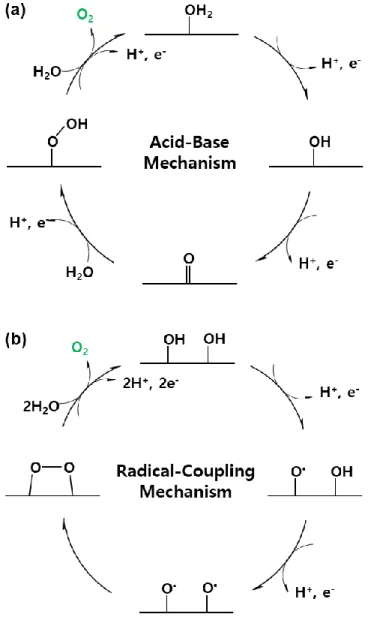
Most interesting issue in water splitting is how O-O bond formation occur during the reaction. Typically, two types of mechanisms are reported for the O-O bond, that is Acid-Base mechanism (AB mechanism) and Radical coupling mechanism (RC mechanism). In AB mechanism, water molecule in the bulk electrolyte attack the high valent oxo species to form M-OOH species. However, in RC mechanism, two oxo radical (M-O*) on the catalysts are involved in O-O bond
to form M-OO-M species. AB mechanism were regarded as energetically favor path way based on the DFT studies for various materials. For example, Liu and Fang reported that AB mechanism had lower energy barrier in high overpotential in RuO2.7
In addition to DFT calculation, experimental investigations of O-O bonding formation have been reported. For the cobalt oxide, Co(IV)-OOH intermediate was captured through time-resolved FTIR by Frei’s group.8 In his paper, he observed that there are two active pathways that one is fast cycle by dual Co edge site, and another is slow cycle by single Co site. The cooperative effect of adjacent electronically coupled Co(IV)=O sites was proposed, which is absent in the H2O addition reaction at the slow site. However, For the cobalt phosphate catalyst known as amorphous cobalt oxide nanoparticle, radical coupling between the cobalt(III) oxo radical was proposed by Nocera’s group through 18O isotope experiment.9 Moreover, recent DFT studies by Wang and his co-workers, oxo hopping mechanism was proposed.10 In this mechanism, Co(IV)=O species on the surface of catalyst are hopping by redox reaction with neighboring Co(III)-OH. Through the calculation, they reported O-O bonding formation by nucleophilic attack of water molecules are favor energetically then radical coupling mechanism.
Figure 1.1 Schematic representation of water oxidation mechanism (a) Acid-Base (AB) mechanism for O-O bond formation (b) Radical-Coupling (RC) mechanism for O-O bond formation.
1.2.3 ‘Design rule’ for artificial OER catalyst
Heterogeneous electrochemical reaction involves various complex phenomena, which makes rational design difficult. Therefore, many research has been conducted to identify and develop valid ‘descriptor’ which means key parameter that is principally responsible for the catalytic activity.
Reported thermodynamic and kinetic ‘descriptors’ were summarized in this chapter.
In the DFT calculation study, Norkov, Rossmeisl and co-works suggested the origins of the overpotential of OER.11 First, binding energy between catalytic active site and reaction intermediates (*O, *OH and *OOH) is parameters for gibbs energy of intermediate species. Thermodynamic energy barrier is calculated by difference between reaction intermediates and the reaction step having highest energy barrier becomes the RDS. Interestingly, the binding energy with O, OH, and OOH for various metal and metal oxide catalyst has linear dependency where EOOH
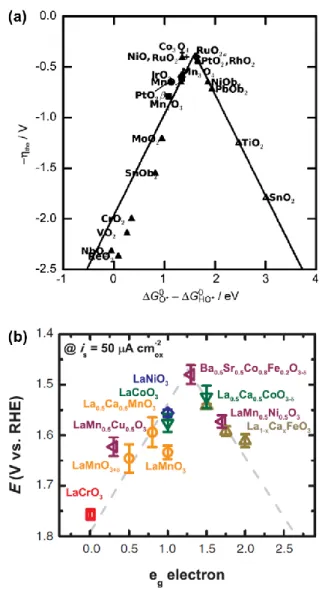
vs. EO and EOH vs. EO have slopes close to 0.5.12 It means that the catalyst having high binding affinity with *OOH, also bind strongly with *O or *OH. As shown in Figure 1.2a, the volcano plot for catalytic activities were presented and proposed that materials having proper binding energy with intermediates are highly active for OER.13
In addition to binding energy, Yang Shao-Horn and co-worker suggested the eg occupancy as descriptor for OER.14 Their approach was based on the molecular orbital boding framework. They reported that the binding with oxygen related intermediate species was highly affected by the occupancy of eg orbital. The reason was that the eg orbital of surface transition metal ions participates in σ-bonding with a surface-anion adsorbate. In Figure 1.2b, volcano shaped plot can be also shown according to the electronic density of eg electron, and the materials having proper eg
electron occupancy showed superior activities for OER.
Recently, however, Over and many scientists insisted that thermodynamically defined overpotential has limitation for anticipating catalytic activities.15 In his study, Over showed the potential determined step is not always equal with rate determined step, and presented DFT calculation results more matched with experimental results. However, considering kinetic parameters such as transition state or solvent effect is still challenging.
Figure 1.2 Volcano plots between catalytic activities and proposed descriptors. (a) Activity trends towards oxygen evolution. The negative values of theoretical overpotential were plotted against the standard free energy of ΔGHO*-ΔGO* step.13 (b) The relation between the OER catalytic activity and the occupancy of the eg- symmetry electron of the transition metal (B in ABO3).14
1.3 Water Oxidation Enzyme in Nature: Photosystem II 1.3.1 Photosystem II (PS II) in biological system
Photosystem II (PS II) is water oxidation enzyme located in the thylakoid membranes of photosynthetic organisms. The overall structure of PS II is shown in Figure 1.2.16 Through a series of light induced electron transfer reactions, PS II oxidize water molecules to protons and molecular oxygen with redox-active tyrosine residue (Tyr161, Yz), oxidized by light absorption from P680 reaction center.
4 Yz + 2 H2O 4 Yz• + 4 H+ + O2
Like other enzymes in nature, PS II exhibits superior catalytic properties to artificial catalysts for oxygen evolution reaction. According to previous study, turnover frequency (TOF) value of PS II is around 50 O2 molecules per second at 60 mV overpotential.17 In order to develop artificial catalyst having properties close to PS II, fundamental challenge is to understand the mechanistic features of lowering energy barriers. In this section, we will discuss the entropic effect on the unprecedented efficiency of water oxidation catalysis.
1.3.2 Oxygen evolving complex (OEC) in PS II
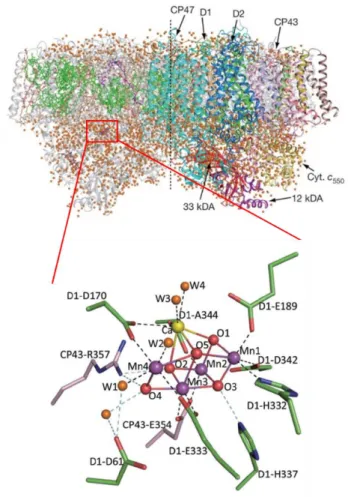
Active site of water oxidation in PS II is oxygen evolving complex composed of a Mn4CaO5 inorganic cluster ligated by waters and amino-acid side chains. In 2011, the structure of Mn4Ca cluster in S1 state successfully resolved at a resolution of 1.9 Å through X-ray diffraction technique.16 As shown in Figure 1.3, Mn4CaO5 cluster reveal distorted cubane Mn3CaO4 with dangling forth Mn and fifth O (O5). In the Mn3CaO4 cubane, O5 has longer bond length with Mn4, Mn3, Mn1 and Ca ion. In addition, four water molecules are coordinated in Mn4CaO5 cluster.
Two water molecules (W1, W2) are associated with dangling Mn4 with bond length of 2.1-2.2 Å and other two water molecules (W3, W4) coordinated to Ca in the cubane structure. Two of these water molecules may participate in the water oxidation as water substrates.
Mn4Ca cluster is surrounded by various amino-acid residues. In the first coordination sphere, amino-acid residues such as D1-G189 and D1-Asp170 directly ligated with Mn4Ca cluster. These structure may have important effect in the water oxidation mechanisms and O-O bond formation. In the distance further from Mn4Ca cluster than first coordination sphere, several amino-acids are located in the second coordination sphere and they play an important role in maintaining structure and forming hydrogen-bond networks in OEC which are crucial part in OER activities.20 Tyrosine residue (D1-Tyr161 or Yz) located between the Mn4Ca cluster and PS II
reaction centre mediates electron transfer between two species.
There are two Cl ion in the vicinity of the Mn4Ca cluster. These two Cl- surrounded by two water molecules, amino-acid and backbone nitrogen are presumed that they function to maintain the coordination environment of Mn4Ca cluster.20 As well as structural roles, considering Cl ion are involved in hydrogen- bond with a surrounding water and proteins, they may participate in transferring proton out or water into the Mn4Ca cluster. The roles of hydrogen-bond network and channels in OEC will be discussed in detail in the next section.
Figure 1.3 Overall structure of PS II at a resolution of 1.9 Å and structure of OEC involving the Mn4Ca cluster and surrounding proteins.
1.3.3 Hydrogen-bond network and protein channel in PS II
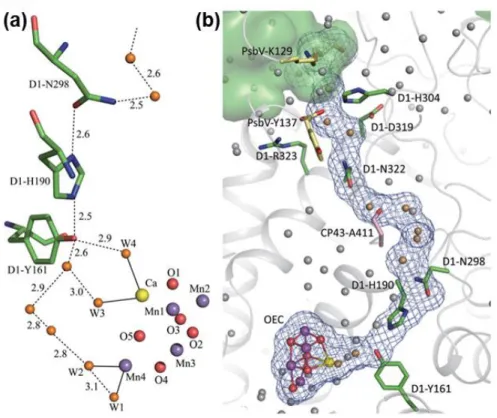
Hydrogen-bond networks in second shell protein around OEC (Figure 1.4) is important because they play a key role in transporting substrate water, protons and release O2 out of OEC.22 There are a lot of voids between protein structure in PS II, and these were proposed as water and O2 channels. However, it was revealed that most of these voids are impermeable to water having energy barrier of ~22 kcal/mol in water transport through molecular dynamic.23
These day, only three possible water channels were reported as shown in Figure 1.5. The Asp61 channel, also called narrow channel, is connected from D1- Asp61 to the O4 bridge of the Mn4Ca cluster with hydrogen-bonds. The W1 ligand of Mn4 is regarded as associated with this channel, and Pantazis, Cox and co-workers reported that water molecules are inserted to Mn4 in S2-S3 transition.22,24 On the other side of D1-Asp61, another channel passes the vicinity of Mn4 and proximal Cl-, so called Cl- channel or broad channel. Proton is transferred through this channel in deprotonation step in S2-S3 transition. In this step, D1-Asp61 acts as the proton acceptor. Last channel is Ca2+ channel, also known as large channel, involving Ca bound water (W3, W4) and vicinity of the O1 bridge. Considering these site of OEC has hydrophobic nature and Ca2+ may facilitate the release of O2 molecules, Ca2+
channel is proposed to be responsible for O2 release as well as water substrate delivery.23 Calculated energy barriers for water transport are 9 kcal/mol, 12 kcal/mol
and 10 kcal/mol for each channel.
Through H/D or 18O isotope experiments and protein mutant experiments, the role of hydrogen-bond networks in water channels is reported to be important in water substrate exchange. According to H/D isotope experiments, the rate of exchange of two water substrate is highly reduced, which means that hydrogen bonding is important for the movement of water molecules.25 However, the degree of rate reduction is different between two water substrate, which means that two water molecules are transported by different mechanisms or by different channels.
The importance of hydrogen-bond networks was also reported through protein mutant experiments. PS II containing mutation of amino acid residue belonging to the water channels shows slow kinetics for water exchange. In mutation of D1- Asp61N that Aspartic acid (Asp) amino acid in D1 protein exchanged to asparagine (Asn), water exchange rate is slow down by 3 and 6.5 times,26 respectively, which means hydrogen-bond networks contribute to water oxidation kinetics critically.
Figure 1.4 Hydrogen-bond networks surrounding OEC. (a) H-bond around Yz.
Solid line depicts the bond between metal and water molecules, and H-bonds are represented as dashed lines. (b) H-bond networks from Mn4Ca cluster to luminal bulk phase.
Figure 1.5 Proposed water channels and surrounding amino-acid residues. Circled Asp61, Val185 and Ca2+ in Mn4Ca cluster play central roles to make entropic contribution favorable.
1.3.4 Entropic contribution to water oxidation in PS II
Distorted cubane structure of Mn4Ca cluster and hydrogen-bond networks surrounding the cluster are characteristics of biological catalyst which have superior catalytic performance for oxygen evolving compared with artificial catalysts. In order to mimic Mn4Ca cluster and its performance, fundamental challenge is to understand the catalytic mechanism specifically and investigate the roles of atomic components and coordinated amino-acid residue. Although it is hard to probe intermediates, especially in S3 – S0 transition, due to the too short halftimes of these state, development of time-resolved techniques gives some clues in understanding mechanism. Also, through mutant PS II where specific site was exchanged, the roles of components on the catalytic activities have been revealed. According to these studies, it has been known that OEC has an entropy-favorable structural and mechanistic characteristic.
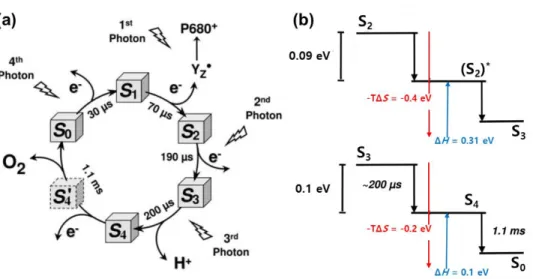
The kok cycle for water oxidation and gibbs free energy of formation intermediate are shown in Figure 1.6.27 Dau and co-worker monitored redox state and structural change in metal centers of Mn4Ca cluster in real time with 10-ms resolution through time-resolved X-ray absorption spectroscopy (XAS).27 In this study, they found that S4 state was formed without changing oxidation state of Mn and Yz. They also showed that gibbs energy of S4 formation is pH dependent and effected by H2O/D2O isotope exchange. Considering these finding, they reported that
ambiguous S4 state is formed by deprotonation ration before O-O bond formation.
Importantly, formation of S4 state is entropy-driven (ΔG=-0.1 eV, ΔH=+0.1 eV, - TΔS=-0.2 eV), which supports the proton release into the bulk-phase water.
In the ambiguous of mechanistic understanding about S3 – S0 state, Ca2+ in the Mn4Ca cluster, D1-Asp61, and D1-Val185 in second shell proteins are reveal to contribute reaction kinetic severely by mutation experiments. As shown in Figure 1.7, mutant PS II which contains i) Ca2+ was exchanged to Sr2+ (Sr-PS II), ii) Asp in D1-Asp61 was exchanged to Asn (D1-D61N), and iii) Val in D1-Val185 was exchanged to Asn (D1-V185N) exhibits slow kinetics of oxygen evolving after injecting third flash. Reaction mechanism for S3 – S0 transition is presented in Figure 1.7. After proton release during the S3+Yz* S3Yz* transition, O-O bond is formed and dioxygen is released from cluster. For the Sr-PS II, D1-D61N and D1-V185N, half time of both lag phase and slow phase got longer that wild type PS II (WT-PS II). Through the temperature dependent kinetic studies, Baussac and co-workers reported that Sr-PS II showed highly unfavorable activation entropy (TΔ‡S) for both phase, while enthalpy of activation (Δ‡H) for both phase were similar with WT-PS II.25 Considering Ca/Sr exchange hardly affects the structure of Mn4Ca cluster in the S0, S1, S2 and S3 states, and the Ca/Sr has similar enthalpies for water dissociation whereas Sr has significantly lower entropic term that Ca, they insisted Ca2+
determines the entropic contribution in S3 – S0 transition associated with reorientation of water molecule bound to Ca. Furthermore, Nilsson et al. suggested that highly ordered intermediate could be formed in WT-PS II before O-O bond
formation step compared to Sr-PS II, which supported the favorable entropic contribution of Ca-PS II.28 In addition to Ca ion, it was revealed that D1-Asp61 and D1-V185 also play a role to make entropy favorable. Burnap and co-worker reported that the kinetic slowdown of mutant PS II (D1-D61N and D1-V175N) stemmed from highly negative entropy of activation.21 Mutants PS II could not form the optimal configuration at transition state, so required high entropic energy barrier. Because Asp and Val are associated with water and proton channels and they suggested these negative entropies may be attribute to the impeded reorganization of OEC during water exchange or deprotonation step.
Figure 1.6 The entropic contribution in formation of intermediate species during S2 – S3, and S3 – S0 transition. (a) The kok cycle of photosynthetic oxygen evolution.
(b) Energetic schemes for S2 – S3, and S3 – S0 transition.
Figure 1.7 Increase of energy barrier for mutant PSII due to the unfavorable entropic contribution. Substitution of Ca2+ to Sr2+ induces the decrease activation entropy (T Δ‡S) by disturbing the formation of ordered transition state prior to O-O bond
formation. Two amino-acid residues (Asp61 and Val185) consist of water channel, and substitution of Asp to Asn (D61A) and Val to Asn (V185N) also induce the decrease of TćS.
1.4 Enzyme Catalysis in Nature
In nature, all of the various biochemical reactions which occur in biological system including animals, plants, and microorganisms are regulated by enzymes.
Enzymes are the catalysts that lower the activation energy barrier of reactions, thereby crucially enhance the rate of reactions in mild condition of cells. They are composed of proteins or catalytic RNA. Comparing with the classical artificial catalysts, enzymes have several advantages. First, reaction kinetics with enzymes is much faster than with catalysts, even in the mild reaction condition of temperature, pressure, pH, or electric potential. Moreover, enzyme reaction shows high selectivity, because each enzymes has their specific substrate for binding. Through this binding site, reaction rate also can be controlled by inhibitor that impede the binding between substrates and enzymes.
For development of the highly active and selective catalyst, fundamental challenges are identifying the key factors which contribute to the enzyme kinetics and mechanism. Here, we discuss about the origins of fast kinetics based on the entropic contribution in enzyme reaction.
1.4.1 Favorable entropic contribution of enzyme catalysis
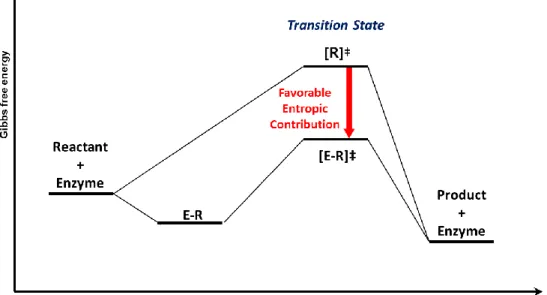
The origin of the fast kinetics in the enzymatic reaction has long been a major interest in chemical society, and was found to be associated with favorable activation entropy (TΔ‡S) by several causes.29 Figure 1.8 shows the free energy diagram for enzyme reaction and importance of entropic contribution is represented in Table 1.1. At first, it was reported that enzyme – substrate (E-S) binding makes entropic contribution (TΔ‡S) favorable to reaction kinetics, because vibrational entropy needed to overcome transition state may already be paid when substrates are frozen by enzymes.30 This hypothesis, known as Circe effect, has been supported by lots of experimental results. Wolfenden and co-workers showed that ribosome needs near zero entropy of activation (Δ‡S) for peptide bond formation reaction that is at least 13 kcal/mol lower than for the reaction in water.31 These favorable entropic contribution is sufficient to account for the 2 * 107-fold rate enhancement in ribosome catalysis
Besides the enzyme-substrate binding effict, it was proposed that hydrogen- bond network or pre-organized protein channels surrounding active site stabilize the activated complexes in transition state.34,35 In recent calculation study, it was reported that entropic cost for solvent reorganization was reduced in ribosome by hydrogen bond network.32 Also, Chen and co-workers reported that E3 ligase confers a large entropic effect to lower the energy barrier in protein modification.33 From the
experimental measurement, favorable activation entropy but unfavorable activation enthalpy was also observed. Based on molecular dynamic simulation, it was revealed that a number of bound water molecules were stabilized within the E3 ligase which results in favorable activation entropy during liberating water molecules at transition state.
In case of deamination of cytidine36 and hydrolysis of guanosine triphosphate (GTP)37, in which both activation enthalpy and entropy are reduced by enzyme (Table 1.1), the origin of entropic contribution was proposed to change of reaction mechanisms with lower activation entropy. As a result of computational calculation for both reaction, it was reported that OH- attack mechanism could be involved on the enzyme reaction which intrinsically shows positive TćS, different with non-enzyme reaction. The charged intermediate states such as OH- can be stabilized in electrostatically pre-organized enzyme, and the speed of mechanism can be highly accelerated with positive entropic contribution.
Figure 1.8 Scheme which represents the entropic contribution in enzyme reaction. Favorable entropic contribution in enzyme reaction has been explained by two theories. First, required entropic energy barrier decrease due to the loss of vibrational entropy of substrate during the enzyme-substrate binding. In addition, transition state could be stabilized in enzyme by H-bond networks or pre-organized surrounding proteins.
Table 1.1 Measured activation energetic parameters for various enzyme reaction.
Gibbs energy of activation (Δ‡G) decreased by enzyme, and measured Δ‡H and Δ‡S showed it was derived from entropic contribution, not enthalpic contribution.
1.5 Artificial Electrocatalysts for Water Oxidation 1.5.1 Bioinspired Mn based Catalyst
There has been an attempt to synthesize efficient catalysts by applying lessons from the biological enzyme systems. In nature Photosystem II, oxygen evolving center (OEC) efficiently catalyze the OER under neutral condition with markedly higher turnover frequency. The OEC consists of an inorganic Mn4CaO5
cluster and its unique ligand environment (Figure 1.3). From the recent X-ray analysis, detailed structural information of Mn4CaO5 cluster was obtained.20 The cluster has low-symmetry structure containing a distorted cubane core of Mn3CaO4
with fourth Mn bridged through one oxygen of the cubane core. This Mn4CaO5
cluster undergoes successive changes in oxidation state and its geometry, taking part in a so-called Kok cycle (Figure 1.6).
One key lesson we could get from the biological system is that the distorted structure plays an important role in the stabilization of high valent Mn oxidation state and catalytic activity. For example, Driess group developed amorphous MnOX
nanoparticles whose local structure and oxidation state of Mn are similar to Mn4CaO5
cluster.38 Amorphized MnOX nanoparticles showed higher catalytic activity.
Moreover, Dismukes group made λ–MnO2 by removing Li ions from LiMn2O4, which structure is similar with that of Mn3CaO4 core of the cluster.39 Interestingly, λ–MnO2 showed catalytic activity whereas the parent LiMn2O4 was inactive.
Improved OER activity was also reported from Dau group by switching the voltage during the electrodeposition. From X-ray adsorption spectroscopy (XAS) analysis, they found active catalyst had a disordered Mn geometry and mix oxidation state of Mn (III/IV).40 In addition, many manganese-based heterogeneous OER catalysts have been reported inspired by the unique properties of OEC. In an effort to translate the principles of the biological OEC to synthetic heterogeneous manganese-oxide- based catalysts, our group also synthesized several manganese-based heterogeneous catalysts such as hydrated manganese (II) phosphate41, lithium manganese pyrophosphate42, and manganese oxide nanoparticles43. Through a series of experiments, we found that the stabilization of Mn (III) by the distorted geometric structure plays an important role in the OER activity. It has been shown that the lessons from biological Mn4CaO5 cluster can be successfully applied to synthetic heterogeneous OER electrocatalysts.
1.5.2 Computational entropic consideration in DFT study
In previous section, importance of entropic contribution was represented in biological water oxidation in PS II and various enzyme catalysis. Here, we explain how entropy is considered in synthetic catalysis. Computational results are suggested in this chapter, and experimental results will be summarized in next chapter.
In computational studies, the change in entropy (ΔS) is calculated using DFT calculations of the vibrational frequencies and standard tables for gas phase molecules. Calculated entropy of H2O and H2 molecules and reaction intermediates are summarized in Table 1.2.7, 10, 44-47 Entropy of H2O and H2 are considered from the thermodynamic data base, and in case of intermediate species, vibration entropy is mainly calculated or approximated to 0.
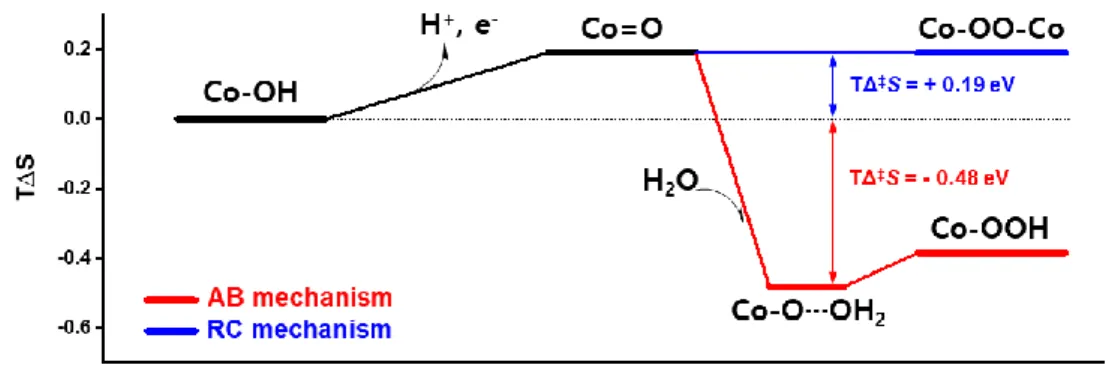
Considering these calculation results, we represented the entropy energy diagram within different O-O bonding formation mechanism in Figure. 1.9. In both radical coupling mechanism (RC mechanism) and acid-base mechanism (AB mechanism), entropy (S) increase in deprotonation step while one proton is released to bulk solution. After that, during O-O bond formation, there is severe difference in entropic contribution between two mechanisms. In RC mechanism, additional entropic energy barrier was not required in RDS where two oxo radicals form O-O bond. On the other hand, in AB mechanism, huge entropic energy is needed to form O-O bond. This is because during O-O bond formation by nucleophilic attack of water molecule, the degree of freedom of whole system highly decrease as much as the vibrational, rotational, and translational entropy of water molecule. As shown in Figure 1.9, entropic contribution (TćS) for AB mechanism was calculated to -0.48 eV, while RC mechanism has positive entropic contribution, TćS = + 0.19 eV.
Table 1.2 Reported TS (eV) from the DFT study for various materials (T=25ºC).
Figure 2.9 TΔS diagram based on the DFT calculation. Co-OH is initial state and Co=O is formed by deprotonation step. After that, O-O bond formation step is following through acid-base mechanism (AB mechanism) and radical coupling mechanism (RC mechanism). RC mechanism has positive entropic contribution due to the deprotonation step. On the other hand, highly negative activation entropy (TΔ‡S) is required in nucleophilic attack of H2O in O-O bond formation (T=25ºC).
1.5.3 Experimental measurement of entropy
Temperature dependent analysis to measure kinetic barrier have also been conducted in electrochemical heterogeneous and homogeneous catalysis. As shown in Table 1.3, in homogenous system, Gibbs energy of activation (Δ‡G) can be e by measured Δ‡H and Δ‡S. Moreover, reaction mechanisms can be also understood based on the entropic contribution to reaction kinetics. According to recent reports, highly negative entropic contribution (TΔ‡S = -0.61 eV at 25°C) was observed in O- O bond formation by nucleophilic attack of water molecules, while there was little entropic contribution in intermolecular O-O bond formation.
In contrast to molecular catalysis, in which detailed understanding has already been established, both description of activity trends and OER mechanism for heterogeneous system has not been yet fully validated based on experimental results.
In heterogeneous system, only activation energy (Ea), which is converted to activation enthalpy (ćH) by Ea = ćH + RT, has been measured and reported, due to the difficulties of measuring activation entropy (ćS). Although some reports tried to evaluate catalytic performance or identify OER mechanism based on activation enthalpy, these approaches had fundamental limitation that entropic contribution was excluded in estimating kinetic barrier (ćG = ćH - TćS). Therefore, without considering activation entropy, temperature dependent analysis is not necessarily able to unravel the precise nature of reaction kinetic and mechanism.
Table 1.3 Measured activation parameters (Δ‡H and Δ‡S) through temperature dependent kinetic analysis in heterogeneous and homogeneous catalyst systems (*T
= 25°C).
1.5.4 Transition state theory for electrochemical OER
In 1935, Henry Eyring developed the eyring equation to describe the chemical reaction rate depend on temperature based on transition state theory.63
𝑘 =𝑘𝐵𝑇
ℎ 𝑒𝑥𝑝 (−𝛥‡𝐺
𝑅𝑇 )
In this equation, rate constant (k) is determined by gibbs energy of activation (Δ‡G) which is energy barrier of reaction. In the chemical reaction, Δ‡G cannot be controlled unless reaction or enzyme is changed.
However, in electrochemical reaction, energy barrier can be controlled by electrode potential because electrochemical potential (μ) of reactant on the electrode can increase or decrease with electrode potential. Therefore, reaction kinetics of electrochemical half reaction can be described as below. Location of transition state is defined as symmetric factor (β), and η is E – E0.
𝑘+=𝑘𝐵𝑇
ℎ 𝑒𝑥𝑝 (−(𝛥‡𝐺0−𝛽𝜂𝐹)
𝑅𝑇 )
When reaction is composed of multi-step electron transfer steps, reaction kinetics depends on two factors.
i) Potential dependent energy barrier of electron transfer reaction in rate determining step (RDS). It is affected by symmetric factor (β) that is usually 0.5 for electron transfer reaction, 0 for chemical reaction.
ii) Potential dependent population of reactant in RDS which means equilibrium state of pre-RDS steps is changed by electrode potential.
Equilibrium state of electrochemical reaction is governed by Nernst equation.
𝐸 = 𝐸0− 𝑅𝑇
𝐹 ln (𝑎𝑅𝑒𝑑
𝑎𝑜𝑥)
Considering these two factor, reaction rate of multi-electron transfer reaction is described as below.
𝑘+=𝑘𝐵𝑇
ℎ 𝑒𝑥𝑝 (−(𝛥‡𝐺0−𝛼𝐸𝐹)
𝑅𝑇 )
α = np + nqβ
α is transfer coefficient where nq is the number of electrons transferred in RDS, and np is the number of electrons transferred prior to RDS. This equation is so-called Butler-Volmer equation.64
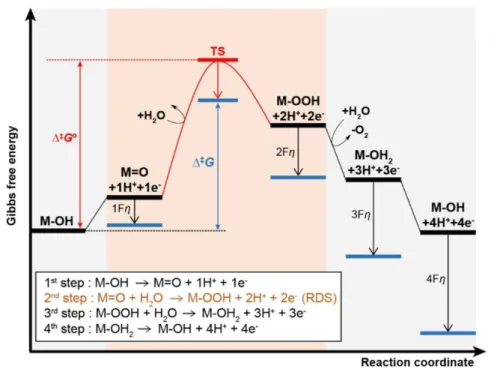
The free energy diagram of electrochemical oxygen evolution reaction is represented in Figure 1.10. In this diagram, reaction mechanism was considered to typical OER mechanism with 4 electron transfer steps and O-O bond formation as rate determined step (RDS). Initial state of electrode was assumed to M-OH, based on the previous reports for mechanistic studies in neutral condition.4 To consider the kinetic energy barrier, free energy of transition state (TS) of RDS was depicted. The reaction rate of OER is determined by kinetic energy barrier which is difference of
energy level between initial state (M-OH) and TS with highest free energy.
Under standard electrode potential (E°), reaction has kinetic energy barrier as high as standard Gibbs energy of activation (Δ‡G°), and it decrease gradually in proportion to transfer coefficient (α) as applying overpotential (η). In multi-step electron transfer reaction, transfer coefficient of oxidation reaction is defined as below (1) when np is the number of electrons transferred prior to RDS, nq is the number of electrons transferred in RDS, and β is symmetric factor for RDS. And, the electrochemical reaction rate is expressed by the Butler-Volmer equation (2). Δ‡G°- αFη represents the potential dependence of Gibbs energy of activation, and Γact is the number of active site.
𝛼 = 𝑛𝑝+ 𝑛𝑞𝛽 (1)
𝑖 = 𝑛𝐹𝑘𝐵𝑇
ℎ 𝛤𝑎𝑐𝑡𝑒𝑥𝑝 (−𝛥‡𝐺𝑜
𝑅𝑇 ) 𝑒𝑥𝑝 (𝛼𝐹𝜂
𝑅𝑇) (2)
Several kinetic parameters can be measured based on the temperature dependent kinetics of the Butler-Volmer equation (3). In the Eyring plot as shown in Figure 1.11, the linear slope and y-intercept have kinetic meaning related to Δ‡H and Δ‡S. As described in (4), potential dependent activation enthalpy (Δ‡H) could be measured in Eyring plot, and the slope of Eyring plot gradually decrease with increasing overpotential (η1 < η2).
𝑙𝑛 (𝑖
𝑇) = −𝛥‡𝐻𝑜
𝑅𝑇 +𝛼𝐹𝜂
𝑅𝑇 +𝛥‡𝑆
𝑅 + 𝑙𝑛 (𝑛𝐹𝑘𝐵
ℎ 𝛤𝑎𝑐𝑡) (3)
𝑠𝑙𝑜𝑝𝑒 =𝛥‡𝐻𝑜−𝛼𝐹𝜂
𝑅 =𝛥‡𝐻
𝑅 (4)
𝑦 − 𝑖𝑛𝑡𝑒𝑟𝑐𝑒𝑝𝑡 =𝛥‡𝑆
𝑅 + 𝑙𝑛 (𝑛𝐹𝑘𝐵
ℎ 𝛤𝑎𝑐𝑡) (5)
However, several kinetics parameters such as the number of active site (Γact) or Gibbs energy of activation (Δ‡G) should be known, in order to obtain the activation entropy through (5) or (6). In molecular catalysis where most of catalytic centers are dispersed in electrolyte, evaluation of Γact or Δ‡G is straightforward.
However, the presence of a non-active bulk phase in heterogeneous catalysts makes the investigation of kinetic parameters (Γact or Δ‡G) challenging, which result in hardness of measuring activation entropy (Δ‡S) experimentally.
𝛥‡𝐺 = 𝛥‡𝐻 − 𝑇𝛥‡𝑆 (6)
Recently, Bard group proposed the methodology to measure the rate constant (k) and the number of active site (Γact) for heterogeneous electrochemical reaction via surface interrogation scanning electrochemical microscopy (SI-SECM).
In this paper, kinetic parameters for Co-Pi was investigated and it was reported that 11 Co site/nm2 are involved as active site in Co-Pi film, and rate constant for OER as 1.2 s-1 - 3.2 s-1 at 0.41 V overpotential. Gibbs energy of activation (Δ‡G) can be calculated to 0.75 eV - 0.73 eV based on Eyring equation (7). From these advanced time-resolved surface titration method, it become possible to measure the activation entropy of Co-Pi film in heterogeneous OER. In this paper, based on the reported two kinetic parameters for Co-Pi (k, Γact), we calculated the entropy of activation
(Δ‡S) for OER on Co-Pi through temperature dependent analysis.
𝑘 =𝑘𝐵𝑇
ℎ 𝑒𝑥𝑝 (−𝛥‡𝐺
𝑅𝑇 ) (7)
Figure 1.10 Free energy diagram of typical electrochemical oxygen evolution reaction. It is assumed that reaction is proceeded by acid-base mechanism, and O-O bond formation step is rate determining step (RDS). The experimentally measured activation parameters are the difference of energy state between initial state and transition state of RDS. Red bar and black bars represent the free energy of activated species in RDS, and free energy of intermediate species at standard electrode potential (E°), respectively. Blue bars represent the free energy of intermediates when overpotential (η) is applied.
1.6 Objective of the Thesis
For the decades, people tried to develop the OER catalysts with characteristics close to PS II having TOF around 50 O2 molecules per second at 60 mV overpotential.
However, k0 of iridium oxide, which is reported to have the best properties among the artificial catalysts, is far below that PS II.65 Considering these novel metal based catalysts such as iridium oxide or ruthenium oxide are located near the top of the volcano plot, breakthrough other than the previously reported descriptor, which is based on the enthalpic contribution, is needed.
Indeed, the superior kinetic of enzymes in nature, including PS II, is contributed from the entropic effect. From now on, many researchers reported the activation energy parameters in molecular catalysis through temperature dependent kinetic analysis. In heterogeneous electrochemical reaction, however, only few studies reported activation energy or enthalpy of activation, not activation entropy as shown in Table 1.3. These are result from the difficulties to measured temperature dependent kinetics for electrochemical reaction and to identify the number of active sites in heterogeneous reaction.
In this study, we have attempted to investigate the entropic contribution in heterogeneous electrochemical water oxidation reaction. Using temperature dependent Eyring plot, we successfully measured the kinetic energy barrier containing enthalpy and entropy of activation for Mn3O4 nanoparticles and Co-Pi
films. As a result, we confirmed that activation entropy contributes highly unfavorable to reaction kinetics. Based on the reported calculation entropy value, the origin of entropy effect was proposed to mechanistic effect that nucleophilic attack of water molecules during O-O bond formation.
Figure 1.11 Butler-Volmer equation and Eyring plot for electrochemical reaction.
(Δ‡G : Gibbs free energy of activation, Δ‡H : enthalpy of activation, Δ‡S : entropy of activation, α : transfer coefficient and Γact : the number of active site).
Table 1.4 Comparison of kinetic equation and energetic parameters which can be measured from temperature dependent analysis between Arrhenius and Eyring model.
Chapter 2. Experimental and Procedure
2.1 Preparation of catalysts 2.1.1 Materials
Manganese acetate dehydrate (Mn(CH3COO)3·2H2O,97%), Myristic acid (CH3(CH2)12COOH,≥99%), Octadecene (CH3(CH2)15CH=CH2, 90%), K2Ir(IV)Cl6
(99.99%), Na2HPO4-7H2O (ACS reagent, 98.0-102.0%) and NaH2PO4-2H2O (99.0%) were purchased from Sigma Aldrich and Co(NO3)2·6H2O (ACS, 98.0-102.0%) was purchased from Alfa Aesar. Decanol (CH3(CH2)9OH, ≥99%) was purchased from Tokyo Chemical Industry (TCI) and Toluene (C6H5CH3, 99.5%) and Acetone (CH₃COCH₃, 99.5%) were purchased from Daejung Chemical and Metals. All chemicals were used without additional purification. Fluorine doped Tin-Oxide coated glass (FTO, TEC-8) which has 15Ω/sq surface resistivity was obtained as precut by 1.0 cm × 1.5 cm glass pieces from Pilington Company.
2.1.2 Manganese oxide nanoparticles (Mn
3O
4NPs)
The manganese oxides nanoparticles were synthesized via hot injection method to