저작자표시-비영리-변경금지 2.0 대한민국 이용자는 아래의 조건을 따르는 경우에 한하여 자유롭게
l 이 저작물을 복제, 배포, 전송, 전시, 공연 및 방송할 수 있습니다. 다음과 같은 조건을 따라야 합니다:
l 귀하는, 이 저작물의 재이용이나 배포의 경우, 이 저작물에 적용된 이용허락조건 을 명확하게 나타내어야 합니다.
l 저작권자로부터 별도의 허가를 받으면 이러한 조건들은 적용되지 않습니다.
저작권법에 따른 이용자의 권리는 위의 내용에 의하여 영향을 받지 않습니다. 이것은 이용허락규약(Legal Code)을 이해하기 쉽게 요약한 것입니다.
Disclaimer
저작자표시. 귀하는 원저작자를 표시하여야 합니다.
비영리. 귀하는 이 저작물을 영리 목적으로 이용할 수 없습니다.
변경금지. 귀하는 이 저작물을 개작, 변형 또는 가공할 수 없습니다.
데이터사이언스석사 학위논문
Analysis of Tokenizers for Various Korean NLP Tasks
(한국어 자연어 처리를 위한 토크나이저에 대한 분석)
2023년 2월
서울대학교 대학원
데이터사이언스학과
이 소 람
Analysis of Tokenizers for Various Korean NLP Tasks
(한국어 자연어 처리를 위한 토크나이저에 대한 분석)
지도교수 이 재 진
이 논문을 데이터사이언스석사 학위논문으로 제출함
2022년 12월
서울대학교 대학원
데이터사이언스학과
이 소 람
이 소 람의 데이터사이언스석사 학위논문을 인준함
2032년 1월
위 원 장 이 승 근
(인)부 위 원 장 이 재 진
(인)위 원 이 준 석
(인)Abstract
Although there have been studies on Korean tokenizers intensively, there are not many studies that have reflected the grammatical characteristics of Korean, which is classified as an agglutinative language. In Korean, unlike inflectional languages such as English, where each word segment is a single word, a word segment is not a single word, but a combination of several words or a word and its corresponding grammatical elements. Therefore, it is unreasonable to use tokenizers developed based on English for Korean NLP (Natural Language Processing).
By comparing and analyzing 7 tokenizers (Mecab-ko, BPE, WordPiece, Unigram) that are currently mainly used in Korean NLP, we raise the ne- cessity for a new Korean tokenizer that reflects Korean grammatical charac- teristics. And we summarize the Korean grammar characteristics that a new tokenizer should reflect.
Key words: Tokenization, Word Segmentation Student Number: 2021-20066
Contents
Abstract i
1 Introduction 1
1.1 Purpose of Research . . . 2
2 Background and Related Work 3 2.1 Tokenizer . . . 3
2.2 GPT-2 . . . 4
2.3 Related Work . . . 5
3 Experiments 6 3.1 Dataset . . . 6
3.2 Tokenizer Training . . . 6
3.3 GPT Pretraining . . . 7
3.4 GPT Finetuning . . . 7
3.5 Results . . . 8
4 Conclusion 14 4.1 Analysis . . . 14
Abstract (in Korean) 18
Chapter 1 Introduction
Tokenization is a natural language preprocessing task that separates raw text into semantic units to make computers better understand natural language.
Tokenization is being studied in various ways, but most studies focus on English. Thus, applying it directly to languages such as Korean, Japanese, and Turkish with a different morphological structure from English is difficult.
Korean English
그는 매일 점심으로 샐러드를 먹는다.
He eatssalad for lunch every day.그는 어제 저녁에 피자를 먹었다.
He atepizza last night.Table 1.1: Inflected language v.s. agglutinative language
English is morphologically an inflected language, in which the form or ending of a word changes according to its grammatical characteristics in sen- tences. Unlike English, Korean is morphologically an agglutinative language, in which words are formed by combining smaller morphemes with different meanings or functions. It is possible to generate hundreds of different forms from a given root word.
For example, as shown in Table 1.1, different meanings of a word in Ko- rean are expressed by adding the present (‘-는다’) and past tense endings (‘-
었다’) after ‘먹’ that is a root and means to eat. On the other hand, in
English, the word ’eat’ changes to ’eats’ when it is a singular verb and to’ate’ when it is a past tense verb.
In the case of English, the unit of white space is one word, but in the
CHAPTER 1. INTRODUCTION
case of Korean, a tokenization technique is additionally required because a unit of white space is formed by combining suffixes or endings to stems. As the example in Table 1.1, in the case of ’점심으로(for lunch)’, in English, ’for lunch’ can be tokenized to ’for’ and ’lunch’ as a white space. On the other hand, in the case of Korean, it is necessary to separate even a single word
‘점심으로’ into ’점심’ and ’으로’.
1.1 Purpose of Research
Recently, subword tokenizers that are easy to learn, such as BPE or Unigram, and can be used regardless of a language type, are often used when train- ing Korean models. However, there are few studies on why such tokenizers should be used and whether better performance is guaranteed compared to existing morphological unit tokenization. So, we will analyze how each tok- enizer affects the Korean language model by pretraining the GPT-2 model for each tokenizer, which tokenizer is suitable for each task (MRC, sentiment analysis, sentence similarity).
Subword tokenizer has the advantage of being able to adjust the vocab size but has a limit that the result of tokenizing depends on the training data.
The morpheme tokenizer reflects the grammatical characteristics of Korean language well, but it cannot be used to encode the tokenization result as it is because the number of morphemes is too large. For example, Mecab- ko provides more than 2 million morphemes (containing 650,000 morphemes consisting only of Korean), so it is not suitable to use all of them for a lan- guage model. Finally, we will define what is needed to create a new tokenizer that compensates for the shortcomings of these two tokenizers.
Chapter 2
Background and Related Work
2.1 Tokenizer
2.1.1 BPE
Byte-Pair Encoding is a data compression algorithm, in NLP, it was first used as a tokenizer in Machine Translation[8]. The vocabulary list is created by finding a pair of consecutively most frequent characters and merging them into a single symbol. ‘Since the vocabulary list is created based on frequency, it does not reflect the characteristics of the language, and it can be applied to any language.
2.1.2 Unigram
In the case of Unigram, a probability-based language model is trained for tokenizers. By calculating the likelihood loss that occurs when each subword is removed from the corpus, the subwords that have the least influence are removed.
2.1.3 WordPiece
Wordpiece model is a subword tokenizer proposed in [1]. BPE merges based on frequency, whereas wordpiece model creates vocabulary by merging pairs by maximizing the likelihood of the language model.
CHAPTER 2. BACKGROUND AND RELATED WORK
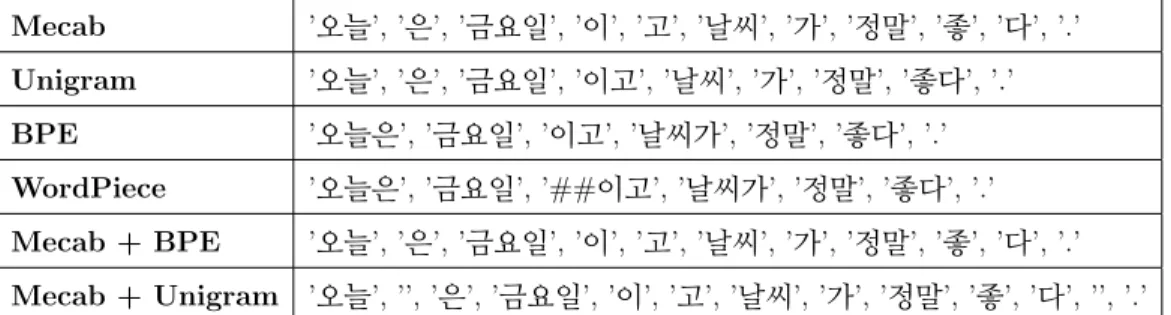
Sentence : ”오늘은 금요일이고날씨가정말 좋다.”
Vocabulary Size : 32000
Mecab ’오늘’, ’은’, ’금요일’, ’이’, ’고’, ’날씨’, ’가’, ’정말’, ’좋’, ’다’, ’.’
Unigram ’오늘’, ’은’, ’금요일’, ’이고’, ’날씨’, ’가’, ’정말’, ’좋다’, ’.’
BPE ’오늘은’, ’금요일’, ’이고’, ’날씨가’, ’정말’, ’좋다’, ’.’
WordPiece ’오늘은’, ’금요일’, ’##이고’, ’날씨가’, ’정말’, ’좋다’, ’.’
Mecab + BPE ’오늘’, ’은’, ’금요일’, ’이’, ’고’, ’날씨’, ’가’, ’정말’, ’좋’, ’다’, ’.’
Mecab + Unigram ’오늘’, ’’, ’은’, ’금요일’, ’이’, ’고’, ’날씨’, ’가’, ’정말’, ’좋’, ’다’, ’’, ’.’
Table 2.1: Tokenizer
별 문장
tokenizing예시
2.1.4 Mecab
It is a tokenizer[2] released as an open source in Japan and provides not only tokenizing but also pos(part-of-speech) tagging. Unlike the previous subword tokenizers, it tokenizes sentences in morpheme units. The tokenizer is trained using a conditional random fields (CRFs) model. Eunjeon released mecab-ko by adding a suitable function for Korean language characteristics, and it is the most commonly used among Korean morpheme tokenizers. Unlike the previous three subword tokenizers, the vocabulary size is not limited (basi- cally, the size of the provided vocabulary consisting only of Korean is about 650,000), and the vocabulary list can be managed by adding morphemes and corresponding part-of-speech information.
Table 2.1 is an example of tokenizing when the vocabulary size of the above tokenizers is 32000. In the case of Unigram, it can be seen that the stem and the ending are separated for all words, and in the case of BPE and WordPiece, the tokenizing results are the same.
2.2 GPT-2
GPT-2 [7] is a language model published by OpenAI and consists of only the decoder of the transformer model. It is trained by predicting the next word and is trained using a large dataset that is not oriented to a specific task. If GPT-1 [6] performed fine tuning with supervised learning for specific task data, GPT-2 has the characteristic of being able to perform downstream tasks with zero-shot.
CHAPTER 2. BACKGROUND AND RELATED WORK
2.3 Related Work
[4] analyzed how tokenizers of various units such as CV(consonant and vowel), syllables, morpheme, subwords, and words affect the Korean NLP task. The combination of subword and morpheme unit tokenizing showed the highest performance except for MRC. In Korean, when the morphological analysis is performed, words are sometimes transformed, such as ‘반가워요’→ ’반갑’+’
어요’. In [11], the morpheme prototype is restored by learning the Seq2Seq
model, and then the segmentation step is performed in units of morphemes.In [12], to create a rule-based Korean morpheme analyzer, types of Korean word segments were defined and a morpheme analysis rule system suitable for each type was defined. A word segment in Korean is composed of several words, or words and their corresponding grammatical elements. The combi- nation of ’noun’ + ’postposition’ is the most common, and ’verb’ + ’ending’,
’adverb’ + ’postposition’ combinations, etc.
Chapter 3 Experiments
3.1 Dataset
Three datasets are used for training the pretraining model. A total of about 15.7 GB of data set is used, including two dump files for Korean Wikipedia and Namu Wiki, and a crawled data set (7 GB). The sampled data above is also used to learn the subword tokenizer.
As the dataset for the downstream task, the KLUE dataset, and NSMC dataset are used. In the KLUE dataset, the NLI dataset that classifies the relationship between two sentences, the STS dataset that calculates the simi- larity between two sentences are used, and the Naver Sentiment Movie Corpus (NSMC) dataset is used to analyze the sentiment of movie reviews.
3.2 Tokenizer Training
A total of 7 tokenizers are compared to analyze the impact of tokenizers on each downstream task. Mecab-ko, a morpheme tokenizer, BPE, Word- Piece, and Unigram corresponding to subword tokenizers, and Mecab-ko and subword tokenizers mentioned above are used in combination as a morpheme- aware tokenizer in [4].
Huggingface’s Tokenizers library is used to train subword tokenizers. It is trained using a 4 GB dataset, and the vocab size is set to 32,000 and 64,000.
In the case of the morpheme tokenizer, when tokenizing the training data, vocabularies with the highest frequency of appearance are selected to create and use a vocab list, and tokens that did not belong to the vocab are treated
CHAPTER 3. EXPERIMENTS
as unknown tokens. Morpheme-aware tokenizer used subword tokenizer after pre-application of morpheme tokenizer as in [4].
3.3 GPT Pretraining
For each of the seven tokenizers, GPT-2 models are trained. The architecture of the GPT-2 small model is used. The number of layers is 12, the hidden layers of 768 dimensions, and the vocabulary size is 32,000 and 64,000. The hyperparameters of pretraining are as Table 3.1, and the training is conducted using Megatron-LM and 4 NVIDIA RTX 3090 GPUs.
Name Value
Num layer 12
Hidden size 768 Sequence length 512 Learning rate 1e-5
Vocab Size 32000, 64000
Table 3.1: Hyperparameters for GPT Training
3.4 GPT Finetuning
3.4.1 KLUE
KLUE Benchmark is the Korean version of GLUE, which is widely used in English NLP. According to [5], datasets for 8 tasks are included, and among them, in this paper, we use the KLUE-NLI dataset, which classifies the relationship between two sentences into three (entailment, contradiction, neutral), and the KLUE-STS dataset that predicts semantic similarity be- tween two sentences. The similarity is represented by a value between 1 and 5, and fine-tuning is performed to predict the similarity. For evaluation, if the similarity is greater than 3, it is labeled as 1, otherwise, it is labeled as 0.
CHAPTER 3. EXPERIMENTS
3.4.2 NSMC
NSMC (Naver Sentiment Movie Corpus) is a dataset that classifies whether a movie review is positive (1) or negative (0). There is a total of 200K data, and there are 100K data for each of the two classes.
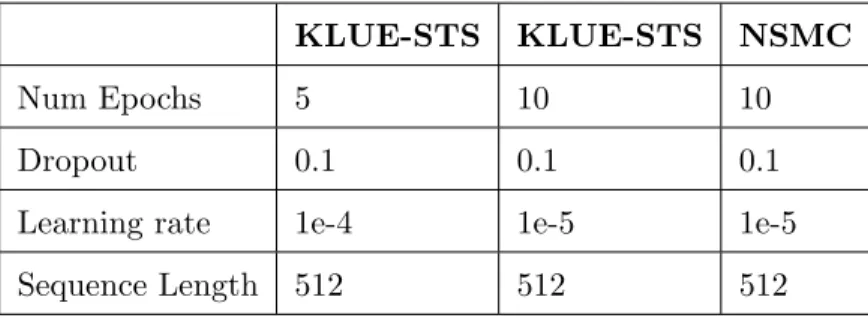
Finetuning is performed for each downstream task. NLI measures perfor- mance with accuracy as classification, STS measures performance based on f1-score, and NSMC uses accuracy. The hyperparameters for finetuning each task are set in Table 3.2.
KLUE-STS KLUE-STS NSMC
Num Epochs 5 10 10
Dropout 0.1 0.1 0.1
Learning rate 1e-4 1e-5 1e-5
Sequence Length 512 512 512
Table 3.2: Hyperparameters for fine-tuning
3.5 Results
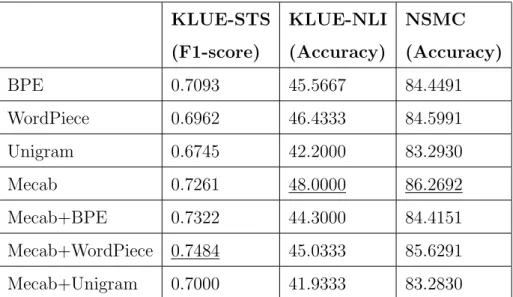
The performance of downstream tasks for each tokenizer is compared in Ta- ble 3.3 and Table 3.4.
In the KLUE-NLI and NSMC tasks, the highest accuracy is obtained when Mecab, a morpheme tokenizer, is used, and in the KLUE-STS task, the highest performance is obtained when Mecab-WordPiece tokenizer is applied.
Unigram tokenizer shows the lowest performance in all tasks, and in the case of the KLUE-STS task, the morpheme-aware subword tokenizers show better performance than the subword tokenizers.
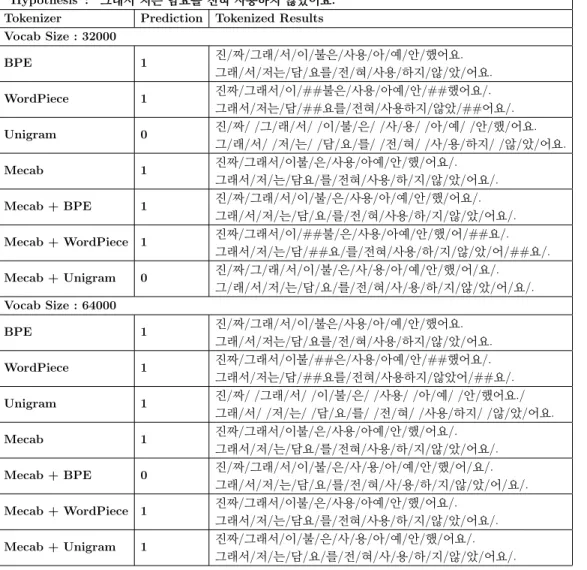
Table 3.5 shows the tokenization results and prediction results of the data sample of KLUE-STS, Table 3.6 of KLUE-NLI, and Table 3.7 of NSMC. In Table 3.5, the two sentences have similar meanings. For these two sentences to be predicted similarly, it is important that these tokens, which have similar meanings of ‘담요(blanket)’ and ‘이불(blanket)’, ‘전혀 (not at all)’ and ‘
아
예(not at all)’, and ‘안했어요(didn’t)’ and ‘않았어요(didn’t)’, are tokenized
CHAPTER 3. EXPERIMENTS
KLUE-STS (F1-score)
KLUE-NLI (Accuracy)
NSMC (Accuracy)
BPE 0.7093 45.5667 84.4491
WordPiece 0.6962 46.4333 84.5991
Unigram 0.6745 42.2000 83.2930
Mecab 0.7261 48.0000 86.2692
Mecab+BPE 0.7322 44.3000 84.4151
Mecab+WordPiece 0.7484 45.0333 85.6291
Mecab+Unigram 0.7000 41.9333 83.2830
Table 3.3: Results of Experiments in case of 32000 Vocabulary Size
KLUE-STS (F1-score)
KLUE-NLI (Accuracy)
NSMC (Accuracy)
BPE 0.7059 44.8333 85.3165
WordPiece 0.7536 47.7333 86.9451
Unigram 0.7417 45.0333 85.2925
Mecab 0.7484 46.4333 86.8550
Mecab+BPE 0.7111 42.5000 84.8978
Mecab+WordPiece 0.7541 48.7333 87.3137
Mecab+Unigram 0.6532 41.6000 83.9984
Table 3.4: Results of Experiments in case of 64000 Vocabulary Size
CHAPTER 3. EXPERIMENTS
well. WordPiece and Mecab, and the combination of Mecab and WordPiece, well tokenized ‘전혀(not at all)’ and ‘
아예(not at all)’, 안
(’not’) and않
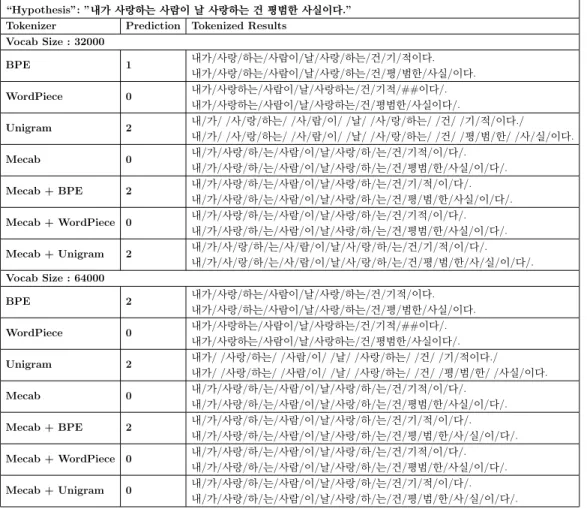
(’not’), which contain negative meanings.In Table 3.6, the two sentences have opposite meanings. For these two sentences to be classified as the opposite,
기적(’miracle’) and 평범(’ordinary’)
are key tokens, so it is important to tokenize them well. In the combination of WordPiece and Mecab and Mecab and WordPiece that correctly predicted, it can be seen that기적
(’miracle’ ) and평범
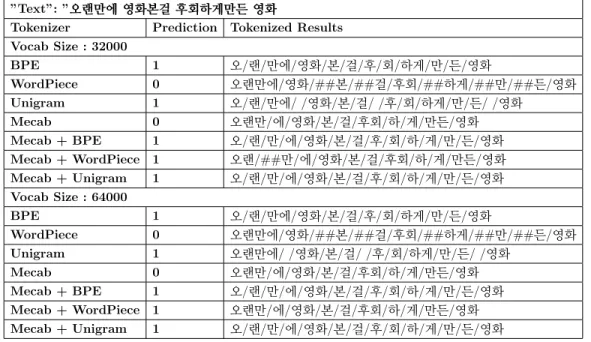
(’ordinary’) are included in the token.The previous two tasks compare two sentences, but in the case of sen- timent analysis, the relationship between tokens within a sentence or the meaning of the token itself is important. In Table 3.7, it can be seen that whether the word
후회(’regret’) with a negative meaning is well tokenized
affected the prediction results.CHAPTER 3. EXPERIMENTS
”Label” : 3.4 (1)
”Premise”: ”진짜그래서이불은사용아예안했어요.”
“Hypothesis”: ”그래서저는 담요를전혀사용하지않았어요.”
Tokenizer Prediction Tokenized Results Vocab Size : 32000
BPE 1 진/짜/그래/서/이/불은/사용/아/예/안/했어요.
그래/서/저는/담/요를/전/혀/사용/하지/않/았/어요.
WordPiece 1 진짜/그래서/이/##불은/사용/아예/안/##했어요/.
그래서/저는/담/##요를/전혀/사용하지/않았/##어요/.
Unigram 0 진/짜/ /그/래/서/ /이/불/은/ /사/용/ /아/예/ /안/했/어요.
그/래/서/ /저/는/ /담/요/를/ /전/혀/ /사/용/하지/ /않/았/어요.
Mecab 1 진짜/그래서/이불/은/사용/아예/안/했/어요/.
그래서/저/는/담요/를/전혀/사용/하/지/않/았/어요/.
Mecab + BPE 1 진/짜/그래/서/이/불/은/사용/아/예/안/했/어요/.
그래/서/저/는/담/요/를/전/혀/사용/하/지/않/았/어요/.
Mecab + WordPiece 1 진짜/그래서/이/##불/은/사용/아예/안/했/어/##요/.
그래서/저/는/담/##요/를/전혀/사용/하/지/않/았/어/##요/.
Mecab + Unigram 0 진/짜/그/래/서/이/불/은/사/용/아/예/안/했/어/요/.
그/래/서/저/는/담/요/를/전/혀/사/용/하/지/않/았/어/요/.
Vocab Size : 64000
BPE 1 진/짜/그래/서/이/불은/사용/아/예/안/했어요.
그래/서/저는/담/요를/전/혀/사용/하지/않/았/어요.
WordPiece 1 진짜/그래서/이불/##은/사용/아예/안/##했어요/.
그래서/저는/담/##요를/전혀/사용하지/않았어/##요/.
Unigram 1 진/짜/ /그래/서/ /이/불/은/ /사용/ /아/예/ /안/했어요./
그래/서/ /저/는/ /담/요/를/ /전/혀/ /사용/하지/ /않/았/어요.
Mecab 1 진짜/그래서/이불/은/사용/아예/안/했/어요/.
그래서/저/는/담요/를/전혀/사용/하/지/않/았/어요/.
Mecab + BPE 0 진/짜/그래/서/이/불/은/사/용/아/예/안/했/어/요/.
그래/서/저/는/담/요/를/전/혀/사/용/하/지/않/았/어/요/.
Mecab + WordPiece 1 진짜/그래서/이불/은/사용/아예/안/했/어요/.
그래서/저/는/담요/를/전혀/사용/하/지/않/았/어요/.
Mecab + Unigram 1 진짜/그래서/이/불/은/사/용/아/예/안/했/어요/.
그래서/저/는/담/요/를/전/혀/사/용/하/지/않/았/어요/.
Table 3.5: Tokenized Examples of KLUE-STS Task
CHAPTER 3. EXPERIMENTS
”Label” : Contradiction (0)
”Premise”: ”내가사랑하는사람이날사랑하는건기적이다.”
“Hypothesis”: ”내가사랑하는사람이날사랑하는건평범한사실이다.”
Tokenizer Prediction Tokenized Results Vocab Size : 32000
BPE 1 내가/사랑/하는/사람이/날/사랑/하는/건/기/적이다.
내가/사랑/하는/사람이/날/사랑/하는/건/평/범한/사실/이다.
WordPiece 0 내가/사랑하는/사람이/날/사랑하는/건/기적/##이다/.
내가/사랑하는/사람이/날/사랑하는/건/평범한/사실이다/.
Unigram 2 내/가/ /사/랑/하는/ /사/람/이/ /날/ /사/랑/하는/ /건/ /기/적/이다./
내/가/ /사/랑/하는/ /사/람/이/ /날/ /사/랑/하는/ /건/ /평/범/한/ /사/실/이다.
Mecab 0 내/가/사랑/하/는/사람/이/날/사랑/하/는/건/기적/이/다/.
내/가/사랑/하/는/사람/이/날/사랑/하/는/건/평범/한/사실/이/다/.
Mecab + BPE 2 내/가/사랑/하/는/사람/이/날/사랑/하/는/건/기/적/이/다/.
내/가/사랑/하/는/사람/이/날/사랑/하/는/건/평/범/한/사실/이/다/.
Mecab + WordPiece 0 내/가/사랑/하/는/사람/이/날/사랑/하/는/건/기적/이/다/.
내/가/사랑/하/는/사람/이/날/사랑/하/는/건/평범/한/사실/이/다/.
Mecab + Unigram 2 내/가/사/랑/하/는/사/람/이/날/사/랑/하/는/건/기/적/이/다/.
내/가/사/랑/하/는/사/람/이/날/사/랑/하/는/건/평/범/한/사/실/이/다/.
Vocab Size : 64000
BPE 2 내가/사랑/하는/사람이/날/사랑/하는/건/기적/이다.
내가/사랑/하는/사람이/날/사랑/하는/건/평/범한/사실/이다.
WordPiece 0 내가/사랑하는/사람이/날/사랑하는/건/기적/##이다/.
내가/사랑하는/사람이/날/사랑하는/건/평범한/사실이다/.
Unigram 2 내가/ /사랑/하는/ /사람/이/ /날/ /사랑/하는/ /건/ /기/적이다./
내가/ /사랑/하는/ /사람/이/ /날/ /사랑/하는/ /건/ /평/범/한/ /사실/이다.
Mecab 0 내/가/사랑/하/는/사람/이/날/사랑/하/는/건/기적/이/다/.
내/가/사랑/하/는/사람/이/날/사랑/하/는/건/평범/한/사실/이/다/.
Mecab + BPE 2 내/가/사랑/하/는/사람/이/날/사랑/하/는/건/기/적/이/다/.
내/가/사랑/하/는/사람/이/날/사랑/하/는/건/평/범/한/사/실/이/다/.
Mecab + WordPiece 0 내/가/사랑/하/는/사람/이/날/사랑/하/는/건/기적/이/다/.
내/가/사랑/하/는/사람/이/날/사랑/하/는/건/평범/한/사실/이/다/.
Mecab + Unigram 0 내/가/사랑/하/는/사람/이/날/사랑/하/는/건/기/적/이/다/.
내/가/사랑/하/는/사람/이/날/사랑/하/는/건/평/범/한/사/실/이/다/.
Table 3.6: Tokenized Examples of KLUE-NLI Task
CHAPTER 3. EXPERIMENTS
”Label” : 0 (Negative)
”Text”: ”오랜만에영화본걸후회하게만든영화
Tokenizer Prediction Tokenized Results Vocab Size : 32000
BPE 1 오/랜/만에/영화/본/걸/후/회/하게/만/든/영화
WordPiece 0 오랜만에/영화/##본/##걸/후회/##하게/##만/##든/영화
Unigram 1 오/랜/만에/ /영화/본/걸/ /후/회/하게/만/든/ /영화
Mecab 0 오랜만/에/영화/본/걸/후회/하/게/만든/영화
Mecab + BPE 1 오/랜/만/에/영화/본/걸/후/회/하/게/만/든/영화
Mecab + WordPiece 1 오랜/##만/에/영화/본/걸/후회/하/게/만든/영화 Mecab + Unigram 1 오/랜/만/에/영화/본/걸/후/회/하/게/만/든/영화 Vocab Size : 64000
BPE 1 오/랜/만에/영화/본/걸/후/회/하게/만/든/영화
WordPiece 0 오랜만에/영화/##본/##걸/후회/##하게/##만/##든/영화
Unigram 1 오랜만에/ /영화/본/걸/ /후/회/하게/만/든/ /영화
Mecab 0 오랜만/에/영화/본/걸/후회/하/게/만든/영화
Mecab + BPE 1 오/랜/만/에/영화/본/걸/후/회/하/게/만/든/영화
Mecab + WordPiece 1 오랜만/에/영화/본/걸/후회/하/게/만든/영화 Mecab + Unigram 1 오/랜/만/에/영화/본/걸/후/회/하/게/만/든/영화
Table 3.7: Tokenized Examples of NSMC Task
Tokenizer Text :동대구·김천구미·신경주역에서 Text :동대구역,김천구미역,신주역을
BPE 동/대구/·김/천/구미/·/신경/주/역에서 동/대/구역/,/김/천/구미/역,/신/주/역을
WordPiece 동/##대구/·/김천/##구미/·/신경/##주/##역에서 동/##대구/##역/,/김천/##구미/##역/,/신주/##역을 Unigram 동/대/구/·/김/천/구/미/·/신경/주/역/에서 동/대/구역/,/ /김/천/구/미/역/,/ /신/주/역을
Mecab 동대구/·/김천구/미/·/신경주역/에서 동대구역/,/김천구/미역/,/신/주역
Mecab + BPE 동/대구/·/김/천/구/미/·/신경/주/역/에서 동/대/구역/,/김/천/구/미/역/,/신/주/역/을 Mecab + WordPiece 동/##대구/·/김천/##구/미/·/신경/##주/##역/에서 동/##대구/##역/,/김천/##구/미역/,/신/주역/을 Mecab + Unigram 동/대/구/·/김/천/구/미/·/신경/주/역/에서 동/대/구역/,/김/천/구/미/역/,/신/주/역/을
Table 3.8: Tokenized Examples of Sentences Containing Proper Nouns
Chapter 4 Conclusion
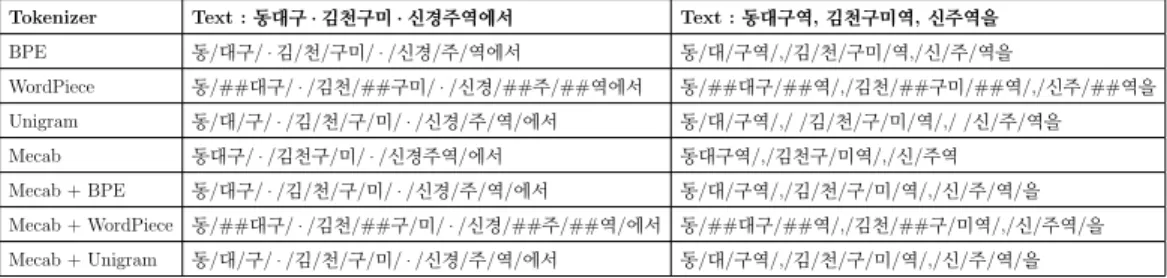
As a result of comparing experiments of various types of tokenizers, we ob- serve that Mecab, a morpheme tokenizer that reflects the grammatical char- acteristics of Korean, shows generally high performance for all tasks. In the case of subword tokenizers, they can not separate postpositions or endings in Korean well. However, even in the case of Mecab, as shown in Table 3.8, tokenizing does not work well when proper nouns or new words are included in the sentence.
It seems natural to expect that there would be a suitable tokenizer for each downstream task. However, we can check that tokenizers show similar performance with respect to types of tasks. A new Korean tokenizer has to separate things like postpositions and endings well and create a vocabulary list by adjusting the vocabulary size well so that one word is not tokenized into syllables.
4.1 Analysis
We analyzed existing tokenizers from two perspectives and derived limita- tions.
4.1.1 Grammatical
As Table 3.3, Table 3.4, the morpheme tokenizer generally shows good per- formance compared to other tokenizers. Especially when the vocabulary size is 32,000, better performance is shown when the subword tokenizer is not
CHAPTER 4. CONCLUSION
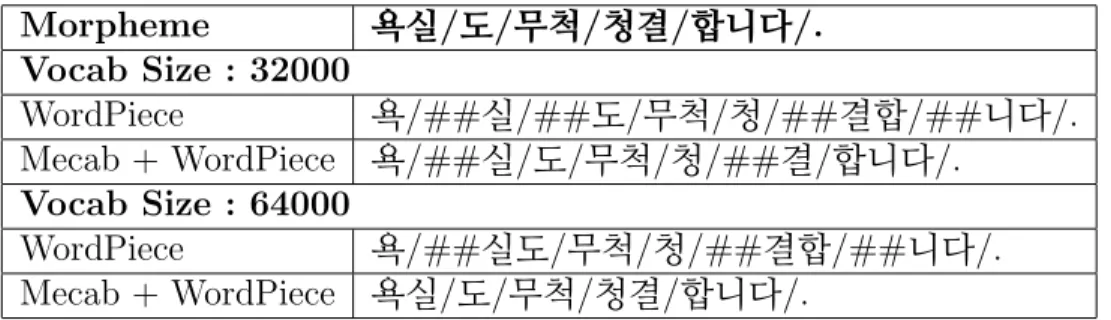
Morpheme
욕실/도/무척/청결/합니다/.
Vocab Size : 32000
WordPiece
욕/##실/##도/무척/청/##결합/##니다/.
Mecab + WordPiece
욕/##실/도/무척
/청
/##결/합니다/.Vocab Size : 64000
WordPiece
욕/##실도/무척/청/##결합/##니다/.
Mecab + WordPiece
욕실/도/무척/청결/합니다/.
Table 4.1: Examples of Tokenized Sentence
used alone. This supports the need for tokenizers to reflect grammatical fea- tures. When comparing the result of the morpheme tokenizer with subword tokenizers Table 4.1, grammatical elements such as postpositions and endings could not be properly separated. The words that should not be separated are tokenized, and tokens that are not related to the meaning of the sentence are tokenized. To reduce the division of words into syllable units (characters in the case of English), we experimented by increasing the vocabulary size to 64,000. When only the subword tokenizer is used, ’##실’ and ’도’ are combined instead of ’욕’ and ’##실’. On the other hand, when used with Mecab, tokenization is correctly performed in units of morpheme.
4.1.2 Systemmatical
In the case of the Mecab tokenizer, it has the advantage that it can be used without training. However, since the provided vocabulary size is too large, it is necessary to select the vocabulary list to use. In addition, words such as neologisms and proper nouns require additional training.
In order to overcome the limitations of the two points of view, the new Korean tokenizer needs to consider the following things:
• Separate grammatical elements using the morpheme tokenizer
• Define the finite list of grammatical elements to manage the vocabulary size
- Replace elements with similar meanings to one representative element
• Train a new tokenizer with the sentences where grammatical elements are removed
Bibliography
[1] Jacob Devlin, Ming-Wei Chang, Kenton Lee, and Kristina Toutanova.
BERT: Pre-training of deep bidirectional transformers for language un- derstanding. In Proceedings of the 2019 Conference of the North Amer- ican Chapter of the Association for Computational Linguistics: Human Language Technologies, Volume 1 (Long and Short Papers), pages 4171–
4186, Minneapolis, Minnesota, June 2019. Association for Computa- tional Linguistics.
[2] T. Kudo. Mecab : Yet another part-of-speech and morphological ana- lyzer. http://mecab.sourceforge.jp, 2006.
[3] Taku Kudo. Subword regularization: Improving neural network trans- lation models with multiple subword candidates. In Proceedings of the 56th Annual Meeting of the Association for Computational Linguistics (Volume 1: Long Papers), pages 66–75, Melbourne, Australia, July 2018.
Association for Computational Linguistics.
[4] Kyubyong Park, Joohong Lee, Seongbo Jang, and Dawoon Jung. An em- pirical study of tokenization strategies for various Korean NLP tasks. In Proceedings of the 1st Conference of the Asia-Pacific Chapter of the As- sociation for Computational Linguistics and the 10th International Joint Conference on Natural Language Processing, pages 133–142, Suzhou, China, December 2020. Association for Computational Linguistics.
[5] Sungjoon Park, Jihyung Moon, Sungdong Kim, Won-Ik Cho, Jiyoon Han, Jangwon Park, Chisung Song, Junseong Kim, Yongsook Song, Tae Hwan Oh, Joohong Lee, Juhyun Oh, Sungwon Lyu, Younghoon Jeong, Inkwon Lee, Sangwoo Seo, Dongjun Lee, Hyunwoo Kim, Myeonghwa Lee, Seongbo Jang, Seungwon Do, Sunkyoung Kim, Kyung- tae Lim, Jongwon Lee, Kyumin Park, Jamin Shin, Seonghyun Kim, Eun-
BIBLIOGRAPHY
jeong Lucy Park, Alice Oh, Jung-Woo Ha, and Kyunghyun Cho. KLUE:
korean language understanding evaluation. CoRR, abs/2105.09680, 2021.
[6] Alec Radford and Karthik Narasimhan. Improving language under- standing by generative pre-training. 2018.
[7] Alec Radford, Jeff Wu, Rewon Child, David Luan, Dario Amodei, and Ilya Sutskever. Language models are unsupervised multitask learners.
2019.
[8] Rico Sennrich, Barry Haddow, and Alexandra Birch. Neural machine translation of rare words with subword units. In Proceedings of the 54th Annual Meeting of the Association for Computational Linguistics (Volume 1: Long Papers), pages 1715–1725, Berlin, Germany, August 2016. Association for Computational Linguistics.
[9] Jooyoul Lee Seungyoung Lim, Myungji Kim. Korquad: Korean qa dataset for machine comprehension. The Korean Institute of Informa- tion Scientists and Engineers, pages 539–541, 2018.
[10] Yonghui Wu, Mike Schuster, Zhifeng Chen, Quoc V. Le, Mohammad Norouzi, Wolfgang Macherey, Maxim Krikun, Yuan Cao, Qin Gao, Klaus Macherey, Jeff Klingner, Apurva Shah, Melvin Johnson, Xiaobing Liu, Lukasz Kaiser, Stephan Gouws, Yoshikiyo Kato, Taku Kudo, Hideto Kazawa, Keith Stevens, George Kurian, Nishant Patil, Wei Wang, Cliff Young, Jason Smith, Jason Riesa, Alex Rudnick, Oriol Vinyals, Greg Corrado, Macduff Hughes, and Jeffrey Dean. Google’s neural machine translation system: Bridging the gap between human and machine trans- lation. CoRR, abs/1609.08144, 2016.
[11] Jun Young Youn and Jae Sung Lee. A deep learning-based two-steps pipeline model for korean morphological analysis and part-of-speech tag- ging. Journal of KIISE, 48(4):444–452, 2021.
[12] Lee Youngmyn. Grammatical strategy to develop a korean morpheme analyser. Journal of Korean Language Education, 2017.
국문초록
한국어 토크나이저에 관한 연구는 계속되어 왔지만, 한국어의 문법적 특성을 반영한 토크나이저에 대한 연구는 많지 않다. 한국어는 하나의 어절이 여러 개의 단어 혹은 단어와 그에 대응되는 문법적 요소들로 구성된 교착어의 특징 을 가지고 있다. 이는 하나의 어절이 하나의 단어로 구성되어 있고, 굴절어의 특징을 갖고 있는 영어와는 다르기 때문에 영어를 기반으로 개발된 토크나이 저들을 한국어 자연어 처리에 사용하는 것은 적합하지 않다. 본 논문에서는 한국어 자연어 처리에서 주로 사용되는
7개의토크나이저
(Mecab-ko, BPE, WordPiece, Unigram)들을 비교하고 분석한다. 분석 결과를 바탕으로 한국 어의 문법적 특성을 반영한 새로운 토크나이저의 필요성을 제안하고, 해당 토크나이저가 반영해야 할 요소들에 대하여 정리하였다.
주요어휘: 자연어처리, 토크나이저, 형태소분석기