저작자표시-비영리-변경금지 2.0 대한민국 이용자는 아래의 조건을 따르는 경우에 한하여 자유롭게
l 이 저작물을 복제, 배포, 전송, 전시, 공연 및 방송할 수 있습니다. 다음과 같은 조건을 따라야 합니다:
l 귀하는, 이 저작물의 재이용이나 배포의 경우, 이 저작물에 적용된 이용허락조건 을 명확하게 나타내어야 합니다.
l 저작권자로부터 별도의 허가를 받으면 이러한 조건들은 적용되지 않습니다.
저작권법에 따른 이용자의 권리는 위의 내용에 의하여 영향을 받지 않습니다. 이것은 이용허락규약(Legal Code)을 이해하기 쉽게 요약한 것입니다.
Disclaimer
저작자표시. 귀하는 원저작자를 표시하여야 합니다.
비영리. 귀하는 이 저작물을 영리 목적으로 이용할 수 없습니다.
변경금지. 귀하는 이 저작물을 개작, 변형 또는 가공할 수 없습니다.
의학석사 학위논문
Effect of Urinary Retention on Photoselective Laser Vaporization
Prostatectomy Outcome
요축적이 레이저 전립선기화술의 수술 후 성적에 미치는 영향
2013년 2월 서울대학교 대학원
임상의과학과
노 윤 관
의학석사 학위논문
Effect of Urinary Retention on Photoselective Laser Vaporization
Prostatectomy Outcome
요축적이 레이저 전립선기화술의 수술 후 성적에 미치는 영향
2013년 2월 서울대학교 대학원
임상의과학과
노 윤 관
Master’s Degree Thesis
요축적이 레이저 전립선기화술의 수술 후 성적에 미치는 영향
Effect of Urinary Retention on Photoselective Laser Vaporization
Prostatectomy Outcome
February 2013
Department of Clinical Medical Sciences, Graduate School
Seoul National University College of Medicine
Yun Kwan Ro
Effect of Urinary Retention on Photoselective Laser Vaporization
Prostatectomy Outcome
지도 교수 손 환 철
이 논문을 의학석사 학위논문으로 제출함 2012년 12월
서울대학교 대학원 임상의과학과, 비뇨기과 전공
노 윤 관
노윤관의 의학석사 학위논문을 인준함 2012년 12월
위 원 장 정 현 (인)
부위원장 손 환 철 (인)
위 원 정 우 영 (인)
i
Abstract
Introduction:
The objective of this study was to evaluate the effect of acute urinary retention (AUR) on the outcome of photoselective vaporization of the prostate (PVP) patients and to compare postoperative results between patients with and without preoperative retention.
Methods:
A total of 476 patients who underwent photoselective laser vaporization prostatectomy for voiding difficulty at a single center were included in this study.
Transrectal ultrasound (TRUS) and urodynamic studies (UDS), serum prostate specific antigen (PSA), maximum urine flow rate(Qmax), post void residue (PVR), voiding diary parameters, international prostatic symptom score (IPSS), uroflowmetry (UFM), were collected at baseline, 2 week, 1 month, 3 month, 6 month, 12 month and then annually up to 3 years postoperatively. Subjects were divided into AUR group and non-AUR group to analyze clinical parameters.
Results:
Mean total IPSS of the entire sample was 20±8.7 and mean Qmax 10.24±7.34 ml/sec. Mean PVR was 87.56±120.4ml. After 1 year postoperative follow-up, post- operative IPSS was reduced to 10.87±8.09 and mean Qmax increased to 16.3±20.01 ml/sec. A total of 91 patients had at least one episode of AUR. When comparing both groups, there were significant differences in age (mean 71.75±8.88 vs. 68.01±7.70 years), PSA (10.81±14.78 vs. 3.94±6.19 ng/ml), BMI (22.65±3.23 vs. 24.15±3.01), and prostate size (69.14±40.93 vs. 48.92±29.82 ml). UFM report in the first 2 weeks showed that the AUR group had lower Qmax (11.38±5.46 vs. 14.44±7.79 ml/sec) and higher PVR but on later follow-ups there was no significant difference.
On 1 year follow-up the total IPSS was 7.57±6.79 for the AUR group and
ii
11.42±8.17 for the NUR showing a more significant improvement in the AUR group (p=0.018). However, the AUR group had a risk of 4.6 times higher to have immediate postoperative retention than the NUR group.
Urodynamic data showed that only MUP (82.89±30.17 vs. 91.79±26.21), MCC (373±103.62 vs. 403.69±71.65), PdetQmax (58.75±22.52 vs. 49.13±25.82) and BOO index (45.50±23.68 vs. 32.54±27.97) had significant differences.
Conclusions:
Almost all patients had improvements in subjective and objective voiding parameters after PVP regardless of the presence of preoperative AUR but those with history of acute urinary retention have higher risk of having immediate postoperative voiding failure.
---
Keywords: Urinary retention, prostatectomy, Transurethral Resection of Prostate
Student Number: 2011-21980
iii
CONTENTS
Abstract………..…..…………..…..i
Contents………...……..………iii
List of tables and figures………...…….iv
Introduction………....….1
Material and Methods………...……2
Results……….…..………..3
Discussion………..…….……..…11
References………..…..….……14
Abstract in Korean………...….…17
iv
LIST OF TABLES AND FIGURES
Table 1 Preoperative patient’s characteristics…………..….…5 Table 2 Percentage of follow-up and mean IPSS ………….…6 Table 3 Urodynamic parameters by group………...….7
Figure 1 IPSS from preoperative to 3-year follow-up……....…9
Figure 2 Presence of postoperative retention…………...…….10
1
INTRODUCTION
Benign prostatic hyperplasia (BPH) is highly prevalent in elderly men and is the most common cause of lower urinary tract symptoms (LUTS) (1,2). BPH is also the most typical disorder that reduces the quality of life (QoL) in men (3). Urinary symptoms from BPH become more frequent with advanced age and about 80% of men in their 70s suffer from BPH-related LUTS (4). As Korea is fast becoming an aging society, the incidence of LUTS caused by BPH is expected to rise accordingly.
Acute urinary retention (AUR) is a serious and common complication of BPH that often requires painful emergency urinary drainage via catheterization directly affecting the QoL of patients. Long standing or repeated urinary retention can even potentially lead to the development of chronic renal failure (CRF) (5). Factors related to AUR include old age, urinary tract infections, low peak urinary flow rate and larger prostate volume (6). AUR is one of the indications for surgery with a reported 25-30%
of patients undergoing transurethral resection of the prostate being affected by it (7).
The objective of this study was to evaluate the effect of acute urinary retention (AUR) on the outcome of photoselective vaporization of the prostate (PVP) patients and to compare postoperative results between patients with and without preoperative voiding failure.
2
MATERIAL AND METHODS
Retrospectively, 481 men who presented with voiding difficulty and underwent photovaporization of the prostate (PVP) between January 2008 and July 2012 were analyzed. All operations were done by a single surgeon. The study protocol was approved by the Institutional Review Board at the Boramae Hospital (IRB #06-011- 189). The procedure in the present study complies with the Declaration of Helsinki (revised Edinburgh, 2000).
All procedures were performed using a 120W GreenLight HPS laser. Medical histories and physical exams were performed as well as preoperative evaluations such as transrectal ultrasound (TRUS) and multichannel video urodynamics (MMS UD- 2000, Medical Measurement System, Enscheded, The Netherlands). Age, serum PSA, IPSS, Qmax, PVR, voiding diary parameters, urodynamic parameters, and surgical methods were analyzed. Five patients with no postoperative follow up were excluded from this study leaving 476 patients to be analyzed. Data from IPSS, uroflowmetry, and PVR were collected 2 week, 1 month, 3 month, 6 month, 12 month and then annually up to 3 years postoperatively. In some cases, IPSS data was collected through telephone survey. Patients with follow-up visits of 3 months or less were excluded. Subjects were divided into AUR group and non-AUR group to analyze clinical parameters. A total of 33 patients were unable to void following decatheterization on the first postoperative day.
Variables were presented as mean ± standard deviation. All pre- and postoperative variables were analyzed for statistically significant differences using the independent t-test. To compare pre- and postoperative clinical parameters, ANOVA or a paired t- test was used. To evaluate predictors of response to treatment, logistic regression analysis was used. A p value of <0.05 was considered statistically significant, and
3
analyses were performed using the Statistical Package for the Social Sciences® 20.0 software (IBM, New York, NY, USA).
4
RESULTS
Of the 476 patients analyzed, a total of 91 (19.1%) patients had at least one episode of acute urinary retention before undergoing surgery. Mean age of the total sample was 68.65±8.58 years, mean PSA was 5.25±8.93ng/ml. Mean prostate volume measured by TRUS was 52.63±33.08ml. Mean total IPSS was 20±8.7 and mean Qmax 10.24±7.34ml/sec. Lastly, mean PVR was 87.56±120.4ml (Table 1). After 1 year follow-up, post-operative IPSS was reduced to 10.87±8.09 and mean Qmax increased to 16.3±20.01ml/sec. Mean PVR was 33.98±49.47ml. When comparing the AUR and NUR group, there were statistically significant differences in age (mean 71.75±8.88 vs.68.01±7.70 years), PSA (10.81±14.78 vs. 3.94±6.19ng/ml), BMI (22.65±3.23 vs. 24.15±3.01), and prostate size (69.14±40.93 vs. 48.92±29.82 ml), showing that the AUR group was older, had a higher PSA, lower BMI and bigger prostate. There were no significant differences in voiding diary parameters. It was also reported that the AUR group had longer operation (85.66±50.17 vs. 69.23±45.35 min) and lasing time (32.40±18.15 vs. 26.77±24.59 min). UFM report in the first 2 weeks of follow-up showed that the AUR group had lower Qmax (11.38±5.46 vs.
14.44±7.79 ml/sec) and higher PVR but on later follow-up there was no significant difference.
Overall, at 1 year follow-up 198 (41.59%) patients reported a mean IPSS of 10.92±8.08and 203 (42.64%) patients had a mean Qmax of 16.30±20.06 ml/sec. At 2- year follow-up the mean IPSS of 134 (28.15%) patients was 11.93±7.78 and mean Qmax in 100 (21%) patients was 15.16±14.35 ml/sec while at 3-yr follow-up mean IPSS of 122 (25.63%) patients was 14.07±8.90 and mean Qmax in 10 (2.1%) was 10.30±5.75. Follow-up proportion by group is shown on table 2.
On 1 year follow-up the total IPSS was 7.57±6.79 for the AUR and 11.42±8.17 for
5
the NUR showing a more significant improvement in the AUR group (p=0.018).
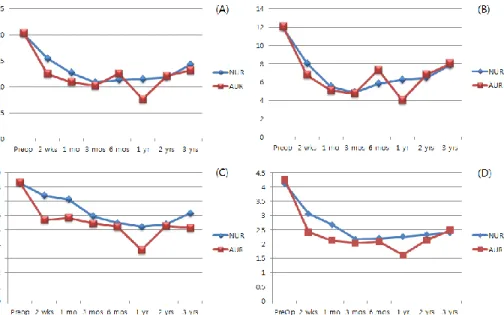
However, when matched for prostate size, there were no statistically significant differences between the AUR and NUR group in any of the IPSS results. Figure 1 shows changes, from baseline to 3-year follow-up, in total IPSS, also divided by voiding and storage symptoms score, and QOL.
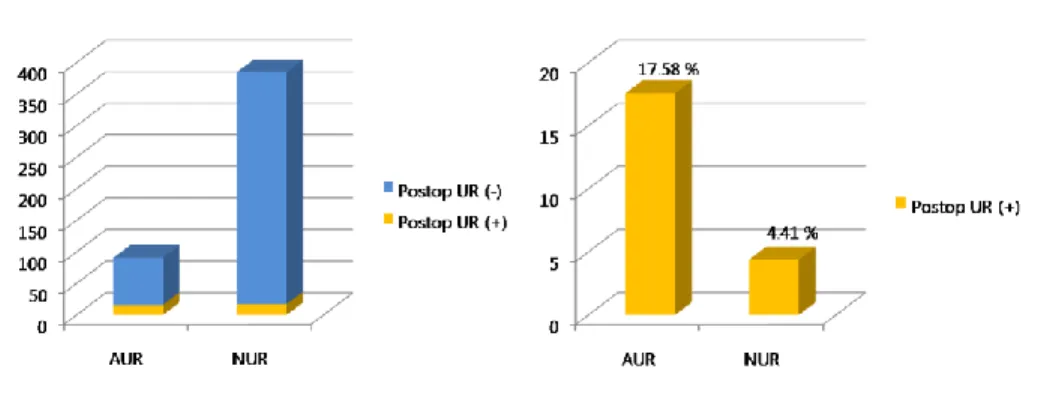
Lastly, of the 385 patients in the NUR group 17 (4.41%) presented with temporary voiding failure on the first postoperative day while 16 patients out of 91 (17.58%) patients of the AUR group had this complication. However, the AUR group had a risk of 4.6 times higher to have immediate postoperative voiding failure than the NUR group (Fig. 2). Additionally, when grouped according to prostate size (less than 60ml vs. 60ml or larger), there was no statistically significant difference in the rate of immediate postoperative voiding failure in both groups. (8.72 vs. 5.99% , p>0.05)
Of the 91 patients from the AUR group,8 (8.79%) were unable to complete urodynamic studies. When comparing the AUR group vs. that NUR group using the various parameters of the urodynamic studiesonly MUP (82.89±30.17 vs.
91.79±26.21, p=0.014), MCC (373±103.62 vs. 403.69±71.65, p=0.039), PdetQmax (58.75±22.52 vs. 49.13±25.82, p=0.011) and BOO index (45.50±23.68 vs.
32.54±27.97, p=0.002) showed statistically significant differences (Table 3).
6 Table 1. Preoperative patient’s characteristics
Total AUR group NUR group p value
Age 68.65±8.58 71.75±8.88 68.01±7.7 <0.05
PSA 5.25±8.93 10.81±14.78 3.94±6.19 <0.05
TRUS 52.63±33 69.14±40.93 48.92±29.82 <0.05
Total IPSS 20±8.7 19.85±10.67 20.20±8.21 0.913
Qmax 10.24±7.34 8.68±7.56 10.53±7.28 0.071
PVR 87.56±120.4 152.90±230.22 75.26±81 <0.05
PSA: prostate specific antigen, TRUS: transrectal ultrasound, IPSS: international prostate symptom score, Qmax: maximum flow, PVR: post void residue
7 Table 2. Percentage of follow-up and mean IPSS (in parentheses)
Preop 2 weeks 1 month 3 months 6 months 1 year 2 years 3 years
AUR 83
(20.33)
40 (12.43)
52 (10.90)
33 (10.18)
25 (12.52)
28 (7.57)
23 (12.09)
23 (13.13)
NUR 378
(20.19)
248 (15.43)
260 (12.63)
219 (10.81)
135 (11.29)
170 (11.47)
112 (11.84)
99 (14.29) Total [%] 461
[96.84]
288 [60.50]
312 [65.54]
252 [52.94]
160 [33.61]
198 [41.59]
135 [28.36]
122 [25.63]
8 Table 3. Urodynamic parameters by group
n Mean±SD p value
Qmax NUR 261 12.53 ± 36.76
0.542
AUR 33 8.61 ± 4.57
VV NUR 260 158.85 ± 118.31
0.428
AUR 33 141.54 ± 116.29
PVR NUR 291 56.02 ± 73.44
0.227
AUR 39 90.82 ± 174.91
MUP NUR 317 91.79 ± 26.21
0.014
AUR 68 82.89 ± 30.17
MCP NUR 320 85.60 ± 26.18
0.474
AUR 68 81.63 ± 43.91
FDV NUR 317 173.55 ± 82.62
0.755
AUR 66 169.95 ± 95.27
NDV NUR 314 253.48 ± 151.26
0.227
AUR 66 229.52 ± 118.92
SDV NUR 294 354.23 ± 92.17
0.002
AUR 53 310.25 ± 101.93
MCC NUR 242 403.69 ± 71.65
0.039
AUR 56 373.00 ± 103.62
PdetQmax NUR 309 49.13 ± 25.82v
0.011
AUR 53 58.75 ± 22.52
BOO NUR 299 32.54 ± 27.97
0.002
AUR 52 45.50 ± 23.68
Qmax: maximum flow, VV: voided volume, PVR: post void residue, MUP: maximum urethral pressure, MCP: maximum closure pressure, FDV: first desire to void, SDV: strong desire to void, MCC: maximum cystometric capacity, PdetQmax: detrusor pressure at maximum flow, BOO: bladder outlet obstruction
9
Figure 1.(A) Change in mean total IPSS from preoperative to 3-year follow-up; (B) Voiding symptoms score; (C) Storage symptoms score; (D) QoL.
10
Figure 2. Presence of postoperative voiding failure divided by AUR and NUR group.
11 DISCUSSION
Photovaporization of the prostate is one of the several treatments available for BPH.
Several studies have asserted the safety and efficacy of PVP with KTP laser (9-14) including on a population of Korean men. In 2005, Malek et al. (13) reported excellent clinical outcomes and the symptomatic and urodynamic improvements were sustained with a minimum necessity for re-intervention after a 5-year followup. In another 5-year followup study, Hai et al. (14) reported improvement in the IPSS, QoL score, Qmax, TRUS, and PVR. Our data showed improved in both the AUR and NUR group. Although there were some differences between the two groups in respect of age, PSA, BMI and prostate size, immediate and sustained improvement in IPSS, QoL, PVR and Qmax was reported.
At the second postoperative week the AUR group had significant lower Qmax and higher PVR on uroflowmetry but on consequent follow-up visits there were no significant differences. This possibly means that patients with preoperative retention require more time to recover. We recognize that this data might be biased since some of the uroflowmetry measurements were taken during episodes of retention or when the patients complained the most of voiding difficulty. This also includes measurements taken various months prior to surgery because some patients presented with acute retention after being routinely followed up, which means these patients had a Qmax and PVR non-consistent with AUR. Another interesting point in our study is that at 1-year follow-up the AUR group had better IPSS results than the NUR group, even though this difference was not seen after matching for prostate size.
Our study suggests that PVP is and efficient method for treating BPH regardless of the presence of AUR history as significant improvement in IPSS, QoL score, Qmax and PVR was seen in patients after operation. Jacobsen et al. (6) found a direct relationship between AUR and LUTS, old age, low Qmax and enlarged prostate. In
12
our study, the same parameters were found to be associated with the AUR group.
Furthermore, when the data was matched for prostate size, the same improvements on IPSS and Qmax was seen.
The hemostatic properties of the KTP laser is achieved thanks to the selective absorption of energy in vessels containing hemoglobin while minimal energy propagation through water. Since bleeding can be controlled more easily during operation, we can obtain a better visual field. The excellent clinical outcomes, low morbidity, technical simplicity, and cost-effectiveness of GreenLight laser photoselective vaporization have made this technology a valid and efficacious clinical alternative to TURP. (16) In our experience, patients undergoing PVP have low complication rates and 60% ofpatients maintained efficacy at 3 years postoperatively.
(19)
When we analyzed the preoperative urodynamic parameters, we found that the AUR group had lower MUP and MCC while having higher PdetQmax and BOO index. Although higher BOO index is somewhat expected to occur in patients with AUR, the lower MCC could be explained due to the fact that AUR patients who were unable to void did not complete the study and no data on bladder capacity was taken into account. Djavan et al. (18) suggested that the history of AUR and low maximal detrusor pressure were some of the factors accounting for high risk of treatment failure after TURP. However, since the detrusor may recover in some patients, the authors recommended TURP should be performed in this group even if preoperative urodynamics suggest an unfavorable outcome.Even though our study did not focus on treatment failure rate, only 3 patients with low maximal detrusor pressure (<28 cm of water) had postoperative voiding failure.
This study has several limitations. First, as a retrospective study based on electronic medical records, it is susceptible to bias and dependent on the integrity of the record keeping. Second, the data collected for this study did not include any complications besides post-operative voiding failure. We recognize the need to further evaluate other
13
risks that could be associated with the time of recovery after PVP in AUR patients.
Lastly, this study did not include the use of drugs such as alpha antagonists, alpha reductase inhibitors or anticholinergics. Such drugs might have had an impact on the presence of AUR in the first place and later in the post-operative phase. Further investigation on the impact that said drugs can have in this group of patients is warranted.
In conclusion, almost all patients had improvements in subjective and objective voiding parameters after undergoing HPS-PVP regardless of the presence of preoperative urinary retention. Patients with history of acute urinary retention have higher risk of having immediate postoperative voiding failure.
14 REFERENCE
1. Lee E, Yoo KY, Kim Y, Shin Y, Lee C. Prevalence of lower urinary tract symptoms in Korean men in a community-based study. EurUrol 1998;33:17-21.
2. Garraway WM, Collins GN, Lee RJ. High prevalence of benign prostatic hypertrophy in thecommunity. Lancet 1991;338:469-71.
3. Jacobsen SJ, Guess HA, Panser L, Girman CJ, Chute CG, et al. A population-based study of health care-seeking behavior for treatment of urinary symptoms. The Olmsted County Study of Urinary Symptoms and Health Status Among Men. Arch Fam Med 1993;2(7):729-35.
4. Berry SJ, Coffey DS, Walsh PC, Ewing LL. The development of human benign prostatic hyperplasia with age. J Urol 1984;132:474–9.
5. Rule AD, Lieber MM, Jacobsen SJ. Is benign prostatic hyperplasia a risk factor for chronic renal failure? J Urol 2005;173:691–6.
6. Jacobsen SJ, Jacobsen DJ, Girman CJ, Roberts RO, Rhodes T, et al. Natural history of prostatism: Risk factors for acute urinary retention. J Urol 1997;158:481–7.
7. Mebust WK, Holtgrewe HL, Cockett AT, Peters PC. Transurethral prostatectomy:
immediate and postoperative complications. A cooperative study of 13 participating institutions evaluating 3885 patients. J Urol 1989;141:243–7
8. Kaplan SA, Te AE.Uroflowmetry and urodynamics.UrolClin North Am 1995;22:309-20.
9.Sandhu JS, Ng C, Vanderbrink BA, Egan C, Kaplan SA, Te AE. High-power potassium-titanyl-phosphate photoselective laser vaporization of prostate for treatment of benign prostatic hyperplasia in men with large prostates. Urology
15 2004;64:1155-9.
10.Te AE, Malloy TR, Stein BS, Ulchaker JC, Nseyo UO, et al. Photo selective vaporization of the prostate for the treatment of benign prostatic hyperplasia12-month results from the first United States multicenter prospective trial. J.
Urol2004;172:1404-8.
11. Cho SY, Park S, Jeong MY, Ro YK, Son H. 120W GreenLight High Performance System laser for benign prostate hyperplasia: 68 patients with 3-year follow-up and analysis of predictors of response. Urology 2012;80(2):396-401.
12. Son H, Song SH, Paick JS. Current laser treatments for benign prostatic hyperplasia.Korean J Urol. 2010 Nov;51(11):737-44.
13. Malek RS, Kuntzman RS, Barrett DM. Photoselective potassium-titanyl- phosphate laser vaporization of the benign obstructive prostate: observations on long- term outcomes. J Urol 2005;174:1344–8.
14. Hai MA. Photoselective vaporization of prostate: five-year outcomes of entire clinic patient population. Urology 2009;73:807–10.
15. Crawford ED, Wilson SS, McConnell JD, Slawin KM, Lieber MC, et al.Baseline factors as predictors of clinical progression of benign prostatic hyperplasia in men treated with placebo.J Urol. 2006 Apr;175(4):1422-6
16. Wosnitzer MS, Rutman MP. KTP/LBO laser vaporization of the prostate. UrolClin North Am. 2009 Nov;36(4):471-83
17. Monoski MA, Gonzalez RR, Sandhu JS, Reddy B, Te AE.Urodynamic predictors of outcomes with photoselective laser vaporization prostatectomy in patients with benign prostatic hyperplasia and preoperative retention. Urology 2006 Aug;68(2):312- 7.
16
18. Djavan B, Madersbacher S, Klingler C, Marberger M.Urodynamic assessment of patients with acute urinary retention: is treatment failure after prostatectomy predictable?J Urol. 1997 Nov;158(5):1829-33.
19. Cho SY, Park S, Jeong MY, Ro YK, Son H.120W GreenLight High Performance System laser for benign prostate hyperplasia: 68 patients with 3-year follow-up and analysis of predictors of response.Urology. 2012 Aug;80(2):396-401
20. McNeill AS, Rizvi S, Byrne DJ. Prostate size influences the outcome after presenting with acute urinary retention. BJU Int. 2004 Sep;94(4):559-62.
17
국 문 초 록
서론:
본 연구의 목표는 급성 요축적이 레이저를 이용한 광선택적 전립선기화술 결과에 미치는 영향을 분석하고 수술 전 요축적이 없는 환자군과 수술 결과를 비교 분석하는 것이다
방법:
레이저를 이용한 광선택적전립선기화술시행 받은 총 476명을 대상으로 곧창자경유초음파촬영술 (TRUS)과 요역동학검사 (UDS)를 베이스라인으로 측정하였고, 혈청전립선특이항원 (PSA), 국제전립선증상점수 (IPSS), 최대요흐름속도 (Qmax)와 배뇨후잔뇨 (PVR), 배뇨일지 (VD) 및 요로흐름검사 (UFM)를 수집 후 수술 후 2주, 1, 3, 6, 12개월 그리고 3년 까지 매년 기록하였다. 수술 전 급성요축적 유무에 따라 두 집단으로 분류하여 분석하였다.
결과:
수술 전 총 91명의 환자가 최소한 1회의 요축적의 과거력이 있었다.
전체 환자군에서 평균 총 IPSS는 20±8.7이었으며 평균 Qmax는 10.24±7.34 ml/sec이었다. 평균 PVR은 87.56±120.4ml. 수술 후 1년이 지난 평균 IPSS는 10.87±8.09로 감소하였고 평균 Qmax는 16.3±20.01 ml/sec로 증가하였다. 요축적과 비요축적 그룹을 비교하였을 때 나이 (평균 71.75±8.88 대 68.01±7.70세), PSA (10.81±14.78 대 3.94±6.19 ng/ml), BMI (22.65±3.23 대 24.15±3.01)와 전립선 크기
18
(69.14±40.93 대 48.92±29.82 ml)에서 유의한 차이를 보였다.
일년째 추적결과 요축적 그룹의 총 IPSS는 7.57±6.79이었고 비요축적 그룹은 11.42±8.17이었으며 요축적 그룹에서 더 많은 호전을 보였다.
수술 후 요축적이 재발할 확률은 요축적 그룹이 비요축적 그룹 보다 4.6배가 높았다.
요역동학검사에서는 최대요도압 (maximal urethral pressure, MUP) (82.89±30.17 대 91.79±26.21), 최대방광용적 (maximal cystometric capacity, MCC) (373±103.62 대 403.69±71.65), 최대요흐름시배뇨근압 (detrusor pressure at maximal flow, PdetQmax) (58.75±22.52 대 49.13±25.82)와 방광배출로폐색지수 (bladder outlet obstruction index, BOOI) (45.50±23.68 대 32.54±27.97)에서 유의한 차이를 보였다.
결론:
수술 전 요축적 유무와 상관없이 대부분의 환자들은 주관적-객관적 배뇨증상에 호전을 보였으나 요축적 과거력이 있는 환자들은 그렇지 않은 환자보다 수술 직후 일시적인 요축적이 발생 확률이 높은 것으로 조사되었다.
--- 주요어: 요축적, 전립선절제술, 경요도전립선절제술
학 번:2011-21980