저작자표시-비영리-변경금지 2.0 대한민국 이용자는 아래의 조건을 따르는 경우에 한하여 자유롭게
l 이 저작물을 복제, 배포, 전송, 전시, 공연 및 방송할 수 있습니다. 다음과 같은 조건을 따라야 합니다:
l 귀하는, 이 저작물의 재이용이나 배포의 경우, 이 저작물에 적용된 이용허락조건 을 명확하게 나타내어야 합니다.
l 저작권자로부터 별도의 허가를 받으면 이러한 조건들은 적용되지 않습니다.
저작권법에 따른 이용자의 권리는 위의 내용에 의하여 영향을 받지 않습니다. 이것은 이용허락규약(Legal Code)을 이해하기 쉽게 요약한 것입니다.
Disclaimer
저작자표시. 귀하는 원저작자를 표시하여야 합니다.
비영리. 귀하는 이 저작물을 영리 목적으로 이용할 수 없습니다.
변경금지. 귀하는 이 저작물을 개작, 변형 또는 가공할 수 없습니다.
공학석사 학위논문
산화수 보존 전기화학적 이산화탄소 전환을 통한 다이메틸 카보네이트의 생성에 대한 연구
2021년 8월
서울대학교 대학원
Study on Redox-Neutral
Electrochemical CO 2 conversion
to dimethyl carbonate
Abstract
Redox-neutral Electrochemical Conversion of Carbon Dioxide to Dimethyl Carbonate
Kyu Min Lee Department of Materials Science and Engineering The Graduate School Seoul National University
Since the industrial revolution, increasing consumptions of fossil fuels has led to an increase in atmospheric CO2 concentrations. As a result, atmospheric CO2
levels have increased dramatically, leading to environmental problems such as climate changes, destruction of ecosystems, melting glaciers. Therefore, the development of effective technology for CO2 capture and utilizations is considered as an important research direction in the future. Among various methods, electrochemical CO2 reduction (eCO2RR) is regarded as one of the most useful technique for the CO2 utilization. Until now, eCO2RR has been primarily focused to reduction reaction at the cathode. Thus, the major targeted products were inevitably
conversion. Unlike conventional direct CO2 reduction methods, by utilizing both anodic and cathodic reaction, it is possible to produce a material in a completely different form than simply reduced from CO2. In particular, by injecting electrons into the carbon dioxide, a material whose central oxidation number does not change from carbon dioxide was synthesized. To realize redox-neutral electrochemical CO2
conversion, three redox cycles through which electrons can flow were designed. The optimal combination of redox cycles was investigated to efficiently synthesize DMC.
As a result, maximum 60% F.E. of DMC was synthesized from methanol and CO2
under room temperature in a single cell. Mechanistic study was further investigated, which emphasized the role of the Pd catalyst and the progress of all three redox cycles in balance. Furthermore, the potential expandability to synthesize other dialkyl carbonates were suggested by synthesizing diethyl carbonate from ethanol and CO2 in our system.
Keywords: Electrochemical CO2 reduction, Redox-Neutral DMC conversion, Dimethyl carbonate, Dialkyl carbonate
Student Number: 2019-20728
Contents
Abstract ... ⅰ
List of Figures ... vi
Chapter 1. Introduction ... 1
1.1 Conventional electrochemical conversion of CO
2... 1
1.2 Previous studies of redox-neutral electrosynthesis ... 3
1.3 Value of dimethyl carbonate and its conventional production methods. ... 4
1.4 Objective of the thesis... 5
Chapter 2. Design strategy of electrochemical DMC synthesis from CO
2and methanol ... 6
Chapter 3. Experimental Procedure ... 11
3.1 Chemicals and materials ...11
3.2.4 Capturing methoxide during the DMC synthesis ... 13
3.2.5 Product analysis ... 13
Chapter 4. Results and Discussion ... 15
4.1 Electrochemical Investigation of three redox cycles ...15
4.1.1 Investigation of the X
-/X
2redox cycle at the anode ... 15
4.1.2 Investigation of the CO
2/CO redox cycle at the cathode ... 20
4.1.3 Investigation of the M(II)/M(0) redox cycle at the solution .... 24
4.2 Characterization of optimized conditions of the redox- neutral conversion of CO
2to DMC ...27
4.3 Importance of CO
2in preventing bromine loss ...30
4.4 Mechanistic study of redox-neutral DMC synthesis ...32
4.4.1 Pd catalyst catalyzed DMC synthesis pathway ... 32
4.4.2 Minor DMC synthesis mechanism ... 37
4.5 Economic analysis of the redox-neutral CO
2conversion system. ...39
4.6 Potential expandability of the redox-neutral CO
2conversion system to synthesize dialkyl carbonates ...44
Chapter 5. Conclusion ... 47
References...49
List of Figures
Figure 2. 1 Reaction scheme of the system for the synthesis of DMC from CO2. .. 9 Figure 2. 2 Detailed mechanism of DMC synthesis and electron flow from cathode
to anode through three redox cycles. ... 10 Figure 4. 1 DMC F.E. values with five different supporting electrolytes. NaClO4
represents the case when no oxidant is produced from the anode. ... 17 Figure 4. 2 Chemical yields of the DMC synthesis when different amounts of Br2,
Cl2 oxidants were added. ... 18 Figure 4. 3 Chemical yield of the DMC synthesis when three types of hypervalent
iodine (III) oxidants were tested. ... 18 Figure 4. 4 (a) Cyclic voltammogram of the bromine evolution reaction on the
glassy carbon anode in Ar-saturated methanol solution containing 0.1 M NaBr. (b) F.E. values of bromine evolution on the anode at five different current densities ... 19 Figure 4. 5 Faradaic efficiencies of CO2 reduction to CO on Au (red) and Ag (blue)
electrodes at different current densities. ... 22 Figure 4. 6 (a) Cyclic voltammograms of CO2 reduction on the Au cathode. (b) F.E.
values of CO2 reduction to CO on the cathode at five different current densities. ... 23 Figure 4. 7 Average DMC F.E. values in the absence of a catalyst and when using
Figure 4. 10 Mass spectra of solution after the bulk electrolysis when 12CO2 and 13CO2 was provided respectively. ... 29 Figure 4. 11 Reaction of Br2 and methoxide in CO and CO2 environments. ... 31 Figure 4. 12 Photographs of solutions after bulk electrolysis when methanol solution
was pressurized with (a) CO2 and (b) CO. ... 31 Figure 4. 13 Investigation of the Pd state during the DMC synthesis. (a) Photographs
of the solution according to the different state of Pd. (b) Cyclic voltammetry curves of each solution. ... 34 Figure 4. 14 Investigation of the methoxide involvement during the DMC synthesis.
(a) Conventional oxidative carbonylation of methanol routes (b) GC- MS mass spectrum of butyl methyl ester ... 35 Figure 4. 15 Schematic of the proposed reaction mechanism of DMC synthesis. 36 Figure 4. 16 Minor DMC synthesis pathway in the absence of CO2 ... 38 Figure 4. 17 DMC faradaic efficiencies at different current densities with oxide
derived-Au cathode in CO2 saturated methanol solution containing 0.1M NaBr. ... 41 Figure 4. 18 Potential (V) vs. time(s) curve when oxide derived-Au cathode was
utilized. ... 41 Figure 4. 19 The required electrical energy of the direct electrochemical CO2
reduction products and dimethyl carbonate (DMC) from our redox- neutral system. ... 42 Figure 4. 20 Calculation of the required electrical energy of the direct
electrochemical CO2 reduction products and dimethyl carbonate (DMC) from CO2 and CO ... 43
Figure 4. 21 Faradaic efficiencies of CO production on Au electrodes at different current densities in 0.1M NaBr in methanol and ethanol solution. .... 45 Figure 4. 22 (a) GC-MS mass spectrum of diethyl carbonate. (b) Reaction formula
of synthesizing dialkyl carbonate from CO2 and ethanol. ... 46
Chapter 1. Introduction
1.1 Conventional electrochemical conversion of CO
2Carbon dioxide (CO2) is an indispensable source of carbon to sustain life on Earth. Historically, nature has been able to control the CO2 concentration in the atmosphere while maintaining a balance between consumption and production.
However, the increase in fossil fuel consumption has led to a significant increase in annual CO2 consumption, which has made the natural carbon cycle unacceptable.
Consequently, atmospheric CO2 concentrations have increased dramatically, and as a result, the greenhouse effect has had a major impact on climate change. Therefore, it is important to develop technology that could effectively minimize the accumulation of CO2. In this regard, electrochemical CO2 reduction could be one of the most promising method to mitigate this CO2 issue. Especially, electrochemical CO2 reduction to valuable fuels and chemicals is an excellent potential technology that utilizes electricity obtained from renewable energy sources1,2. The electrochemical CO2 conversion products, such as CO, formic acid, methanol and ethylene, can be used as reagents to synthesize various chemicals and fuels3, providing a possibility to replace fossil fuel-based processes4,5. At present, however, products are limited to reduced form and the economic feasibility of the electrochemical CO2 reduction also remains an issue6,7. One main factor for the low efficiency is the competition with the hydrogen evolution reaction (HER), which is
inevitable in the aqueous electrolytes8,9. Moreover, intrinsic limitations also need to be considered such as trade-off between value-addition and production cost since the greater number of electrons are needed to produce products with a higher energy density.
1.2 Previous studies of redox-neutral electrosynthesis
To overcome the limitation of conventional electrochemical CO2 reduction, coupling of the intermediates generated form two half reactions performed at the anode and cathode could be an effective strategy for energy efficient processes.
Subsequently, the product spectrum can be expanded by incorporating this method to the electrochemical CO2 reduction10.
Thus, redox-neutral electrosynthesis could be a promising approach for the formation of value-added materials different from the reductive transformation of the CO2. Despite the potential advantages of this method, no previous attempts have been made for the redox-neutral electrochemical value addition of CO2, due to the instability of the intermediates and difficulty in coupling anodic and cathodic reactions, which usually leads to uphill energy flow. However, sufficient examples have been explored for other organic reactions successfully11–14. Interestingly, molecular based NiI/NiIII cycle have been recently utilized for redox neutral C-N bond formation13. In detail, by generating the low-valent Ni(I) required for oxidative addition at the cathode and the high-valent Ni(III) required for reductive elimination at anode, cross coupling of aryl halide and amine has been achieved. Therefore, we envisioned that by combining the sequential redox cycles, redox-neutral electrosynthesis could be realized in electrochemical CO2 conversion system, resulting in the synthesis of dialkyl carbonates.
1.3 Value of dimethyl carbonate and its conventional production methods.
Meanwhile, dialkyl carbonates acts as important building blocks in synthetic chemistry and polymer industries15. For instance, dimethyl carbonate (DMC) is used in making polycarbonate resins and methylation agents and transesterification of polymer feedstock16,17. Traditional synthesis of DMC includes oxidative carbonylation18,19, two-step synthesis using CO and nitric oxide (NO)20, transesterification using ethylene carbonate or propylene carbonate21,22 and direct synthesis from CO2 and methanol23. In most of the cases, either phosgene or CO or NO and moderate temperature and harsh reaction conditions are necessary.
Nevertheless, the direct synthesis of DMC from CO2 and methanol is indispensable to avoid the use of phosgene gas and to avoid the CO from methane and to utilize the non-toxic easily available CO2 as feedstock24. Although, chemical (non- electrochemical) synthesis of DMC from CO2 have been developed, low conversion efficiency, necessity of dehydrating agents and complicated separation process limiting the industrialization25. Thus, more efficient and versatile method needs to be developed for the synthesis of DMC and other dialkyl carbonates.
1.4 Objective of the thesis
In this study, we propose an unprecedented scheme of redox neutral electrosynthesis of dialkyl carbonates from CO2 and alcohol under the room temperature. Interestingly, anodic and cathodic half-reactions were coupled through a solution-based heterogeneous redox cycle, resulting in electro neutrality.
Consequently, electron downhill flow from the cathode to the anode have been achieved through chemical network of three redox cycles such as CO2/CO, Pd(II)/Pd(0) and Br-/Br2. By coupling these three redox cycles, for the first time, we established the direct synthesis of dialkyl carbonates from CO2 at room temperature and without the direct use of CO. Moreover, the faradic efficiency of redox-neutral synthesis of DMC reached up to 60% in methanol at room temperature. The combinations of redox cycles have been found by studying the reaction conditions such as electrode materials, electrolytes and catalysts. The cooperative mechanism of electron transfer pathways and C-O coupling have been verified by decoupling the redox cycles and isotopic labelling studies respectively. Moreover, the same method has been extended for the direct synthesis of other dialkyl carbonates from CO2 instead of CO signifying the versatility and sustainability of this method.
Chapter 2. Design strategy of electrochemical DMC synthesis from CO
2and methanol
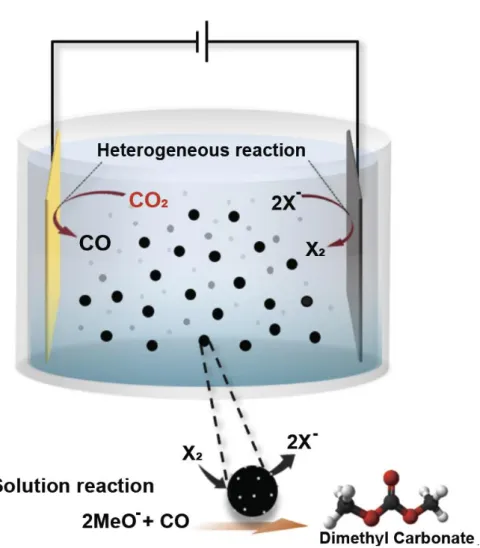
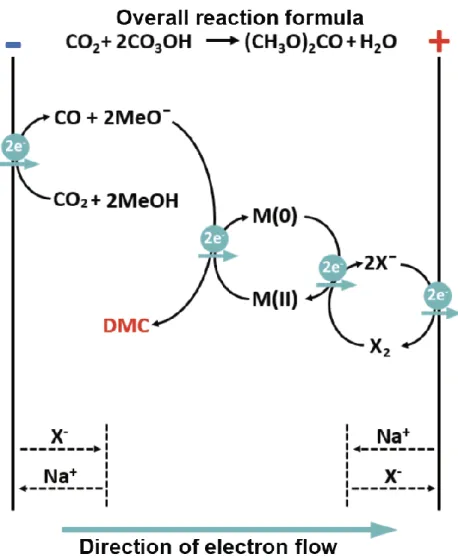
The direct electrochemical coupling of the carbon dioxide with alcohol is greener and sustainable, yet difficult, due to the limitation of activation barrier and chemical equilibrium. Thus, activation of both CO2 and alcohol are prerequisite to shift the reaction towards forward direction. Besides, the byproduct such as water to be removed from the reaction mixture and the activated intermediates must be coupled selectively. Therefore, a unique strategy such as redox-neutral synthesis was anticipated to activate the substrates, to overcome the chemical equilibrium and to carryout selective C-O coupling. Accordingly, the design strategy of redox-neutral synthesis includes three different sequential redox cycles or reaction pathways, which is facilitated by electrochemically (Fig 2. 1 and Fig. 2. 2). The projected three cycles are destined for separate chemical conversions, which drives the overall conversion processes towards electroneutrality. The first cycle is intended for CO2/CO conversion, involving two electrons transfers from the cathode to CO2 along with two protons transfers. The non-aqueous system has been preferred for CO production to avoid the problem associated with chemical equilibrium and the
would be coupled to produce the corresponding dialkyl carbonates in the sequential redox cycles. Thus, solution-based conversion has been anticipated and metal- decorated carbon (M-C-Catalyst) as catalysts have been chosen to couple the methoxide and CO by oxidative addition. Accordingly, the electrochemically generated CO transfers two electrons to the dispersed M-C-catalyst in the electrolyte along with binding of alkoxide ions. The CO and alkoxide bound Pd-adduct undergo intra-molecular C-O coupling to produce dialkyl carbonates. To sustain the coupling processes towards electroneutral at room temperature, oxidant is mandatory.
Therefore, we anticipated that coupling of the anodic reaction facilitate the generation of the oxidant and halogen molecules (X2) such as Cl2 (1.36V), Br2
(1.07V) or I2 (0.54V) have been chosen to regenerate the M-C-catalyst. As the halogens are neutral molecules, it can be generated from the oxidation of the halide ions at the anode under applied potential. The halogen molecules act as a trap for the two electrons released from the catalysts after the coupling of CO and alkoxide and can generate two halide anions and sustain the oxidative coupling. Finally, X- oxidize at the anode and transfers electrons to form X2 and the electrons can be used for CO2RR at the cathode and the cycle to be continued under applied potential.
To realize the redox-neutral DMC synthesis, all of the three redox cycles must efficiently carry out each designated chemical reactions, and consequently combine with each other to complete electron downhill flow between anode and cathode. The important thing is that the energy of the electron should be gradually lowered as the electrons pass through the redox cycle, where the standard redox
potential gradually decreases. From the kinetical view, all reactions should selectively occur while suppressing possible side reactions. For instance, hydrogen evolution reaction should be suppressed when the CO2 reduction reaction occurs. In addition, the generation of DMO, which can be synthesized by oxidative carbonylation of methanol, should be suppressed because it can lower the DMC efficiency. Finally, it is necessary to prevent metal dissolution at the anode and overoxidation of methanol to dimethoxymethane.
Figure 2. 1 Reaction scheme of the system for the synthesis of DMC from CO2.
Figure 2. 2 Detailed mechanism of DMC synthesis and electron flow from cathode to anode through three redox cycles.
Chapter 3. Experimental Procedure
3.1 Chemicals and materials
Palladium on activated carbon (Pd/C) was purchased from premetek, Copper on Vulcan (Cu/C) was purchased from fuel cell store, palladium bromide, copper bromide, (diacetoxyiodo) benzene, bis(tert-butylcarbonyloxy)iodobenzene, [bis(trifluoroacetoxy)iodo]benzene, tetrabutylammonium bromide, sodium chloride, sodium bromide, sodium iodide, titanium foil, 1-iodobutane, sodium methoxide were purchased from Sigma Aldrich. During the experiments, solvents (methanol and ethanol) were used after drying process, by storing in molecular sieve. Glassy carbon, Au foil, Ag foil, Ti foil was purchased from Sigma Aldrich. During the experiment, Au foil was prepared thorough sputtering on titanium foil. Glassy carbon was utilized after polishing with diamond paste.
3.2 Methods
3.2.1 Electrochemical analysis
During the characterization of anode and cathode, membrane separated H- type cell was utilized. Current constant bulk electrolysis was conducted and the passed total charge was 5 C. After the bulk electrolysis, the gas composition in the cathodic compartment was evaluated by gas chromatography. For the anode, Br2
evolution ability at the glassy carbon anode was tested. Br2 evolution efficiency was analyzed using a UV/Vis/NIR spectrometer. During the DMC synthesis process, membrane was removed and single cell was utilized. 40 mg catalyst was uniformly dispersed through continuous stirring in 15 ml solution. The cell was tightly concealed to prevent the loss of gas reactant. Constant current bulk electrolysis was conducted and the total passed charge was 30 C. After the bulk electrolysis, solution was centrifuged for 5 minutes at 3000 rpm to separate catalyst and clear solution at the above was measured by GC-MS.
3.2.2 Chemical DMC synthesis experiment:
In this paper, chemical DMC synthesis experiments were additionally
hypervalent iodine oxidants were added into the solution which contains Pd/C catalyst. After 30 minutes, CO and methoxide were added into the solution and DMC yield was after evaluated. Cl2 gas was in-situ generated by injecting hydrogen chloride solution into 10 ml NaClO solution. During the investigation of Br2 loss mechanism, 0.1 mmol Br2 was first dissolved in 10 ml 0.1 M NaBr-methanol solution. In addition, the solution was supplied with CO and CO2 respectively in a pressure vessel. Additionally, methoxide was added into the solution.
3.2.3 Measurement of CO2 in methoxide-MeOH solution
In this paper, to investigate the importance of CO2, amount of CO2 captured in the methoxide containing solution was evaluated. First, different amount of NaCH3O was added into the methanol solution. Additionally, the solution was purged with CO2 for 10 minutes. Finally, 0.2 ml hydrochloric acid solution was added to the solution and the amount of CO2 evolution was measured.
3.2.4 Capturing methoxide during the DMC synthesis
During the DMC synthesis, methoxide played an important role for the intermediate. To confirm the existence of methoxide during the bulk electrolysis, bulk electrolysis was conducted in membrane-separated H-type cell. After the bulk electrolysis, 1-iodobutane which is the methoxide capturing agent was added to the solution. The solution was analyzed through GC-MS.
3.2.5 Product analysis
Dimethyl carbonate and diethyl carbonate were analyzed by GC-MS, and the faradaic efficiency was calculated through the following equations.
DMC(dimethylcarbonate) =2 × 𝐷𝑀𝐶(𝑚𝑜𝑙) × 96485(𝐶 𝑚𝑜𝑙−1)
𝑐𝑜𝑢𝑙𝑜𝑚𝑏 (𝐶) × 100(%)
DEC(diethylcarbonate) =2 × 𝐷𝐸𝐶(𝑚𝑜𝑙) × 96485(𝐶 𝑚𝑜𝑙−1)
𝑐𝑜𝑢𝑙𝑜𝑚𝑏 (𝐶) × 100(%)
Chapter 4. Results and Discussion
4.1 Electrochemical Investigation of three redox cycles
4.1.1 Investigation of the X-/X2 redox cycle at the anode
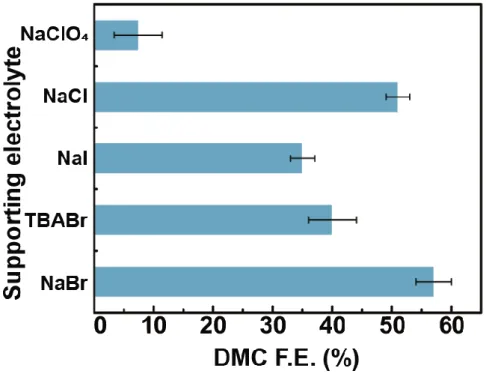
To understand the overall redox-neutral electrolysis process, suitability of all the redox cycles needs to be investigated separately. To act as an oxidant or trap for the electrons released from the M-C-Catalysts during oxidative addition, X-/X2 redox cycle has been chosen as the anodic reaction. Alkali halides and glassy carbon have been used as an electrolyte and anode material respectively. Indeed, selection of electrolyte is important because supporting electrolyte is particularly related to the type of the oxidant produced at the anode and CO production efficiency at the cathode. Therefore, the effect of both anion and cation of alkali halides towards the F.E. of dialkyl carbonates have been investigated. The anionic effect has been verified by using NaCl, NaBr and NaI electrolytes, which produce Cl2, Br2 and I2 as an oxidant respectively. As a representative example, constant current electrolysis was performed at 12 mA cm-
2 with Pd/C as a catalyst dispersed in methanol. NaCl, NaBr, and NaI exhibited the F.E. of DMC to 51%, 57%, and 33% respectively, indicating that Br2 is the most suitable oxidant under the reaction condition (Fig. 4. 1). NaI showed significantly lower FE than that of NaCl and NaBr, which may be due to the weak
oxidizing power of I2 (E0 = 0.5 V) compared to that of Br2 (E0 = 1.0V) and Cl2 (E0
= 1.3V). Lower F.E of Cl2 even with sufficient oxidizing power is due to the low solubility of Cl2 in methanol. According to our model chemical experiment, DMC yield was 67.8% when 0.1 mmol Cl2 was provided (Fig. 4. 2). Since other side reaction by Cl2 was not observed, and DMC can be synthesized at almost 100%
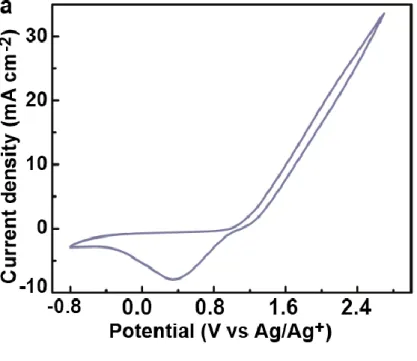
(96.7%) by continuously supplying Cl2 gas to the solution, lower DMC yield in stoichiometric reaction (67.8%) shows that undissolved Cl2 gas remained in headspace. In addition, similar model chemical experiments were also conducted to investigate if other environmentally benign oxidants could be used as an alternative to halogen molecules. When hypervalent iodine (III) oxidants were used, DMC yield was 52.8%, 50.7%, and 44.5% for (diacetoxyiodo)benzene, bis(tert-butylcarbonyloxy) iodobenzene, and bis(trifluoroacetoxy)iodobenzene respectively (Fig. 4. 3). This successful DMC synthesis results, and previous researches which utilized in-situ generated hypervalent iodine (III) by electrochemical oxidation of iodine(I)26, suggest that these oxidants can be certainly utilized in our redox-neutral system. Since bromine showed the highest DMC F.E., we further evaluated oxidant evolution reaction at the anode electrochemically. The cyclic voltammetry of 0.1 M NaBr in methanol solution (Fig. 4. 4) indicated that bromine evolution starts at the onset potential of 1.5 V
Figure 4. 1 DMC F.E. values with five different supporting electrolytes. NaClO4
represents the case when no oxidant is produced from the anode.
Figure 4. 2 Chemical yields of the DMC synthesis when different amounts of Br2, Cl2 oxidants were added.
Figure 4. 4 (a) Cyclic voltammogram of the bromine evolution reaction on the glassy carbon anode in MeOH solution containing 0.1 M NaBr. (b) F.E. values of bromine evolution on the anode at five different current densities
4.1.2 Investigation of the CO2/CO redox cycle at the cathode
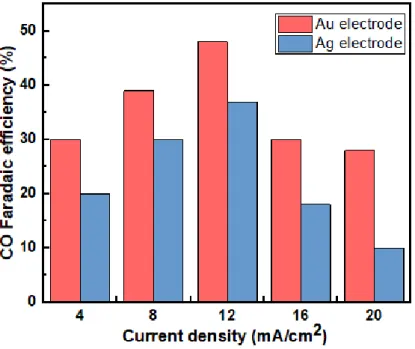
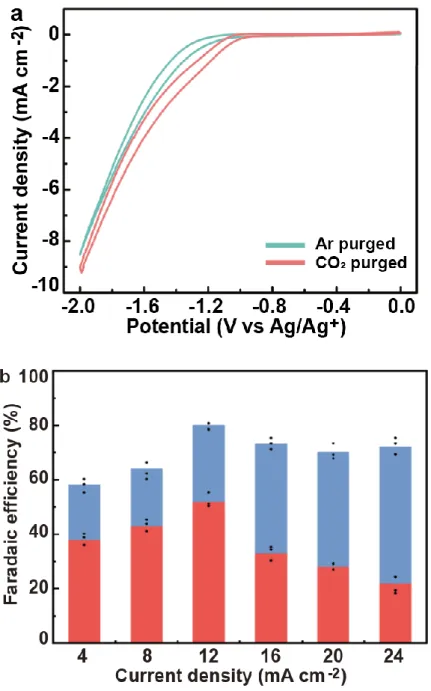
At the cathode, CO2 reduction cycle was designed to produce CO as a reactant. To efficiently produce CO, Au and Ag electrodes, which are well-known CO producing catalyst27–29, were tested as the cathode and the faradaic efficiency (FE) of the CO production was determined by gas chromatographic (GC-FID) analysis. Among the two electrodes, Au exhibited higher CO FE (48%) than that of Ag electrode (37%) (Fig. 4. 5). Thus, Au electrode has been used as cathode for the entire redox-neutral synthesis and investigated further using cyclic voltammetry (CV) in 0.1M NaBr-methanol solution. The CV curve (Fig. 4. 6) indicates that the CO2 electroreduction starts at the onset potential of -1.1V (vs.
Ag/Ag+). To find out the peak potential of CO production, CO2 reduction has been performed at various current density and highest F.E. (48%) for CO achieved at a current density of 12 mA cm-2 (Fig. 4. 6). The total F.E. of 54%, 67%, 81%, 78% and 80% observed at the current densities of 4, 8, 12, 16 and 20 mA/cm-2 respectively, revealing that the competing HER is also occurred at the cathode.
The total FE is always lower than 100 % and the electron loss is due to the high solubility of CO gas in methanol. According to the previous reports, CO solubility in MeOH is 90 mg/L30, which is three times higher than that in water (27.6 mg/L).
suppression was correlated with change in the local pH and the local CO2
concentration near the electrode surface. Therefore, the effect of cation on the F.E.
of DMC have been investigated by using cations such as TBABr and NaBr and exhibited the F.E. of 39% and 57%, respectively. This might be due to the effect of cation in the production of CO from CO2 at the cathode-electrolyte interface.
The relationship between the F.E. of CO and DMC with cation type clearly suggesting that the careful selection of supporting electrolyte is essential to match with the sufficient oxidizing power as well as to enhance the CO production.
Figure 4. 5 Faradaic efficiencies of CO2 reduction to CO on Au (red) and Ag (blue) electrodes at different current densities.
Figure 4. 6 (a) Cyclic voltammograms of CO2 reduction on the Au cathode. (b) F.E. values of CO2 reduction to CO on the cathode at five different current densities.
4.1.3 Investigation of the M(II)/M(0) redox cycle at the solution
Based on the electrochemical understanding of each half electrode reactions under three electrode set-up, the redox-neutral synthesis has proceeded under two electrode system containing the M-C-catalyst in solution. To enhance the oxidative coupling of the CO with methoxide, the solution was stirred vigorously for uniform dispersion of the catalyst. The M-C-catalyst is not only catalyzing the DMC synthesis, but also complete the downhill electron flow from cathode to anode by connecting the CO2/CO and Br-/Br2 redox cycles through its own redox cycle.
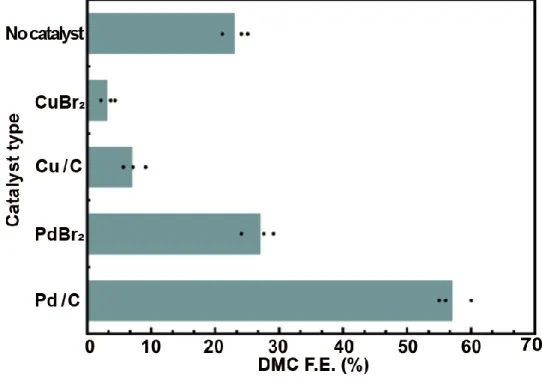
To establish an efficient redox-neutral electrolysis system, efficiency of the dispersed catalyst in solution for the coupling of CO with alcohol/alkoxide and overall electron flow needs to be determined. Previous studies suggesting that Pd and Cu based catalysts are ideal candidates for the thermochemical synthesis of DMC19,31–33. Thus, four different catalytic materials such as Pd/C, PdBr2, Cu/C, CuBr2 have been screened under redox-neutral conditions. Au and glassy carbon electrode were fixed as cathode and anode and constant current electrolysis at the highest CO F.E. (12 mA cm-2), was performed in 0.1 M NaBr-methanol solution.
Amount of DMC produced has been quantified by GC-MS analysis. As shown in
even without any dispersed catalysts, the F.E. of DMC reached to 23%, whereas, copper-based catalysts exhibited very low F.E. (10%<). It is speculated that the sluggishness of Cu(II)/Cu(0) redox couple may be the cause of lower F.E., which is important for DMC production under the current reaction conditions. This is also supported by the accumulation of Cu(II) species in the solution, which prevent the regeneration of Cu(0) during electrolysis with Cu/C catalyst.
Moreover, cathodic deposition of copper on the Au cathode was observed, which further reduce the catalytic activity (Fig. 4. 8). On the other hand, Pd-based catalysts efficiently catalyze the synthesis of DMC from CO and methanol.
Irrespective of the initial oxidation state of Pd, both of the Pd-based catalysts exhibits activity. This result clearly illustrating that the cyclic changes between Pd(II) and Pd(0) might be the catalytically active cycle under the reaction conditions. PdBr2 exhibited lower F.E. for DMC selectivity, due to the electro- deposition of Pd(II) ions on Au cathode, which diminish the CO production efficiency. All the above observation clearly suggesting that the stability and regenerative redox cycle of dispersed catalysts in the electrolyte is crucial for the efficient synthesis of DMC as well as to achieve redox-neutrality. Moreover, homogeneously dispersed ionic catalysts are not suitable for this system, because of the possibility of electrodeposition on the cathode material, which prevent CO2RR. Therefore, Pd/C acts as an ideal choice of catalyst for the efficient synthesis of DMC from CO2 and methanol under redox-neutral condition.
Figure 4. 7 Average DMC F.E. values in the absence of a catalyst and when using four different catalysts dispersed in solution.
4.2 Characterization of optimized conditions of the redox-neutral conversion of CO
2to DMC
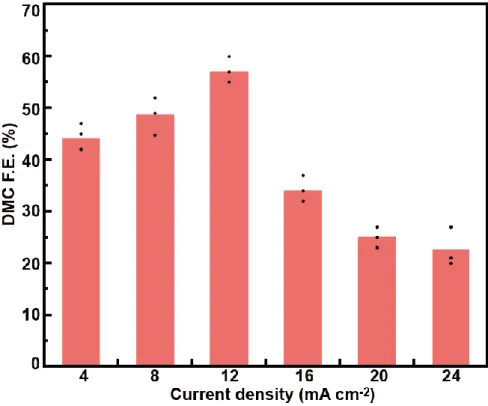
To achieve the efficient and sustainable direct synthesis of dialkyl carbonates from CO2 and methanol, a unique method such as redox-neutral synthetic method has been proposed and successfully realized towards the synthesis of dialkyl carbonates. In particular, the F.E. of DMC is reached up to 60% under the reaction conditions. The plot of different applied current density versus FE (Fig. 4. 9) of DMC showing the peak current density (12 mA cm-2) observed for DMC synthesis. The similarity in the peak current density between CO (12 mA cm-2) and DMC generation suggesting that the sufficient CO generation might be the determinant factor for the efficient synthesis of DMC.
Although, only stoichiometric amount of CO is required for DMC formation, at certain current density, higher FE of DMC is observed than that of CO F.E. For example, while the FE of CO is 48% at 12 mA cm-2, the observed F.E. of DMC is 57%. This discrepancy may be attributed to the underestimated CO F.E. because around 3.26 times higher CO can be soluble in methanol than that of water.
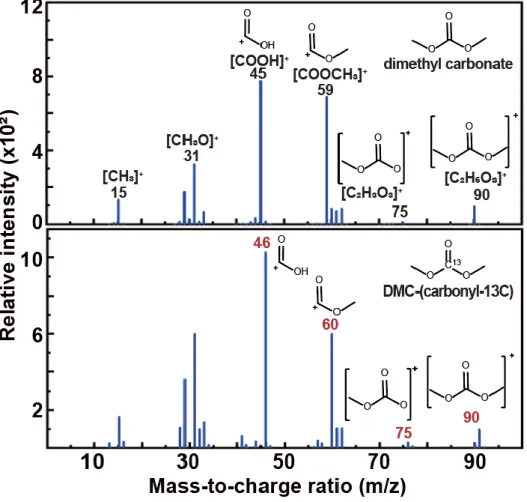
Furthermore, isotopic labeling studies using 13C-labeled CO2 was conducted to verify DMC was produced from CO2. The shift in the mass peak of the molecular cation radical (Fig. 4. 10) clearly indicates that DMC is produced from the redox- neutral transformation of CO2.
Figure 4. 9 Average DMC F.E. values at different current densities
Figure 4. 10 Mass spectra of solution after the bulk electrolysis when 12CO2 and 13CO2 was provided respectively.
4.3 Importance of CO
2in preventing bromine loss
According to our mechanistic understanding, bromine should efficiently oxidize Pd/C to achieve high DMC efficiency. As discussed previously, Br2 can undergo reactions such as direct reduction at the cathode, oxidation of Pd/C to Pd(ll), oxidation of CO to form COBr2. Among these reactions, direct reduction at the cathode was regarded as minor bromine loss pathway consuming about 8% of produced Br2. In fact, another bromine loss mechanism can be considered which is the reaction between methoxide and Br2 producing CH3OBr. Interestingly, we found out that this reaction does not occur in CO2 environment, indicating that CO2 is essential to suppress bromine loss in our redox-neutral system. When methoxide was dissolved in bromine-methanol solution in CO2 environment, the solution color remained unchanged (In the absence of CO2 the color of the yellowish solution suddenly became transparent, Fig. 4. 11). This was due to the acid-base interaction between CO2 and methoxide, making methoxide less reactive towards Br2. Further, the increased amount of CO2 dissolved in methanol upon increasing the methoxide concentration supported that the interaction of methoxide and CO2 exist. Importance of CO2 was further verified in electrochemical system. Fig. 5a shows that in CO environment, lower F.E. was obtained (47%) and bromine loss occurred (Fig. 4. 12).
Figure 4. 11 Reaction of Br2 and methoxide in CO and CO2 environments.
Figure 4. 12 Photographs of solutions after bulk electrolysis when methanol solution was pressurized with (a) CO2 and (b) CO.
4.4 Mechanistic study of redox-neutral DMC synthesis
4.4.1 Pd catalyst catalyzed DMC synthesis pathway
To understand the mechanism of the C-O coupling in the synthesis of DMC, cyclic voltammetry and GC-MS analysis have been performed. The GC-MS analysis of the mixture of methanol, CO and Pd/C catalysts did not show the production of DMC, which is clearly indicating that the methanol is not coupled with CO through oxidative carbonylation. Therefore, we anticipated that Pd(II) is involved in the production of DMC and CV have been conducted to verify it. The CV curve of the PdBr2 in methanol exhibited the Pd(II)/Pd(I) redox wave at -0.7V vs. Ag/Ag+ (Fig.
4. 13). After, we provided CO into the PdBr2 in methanol solution, and the color of the solution changed from dark orange to pale yellow. The CV of the mixture exhibited, shift in redox position from -0.7 V to -0.9 V vs Ag/AgCl, supporting that the CO binding with Pd center and the redox wave is assigned to the PdII(CO)Br adduct. Interestingly, addition of methoxide to the mixture of PdBr2 in methanol and CO, generate the formation of particle in the solution (Pd(0)). The CV of the mixture showed the disappearance of the redox wave at -0.9 V of the PdII(CO)Br adduct and GC-MS analysis of mixture showed the production of DMC suggesting the
carbonate (DMC). Typically, two parallel pathways for the production of DMO/DMC exists and the selectivity between the two products is determined by types of catalyst and reaction condition (Fig. 4. 14). Moreover, methyl nitrite s used as the precursor to generate methoxide anion (CH3O-) to couple with CO for the production of DMC. Therefore, the regeneration of methyl nitrite from the NO and methanol is required for the conventional production. Accordingly, the electrochemical generation of CH3O- might be the key factor for the synthesis of DMC at room temperature. Interestingly, the CO production in the non-aqueous medium enabled the production of methoxide, which enhance the selectivity of DMC rather than DMO under the redox-neutral condition. The formation of CH3O- after bulk electrolysis is also confirmed by GC-MS analysis. Addition of the CH3O- capturing agent such as 1-iodobutane to the bulk electrolyzed solution produced butylmethylether (Fig. 4. 13) confirm the generation of CH3O-.
The CV and GC-MS analysis clearly suggesting that the CO and methoxide binding to Pd(II) enables the synthesis of DMC and generate Pd(0). Later, Br2
oxidized the Pd(0) and generate the Pd(II) to sustain the cycle under applied potential (Fig. 4. 15). All the above observation clearly suggesting that the CO2RR at the cathode and solution-based coupling of CO with methoxide and catalysts regeneration by the anodically generated Br2 are coupled each other sequentially, which drives the process to achieve the redox-neutrality.
Figure 4. 13 Investigation of the Pd state during the DMC synthesis. (a) Photographs of the solution according to the different state of Pd. (b) Cyclic voltammetry curves of each solution.
Figure 4. 14 Investigation of the methoxide involvement during the DMC synthesis.
(a) Conventional oxidative carbonylation of methanol routes (b) GC-MS mass spectrum of butyl methyl ester
Figure 4. 15 Schematic of the proposed reaction mechanism of DMC synthesis.
4.4.2 Minor DMC synthesis mechanism
DMC could also be synthesized in the absence of Pd catalyst. Specifically, in our system, two minor DMC synthesis mechanisms exist. First, DMC could be synthesized by a COBr2 intermediate pathway, as the same mechanism reported by Vuong et al.34 This was confirmed through chemical DMC synthesis experiments.
When we simply dissolve CO into the methanol solution, DMC was not synthesized.
However, when we dissolve CO in 10 mM bromine-methanol solution, DMC was synthesized with the yield of 8.4%. Moreover, higher Br2 concentration resulted in the greater amount of DMC synthesis (0.0084 mmol, 0.0102 mmol, and 0.0126 mmol was synthesized respectively in 10 mM, 50 mM, 100 mM bromine-methanol solution during 30 minutes). This result indicates that DMC can be synthesized in the absence of methoxide. Also, reactive intermediate which involves CO and Br2
could be formed during this mechanism. Since COBr2 can be generated by reaction between CO and Br2, and is known to be highly reactive with alcohol to produce dialkyl carbonates, we concluded that COBr2 was produced as an intermediate.
Another minor DMC synthesis mechanism could be a direct oxidation at the anode. When NaClO4 was utilized as supporting electrolyte, DMC F.E. was about 8% even though oxidant is not generated in this system. This result shows that CO and methanol could be direct oxidized at the anode, and thus producing DMC.
Figure 4. 16 Minor DMC synthesis pathway in the absence of CO2
4.5 Economic analysis of the redox-neutral CO
2conversion system.
Along with the faradaic efficiency, current density and the cell voltage are also the important factors which determines the actual applicability and efficiency of the electrochemical DMC production. Our redox-neutral synthetic method exhibited enhanced current density (12 mA cm-2 at Vcell=3.9 V) as well as moderate F.E. (60%) compared to previously reported electro-synthesis of DMC from CO with low peak current (<10mA cm-2). Because the underlying mechanisms are completely different from previous reports, we expected to achieve higher current densities and lower cell voltages. By generating a redox mediator rather than directly oxidizing the reactants using the anode, side reactions including the methanol over-oxidation to dimethoxymethane and the anode dissolution of the metal catalyst at high current could be prevented. When the cathode (Au plate) was replaced by oxide derived Au which is known to exhibit better CO2 to CO reduction activity35, significant decrease in cell voltage and higher current density was achieved. Specifically, cell voltage at the maximum F.E. decreased from 3.9 to 2.8 V (FE = 48%; j = 20mA cm-2, Fig 4.
17). Furthermore, high current density with moderate faradaic efficiency of 20mA cm-2 (FE = 48%), 30mA cm-2 (FE = 44%) and 40mA cm-2 (FE = 40%) was achieved, much higher than that of the direct DMC synthesis from CO (Fig. 4. 18). In case of the CO based DMC synthesis, additional electric energy should be added for the conversion of CO2 to CO in a separate cell, adding about 20 % of overall energy
input. To find out the economic viability of redox-neutral electrochemical synthesis of DMC, the required electric energy of possible chemicals producible from the CO2
reduction reactions has been compared (Fig. 4. 19 and Fig 4. 18). The calculated energy input of our DMC synthesis is 3.5 kWh/kg. Note that required electrical energy of the reported electrochemical CO2 conversion products such as carbon monoxide (4.5 kWh/kg), formic acid (2.9 kWh/kg), methanol (33 kWh/kg) and ethylene (27 kWh/kg). It is worthy to mention that market price of DMC (1200$/ton)31 is about three times higher than formic acid (400$/ton).
Figure 4. 17 DMC faradaic efficiencies at different current densities with oxide derived-Au cathode in CO2 saturated methanol solution containing 0.1M NaBr.
Figure 4. 18 Potential (V) vs. time(s) curve when oxide derived-Au cathode was utilized.
Figure 4. 19 The required electrical energy of the direct electrochemical CO2
reduction products and dimethyl carbonate (DMC) from our redox-neutral system.
Vcell (V)
Cathode potential + Anode potential
Faradaic efficiency
(%)
Required electrical energy (kWh/kg)
CO
OER(1.23+0.25)36 + CO2RR(0.1+0.8)36
Vcell = 2.38V
100 a4.5 kWh/kg
Formic acid
OER(1.23+0.25)36 + CO2RR(0.02+1.01)36
Vcell = 2.51V
100 a2.9 kWh/kg
ethylene
OER(1.23+0.25)36 + CO2RR(- 0.08+0.62)36
Vcell =2.02V
7037 a27 kWh/kg
methanol
OER(1.23+0.25)36 + CO2RR(- 0.03+0.84)36
Vcell =2.29V
42.338 a33 kWh/kg
DMC (CO)
AnodeDMC(1.4)31 + cHER(1.86)
Vcell = 3.26V 8331
a2.35 kWh/kg +
b1.40kWh/kg
= 3.75kWh/kg DMC
(CO2) Vcell = 2.8V 48 a3.5 kWh/kg
Figure 4. 20 Calculation of the required electrical energy of the direct electrochemical CO2 reduction products and dimethyl carbonate (DMC) from CO2
(redox neutral system) and CO (previous report). aRequired electrical energy (J/g):
Vcell*I/(I*FE/nelectron/96485*Mw) = Vcell*nelectron*96485/FE/Mw, Required electrical energy (kWh/kg): Required electrical energy (J/g)/3600. bRequired electrical energy for CO supply: 4.5kWh/kg*Mw(CO)/Mw(DMC). cCathode potential of the DMC from CO is based on the experimental value. Methanol solution containing 0.1M NaClO4, Current density of Pt cathode : 1mA cm-2
4.6 Potential expandability of the redox-neutral CO
2conversion system to synthesize dialkyl carbonates
Many dialkyl carbonates act as potentially useful materials for various applications in chemical and polymer industries. For instance, diethyl carbonate (DEC) can be used to make the polymer called Lexan by the reaction with bisphenol A and used as an excellent electrolyte in Li-ion batteries and used as an additive in fuels39,40. Thus, the applicability of the redox-neutral electrochemical synthesis is extended to other substrates such as ethanol. However, synthesis of DEC is more difficult than that of DMC, because ethanol is less reactive than that of methanol due to relatively low acidic nature. Most of the previous studies reported the average conversion of about 30% only from direct coupling of CO2 and ethanol, due to the thermodynamic barrier. The constant current electrolysis of Pd/C catalyst in ethanol solution at 12 mA/cm2 leads to the formation of diethyl carbonate with the FE of up to 18% (Fig. 4. 22). The moderate conversion efficiency may be related to inefficient CO production (Fig. 4. 21) and non-uniform dispersion of the Pd/C catalysts in ethanol solution. Despite the moderate yield, the successful synthesis of diethyl carbonate shows the potential expandability of our redox-neutral system for the other
Figure 4. 21 Faradaic efficiencies of CO production on Au electrodes at different current densities in 0.1M NaBr in methanol and ethanol solution.
Figure 4. 22 (a) GC-MS mass spectrum of diethyl carbonate. (b) Reaction formula of synthesizing dialkyl carbonate from CO2 and ethanol.
Chapter 5. Conclusion
In summary, we demonstrate the redox-neutral synthesis of dimethyl carbonate directly from CO2 and methanol under the ambient conditions. This system takes the advantage of electrochemical reactions and chemical reaction for the synergistic combination. A key feature is the successful construction of downhill flow of electrons from high potential to low through the electrolyte by combining three redox/chemical cycles. The DMC FE achieved here is maximum 60% and can increase up to 70% with the additional supply of CO. We also clarified the mechanism which involves methoxide intermediates and Pd / Pd (II) redox cycles.
The method suggested here can be further applied to a various carbonate production reaction, providing an unexplored new platform and further reduce the costs of electrochemical manufacturing and overall systems.
References
1. Jones, J. P.; Prakash, G. K. S.; Olah, G. A. Electrochemical CO2
Reduction: Recent Advances and Current Trends. Isr. J. Chem. 2014, 54 (10), 1451–1466.
2. Nitopi, S.; Bertheussen, E.; Scott, S. B.; Liu, X.; Engstfeld, A. K.; Horch, S.; Seger, B.; Stephens, I. E. L.; Chan, K.; Hahn, C.; et al. Progress and Perspectives of Electrochemical CO2 Reduction on Copper in Aqueous Electrolyte. Chem. Rev. 2019, 119 (12), 7610–7672.
3. Liu, A.; Gao, M.; Ren, X.; Meng, F.; Yang, Y.; Gao, L.; Yang, Q.; Ma, T.
Current Progress in Electrocatalytic Carbon Dioxide Reduction to Fuels on Heterogeneous Catalysts. J. Mater. Chem. A 2020, 8 (7), 3541–3562.
4. Chan, K. A Few Basic Concepts in Electrochemical Carbon Dioxide Reduction. Nat. Commun. 2020, 11 (1), 2–5.
5. Lu, Q.; Jiao, F. Electrochemical CO2 Reduction: Electrocatalyst, Reaction Mechanism, and Process Engineering. Nano Energy 2016, 29, 439–456.
6. Chen, C.; Khosrowabadi Kotyk, J. F.; Sheehan, S. W. Progress toward Commercial Application of Electrochemical Carbon Dioxide Reduction.
Chem 2018, 4 (11), 2571–2586.
7. Kongpanna, P.; Pavarajarn, V.; Gani, R.; Assabumrungrat, S. Techno- Economic Evaluation of Different CO2-Based Processes for Dimethyl Carbonate Production. Chem. Eng. Res. Des. 2015, 93 (July), 496–510.
Rufford, T. E. Advances and Challenges in Electrochemical CO2 Reduction Processes: An Engineering and Design Perspective Looking beyond New Catalyst Materials. J. Mater. Chem. A 2020, 8 (4), 1511–1544.
10. Mo, Y.; Lu, Z.; Rughoobur, G.; Patil, P.; Gershenfeld, N.; Akinwande, A.
I.; Buchwald, S. L.; Jensen, K. F. Microfluidic Electrochemistry for Single- Electron Transfer Redox-Neutral Reactions. Science (80-. ). 2020, 368 (6497), 1352–1357.
11. Liang, S.; Zeng, C. C.; Luo, X. G.; Ren, F. Z.; Tian, H. Y.; Sun, B. G.;
Little, R. D. Electrochemically Catalyzed Amino-Oxygenation of Styrenes:
N-Bu4NI Induced C-N Followed by a C-O Bond Formation Cascade for the Synthesis of Indolines. Green Chem. 2016, 18 (7), 2222–2230.
12. Jud, W.; Kappe, C. O.; Cantillo, D. Catalyst-Free Oxytrifluoromethylation of Alkenes through Paired Electrolysis in Organic-Aqueous Media. Chem. - A Eur. J. 2018, 24 (65), 17234–17238.
13. Ma, Y.; Yao, X.; Zhang, L.; Ni, P.; Cheng, R.; Ye, J. Direct Arylation of α- Amino C(Sp3)-H Bonds by Convergent Paired Electrolysis. Angew. Chemie - Int. Ed. 2019, 58 (46), 16548–16552.
14. Kawamata, Y.; Vantourout, J. C.; Hickey, D. P.; Bai, P.; Chen, L.; Hou, Q.;
Qiao, W.; Barman, K.; Edwards, M. A.; Garrido-Castro, A. F.; et al.
Electrochemically Driven, Ni-Catalyzed Aryl Amination: Scope, Mechanism, and Applications. J. Am. Chem. Soc. 2019, 141 (15), 6392–
6402.
15. Huang, S.; Yan, B.; Wang, S.; Ma, X. Recent Advances in Dialkyl Carbonates Synthesis and Applications. Chem. Soc. Rev. 2015, 44 (10), 3079–3116.
16. Fiorani, G.; Perosa, A.; Selva, M. Dimethyl Carbonate: A Versatile Reagent
for a Sustainable Valorization of Renewables. Green Chem. 2018, 20 (2), 288–322.
17. Selva, M.; Perosa, A.; Rodríguez-Padrón, D.; Luque, R. Applications of Dimethyl Carbonate for the Chemical Upgrading of Biosourced Platform Chemicals. ACS Sustain. Chem. Eng. 2019, 7 (7), 6471–6479.
18. Itoh, H.; Watanabe, Y.; Mori, K.; Umino, H. Synthesis of Dimethyl Carbonate by Vapor Phase Oxidative Carbonylation of Methanol. Green Chem. 2003, 5 (5), 558–562.
19. Du, Z.; Xiong, L.; Lin, Z.; Li, X.; Ding, Y.; Wu, Y. Oxidative Carbonylation of Methanol to Dimethyl Carbonate over Cu(II)-1,10- Phenanthroline Bromide Complexes. Chinese J. Chem. Eng. 2014, 22 (10), 1117–1121.
20. Fujita, S. I.; Bhanage, B. M.; Ikushima, Y.; Arai, M. Synthesis of Dimethyl Carbonate from Carbon Dioxide and Methanol in the Presence of Methyl Iodide and Base Catalysts under Mild Conditions: Effect of Reaction Conditions and Reaction Mechanism. Green Chem. 2001, 3 (2), 87–91.
21. Haba, O.; Itakura, I.; Ueda, M.; Kuze, S. Synthesis of Polycarbonate from Dimethyl Carbonate and Bisphenol-A through a Non-Phosgene Process. J.
Polym. Sci. Part A Polym. Chem. 1999, 37 (13), 2087–2093.
22. Wang, J. Q.; Sun, J.; Shi, C. Y.; Cheng, W. G.; Zhang, X. P.; Zhang, S. J.
Synthesis of Dimethyl Carbonate from CO2 and Ethylene Oxide Catalyzed by K2CO3-Based Binary Salts in the Presence of H2O. Green Chem. 2011,
Recyclable Catalyst and Dehydrant. ChemSusChem 2017, 10 (9), 2046–
2052.
24. Aouissi, A.; Al-Othman, Z. A.; Al-Amro, A. Gas-Phase Synthesis of Dimethyl Carbonate from Methanol and Carbon Dioxide over
Co1.5PW12O40 Keggin-Type Heteropolyanion. Int. J. Mol. Sci. 2010, 11 (4), 1343–1351.
25. Santos, B. A. V.; Silva, V. M. T. M.; Loureiro, J. M.; Rodrigues, A. E.
Review for the Direct Synthesis of Dimethyl Carbonate. ChemBioEng Rev.
2014, 1 (5), 214–229.
26. Francke, R. Electrogenerated Hypervalent Iodine Compounds as Mediators in Organic Synthesis. Curr. Opin. Electrochem. 2019, 15, 83–88.
27. Vickers, J. W.; Alfonso, D.; Kauffman, D. R. Electrochemical Carbon Dioxide Reduction at Nanostructured Gold, Copper, and Alloy Materials.
Energy Technol. 2017, 5 (6), 775–795.
28. Zhao, S.; Jin, R.; Jin, R. Opportunities and Challenges in CO2 Reduction by Gold- and Silver-Based Electrocatalysts: From Bulk Metals to
Nanoparticles and Atomically Precise Nanoclusters. ACS Energy Lett.
2018, 3 (2), 452–462.
29. Ma, M.; Trześniewski, B. J.; Xie, J.; Smith, W. A. Selective and Efficient Reduction of Carbon Dioxide to Carbon Monoxide on Oxide-Derived Nanostructured Silver Electrocatalysts. Angew. Chemie - Int. Ed. 2016, 55 (33), 9748–9752.
30. Liu, Q.; Takemura, F.; Yabe, A. Solubility and Diffusivity of Carbon Monoxide in Liquid Methanol. J. Chem. Eng. Data 1996, 41 (3), 589–592.
31. Zhuang, T. T.; Nam, D. H.; Wang, Z.; Li, H. H.; Gabardo, C. M.; Li, Y.;
Liang, Z. Q.; Li, J.; Liu, X. J.; Chen, B.; et al. Dopant-Tuned Stabilization
of Intermediates Promotes Electrosynthesis of Valuable C3 Products. Nat.
Commun. 2019, 10 (1), 1–7.
32. Zheng, T.; Jiang, K.; Wang, H. Recent Advances in Electrochemical CO2- to-CO Conversion on Heterogeneous Catalysts. Adv. Mater. 2018, 30 (48), 1–15.
33. Ismael, A.; Gevorgyan, A.; Skrydstrup, T.; Bayer, A. Renewable Solvents for Palladium-Catalyzed Carbonylation Reactions. Org. Process Res. Dev.
2020, 24 (11), 2665–2675.
34. Vuong, K. Q.; Effenberger, R.; Zilberman, J.; Smart, S.; Williams, C. M.;
McFarland, E. W. Dialkyl Carbonate Synthesis via in Situ Generated Carbonyl Dibromide on Porous Glass. ACS Sustain. Chem. Eng. 2017, 5 (9), 7492–7495.
35. Chen, Y.; Li, C. W.; Kanan, M. W. Aqueous CO2 Reduction at Very Low Overpotential on Oxide-Derived Au Nanoparticles. J. Am. Chem. Soc.
2012, 134 (49), 19969–19972.
36. Na, J.; Seo, B.; Kim, J.; Lee, C. W.; Lee, H.; Hwang, Y. J.; Min, B. K.; Lee, D. K.; Oh, H. S.; Lee, U. General Technoeconomic Analysis for
Electrochemical Coproduction Coupling Carbon Dioxide Reduction with Organic Oxidation. Nat. Commun. 2019, 10 (1).
37. Dinh, C. T.; Burdyny, T.; Kibria, G.; Seifitokaldani, A.; Gabardo, C. M.;
Pelayo García De Arquer, F.; Kiani, A.; Edwards, J. P.; De Luna, P.;
Bushuyev, O. S.; et al. CO2 Electroreduction to Ethylene via Hydroxide-
343, 232–239.
39. Lamb, J.; Orendorff, C. J.; Roth, E. P.; Langendorf, J. Studies on the Thermal Breakdown of Common Li-Ion Battery Electrolyte Components. J.
Electrochem. Soc. 2015, 162 (10), A2131–A2135.
40. Shukla, K.; Srivastava, V. C. RSC Advances Diethyl Carbonate : Critical Review of Synthesis Routes , Catalysts Used and Engineering Aspects.
2016, 32624–32645.
국 문 초 록
이산화탄소는 공업, 운송, 농축산업 등 인간 활동의 결과 발생하고, 대기 중으로 배출되어 지구온난화, 생태계 파괴 등 많은 심각한 문제들을 일으키고 있다. 대기 중 이산화탄소 농도의 증가를 막는 방안으로써, 포집 된 이산화탄소를 활용하는 방안은 지속가능한 탄소 순환 생태계를 구축할 수 있는 방법으로 많은 연구가 진행 중이다. 특히, 이산화탄소를 탄소 자원으로써 사용하여 산업적으로 유용한 화합물을 만드는 방법은 기존 화학 산업의 석탄, 석유 및 천연가스 의존도를 낮춰 탄소 중립 사회로 나아가는 주요한 전략이다.
현재까지 개발된 전기화학적으로 이산화탄소를 전환하는 방법은 음극에서 이산화탄소에 전자를 주입하여 환원된 형태의 생성물들을 만드는 방법이다. 그에 따라 생산가능한 물질들은 일산화탄소, 메탄, 메탄올, 포름산 및 에틸렌 등 환원된 꼴의 단순한 화합물들로 한정되어 있다. 본 연구에서는, 용액에서 전이금속의 산화환원 주기와, 전극에서의 산화 환원 매개체를 활용함으로써, 음극과 양극을 동시에 활용할 수 있는 새로운 전기화학적 이산화탄소 전환 시스템을 개발하였다. 이를 통해
이산화탄소로부터 환원된 꼴이 아닌, 산화수가 일정한 카보네이트 종류 화합물 합성을 가능하게 하였다.
특히 본 연구에서 약 60%의 효율로 합성에 성공한 화합물인 다이메틸카보네이트는 현재 친환경적 화합물로 세계적으로 주목받고
이산화탄소로부터 합성할 경우 높은 온도가 요구되는 한계점을 극복 할 수 있다.
Chapter2 에서는 이산화탄소로부터 다이메틸 카보네이트를 만드는 시스템을 디자인한 과정을 설명하였다. 음극에서는 이산화탄소로와 메탄올로부터 일산화탄소와 메톡사이드가 생성되며 이 생성된 중간체들은 용액에서 전이금속촉매에 의해 결합되어 다이메틸 카보네이트를 생성한다.
촉매는 양극에서 생성된 산화제를 통해 재사용될 수 있다. 종합적으로, 양쪽 전극에서의 산화/환원 반응과 용액에서 촉매의 산화환원 주기에 의해 지속적이고 친환경적인 다이메틸카보네이트 합성이 가능할 수 있다.
Chapter4에서는 높은 효율로 다이메틸카보네이트를 합성하기
위한 최적화 조건에 대한 탐구와 더불어 메커니즘적인 탐구, 경제성 분석, 시스템에 확장성에 대해 탐구한다. 전기화학적 실험과 함께 화학적 실험을 통해 메커니즘을 제안하였으며, 전극에서의 반응성 높은 중간체 생성이 중요하다는 것을 밝혔다. 경제성 분석을 통해 기존 이산화탄소 전환을 통해 얻는 생성물에 비교하여 다이메틸 카보네이트틑 적은 전기 에너지 비용을 통해 고부가가치의 화합물이 합성가능함을 계산하였다. 마지막으로 에탄올 용매를 사용해 다이 에틸 카보네이트 합성 또한 성공함으로써 시스템의 확장성을 제안한다.
종합적으로, 전기화학적으로 이산화탄소로부터 카보네이트 종류 화합물을 합성할 수 있는 새로운 시스템을 제안하였다. 이를 통해
이산화탄소 전환 분야에 새로운 방향성을 제안하길 기대한다.
감사의 글 (Acknowledgement)
대학원 석사 학위과정이 끝난 후 그 기간을 되돌아보니 많은 일들이 있었고, 그 시간이 하루하루는 길게 느껴졌었지만 지나고 나니 빠르게 흘러갔던 것 같습니다. 혼자만의 힘으로는 무사히 대학원 생활을 마치기 힘들었을 것 같고 많은 분들의 도움으로 학위 과정을 마무리할 수 있었던 것 같습니다. 제가 잘 마무리할 수 있도록 저를 가르쳐 주시고 도움을 주셨던 모든 분들께 감사 인사를 드립니다.
가장 먼저, 지도교수님으로써 저를 가장 많이 가르쳐 주시고, 이끌어 주신 남기태 교수님께 감사인사를 드립니다. 교수님의 섬세하고 열정적인 가르침 덕분에 많이 배울 수 있었고, 많이 성장할 수 있었던 것 같습니다. 처음 연구를 해보는 저에게 논리적으로 생각을 이끌어가는 방법부터 논문 쓰는 방법까지 모두 알려주시고, 이 외에도 많은 것들을 경험하며 배울 수 있었습니다. 하나의 프로젝트를 시작하는 것부터 마무리하는 것까지 경험해 봄으로써 석사 과정동안 어디서도 할 수 없는 좋은 경험을 해 볼 수 있었으며, 이 경험이 앞으로 제가 배우고 나아가는 데에 있어서 큰 힘이 될 것 같습니다. 교수님께서 항상 열심히 하루를 보내시는 모습에 항상 존경하며 저도 더 나은 연구자가 될 수 있도록 노력하겠습니다.
다음으로 대학원 생활동안 가장 많이 생활해 왔던 연구실 멤버들, 모두 감사합니다. 먼저 저에게 가장 큰 힘이 되었던 저희 씨오투 팀에게
항상 들어주고, 조언해주고 힘이 되주어서 감사합니다. 오빠는 정말 제가 본 사람들 중에 여러모로 가장 대단한 것 같고 정말 존경해요. 오빠를 통해 많이 배우고 성장해서 연구실을 졸업할 수 있었어요. 정말 감사합니다.
연구실 선배이면서 친 언니처럼 챙겨줬던 정은언니, 옆자리에 앉아서 했던 얘기들이 정말 셀 수 없이 많은데 그 시간들이 졸업하고 나서도 생각날 것 같아. 연구적 디스커션부터 논문 쓰는 것, 피피티 자료 만드는 것 등등 사소한 것이라도 언니일처럼 고민해주고 꼼꼼하게 도와줘서 고마워.
언니의 신중함과 섬세함을 보며 항상 대단하다고 생각하고 나도 그 모습 조금이나마 배울 수 있었어. 졸업했지만 많은 시간을 함께 보냈던 쌤, 해외에 있지만 좋은 일 있으면 축하해주고, 궁금한 거 있으면 알려주고, 영어 영작도 도와주고, 너무 고마워. 말레이시아로 가버려서 못 본지 너무 오래된 것 같아서 보고싶어. 그래도 곧 돌아오니까 한국오면 만나자.
다음은 영인이, 항상 앞에서는 장난치긴 해도 뒤에서는 날 잘 챙겨주고 배려해 준거 잘 알고 있고 고맙게 생각해. 너를 보면 아직 연구실 들어 온지 얼마 안됐는데도 연구적으로 누구보다 뛰어나고, 할 일이 많아도 불평 없이 묵묵히 열심히 하는 모습을 보면서 대단하다고 생각해. 앞으로도 열심히 해서 잘 마무리해보자. 옆자리였던 무영오빠, 제가 옆에서 기계 만지는 것 서툴러 할 때마다 컴퓨터 설치부터 프린트 등등 사소한 것 잘 알려줘서 고마워요. 최근에 조금 지쳐 보였었는데 앞으로는 쭉 잘 풀렸으면 좋겠어요. Dr. Bala, thank you for your help and advice when I was having a hard time writing the paper. Thanks to your help, the quality of our thesis has been greatly improved. 정석오빠, 연구실 초반에는 자주 봐서 많은 얘기들도 하고 친하게 지냈었는데, 성대를 출근하면서 많이 못 본 것 같아 아쉬워요. 3D 프린터 매번 부탁할 때마다 뽑아주고, 셀 만드는 것도 도와주고, 피겨 작업도 도와줘서 고마워요.
씨오투팀 회식때 항상 같이 있었던 경도오빠, 코로나 때문에 후반에는 많이
보지 못했었지만 그래도 4층에서, 회식자리에서 많은 이야기들을
했었는데, 중간중간 제가 물어보던 사소한 것들도 친절하게 잘 알려주셔서 감사했어요. 앞으로 좋은 일들만 있길 바랄게요. 마지막에 우리 팀에 합류한 창완오빠. 처음 연구실 들어와서 학부 때 같이 팀플 했던 오빠가 있어서 깜짝 놀랐었는데 그게 벌써 이년 전이네. 서류제출 하는 것부터 내가 깜박할 때마다 미리 챙겨주고 알려줘서 고마워. 오빠 너무 고생했고, 졸업해서 더 잘되길 바랄게. 연구적으로 많은 도움을 줬던 승학오빠. 오빠 외국 가기 전 여행 가는 기회가 생길 것 같아