서 론
여성에서는 폐경 후 호르몬 상태의 변화 등으로 인해 심혈관 질 환의 발병이 급격히 증가하는 경향을 보인다.1-3)
Ridker
등4)은 폐경 후 여성에서 염증지표들과 심혈관 질환과의 관련성을 분석한 결과,high sensitivity C-reactive protein
(hs-CRP
)이 심혈관 질환에 대한 가 장 강력한 단일 예측인자라는 결과를 발표하였다.C-reactive protein
(CRP
)은 급성기 반응 단백질로서 전신적인 염증반응의 표지자로 사 용되어왔다. 전통적인CRP
검사 방법은 민감도가 떨어져 만성 염증 에 의한 경도의CRP
상승은 발견하기 어려웠으나CRP
농도를0
.3
Received August 22, 2019 Revised October 28, 2019Accepted February 11, 2020 Corresponding author Jin Wook Kim Tel: +82-31-799-5541, Fax: +82-31-744-8994 E-mail: [email protected]
ORCID: http://orcid.org/0000-0001-9584-0974
Jin Wook Kim’s current affiliation: Department of Family Medicine, CHA University, Seongnam, Korea
Copyright © 2020 The Korean Academy of Family Medicine
This is an open-access article distributed under the terms of the Creative Commons At- tribution Non-Commercial License (http://creativecommons.org/licenses/by-nc/4.0) which permits unrestricted noncommercial use, distribution, and reproduction in any medium, provided the original work is properly cited.
Original Article
https://doi.org/10.21215/kjfp.2020.10.2.96 eISSN 2233-9116
Korean J Fam Pract. 2020;10(2):96-102
Korean Journal of Family Practice
KJFP
폐경 후 여성에서 고감도 C-반응 단백에 영향을 미치는 요인:
국민건강영양조사 2016–2017년 자료 이용
김재경,ˍ문다운,ˍ정연택,ˍ김혜연,ˍ한진아,ˍ김진욱*
성남중앙병원 가정의학과
The Factors Associated with High-Sensitivity C-Reactive Protein in Postmenopausal Women: Based on Korea National Health and Nutrition Examination Survey 2016–2017
Jae Kyung Kim, Da Woon Moon, Yeon Tak Chung, Hye Yun Kim, Jin Ah Han, Jin Wook Kim*
Department of Family Medicine, Seongnam Central Hospital, Seongnam, Korea
Background: Postmenopausal status increases the risk of cardiovascular disease, and C-reactive protein (CRP) constitutes an independent cardiovascular risk factor. This study aimed to investigate the factors associated with increased high-sensitivity CRP (hs-CRP) level in postmenopausal women.
Methods: We included postmenopausal women without laboratory test results that suggested acute inflammation who participated in the Korea National Health and Nutrition Examination Survey between 2016 and 2017. The participants were divided into high and low hs-CRP groups (cutoff value, 3.0 mg/L). We investigated factors that influenced the hs-CRP level with logistic regression analysis.
Results: The total number of subjects was 2,739, of whom 76.4% had low hs-CRP levels and 23.6% had high hs-CRP levels. The mean age and body mass index were higher in the high than in the low hs-CRP group. In the simple logistic regression analysis, high hs-CRP level was associated with smoking, whereas low hs-CRP level was associated with aerobic exercise, use of oral contraceptives, and history of pregnancy in postmenopausal women. When the analysis was adjusted for confounding variables, histories of smoking and pregnancy had a statistically significant association with high hs-CRP level.
Conclusion: This study showed that the important modifiable risk factors of elevated hs-CRP level in postmenopausal women of Korea include obesity, smoking, and lack of aerobic exercise, but well-controlled prospective investigations should be considered.
Keywords: C-Reactive Protein; Postmenopause; Women; Cardiovascular Disease Risk Factors
김재경 외. 폐경 후 여성에서 C-반응 단백에 영향을 미치는 요인 Korean Journal of Family Practice
KJFP
mg
/L
이하까지 측정할 수 있는hs-CRP
의 등장으로 낮은 범위의CRP
도 정밀하게 측정할 수 있게 되었으며, 이를 심혈관 질환 발생의 위험도 평가 및 예후를 추정하는 지표로 활용할 수 있게 되었다.5,6)hs-CRP
는 심혈관 질환의 단순한 표지자가 아니라 독립적 위험인자로 밝혀졌다.7) 혈관내피세포의 기능장애 촉진, 혈전 형성 증진 등 의 작용을 통해 동맥경화와 그로 인한 합병 질환의 발생에 중요한 역할을 한다고 받아들여지고 있다.8-10) 미국 질병관리본부(
Centers for Disease Control and Prevention
,CDC
)와 미국 심장학회(American Heart Association
,AHA
)에서는hs-CRP
값을 삼분위로 나누어,1
.0 mg
/L
미만은 심혈관 질환 저위험군,1
.0 mg
/L
이상,3
.0 mg
/L
미만 은 보통 위험군,3
.0 mg
/L
이상은 고위험군으로 분류하였으며, 고위 험군은 저위험군보다 심혈관 질환 발생 위험이2
배 증가하는 것으 로 나타났다.11)따라서
CRP
를 증가시킬 수 있는 교정 가능한 요인들을 밝혀낸다 면 궁극적으로 심혈관 질환의 발생의 예방에 도움이 될 것이다.Saito
등12)의 연구에서hs-CRP
와 관련된 요인으로 연령, 비만, 고혈압, 고 지혈증, 흡연여부 등을 제시하였다. 그러나 폐경 후 여성을 대상으로CRP
상승 요인을 분석한 대규모 연구는 미흡한 실정이다. 본 연구 는 제7
기1–2
년차(2016–2017
년) 국민건강영양조사 자료를 이용하여 자연 폐경 후 여성을 대상으로CRP
상승 요인을 분석하였다.방 법
1. 연구설계
본 연구는 제
7
기1–2
년차 국민건강영양조사 통계 자료를 이용한 이차분석연구이다.2. 연구대상
제
7
기1–2
년차(2016–2017
년) 국민건강영양조사에 참여한 자연 폐 경 여성 중, 악성 종양, 자가면역 질환 유병자, 염증 상태를 의심할 수 있는 백혈구10
,000 cells
/μL
이상 또는hs-CRP 10 mg
/dL
이상13) 중 한 개 조건이라도 해당되는230
명을 제외하고2
,739
명을 연구 대 상자로 선정하였다. 국민건강영양조사는 국가가 직접 공공복리를 위해 수행하는 연구에 해당하여 연구윤리심의위원회 심의를 면제 받았다.3. 연구도구
자연 폐경은 병적 요인 없이 연속적으로
12
개월간 생리가 없는 경 우를 말하며 본 연구에서는 자가기입식 설문지에 자연 폐경으로 응 답한 경우로 정하였다.hs-CRP 3
.0 mg
/L
미만을low hs-CRP
군,hs-
CRP 3
.0 mg
/L
이상을high hs-CRP
군으로 분류하였다.14)사회경제적 지표는 거주 지역, 가구 소득, 교육 수준을 변수로 이 용하였다. 거주 지역은 주소에 따라 동 거주자의 경우 도시로 분류 하였고 읍, 면 거주자의 경우 시골 지역으로 분류하였다. 가구 소득 은 월평균 가구 균등화 소득에 따라
4
개 그룹으로 구분하였으며, 교육 수준은 초등학교 졸업 이하, 중학교 졸업, 고등학교 졸업, 대학 교 졸업 이상의4
개 그룹으로 구분하였다.건강행위 변수는 흡연력, 음주력, 근력 운동과 유산소 신체활동 실천 여부를 이용하였다. 흡연은 평생 담배
5
갑(100
개비) 이상 흡연 여부를 기준으로 흡연자와 비흡연자로 구분하였다. 음주는 국민건 강영양조사의 ‘고위험 음주’ 기준에 근거하여 금주군, 적정 음주군, 고위험 음주군(평균 음주량이5
잔 이상이고, 주2
회 이상 음주)으 로 분류하였다. 근력 운동, 유산소 신체활동은 ‘한국인을 위한 신체 활동 지침서’에 제시된 지침을 기준으로 평가 하였다. 근력운동은 주2
회 이상, 유산소 운동은 일주일에 중강도 신체활동을2
시간30
분 이상 또는 고강도 신체활동을1
시간15
분 이상 또는 중강도와 고 강도 신체활동을 섞어서 각 활동에 상당하는 시간을 실천하는 것 을 기준으로 하였다.15)여성건강 관련 변수는 초경 연령, 폐경 연령, 임신 경험, 출산 경 험, 모유수유 경험, 경구피임약 복용 경험을 이용하였다. 임신 경험 은 자연유산, 인공유산, 자궁 외 임신 등 모두 포함하며, 출산 경험 은 정상출산 또는 조산을 한 경우를 모두 포함하였다. 모유수유는 최소한 한 달 이상 모유수유를 했다고 응답한 경우 모유수유 경험 이 있는 것으로 분류하였다. 경구피임약은 한 달 이상 복용한 경험 이 있다고 응답한 경우 복용 경험이 있는 것으로 분류하였다.
만성 질환은 고혈압, 당뇨병, 이상지질혈증, 뇌졸중, 허혈성 심질 환(협심증과 심근경색)으로 국한하였다. 수축기 혈압이
120 mmHg
이상,140 mmHg
미만 또는 이완기 혈압이80 mmHg
이상,90 mmHg
미만인 경우 고혈압 전단계, 수축기 혈압이140 mmHg
이상 이거나 이완기 혈압이90 mmHg
이상인 경우 또는 고혈압 약을 복 용하는 경우 고혈압으로 정의하였다. 공복혈당이100 mg
/dL
이상,126 mg
/dL
미만인 경우 공복혈당 장애, 공복혈당이126 mg
/dL
이 상 또는 의사진단을 받았거나, 혈당강하제 또는 인슐린을 투약하고 있는 경우 당뇨병으로 정의하였다. 이상지질혈증은 총 콜레스테롤240 mg
/dL
이상 또는 콜레스테롤 약 복용중인 고콜레스테롤혈증,12
시간 이상 공복시 중성지방200 mg
/dL
이상인 고중성지방증으로 분류하여 분석하였다. 뇌졸중과 허혈성 심질환의 유병여부는 의사 에게 진단 받은 경우로 정의하였다.Original Article
Korean Journal of Family Practice
Jae Kyung Kim, et al. Factors Associated with CRP in Postmenopausal Women
Korean Journal of Family Practice
KJFP
4. 통계 분석
본 연구에서는 가중치를 적용한 복합표본분석을 실시하였다. 연 구대상자들의 일반적, 부인과적 특성을 분석하기 위해
chi-square
test
와 독립표본t-
검정을 이용하여 연속 변수는 평균±표준오차로 제시하였고, 범주 변수는 % (표준오차)로 나타냈다.CRP
군에 따른 만성질환의 교차비 분석을 위해 로지스틱 회귀분석을 시행하였다.hs-CRP
에 영향을 미치는 요인을 파악하기 위해5
개의Model
모형으 로 나누어 단계적으로 보정 변수를 추가하여 로지스틱 회귀분석을 시행하였다. 통계량의 유의 수준은95
% 신뢰구간(confidence interval
)에서P-value
가0
.05
미만인 경우로 정의하였으며 통계 프로 그램은IBM SPSS Statistics ver
.22
.0
(IBM Co
.,Armonk
,NY
,USA
)을 사용하였다.결 과
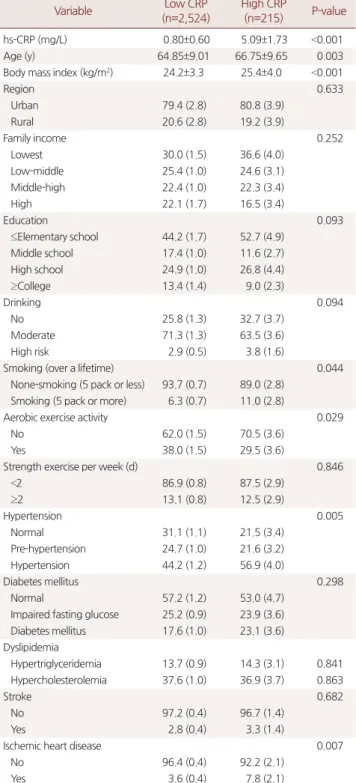
1. High sensitivity C-reactive protein 군에 따른 일반적 특성 비교
Table 1
에hs-CRP
군에 따른 일반적 특성을 제시하였다. 연구 대 상자는2
,739
명이며,low hs-CRP
군2
,524
명(76
.4
%),high hs-CRP
군215
명(23
.6
%)이었다. 평균 연령(P=0
.003
), 체질량지수(P<0
.001
), 흡연 (P=0
.044
), 유산소 운동 실천(P=0
.024
), 고혈압(P=0
.005
) 또는 허혈섬 심질환(P=0
.007
) 이환 여부가 두 군 사이에 차이가 있었다.2. High sensitivity C-reactive protein 군에 따른 산부인과적 특성 비교
hs-CRP
군에 따른 산부인과적 특성은Table 2
에 제시하였다.high hs-CRP
군에서 임신 경험이 없는 군(P=0
.027
), 경구피임약 복용 경험 이 없는 군(P=0
.044
)의 비율이 높았다. 출산 경험, 모유수여 경험 여 부는hs-CRP
군 간에 차이가 없었다.Table 1. General and life style characteristics of the study population
Variable Low CRP
(n=2,524)
High CRP
(n=215) P-value
hs-CRP (mg/L) 0.80±0.60 5.09±1.73 <0.001
Age (y) 64.85±9.01 66.75±9.65 0.003
Body mass index (kg/m2) 24.2±3.3 25.4±4.0 <0.001
Region 0.633
Urban 79.4 (2.8) 80.8 (3.9)
Rural 20.6 (2.8) 19.2 (3.9)
Family income 0.252
Lowest 30.0 (1.5) 36.6 (4.0)
Low-middle 25.4 (1.0) 24.6 (3.1)
Middle-high 22.4 (1.0) 22.3 (3.4)
High 22.1 (1.7) 16.5 (3.4)
Education 0.093
≤Elementary school 44.2 (1.7) 52.7 (4.9)
Middle school 17.4 (1.0) 11.6 (2.7)
High school 24.9 (1.0) 26.8 (4.4)
≥College 13.4 (1.4) 9.0 (2.3)
Drinking 0.094
No 25.8 (1.3) 32.7 (3.7)
Moderate 71.3 (1.3) 63.5 (3.6)
High risk 2.9 (0.5) 3.8 (1.6)
Smoking (over a lifetime) 0.044
None-smoking (5 pack or less) 93.7 (0.7) 89.0 (2.8) Smoking (5 pack or more) 6.3 (0.7) 11.0 (2.8)
Aerobic exercise activity 0.029
No 62.0 (1.5) 70.5 (3.6)
Yes 38.0 (1.5) 29.5 (3.6)
Strength exercise per week (d) 0.846
<2 86.9 (0.8) 87.5 (2.9)
≥2 13.1 (0.8) 12.5 (2.9)
Hypertension 0.005
Normal 31.1 (1.1) 21.5 (3.4)
Pre-hypertension 24.7 (1.0) 21.6 (3.2)
Hypertension 44.2 (1.2) 56.9 (4.0)
Diabetes mellitus 0.298
Normal 57.2 (1.2) 53.0 (4.7)
Impaired fasting glucose 25.2 (0.9) 23.9 (3.6) Diabetes mellitus 17.6 (1.0) 23.1 (3.6) Dyslipidemia
Hypertriglyceridemia 13.7 (0.9) 14.3 (3.1) 0.841 Hypercholesterolemia 37.6 (1.0) 36.9 (3.7) 0.863
Stroke 0.682
No 97.2 (0.4) 96.7 (1.4)
Yes 2.8 (0.4) 3.3 (1.4)
Ischemic heart disease 0.007
No 96.4 (0.4) 92.2 (2.1)
Yes 3.6 (0.4) 7.8 (2.1)
Values are presented as mean±standard error or weighted % (standard error).
hs-CRP, high sensitivity C-reactive protein.
Table 2. Obstetric characteristics of the study population
Variable Low CRP (n=2,524) High CRP (n=215) P-value
Menarche age (y) 15.1±2.0 15.2±1.9 0.213
Menopause age (y) 49.8±4.3 50.2±4.6 0.236
Gravidity 0.027
0 (nulligravida) 1.6 (0.3) 3.9 (1.5)
≥1 98.4 (0.3) 96.1 (1.5)
Parity 0.099
0 (nullipara) 1.5 (0.3) 0.3 (0.3)
≥1 98.5 (0.3) 99.7 (0.3)
Breast feeding 0.537
No 11.4 (0.8) 13.3 (3.1)
Yes 88.6 (0.8) 86.7 (3.1)
Oral contraceptive 0.044
No 78.8 (0.9) 84.6 (2.6)
Yes 21.2 (0.9) 15.4 (2.6)
Values are presented as mean±standard error or weighted % (standard error).
CRP, C-reactive protein.
김재경 외. 폐경 후 여성에서 C-반응 단백에 영향을 미치는 요인 Korean Journal of Family Practice
KJFP
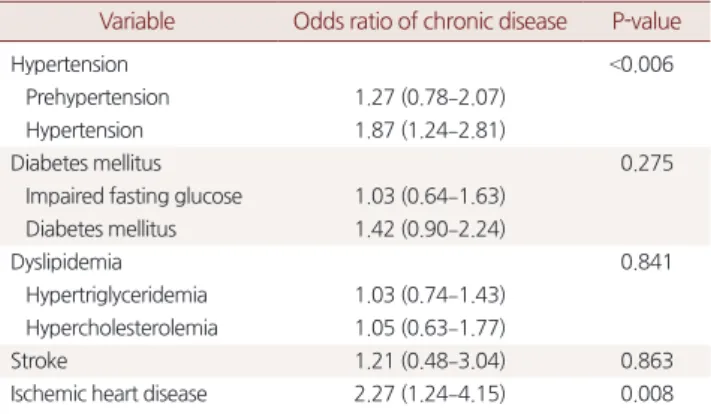
3. High sensitivity C-reactive protein 군에 따른 만성질환 이환 교차비
Table 3
에는hs-CRP
군에 따른 만성질환 이환 교차비를 제시하였 다. 혈중hs-CRP
가3
.0 mg
/L
이상으로 높은 군에서 고혈압 교차비 는1
.87
배(1
.24–2
.81
), 허혈성 심질환 교차비는2
.27
배(1
.24–4
.15
) 증가 하였다. 고혈압 전단계, 공복혈당장애, 당뇨병, 고지혈증, 뇌졸중에 는CRP
군에 따른 질환 이환 위험도의 차이가 없었다.4. High sensitivity C-reactive protein 상승에 영향을 주는 요인 분석
일반적, 산부인과적 특성 중
hs-CRP
군에 따른 통계적 차이가 있 었던 연령, 체질량지수, 흡연력, 유산소 운동 실천, 임신 경험, 경구 피임약 복용 경험을 요인으로 설정하여high hs-CRP
가 될 교차비를 복합표본 로지스틱 회귀분석을 이용하여 분석하였다(Table 4
).Model 1
은 특정 변수로 보정하지 않은 결과이며,Model 2
는 연령, 체 질량지수로 보정한 모형,Model 3
,4
,5
는Model 2
에 사회경제적 지 표, 건강행위 요인, 부인과적 요인을 차례로 보정 변수로 추가한 모 형이다.Model 1
에서는high hs-CRP
군에 속할 교차비가 연령이10
세 증가할 때1
.20
배(1
.00–1
.43
), 체질량지수가0
.5 kg
/m
2 증가할 때1
.05
배(1
.03–1
.08
), 평생5
갑 이상 흡연 경험이 있는 경우1
.84
배(1
.01–
3
.37
) 증가하였으며, 유산소 운동 실천(0
.68
배[0
.48–0
.96]
), 임신 경험 (0
.40
배[0
.18–0
.93]
), 경구피임약 복용 경험(0
.68
배[0
.46–0
.99]
)이 있는 경우 교차비가 감소하였다. 평생5
개비 이상의 흡연 경험이 있는 경 우high hs-CRP
군에 속하게 될 교차비가 보정 변수가 추가될수록 값이 커졌다. 임신 경험이 있는 경우 미임부와 비교하여Model 2
,3
,4
,5
에서도high hs-CRP
군이 될 교차비가 통계적으로 의미 있게 감 소하였다. 유산소 신체활동 실천, 경구피임약 복용 경험은 다변량 분석시high hs-CRP
군이 될 교차비에 미치는 영향의 방향성은Model 1
과 같았으나 통계적으로 의미는 없었다.Table 3. Odds ratios of chronic diseases in relation to high hs-CRP level (≥0.3 mg/dL) in postmenopausal women
Variable Odds ratio of chronic disease P-value
Hypertension <0.006
Prehypertension 1.27 (0.78–2.07)
Hypertension 1.87 (1.24–2.81)
Diabetes mellitus 0.275
Impaired fasting glucose 1.03 (0.64–1.63) Diabetes mellitus 1.42 (0.90–2.24)
Dyslipidemia 0.841
Hypertriglyceridemia 1.03 (0.74–1.43) Hypercholesterolemia 1.05 (0.63–1.77)
Stroke 1.21 (0.48–3.04) 0.863
Ischemic heart disease 2.27 (1.24–4.15) 0.008
Values are presented as odds ratio (95% confidence interval).
hs-CRP, high sensitivity C-reactive protein.
Table 4. Logistic regression analysis of the relation between variables and high hs-CRP level (≥0.3 mg/dL) in postmenopausal women Variable Odds ratio (95% confidence interval) of a high hs-CRP level
Mode 1a Model 2b Model 3c Model 4d Model 5e
Age 1.20 (1.00–1.43) 1.17 (0.97–1.41) 1.13 (0.90–1.42) 1.10 (0.87–1.38) 1.12 (0.87–1.45)
BMI 1.05 (1.03–1.08) 1.05 (1.03–1.08) 1.05 (1.03–1.08) 1.05 (1.03–1.08) 1.06 (1.03–1.08)
Smoking (over a lifetime)
<Five pack 1 1 1 1 1
≥Five pack 1.84 (1.01–3.37) 1.97 (1.06–3.63) 2.06 (1.12–3.78) 2.15 (1.18–3.90) 2.15 (1.20–3.88) Aerobic exercise activity
No 1 1 1 1 1
Yes 0.68 (0.48–0.96) 0.76 (0.53–1.08) 0.78 (0.54–1.13) 0.81 (0.56–1.16) 0.83 (0.51–1.20)
Gravidity
0 (nulligravida) 1 1 1 1 1
≥1 0.40 (0.18–0.93) 0.36 (0.16–0.81) 0.35 (0.15–0.80) 0.38 (0.15–0.95) 0.34 (0.13–0.89)
Oral contraceptive
No 1 1 1 1 1
Yes 0.68 (0.46–0.99) 0.65 (0.44–0.97) 0.68 (0.45–1.02) 0.71 (0.47–1.06) 0.75 (0.49–1.14)
hs-CRP, high sensitivity C-reactive protein; BMI, body mass index.
aUnadjusted.
bAdjusted by age, BMI.
cAdjusted by age, BMI, socioeconomic status (region, houseresidential area, household income, house income, education level).
dAdjusted by age, BMI, socioeconomic status (region, houseresidential area, household income, education level), health behaviors (smoking, alcohol drinking, aerobic exercise, strength exercise).
eAdjusted by age, BMI, socioeconomic status (region, house residential area, household income, education level), health behaviors (smoking, alcohol drinking, aerobic exercise, strength exercise), obstetric characteristics (menarche age, menopause age, gravidity, oral contraceptive).
Jae Kyung Kim, et al. Factors Associated with CRP in Postmenopausal Women
Korean Journal of Family Practice
KJFP
고 찰
전신적인 염증반응의 생물학적 표지자로 사용되어온
hs-CRP
가 심혈관계 질환과 관련이 있음이 여러 연구에서 밝혀졌으며14) 폐경 후 여성을 대상으로 한 선행 연구에서hs-CRP
가 심혈관 질환에 대 한 가장 강력한 단일 예측인자라는 연구 결과가 보고되었다.4)본 연구는 제
7
기1–2
년차 국민건강영양조사에 참여한 폐경 후 여 성을CDC
/AHA
기준을 이용하여hs-CRP
가 높은 군과 낮은 군으로 분류하여hs-CRP
상승 요인을 분석하였다.CDC
/AHA
이 제시한 절 단점을 한국인에게 그대로 적용 할 수 있는지에 대해서는 추가적인 연구가 필요하다. 본 연구에서 고혈압, 심근경색과 협심증의 유병율 이high hs-CRP
에서 통계적으로 의미 있게 높았으며,high hs-CRP
군에서 고혈압과 허혈성 심질환에 이환될 교차비가 증가하였다. 그 러나 뇌졸중은CRP
군과 연관성이 없었다.hs-CRP
와 뇌졸중의 관 계에 대한 메타분석연구에 의하면CRP
상승이 허혈성 뇌졸중 발생 위험을 높이는 것으로 나타났으나 출혈성 뇌졸중에는 영향을 미치 지 않았다.16) 국민건강영양평가 자료는 허혈성 뇌졸중과 출혈성 뇌 졸중을 분류하여 유병율을 제시하고 있지 않기 때문에CRP
와 뇌졸 중의 관계가 명확하게 나타나지 않았을 수 있다.폐경 후 여성의
hs-CRP
에 영향을 준 요소는 연령, 체질량지수, 흡 연력, 유산소 운동 실천 여부, 임신 또는 경구피임약 복용 경험이었 다. 연령과 체질량지수 증가에 따른hs-CRP
의 증가는 선행 연구에 서도 관찰되었다. 노화는 낮은 수준의 만성염증으로 받아들여지고 있다.17) 또한, 여러 선행 연구를 통해 비만과hs-CRP
의 상관성이 보 고되었다.18) 그러나 체질량지수만으로 비만을 평가하는 것은 한계가 있으며, 일본인을 대상으로 한 연구에서 체질량지수보다 내장지방 량이hs-CRP
농도 예측에 더 유효하다는 보고도 있었다.19) 따라서 한국인에서 지방의 분포, 실체 체지방량 등이hs-CRP
에 미치는 영 향에 대한 분석을 통해 비만과hs-CRP
에 대한 추가적인 연구가 필 요할 것이다.건강행위 변수 중
CRP
에 영향을 주는 것은 흡연 경험과 유산소 운동실천 여부였다. 흡연과CRP
의 연관성은 여러 선행 연구에서도 관찰되었다.20) 흡연에 의해 치주염, 호흡기염증 등의 만성염증상태 가 발생하여hs-CRP
가 증가할 수 있으며, 흡연에 의해 발생한 활성 산소와 같은 물질들이 대식세포를 자극하여 염증성 사이토카인을 생성하게 한다는 연구 결과가 있다.21) 단변량 분석에서 유산소 운동 을 실천하는 경우high hs-CRP
군에 속할 가능성이 높았으며, 근력 운동 실천은 영향이 없었다. 선행연구에 의하면 운동 종류, 기간에 따라CRP
등 염증반응에 미치는 영향이 다르게 나타났다.22) 운동이 지질대사와 체중, 체질량지수에 영향을 주어CRP
감소를 유발한다는 주장이 제기되었으며23) 몇몇 연구는 규칙적 운동이 염증반응을 감소시키며, 운동량이 많을수록 혈중
hs-CRP
의 농도가 낮다고 보고 하고 있다.24)부인과적 요인 중에서는 단변량 분석 시 임신 경험, 경구피임약 복용 경험이
high hs-CRP
군에 속할 위험을 낮추는 요인으로 나타 났으며 출산여부, 모유수여 경험 여부는hs-CRP
에 영향이 없었다.임신 경험 여부가
hs-CRP
에 미치는 영향에 대한 연구는 거의 없으 나 임신 경험이 배란 횟수에 영향을 주기 때문으로 생각해 볼 수 있 다. 배란이 일종의 염증반응 이라는 주장이 있다.25) 그러나 본 연구 에서 배란횟수에 영향을 줄 수 있는 다른 부인과적 요인은CRP
에 영향이 없는 것으로 나타났다. 초경, 폐경 연령은 회상오류 가능성 이 더 크기 때문일 수 있으나, 가임기 동안의 배란 횟수의 감소가 폐 경 후에hs-CRP
에 실제로 영향을 미치는지에 대해서는 추가적인 검 증이 필요하다. 본 연구에서 관찰된 경구피임약 복용 경험에 의한hs-CRP
감소도 배란 횟수 감소에 의한 것으로 생각해 볼 수 있으며3
세대 경구피임약 복용이hs-CRP
를 감소시킨다는 선행 연구 결과 보고도 있었다.26) 그러나 반대의 결과도 발표되었으며27) 경구피임약 과CRP
에 관한 선행 연구들은 가임기 여성을 대상으로 하고 있기 때문에 본 연구 결과와 비교하기는 어렵다. 여러 임상연구에서 폐경 후 여성에서의 경구적 에스트로겐의 투여는CRP
를 증가시켰다.28) 경구피임약과 폐경 후 호르몬 요법은 각각 사용되는 약제의 구성 성분 및 용량 등이 다르기 때문에CRP
와의 연관성에도 차이가 있 을 것으로 생각된다.본 연구는 다음과 같은 제한점을 갖는다. 먼저, 앞서 언급한 것처 럼 심혈관 질환의 위험도를 평가하기 위해
CDC
/AHA
가 제시한 절 단점이 한국인에서도 유용한지에 대한 추가적인 검증이 필요하다.또한, 본 연구는 국민건강영양조사를 이용한 단면 연구로, 조사가 이루어진 시점의
hs-CRP
수준이 추후 실제로 심혈관 질환 등에 어 떠한 영향을 미쳤는지 추적 조사하기 어려우며, 실험실 검사를 제 외한 자가 응답식 설문 문항에 대해서는 회상 오류 등이 있을 수 있 다.결론적으로, 우리나라의 폐경 후 여성에서 고연령, 높은 체질량 지수, 흡연 경험이
hs-CRP
증가와 관련성이 높으며, 적절한 유산소 운동의 실천, 임신경험, 경구피임약 복용 경험은CRP
증가 위험을 낮추는 것으로 나타났다.CRP
는 폐경 후 여성에서 심혈관 질환의 강력한 예측인자 및 독립적 위험인자이므로 폐경 후 여성에서hs-
CRP
와 관련성 있는 요인 중 체질량지수, 흡연 경험, 유산소 운동 실 천 여부와 같은 교정 가능한 요인을 적극적으로 관리할 필요가 있 음을 본 연구를 통해 알 수 있었다.김재경 외. 폐경 후 여성에서 C-반응 단백에 영향을 미치는 요인 Korean Journal of Family Practice
KJFP
요 약
연구배경: 폐경 후 여성에서 혈중
high sensitivity C-reactive protein
(hs-CRP
) 농도의 상승이 심혈관 질환에 대한 예측인자이자 위험인 자라는 연구 결과가 발표되었다. 그러나 폐경 후 여성을 대상으로CRP
상승 요인을 분석한 국내 연구는 부족한 실정이다.방법:
2016–2017
년 국민건강영양조사 결과를 이용하여 폐경 후 여 성2
,739
명을 연구 대상자로 선정하였다.Centers for Disease Control and Prevention
/American Heart Association
에서 제시한 심혈관계 질 환 발생 위험도 분류에 근거하여hs-CRP 3
.0 mg
/L
을 절단점으로hs- CRP
가 낮은 군과 높은 군으로 연구 대상자를 분류하였다.Chi- square test
와 독립표본t-
검정을 이용하여 두 군 사이의 일반적, 부인 과적 특성의 차이를 살펴보고, 로지스틱 회귀분석을 시행하여hs- CRP
에 영향을 주는 인자를 분석하였다.결과: 폐경 후 여성 중 낮은
hs-CRP
군은76
.4
%, 높은hs-CRP
군은23
.6
%였으며, 평균 나이연령, 체질량지수는hs-CRP
가 높은 군에서 더 높았다.hs-CRP
가 높은 군에서 고혈압, 허혈성 심질환 이환 교차 비가 증가하였다. 단변량 분석 시 고령, 높은 체질량지수, 흡연 경험 이hs-CRP
를 증가시켰으며, 유산소 운동 실천, 임신 경험, 경구피임 약 복용 경험은 이를 감소시켰다. 다변량 모델에서도 고령, 높은 체 질량지수, 흡연 경험은hs-CRP
를 증가시키는 것으로 나타났으며,hs- CRP
를 감소시키는 요인 중에서는 임신 경험만 통계적 의미가 있었 다.결론: 우리나라의 폐경 후 여성에서 고령, 높은 체질량지수, 흡연 경 험이
hs-CRP
를 증가시키는 것으로 나타났다. 심혈관 질환의 예측지 표이자 위험인자로 작용하는hs-CRP
를 낮추기 위해 교정 가능한 요 인을 적극적으로 관리할 필요하다.중심단어:
C-
반응 단백; 폐경; 여성; 심혈관계 위험인자 CONFLICT OF INTERESTNo potential conflict of interest relevant to this article was reported
. ORCIDJae Kyung Kim
,https
://orcid
.org
/0000-0003-3393-1760 Da Woon Moon
,https
://orcid
.org
/0000-0002-4611-5183 Yeon Tak Chung
,https
://orcid
.org
/0000-0002-9570-9180 Hye Yun Kim
,https
://orcid
.org
/0000-0003-0855-1715
Jin Ah Han
,https
://orcid
.org
/0000-0001-5401-3833 Jin Wook Kim
,https
://orcid
.org
/0000-0001-9584-0974
REFERENCES
1. Hanke H, Hanke S, Bruck B, Brehme U, Gugel N, Finking G, et al. Inhibition of the protective effect of estrogen by progesterone in experimental athero- sclerosis. Atherosclerosis 1996; 121: 129-38.
2. Gebara OC, Mittleman MA, Sutherland P, Lipinska I, Matheney T, Xu P, et al. Association between increased estrogen status and increased fibrinolytic potential in the Framingham Offspring Study. Circulation 1995; 91: 1952-8.
3. Rossouw JE. Hormones, genetic factors, and gender differences in cardio- vascular disease. Cardiovasc Res 2002; 53: 550-7.
4. Ridker PM, Hennekens CH, Buring JE, Rifai N. C-reactive protein and other markers of inflammation in the prediction of cardiovascular disease in women. N Engl J Med 2000; 342: 836-43.
5. Danesh J, Wheeler JG, Hirschfield GM, Eda S, Eiriksdottir G, Rumley A, et al. C-reactive protein and other circulating markers of inflammation in the prediction of coronary heart disease. N Engl J Med 2004; 350: 1387-97.
6. Danesh J, Whincup P, Walker M, Lennon L, Thomson A, Appleby P, et al.
Low grade inflammation and coronary heart disease: prospective study and updated meta-analyses. BMJ 2000; 321: 199-204.
7. Lagrand WK, Visser CA, Hermens WT, Niessen HW, Verheugt FW, Wolbink GJ, et al. C-reactive protein as a cardiovascular risk factor: more than an epi- phenomenon? Circulation 1999; 100: 96-102.
8. Yeh ET. CRP as a mediator of disease. Circulation 2004; 109(21 Suppl 1):
II11-4.
9. de Maat MP, Trion A. C-reactive protein as a risk factor versus risk marker.
Curr Opin Lipidol 2004; 15: 651-7.
10. Li JJ, Fang CH. C-reactive protein is not only an inflammatory marker but also a direct cause of cardiovascular diseases. Med Hypotheses 2004; 62:
499-506.
11. Pearson TA, Mensah GA, Alexander RW, Anderson JL, Cannon RO 3rd, Criqui M, et al. Markers of inflammation and cardiovascular disease: appli- cation to clinical and public health practice: a statement for healthcare pro- fessionals from the Centers for Disease Control and Prevention and the American Heart Association. Circulation 2003; 107: 499-511.
12. Saito M, Ishimitsu T, Minami J, Ono H, Ohrui M, Matsuoka H. Relations of plasma high-sensitivity C-reactive protein to traditional cardiovascular risk factors. Atherosclerosis 2003; 167: 73-9.
13. Roberts WL, Moulton L, Law TC, Farrow G, Cooper-Anderson M, Savory J, et al. Evaluation of nine automated high-sensitivity C-reactive protein methods: implications for clinical and epidemiological applications. Part 2.
Clin Chem 2001; 47: 418-25.
14. Myers GL, Rifai N, Tracy RP, Roberts WL, Alexander RW, Biasucci LM, et al.
CDC/AHA workshop on markers of inflammation and cardiovascular dis- ease: application to clinical and public health practice: report from the labo- ratory science discussion group. Circulation 2004; 110: e545-9.
15. Ministry of Health and Welfare. The physical activity guide for Koreans [In- ternet]. 2014. [cited 2019 Aug 1]. Available from: http://health.cdc.go.kr/
health/ReferenceRoomArea/HealthFileRoom/healthFileDetail.do?ED_
NO=1851.
Jae Kyung Kim, et al. Factors Associated with CRP in Postmenopausal Women
Korean Journal of Family Practice
KJFP
16. Zhou Y, Han W, Gong D, Man C, Fan Y. Hs-CRP in stroke: a meta-analysis.
Clin Chim Acta 2016; 453: 21-7.
17. Rea IM, Gibson DS, McGilligan V, McNerlan SE, Alexander HD, Ross OA.
Age and age-related diseases: role of inflammation triggers and cytokines.
Front Immunol 2018; 9: 586.
18. Timpson NJ, Nordestgaard BG, Harbord RM, Zacho J, Frayling TM, Tyb- jærg-Hansen A, et al. C-reactive protein levels and body mass index: eluci- dating direction of causation through reciprocal Mendelian randomization.
Int J Obes (Lond) 2011; 35: 300-8.
19. Tsuriya D, Morita H, Morioka T, Takahashi N, Ito T, Oki Y, et al. Significant correlation between visceral adiposity and high-sensitivity C-reactive pro- tein (hs-CRP) in Japanese subjects. Intern Med 2011; 50: 2767-73.
20. Kim SK, Park JA, Ham SK, Shin MW, Yu EH, Sohn YH. The relation of high- sensitivity C-reactive protein with metabolic syndrome in Korean adults:
based on the Korean Health and Nutrition Examination Survey, 2015. Ko- rean J Fam Pract 2018; 8: 684-9.
21. Tappia PS, Troughton KL, Langley-Evans SC, Grimble RF. Cigarette smok- ing influences cytokine production and antioxidant defences. Clin Sci (Lond) 1995; 88: 485-9.
22. King DE, Carek P, Mainous AG 3rd, Pearson WS. Inflammatory markers and exercise: differences related to exercise type. Med Sci Sports Exerc 2003;
35: 575-81.
23. Tchernof A, Nolan A, Sites CK, Ades PA, Poehlman ET. Weight loss reduces C-reactive protein levels in obese postmenopausal women. Circulation 2002; 105: 564-9.
24. Kasapis C, Thompson PD. The effects of physical activity on serum C-reac- tive protein and inflammatory markers: a systematic review. J Am Coll Car- diol 2005; 45: 1563-9.
25. Capobianco G, de Muro P, Cherchi GM, Formato M, Lepedda AJ, Cigliano A, et al. Plasma levels of C-reactive protein, leptin and glycosaminoglycans during spontaneous menstrual cycle: differences between ovulatory and anovulatory cycles. Arch Gynecol Obstet 2010; 282: 207-13.
26. Cauci S, Di Santolo M, Culhane JF, Stel G, Gonano F, Guaschino S. Effects of third-generation oral contraceptives on high-sensitivity C-reactive protein and homocysteine in young women. Obstet Gynecol 2008; 111: 857-64.
27. van Rooijen M, Hansson LO, Frostegård J, Silveira A, Hamsten A, Bremme K. Treatment with combined oral contraceptives induces a rise in serum C- reactive protein in the absence of a general inflammatory response. J Thromb Haemost 2006; 4: 77-82.
28. Lakoski SG, Herrington DM. Effects of hormone therapy on C-reactive protein and IL-6 in postmenopausal women: a review article. Climacteric 2005; 8: 317-26.