서 론
C-reactive protein (CRP)은 proinflammatory cytokine에 반응하여 hepatocyte에 의해 합성·분비되는 물질로, acute phase protein 중의 하나이며1) CRP의 혈청 농도는 만성적인 low-grade inflammation의
좋은 biomarker이다.2) 이러한 만성 염증은 암, 죽상 동맥 경화 질환 및 제2형 당뇨를 비롯한 다양한 질병의 발병 기전과 연관이 있으며3-5) CRP는 여러 다른 염증 마커와 비교하여 심혈관 위험의 강력한 예측 인자로 알려져 있다.6)
커피의 chlorogenic acid 및 caffeic acid와 같은 성분은 항염증7) 및
Received July 30, 2018 Revised September 30, 2018 Accepted October 17, 2018
Corresponding author Young Sung Kim Tel: +82-31-900-0433, Fax: +82-31-900-0340 E-mail: [email protected]
ORCID: http://orcid.org/0000-0002-4990-3783
Copyright © 2019 The Korean Academy of Family Medicine
This is an open-access article distributed under the terms of the Creative Commons At- tribution Non-Commercial License (http://creativecommons.org/licenses/by-nc/4.0) which permits unrestricted noncommercial use, distribution, and reproduction in any medium, provided the original work is properly cited.
Original Article
https://doi.org/10.21215/kjfp.2019.9.2.216 eISSN 2233-9116
Korean J Fam Pract. 2019;9(2):216-223
Korean Journal of Family Practice
KJFP
한국 성인 남녀에서의 커피 및 녹차 섭취량과 C -Reactive
Protein과의 관계: 2015-2016년도 국민건강영양조사를 이용하여
박주현
1, 김영성
2,*, 정한얼
1, 이혜준
1, 박성배
21연세대학교 의과대학 가정의학교실, 2국민건강보험 일산병원 가정의학과
The Relationship between Coffee and Green Tea Consumption and C-Reactive Protein in Korean Men and Women: Using the Korea National Health and Nutrition Examination Survey, 2015-2016
Joo Hyun Park1, Young Sung Kim2,*, Hanul Chong1, Hye Jun Lee1, Sung Bae Park2
1Department of Family Medicine, Yonsei University College of Medicine, Seoul; 2Department of Family Medicine, National Health Insurance Service Ilsan Hospital, Goyang, Korea
Background: C-reactive protein (CRP) is known as a strong predictor of cardiovascular risk compared with several other inflammatory markers. Coffee and green tea components, such as chlorogenic acid, caffeic acid, and polyphenol are known to have anti-inflammatory and antioxidative properties. The purpose of this study was to investigate the relationship between coffee and green tea consumption and CRP levels in Korean adults.
Methods: The study included 3,031 people who participated in the Korea National Health and Nutrition Examination Survey, sixth (2015) and seventh year (2016). In order to analyze the characteristics according to coffee and green tea consumption, continuous variables were presented as mean and standard error, and analysis of variance was performed. Multiple linear regression analysis was used to confirm the correlation between coffee and green tea consumption and CRP levels.
Results: There was no significant correlation between coffee consumption and CRP level. In case of green tea consumption, the correlation was not significant in women. The regression coefficients and standard errors were -0.26 (-0.51 to -0.01) with the consumption of one cup or less, -0.40 (-1.06 to 0.25) with the consumption of two cups, and -0.55 (-0.89 to -0.20) with the consumption of three cups or more in men, demonstrating a decrease in CRP levels with an increase in green tea consumption.
Conclusion: There was no significant relationship between coffee consumption and serum CRP levels in Korean adults. Serum CRP levels decreased significantly as the intake increased among men who consumed green tea compared with the men in the control group.
Keywords: Coffee; Green Tea; C-Reactive Protein; Anti-Inflammatories; Anti-Oxidants
박주현 외. 한국 성인 남녀에서의 커피 및 녹차 섭취량과 C-Reactive Protein과의 관계 Korean Journal of Family Practice
KJFP
항산화작용8)을 하는 것으로 알려져 있으며, 이전의 연구를 통해 커 피의 섭취가 다양한 만성 질환의 유병률9) 및 사망률 감소10)와 연관 이 있음이 보고 되었으며, 이러한 항염증 및 항산화 효과로 인해 커 피의 섭취가 CRP를 낮추는 효과가 있는 것으로 보고 되었다.11,12) 녹 차 역시 antioxidant flavonoids의 중요한 source로13) 녹차의 섭취가 산 화 스트레스의 관리와 내피 기능장애에 유리한 효과가 있으며14) 녹 차의 polyphenol 성분이 항산화 효과에 의해 항염작용을 하는 것으 로 알려져 있다.15) 녹차는 이전의 연구에서는 만성적인 섭취가 CRP 를 감소시키는 것으로 보고되었으나16) 최근의 연구에서는 CRP 감소 와 연관성이 없는 것으로 보고된 바 있다.11,15,17,18) 이와는 반대로 흡연, 비만, 폐기능 저하 등은 CRP 증가와 연관이 있는 것으로 보고되어 있다.19-21)
아직까지 우리나라에는 커피 및 녹차 섭취와 CRP 간의 연관성에 대한 연구는 없으며, 본 연구에서는 국민건강영양조사 자료를 이용 하여 한국 성인 남녀에서 커피 및 녹차의 섭취량과 CRP의 관계에 대 해 알아보고자 하였다.
방 법
1. 연구 대상
본 연구는 한국질병관리본부에서 시행한 국민건강영양조사 중 제6기 3차년도(2015년),22) 제7기 1차년도(2016년)23) 자료를 가중치 비 율 1:1로 통합하여 사용하였다. 국민건강영양조사는 국민의 건강행 태, 만성질환 유병현황, 식품 및 영양섭취실태에 관한 법정 조사로, 가구원 확인조사, 건강설문조사, 검진조사, 영양조사를 통해 자료를 수집하였다.
조사 중 식품섭취빈도조사 응답 대상자를 고려하여 20세 이상부 터 64세까지의 성인 남녀를 대상으로 하였고, 만성질환(고혈압, 고지 혈증, 뇌혈관질환, 협심증, 심근경색증, 관절염, 류마티스성 관절염, 천식, 만성 폐쇄성 폐질환, 만성신장질환) 진단자 및 체질량지수 (body mass index, BMI) 25 kg/m2 이상, 연구변수에 결측값이 있는 경 우는 배제하였다. 최초 대상자 15,530명 중 만 20–64세인 경우는 8,990명이었고, 이 중 만성질환 해당 및 BMI 25 kg/m2 이상인 경우를 제외하면 4,290명이었으며, 최종적으로 이 중 연구변수에 결측값이 없는 3,031명(여: 2,036명, 남: 995명)을 대상자로 하였다. 커피 및 녹차 섭취량, 나이, 체질량지수, 수축기 혈압, 흡연자, 음주, 공복혈당, 총콜 레스테롤, high density lipoprotein (HDL) cholesterol, triglycerides (TG), low density lipoprotein (LDL) cholesterol, white blood cells (WBC)는 CRP에 영향을 줄 수 있는 요인으로 생각하여 통계 분석 시 보정하 였다. 제외기준 및 혼란변수 설정은 혈중 CRP를 이용한 선행 연구들
을 참고하였다.19,20,24)
2. 연구 자료
국민건강영양조사는 건강설문조사, 영양조사, 검진조사의 세 부 분으로 이루어져 있다. 건강설문조사에서는 성별, 연령, 흡연력, 음주 력, 만성 질환별 이환, 영양 조사 부분에서는 식품섭취빈도조사, 검 진조사에서는 체질량지수, 혈압 및 혈액검사 자료를 이용하였다.
3. 커피 및 녹차 섭취량 조사
영양 조사 중 식품섭취빈도조사는 만 19–64세를 대상으로 112항 목의 음식에 대해 조사하였으며, 그 중 커피 및 녹차 섭취량에 대해 서는 최근 1년간 평균 섭취빈도, 1회 평균 섭취량에 대해 응답자가 설 문지에 대답한 것을 토대로 본 연구에서는 거의 섭취하지 않음, 하루 1잔 이하, 하루 2잔, 하루 3잔 이상 섭취군의 네 군으로 분류하였다.
4. CRP
CRP는 Immunoturbidimetry법을 이용하여 Roche Cardiac C-Reac- tive Protein High Sensitive (Roche, Mannheim, Germany)의 kit를 이용 하였다. 무증상 성인에서 CRP의 상승은 기존 연구에 근거하여 2.2 mg/L 이상인 경우를 상승된 것으로 간주하였다.19,20,24)
5. 통계분석
남녀 각각 커피 섭취량, 녹차 섭취량에 따른 범주형 변수의 빈도와 가중 백분율을 제시하고 Rao-Scott 보정을 적용한 카이제곱 검정 (chi-square test)을 실시하였으며, 연속형 변수의 평균과 표준오차를 제시하고 분산분석(ANOVA)을 실시하였다. 남녀 각각 커피, 녹차 섭 취량과 CRP 간 연관성을 확인하기 위해 다중선형회귀분석(multiple linear regression analysis)을 실시하였다. 모형 1에서는 무보정한 분석 을 실시하였고, 모형 2에서는 커피 및 녹차 섭취량, 나이, BMI, 수축기 혈압, 현재 흡연, 현재 음주, 공복혈당, 총 콜레스테롤, HDL, TG, LDL, WBC 변수를 보정하였다. 커피, 프림, 설탕 녹차 섭취량에 따른 CRP 증가의 빈도와 가중 백분율을 제시하고 Rao-Scott 보정을 적용한 카 이제곱 검정(chi-square test)을 실시하였다.
분석 프로그램은 IBM SPSS 23 (IBM Co., Armonk, NY, USA)을 사 용하였고, 복합표본설계에 맞는 방법으로 분석을 실시하였다.
결 과
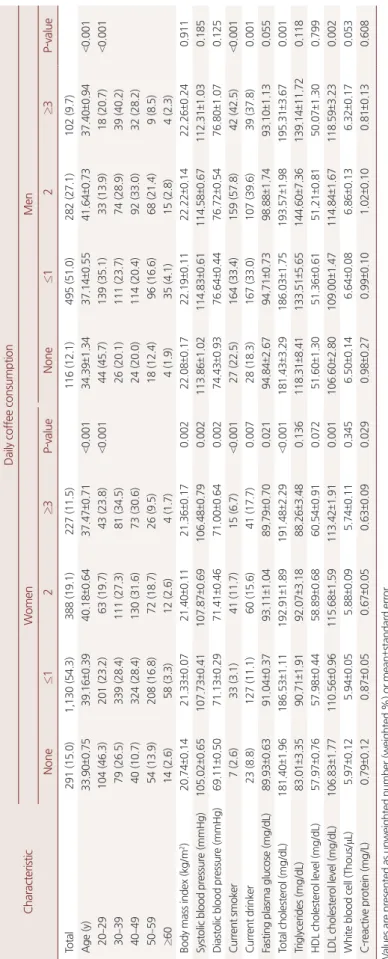
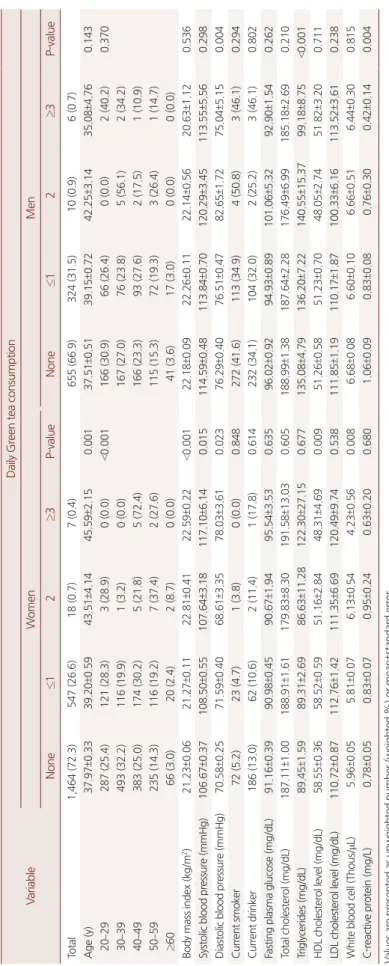
연구에 포함된 3,031명의 20–64세 성인 남녀를 하루 커피 및 녹차 섭취량으로 4개 군으로 나누었으며, 각 군에 따른 임상적인 특징은
Original Article
Korean Journal of Family Practice
Joo Hyun Park, et al. The Relationship between Coffee and Green Tea Consumption and CRP
Korean Journal of Family Practice
KJFP
Table 1. Characteristics of study participants by categories of coffee consumption Characteristic
Daily coffee consumption WomenMen None≤12≥3P-valueNone≤12≥3P-value Total291 (15.0)1,130 (54.3)388 (19.1)227 (11.5)116 (12.1)495 (51.0)282 (27.1)102 (9.7) Age (y)33.90±0.7539.16±0.3940.18±0.6437.47±0.71<0.00134.39±1.3437.14±0.5541.64±0.7337.40±0.94<0.001 20–29104 (46.3)201 (23.2)63 (19.7)43 (23.8)<0.00144 (45.7)139 (35.1)33 (13.9)18 (20.7)<0.001 30–3979 (26.5)339 (28.4)111 (27.3)81 (34.5)26 (20.1)111 (23.7)74 (28.9)39 (40.2) 40–4940 (10.7)324 (28.4)130 (31.6)73 (30.6)24 (20.0)114 (20.4)92 (33.0)32 (28.2) 50–5954 (13.9)208 (16.8)72 (18.7)26 (9.5)18 (12.4)96 (16.6)68 (21.4)9 (8.5) ≥6014 (2.6)58 (3.3)12 (2.6)4 (1.7)4 (1.9)35 (4.1)15 (2.8)4 (2.3) Body mass index (kg/m2)20.74±0.1421.33±0.0721.40±0.1121.36±0.170.00222.08±0.1722.19±0.1122.22±0.1422.26±0.240.911 Systolic blood pressure (mmHg)105.02±0.65107.73±0.41107.87±0.69106.48±0.790.002113.86±1.02114.83±0.61114.58±0.67112.31±1.030.185 Diastolic blood pressure (mmHg)69.11±0.5071.13±0.2971.41±0.4671.00±0.640.00274.43±0.9376.64±0.4476.72±0.5476.80±1.070.125 Current smoker7 (2.6)33 (3.1)41 (11.7)15 (6.7)<0.00127 (22.5)164 (33.4)159 (57.8)42 (42.5)<0.001 Current drinker23 (8.8)127 (11.1)60 (15.6)41 (17.7)0.00728 (18.3)167 (33.0)107 (39.6)39 (37.8)0.001 Fasting plasma glucose (mg/dL)89.93±0.6391.04±0.3793.11±1.0489.79±0.700.02194.84±2.6794.71±0.7398.88±1.7493.10±1.130.055 Total cholesterol (mg/dL)181.40±1.96186.53±1.11192.91±1.89191.48±2.29<0.001181.43±3.29186.03±1.75193.57±1.98195.31±3.670.001 Triglycerides (mg/dL)83.01±3.3590.71±1.9192.07±3.1888.26±3.480.136118.31±8.41133.51±5.65144.60±7.36139.14±11.720.118 HDL cholesterol level (mg/dL)57.97±0.7657.98±0.4458.89±0.6860.54±0.910.07251.60±1.3051.36±0.6151.21±0.8150.07±1.300.799 LDL cholesterol level (mg/dL)106.83±1.77110.56±0.96115.68±1.59113.42±1.910.001106.60±2.80109.00±1.47114.84±1.67118.59±3.230.002 White blood cell (Thous/μL)5.97±0.125.94±0.055.88±0.095.74±0.110.3456.50±0.146.64±0.086.86±0.136.32±0.170.053 C-reactive protein (mg/L)0.79±0.120.87±0.050.67±0.050.63±0.090.0290.98±0.270.99±0.101.02±0.100.81±0.130.608 Values are presented as unweighted number (weighted %) or mean±standard error. HDL, high density lipoprotein; LDL, low density lipoprotein. P-values are from Rao-scott χ2 test or ANOVA.
박주현 외. 한국 성인 남녀에서의 커피 및 녹차 섭취량과 C-Reactive Protein과의 관계 Korean Journal of Family Practice
KJFP
Table 2. Characteristics of study participants by categories of green tea consumption Variable
Daily Green tea consumption WomenMen None≤12≥3P-valueNone≤12≥3P-value Total1,464 (72.3)547 (26.6)18 (0.7)7 (0.4)655 (66.9)324 (31.5)10 (0.9)6 (0.7) Age (y)37.97±0.3339.20±0.5943.51±4.1445.59±2.150.00137.51±0.5139.15±0.7242.25±3.1435.08±4.760.143 20–29287 (25.4)121 (28.3)3 (28.9)0 (0.0)<0.001166 (30.9)66 (26.4)0 (0.0)2 (40.2)0.370 30–39493 (32.2)116 (19.9)1 (3.2)0 (0.0)167 (27.0)76 (23.8)5 (56.1)2 (34.2) 40–49383 (25.0)174 (30.2)5 (21.8)5 (72.4)166 (23.3)93 (27.6)2 (17.5)1 (10.9) 50–59235 (14.3)116 (19.2)7 (37.4)2 (27.6)115 (15.3)72 (19.3)3 (26.4)1 (14.7) ≥6066 (3.0)20 (2.4)2 (8.7)0 (0.0)41 (3.6)17 (3.0)0 (0.0)0 (0.0) Body mass index (kg/m2)21.23±0.0621.27±0.1122.81±0.4122.59±0.22<0.00122.18±0.0922.26±0.1122.14±0.5620.63±1.120.536 Systolic blood pressure (mmHg)106.67±0.37108.50±0.55107.64±3.18117.10±6.140.015114.59±0.48113.84±0.70120.29±3.45113.55±5.560.298 Diastolic blood pressure (mmHg)70.58±0.2571.59±0.4068.61±3.3578.03±3.610.02376.29±0.4076.51±0.4782.65±1.7275.04±5.150.004 Current smoker72 (5.2)23 (4.7)1 (3.8)0 (0.0)0.848272 (41.6)113 (34.9)4 (50.8)3 (46.1)0.294 Current drinker186 (13.0)62 (10.6)2 (11.4)1 (17.8)0.614232 (34.1)104 (32.0)2 (25.2)3 (46.1)0.802 Fasting plasma glucose (mg/dL)91.16±0.3990.98±0.4590.67±1.9495.54±3.530.63596.02±0.9294.93±0.89101.06±5.3292.90±1.540.262 Total cholesterol (mg/dL)187.11±1.00188.91±1.61179.83±8.30191.58±13.030.605188.99±1.38187.64±2.28176.49±6.99185.18±2.690.210 Triglycerides (mg/dL)89.45±1.5989.31±2.6986.63±11.28122.30±27.150.677135.08±4.79136.20±7.22140.55±15.3799.18±8.75<0.001 HDL cholesterol level (mg/dL)58.55±0.3658.52±0.5951.16±2.8448.31±4.690.00951.26±0.5851.23±0.7048.05±2.7451.82±3.200.711 LDL cholesterol level (mg/dL)110.72±0.87112.76±1.42111.35±6.69120.49±9.740.538111.85±1.19110.17±1.87100.33±6.16113.52±3.610.238 White blood cell (Thous/μL)5.96±0.055.81±0.076.13±0.544.23±0.560.0086.68±0.086.60±0.106.66±0.516.44±0.300.815 C-reactive protein (mg/L)0.78±0.050.83±0.070.95±0.240.63±0.200.6801.06±0.090.83±0.080.76±0.300.42±0.140.004 Values are presented as unweighted number (weighted %) or mean±standard error. HDL, high density lipoprotein; LDL, low density lipoprotein. P-values are from Rao-scott χ2 test or ANOVA.
Joo Hyun Park, et al. The Relationship between Coffee and Green Tea Consumption and CRP
Korean Journal of Family Practice
KJFP
Tables 1, 2와 같다. 여성의 경우 CRP와 커피 섭취량 간 차이는 유의미 하였으며(P=0.029) 남성의 경우 차이가 유의미하지 않았다(P=0.608) (Table 1). 또한, 여성은 CRP와 녹차 섭취량 간 차이는 유의미하지 않 았으며(P=0.680) 남성의 경우 CRP와 녹차 섭취량 간 차이가 유의미 하였다(P=0.004) (Table 2).
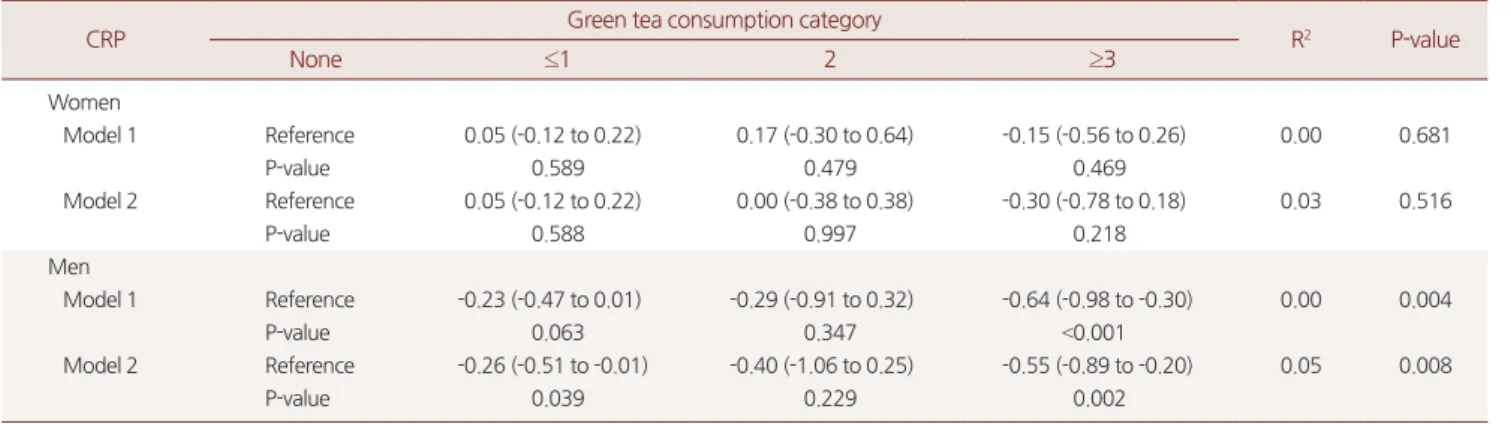
남녀 각각 커피, 녹차 섭취량과 CRP간 연관성을 확인하기 위해 시 행한 다중선형회귀분석(multiple linear regression analysis)에서 커피 섭취의 경우 남녀 모두 연관성이 유의한 경우가 없었다(Table 3). 녹 차 섭취는 여성의 경우 연관성이 유의한 경우가 없었으며, 남성의 경 우 각각의 회귀계수 및 표준오차는 1잔 이하 섭취군에서는 -0.26 (-0.51 to -0.01), 2잔 섭취군에서는 -0.40 (-1.06 to 0.25), 3잔 이상 섭취군 에서는 -0.55 (-0.89 to -0.20)로 녹차 섭취량이 증가할수록 CRP가 감 소하였으며 none일때에 비해 1잔 이하인 경우와(β=-0.26, P<0.05), 3 잔 이상일 때의(β=-0.55, P=0.002) 부적 영향이 유의하였다(Table 4).
커피, 프림, 설탕 및 녹차 섭취량과 상승된 CRP 빈도의 관계를 Ta- ble 5에 정리하였다. 전체 대상자 3,031명 중 229명(7.3%)이 상승된 CRP 수치를 보였으며 각각의 섭취량과 혈중 CRP 농도에는 연관성 이 유의미한 경우가 없었다.
고 찰
한국 성인 남녀에서 커피 섭취량과 혈중 CRP 농도는 유의미한 관 계가 없었으며, 녹차 섭취량에 있어서는 남성의 경우 섭취하지 않은 군과 비교하여 섭취량이 증가할수록 혈중 CRP 농도가 유의미하게 감소하였다.
Maki 등11)의 일본 성인 남녀 10,325명을 대상으로 한 연구에서는 알코올 섭취 50 g/day 이상인 남성에서 커피 섭취와 CRP 농도가 역의 상관관계가 있었으나 여성에서는 상관관계가 없어 이를 통해 커피
Table 3. Association between coffee consumption and CRP
CRP Coffee consumption category
R2 P-value
None ≤1 2 ≥3
Women
Model 1 Reference 0.07 (-0.17 to 0.32) -0.12 (-0.38 to 0.14) -0.16 (-0.46 to 0.13) 0.00 0.029
P-value 0.552 0.364 0.285
Model 2 Reference 0.05 (-0.20 to 0.29) -0.10 (-0.35 to 0.16) -0.12 (-0.40 to 0.17) 0.03 0.159
P-value 0.697 0.463 0.412
Men
Model 1 Reference 0.01 (-0.55 to 0.57) 0.04 (-0.51 to 0.58) -0.17 (-0.75 to 0.41) 0.00 0.608
P-value 0.970 0.895 0.565
Model 2 Reference -0.01 (-0.54 to 0.53) -0.12 (-0.68 to 0.44) -0.17 (-0.72 to 0.38) 0.05 0.779
P-value 0.975 0.679 0.546
Values are from multiple linear regression analysis and expressed as β (95% confidence interval).
Model 1 was unadjusted. Model 2 was adjusted for green tea consumption, age, body mass index, systolic blood pressure, smoking group (current/non-smoker), alco- hol group (current/non-drinker), fasting glucose, total cholesterol, high density lipoprotein cholesterol, triglyceride, low density lipoprotein cholesterol, white blood cells.
CRP, C-reactive protein.
Table 4. Association between green tea consumption and CRP
CRP Green tea consumption category
R2 P-value
None ≤1 2 ≥3
Women
Model 1 Reference 0.05 (-0.12 to 0.22) 0.17 (-0.30 to 0.64) -0.15 (-0.56 to 0.26) 0.00 0.681
P-value 0.589 0.479 0.469
Model 2 Reference 0.05 (-0.12 to 0.22) 0.00 (-0.38 to 0.38) -0.30 (-0.78 to 0.18) 0.03 0.516
P-value 0.588 0.997 0.218
Men
Model 1 Reference -0.23 (-0.47 to 0.01) -0.29 (-0.91 to 0.32) -0.64 (-0.98 to -0.30) 0.00 0.004
P-value 0.063 0.347 <0.001
Model 2 Reference -0.26 (-0.51 to -0.01) -0.40 (-1.06 to 0.25) -0.55 (-0.89 to -0.20) 0.05 0.008
P-value 0.039 0.229 0.002
Values are from multiple linear regression analysis and expressed as β (95% confidence interval).
Model 1 was unadjusted. Model 2 was adjusted for coffee consumption, age, body mass index, systolic blood pressure, smoking group (current/non-smoker), alcohol group (current/non-drinker), fasting glucose, total cholesterol, high density lipoprotein cholesterol, triglyceride, low density lipoprotein cholesterol, white blood cells.
CRP, C-reactive protein.
박주현 외. 한국 성인 남녀에서의 커피 및 녹차 섭취량과 C-Reactive Protein과의 관계 Korean Journal of Family Practice
KJFP
가 전신적인 염증보다는 알코올에 의한 간장 염증(hepatic inflamma- tion)을 예방할 수 있다는 가설을 세울 수 있었으며, 녹차 섭취량은 남녀 모두에서 CRP 농도와 상관관계가 없었다. 반면 Kotani 등12)의 일본 성인 여성 459명을 대상으로 한 연구에서는 커피를 하루 1잔 이 상 섭취한 그룹에서는 1잔 미만 섭취한 그룹보다 CRP 농도가 약 20%
낮게 나타났다.
본 연구 결과에서는 변수를 보정하기 전 분석에서(Tables 1, 2) 여성 의 경우 커피 섭취와 CRP가 유의미한 차이를 보였으며(P=0.029), 남 성에서는 유의미한 차이를 보이지 않았다(P=0.608). 회귀분석에서 는 변수를 보정한 결과 남녀 모두 연관성이 유의미한 경우가 없었다 (Table 3). 이는 선행 연구와는 다른 결과로, 우리나라의 커피 섭취 양 상이 믹스커피와 같은 혼합물 상태의 제품을 섭취하는 경향이 있어 단순히 커피의 성분만으로 이루어진 섭취를 토대로 한 조사로 보기 는 어렵기 때문인 것으로 생각된다.
Serban 등15)의 연구에 의하면 11개의 randomized controlled trials에 대한 메타분석에서 녹차 카테킨 보충제가 혈장 CRP 농도에 유의미 한 효과를 나타내지 않았으며, Basu 등18)의 연구에서도 녹차 음료 또 는 추출물 보충제는 무처리군에 비해 혈장 Serum Amyloid A를 선택 적으로 낮추지만 CRP, interleukin (IL)-6, IL-1β 또는 대사 증후군의 특징을 포함한 염증 마커에는 영향을 미치지 않았다. 그러나 본 연
구에서는 남성의 경우 녹차 섭취량과 CRP가 음의 상관관계를 보였 으며(Table 4) 이는 녹차의 polyphenol 성분의 항산화 및 항염증 작용 을 반영한 결과로 생각된다. 이러한 결과를 토대로 우리나라 커피 섭 취와 CRP의 관계에 대한 면밀한 분석을 위해 혼합물이 첨가되지 않 은 커피 섭취에 대한 조사를 기반으로 한 연구가 필요할 것으로 생 각된다.
본 연구는 몇 가지 제한점이 있다. 첫째, 본 연구는 단면연구이므 로 커피 및 녹차 섭취량과 혈중 CRP 간의 연관성은 제시할 수 있으 나 상호 인과관계를 설명하는 데는 한계가 있다. 둘째, 국민건강영양 조사에서는 설문의 한계로 인하여 커피를 카페인 커피와 디카페인 커피로 나누어 조사하지 않았으며, 한국 커피 섭취의 특성 상 커피, 프림, 설탕을 복합적으로 섭취하는 경우가 많으나 커피 섭취의 종류 와 양 및 카페인의 총량이 정량화되지 않아 정확한 분석에 한계가 있었다. 셋째, 호르몬 대체요법을 받는 폐경기 여성의 경우 CRP가 증 가하고 심혈관질환 위험률 증가와 연관이 있다는 보고가 있으나 본 연구에서는 이러한 점이 고려되지 않았으며, 본 연구 대상자에 포함 된 50세 이상 여성은 22.0%로 높은 비중을 차지하고 있어 여성의 녹 차 섭취량과 CRP의 관계 분석에서 이러한 점이 고려 되어야 할 것으 로 생각된다. 넷째, 연구 대상자들의 신체계측과 혈액검사를 1회 측 정했으므로 재측정에 따른 결과의 차이가 있을 수 있어 CRP를 연구 에 활용하기 위해서는 2회 이상 측정하여 평균값을 구하는 작업이 필요할 것으로 생각된다.
결론적으로 한국 성인 남녀에서 커피 섭취량과 혈중 CRP 농도는 유의미한 관계가 없었으며, 녹차 섭취량에 있어서는 남성의 경우 섭 취하지 않은 군과 비교하여 섭취량이 증가할수록 혈중 CRP 농도가 유의미하게 감소하였다. 추후 한국인을 대상으로 한 커피 섭취와 CRP의 관계에 대한 추가적인 연구가 필요할 것으로 생각되며, 커피 와 녹차 섭취 외에도 카페인 섭취와 관련된 확대 연구가 필요할 것으 로 생각된다.
CONFLICT OF INTEREST
No potential conflict of interest relevant to this article was reported.
요 약
연구배경:
C-reactive protein (CRP)는 다른 염증 마커와 비교하여 심 혈관 위험의 강력한 예측 인자로 알려져 있으며, 커피 및 녹차의 chlorogenic acid 및 caffeic acid, polyphenol과 같은 성분은 항염증 및 항산화작용을 하는 것으로 알려져 있다. 아직까지 우리나라에는 커 Table 5. Elevated CRP (≥2.2 mg/L) by coffee and green tea consumptionVariables Number (%) Number of
elevated CRP (%) P-value
Total 3,031 (100.0) 229 (7.3)
Daily coffee consumption 0.510
None 407 (13.8) 28 (13.1)
≤1 1,625 (53.0) 133 (57.6)
2 670 (22.4) 48 (21.2)
≥3 329 (10.8) 20 (8.1)
Daily cream consumption 0.763
None 1,170 (38.8) 88 (42.3)
≤1 1,476 (47.6) 111 (44.1)
2 358 (12.7) 28 (12.7)
≥3 27 (0.9) 2 (0.9)
Daily sugar consumption 0.998
None 1,150 (38.0) 76 (37.9)
≤1 1,486 (48.0) 121 (47.8)
2 367 (13.1) 30 (13.4)
≥3 28 (0.9) 2 (0.9)
Daily Green tea consumption 0.610
None 2,119 (70.1) 157 (71.6)
≤1 871 (28.6) 68 (26.8)
2 28 (0.8) 3 (1.4)
≥3 13 (0.6) 1 (0.3)
Values are expressed as unweighted number (weighted %).
CRP, C-reactive protein.
P-values are from Rao-scott χ2 test.
Joo Hyun Park, et al. The Relationship between Coffee and Green Tea Consumption and CRP
Korean Journal of Family Practice
KJFP
피 및 녹차 섭취와 CRP 간의 연관성에 대한 연구는 없는 상태로, 본 연구에서는 국민건강영양조사 자료를 이용하여 한국 성인남녀에서 커피 및 녹차의 섭취량과 CRP의 관계에 대해 알아보고자 하였다.
방법:
국민건강영양조사 중 제6기 3차년도(2015년), 제7기 1차년도 (2016년) 자료를 이용하였으며 연구변수에 결측값이 없는 3,031명을 대상자로 하였다. 커피 및 녹차 섭취량에 따른 경향 분석을 위해 연 속형 변수의 평균과 표준오차를 제시하고 분산분석(ANOVA)을 실 시하였으며, 커피, 녹차 섭취량과 CRP 간 연관성을 확인하기 위해 다 중선형회귀분석(multiple linear regression analysis)을 실시하였다.결과:
커피 및 녹차 섭취량과 CRP와의 관계를 확인하기 위해 혼란 변수를 보정한 후 시행한 다중선형회귀분석에서는 커피의 경우 연 관성이 유의미한 경우가 없었고, 녹차 섭취의 경우 여성에서는 연관 성이 유의미한 경우가 없었으나 남성의 경우 각각의 회귀계수 및 표 준오차는 1잔 이하 섭취군에서는 -0.26 (-0.51 to -0.01), 2잔 섭취군에 서는 -0.40 (-1.06 to 0.25), 3잔 이상 섭취군에서는 -0.55 (-0.89 to -0.20) 로 녹차 섭취량이 증가할수록 CRP가 감소하였다.결론:
한국 성인 남녀에서 커피 섭취량과 혈중 CRP 농도는 유의미 한 관계가 없었으며, 녹차 섭취량에 있어서는 남성에서 섭취하지 않 은 군과 비교하여 섭취량이 증가할수록 혈중 CRP 농도가 유의미하 게 감소하였다.중심단어:
커피; 녹차; C-Reactive Protein; 항염증작용; 항산화작용 ORCID박주현, http://orcid.org/0000-0002-9980-4222 김영성, http://orcid.org/0000-0002-4990-3783 정한얼, http://orcid.org/0000-0002-7978-4973 이혜준, http://orcid.org/0000-0001-5810-9787 박성배, http://orcid.org/0000-0001-8939-8737
REFERENCES
1. Pepys MB, Hirschfield GM. C-reactive protein: a critical update. J Clin In- vest 2003; 111: 1805-12.
2. Pearson TA, Mensah GA, Alexander RW, Anderson JL, Cannon RO 3rd, Criqui M, et al. Markers of inflammation and cardiovascular disease: appli- cation to clinical and public health practice: a statement for healthcare pro- fessionals from the Centers for Disease Control and Prevention and the American Heart Association. Circulation 2003; 107: 499-511.
3. Coussens LM, Werb Z. Inflammation and cancer. Nature 2002; 420: 860-7.
4. Danesh J, Whincup P, Walker M, Lennon L, Thomson A, Appleby P, et al.
Low grade inflammation and coronary heart disease: prospective study and updated meta-analyses. BMJ 2000; 321: 199-204.
5. Wellen KE, Hotamisligil GS. Inflammation, stress, and diabetes. J Clin Invest 2005; 115: 1111-9.
6. Ridker PM, Hennekens CH, Buring JE, Rifai N. C-reactive protein and other markers of inflammation in the prediction of cardiovascular disease in women. N Engl J Med 2000; 342: 836-43.
7. Chang WC, Chen CH, Lee MF, Chang T, Yu YM. Chlorogenic acid attenu- ates adhesion molecules upregulation in IL-1beta-treated endothelial cells.
Eur J Nutr 2010; 49: 267-75.
8. Sato Y, Itagaki S, Kurokawa T, Ogura J, Kobayashi M, Hirano T, et al. In vitro and in vivo antioxidant properties of chlorogenic acid and caffeic acid. Int J Pharm 2011; 403: 136-8.
9. Higdon JV, Frei B. Coffee and health: a review of recent human research.
Crit Rev Food Sci Nutr 2006; 46: 101-23.
10. Loftfield E, Freedman ND, Graubard BI, Guertin KA, Black A, Huang WY, et al. Association of coffee consumption with overall and cause-specific mortality in a large US prospective cohort study. Am J Epidemiol 2015; 182:
1010-22.
11. Maki T, Pham NM, Yoshida D, Yin G, Ohnaka K, Takayanagi R, et al. The re- lationship of coffee and green tea consumption with high-sensitivity C-re- active protein in Japanese men and women. Clin Chem Lab Med 2010; 48:
849-54.
12. Kotani K, Tsuzaki K, Sano Y, Maekawa M, Fujiwara S, Hamada T, et al. The relationship between usual coffee consumption and serum C-reactive pro- tein level in a Japanese female population. Clin Chem Lab Med 2008; 46:
1434-7.
13. Hertog MG, Kromhout D, Aravanis C, Blackburn H, Buzina R, Fidanza F, et al. Flavonoid intake and long-term risk of coronary heart disease and cancer in the seven countries study. Arch Intern Med 1995; 155: 381-6.
14. Cabrera C, Artacho R, Giménez R. Beneficial effects of green tea--a review. J Am Coll Nutr 2006; 25: 79-99.
15. Serban C, Sahebkar A, Antal D, Ursoniu S, Banach M. Effects of supplemen- tation with green tea catechins on plasma C-reactive protein concentra- tions: a systematic review and meta-analysis of randomized controlled trials.
Nutrition 2015; 31: 1061-71.
16. Steptoe A, Gibson EL, Vuononvirta R, Hamer M, Wardle J, Rycroft JA, et al.
The effects of chronic tea intake on platelet activation and inflammation: a double-blind placebo controlled trial. Atherosclerosis 2007; 193: 277-82.
17. Koutelidakis AE, Rallidis L, Koniari K, Panagiotakos D, Komaitis M, Zamp- elas A, et al. Effect of green tea on postprandial antioxidant capacity, serum lipids, C-reactive protein and glucose levels in patients with coronary artery disease. Eur J Nutr 2014; 53: 479-86.
18. Basu A, Du M, Sanchez K, Leyva MJ, Betts NM, Blevins S, et al. Green tea minimally affects biomarkers of inflammation in obese subjects with meta- bolic syndrome. Nutrition 2011; 27: 206-13.
19. Choun JK, Paek YJ, Byun JS, Park KH, Song HJ, Cho JJ. The association be- tween C-reactive protein and smoking characteristics among Korean men. J Korean Acad Fam Med 2005; 26: 621-8.
20. Hwang JS, Lee SH, Park HS. The association between C-reactive protein and obesity among Korean men. J Korean Acad Fam Med 2003; 24: 68-63.
21. Lee JU, Paek YJ. The relationship between reduced lung function and high sensitive C-reactive protein in healthy adult men. J Korean Acad Fam Med
박주현 외. 한국 성인 남녀에서의 커피 및 녹차 섭취량과 C-Reactive Protein과의 관계 Korean Journal of Family Practice
KJFP
2007; 28: 860-6.
22. Korea Centers for Disease Control and Prevention. The sixth Korea Na- tional Health and Nutrition Examination Survey (KNHANES VI-3). Os- ong: Korea Centers for Disease Control and Prevention; 2015.
23. Korea Centers for Disease Control and Prevention. The seventh Korea Na-
tional Health and Nutrition Examination Survey (KNHANES VII-1). Os- ong: Korea Centers for Disease Control and Prevention; 2016.
24. Visser M, Bouter LM, McQuillan GM, Wener MH, Harris TB. Elevated C- reactive protein levels in overweight and obese adults. JAMA 1999; 282:
2131-5.