서 론
우리나라에서도 경제 성장과 함께 서구화된 생활 습관으로 인해 심혈관계 위험과 관련된 질환이 증가하고 있다.
2018
년 우리나라 질 병사망원인 통계에 의하면 심장질환에 의한 사망률은 남자 인구10
만명당
60
.9
명, 여자63
.9
명으로 사망원인 남녀 각각2
위이며, 뇌혈 관질환에 의한 사망률은 남자 인구10
만명당42
.7
명, 여자46
.7
명으 로 사망원인 남녀 각각4
위,3
위를 차지하고 있다.1)이에 죽상경화증(
atherosclerosis
)에 대한 관심이 증가하였으며, 고 감도C-
반응성 단백(high-sensitivity C-reactive protein
,hs-CRP
)이 전Received July 20, 2020 Revised October 28, 2020 Accepted November 22, 2020
Corresponding author Sunmi Kim Tel: +82-33-258-2401, Fax: +82-33-258-2165 E-mail: [email protected]
ORCID: https://orcid.org/0000-0002-8801-3353
Copyright © 2020 The Korean Academy of Family Medicine
This is an open-access article distributed under the terms of the Creative Commons At- tribution Non-Commercial License (http://creativecommons.org/licenses/by-nc/4.0) which permits unrestricted noncommercial use, distribution, and reproduction in any medium, provided the original work is properly cited.
Original Article
https://doi.org/10.21215/kjfp.2020.10.6.456 eISSN 2233-9116
Korean J Fam Pract. 2020;10(6):456-460
Korean Journal of Family Practice
KJFP
대한민국 성인에서 혈중 비타민 E의 농도와 혈중 고감도
C-반응성 단백 농도(High-Sensitivity C-Reactive Protein)의 연관성: 국민건강영양조사 자료 이용
김준태
1, 김선미
2,*
1강원대학교병원 가정의학과, 2강원대학교 의학전문대학원 가정의학과
Relationship between Serum Vitamin E Level and Serum High-Sensitivity C-Reactive Protein in Koreans: Based on National Health and Nutrition Survey
Juntae Kim1, Sunmi Kim2,*
1Department of Family Medicine, Kangwon National University Hospital; 2Department of Family Medicine, Kangwon National University School of Medicine, Chuncheon, Korea
Background: Inflammation plays a major role in atherothrombosis, and measuring inflammatory markers such as high-sensitivity C-reactive protein (hs-CRP) may provide a novel method for identifying individuals at high risk of plaque rupture. Atherogenesis results from the oxidation of lipids in low-density lipoprotein (LDL). Vitamin E facilitates the reduction in LDL-oxidation, and increases the antioxidant defense system. Therefore, our study aimed to examine the relationship between vitamin E and hs-CRP levels in Korean adults.
Methods: We used data from the Seventh Korea National Health and Nutrition Examination Survey (2016–2018). The study population included healthy adults aged >20 years. We investigated age, blood pressure, glucose levels, total cholesterol, triglyceride, high-density lipoprotein cholesterol, low-density lipoprotein cholesterol, body mass index, serum vitamin E, and serum hs-CRP levels. We analyzed the relationship between serum vitamin E and serum hs-CRP levels using multiple regression tests.
Results: On statistical analysis, vitamin E levels showed a positive correlation with hs-CRP levels in the female group and the total of the unadjusted model. However, the R2 value is low. After adjustment for factors that may affect hs-CRP, no significant correlation was observed between serum vitamin E and serum hs-CRP levels.
Conclusion: No significant correlation was observed between serum vitamin E and serum hs-CRP levels. Further research is needed on this topic.
Keywords: Vitamin E; High-Sensitivity C-Reactive Protein; Cardiovascular Disease; Antioxidant
김준태, 김선미. 혈중 비타민 E와 고감도 C-반응성 단백 농도의 연관성 Korean Journal of Family Practice
KJFP
신염증반응 표지자로서 죽상경화판(
atherosclerotic plaque
)의 불안정 성을 나타내며, 미래의 심혈관 질환의 중증도와 예후를 가늠할 수 있는 인자로 알려져 있다.2) 또한hs-CRP
의 상승은 염증, 노화, 암 등 과 연관이 있는 것으로 알려져 있으며, 협심증이나 관상동맥질환, 만성 폐쇄성 폐질환, 뇌졸중 등과의 연관성이 있는 것으로 보고되 고 있다.3-5) 한편 저밀도지단백 콜레스테롤(low density lipoprotein cholesterol
,LDL-C
)의 산화가 죽상경화증을 유발하는 것으로 보고 되었으며,6) 이 과정에서LDL-C
의 산화는 염증 전 반응으로IL-1
β와TNF-
α 및IL-6
의 분비를 증가시키며, 이때 분비된IL-6
는 간에서hs- CRP
를 분비하는 것으로 알려졌다.7) 이를 예방하기 위해 항산화제 가 관심을 불러일으키고 있으며,8) 비타민E
는 항산화 및 항염증 반 응으로LDL-C
의 산화를 막아주는 것으로 알려져 있다.9)최근의 연구에 의하면 고농도의 비타민
E
의 섭취군이 대조군과 비교했을 때,hs-CRP
가 더 낮게 나타났다고 보고하였다.10) 이 연구 에서는 고용량의 비타민E
복용에 대한 연구로, 정상인의 혈중 비타 민E
의 농도와hs-CRP
농도와의 관련에 대해서는 평가를 하지 못했 다고 할 수 있다.이에 본 연구에서는 질병관리본부에서 시행하는 국민건강영양조 사(
Korea National Health and Nutrition Examination Survey
,KNHANES
) 자료를 이용하여 비교적 건강한 사람에서 혈중 비타민E
의 농도와hs-CRP
농도와의 연관성을 조사해 보았다.방 법
1. 연구 대상
KNHANES
는 국민건강증진법 제16
조에 의거하여 한국 국민의 건 강행태, 만성질환 유병현황, 식품 및 영양섭취실태에 관한 법정조사 이다.본 연구는 횡단적 단면 연구로서 보건복지부 산하 질병관리본부 에서 시행하는
KNHANES
중 제7
기(2016–2018
) 국민건강영양조사에 참여한 대상19
,189
명 중 현재 전신적 질환, 염증성 질환,hs-CRP 10
이상인 대상 및 인구통계학적 특성에 결측치가 있는 대상을 제외한 만20
세 이상 성인3
,725
명(남성1
,718
명, 여성2
,007
명) 을 대상으로 분석하였다. 또한, 흡연자는 조사당시의 흡연자를 대상으로 하였으 며, 음주자는 조사당시를 기준으로 최근1
년 동안 월1
회 이상 음주 를 한 대상을 선택하여 분석하였다. 전신적 질환 및 염증성 질환으 로 현재 위암, 간암, 대장암, 유방암, 폐암, 갑상선암, 기타암, 뇌졸 중, 심근경색 또는 협심증, 관절염, 폐결핵, 천식, 갑상선 질환, 부비 동염, 중이염, 신부전,B
형간염,C
형간염, 간경변증을 제외하고 분 석하였다.2. 연구 방법
본 연구에서 혈중 비타민
E
를 보유한 정도를 평가하기 위한 검사 방법으로HPLC-FID
를 사용하였으며, 장비로는Agilent 1200
(Agilent
,Santa Clara
,CA
,USA
)가 혈중 비타민E
의 농도를 측정하기 위해 사 용되었다. 혈중 고감도C-
반응성 단백(hs-CRP
)을 보유한 정도에는Immunoturbidimetry
방법을 사용하였으며, 장비로는Cobas
(Roche
,Basel
,Switzerland
)가 혈중hs-CRP
농도를 측정하기 위해 사용되었다.기타 변수로는 연구 대상자들의 기본적인 특성을 파악하고,
hs- CRP
에 영향을 줄 수 있는 연령, 혈압, 혈당, 총 콜레스테롤, 중성지 방,high density lipoprotein
(HDL
) 콜레스테롤,LDL
콜레스테롤, 체질 량지수(body mass index
,BMI
), 흡연, 음주를 함께 고려하여 분석하 였다.10-12)3. 통계분석
본 연구에서는 수집된 자료를
IBM SPSS Statistics version 26
.0
(IBM Co
.,Armonk
,NY
,USA
)을 이용하여 분석하였다. 측정값들은 모두 소수점 첫째 자리까지 표시하였으며, 모든 검증의 통계 유의 수준은P<0
.05
,P<0
.01
로 설정하였다.대상자의 일반적인 특성은 남녀로 나누어 제시하였으며, 남녀 두 군 간의 평균 차이는
t-test
및chi-square test
를 통해 분석하였다. 또한 가설의 검증은 종속변수인hs-CRP
에 대해서 다중 회귀 분석을 통 해 분석하였으며, 혈중 비타민E
이외에 통계분석에 영향을 줄 수 있는 나이, 혈압, 혈당, 총 콜레스테롤, 중성지방,HDL
콜레스테롤,LDL
콜레스테롤,BMI
, 흡연, 음주 등을 모두 보정하였다.결 과
1. 대상자들의 일반적인 특성
분석 항목에 대한 결측값이 하나라도 있었던 대상자를 제외한 총 분석 인원은 총
3
,725
명이었다.Hs-CRP
에 영향을 줄 수 있는 비 타민E
농도를 포함한 기타 변수로 나이, 혈압, 혈당, 총 콜레스테롤, 중성지방,HDL
콜레스테롤,LDL
콜레스테롤,BMI
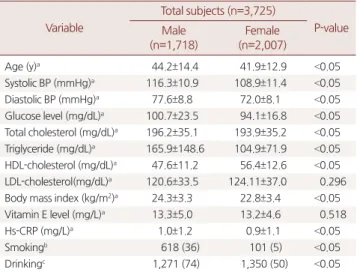
등을 함께 조사 하였고, 결과는 평균으로 제시하였으며, 흡연자와 음주자는 인원수 로 제시하였다(Table 1
).결과값은 남녀로 나누어 제시하였으며, 남녀 두 군 간의 평균 차 이는
t-test
및chi-square test
를 통해 분석하였고, 그 결과 나이, 수축 기혈압, 이완기혈압, 혈당, 총 콜레스테롤, 중성지방,HDL
콜레스테 롤,BMI
,hs-CRP
, 흡연자, 음주자는 유의한 평균 및 인원수에 차이 를 보였으나,LDL
콜레스테롤, 비타민E
는 남녀에 따라 평균치의 차 이를 보이지 않았다.Original Article
Korean Journal of Family Practice
Juntae Kim, Sunmi Kim. Relationship between Serum Vitamin E Level and Serum High-Sensitivity C-Reactive Protein
Korean Journal of Family Practice
KJFP
2. 비타민 E와 Hs-CRP와의 관계
비타민
E
와hs-CRP
와의 관계는 다중회귀분석을 시행하였으며,3
가지 모델을 통해 분석하였다. 모델1
은 다른 기타 변수의 보정 없이 비타민E
와hs-CRP
와의 관계를 보았으며, 그 결과 전체 분석 대상을 적용한 그룹과 여성 그룹에서 통계적으로 양의 상관관계를 보였으 나(<0
.01
),R
2값이 작아 설명력이 높지 않았다. 이와 함께 남성 그룹 의 분석결과는 통계적으로 유의하지 않았다.모델
2
는 나이, 혈압, 혈당, 총 콜레스테롤, 중성지방,HDL
콜레스 테롤,LDL
콜레스테롤,BMI
를 보정하여 진행하였다. 결과는 남녀 그룹 나누어서 분석한 결과 통계적으로 유의성을 보이지 않았고 (P=0
.978
,P=0
.186
), 남녀를 합친 그룹에서도 유의하지 못한 결과가 관찰되었다(P=0
.357
). 모델3
은 나이, 혈압, 혈당, 총콜레스테롤, 중 성지방,HDL
콜레스테롤,LDL
콜레스테롤,BMI
와 함께 흡연과 음 주를 보정하여 진행하였다. 이 모델 역시 남성 그룹, 여성 그룹, 남녀 합친 그룹에서 각각 유의하지 못한 결과를 보여주었다(P=0
.927
,P=0
.231
,P=0
.420
) (Table 2
).고 찰
심혈관 질환은 전세계적으로 사망률과 질병률의 주요 원인이다.
심혈관 질환은 여러 위험인자가 알려져 있지만, 비지질성 위험인자 로
hs-CRP
가 증가할수록 정상인에서 심근경색, 협심증의 위험도가 증가하며, 사망률 증가와도 연관되는 위험인자로 알려져 있다.2,13) 이 위험인자의 감소를 위해 항산화제인 고용량의 비타민E
보충이hs- CRP
를 낮춘다는 보고가 최근까지 있어 왔다.10,11,14-17) 그러나 국내에 서는 항산화 효과가 있는 혈장 비타민E
와hs-CRP
의 관계에 대한 연구가 미비한 실정이다. 이에 항산화제인 비타민E
의 혈장농도와hs-CRP
농도 간의 연관성을 알아보는 것은 의미 있는 연구라고 생각된다.
본 연구는 만
20
세 이상 대한민국 성인 인구를 대상으로 진행된 자료에 바탕하여 분석한 것이다. 연구 결과 혈중 비타민E
와hs-CRP
사이에 의미 있는 상관관계를 확인할 수 없었다. 기타 변수를 보정 하지 않은 분석에서는 여성 그룹과 남성과 여성을 합친 그룹에서 통 계적으로 유의성이 확인되었으나,R
2의 값이 작아 설명력이 높지 않 았다. 이는 임상적인 유의성은 없는 것으로 보인다.이들 그룹에서 통계적 유의성과 함께 비타민
E
와hs-CRP
와의 양 의 계수의 결과를 얻은 원인으로는hs-CRP
에 영향을 미칠 수 있는 변수들의 보정이 이루어지지 않았고, 또한hs-CRP
에 영향을 줄 수 있는 요소들을 전부 보정할 수 없었으므로 예상치 못한 결과를 보 였을 가능성이 있다.Hs-CRP
값은 심혈관의 상대적 위험도에 따라 분류된다.18) 낮은 위험도(<1 mg
/L
), 평균(2–3 mg
/L
), 높은 위험도(>3 mg
/L
)로 분류된 다. 이것은 본 연구에서 연구대상자의 일반적 특성에서 남녀 그룹의hs-CRP
농도 평균은 각각1
.0
±1
.2
와0
.9
±1
.1
이었다. 이 수치는 낮은 위험도에 속하는 값들로써vitamin E
의 혈중 농도가 증가해도hs- CRP
의 혈중 농도는 기저치를 유지하고 있기 때문에 두 연구 변수의 관계는 통계적으로 유의성 없음을 설명할 수 있는 이유일 것이다.Table 1. Baseline characteristics of subjects according to sex Variable
Total subjects (n=3,725)
P-value Male
(n=1,718)
Female (n=2,007)
Age (y)a 44.2±14.4 41.9±12.9 <0.05
Systolic BP (mmHg)a 116.3±10.9 108.9±11.4 <0.05
Diastolic BP (mmHg)a 77.6±8.8 72.0±8.1 <0.05
Glucose level (mg/dL)a 100.7±23.5 94.1±16.8 <0.05 Total cholesterol (mg/dL)a 196.2±35.1 193.9±35.2 <0.05 Triglyceride (mg/dL)a 165.9±148.6 104.9±71.9 <0.05 HDL-cholesterol (mg/dL)a 47.6±11.2 56.4±12.6 <0.05 LDL-cholesterol(mg/dL)a 120.6±33.5 124.11±37.0 0.296 Body mass index (kg/m2)a 24.3±3.3 22.8±3.4 <0.05
Vitamin E level (mg/L)a 13.3±5.0 13.2±4.6 0.518
Hs-CRP (mg/L)a 1.0±1.2 0.9±1.1 <0.05
Smokingb 618 (36) 101 (5) <0.05
Drinkingc 1,271 (74) 1,350 (50) <0.05
Values are presented as mean±standard deviation or number (%).
BP, blood pressure; HDL, high density lipoprotein; LDL, low density lipoprotein;
hs-crp, high sensitivity C-reactive protein.
aEach data was analyzed by t-test. bSmoking, cdrinking data was analyzed by chi- square test.
Table 2. Relationship between serum vitamin E level and hs-CRP by multiple regression analyses
Model Male Female Total
β R2 P-value β R2 P-value β R2 P-value
Model 1 0.003 0.000 0.563 0.020 0.006 <0.01 0.012 0.002 <0.01
Model 2 0.000 0.076 0.978 0.025 0.178 0.186 0.009 0.105 0.357
Model 3 -0.001 0.080 0.927 0.023 0.206 0.231 0.008 0.114 0.420
Model 1: No adjusted; Model 2: adjusted for age, sex, systolic blood pressure, diastolic blood pressure, glucose level, total cholesterol, triglyceride, HDL-cholesterol, LDL- cholesterol, body mass index; Model 3: adjusted for age, sex, systolic blood pressure, diastolic blood pressure, glucose level, total cholesterol, triglyceride, HDL-cholester- ol, LDL-cholesterol, body mass index, smoking, alcohol.
HDL, high density lipoprotein; LDL, low density lipoprotein.
김준태, 김선미. 혈중 비타민 E와 고감도 C-반응성 단백 농도의 연관성 Korean Journal of Family Practice
KJFP
Rafraf
등11)에 의하면hs-CRP
의 농도가 기저치인 당뇨환자에게 고용 량의vitamin E
를 복용시켰을 때hs-CRP
의 변화가 없었다는 연구결 과와 일치하는 것으로 생각된다.그리고 비타민
E
와hs-CRP
와 관련된 논문들은 고용량의 비타민E
섭취가hs-CRP
의 값을 낮출 수 있다고 보고되었다.10,16,19) 비타민E
의 혈중 평균농도는5
.7 mg
/L–20 mg
/L
로 알려져 있다.11) 본 논문의 연구 대상자들의 혈중 비타민E
농도의 평균은 남녀 그룹 각각13
.3
±5
.0
,13
.2
±4
.6
로서 평균범위 내의 값을 가지고 있다. 연구 대상 자들은 고농도의 비타민E
가 아니기에 통계적으로 유의한 결과를 얻지 못한 것으로 생각해 볼 수 있을 것이다.본 연구의 한계점은 단면 연구였다는 점과 연구 대상자들의
hs- CRP
의 평균이 낮은 위험도의 값에 분포되어 있어 변화를 고찰하기 에는 어려웠음을 들 수 있다. 또한 본 연구에서 여러 공변량을 보정 하였으나 그 밖에도hs-CRP
농도에 영향을 줄 수 있는 여러 요소들, 예를 들면 항산화 및 항염증 효과가 있는 것으로 알려져 있는 비타 민C
, 베타카로틴과 미네랄 셀레늄, 아연 등을 전부 보정할 수 없었 다는 점이다.그럼에도 불구하고 대한민국 인구집단을 대상으로 혈중의 비타 민
E
농도에 따른 혈중hs-CRP
농도의 연관성을 조사한 연구라는 점에서 의미가 있을 것으로 보인다.향후, 혈중
hs-CRP
농도에 영향을 줄 수 있는 요인들을 추가한 분 석연구가 필요할 것으로 생각되며, 또한 대한민국 인구집단을 대상 으로 고용량 비타민E
의 섭취가hs-CRP
농도에 미치는 영향뿐 아니 라, 식이 중 비타민E
의 섭취 증가가 혈중 비타민E
농도 및hs-CRP
농도에 미치는 영향에 대한 전향적 연구가 필요할 것으로 생각된다.요 약
연구배경: 고감도
C-
반응성 단백(high-sensitive C-reactive protein
,hs- CRP
)은 전신염증반응 표지자로서 죽상경화판(atherosclerotic plaque
) 의 불안정성을 나타내며, 미래의 심혈관 질환의 중증도와 예후를 가늠할 수 있는 인자로 알려져 있다. 한편,LDL
콜레스테롤의 산화 가 죽상경화증을 유발하는 것으로 보고되었으며, 비타민E
는 항산 화 및 항염증 반응으로LDL
콜레스테롤의 산화를 막아주는 것으로 알려져 있다. 이에 혈중 비타민E
농도와hs-CRP
농도의 연관성을 조사하고자 하였다.방법: 제
7
기(2016–2018
) 국민건강영양조사에 참여한 만20
세 이상의 성인 중 질환이 있는 대상을 제외한 남성1
,718
명, 여성2
,007
명을 대 상으로 하였다.Hs-CRP
에 영향을 줄 수 있는 연령, 혈압, 혈당, 총 콜레스테롤, 중성지방,HDL
콜레스테롤,LDL
콜레스테롤,BMI
, 흡연, 음주에 대한 변수를 보정하면서, 혈중 비타민
E
농도와 혈중hs- CRP
농도의 연관성을 분석하였다.결과: 변수를 보정하지 않는 모델
1
(model 1
)에서는 여성 그룹과 전 체 그룹에서 혈중 비타민E
와 혈중hs-CRP
농도와의 유의한 양의 상관관계가 있는 것으로 나타났으나,R
2의 값이 작아 유의성은 없는 것으로 보인다. 변수를 보정한 모델2
(model 2
), 모델3
(model 3
)은 남성 그룹, 여성 그룹 및 전체 그룹에서 통계적으로 유의성이 없었 다.결론: 결과적으로 혈중 비타민
E
농도와 혈중hs-CRP
농도와는 연 관성이 없었다. 향후 이 주제에 대한 추가적 연구가 필요할 것으로 생각된다.중심단어: 비타민
E
; 고민감도C-
반응성 단백; 심혈관 질환; 항산화제 CONFLICT OF INTERESTNo potential conflict of interest relevant to this article was reported
. ORCIDJuntae Kim
,https
://orcid
.org
/0000-0002-4628-3929 Sunmi Kim
,https
://orcid
.org
/0000-0002-8801-3353
REFERENCES
1. Statistics Korea. Cause of death statistics 2018. Daejeon: Statistics Korea;
2019.
2. Ridker PM. High-sensitivity C-reactive protein: potential adjunct for global risk assessment in the primary prevention of cardiovascular disease. Circu- lation 2001; 103: 1813-8.
3. Lichtenstern C, Brenner T, Bardenheuer HJ, Weigand MA. Predictors of survival in sepsis: what is the best inflammatory marker to measure? Curr Opin Infect Dis 2012; 25: 328-36.
4. Colak E, Majkic-Singh N, Zoric L, Radosavljevic A, Kosanovic-Jakovic N.
The role of CRP and inflammation in the pathogenesis of age-related mac- ular degeneration. Biochem Med (Zagreb) 2012; 22: 39-48.
5. Allin KH, Nordestgaard BG. Elevated C-reactive protein in the diagnosis, prognosis, and cause of cancer. Crit Rev Clin Lab Sci 2011; 48: 155-70.
6. Witztum JL, Steinberg D. Role of oxidized low density lipoprotein in athero- genesis. J Clin Invest 1991; 88: 1785-92.
7. Singh U, Devaraj S, Jialal I. Vitamin E, oxidative stress, and inflammation.
Annu Rev Nutr 2005; 25: 151-74.
8. Diaz MN, Frei B, Vita JA, Keaney JF Jr. Antioxidants and atherosclerotic heart disease. N Engl J Med 1997; 337: 408-16.
9. Thomas SR, Stocker R. Molecular action of vitamin E in lipoprotein oxida-
Juntae Kim, Sunmi Kim. Relationship between Serum Vitamin E Level and Serum High-Sensitivity C-Reactive Protein
Korean Journal of Family Practice
KJFP
tion: implications for atherosclerosis. Free Radic Biol Med 2000; 28: 1795- 805.
10. Schwab S, Zierer A, Schneider A, Heier M, Koenig W, Kastenmüller G, et al.
Vitamin E supplementation is associated with lower levels of C-reactive protein only in higher dosages and combined with other antioxidants: the Cooperative Health Research in the Region of Augsburg (KORA) F4 study.
Br J Nutr 2015; 113: 1782-91.
11. Rafraf M, Bazyun B, Sarabchian MA, Safaeiyan A, Ghaemmaghami Heza- veh SJ. Impact of vitamin E supplementation on blood pressure and hs-CRP in type 2 diabetic patients. Health Promot Perspect 2012; 2: 72-9.
12. Li Q, Dai Z, Cao Y, Wang L. Association of C-reactive protein and vitamin D deficiency with cardiovascular disease: a nationwide cross-sectional study from National Health and Nutrition Examination Survey 2007 to 2008.
Clin Cardiol 2019; 42: 663-9.
13. Futterman LG, Lemberg L. High-sensitivity C-reactive protein is the most effective prognostic measurement of acute coronary events. Am J Crit Care 2002; 11: 482-6.
14. Upritchard JE, Sutherland WH, Mann JI. Effect of supplementation with to- mato juice, vitamin E, and vitamin C on LDL oxidation and products of in-
flammatory activity in type 2 diabetes. Diabetes Care 2000; 23: 733-8.
15. Devaraj S, Jialal I. Alpha tocopherol supplementation decreases serum C- reactive protein and monocyte interleukin-6 levels in normal volunteers and type 2 diabetic patients. Free Radic Biol Med 2000; 29: 790-2.
16. Jialal I, Devaraj S, Venugopal SK. Oxidative stress, inflammation, and diabet- ic vasculopathies: the role of alpha tocopherol therapy. Free Radic Res 2002;
36: 1331-6.
17. Singh U, Jialal I. Anti-inflammatory effects of alpha-tocopherol. Ann N Y Acad Sci 2004; 1031: 195-203.
18. Pearson TA, Mensah GA, Alexander RW, Anderson JL, Cannon RO 3rd, Criqui M, et al. Markers of inflammation and cardiovascular disease: appli- cation to clinical and public health practice: a statement for healthcare pro- fessionals from the Centers for Disease Control and Prevention and the American Heart Association. Circulation 2003; 107: 499-511.
19. Wu JH, Ward NC, Indrawan AP, Almeida CA, Hodgson JM, Proudfoot JM, et al. Effects of alpha-tocopherol and mixed tocopherol supplementation on markers of oxidative stress and inflammation in type 2 diabetes. Clin Chem 2007; 53: 511-9.