서 론
주관적 건강 상태 평가(
self-reported health status
)란 자신의 신체적, 정신적. 건강을 포함하여 한 개인이 자신의 전반적인 건강에 대해 내린 평가 혹은 인식을 의미하는 지표로서,1) ‘당신의 건강에 대하여어떻게 생각하십니까?’라는 질문에 매우 좋음, 좋음, 보통, 나쁨, 매 우 나쁨으로 의사를 표시하도록 되어 있다.2)
주관적 건강 상태 평가는 여러 건강 관련 인자들과 연관성이 있 다고 평가되고 있는데,3) 특히 주관적 건강 상태가 사망률의 예측에 유의한 도움을 준다는 결론은 다수의 연구에서 일관성을 유지하고
Received August 10, 2018 Accepted August 16, 2019 Corresponding author Da-Hye Choi
Tel: +82-42-939-0314, Fax: +82-42-939-0567 E-mail: [email protected]
ORCID: https://orcid.org/0000-0002-0522-982X
Copyright © 2021 The Korean Academy of Family Medicine
This is an open-access article distributed under the terms of the Creative Commons At- tribution Non-Commercial License (http://creativecommons.org/licenses/by-nc/4.0) which permits unrestricted noncommercial use, distribution, and reproduction in any medium, provided the original work is properly cited.
Original Article
https://doi.org/10.21215/kjfp.2021.11.4.247 eISSN 2233-9116
Korean J Fam Pract. 2021;11(4):247-255
Korean Journal of Family Practice
KJFP
한국 성인에서 주관적 건강 상태 평가와 독감 예방 접종과의 연관성: 2014–2015년도 국민건강영양조사를 이용하여
안영인, 최다혜*, 이태영, 박성지, 정명철, 장 훈, 심근효
대전보훈병원 가정의학과
Association between Self-Reported Health Status and Influenza Vaccination in Korean Adults:
Analysis of the 2014–2015 Korea National Health and Nutrition Examination Survey
Young-In An, Da-Hye Choi*, Tae-Young Lee, Seong-Jee Park, Myung-Chul Jung, Hoon Jang, Geun-Hyo Shim Department of Family Medicine, Daejeon Veterans Hospital, Daejeon, Korea
Background: Many studies have shown that self-reported health status is related to current health status and various health-related factors. However, few studies have examined the association between self-reported health status and health promotion activities. Thus, this study was conducted to assess the association between self-reported health status and influenza vaccination.
Methods: In total, 9,825 adults aged 19 years or older who responded to the influenza vaccination questionnaire as part of the 6th Korean National Health and Nutrition Examination Survey (KNHANES, 2014–2015) were included. Related factors were grouped into three categories:
socioeconomic, medical, and health related. Univariate analysis was performed to investigate the relationship between influenza vaccination and each variable. Multivariate analysis was conducted by adjusting variables that were statistically significant in the univariate analysis.
Results: Multivariate analysis showed that the influenza vaccination rates were significantly lower in men, medium-highest income level earners, current smokers, and high-risk drinkers (P<0.05). In women, elementary school or lower education level, being married, and having a comorbidity were associated with higher vaccination rates (P<0.05). Although in all the subjects, influenza vaccination rate decreased with better self-reported health status, the association was not statistically significant (odds ratio [OR], 0.844; 95% confidence interval [CI], 0.711–1.002). However, subgroup analysis with respect to sex revealed that in women, better self-reported health status was associated with a lower likelihood of having an influenza vaccination (OR, 0.759; 95% CI, 0.606–0.950).
Conclusion: Better self-reported health status may be associated with lower influenza vaccination rates. There is a need for a strategy to increase the influenza vaccination rate among people with good self-reported health status.
Keywords: Health Status; Subjective; Influenza; Vaccination
Young-In An, et al. Self-Reported Health Status and Influenza Vaccination
Korean Journal of Family Practice
KJFP
있다.4-7) 또한, 현재 건강상태,8,9) 만성질환,10) 신체기능,11) 약물 복용 력,12) 삶의 질13) 등 다양한 요인들과의 관계에 대한 연구도 꾸준히 진행되었다.
하지만, 현재까지의 연구들은 주로 질환 이환율 및 사망률 등의 질병 관련된 지표나, 음주, 흡연 등의 건강을 위협하는 행태와의 연 관성에 주로 초점을 맞추고 있다.14,15) 적극적인 수준의 건강관련 행 태인 건강 검진 수검, 체중 및 식이 조절, 운동, 그리고 예방 접종 등 을 포함하는 이른바 ‘건강 증진 활동’의 주관적 건강 상태 평가와의 연관성에 대해서는 상대적으로 연구가 부족한 실정이다.16)
예방접종 사업은 국가관리하에 이루어지는 건강 증진 활동의 하 나로,17)
2001
년New England Journal of Medicine 3
월호Reichert
등18) 의 보고에 의하면, 일본에서1962
년부터1987
년까지 국가적 차원에 서 학생들을 대상으로 독감 예방 접종을 강제적으로 시행한 결과, 독감과 폐렴으로 인한 사망률이3
배 이상 감소하였다고 보고하였 다.본 연구는 국민건강영양조사 자료를 이용하여 대표적 건강 증진 활동인 독감 예방 접종이 주관적 건강 상태 평가와 갖는 연관성에 대해 분석하였다. 주관적 건강 상태 평가 지표와 더불어 삶의 질 평 가 항목인
Euro-Qol 5 Dimension 3 Level
(EQ-5D 3L
)과의 연관성도 분석하였다.방 법
1. 대상
본 연구는 질병관리본부 주관으로 시행된 제
6
기 국민건강영양조 사 자료 중2014
년과2015
년,2
개년 자료를 이용하였다. 독감 예방 접종 여부에 응답을 한 대상자 중에 모름, 무응답을 제외한19
세 이 상 성인을 대상으로 분석하였다. 총 조사 대상자14
,144
명 중, 결측 자료4
,319
명을 제외한9
,825
명으로, 남성4
,161
명과 여성5
,664
명을 대상으로 하였다.2. 조사 변수
지난
12
개월 내 독감 예방 접종 여부와 사회경제적 요인 및 의료 적 요인과 건강 행태에 관련된 내용을 설문을 통해 수집하였다.사회경제적인 요인으로 나이, 성별, 교육수준, 가구소득, 주거지 역, 결혼상태를 고려하였다. 교육수준의 경우, 초졸 이하, 중졸, 고 졸, 대졸 이상으로 분류하였고 가구소득은 소득 수준을 가구 균등 화 소득에 따라 조정한 값을 적용하여, 하, 중하, 중상, 상으로
4
분 위 분류하였다. 주거지역은 행정 명칭상 “동”으로 분류된 지역과“읍”, ”면”으로 분류된 지역으로 이분화하였고, 결혼상태는 결혼 유
지, 이혼이나 사별, 미혼으로 구분하였다.
건강행태로는 흡연력, 음주력, 규칙적인 운동 실천 여부를 조사 하였다. 흡연의 경우 비흡연, 과거 흡연, 현재 흡연으로 분류하였고, 과거 흡연의 경우 과거
100
개피 이상 흡연을 한 후 현재 금연상태의 경우로 정의하며 현재 흡연의 경우, 현재에도 흡연하는 경우로 정의 하였다. 음주의 경우 음주량에 대해, 한 달에 한 번 미만 음주하는 경우 비음주군, 한 달에 한 번 이상 음주하는 경우 음주군으로 분 류하였고, 한번에 마시는 음주량이 남성은7
잔 이상, 여성은5
잔 이 상일 경우 고위험 음주군으로 정의하였다. 규칙적인 운동 실천 여 부는, 일주일 평균150
분 이상 유산소 운동을 실천하는 경우를 실 천군으로, 아닌 경우를 비실천군으로 분류했다.의료적 요인으로는 동반질환 이환 유무를 조사하였다. 최근
2
주 내에 동반질환 진료를 위해, 병원 방문경험이 있는 경우를 동반질환 이환군으로 분류하였다.주관적 건강 상태 평가는 매우 좋음, 좋음, 보통, 나쁨, 매우 나쁨
5
단계로 답하도록 설문이 이루어졌으나, 본 연구에서는 좋음, 보통, 나쁨3
단계로 분류하여 연구하였다. 매우 좋음군은 좋음군에, 매우 나쁨군은 나쁨군에 포함시켰다.삶의 질 관리 정도 평가는 타당도 평가가 완료된
EQ-5D 3L
을 사 용하였고, 운동(mobility
), 자기관리(self-care
), 일상활동(usual- activity
), 통증/불편(pain
/discomfort
), 불안/우울(anxiety
/depression
),5
개의 항목별로 좋음, 보통, 나쁨3
단계로 응답하도록 조사가 이루어 졌다. 본 연구는 ‘전혀 지장이 없는 군’과 하위 항목 중, 경중에 상관 없이 ‘하나라도 지장이 있는 군’으로 분류하였다.3. 통계 분석
국민건강영양조사 자료에서 제시한 표본가중치를 적용하여
IBM SPSS Statistics ver
.23
.0
(IBM Co
.,Armonk
,NY
,USA
)을 사용하여 분 석하였다.독감 예방 접종 여부와 변수들의 연관성을 파악하기 위해 각 변 수에 대하여 카이 제곱 테스트를 이용하여 단변량 분석을 실시하였 으며, 통계적으로 유의한 변수를 찾아 보정변수로 사용하여 다중 로지스틱 회귀분석(
multiple logistic regression analysis
)을 실시하였다.주관적 건강 상태 평가와 삶의 질 평가의 독감 예방 접종 여부에 미 치는 영향에 대해 교차비(
odds ratio
,OR
)와95
% 신뢰구간(confidence
interval
,CI
)을 계산하였다.P
값이0
.05
미만인 경우를 통계적으로 유의성을 가진 것으로 평가하였다.안영인 외. 주관적 건강 상태 평가와 독감 예방접종과의 연관성 Korean Journal of Family Practice
KJFP
Table 1. Influenza vaccination rates, stratified by age groups CharacteristicsTotal (n=9,825)Age 19–39 y (n=2,759)Age 40–64 y (n=4,593)Age ≥65 y (n=2,473) All N (%a)Vaccinated %a (SE)P-valueAll N (%a)Vaccinated %a (SE)P-valueAll N (%a)Vaccinated %a (SE)P-valueAll N (%a)Vaccinated %a (SE)P-value Sex<0.001*<0.001*<0.001*<0.001* Male4,161 (48.8)28.0 (0.8)1,162 (50.7)20.0 (1.3)1,900 (49.0)21.6 (1.0)1,099 (43.2)75.9 (1.5) Female5,664 (51.2)38.8 (0.9)1,597 (49.3)27.9 (1.3)2,693 (51.0)31.1 (1.0)1,374 (56.8)85.4 (1.2) Education<0.001*<0.001*<0.001*0.090 Elementary or lower2,263 (15.8)62.6 (1.4)18 (0.6)22.4 (10.4)762 (13.7)35.1 (2.2)1,483 (61.6)83.1 (1.3) Middle1,073 (9.0)40.4 (1.9)47 (1.6)9.4 (3.4)684 (13.8)32.1 (2.1)342 (13.0)78.8 (2.8) High3,300 (38.0)25.2 (0.9)1,144 (44.0)20.1 (1.5)1,735 (39.8)22.9 (1.1)421 (16.7)77.8 (2.3) College and higher3,189 (37.2)28.1 (1.0)1,550 (53.8)27.5 (1.3)1,412 (32.7)24.7 (1.4)227 (8.7)78.7 (3.2) Income<0.001*<0.015*<0.021*0.367 Lowest1,815 (14.4)51.6 (1.7)190 (7.5)16.7 (3.1)517 (10.3)29.1 (2.1)1,108 (45.5)82.8 (1.5) Medium-lowest2,440 (24.1)35.4 (1.4)624 (23.3)26.5 (2.3)1,118 (23.6)26.6 (1.6)698 (27.4)79.4 (1.7) Medium-highest2,776 (30.5)27.0 (1.1)1,012 (35.8)21.3 (1.4)1,372 (30.6)23.2 (1.4)392 (16.3)82.2 (2.5) Highest2,794 (31.0)30.2 (1.1)933 (33.4)26.4 (1.7)1,586 (35.5)28.5 (1.4)287 (10.8)7805 (2.8) Living area<0.001*0.9980.8680.823 Urban8,004 (84.0)32.6 (0.8)2,425 (87.7)23.9 (1.1)3,784 (83.7)26.4 (0.9)1,795 (75.1)81.2 (1.2) Rural1,821 (16.0)38.5 (1.7)334 (12.3)23.9 (2.7)809 (16.3)26.8 (2.0)678 (24.9)81.7 (1.9) Marital status<0.001*<0.001*<0.005*<0.031* Married6,914 (66.6)36.5 (0.8)1,345 (43.4)35.7 (1.7)3,918 (85.9)26.2 (0.9)1,651 (65.5)80.9 (1.2) Divorced/separated/widowed1,350 (10.0)57.4 (1.7)34 (1.0)32.1 (8.8)509 (9.8)32.3 (2.3)807 (33.9)82.6 (1.8) Single1,561 (23.4)15.0 (1.0)1,380 (55.6)14.5 (1.1)166 (4.3)19.0 (3.3)15 (0.6)50.6 (13.6) Smoking<0.001*<0.001*<0.001*<0.001* Current smoker1,755 (21.9)22.1 (1.2)614 (25.2)16.3 (1.7)884 (22.9)20.4 (1.6)257 (9.9)71.8 (3.2) Ex-smoker1,842 (18.1)37.6 (1.3)298 (11.2)26.9 (3.0)853 (20.7)25.4 (1.6)691 (27.9)77.6 (1.8) Non-smoker6,228 (60.0)36.5 (0.9)1,847 (63.6)26.3 (1.2)2,856 (56.4)29.3 (1.0)1,525 (62.2)84.5 (1.2) Drinking<0.001*0.075<0.001*0.051 Heavy drinker1,010 (12.7)20.9 (1.4)359 (13.9)19.1 (2.2)558 (14.5)18.7 (1.7)93 (3.7)74.3 (5.7) Mild to moderate drinker4,214 (45.8)30.5 (0.9)1,437 (52.8)24.1 (1.4)1,963 (44.5)25.6 (1.2)820 (32.1)79.0 (1.6) Non-drinker4,601 (41.5)40.9 (1.0)969 (33.3)25.5 (1.6)2,072 (41.0)30.4 (1.2)1,560 (64.2)82.9 (1.2) Regular exercise<0.001*0.2110.3160.142 Yes4,911 (54.2)30.5 (0.9)1,666 (62.0)23.1 (1.2)2,316 (52.9)25.8 (1.1)929 (37.9)83.0 (1.4) No4,914 (45.8)37.2 (0.8)1,093 (38.0)25.2 (1.4)2,277 (47.1)27.2 (1.1)1,544 (62.1)80.2 (1.3) Comorbidity<0.001*0.514<0.001*<0.001* Yes2,033 (18.2)43.9 (1.3)356 (13.5)22.4 (2.4)886 (17.7)33.4 (1.8)791 (32.1)85.7 (1.5) No7,792 (81.8)31.3 (0.8)2,403 (86.5)24.1 (1.1)3,707 (82.3)25.0 (0.9)1,862 (67.9)79.2 (1.2) Self-reported health status<0.001*0.806<0.001*0.102 Good2,901 (31.6)29.4 (1.1)1,005 (37.1)23.3 (1.6)1,321 (30.0)24.2 (1.4)575 (22.2)78.2 (1.9) Moderate5,031 (51.3)33.0 (0.8)1,418 (50.6)24.5 (1.3)2,459 (52.9)25.9 (1.0)1,154 (45.0)81.2 (1.6) Poor1,893 (17.1)42.9 (1.4)336 (12.3)23.0 (2.6)813 (17.1)32.2 (1.8)744 (29.8)83.7 (1.6) EQ-5D 3L<0.001*0.594<0.048*<0.001* No problems6,597 (71.1)30.1 (0.8)2,159 (78.3)24.1 (1.1)3,262 (72.8)25.6 (0.9)1,176 (46.9)77.9 (1.4) ≥Some problemsb3,228 (28.9)42.1 (1.1)600 (21.7)23.0 (1.9)1,331 (27.2)28.8 (1.3)1,297 (53.1)84.3 (1.2) EQ-5D 3L, EuroQol-5 dimension-3 level; SE, standard error. aWeighted data. bRegardless of severity, have more than slightly problem. *P-value was obtained by chi-square; P<0.05.
Young-In An, et al. Self-Reported Health Status and Influenza Vaccination
Korean Journal of Family Practice
KJFP
결 과
1. 일반적 특성 및 독감 예방 접종 여부
전체 대상자
9
,825
명 중에 지난1
년간 독감 예방 접종을 받은 사 람은4
,062
명으로41
.3
%였다. 분석 대상자 수는19–39
세2
,759
명,40–64
세4
,593
명,65
세 이상2
,473
명이었으며, 접종률은 각각25
.1
%,29
.2
%,81
.8
%로 나타났다.전체 연령에서는 여성, 교육수준 초졸 이하, 가구소득수준 하, 읍·면 거주자, 결혼상태 이혼 혹은 사별, 과거 흡연자, 비음주자, 규 칙적인 운동 미실천자, 동반질환 소유자, 주관적 건강 상태 평가 나 쁨, 삶의 질 관리 한 영역이라도 지장이 있음 군에서 접종률이 높게 나타났다(
P≤0
.05
).19–39
세는 여성, 교육수준 대졸 이상, 가구소득수준 중하, 결혼상태 결혼 유지, 과거 흡연자군에서 높은 접종률을 보였고(
P≤0
.05
),40–64
세에서는 여성, 교육수준 초졸 이하, 가구소 득수준 하, 결혼상태 이혼 혹은 사별, 비흡연자, 비음주자, 동반질 환 소유자, 주관적 건강 상태 평가 나쁨, 삶의 질 관리 한 영역이라 도 지장이 있음 군에서(P≤0
.05
) 접종률이 높게 나타났다.65
세 이상 에서는 여성, 결혼상태 이혼 혹은 사별, 비흡연자, 동반질환 소유자, 삶의 질 관리 한 영역이라도 지장이 있음 군에서 높은 접종률을 보 였다(P≤0
.05
) (Table 1
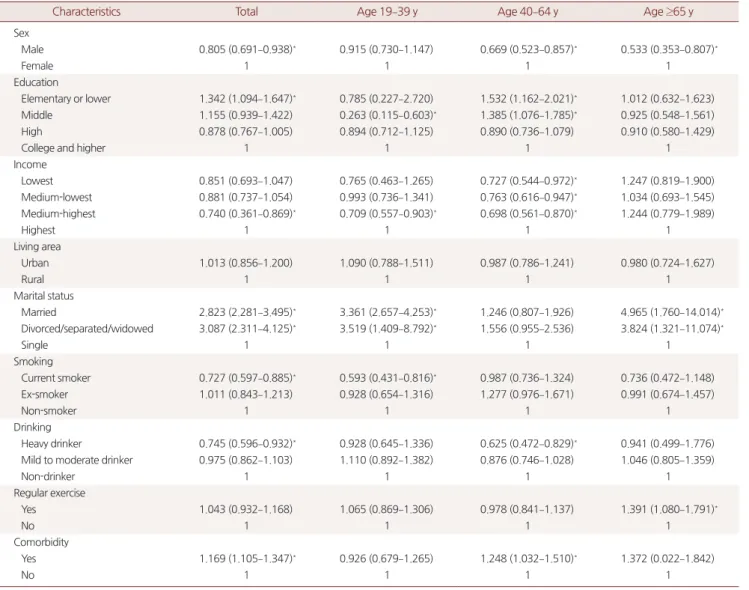
).2. 연령에 따른 독감 예방 접종 관련 요인
유의한 변수를 보정하여 연령별로 독감 예방 접종 관련 요인을 분석하여 독감 예방 접종률의
OR
을 계산하였다. 전체연령에서는 여Table 2. Factors associated with influenza vaccination, stratified by age groups
Characteristics Total Age 19–39 y Age 40–64 y Age ≥65 y
Sex
Male 0.805 (0.691–0.938)* 0.915 (0.730–1.147) 0.669 (0.523–0.857)* 0.533 (0.353–0.807)*
Female 1 1 1 1
Education
Elementary or lower 1.342 (1.094–1.647)* 0.785 (0.227–2.720) 1.532 (1.162–2.021)* 1.012 (0.632–1.623)
Middle 1.155 (0.939–1.422) 0.263 (0.115–0.603)* 1.385 (1.076–1.785)* 0.925 (0.548–1.561)
High 0.878 (0.767–1.005) 0.894 (0.712–1.125) 0.890 (0.736–1.079) 0.910 (0.580–1.429)
College and higher 1 1 1 1
Income
Lowest 0.851 (0.693–1.047) 0.765 (0.463–1.265) 0.727 (0.544–0.972)* 1.247 (0.819–1.900)
Medium-lowest 0.881 (0.737–1.054) 0.993 (0.736–1.341) 0.763 (0.616–0.947)* 1.034 (0.693–1.545) Medium-highest 0.740 (0.361–0.869)* 0.709 (0.557–0.903)* 0.698 (0.561–0.870)* 1.244 (0.779–1.989)
Highest 1 1 1 1
Living area
Urban 1.013 (0.856–1.200) 1.090 (0.788–1.511) 0.987 (0.786–1.241) 0.980 (0.724–1.627)
Rural 1 1 1 1
Marital status
Married 2.823 (2.281–3.495)* 3.361 (2.657–4.253)* 1.246 (0.807–1.926) 4.965 (1.760–14.014)* Divorced/separated/widowed 3.087 (2.311–4.125)* 3.519 (1.409–8.792)* 1.556 (0.955–2.536) 3.824 (1.321–11.074)*
Single 1 1 1 1
Smoking
Current smoker 0.727 (0.597–0.885)* 0.593 (0.431–0.816)* 0.987 (0.736–1.324) 0.736 (0.472–1.148)
Ex-smoker 1.011 (0.843–1.213) 0.928 (0.654–1.316) 1.277 (0.976–1.671) 0.991 (0.674–1.457)
Non-smoker 1 1 1 1
Drinking
Heavy drinker 0.745 (0.596–0.932)* 0.928 (0.645–1.336) 0.625 (0.472–0.829)* 0.941 (0.499–1.776) Mild to moderate drinker 0.975 (0.862–1.103) 1.110 (0.892–1.382) 0.876 (0.746–1.028) 1.046 (0.805–1.359)
Non-drinker 1 1 1 1
Regular exercise
Yes 1.043 (0.932–1.168) 1.065 (0.869–1.306) 0.978 (0.841–1.137) 1.391 (1.080–1.791)*
No 1 1 1 1
Comorbidity
Yes 1.169 (1.105–1.347)* 0.926 (0.679–1.265) 1.248 (1.032–1.510)* 1.372 (0.022–1.842)
No 1 1 1 1
Values are presented as odds ratio (95% confidence interval).
Multiple logistic regression analysis adjusted for sex, education, income, living area, marital status, smoking, drinking, regular exercise, and comorbidity.
*P<0.05.
안영인 외. 주관적 건강 상태 평가와 독감 예방접종과의 연관성 Korean Journal of Family Practice
KJFP
성보다는 남성(
OR
,0
.805
;95
%CI
,0
.691–0
.938
), 가구소득수준이 상 인 군보다는 중상인 군(OR
,0
.740
;95
%CI
,0
.361–0
.869
), 비흡연자군 보다는 현재 흡연자군(OR
,0
.727
;95
%CI
,0
.579–0
.885
), 비음주자군 보다는 고위험 음주자군(OR
,0
.745
;95
%CI
,0
.596–0
.932
)이 상대적 으로OR
이 유의하게 낮았고, 교육수준 대졸 이상에 비해 초졸 이하 인 군(OR
,1
.342
;95
%CI
,1
.094–1
.647
), 미혼자보다는 이혼 혹은 사 별군(OR
,3
.087
;95
%CI
,2
.311–4
.125
), 동반질환이 없는 군에 비해 소유하고 있는 군(OR
,1
.169
;95
%CI
,1
.105–1
.347
)이 높은OR
을 보 였다.연령별로 분석 결과,
19–39
세에서는, 교육수준 중졸자군(OR
,0
.263
;95
%CI
,0
.115–0
.603
), 가구소득 수준이 중상인 군(OR
,0
.709
;95
%CI
,0
.557–0
.903
), 현재 흡연자군(OR
,0
.593
;95
%CI
,0
.431–0
.816
) 이 낮은OR
을 보였고, 이혼 혹은 사별군(OR
,3
.519
;95
%CI 1
.409–
8
.792
)이 높은OR
을 보였다.40–64
세에서는 남성(OR
,0
.669
;95
%CI
,0
.523–0
.857
), 가구소득수준이 중하인 군(OR
,0
.763
;95
%CI
,0
.616–
0
.947
), 고위험 음주자군(OR
,0
.625
;95
%CI
,0
.472–0
.829
)이 낮은OR
을 보였고, 교육수준이 초졸 이하인 군(OR
,1
.532
;95
%CI
,1
.162–
2
.021
), 동반질환을 가지고 있는 군(OR
,1
.248
;95
%CI
,1
.032–1
.510
) 이 높은OR
을 보였다.65
세 이상에서는 남성(OR
,0
.533
;95
%CI
,0
.353–0
.807
)이 낮은OR
을 보였고 기혼자군(OR
,4
.965
;95
%CI
,1
.760–14
.014
), 규칙적인 운 동을 실천하는 군(OR
,1
.391
;95
%CI
,1
.080–1
.791
)이 높은OR
을 보 였다(Table 2
).3. 주관적 건강 상태 평가와 독감 예방 접종과의 연관성
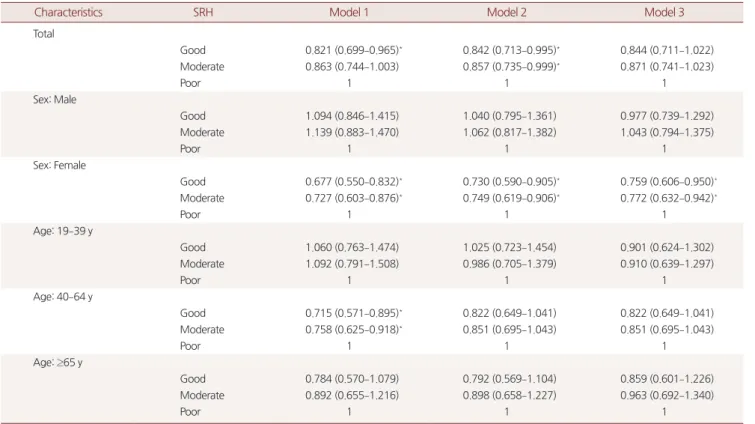
전체 연령에서 주관적 건강 상태 평가가 좋을수록 독감 예방 접 종률이 감소하는 양상을 보였으나, 통계적 유의성은 없었다. 연령별 로 세분하여 보았을 때에도 통계적 유의성은 없었다.
Model 1
에서는 연령과 성별을 보정하였고,Model 2
는 교육수준, 가구소득수준, 주거지역, 결혼상태를 추가 보정하였으며,Model 3
은 흡연력, 음주력, 규칙적인 운동 실천 여부, 동반질환 여부까지 추 가하여 보정하였다.Model 3
에서, 여성에서 주관적 건강 상태 평가 가 보통인 군의OR
이0
.772
(95
%CI
,0
.632–0
.942
), 좋음인 군의OR
이0
.759
(95
%CI
,0
.606–0
.950
)로 주관적 건강 상태 평가가 좋을수Table 3. Association between the SRH and influenza vaccination
Characteristics SRH Model 1 Model 2 Model 3
Total
Good 0.821 (0.699–0.965)* 0.842 (0.713–0.995)* 0.844 (0.711–1.022)
Moderate 0.863 (0.744–1.003) 0.857 (0.735–0.999)* 0.871 (0.741–1.023)
Poor 1 1 1
Sex: Male
Good 1.094 (0.846–1.415) 1.040 (0.795–1.361) 0.977 (0.739–1.292)
Moderate 1.139 (0.883–1.470) 1.062 (0.817–1.382) 1.043 (0.794–1.375)
Poor 1 1 1
Sex: Female
Good 0.677 (0.550–0.832)* 0.730 (0.590–0.905)* 0.759 (0.606–0.950)*
Moderate 0.727 (0.603–0.876)* 0.749 (0.619–0.906)* 0.772 (0.632–0.942)*
Poor 1 1 1
Age: 19–39 y
Good 1.060 (0.763–1.474) 1.025 (0.723–1.454) 0.901 (0.624–1.302)
Moderate 1.092 (0.791–1.508) 0.986 (0.705–1.379) 0.910 (0.639–1.297)
Poor 1 1 1
Age: 40–64 y
Good 0.715 (0.571–0.895)* 0.822 (0.649–1.041) 0.822 (0.649–1.041)
Moderate 0.758 (0.625–0.918)* 0.851 (0.695–1.043) 0.851 (0.695–1.043)
Poor 1 1 1
Age: ≥65 y
Good 0.784 (0.570–1.079) 0.792 (0.569–1.104) 0.859 (0.601–1.226)
Moderate 0.892 (0.655–1.216) 0.898 (0.658–1.227) 0.963 (0.692–1.340)
Poor 1 1 1
Values are presented as odds ratio (95% confidence interval).
SRH, self-reported health status.
The first model (Model 1) was adjusted for age or sex or both. The second model (Model 2) was additionally adjusted for education, income, living area, and marital status. The third model (Model 3) was additionally adjusted for smoking, drinking, regular exercise, and comorbidity.
*P-value was obtained by multiple logistic regression analysis; P<0.05.
Young-In An, et al. Self-Reported Health Status and Influenza Vaccination
Korean Journal of Family Practice
KJFP
록 나쁜 군에 비해 독감 예방 접종률이 유의하게 감소하는 양상을 보였다. 남성에서는 통계적 유의성이 없었다(
Table 3
).4. 삶의 질 관리 정도와 독감 예방 접종과 연관성
EQ-5D 3L
을 사용한 설문에서, 경중에 상관없이 한 영역이라도 지장이 있는 군의
OR
을1
로 놓고, 전혀 지장이 없는 군의 독감 예방 접종률의OR
을 구하였다.전체 대상자와 남성에서의
EQ-5D 3L
와 독감 예방 접종과의 연관 성은 통계적 유의성이 없었다.전체 여성의 연령만 보정한
Model 1
에서, 삶의 질 관리에 전혀 지Table 4. Association between the degree of total score on EQ-5D 3L and influenza vaccination
Characteristics EQ-5D 3L Model 1 Model 2 Model 3
Total
No problems 0.935 (0.830–1.052) 0.953 (0.542–1.078) 0.992 (0.870–1.131)
≥Some problemsa 1 1 1
Sex: Male
No problems 1.063 (0.876–1.289) 1.028 (0.842–1.254) 1.041 (0.844–1.283)
≥Some problemsa 1 1 1
Sex: Female
No problems 0.861 (0.746–0.993)* 0.901 (0.777–1.045) 0.948 (0.809–1.110)
≥Some problemsa 1 1 1
Age: 19–39 y
No problems 1.111 (0.878–1.405) 1.115 (0.877–1.418) 1.109 (0.858–1.434)
≥Some problemsa 1 1 1
Age: 40–64 y
No problems 0.901 (0.770–1.055) 0.953 (0.806–1.128) 1.028 (0.859–1.231)
≥Some problemsa 1 1 1
Age: ≥65 y
No problems 0.736 (0.578–0.937)* 0.730 (0.562–0.947)* 0.763 (0.574–1.015)
≥Some problemsa 1 1 1
Values are presented as odds ratio (95% confidence interval).
EQ-5D 3L, EuroQol-5 dimension-3 level.
The first model (Model 1) was adjusted for age or sex or both. The second model (Model 2) was additionally adjusted for education, income, living area, and marital status. The third model (Model 3) was additionally adjusted for smoking, drinking, regular exercise, and comorbidity.
aRegardless of severity, have more than slightly problem.
*P-value was obtained by multiple logistic regression analysis; P<0.05.
Table 5. Association between the degree of each score on EQ-5D 3L subtypes and influenza vaccination
EQ-5D 3L subtype Total Age 19–39 y Age 40–64 y Age ≥65 y
Mobility
No problems 0.948 (0.788–1.141) 1.013 (0.566–1.813) 1.101 (0.779–1.288) 0.917 (0.685–1.227)
≥Some problemsa 1 1 1 1
Self care
No problems 0.843 (0.599–1.187) 0.620 (0.176–2.183) 0.808 (0.524–1.247) 1.061 (0.700–1.608)
≥Some problemsa 1 1 1 1
Usual activity
No problems 0.943 (0.753–1.182) 1.281 (0.535–3.062) 0.907 (0.666–1.235) 0.962 (0.696–1.331)
≥Some problemsa 1 1 1 1
Pain/discomfort
No problems 1.032 (0.902–1.182) 1.342 (1.015–1.774)* 0.967 (0.798–1.171) 0.859 (0.660–1.119)
≥Some problemsa 1 1 1 1
Anxiety/depression
No problems 0.956 (0.808–1.130) 1.169 (0.819–1.667) 0.929 (0.724–1.193) 0.800 (0.560–1.143)
≥Some problemsa 1 1 1 1
Values are presented as odds ratio (95% confidence interval).
EQ-5D 3L, EuroQol-5 dimension-3 level.
Multiple logistic regression analysis adjusted for sex, education, income, living area, marital status, smoking, drinking, regular exercise, and comorbidity.
aRegardless of severity, have more than slightly problem.
*P<0.05.
안영인 외. 주관적 건강 상태 평가와 독감 예방접종과의 연관성 Korean Journal of Family Practice
KJFP
장이 없는 사람의
OR
이0
.861
(95
%CI
,0
.746–0
.993
)로, 이는 삶의 질 관리에 어느 한 영역이라도 지장이 있을 경우 독감 예방 접종률이 높은 것으로 분석할 수 있으나,Model 2
,Model 3
은 통계적 유의성 이 없었다(Table 4
).Table 5
는EQ-5D 3L
의 하위 항목별로 분석한 결과이다.19–39
세 에서, 통증/불편 관리 능력에 전혀 지장이 없는 경우의OR
이1
.342
(95
%CI
,1
.015–1
.774
)로,19-39
세에서 통증/불편 관리가 불량할수록 독감 예방 접종률이 떨어지는 것으로 분석 가능하나, 나머지 분석 에서는 통계적 유의성이 없었다.고 찰
본 연구는 한국 성인의 독감 예방 접종에 영향을 줄 수 있는 요인 중, 주관적 건강 상태 평가에 중점을 두어 진행하였다. 독감 예방 접 종률은
19–39
세에서25
.1
%,40–64
세에서29
.2
%,65
세 이상에서81
.8
%로 이전연구와 비교하여 큰 차이는 없었다.19,20) ‘노인 인플루엔 자 예방접종 사업’이 시행된 이후 노인 인구는 높은 접종률을 유지 하고 있지만, 나머지 인구의 접종률은 여전히 낮은 단계이다. 많은 연구에서 권고만으로는 접종률을 높이기에 한계가 있고, 접종률 향 상을 위해 일반 성인에서도 국가적 지원이 필요함을 주장한다.18)모든 연령군에서 여성의 접종률이 높았고, 이전 연구도 동일한 결과를 보여준다.21,22) 이는 여성이 남성보다 시간적인 여유가 많고, 건강에 대한 관심이 높아 병원 방문율 및 정보 노출 정도가 높기 때 문으로 추정할 수 있다.23)
또한, 현재 흡연자군과 고위험 음주군에서 접종률이 유의하게 낮 은 것으로 나타났다. 이 또한 다른 국내 연구들과의 결과와 일치한
다.24,25) 현재 흡연자, 고위험 음주자의 경우 건강에 대한 염려와 건강
증진을 위한 활동이 비흡연, 비음주자들에 비해 불량하기 때문으로 생각된다.
주관적 건강 상태 평가가 좋을수록, 독감 예방 접종률이 유의하 게 감소하였는데, 이는 주관적 건강 상태 평가와 대부분의 건강 증 진 활동과의 연관성이 양의 상관 계수를 나타낸다는 기존의 연구 결과와 상반되지만,26) 건강 증진 행위 중, 건강 검진 수검률은 예외 적으로 음의 상관 계수를 나타내는 것과는 일치한다.26) 질병에 이환 되지 않은 사람의 건강 검진 수검률이 낮다는 결과도 본 연구에 적 용할 때 의미가 있고,27) 건강 검진 수검률이 낮은 군에서, 독감 예방 접종률이 유의하게 낮다는 연구 결과 또한 주관적인 건강 상태 평 가가 독감 예방 접종과 밀접한 관계가 있다는 사실을 뒷받침한다.28)
반대로, 주관적인 건강 상태가 불량할수록 독감 예방 접종률이 증가하는 것은, 질병 이환 상태일 경우 건강 검진 수검률이 증가하
는 것과 같은 맥락으로 이해할 수 있다. 이는 주관적 건강 상태가 나쁠수록, 실제 질병에 이환되어 있을 가능성이 크고, 이로 인해 의 료기관 접촉과 관련정보 노출이 많아져서 건강 증진 활동을 실천하 려는 의지가 상대적으로 증가하는 것으로 추론할 수 있다. 이런 현 상을 여러 연구에서 ‘건강 관련 감수성’이 증가하는 것이라고 표현 하고 있다.21,24)
본 연구는 특히 여성에서, 관련변수를 보정한 뒤에도 주관적 건 강 상태 평가와 독감 예방 접종이 통계학적으로 유의한 연관성을 보였다. 기존 연구에서도, 여성에서의 주관적 상태 평가가 실제 질 병 이환의 유효한 대리 변수일 가능성이 남성보다 높다는 결과를 보 인다.29)
EQ-5D 3L
과 독감 예방 접종과의 연관성은 통계적인 유의성이 없었다. 삶의 질 평가는 질병 관련 요인뿐 아니라 가족구조, 경제력, 사회활동을 포함한 다양한 변수들이 작용하기 때문으로 추론할 수 있다.30)
주관적 건강 상태 평가를 통해 질병 이환 상태를 추론하여, 건강 관련 감수성을 파악해 볼 수 있다. 이는 건강 관련 감수성이 낮은 사람의 독감 예방 접종을 독려하고, 전략적인 접근을 하기 위한 계 획을 수립할 때, 관련자료로 주관적 건강 상태 평가를 이용할 수 있 음을 시사한다.
본 연구는 몇 가지 제한점이 있다. 첫째, 본 연구는 단면 연구이기 때문에 시간적 선후 관계 및 역 인과 관계의 가능성을 파악할 수 없 다. 둘째, 성별이나 연령을 포함한 각각의 인구, 사회학적 특성마다 설문 응답의 정확성이 다른 점이 고려되지 않았다. 셋째, 한국에서 는
65
세 이상에서 독감 예방 접종을 무료로 시행하기에,65
세 이상 을 포함한 결과들은 일반화에 한계가 있다. 추후 주관적 건강 상태 평가 변화 양상과 독감 예방 접종률 증감 추이를 비교하는 대규모 전향적 연구가 필요하겠다.요 약
연구배경: 주관적 건강 상태 평가는 현재의 건강 상태 및 여러 건강 관련 인자들과 연관성이 있는 것으로 알려져 있으나, 건강 증진 활 동과의 연관성을 조사한 연구는 부족하다. 본 연구는 주관적 건강 상태 평가와 독감 예방 접종과의 연관성을 평가하기 위해 수행되었 다.
방법: 국민건강영양조사
2014–2015
년도 자료를 이용하여, 독감 예방 접종 항목에 응답한19
세 이상9
,825
명을 대상을 하였다. 독감 예방 접종 여부, 나이, 성별, 교육수준, 가구소득 수준, 주거지역, 결혼상 태, 흡연력, 음주력, 규칙적인 운동 실천 여부, 동반질환 이환 여부,Young-In An, et al. Self-Reported Health Status and Influenza Vaccination
Korean Journal of Family Practice
KJFP
주관적 건강 상태 평가, 삶의 질 관리 평가에 관련된 내용은 설문을 통해 수집되었다. 독감 예방 접종과 각 변수의 연관성을 관찰하기 위해 단변량 분석을 실시하였고 통계적으로 유의한 변수를 보정 변 수로 사용하여 다변량 분석을 시행했다.
결과: 남성, 가구소득수준 중상, 현재 흡연자, 고위험 음주자군의 독감 예방 접종률이 유의하게 낮았고(
P<0
.05
), 여성, 교육수준 초졸 이하, 기혼자, 동반질환 이환군의 독감 예방 접종률이 유의하게 높 았다(P<0
.05
). 대상자 전체에서 주관적 건강 상태 평가가 좋을수록 독감 예방 접종률이 감소하는 양상으로, 통계적인 유의성은 없었으 나(OR
,0
.844
;95
%CI
,0
.711–1
.002
), 여성에서는 유의한 결과를 보였 다(OR
,0
.759
;95
%CI
,0
.606–0
.950
).결론: 주관적 건강 상태 평가가 양호할수록 낮은 독감 접종률과 연 관성이 있다. 주관적 건강 상태가 양호한 군의 독감 예방 접종률을 높이기 위한 전략이 필요할 수 있다.
중심단어: 건강 상태; 주관적; 독감; 예방접종 CONFLICT OF INTEREST
No potential conflict of interest relevant to this article was reported
. ORCIDYoung-In An
,https
://orcid
.org
/0000-0002-6408-3824 Da-Hye Choi
,https
://orcid
.org
/0000-0002-0522-982X Tae-Young Lee
,https
://orcid
.org
/0000-0001-9620-3360 Seong-Jee Park
,https
://orcid
.org
/0000-0001-9484-3823 Myung-Chul Jung
,https
://orcid
.org
/0000-0002-7670-9265 Hoon Jang
,https
://orcid
.org
/0000-0001-8549-8001 Geun-Hyo Shim
,https
://orcid
.org
/0000-0002-0794-3242
REFERENCES
1. Murray J, Dunn G, Tarnopolsky A. Self-assessment of health: an exploration of the effects of physical and psychological symptoms. Psychol Med 1982;
12: 371-8.
2. Brody JA, Brock DB, Williams TF. Trends in the health of the elderly popula- tion. Annu Rev Public Health 1987; 8: 211-34.
3. Benyamini Y. Why does self-rated health predict mortality? An update on current knowledge and a research agenda for psychologists. Psychol Health 2011; 26: 1407-13.
4. Grove BE, Schougaard LM, Hjollund NH, Ivarsen P. Self-rated health, quali- ty of life and appetite as predictors of initiation of dialysis and mortality in
patients with chronic kidney disease stages 4-5: a prospective cohort study.
BMC Res Notes 2018; 11: 371.
5. Jylhä M. What is self-rated health and why does it predict mortality? To- wards a unified conceptual model. Soc Sci Med 2009; 69: 307-16.
6. Lopez R. Income inequality and self-rated health in US metropolitan areas:
a multi-level analysis. Soc Sci Med 2004; 59: 2409-19.
7. Inkrot S, Lainscak M, Edelmann F, Loncar G, Stankovic I, Celic V, et al. Poor self-rated health predicts mortality in patients with stable chronic heart fail- ure. Eur J Cardiovasc Nurs 2016; 15: 504-12.
8. Sacker A, Wiggins RD, Bartley M, McDonough P. Self-rated health trajecto- ries in the United States and the United Kingdom: a comparative study. Am J Public Health 2007; 97: 812-8.
9. Yeom JH, Park JS, Kim DH. A study of factors affecting self-rated health among Korean elderly: focusing on gender difference. J Korean Gerontol Soc 2012; 32: 1101-18.
10. Goldstein MS, Siegel JM, Boyer R. Predicting changes in perceived health status. Am J Public Health 1984; 74: 611-4.
11. Ferraro KF. Self-ratings of health among the old and the old-old. J Health Soc Behav 1980; 21: 377-83.
12. Kaplan G, Barell V, Lusky A. Subjective state of health and survival in elderly adults. J Gerontol 1988; 43: S114-20.
13. Linn BS, Linn MW. Objective and self-assessed health in the old and very old. Soc Sci Med Med Psychol Med Sociol 1980; 14A: 311-5.
14. Jung JG, Kim JS. The beneficial and harmful effect of drinking on health. J Korean Acad Fam Med 2006; 27: 251-60.
15. Yoo TW, Chung WJ, Lee SM, Lee SH. Alcoholic beverage preference and high risk drinking. J Korean Acad Fam Med 2003; 24: 912-9.
16. Kim HS. A study on self-rated health, health promotion behavior, and health-related quality of life in the elderly. J Korean Gerontol Nurs 2006; 8:
117-27.
17. Korea Centers for Disease Control and Prevention. 2012-2013 Influenza guidelines. Osong: Korea Centers for Disease Control and Prevention; 2012.
18. Reichert TA, Sugaya N, Fedson DS, Glezen WP, Simonsen L, Tashiro M. The Japanese experience with vaccinating schoolchildren against influenza. N Engl J Med 2001; 344: 889-96.
19. Kee SY, Lee JS, Cheong HJ, Chun BC, Song JY, Choi WS, et al. Influenza vac- cine coverage rates and perceptions on vaccination in South Korea. J Infect 2007; 55: 273-81.
20. Yang HJ, Cho SI. Influenza vaccination coverage among adults in Korea:
2008-2009 to 2011-2012 seasons. Int J Environ Res Public Health 2014; 11:
12162-73.
21. Park MB, Kim CB, Joo HS. Factors influencing on influenza vaccination coverage. J Korea Contents Assoc 2013; 13: 300-11.
22. Kee SY, Cheong HJ, Chun BC, Kim WJ. Influenza vaccination coverage rate and factors associated with vaccination in people with chronic disease. In- fect Chemother 2011; 43: 406-11.
23. Jiménez-García R, Hernández-Barrera V, de Andres AL, Jimenez-Trujillo I, Esteban-Hernández J, Carrasco-Garrido P. Gender influence in influenza vaccine uptake in Spain: time trends analysis (1995-2006). Vaccine 2010; 28:
6169-75.
24. Kee SY, Lee JS, Cheong HJ, Chun BC, Song JY, Choi WS, et al. Influenza vac- cine coverage rates and perceptions on vaccination in South Korea. J Infect 2007; 55: 273-81.
안영인 외. 주관적 건강 상태 평가와 독감 예방접종과의 연관성 Korean Journal of Family Practice
KJFP
25. Lee KC, Han K, Kim JY, Nam GE, Han BD, Shin KE, et al. Socioeconomic status and other related factors of seasonal influenza vaccination in the South Korean adult population based on a nationwide cross-sectional study.
PLoS One 2015; 10: e0117305.
26. Moon SS, Lee SB. A study of health behavior through comparative analysis of self-perceived health status and health examination results. J Korean Soc Health Educ Promot 2001; 18: 11-36.
27. Yeo JY, Jeong HS. Determinants of health screening and its effects on health behaviors. Korean J Health Policy Adm 2012; 22: 49-64.
28. Byeon GR, Hur YI, Kang JH, Park HA, Kim KW, Cho YG, et al. Influenza vaccination status in Korean adult population in relation with socioeco- nomic and medical factors. Korean J Health Promot 2016; 16: 20-31.
29. Idler EL. Discussion: gender differences in self-rated health, in mortality, and in the relationship between the two. Gerontologist 2003; 43: 372-5.
30. Jo MW, Yun SC, Lee SI. Estimating quality weights for EQ-5D health states with the time trade-off method in South Korea. Value Health 2008; 11:
1186-9.