The 1970’s Fashion Trend at Vogue Magazine:
If you can’t wrap it, tie it, sling it, fling it.
Ahn Insook
Dept. of fashion design Chung-Ang University
Abstract
The purpose of this study is to understand how the silhouette changed throughout 1970s and assess how US women express their identities through their dress, which may explain societies’ attitudes through the way women dresses. US Vogue fashion magazines were used to explore all the information on fashion and style trends, social trends, beauty, and travel. A content analysis was performed on the issues of the March and September for the years 1970 to 1979. The findings for this study about the 1970s were all about perpetual change, constantly moving forward with innovation. The color ranged from bright, cheery and bold to deep and passionate to subtle neutrals. There were a few constant colors through the decade like white, black and navy. Occasionally the trend would completely change from one season to the next within the same year. They would be full and oversized and then be slim and body conscious. The one trend that stayed true for the entire decade was wrapping. Skirts, pants, dresses, tops, shoes and jewelry; everything wrapped in one-way or another. Clothes steadily became more revealing as the years progressed. Fabrics over all were soft and knitted. Casual and comfortable was the phase heard most often. In the 1970s there was constant change in prints. They were bold and large or subtle and small, ethnic or floral. Hair was mostly smooth and sleek however towards the style moved to a fuller look.
Key words : fashion trends, vogue magazine, 1970s
. Introduction
Ⅰ
Fashion is a style that is popular in certain period or a set of trends that have been accepted by a wide population in the market
Corresponding author: Ahn Insook, Tel. +82-31-670-3539, Fax. +82-676-9932 E-mail: [email protected]
and is a combined phenomenon of psychological, socio-economical, and cultural points of view of the times(Brannon, 2010).
Fashion magazines can be viewed as the voice
of the fashion industry because they provide
visuals and texts that translate their views on various fashion related issues (Choi, Medvedev, Lee, & Hunt-Hurst, 2009). Beyond the primary level of brand advertisement and industry information fashion magazines are cultural objects that reflect the zeitgeist – the spirit of the times - both visually and textually. As cultural media objects and gatekeepers of innovation they introduce, describe dominant cultural patterns, and filtered innovation once innovators introduced new forms so that early adopters would accept changes followed by the mass (Lipovetsky, 2007; McCracken, 2011). The fashion magazines such as Vogue and Bazaar issued once a month, which are brittle and short-lived media outlets, but hold a mirror up to its time and have become the archives of memory (Patcevitch, 1963). There are some books that analyzed fashion changes based on fashion advertisement (Hill, 2007; Mulvagh, 1998), that focused on editorials in England (Howell, 1991) and Vogue covers (Derrick, 2007). Also many studies investigated on how fashion advertising in magazines reflected and changed society (Al-Olayan & Karande, 2000;
Frith, Shaw & Cheng, 2005; Lindner, 2004;
Tiggemann & McGill, 2004) and fashion advertising in magazines reflected on race and gender (Millard & Grant, 2006; Thompson, 2000).
But there is little research on American fashion changes based on analysis of fashion magazines. This study aimed to understand how the silhouette changed throughout 1970s and assess how US women express their identities through their dress, which may explain societies’
attitudes through the way women dresses.
. Methodology
Ⅱ
To analyze the changes in American fashion, a content analysis was performed on the issues of the March and September for the years 1970 to 1978, and the June and August issues of 1979, due to availability. The Vogue USA was selected for the research because it has played a key role as a visual filer of changes in fashion. Each season designers have shown ideas on the stage and Vogue has caught them and introduced them to consumers through its pages (Watson, 1999). Vogue has been of importance to the fashion world as a media outlet and a gatekeeper as well as an indispensable source for museum curators responsible for collections of twentieth century dress (Mendes, 1988).
Women were highly influenced by what they read and saw in magazines. Since Vogue USA Magazine was one of the top women’s fashion magazines in the United States in the 1970s (Choi et al., 2009; Kopnina, 2007), and it underwent extensive editorial and stylistic changes to respond to changes in the lifestyles of its target audience since 1971 under editor-in-chief Grace Mirabella Grace (Mirabella,
& Warner, 1995), it therefore 1970s fashion was chosen for this study. The reason why March and September issues were used for this study is both issues deals with collection issues of the seasonal cycle. They are the first issues to feature the new-season clothes for spring/summer and autumn/winter respectively (Derrick, 2007).
Both the editorial visuals and text of articles
were analyzed to explore all the information on
fashion and style trends, social trends, beauty,
travel and economy; however, the commercial
advertisements were excluded because they are
promoted by the company, not filtered
innovations by the gatekeeper. First, the
researcher searched editorial images and texts
to find out most important colors, silhouettes, length, fabric/print, accessories, and designers.
Second, the articles were sorted into categories based on pre-established criteria: beauty, art, celebrities, economic/politics, and travel to identify whether the fashion of the times reflected the spirit of that time. Each finding was documented in a spreadsheet format and arranged by month and year.
. Findings
Ⅲ
The first year of the 1970s began what was to become an ever-changing, always-moving decade. Women were concerned with getting specialists for all of their beauty concerns, oral surgeons, facialists, and any other type of beauty experts. Oxygen and other products with natural ingredients were encouraged to use on the body. Women also carried around travel perfumes in their purses to smell great while on the go. The most popular haircuts were fringe cuts. To quit smoking some people took a cruise with an emphasis on how to quit. One product used to keep in shape was a tummy tamer. A person wore it and if their tummy was not “sucked in” or they were slouching it would beep until the problem was fixed. Women would usually wear this product for about an hour a day. Hat brands in 1970 were Kimberly, Yves Saint Laurent, Courreges, and Lanvin. They designed pants that were high waisted with a full leg. Women were encouraged to “do their own thing” with hemlines. Slashes, slits, slots and fringe were common details on most garments. Coats were either shaped and belted or a midi coat with swing. Wrapping became extremely popular in outfits. All garments were made in a variety of colors. Apricots, crimsons,
purples, and any colors that resembled spring woodlands and were earthy were very common.
In their free time women traveled to Tambo in the Bahama Islands and Rome, Italy or saw art exhibits like “Spaces” at the Museum of Modern Art and E.A.T. (Experiments in Art and Technology) in Osaka, Japan. The articles discussed sparse-living and how to buy the coin bed vibrators found in some popular hotels of the time. Over all 1970 introduced many trends that would continue for the rest of the decade.
Fashion in 1971 continued the changes made in the initial year of the decade. Women wore false eyelashes, “Smokey” eyes, the “dewy” or moisturized look, and long straight hair. The practice of using natural products and remedies for hair and skin care continued during 1971.
Balanced nutrition was also encouraged to maintain a healthy look. Ballet and dance excise were new and innovative ways of exercising that were introduced in 1971 to stay physically fit.
For accessories women wore large, tie belts,
shoes that were heavy-soled and laced up,
fitted hats and berets with casual ensembles,
and large chunky jewelry. The main designers
that year were Scott Barrie, Robert-David
Morgan, Jean Muir, Butch Scheck, Pat Ashley,
Marshall Lugman, Santos Santiago, Anne Klein,
Bill Blass, Kasper, Christian Dior, Oscar de la
Renta, Malcom Starr, Kimberly and Cardin. Scott
Barrie, Robert-David Morgan, Jean Muir, Butch
Sheck, Pat Ashley, Marshall Lugman, and Santos
Santiago were concerned with cheap chic, a
popular trend in 1971. Clothes that were less
expensive but still chic were extremely
appreciated by women. Some other popular
trends were capes, long chemises, shirt dresses,
gauchos, hot pants, and flamenco skirts. Also
pantsuits for evening wear, short dresses, and
layering were important and new trends were gaining popularity: sweaters, shirts, fitted vests and tank tops. The Military Look with lots of buttons and patches gained popularity in 1971.
Fashionable details on garments were sequins, smocking, and matching tops and bottoms.
Scarf prints with tribal and swirl details were trendy prints. 1971 brought garments that came in a variety of fabrics and colors including jersey and knits, wools, suede, satin, and velvet, in navy, beige, eggplant, black, and bold citrus hues. Vogue also released a book on etiquette.
Popular travel destinations were Spain, Dallas, Texas, San Francisco, California, and London.
Vogue, in 1972, showed women how to dare to bare it. Casual, soft, textured styles in neutral colorings accentuated easy separates dressing.
In the matters of beauty they used sun lamps, belly dancing, swimming, yoga to bring out the best in their bodies. Vogue encouraged fitness and exercise rather than artifice. A lot of articles appeared on diet and exercise programs. The new “it” haircut was the Zelda bob, which gave women the opportunity to show off their shoulders more. Accessories were large,
geometric and often in bone or shell tortoise.
Scarves brought attention to the neck and sexy sandals allowed women to bare their feet.
Kimberly, Bill Blass, Jaeger, Scott Barrie, Diane Von Furstenberg, Kasper, Geoffrey Beene, Oscar de la Renta, Anne Klein, Nina Ricci, Christian Dior, and Jerry Silverman were the hit designers of the year. They designed short and baring evening dresses, suits that were separates, wrap tunics, and rolled up sleeves. Mixing patterns, slits, and anything that wrapped continued to be trends in 1972. Looks were easy and personal while still being polished. Garments were made in jersey, wool, angora, velvet and knits in very subtle colors of white, black, brown and navy. A very popular color trend was to dress in all of one tone. People traveled to Italy, Florida, The Rhine, New York and Bermuda. In their free time women saw art exhibits with Russian crafts and Biennale in Italy.
1973 continued the sexy trends started in 1972. Simple, body-conscious and, most important of all, unconstructed clothes were in.
In beauty women had more choices for colors in nail polish and places to go for skin care.
Figure 1.
Crepe de Chine Shirtdress, Klugman for S.T.J., Viscos Rayon
- Vogue (1971, Mar.), p.83
Figure 2.
NY Collection Beautiful Bronze Shirts Dress by Leslie Fay, - Vogue(1971, Sep.), p.234
Figure 3.
Wrap & Tie Coat,
NY Collection,
- Vogue (1972, Sep.), p.265
Now health food stores were selling beauty and skin related items. “Uncurling irons” or straighteners gained popularity this year as well.
You saw more women jumping on the bandwagon for the “do it yourself beauty”
trends. They also thought about the long-term in beauty. They focused on stretching to have good posture and diets that could last the rest of your life. Accessories in 1973 were pretty basic they had large sunglasses, lots of bangles, bronze-colored shoes, and a need for the “right” stockings for their outfits. 1973 brought many designers to the forefront of fashion. Yves Saint Laurent, Missoni, Valentino, Oscar de la Renta, Andre Laug, Scott Barrie, Karl Lagerfeld, Chanel, Dior, Givenchy, Calvin Klein, Halston, Anne Klein, Bill Blass, Stephan Burrows, and Bill Blass were all among the top designers of the year. They produced clothes that were romantic, feminine sensuous, sexy soir, lean, racy, and revealing. They showed off the legs and were body conscious. Pants came in a variety of silhouettes. They had wide legs,
were flared, or lean and straight. Often they came in black satin. Tailored suits and leaner skirts were reintroduced. Wrapped dresses, shirts and skirts continued to be in high demand throughout 1973 as well. There were also large fur jackets, slim dresses with T-shirt or shirtwaist styles in luxurious materials, oversized dresses, lingerie dresses, and a need to always be moving and continual change in fashion.
Garments came in an assortment of colors.
White, coral, blue, navy, black, and anything that was bright and bold or in all of one tone were among the most prominent colors. A large fabric selection was available as well. Clothes came in angora, wool, silk, linen, acrylic, cotton, silk/rayon, cashmere and rayon. There was an article on managing credit so you do not end up poor from it. In their spare time women traveled to Waikiki, Hawaii, China, London, New York, Paris, Los Angeles, or New Zealand and viewed exhibits featuring Eva Hesse sculptures and saw stage shows on Broadway.
1974 brought lingerie into mainstream fashion Figure 4.
Bold Color Accessories - Vogue (1972, Mar.), p.93
Figure 5.
Wool Straight Dress - Vogue (1973, Sep.), p.325
Figure 6.
Wool Metallic Suit
- Vogue (1974, Sep.), p.291
trends. In beauty the focus was on having soft hair with matching eyebrows, darker more dramatic makeup, wearing wigs, fighting wrinkles, moisturizing naturally, repairing the damage from the sun, and how to get extra value from your eyes. Gradually the most ostentatious signs of wealth – large jewels, lavish furs and showy, extravagant clothes were cast aside. Sunglasses had new and interesting shades. Red shoes became popular, as well as small skinny belts to create a small waist.
Watches and wrapped scarves continued to be trendy in 1974. New designers became popular, Mollie Parnis, John Anthony, and Concept VII, were considered the most popular. There were also old favorites, which included Halston, Valentino, Yves Saint Laurent, Calvin Klein, Geoffrey Beene, Ralph Lauren, Bill Blass, Adolfo, Anne Klein, Oscar de la Renta, and Kasper.
Together the new and old designers created exciting collections full of wonderful clothes.
There were smaller tops around the body, narrower pants, oversized shirt dresses, two-piece dresses and a lean towards what was called the “American casual.” Designers brought
lace and other pajama details from lingerie into daywear. String bikinis also gained popularity in 1974. The replacement of the short, kicky skirt by the longer, fuller style was the most important change in the silhouette introduced by European designers in fall 1974. The new coat and cape shapes were also looser, fuller and longer. This voluminous, unconstructed, layered, and peasant inspired dressing was christened the ‘Big Look’
(Mulvagh, 1988). The most prominent colors were neutrals, mainly ivory, skin tones, grey, black and navy. The fabrics consisted of knits, jersey, silk, wool, furs, suede and flannel jersey. Women saw amazing art and countryside as they traveled to Greece, Rome, Paris, London, Barbados, Jamaica, West Africa, Morocco, and Australia. In 1974 there were several exhibits on Islamic art and European jewelry.
The ‘Big Look’ which had been introduced in Paris fall1994 had not been adopted as yet, but American women who were working efficiently wanted a neat, unobtrusive, coordinated look rejected it for their figure – consciousness demanded body-revealing lines. As was the trend in the 1970’s, 1975 was full of continual change.
Figure 7.
Soft velvet tunic pleat tweed skirt - Vogue (1975, Sep.), p.230
Figure 8.
Tailoring Suit by Ralph Lauren - Vogue (1976, Fall), p.297
Figure 9.
Textured Suit - Vogue (1977,
Sep.), p.248
Figure 10.
A contrast of textured
Cardigan Coat
- Vogue (1978, Sep.), p.440
Beauty experts started to realize the effects of aerosols and began using non-aerosol products.
Salons were becoming a one-stop-shop for beauty and styles centered around bangs, crimpers, cuts and curls. At home exercising was also popular. Accessories continued to be bare and natural. Hemp shoes, head wraps and scarves were popular items to accessorize with in 1975. Popular designers of the year were Calvin Klein, John Anthony, Mary McFadden, Geoffrey Beene, Oscar de la Renta, Halston, Anne Klein, Kasper, Ralph Lauren, and Chanel.
The designers created pure, pretty, and classic fashion. There was a focus on revealing necklines, body dressing and safari inspirations.
Popular looks were jeans and t-shirts, sweaters and pleated skirts, tunics, pant suits and the pajama-dressing trend that started in 1974.
Clothes came in cotton gauzes, Chambray, terry, cotton knits, voile, chiffon, poplin, jersey and anything lightweight. The colors were very earthy, with greens, rust, khakis, grays, white, black, and purples. In their free time women collected old post cards, traveled by train or ventured far off places like the Mediterranean, Guatemala, and the West Indies. They also saw exhibits from Picasso, Jean-Baptists Carpeaux, Jasper Jones, and Michelangelo’s drawings.
1976 became much more tailored than previous years. Beauty was sleek and polished.
Chignon buns, sleek hair and heavy bangs were popular hair styles. At home exercising and dance therapy were still important trends as well as smooth skin. Patterned and peasant scarves, bracelets with clean lines, gold hoops, oversized sunglasses, and other classic accessories which were emphasized an outdoor, rustic look, bandeaux, hoods, and enveloping shawls were great choices for women. Henri Bendel, Yves Saint Laurent, Lanvin, Karl Lagerfeld, Ungaro,
Dior, Valentino, Givenchy, Missoni, Calvin Klein, Geoffrey Beene, Mary McFadden, Bill Blass, Halston, and Anne Klein were the most requested designers of the year. Designers were influenced by very tailored and sailor-inspired garments. Other popular trends were unlined clothes, windbreakers, wrap and bare, separate dressing, narrow pants, country gear, drop waists and longer and bulkier furs. The colors were mainly navy and white and natural in cottons, furs, and knitted fabrics. Women saw exhibits on American Photography, and traveled to Nice, New Orleans, Istanbul, and Maine. 1977 was all about customizing your look. Hairstyles were custom, fuller, and freer than previous years. The year hair stood on end with fluorescent dyes.
Women focused on losing weight, roller-skating,
and the birth control pill, also known as the Pill,
became a popular form of contraception. Plastic
sunglasses, specifically plastic aviators, were the
must have items, but the most important
accessory was a smile. The designers of the
year were Karl Lagerfeld, Dior, Yves Saint
Laurent, Sanchez, Geoffrey Beene, Bill Blass,
Ralph Lauren, Donna Karen, Henri Bendel, Oscar
de la Renta, Calvin Klein, Stephan Burrows, Mary
McFadden, and Julio. Their garments tied
everywhere, wrapped and revealed, offered a
slender, body-conscious appearance. As well,
the smocks were low cut, off the shoulder, and
soft with lots of different textures. There were
also plenty of mesh garments, kimono dresses,
and jersey jumpsuits. There were a variety of
fabrics to choose from: cotton, jersey, challis,
chenille, mohair, suede, furs, and knits. The
colors were neutrals with pops of color, soft
reds and pinks, and gold. Women enjoyed trips
to New York, Thailand, Indonesia, Italy, Germany,
Egypt, Australia, and Cuba. They also enjoyed art
exhibits with Improbable Furniture and
turn-of-the-century America.
1978 continued the bare-it-all trend from previous years. The silhouette gradually became tighter and more controlled. The body was back and waists existed, and there was a legginess that had not been seen for years. Ankles were suddenly sexy. In beauty women sought out good massage therapists, and had softer, smoother, yet teased hair. Beauty went back to nature and women were conscious of safety in the sun. For accessories they wore large handbags with shape, black ribbons, strappy heels, black leather belts and various hats. Bold, obvious accessories still the essence of fashion:
enormous glittery paste jewelry and gilets. Yves Sain Laurent, Dior, Ungaro, Givenchy, Gres, Donna Karan, Mary McFadden, Calvin Klein, Geoffrey Beene, Bill Blass, Ralph Lauren and Halston were the top designers of 1978. They designed tiny camisoles, deep “V” dresses, western wear, skirts that had slits and slashes, and very narrow pants that hit above the ankle.
There were also lots of embroidery and texture mixing. Fabrics included silk, satin, lace, Chantilly, linen, cotton gauze, fur, and anything sheer. Colors were a mix of pale and deep with skin tones, pinks, sheers, white, and wine, deep berry, black and grey. Women were rising in the management ladder and becoming very successful. Articles spoke of what to do with
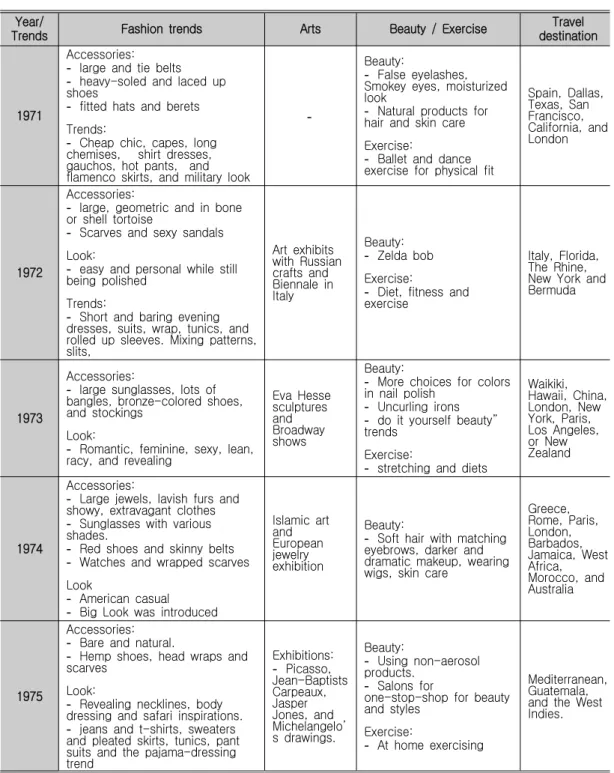
Table 1. The 1970’s Fashion Trend at Vogue Magazine
Year/Trends Fashion trends Arts Beauty / Exercise Travel
destination
1970
Trends:
-
“Do their own thing” with hemlines-
“Do their own thing” with hemlines. Shaped and belted or a midi coat with swing-
WrappingExhibits:
-
“Spaces”at the Museum of Modern Art
-
`E.A.T.Beauty :
-
Oxygen and naturalingredients products for the body
-
Women also carried perfumes-
Fringe haircutsTambo in the Bahama Islands and Rome, Italy
active. Accessories were fluid shapes, in either bright fluorescent colors or gold. Belts were skinny and braided and bags were textured and iridescent. The top designers of 1979 were Yves Saint Laurent Ralph Lauren, Ungaro, Claude Montana, Thierry Mugler, Chanel, Sanchez, Missoni, Chloe, Halston, Chanel, Karl Lagerfeld and Perry Ellis. They produced knee length skirts, jumpsuits, and dinner suits. The trend was quick, easy and comfortable clothes in soft success and inheritance. Artists such as Samuel J. Washington, Jr. and Nogughi were popular.
Women continued to travel to places like Japan, Tangier, Italy, Brussels, and Napa Valley.
The last year of the 1970’s continued the perpetual change just as in previous years.
Women concentrated on quick, on-the-go looks and scents for beauty. For their hair, they wore 1950’s inspired ponytails, smooth and sleek hair.
They also focused on healthy eating and staying
knitted fabrics. They came in iridescent and
bright colors like purple, aqua, and yellows. The
popular fabrics were leather, crepe de Chine,
cashmere/silk, viscose/angora, and any other soft
stretch fabrics. There were several articles related
to money, investments, and taxes. Women saw
exhibits on contemporary sculptures from Israel
and the South Pacific. In 1979 they traveled to
the Himalayans, Greek Isles, Britain’s Irish Sea,
Tahiti, Denmark, New York, Paris and Italy.
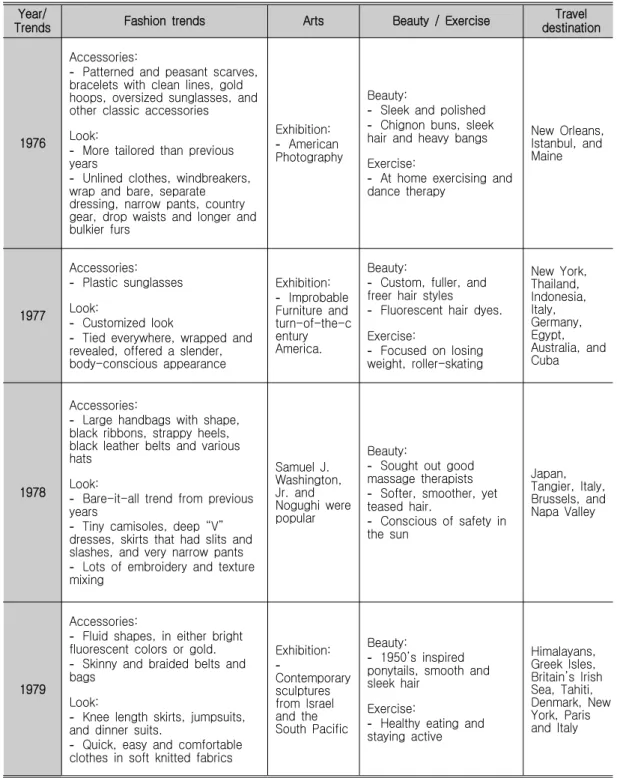
Table 1. Continued
Year/Trends Fashion trends Arts Beauty / Exercise Travel
destination
1971
Accessories:
-
large and tie belts-
heavy-soled and laced up shoes-
fitted hats and berets Trends:-
Cheap chic, capes, long chemises, shirt dresses, gauchos, hot pants, and flamenco skirts, and military look-
Beauty:
-
False eyelashes, Smokey eyes, moisturized look-
Natural products for hair and skin care Exercise:-
Ballet and dance exercise for physical fitSpain, Dallas, Texas, San Francisco, California, and London
1972
Accessories:
-
large, geometric and in bone or shell tortoise-
Scarves and sexy sandals Look:-
easy and personal while still being polishedTrends:
-
Short and baring evening dresses, suits, wrap, tunics, and rolled up sleeves. Mixing patterns, slits,Art exhibits with Russian crafts and Biennale in Italy
Beauty:
-
Zelda bob Exercise:-
Diet, fitness and exerciseItaly, Florida, The Rhine, New York and Bermuda
1973
Accessories:
-
large sunglasses, lots of bangles, bronze-colored shoes, and stockingsLook:
-
Romantic, feminine, sexy, lean, racy, and revealingEva Hesse sculptures andBroadway shows
Beauty:
-
More choices for colors in nail polish-
Uncurling irons-
do it yourself beauty”trends Exercise:
-
stretching and dietsWaikiki, Hawaii, China, London, New York, Paris, Los Angeles, or New Zealand
1974
Accessories:
-
Large jewels, lavish furs and showy, extravagant clothes-
Sunglasses with various shades.-
Red shoes and skinny belts-
Watches and wrapped scarves Look-
American casual-
Big Look was introducedIslamic art andEuropean jewelry exhibition
Beauty:
-
Soft hair with matching eyebrows, darker and dramatic makeup, wearing wigs, skin careGreece, Rome, Paris, London, Barbados, Jamaica, West Africa, Morocco, and Australia
1975
Accessories:
-
Bare and natural.-
Hemp shoes, head wraps and scarvesLook:
-
Revealing necklines, body dressing and safari inspirations.-
jeans and t-shirts, sweaters and pleated skirts, tunics, pant suits and the pajama-dressing trendExhibitions:
-
Picasso,Jean-Baptists Carpeaux, Jasper Jones, and Michelangelo’
s drawings.
Beauty:
-
Using non-aerosol products.-
Salons forone-stop-shop for beauty and styles
Exercise:
-
At home exercisingMediterranean, Guatemala, and the West Indies.
Table 1. Continued
Year/Trends Fashion trends Arts Beauty / Exercise Travel
destination
1976
Accessories:
-
Patterned and peasant scarves, bracelets with clean lines, gold hoops, oversized sunglasses, and other classic accessories Look:-
More tailored than previous years-
Unlined clothes, windbreakers, wrap and bare, separate dressing, narrow pants, country gear, drop waists and longer and bulkier fursExhibition:
-
American PhotographyBeauty:
-
Sleek and polished-
Chignon buns, sleek hair and heavy bangs Exercise:-
At home exercising and dance therapyNew Orleans, Istanbul, and Maine
1977
Accessories:
-
Plastic sunglasses Look:-
Customized look-
Tied everywhere, wrapped and revealed, offered a slender, body-conscious appearanceExhibition:
-
ImprobableFurniture and turn-of-the-c entury America.
Beauty:
-
Custom, fuller, and freer hair styles-
Fluorescent hair dyes.Exercise:
-
Focused on losing weight, roller-skatingNew York, Thailand, Indonesia, Italy, Germany, Egypt, Australia, and Cuba
1978
Accessories:
-
Large handbags with shape, black ribbons, strappy heels, black leather belts and various hatsLook:
-
Bare-it-all trend from previous years-
Tiny camisoles, deep “V”dresses, skirts that had slits and slashes, and very narrow pants
-
Lots of embroidery and texture mixingSamuel J.
Washington, Jr. and Nogughi were popular
Beauty:
-
Sought out good massage therapists-
Softer, smoother, yet teased hair.-
Conscious of safety in the sunJapan, Tangier, Italy, Brussels, and Napa Valley
1979
Accessories:
-
Fluid shapes, in either bright fluorescent colors or gold.-
Skinny and braided belts and bagsLook:
-
Knee length skirts, jumpsuits, and dinner suits.-
Quick, easy and comfortable clothes in soft knitted fabricsExhibition:
-
Contemporary sculptures from Israel and the South PacificBeauty:
-
1950’s inspired ponytails, smooth and sleek hairExercise:
-
Healthy eating and staying activeHimalayans, Greek Isles, Britain’s Irish Sea, Tahiti, Denmark, New York, Paris and Italy